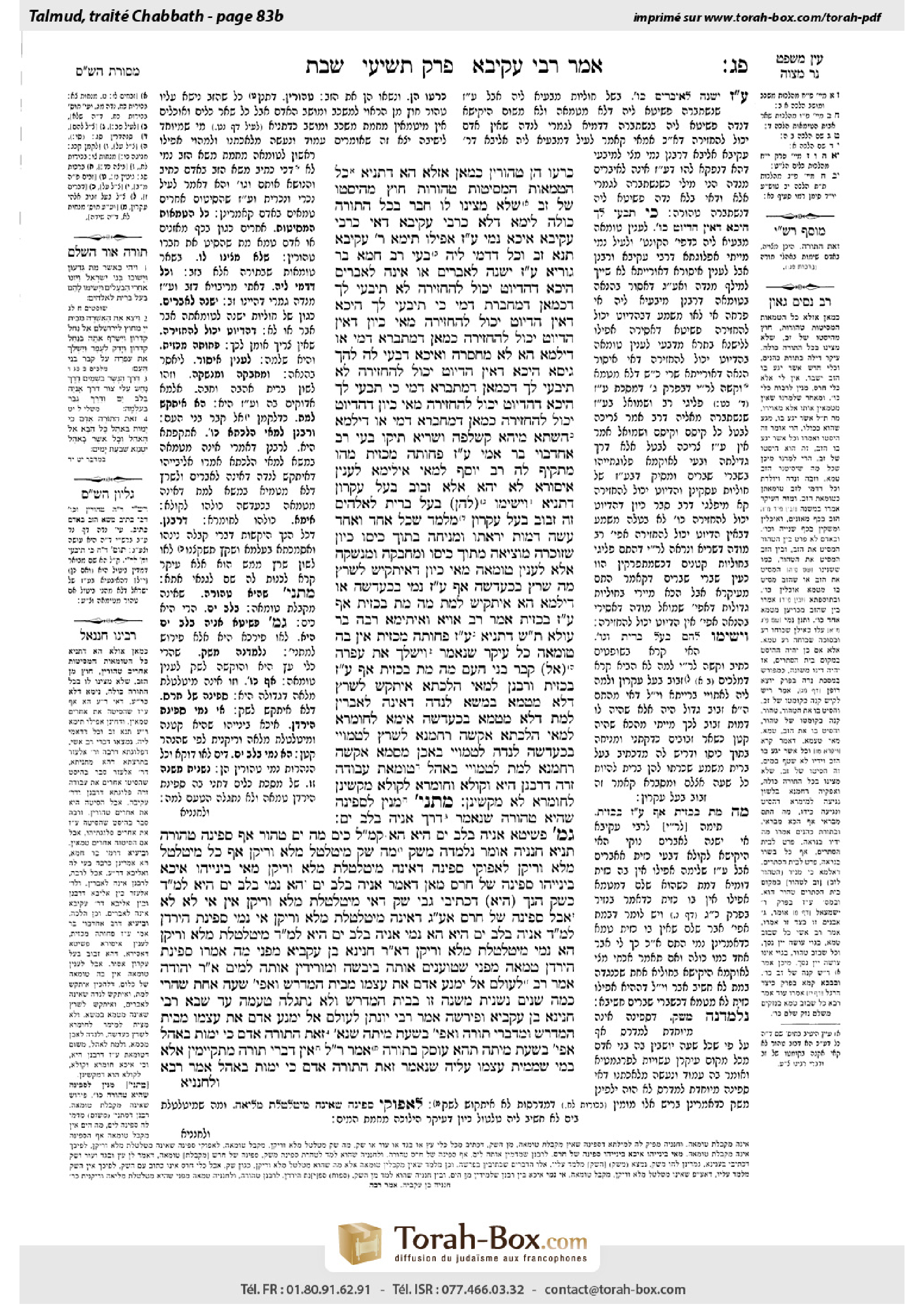
Shabbat 83b: Talmud study for Daf Yomi
Daf Yomi is the daily study of one Talmud folio. Explore 37 tractates with scans, Hebrew text, Sefaria English and AI-generated French translations where annotated.
Passage selection and English or AI-generated French translation are available where the scan has annotations. Daf Study is independent of Torah-Box and Sefaria.
Browse Shabbat · שבת · All tractatesShabbat 83b text and translations
This page of Shabbat includes the Aramaic text, an English translation and an AI-generated French translation, alongside the scan above.
שבת פ״ג ב · Aramaic and Hebrew text
כָּרְעוּ הֵן טְהוֹרִין. כְּמַאן אָזְלָא הָא דְּתַנְיָא כׇּל הַטֻּמְאוֹת הַמְּסִיטוֹת טְהוֹרוֹת, חוּץ מֵהֶיסֵּטוֹ שֶׁל זָב שֶׁלֹּא מָצִינוּ לוֹ חָבֵר בְּכׇל הַתּוֹרָה כּוּלָּהּ — לֵימָא דְּלָא כְּרַבִּי עֲקִיבָא, דְּאִי כְּרַבִּי עֲקִיבָא — אִיכָּא נָמֵי עֲבוֹדָה זָרָה! אֲפִילּוּ תֵּימָא רַבִּי עֲקִיבָא, תְּנָא זָב וְכׇל דְּדָמֵי לֵיהּ.
בָּעֵי רַב חָמָא בַּר גּוּרְיָא: עֲבוֹדָה זָרָה יֶשְׁנָהּ לְאֵבָרִים, אוֹ אֵינָהּ לְאֵבָרִים? הֵיכָא דְּהֶדְיוֹט יָכוֹל לְהַחֲזִירָהּ — לָא תִּיבְּעֵי לָךְ, דִּכְמַאן דִּמְחַבְּרָא דָּמֵי. כִּי תִּיבְּעֵי לָךְ הֵיכָא דְּאֵין הֶדְיוֹט יָכוֹל לְהַחֲזִירָהּ, מַאי? כֵּיוָן דְּאֵין הֶדְיוֹט יָכוֹל לְהַחֲזִירָהּ — כְּמַאן דְּמִתַּבְרָא דָּמֵי, אוֹ דִילְמָא הָא לָא מְחַסְּרָה. וְאִיכָּא דְּבָעֵי לַהּ לְהַךְ גִּיסָא: הֵיכָא דְּאֵין הֶדְיוֹט יָכוֹל לְהַחֲזִירָהּ — לָא תִּיבְּעֵי לָךְ, דִּכְמַאן דְּמִתַּבְרָא דָּמֵי, כִּי תִּבְּעֵי לָךְ הֵיכָא דְּהֶדְיוֹט יָכוֹל לְהַחֲזִירָהּ, מַאי? כֵּיוָן דְּהֶדְיוֹט יָכוֹל לְהַחֲזִירָהּ — כְּמַאן דִּמְחַבְּרָא דָּמֵי, אוֹ דִילְמָא הַשְׁתָּא מִיהַת הָא מִשַּׁלְפָא וְשַׁדְיָא, תֵּיקוּ.
בָּעֵי רַב אַחָדְבוּי בַּר אַמֵּי: עֲבוֹדָה זָרָה פְּחוּתָה מִכְּזַיִת, מַהוּ? מַתְקִיף לַהּ רַב יוֹסֵף: לְמַאי? אִילֵימָא לְעִנְיַן אִיסּוּרָא, לֹא יְהֵא אֶלָּא זְבוּב בַּעַל עֶקְרוֹן. דְּתַנְיָא: ״וַיָּשִׂימוּ לָהֶם בַּעַל בְּרִית לֶאֱלֹהִים״, זֶה זְבוּב בַּעַל עֶקְרוֹן. מְלַמֵּד שֶׁכׇּל אֶחָד וְאֶחָד עֹשֶׂה דְּמוּת יִרְאָתוֹ וּמַנִּיחָהּ בְּתוֹךְ כִּיסוֹ, כֵּיוָן שֶׁזּוֹכְרָהּ מוֹצִיאָהּ מִתּוֹךְ כִּיסוֹ וּמְחַבְּקָהּ וּמְנַשְּׁקָהּ. אֶלָּא לְעִנְיַן טוּמְאָה מַאי? כֵּיוָן דְּאִיתַּקַּשׁ לְשֶׁרֶץ: מָה שֶׁרֶץ בְּכַעֲדָשָׁה, אַף עֲבוֹדָה זָרָה נָמֵי בְּכַעֲדָשָׁה. אוֹ דִילְמָא, הָא אִיתַּקַּשׁ לְמֵת: מָה מֵת בִּכְזַיִת, אַף עֲבוֹדָה זָרָה בִּכְזַיִת.
אָמַר רַב אַוְיָא וְאִיתֵּימָא רַבָּה בַּר עוּלָּא, תָּא שְׁמַע דְּתַנְיָא: עֲבוֹדָה זָרָה פְּחוּתָה מִכְּזַיִת אֵין בָּהּ טוּמְאָה כׇּל עִיקָּר, שֶׁנֶּאֱמַר: ״וַיַּשְׁלֵךְ אֶת עֲפָרָהּ אֶל קֶבֶר בְּנֵי הָעָם״ — מָה מֵת בִּכְזַיִת, אַף עֲבוֹדָה זָרָה בִּכְזַיִת.
וְרַבָּנַן, לְמַאי הִלְכְתָא אִיתַּקַּשׁ לְשֶׁרֶץ — דְּלָא מְטַמֵּא בְּמַשָּׂא, לְנִדָּה — דְּאֵינָהּ לְאֵבָרִין, לְמֵת — דְּלָא מְטַמֵּא בְּכַעֲדָשָׁה. אֵימָא לְחוּמְרָא: לְמַאי הִלְכְתָא אַקְּשַׁהּ רַחֲמָנָא לְשֶׁרֶץ — לְטַמּוֹיֵי בְּכַעֲדָשָׁה, לְנִדָּה — לְטַמּוֹיֵי בְּאֶבֶן מְסָמָא, אַקְּשַׁהּ רַחֲמָנָא לְמֵת — לְטַמּוֹיֵי בְּאֹהֶל! טוּמְאַת עֲבוֹדָה זָרָה דְּרַבָּנַן הִיא, וְקוּלָּא וְחוּמְרָא — לְקוּלָּא מַקְּשִׁינַן, לְחוּמְרָא לָא מַקְּשִׁינַן.
מַתְנִי׳ מִנַּיִן לִסְפִינָה שֶׁהִיא טְהוֹרָה — שֶׁנֶּאֱמַר: ״דֶּרֶךְ אֳנִיָּה בְלֶב יָם״.
גְּמָ׳ פְּשִׁיטָא, אֳנִיָּה בְּלֶב יָם הִיא! הָא קָא מַשְׁמַע לַן כְּיָם: מָה יָם טָהוֹר — אַף סְפִינָה טְהוֹרָה. תַּנְיָא, חֲנַנְיָה אוֹמֵר: נִלְמְדֶנָּה מִשַּׂק, מָה שַׂק מִיטַּלְטֵל מָלֵא וְרֵיקָן — אַף כֹּל מִיטַּלְטֵל מָלֵא וְרֵיקָן. לְאַפּוֹקֵי סְפִינָה, דְּאֵינָהּ מִיטַּלְטֶלֶת מְלֵאָה.
מַאי בֵּינַיְיהוּ? אִיכָּא בֵּינַיְיהוּ סְפִינָה שֶׁל חֶרֶס. מַאן דְּאָמַר ״אֳנִיָּה בְּלֶב יָם״, הָא נָמֵי בְּלֶב יָם הִיא. לְמַאן דְּאָמַר כְּשַׂק — הָנָךְ הוּא דִּכְתִיבִי גַּבֵּי שַׂק, דְּאִי מִיטַּלְטֵל מָלֵא וְרֵיקָן אִין, אִי לָא — לָא. אֲבָל סְפִינָה שֶׁל חֶרֶס, אַף עַל גַּב דְּאֵינָהּ מִיטַּלְטֶלֶת מְלֵאָה.
אִי נָמֵי סְפִינַת הַיַּרְדֵּן. לְמַאן דְּאָמַר אֳנִיָּה בְּלֶב יָם הִיא — הָא נָמֵי אֳנִיָּה בְּלֶב יָם הִיא. לְמַאן דְּאָמַר מִיטַּלְטֶלֶת מָלֵא וְרֵיקָן — הָא נָמֵי מִיטַּלְטֶלֶת מְלֵאָה וְרֵיקָנִית. דְּאָמַר רַבִּי חֲנִינָא בֶּן עֲקַבְיָא: מִפְּנֵי מָה אָמְרוּ סְפִינַת הַיַּרְדֵּן טְמֵאָה — מִפְּנֵי שֶׁטּוֹעֲנִים אוֹתָהּ בַּיַּבָּשָׁה, וּמוֹרִידִין אוֹתָהּ לַמַּיִם. אָמַר רַב יְהוּדָה אָמַר רַב: לְעוֹלָם אַל יִמְנַע אָדָם אֶת עַצְמוֹ מִבֵּית הַמִּדְרָשׁ וַאֲפִילּוּ שָׁעָה אַחַת, שֶׁהֲרֵי כַּמָּה שָׁנִים נִשְׁנֵית מִשְׁנָה זוֹ בְּבֵית הַמִּדְרָשׁ וְלֹא נִתְגַּלָּה טַעְמָהּ עַד שֶׁבָּא רַבִּי חֲנִינָא בֶּן עֲקַבְיָא וּפֵירְשָׁהּ.
אָמַר רַבִּי יוֹנָתָן: לְעוֹלָם אַל יִמְנַע אָדָם אֶת עַצְמוֹ מִבֵּית הַמִּדְרָשׁ וּמִדִּבְרֵי תוֹרָה וַאֲפִילּוּ בִּשְׁעַת מִיתָה, שֶׁנֶּאֱמַר: ״זֹאת הַתּוֹרָה אָדָם כִּי יָמוּת בְּאֹהֶל״ — אֲפִילּוּ בִּשְׁעַת מִיתָה תְּהֵא עוֹסֵק בַּתּוֹרָה. אָמַר רֵישׁ לָקִישׁ: אֵין דִּבְרֵי תוֹרָה מִתְקַיְּימִין אֶלָּא בְּמִי שֶׁמֵּמִית עַצְמוֹ עָלֶיהָ, שֶׁנֶּאֱמַר: ״זֹאת הַתּוֹרָה אָדָם כִּי יָמוּת בְּאֹהֶל״. אָמַר רָבָא
Shabbat 83b · English translation
Even an inanimate object can move a source of impurity in that way. And if the food and drink tipped the scales, they remain ritually pure. The Gemara asks: In accordance with whose opinion is that which was taught in a baraita: All impure items that move other objects remain pure, meaning that an object does not become impure if moved by a source of impurity, except for movement by a zav, which has no counterpart in the whole Torah in its entirety? Let us say that this is not in accordance with the opinion of Rabbi Akiva, as if it were in accordance with the opinion of Rabbi Akiva, there is also the case of idolatry. In his opinion, idolatry also transmits impurity to an object by moving it. The Gemara answers: Even if you say that the baraita is in accordance with the opinion of Rabbi Akiva, teach: Zav and everything similar to it. According to Rabbi Akiva, just as a menstruating woman falls into that category, so too does an idol.
The dilemma that was cited incidental to an earlier discussion is examined here in depth. Rav Ḥama bar Guria raised a dilemma: Does idolatry have the capacity to transmit impurity through limbs or does it not have the capacity to transmit impurity through limbs? The Gemara narrows the parameters of the dilemma. In a situation where a common unskilled person can restore it to its original form, do not raise the dilemma, as in that case it is certainly considered to be attached and is not considered broken. The case where you could raise the dilemma is where a common unskilled person cannot restore it to its original form. What is the ruling in that case? The two sides of the dilemma are: Do we say that since a common unskilled person cannot restore it, it is considered broken? Or perhaps we say that it is not lacking anything? Idolatry can only be nullified by breaking it in a case where, as a result, it is incomplete. And some raise this dilemma in another direction based on a different assumption: In a situation where a common unskilled person cannot restore it to its original form, do not raise the dilemma, as in that case it is certainly considered to be broken. When you could raise the dilemma is in a situation where a common unskilled person can restore it to its original form. What is the ruling in that case? The two sides of the dilemma are: Do we say that since a common unskilled person can restore it, it is considered attached? Or perhaps we say that at present, it is in pieces and permitted? No resolution was found for either version of this dilemma. Therefore, let it stand unresolved.
Rav Aḥadvoi bar Ami raised a dilemma: What is the halakha with regard to idolatry that is less than an olive-bulk? Rav Yosef strongly objected to this: With regard to what use was this dilemma raised? If you say it was raised with regard to the matter of the prohibition of idolatry, let it only be like Zevuv, the Baal of Ekron, which was the size and form of a fly, as it was taught in a baraita with regard to the verse: “And they made Baal Berit into their god” (Judges 8:33). The Sages said that this is referring to Zevuv, the Baal of Ekron. It teaches that each and every person made an image of his god and placed it in his pocket. When he remembered it, he removed it from his pocket and embraced and kissed it. Apparently, even idolatry the size of a fly falls under the rubric of the prohibition of idolatry. Rather, the dilemma is: What is the halakha with regard to the matter of impurity? The two sides of the dilemma are as follows: Since an idol is juxtaposed to a creeping animal, just as a creeping animal transmits impurity when it is a lentil-bulk, so too, idolatry transmits impurity when it is a lentil-bulk. Or perhaps idolatry is juxtaposed to a corpse, and just as a corpse transmits impurity only when it is at least an olive-bulk, so too, idolatry transmits impurity only when it is at least an olive-bulk.
Rav Avya said, and some say it was Rabba bar Ulla who said: Come and hear a resolution to this dilemma from that which was taught in a baraita: Idolatry that is less than an olive-bulk has no impurity at all, as it is stated: “And he brought out the ashera from the house of the Lord, outside Jerusalem, to the brook of Kidron, and burned it at the brook of Kidron, and stamped it into powder, and cast its powder upon the graves of the common people” (II Kings 23:6). Just as a corpse transmits impurity when it is an olive-bulk, so too, idolatry transmits impurity when it is an olive-bulk.
The Gemara now asks a general question: And according to the Rabbis, with regard to what halakha was idolatry juxtaposed to a creeping animal? The juxtaposition establishes that like a creeping animal, it does not transmit impurity through carrying. The juxtaposition to a menstruating woman establishes that like a menstruating woman, it has the capacity to transmit impurity through limbs. The juxtaposition to a corpse establishes that it does not transmit impurity when it is a lentil-bulk. The Gemara suggests: Let us say that all of these juxtapositions come to teach a stringency. With regard to what halakha did the Torah juxtapose idolatry to a creeping animal? It is to establish that it transmits impurity when it is a lentil-bulk. The juxtaposition of idolatry to a menstruating woman is to establish that it transmits impurity via a very heavy stone; and the Torah juxtaposed it to a corpse to establish that it transmits impurity imparted by a tent, all of which are stringencies that exist with regard to those types of impurity. The Gemara answers: The impurity of idolatry is by rabbinic law. And whenever there are two possibilities with regard to a rabbinic decree, a leniency and a stringency, we juxtapose to establish the lenient possibility, and we do not juxtapose to establish the stringent possibility.
MISHNA: This is another mishna that digresses from the central topic of this tractate. It, too, is based on an allusion from the Bible. From where is it derived that the ship is ritually pure, in the sense that it cannot become impure? As it is stated: “The way of a ship in the midst of the sea” (Proverbs 30:19).
GEMARA: The allusion in the mishna requires clarification. The verse appears to state the obvious. Of course a ship is in the midst of the sea. Rather, this verse teaches us an allusion that the legal status of a boat is like that of the sea. Just as the sea is ritually pure and cannot become impure, so too, a boat is ritually pure and cannot become impure. It was taught in a baraita that Ḥananya says: This halakha is derived from the halakha of a sack, as the impurity of wooden vessels is likened to the impurity of a sack. Just as a sack, which can become ritually impure, is carried both full and empty, so too, any object that is carried both full and empty can become ritually impure. This is to exclude a ship, which is not carried on land full and empty, as due to its weight it cannot be carried full.
The Gemara asks: What is the practical difference between the two reasons? The halakhic ruling according to both is that a ship cannot become impure. The Gemara explains: There is a difference between them with regard to a ship made from earthenware or from any material other than wood. According to the one who said that it is derived from the verse: “A ship in the midst of the sea,” this boat is also in the midst of the sea. However, according to the one who said that it is derived from the halakha of a sack, this halakha applies only to those materials that are written in the same verse together with sack and are likened to it. If it is carried both full and empty, yes, it can become impure; and if it can not be carried both full and empty, no, it cannot become impure. However, an earthenware ship can become impure even though it is not carried both full and empty.
Alternatively, there is a difference between them regarding a Jordan ship, which is a small boat used on the Jordan River. According to the one who said that it is derived from the verse: “A ship in the midst of the sea,” this is also a ship in the midst of the sea. A river is pure like the sea and the boat will remain pure. According to the one who said that it is derived from the halakha of a sack, and in order to become impure it must be carried full and empty, this is also carried both full and empty, and can become ritually impure. As Rabbi Ḥanina ben Akavya said: For what reason did they say that a Jordan ship can become impure? Because they load it on dry land and carry it on land and then lower it into the water. It is carried on land when full. Rav Yehuda said that Rav said: One should never prevent himself from attending the study hall for even one moment, as this mishna which states that a Jordan ship can become ritually impure was taught for several years in the study hall, but its reason was not revealed until Rabbi Ḥanina ben Akavya came and explained it.
Following Rav’s statement, the Gemara cites that which Rabbi Yonatan said: One should never prevent himself from attending the study hall or from engaging in matters of Torah, even at the moment of death, as it is stated: “This is the Torah: A person who dies in a tent” (Numbers 19:14). That is an allusion to the fact that even at the moment of death, one should engage in the study of Torah. Reish Lakish said: Matters of Torah only endure in a person who kills himself over the Torah, one who is ready to devote all his efforts to it, as it is stated: “This is the Torah: A person who dies in a tent,” meaning that the Torah is only attained by one who kills himself in its tent. Rava said:
Shabbat 83b · Traduction française (IA)
Même un objet inanimé peut déplacer une source d’impureté de cette manière. Et si la nourriture et la boisson font pencher la balance, elles restent rituellement pures. La Guemara demande : Selon l’opinion de qui faut-il comprendre ce qui a été enseigné dans une baraïta : « Tous les éléments impurs qui déplacent d’autres objets restent purs », c’est-à-dire qu’un objet ne devient pas impur lorsqu’il est déplacé par une source d’impureté, à l’exception du déplacement par un zav, qui n’a aucun équivalent dans toute la Torah ? Disons que cela ne correspond pas à l’opinion de Rabbi Akiva, car si cela correspondait à son opinion, il y aurait aussi le cas de l’idolâtrie. Selon lui, l’idolâtrie transmet également l’impureté à un objet en le déplaçant. La Guemara répond : Même si tu dis que la baraïta correspond à l’opinion de Rabbi Akiva, enseigne : « Le zav et tout ce qui lui est assimilé. » Selon Rabbi Akiva, de même qu’une femme menstruée entre dans cette catégorie, une idole y entre également.
Le dilemme mentionné incidemment au cours d’une discussion précédente est ici examiné en profondeur. Rav Ḥama bar Guria souleva un dilemme : l’idolâtrie a-t-elle la capacité de transmettre l’impureté par l’intermédiaire de ses membres, ou non ? La Guemara précise les paramètres du dilemme. Dans le cas où une personne ordinaire, sans compétence particulière, peut la remettre dans son état initial, ne soulevons pas le dilemme, car elle est alors certainement considérée comme intacte et non comme brisée. Le cas où l’on peut soulever le dilemme est celui où une personne ordinaire ne peut pas la remettre dans son état initial. Quelle est la halakha dans ce cas ? Les deux possibilités sont les suivantes : disons-nous que, puisqu’une personne ordinaire ne peut pas la remettre dans son état initial, elle est considérée comme brisée ? Ou peut-être disons-nous qu’il ne lui manque rien ? L’idolâtrie ne peut être annulée par bris que si, à la suite de ce bris, elle est incomplète. Certains formulent ce dilemme dans l’autre sens, sur la base d’une hypothèse différente : dans le cas où une personne ordinaire ne peut pas la remettre dans son état initial, ne soulevons pas le dilemme, car elle est alors certainement considérée comme brisée. Le cas où l’on peut soulever le dilemme est celui où une personne ordinaire peut la remettre dans son état initial. Quelle est la halakha dans ce cas ? Les deux possibilités sont les suivantes : disons-nous que, puisqu’une personne ordinaire peut la remettre dans son état initial, elle est considérée comme intacte ? Ou peut-être disons-nous qu’à présent, elle est en morceaux et permise ? Aucune solution n’a été trouvée pour l’une ou l’autre version de ce dilemme. Il faut donc le laisser sans résolution.
Rav Aḥadvoi bar Ami souleva un dilemme : quelle est la halakha concernant une idole de moins d’un volume d’olive ? Rav Yosef s’y opposa vivement : à quel sujet ce dilemme a-t-il été soulevé ? Si tu dis qu’il porte sur l’interdiction de l’idolâtrie, qu’il en soit comme Zevuv, le Baal d’Ékron, qui avait la taille et la forme d’une mouche, comme cela a été enseigné dans une baraïta au sujet du verset : « Ils firent de Baal-Berith leur dieu » (Juges 8,33). Les Sages dirent que cela fait référence à Zevuv, le Baal d’Ékron. Cela enseigne que chacun fabriquait une image de son dieu et la plaçait dans sa poche. Lorsqu’il s’en souvenait, il la sortait de sa poche, l’étreignait et l’embrassait. Il apparaît donc que même une idole de la taille d’une mouche relève de l’interdiction de l’idolâtrie. Le dilemme porte plutôt sur la question de l’impureté : quelle est la halakha à cet égard ? Les deux possibilités sont les suivantes : puisque l’idole est rapprochée d’un reptile, de même qu’un reptile transmet l’impureté lorsqu’il a le volume d’une lentille, l’idolâtrie transmet-elle également l’impureté lorsqu’elle a le volume d’une lentille ? Ou bien l’idolâtrie est-elle rapprochée d’un cadavre, et de même qu’un cadavre ne transmet l’impureté que s’il a au moins le volume d’une olive, l’idolâtrie ne transmet-elle également l’impureté que si elle a au moins le volume d’une olive ?
Rav Avya dit, et certains disent que c’est Rabba bar Ulla qui le dit : Viens et entends une réponse à ce dilemme tirée de ce qui a été enseigné dans une baraïta : une idole de moins d’un volume d’olive n’a aucune impureté, comme il est dit : « Il fit sortir l’ashéra de la Maison de l’Éternel, hors de Jérusalem, vers le torrent du Cédron ; il la brûla dans le torrent du Cédron, la réduisit en poudre et jeta sa poudre sur les tombes des gens du peuple » (II Rois 23,6). De même qu’un cadavre transmet l’impureté lorsqu’il a le volume d’une olive, l’idolâtrie transmet également l’impureté lorsqu’elle a le volume d’une olive.
La Guemara pose maintenant une question générale : et selon les Rabbins, pour quelle halakha l’idolâtrie a-t-elle été rapprochée d’un reptile ? Ce rapprochement établit que, comme un reptile, elle ne transmet pas l’impureté par portage. Le rapprochement avec une femme menstruée établit que, comme une femme menstruée, elle peut transmettre l’impureté par l’intermédiaire de ses membres. Le rapprochement avec un cadavre établit qu’elle ne transmet pas l’impureté lorsqu’elle a le volume d’une lentille. La Guemara suggère : disons que tous ces rapprochements viennent enseigner une rigueur. Pour quelle halakha la Torah a-t-elle rapproché l’idolâtrie d’un reptile ? Pour établir qu’elle transmet l’impureté lorsqu’elle a le volume d’une lentille. Le rapprochement de l’idolâtrie avec une femme menstruée vise à établir qu’elle transmet l’impureté par l’intermédiaire d’une pierre très lourde ; et la Torah l’a rapprochée d’un cadavre pour établir qu’elle transmet l’impureté sous une tente. Toutes ces règles sont des rigueurs propres à ces types d’impureté. La Guemara répond : l’impureté de l’idolâtrie relève de la loi rabbinique. Or, chaque fois qu’un décret rabbinique admet deux possibilités, l’une indulgente et l’autre rigoureuse, le rapprochement établit la possibilité indulgente, et non la possibilité rigoureuse.
MICHNA : Voici une autre Michna qui s’écarte du sujet central de ce traité. Elle aussi repose sur une allusion tirée de la Bible. D’où déduit-on qu’un bateau est rituellement pur, en ce sens qu’il ne peut pas devenir impur ? Car il est dit : « Le chemin d’un bateau au milieu de la mer » (Proverbes 30,19).
GUEMARA : L’allusion de la Michna demande à être éclaircie. Le verset semble énoncer une évidence : bien sûr, un bateau se trouve au milieu de la mer. Ce verset nous enseigne plutôt, par allusion, que le statut d’un bateau est semblable à celui de la mer. De même que la mer est rituellement pure et ne peut pas devenir impure, un bateau est lui aussi rituellement pur et ne peut pas devenir impur. Il a été enseigné dans une baraïta que Ḥananya dit : cette halakha est déduite de celle d’un sac, car l’impureté des ustensiles en bois est assimilée à celle d’un sac. De même qu’un sac, qui peut devenir rituellement impur, est transporté aussi bien plein que vide, tout objet transporté aussi bien plein que vide peut également devenir rituellement impur. Cela exclut un bateau, qui n’est pas transporté sur la terre ferme, plein ou vide, car, en raison de son poids, il est impossible de le transporter lorsqu’il est plein.
La Guemara demande : quelle différence pratique y a-t-il entre les deux raisons ? Selon les deux, la décision halakhique est qu’un bateau ne peut pas devenir impur. La Guemara explique : elles diffèrent à propos d’un bateau en terre cuite ou fabriqué dans un matériau autre que le bois. Selon celui qui dit que la règle est déduite du verset « Un bateau au milieu de la mer », ce bateau se trouve lui aussi au milieu de la mer. En revanche, selon celui qui dit que la règle est déduite de celle du sac, elle ne s’applique qu’aux matériaux mentionnés dans le même verset que le sac et qui lui sont assimilés. S’il est transporté aussi bien plein que vide, oui, il peut devenir impur ; et s’il ne peut pas être transporté aussi bien plein que vide, non, il ne peut pas devenir impur. Toutefois, un bateau en terre cuite peut devenir impur même s’il n’est pas transporté aussi bien plein que vide.
Autre possibilité : les deux raisons diffèrent au sujet d’un bateau du Jourdain, une petite embarcation utilisée sur le Jourdain. Selon celui qui dit que la règle est déduite du verset « Un bateau au milieu de la mer », il s’agit lui aussi d’un bateau au milieu de la mer. Un fleuve est pur comme la mer, et le bateau restera pur. Selon celui qui dit que la règle est déduite de celle du sac, et que pour devenir impur le bateau doit être transporté plein et vide, celui-ci est également transporté aussi bien plein que vide et peut donc devenir rituellement impur. Car Rabbi Ḥanina ben Akavya a dit : pour quelle raison a-t-on dit qu’un bateau du Jourdain peut devenir impur ? Parce qu’on le charge sur la terre ferme, qu’on le transporte à terre, puis qu’on le met à l’eau. Il est transporté sur la terre ferme lorsqu’il est plein. Rav Yehouda dit au nom de Rav : on ne doit jamais se priver de se rendre à la maison d’étude, même un seul instant, car cette Michna, qui affirme qu’un bateau du Jourdain peut devenir rituellement impur, a été enseignée pendant plusieurs années à la maison d’étude, mais sa raison n’a été révélée que lorsque Rabbi Ḥanina ben Akavya est venu l’expliquer.
À la suite de la déclaration de Rav, la Guemara cite ce que Rabbi Yonatan a dit : on ne doit jamais se priver de se rendre à la maison d’étude ni de s’occuper des questions de Torah, même au moment de la mort, comme il est dit : « Telle est la Torah : un homme qui meurt dans une tente » (Nombres 19,14). Cela fait allusion au fait que même au moment de la mort, on doit s’occuper de l’étude de la Torah. Reish Lakish a dit : les paroles de Torah ne subsistent chez une personne que si elle se tue pour la Torah, c’est-à-dire si elle est prête à lui consacrer tous ses efforts, comme il est dit : « Telle est la Torah : un homme qui meurt dans une tente », ce qui signifie que la Torah ne s’acquiert que par celui qui se tue dans sa tente. Rava dit :
Traduction française générée par IA à partir de l’édition anglaise de Sefaria. Vérifie toujours un passage avec le texte source.
Text from Sefaria: William Davidson Edition - Vocalized Aramaic (CC BY NC); William Davidson Edition - English (CC BY NC).