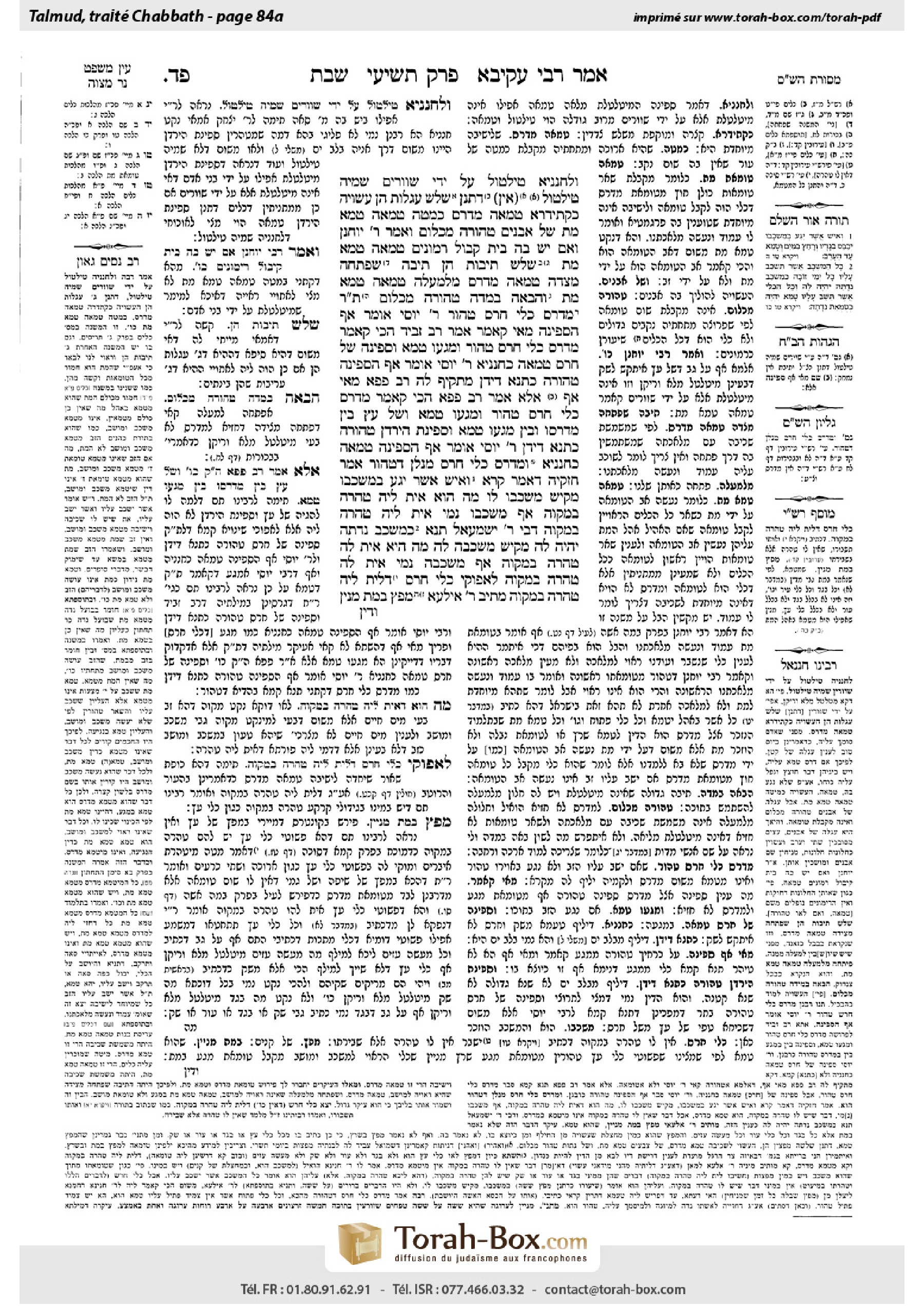
Shabbat 84a: Talmud study for Daf Yomi
Daf Yomi is the daily study of one Talmud folio. Explore 37 tractates with scans, Hebrew text, Sefaria English and AI-generated French translations where annotated.
Passage selection and English or AI-generated French translation are available where the scan has annotations. Daf Study is independent of Torah-Box and Sefaria.
Browse Shabbat · שבת · All tractatesShabbat 84a text and translations
This page of Shabbat includes the Aramaic text, an English translation and an AI-generated French translation, alongside the scan above.
שבת פ״ד א · Aramaic and Hebrew text
וְלַחֲנַנְיָא טִילְטוּל עַל יְדֵי שְׁוָורִים שְׁמֵיהּ טִילְטוּל? אִין דִּתְנַן: שָׁלֹשׁ עֲגָלוֹת הֵן. עֲשׂוּיָה כְּקָתֶידְרָא — טְמֵאָה מִדְרָס. כְּמִטָּה — טְמֵאָה טְמֵא מֵת. שֶׁל אֲבָנִים — טְהוֹרָה מִכְּלוּם. וְאָמַר רַבִּי יוֹחָנָן: וְאִם יֵשׁ בָּהּ בֵּית קִבּוּל רִמּוֹנִים, טְמֵאָה טְמֵא מֵת.
שָׁלֹשׁ תֵּיבוֹת הֵן: תֵּיבָה שֶׁפִּתְחָהּ מִצִּדָּהּ — טְמֵאָה מִדְרָס. מִלְּמַעְלָה — טְמֵאָה טְמֵא מֵת. וְהַבָּאָה בְּמִדָּה, טְהוֹרָה מִכְּלוּם.
תָּנוּ רַבָּנַן: מִדְרַס כְּלִי חֶרֶס טָהוֹר. רַבִּי יוֹסֵי אוֹמֵר: אַף הַסְּפִינָה. מַאי קָאָמַר? אָמַר רַב זְבִיד, הָכִי קָאָמַר: מִדְרַס כְּלִי חֶרֶס — טָהוֹר, וּמַגָּעוֹ טָמֵא, וּסְפִינָה שֶׁל חֶרֶס טְמֵאָה כַּחֲנַנְיָא. רַבִּי יוֹסֵי אוֹמֵר: אַף הַסְּפִינָה טְהוֹרָה, כְּתַנָּא דִידַן. מַתְקִיף לַהּ רַב פָּפָּא: מַאי ״אַף״? אֶלָּא אָמַר רַב פָּפָּא, הָכִי קָאָמַר: מִדְרַס כְּלִי חֶרֶס — טָהוֹר, וּמַגָּעוֹ טָמֵא. וְשֶׁל עֵץ, בֵּין מִדְרָסוֹ וּבֵין מַגָּעוֹ — טָמֵא, וּסְפִינַת הַיַּרְדֵּן — טְהוֹרָה כְּתַנָּא דִידַן. רַבִּי יוֹסֵי אוֹמֵר: אַף הַסְּפִינָה טְמֵאָה, כַּחֲנַנְיָא.
וּמִדְרַס כְּלִי חֶרֶס מְנָלַן דְּטָהוֹר? אָמַר חִזְקִיָּה, דְּאָמַר קְרָא: ״וְאִישׁ אֲשֶׁר יִגַּע בְּמִשְׁכָּבוֹ״, מַקִּישׁ מִשְׁכָּבוֹ לוֹ: מָה הוּא אִית לֵיהּ טׇהֳרָה בְּמִקְוֶה — אַף מִשְׁכָּבוֹ נָמֵי אִית לֵיהּ טׇהֳרָה בְּמִקְוֶה.
דְּבֵי רַבִּי יִשְׁמָעֵאל תָּנָא: ״כְּמִשְׁכַּב נִדָּתָהּ יִהְיֶה לָּהּ״, מַקִּישׁ מִשְׁכָּבָהּ לָהּ: מָה הִיא אִית לַהּ טׇהֳרָה בְּמִקְוֶה — אַף מִשְׁכָּבָהּ נָמֵי אִית לַהּ טׇהֳרָה בְּמִקְוֶה, לְאַפּוֹקֵי כְּלִי חֶרֶס דְּלֵית לֵיהּ טׇהֳרָה בְּמִקְוֶה. מֵתִיב רַבִּי אִילְעָא: מַפָּץ בְּמֵת מִנַּיִן?
Shabbat 84a · English translation
And according to Ḥananya, who holds that a boat carried both full and empty can become ritually impure, is carrying by oxen considered carrying? He answered his own question. Yes, as we learned in a mishna: In terms of the halakhot of ritual purity and impurity, there are three distinct types of wagons: A wagon built like a chair, meaning closed on the sides, can become ritually impure with impurity imparted by treading. Since it is designated for sitting, it becomes impure if a zav sits on it, even if he does not touch it. A wagon built like a bed can become ritually impure with impurity imparted by a corpse. It contracts all types of impurity, except for impurity imparted by the treading of a zav. A wagon made of stone, whose bottom is netting, remains ritually pure and does not become impure from any type of impurity. And Rabbi Yoḥanan said: And if in the stone wagon there is a receptacle for pomegranates, i.e., the holes are not large enough for a pomegranate to fall through, it is considered a utensil and it can become impure with impurity imparted by a corpse. Even though a stone wagon is not carried full, but is pulled by oxen, it can become ritually impure. Apparently, carrying by oxen is considered carrying.
By association, the Gemara now cites the second part of the mishna: With regard to laws of impurity, there are three types of chests: A chest that opens from the side, on which one can sit or lie, because it can be used for sitting, it can become ritually impure with impurity imparted by treading if a zav sits on it. Even if one needs to open the chest, a person can keep sitting on it. A chest that opens from the top does not become ritually impure with impurity imparted by treading because it cannot be opened with somebody on it. However, it can become impure with impurity imparted by a corpse. And a chest that comes in a very large size, and can hold more than forty se’a, remains ritually pure and does not become impure from any type of impurity.
The Sages taught in a baraita: With regard to impurity imparted by treading, an earthenware vessel is ritually pure. If a zav sits on an earthenware vessel and does not touch the inside of it, it does not become impure. Rabbi Yosei says: That is even the status of a ship. The Gemara asks: What is the baraita saying? Rav Zevid said that the baraita is saying the following: According to the first tanna, with regard to impurity imparted by treading, an earthenware vessel is ritually pure; however, if the zav touches the vessel it becomes impure. And an earthenware ship can become impure with impurity imparted by the treading of a zav, in accordance with the opinion of Ḥananya. Rabbi Yosei says: Even a boat is ritually pure, in accordance with the opinion of the tanna of our mishna. Rav Pappa strongly objects to this explanation: If so, what is the meaning of the word even employed by Rabbi Yosei, indicating that he is adding to the opinion of the first tanna of the baraita? According to the above explanation, the first tanna says that a boat can become ritually impure and Rabbi Yosei says that it is pure. Rabbi Yosei is not adding to the previous opinion but disagreeing with it. Rather, Rav Pappa said that the baraita is saying the following: With regard to impurity imparted by treading, an earthenware vessel is ritually pure, and with regard to its contact with a source of ritual impurity, it is impure. And as far as a wooden vessel is concerned, with regard to both its impurity imparted by treading and its contact with a source of ritual impurity, it is impure. And a Jordan ship is ritually pure in accordance with the opinion of the tanna of our mishna. Rabbi Yosei says: Even the boat is impure like other wooden vessels, in accordance with the opinion of Ḥananya.
The Gemara questions what was stated: And from where do we derive that with regard to impurity imparted by treading, an earthenware vessel is ritually pure? Ḥizkiya said: It is as the verse states: “And whoever touches his bed shall wash his clothes, and bathe himself in water, and be impure until the evening” (Leviticus 15:5). The verse juxtaposes his bed to himself. Just as he has the possibility of purification through immersion in a ritual bath, so too, his bed is referring to a vessel that has the possibility of purification in a ritual bath. Since an impure earthenware vessel cannot be purified in a ritual bath, unlike other vessels, it does not become ritually impure when a zav lies on it.
Similarly, the school of Rabbi Yishmael taught that the verse states: “Every bed on which she lies all the days of her zava emission shall be for her like the bed of her menstrual period” (Leviticus 15:26). The verse juxtaposes her bed to herself: Just as she has the possibility of purification in a ritual bath, so too, her bed is referring to a vessel that has the possibility of purification in a ritual bath. This is to the exclusion of an earthenware vessel, which does not have the possibility of purification in a ritual bath. Rabbi Ila strongly objects to this from what we learned: From where is it derived that a reed mat becomes ritually impure from contact with a corpse?
Shabbat 84a · Traduction française (IA)
Et selon Ḥananya, qui estime qu’un bateau transporté qu’il soit plein ou vide peut devenir rituellement impur, le fait d’être tiré par des bœufs est-il considéré comme un transport ? Il répondit lui-même à sa question : oui, comme nous l’avons appris dans une Michna : en matière de pureté et d’impureté rituelles, il existe trois sortes distinctes de chariots. Un chariot construit comme un siège, c’est-à-dire fermé sur les côtés, peut devenir rituellement impur par l’impureté transmise par le piétinement. Puisqu’il est destiné à s’asseoir, il devient impur si un zav s’assoit dessus, même sans le toucher. Un chariot construit comme un lit peut devenir rituellement impur par l’impureté transmise par un cadavre. Il contracte toutes les formes d’impureté, à l’exception de celle transmise par le piétinement d’un zav. Un chariot de pierre, dont le fond est constitué d’un treillis, reste rituellement pur et ne devient impur sous aucune forme d’impureté. Rabbi Yoḥanan a dit : si le chariot de pierre comporte un réceptacle qui retient les grenades, c’est-à-dire que les trous ne sont pas assez grands pour qu’une grenade y tombe, il est considéré comme un ustensile et peut devenir rituellement impur par l’impureté transmise par un cadavre. Même si un chariot de pierre n’est pas transporté lorsqu’il est plein, mais tiré par des bœufs, il peut devenir rituellement impur. Il apparaît donc que le fait d’être tiré par des bœufs est considéré comme un transport.
Par association, la Guemara cite à présent la seconde partie de la Michna : en matière d’impureté rituelle, il existe trois sortes de coffres. Un coffre qui s’ouvre par le côté et sur lequel on peut s’asseoir ou s’allonger peut devenir rituellement impur par l’impureté transmise par le piétinement si un zav s’assoit dessus, puisqu’il peut servir de siège. Même s’il faut ouvrir le coffre, une personne peut rester assise dessus. Un coffre qui s’ouvre par le dessus ne devient pas rituellement impur par l’impureté transmise par le piétinement, car on ne peut pas l’ouvrir lorsqu’une personne est assise dessus. Il peut toutefois devenir impur par l’impureté transmise par un cadavre. Quant à un coffre de très grande taille, pouvant contenir plus de quarante séa, il reste rituellement pur et ne devient impur sous aucune forme d’impureté.
Les Sages ont enseigné dans une baraïta : en ce qui concerne l’impureté transmise par le piétinement, un récipient en terre cuite reste rituellement pur. Si un zav s’assoit sur un récipient en terre cuite sans en toucher l’intérieur, celui-ci ne devient pas impur. Rabbi Yosei dit : tel est aussi le statut d’un bateau. La Guemara demande : que dit la baraïta ? Rav Zevid répond qu’elle dit ceci : selon le premier tanna, en ce qui concerne l’impureté transmise par le piétinement, un récipient en terre cuite reste rituellement pur ; toutefois, si le zav touche le récipient, celui-ci devient impur. Un bateau en terre cuite peut, lui, devenir impur par l’impureté transmise par le piétinement d’un zav, conformément à l’opinion de Ḥananya. Rabbi Yosei dit : même un bateau reste rituellement pur, conformément à l’opinion du tanna de notre Michna. Rav Pappa s’oppose vivement à cette explication : si tel est le cas, que signifie le mot « même » employé par Rabbi Yosei, qui indique qu’il ajoute quelque chose à l’opinion du premier tanna de la baraïta ? Selon l’explication ci-dessus, le premier tanna dit qu’un bateau peut devenir rituellement impur, tandis que Rabbi Yosei dit qu’il est pur. Rabbi Yosei n’ajoute donc rien à l’opinion précédente, mais la contredit. Rav Pappa dit plutôt que la baraïta dit ceci : en ce qui concerne l’impureté transmise par le piétinement, un récipient en terre cuite reste rituellement pur, mais il devient impur au contact d’une source d’impureté rituelle. Quant à un ustensile en bois, il devient impur aussi bien par l’impureté transmise par le piétinement que par le contact avec une source d’impureté rituelle. Un bateau du Jourdain reste rituellement pur, conformément à l’opinion du tanna de notre Michna. Rabbi Yosei dit : même le bateau est impur, comme les autres ustensiles en bois, conformément à l’opinion de Ḥananya.
La Guemara revient sur ce qui a été affirmé : d’où déduisons-nous qu’en ce qui concerne l’impureté transmise par le piétinement, un récipient en terre cuite reste rituellement pur ? Ḥizkiya a dit : cela ressort du verset : « Quiconque touche son lit lavera ses vêtements, se baignera dans l’eau et sera impur jusqu’au soir » (Lévitique 15:5). Le verset rapproche son lit de lui-même : de même qu’il peut se purifier par immersion dans un bain rituel, de même son lit désigne un ustensile qui peut être purifié dans un bain rituel. Puisqu’un récipient en terre cuite impur ne peut pas être purifié dans un bain rituel, contrairement aux autres ustensiles, il ne devient pas rituellement impur lorsqu’un zav s’allonge dessus.
De même, l’école de Rabbi Yishmael a enseigné que le verset dit : « Tout lit sur lequel elle s’allongera pendant tous les jours de son écoulement de zavah sera pour elle comme le lit de ses règles » (Lévitique 15:26). Le verset rapproche son lit d’elle-même : de même qu’elle peut se purifier dans un bain rituel, de même son lit désigne un ustensile qui peut être purifié dans un bain rituel. Cela exclut un récipient en terre cuite, qui ne peut pas être purifié dans un bain rituel. Rabbi Ila s’oppose vivement à cela en invoquant ce que nous avons appris : d’où déduit-on qu’une natte de roseaux devient rituellement impure au contact d’un cadavre ?
Traduction française générée par IA à partir de l’édition anglaise de Sefaria. Vérifie toujours un passage avec le texte source.
Text from Sefaria: William Davidson Edition - Vocalized Aramaic (CC BY NC); William Davidson Edition - English (CC BY NC).