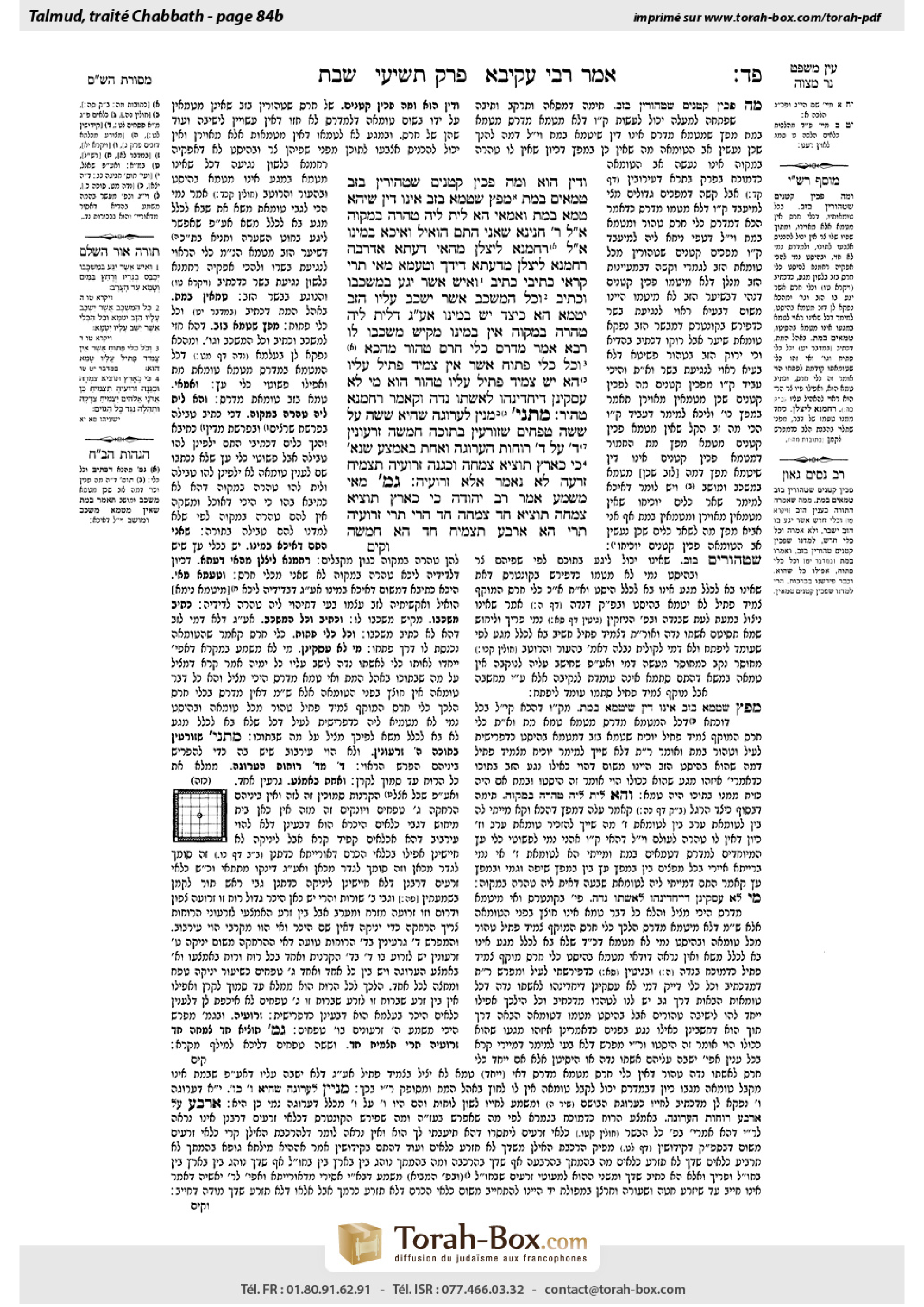
Shabbat 84b: Talmud study for Daf Yomi
Daf Yomi is the daily study of one Talmud folio. Explore 37 tractates with scans, Hebrew text, Sefaria English and AI-generated French translations where annotated.
Passage selection and English or AI-generated French translation are available where the scan has annotations. Daf Study is independent of Torah-Box and Sefaria.
Browse Shabbat · שבת · All tractatesShabbat 84b text and translations
This page of Shabbat includes the Aramaic text, an English translation and an AI-generated French translation, alongside the scan above.
שבת פ״ד ב · Aramaic and Hebrew text
וְדִין הוּא: וּמָה פַּכִּין קְטַנִּים שֶׁטְּהוֹרִין בְּזָב — טְמֵאִים בְּמֵת, מַפָּץ שֶׁטָּמֵא בְּזָב, אֵינוֹ דִּין שֶׁיְּהֵא טָמֵא בְּמֵת?! וְאַמַּאי, הָא לֵית לֵיהּ טׇהֳרָה בְּמִקְוֶה! אֲמַר לֵיהּ רַבִּי חֲנִינָא: שָׁאנֵי הָתָם הוֹאִיל וְאִיכָּא בְּמִינוֹ.
אֲמַר לֵיהּ: רַחֲמָנָא לִיצְלַן מֵהַאי דַּעְתָּא: אַדְּרַבָּה, רַחֲמָנָא לִיצְלַן מִדַּעְתָּא דִידָךְ. וְטַעְמָא מַאי — תְּרֵי קְרָאֵי כְּתִיבִי. כְּתִיב: ״וְאִישׁ אֲשֶׁר יִגַּע בְּמִשְׁכָּבוֹ״, וּכְתִיב: ״וְכׇל הַמִּשְׁכָּב אֲשֶׁר יִשְׁכַּב עָלָיו הַזָּב יִטְמָא״. הָא כֵּיצַד? יֵשׁ בְּמִינוֹ, אַף עַל גַּב דְּלֵית לֵיהּ טׇהֳרָה בְּמִקְוֶה. אֵין בְּמִינוֹ, מַקִּישׁ מִשְׁכָּבוֹ לוֹ.
רָבָא אָמַר: מִדְרַס כְּלִי חֶרֶס טָהוֹר מֵהָכָא: ״וְכֹל כְּלִי פָתוּחַ אֲשֶׁר אֵין צָמִיד פָּתִיל עָלָיו״, הָא יֵשׁ צְמִיד פָּתִיל עָלָיו — טָהוֹר הוּא. מִי לָא עָסְקִינַן דְּיַחֲדִינְהוּ לְאִשְׁתּוֹ נִדָּה, וְקָאָמַר רַחֲמָנָא טָהוֹר!
מַתְנִי׳ מִנַּיִן לַעֲרוּגָה שֶׁהִיא שִׁשָּׁה עַל שִׁשָּׁה טְפָחִים שֶׁזּוֹרְעִין בְּתוֹכָהּ חֲמִשָּׁה זֵרְעוֹנִין, אַרְבָּעָה עַל אַרְבַּע רוּחוֹת הָעֲרוּגָה וְאַחַת בָּאֶמְצַע, שֶׁנֶּאֱמַר: ״כִּי כָאָרֶץ תּוֹצִיא צִמְחָהּ וּכְגַנָּה זֵרוּעֶיהָ תַצְמִיחַ״ — ״זַרְעָהּ״ לֹא נֶאֱמַר, אֶלָּא ״זֵרוּעֶיהָ״.
גְּמָ׳ מַאי מַשְׁמַע? אָמַר רַב יְהוּדָה: ״כִּי כָאָרֶץ תּוֹצִיא צִמְחָהּ״. ״תּוֹצִיא״ — חַד, ״צִמְחָהּ״ — חַד, הֲרֵי תְּרֵי. ״זֵרוּעֶיהָ״ — תְּרֵי, הָא אַרְבְּעָה. ״תַּצְמִיחַ״ — חַד, הָא חַמְשָׁה.
Shabbat 84b · English translation
And it is derived through an a fortiori inference: We know that small vessels do not become ritually impure through the impurity of a zav because they are not designated for sitting, and are too small for the zav to insert his finger into their airspace. If small earthenware pitchers remain pure and are not susceptible to the impurity of a zav, but they do become ritually impure from contact with a corpse; is it not logical that a reed mat, which contracts impurity from a zav, will become ritually impure from contact with a corpse? And why should the reed mat become impure? Isn’t it true that it does not have the possibility of purification in a ritual bath? Rabbi Ḥanina said to him: There, in the case of the mat, it is different because there is purification in other vessels of its kind, i.e., other wooden vessels that are made from materials that grow from the earth can be purified in a ritual bath.
Rabbi Ila said to Rabbi Ḥanina: May the all-Merciful save us from this opinion. Rabbi Ḥanina responded: On the contrary, may the all-Merciful save us from your opinion. And what is the reason that this is relevant? What is the significance of the fact that other vessels of its kind can be purified in a ritual bath if the vessel itself cannot be purified in a ritual bath? It is because two verses are written. In one verse it is written: “And whoever touches his bed shall wash his clothes, and bathe himself in water, and be impure until the evening” (Leviticus 15:5). The verse juxtaposes his bed to himself. Just as he has the possibility of purification through immersion in a ritual bath, so too, his bed has the possibility of purification in a ritual bath. This teaches that his bed has the same legal status as he does; in order for a bed on which a zav lies to be subject to the impurity imparted by lying, it must be immersible in a ritual bath. And in another verse it is written: “Every bed on which the zav lies shall be impure; and every vessel on which he sits shall be impure” (Leviticus 15:4). This verse includes all beds on which a zav might lie, even one that cannot be purified in a ritual bath. How can these two verses be reconciled? If there is purification in other vessels of its kind, even though it itself does not have purification in a ritual bath, it is subject to the impurity imparted by lying. However, if there is no purification in other vessels of its kind, the verse juxtaposes his bed to himself. Any vessel that is not like him in the sense that it cannot be purified in a ritual bath, is not subject to impurity imparted by lying.
Rava said: The fact that with regard to impurity imparted by treading, an earthenware vessel is ritually pure is derived from here, as it is stated: “And any open vessel that does not have a sealed cover on it becomes impure” (Numbers 19:15). By inference, if there is a sealed cover on it, it is pure. Are we not dealing even with a case where one designated the vessel for use by his wife, when she has the status of a menstruating woman? And even so, the Torah states that it is ritually pure? Apparently, an earthenware vessel with a sealed cover is not subject to impurity from any source.
MISHNA: The Gemara continues to discuss an additional halakha based on a biblical allusion. From where is it derived that in a garden bed that is six by six handbreadths, that one may plant five different types of seeds in it? He may do so without violating the prohibition of sowing a mixture of diverse kinds of seeds in the following manner. One sows four types of plants on each of the four sides of the garden bed and one in the middle. There is an allusion to this in the text, as it is stated: “For as the earth brings forth its growth, and as a garden causes its seeds to grow, so will the Lord God cause justice and praise to spring forth before all the nations” (Isaiah 61:11). Its seed, in the singular, is not stated; rather, its seeds, written in the plural. Apparently, it is possible that several seeds may be planted in a small garden.
GEMARA: The Gemara questions this allusion: From where is it inferred that the verse refers to five types of seeds? Rav Yehuda said that it is derived as follows: “For as the earth brings forth its growth” indicates five types of seeds because “brings forth” represents one and “its vegetation” represents one, and that totals two. “Its seeds,” written in the plural, represents at least two, and that totals four. “Cause to grow” is one more. This verse includes terms connoting planting and seeds in a single garden bed that total five species of seeds.
Shabbat 84b · Traduction française (IA)
Cela se déduit par raisonnement a fortiori : nous savons que les petits récipients ne deviennent pas rituellement impurs du fait de l’impureté d’un zav, car ils ne sont pas destinés à servir de siège et sont trop petits pour que le zav puisse introduire son doigt dans leur espace intérieur. Si les petites cruches en terre cuite restent pures et ne sont pas susceptibles de contracter l’impureté d’un zav, mais deviennent rituellement impures au contact d’un cadavre, n’est-il pas logique qu’une natte de roseaux, qui contracte l’impureté d’un zav, devienne rituellement impure au contact d’un cadavre ? Et pourquoi la natte de roseaux deviendrait-elle impure ? N’est-il pas vrai qu’elle ne peut pas être purifiée dans un bain rituel ? Rabbi Ḥanina lui dit : Dans le cas de la natte, la situation est différente, car d’autres récipients de sa catégorie peuvent être purifiés, c’est-à-dire que d’autres récipients en bois, fabriqués à partir de matériaux qui poussent dans la terre, peuvent être purifiés dans un bain rituel.
Rabbi Ila dit à Rabbi Ḥanina : Que le Miséricordieux nous préserve de cette opinion. Rabbi Ḥanina répondit : Au contraire, que le Miséricordieux nous préserve de ton opinion. Et pourquoi cela est-il pertinent ? Quelle importance y a-t-il au fait que d’autres récipients de sa catégorie puissent être purifiés dans un bain rituel, si le récipient lui-même ne peut pas l’être ? C’est parce que deux versets sont écrits. Dans un verset, il est écrit : « Quiconque touche son lit lavera ses vêtements, se baignera dans l’eau et sera impur jusqu’au soir » (Lévitique 15,5). Le verset met son lit en parallèle avec lui-même. De même qu’il peut être purifié par immersion dans un bain rituel, de même son lit peut être purifié dans un bain rituel. Cela enseigne que son lit a le même statut juridique que lui : pour qu’un lit sur lequel un zav est couché soit soumis à l’impureté transmise par la position couchée, il doit pouvoir être immergé dans un bain rituel. Et dans un autre verset, il est écrit : « Tout lit sur lequel le zav se couche sera impur, et tout récipient sur lequel il s’assied sera impur » (Lévitique 15,4). Ce verset inclut tous les lits sur lesquels un zav peut se coucher, même ceux qui ne peuvent pas être purifiés dans un bain rituel. Comment concilier ces deux versets ? Si d’autres récipients de sa catégorie peuvent être purifiés, même si celui-ci ne peut pas l’être dans un bain rituel, il est soumis à l’impureté transmise par la position couchée. En revanche, si aucun autre récipient de sa catégorie ne peut être purifié, le verset met son lit en parallèle avec lui-même. Tout récipient qui ne lui ressemble pas en ce qu’il ne peut pas être purifié dans un bain rituel n’est pas soumis à l’impureté transmise par la position couchée.
Rava dit : Le fait qu’un récipient en terre cuite soit rituellement pur en ce qui concerne l’impureté transmise par le piétinement se déduit d’ici, car il est dit : « Tout récipient ouvert qui n’a pas de couvercle hermétiquement fermé devient impur » (Nombres 19,15). Il s’ensuit que s’il a un couvercle hermétiquement fermé, il est pur. Ne traite-t-on pas même d’un cas où l’on a destiné le récipient à l’usage de sa femme, alors qu’elle a le statut d’une femme menstruée ? Et pourtant, la Torah dit qu’il est rituellement pur. Apparemment, un récipient en terre cuite muni d’un couvercle hermétiquement fermé n’est soumis à l’impureté d’aucune source.
Michna : La Guemara poursuit l’examen d’une halakha fondée sur une allusion biblique. D’où déduit-on que, dans une plate-bande de six sur six palmes, on peut planter cinq espèces différentes de graines ? On peut le faire sans transgresser l’interdiction de semer un mélange d’espèces différentes, de la manière suivante : on sème quatre espèces de plantes, une de chaque côté de la plate-bande, et une au milieu. Le texte y fait allusion, comme il est dit : « Car, comme la terre fait pousser ses produits et qu’un jardin fait germer ses semences, ainsi le Seigneur Dieu fera germer la justice et la louange devant toutes les nations » (Isaïe 61,11). Il n’est pas écrit « sa semence », au singulier, mais « ses semences », au pluriel. Apparemment, plusieurs graines peuvent être plantées dans une petite plate-bande.
Guemara : La Guemara s’interroge sur cette allusion : D’où déduit-on que le verset fait référence à cinq espèces de graines ? Rav Yehuda dit que cela se déduit ainsi : « Car la terre fait pousser ses produits » indique cinq espèces de graines, car « fait pousser » en représente une et « sa végétation » en représente une autre, ce qui fait deux. « Ses semences », au pluriel, en représente au moins deux, ce qui fait quatre. « Faire germer » en représente une de plus. Ce verset contient donc des termes évoquant la plantation et les graines qui, dans une même plate-bande, totalisent cinq espèces.
Traduction française générée par IA à partir de l’édition anglaise de Sefaria. Vérifie toujours un passage avec le texte source.
Text from Sefaria: William Davidson Edition - Vocalized Aramaic (CC BY NC); William Davidson Edition - English (CC BY NC).