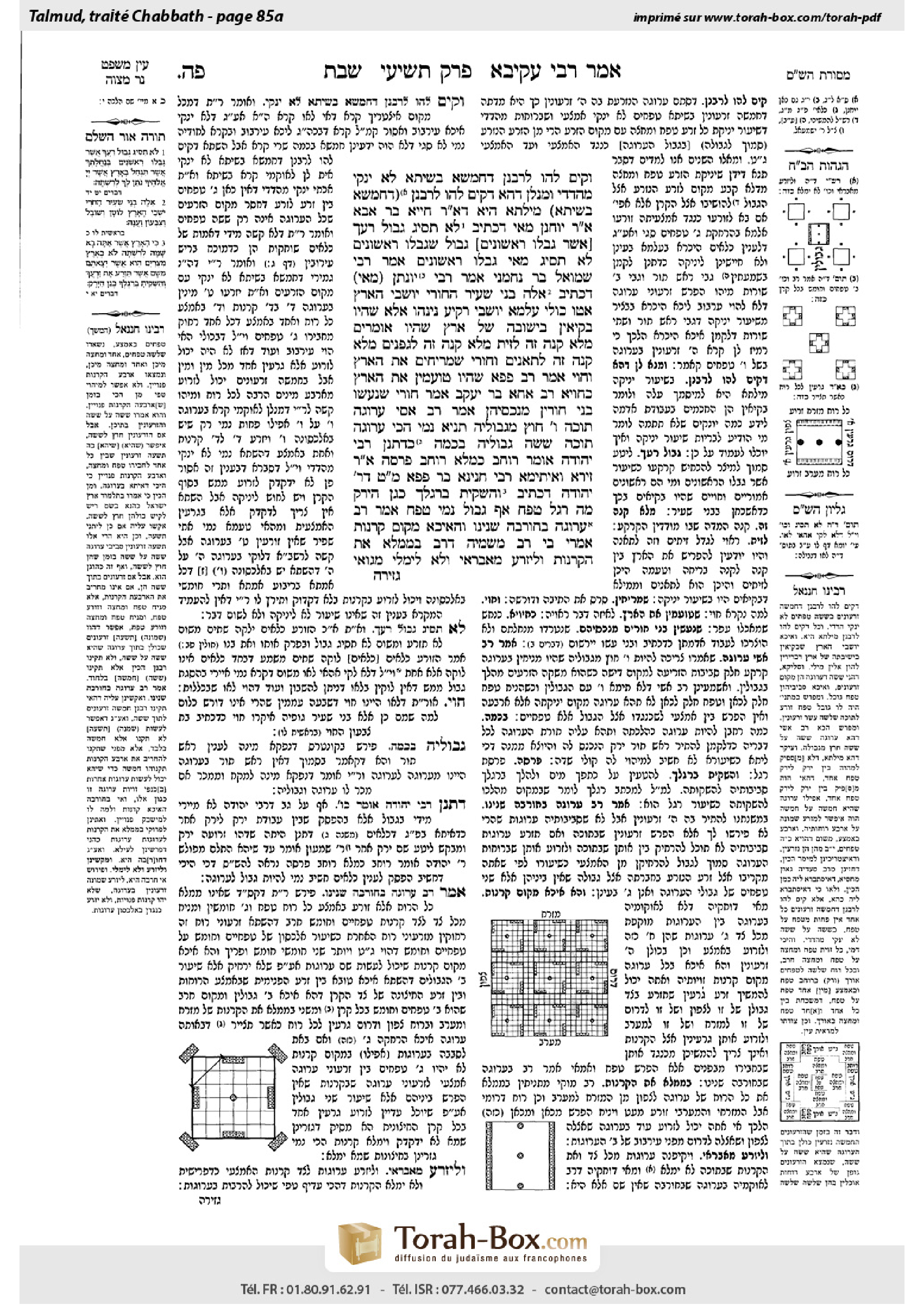
Shabbat 85a: Talmud study for Daf Yomi
Daf Yomi is the daily study of one Talmud folio. Explore 37 tractates with scans, Hebrew text, Sefaria English and AI-generated French translations where annotated.
Passage selection and English or AI-generated French translation are available where the scan has annotations. Daf Study is independent of Torah-Box and Sefaria.
Browse Shabbat · שבת · All tractatesShabbat 85a text and translations
This page of Shabbat includes the Aramaic text, an English translation and an AI-generated French translation, alongside the scan above.
שבת פ״ה א · Aramaic and Hebrew text
וְקִים לְהוּ לְרַבָּנַן דְּחַמְשָׁא בְּשִׁיתָּא לָא יָנְקִי מֵהֲדָדֵי.
וּמְנָלַן דְּהָא דְּקִים לְהוּ לְרַבָּנַן דְּחַמְשָׁא בְּשִׁיתָּא מִילְּתָא הִיא? דְּאָמַר רַבִּי חִיָּיא בַּר אַבָּא אָמַר רַבִּי יוֹחָנָן: מַאי דִּכְתִיב: ״לֹא תַסִּיג גְּבוּל רֵעֲךָ [אֲשֶׁר גָּבְלוּ רִאשׁוֹנִים]״ — גְּבוּל שֶׁגָּבְלוּ רִאשׁוֹנִים לֹא תַסִּיג. מַאי ״גָּבְלוּ רִאשׁוֹנִים״? אָמַר רַבִּי שְׁמוּאֵל בַּר נַחְמָנִי אָמַר רַבִּי יוֹנָתָן: מַאי דִּכְתִיב ״אֵלֶּה בְנֵי שֵׂעִיר הַחֹרִי יֹשְׁבֵי הָאָרֶץ״, אַטּוּ כּוּלֵּי עָלְמָא יוֹשְׁבֵי רָקִיעַ נִינְהוּ?! אֶלָּא שֶׁהָיוּ בְּקִיאִין בְּיִשּׁוּבָהּ שֶׁל אֶרֶץ, שֶׁהָיוּ אוֹמְרִים: מְלֹא קָנֶה זֶה לְזַיִת, מְלֹא קָנֶה זֶה לִגְפָנִים, מְלֹא קָנֶה זֶה לִתְאֵנִים. וְ״חֹרִי״ — שֶׁמְּרִיחִים אֶת הָאָרֶץ. וְ״חִוִּי״, אָמַר רַב פָּפָּא: שֶׁהָיוּ טוֹעֲמִין אֶת הָאָרֶץ כְּחִוְיָא. רַב אַחָא בַּר יַעֲקֹב אָמַר: ״חֹרִי״ — שֶׁנַּעֲשׂוּ בְּנֵי חוֹרִין מִנִּכְסֵיהֶן.
אָמַר רַב אַסִּי: עֲרוּגָה — תּוֹכָהּ שִׁשָּׁה חוּץ מִגְּבוּלֶיהָ. תַּנְיָא נָמֵי הָכִי: עֲרוּגָה תּוֹכָהּ שִׁשָּׁה. גְּבוּלֶיהָ בְּכַמָּה? כְּדִתְנַן, רַבִּי יְהוּדָה אוֹמֵר: רוֹחַב — כִּמְלֹא רוֹחַב פַּרְסָה. אָמַר רַבִּי זֵירָא, וְאִיתֵּימָא רַבִּי חֲנִינָא בַּר פָּפָּא: מַאי טַעְמָא דְּרַבִּי יְהוּדָה — דִּכְתִיב: ״וְהִשְׁקִיתָ בְרַגְלְךָ כְּגַן הַיָּרָק״ — מָה רֶגֶל טֶפַח, אַף גְּבוּל נָמֵי טֶפַח.
אָמַר רַב: עֲרוּגָה — בְּחוּרְבָּה שָׁנִינוּ. וְהָאִיכָּא מָקוֹם קְרָנוֹת! אָמְרִי בֵּי רַב מִשְּׁמֵיהּ דְּרַב: בִּמְמַלֵּא אֶת הַקְּרָנוֹת. וְלִיזְרַע מֵאַבָּרַאי וְלָא לִימַלֵּי מִגַּוַּאי!
Shabbat 85a · English translation
And the Sages have an accepted tradition that five seeds in a six-handbreadth space do not draw sustenance from one another.
The Gemara asks: And from where do we derive that when the Sages have an accepted tradition it is a substantial matter, meaning that the tradition is reliable? Rabbi Ḥiyya bar Abba said that Rabbi Yoḥanan said: What is the meaning of that which is written: “You shall not cross your neighbor’s border, which they of the old times have set in your inheritance that you shall inherit” (Deuteronomy 19:14)? It means that you shall not cross the border that the early generations set, establishing the parameters necessary for each plant. The Gemara asks: What is the meaning of the phrase: The early generations set? Rabbi Shmuel bar Naḥmani said that Rabbi Yonatan said: What is the meaning of that which was written: “These are the sons of Seir the Horite who inhabit the land, Lotan and Shoval and Zibeon and Ana” (Genesis 36:20)? And is everyone else inhabitants of the heavens, that it was necessary for the verse to emphasize that these inhabit the land? Rather, it means that they were experts in the settlement of the land, as they would say: This tract of land that is the full length of a rod is fit for olive trees; this full length of a rod is fit for grapes, this full length of a rod is fit for figs. And the members of this tribe were called Horites [ḥori] since they smelled [heriḥu] the earth to determine what is fit to be grown there. The allusion is based on a transposition of the letters ḥet and reish. And in explanation of why the early inhabitants of Seir were called Hivites [ḥivi] (see Genesis 36:2), Rav Pappa said: Because they would taste the earth like a snake [ḥivya] and determine what should be grown there according to the taste. Rav Aḥa bar Ya’akov said that they were called Horites [ḥori] because they became free [benei ḥorin] of their possessions when the children of Esau drove them from their lands. Their primary name was actually Hivites.
With regard to the halakha itself, Rav Asi said: The garden bed in the mishna whose area is six by six handbreadths is one whose internal area is six by six handbreadths excluding the area of its boundaries, which must be added to the total area. That was also taught in a baraita: The internal area of a garden bed is six by six handbreadths. The Gemara asks: How much is the size of its boundaries? The Gemara answers, as we learned in a mishna that Rabbi Yehuda says: The width of the border is like the width of a foot. And Rabbi Zeira said, and some say it was Rabbi Ḥanina bar Pappa who said: What is the reason for the statement of Rabbi Yehuda? As it is written: “And you water it with your foot like a garden of herbs” (Deuteronomy 11:10), meaning that just as one’s foot is a handbreadth wide, so too, the boundary between garden beds where one walks to water plants is also a handbreadth wide.
Rav said: When we learned in the mishna that one may plant five kinds of seeds within a garden bed without violating the prohibition of diverse kinds, we learned this with regard to a garden bed in a desolate area not surrounded by other plants. However, if the garden bed is among other garden beds, it is prohibited to plant that many species there because seeds from the different beds will intermingle. The Gemara asks: If the mishna is dealing with a solitary garden bed, isn’t there space in the corners, where more species of seeds could be planted without encountering the prohibition of diverse seeds? The school of Rav taught in the name of Rav: Rav’s statement is referring to a case where one fills the corners of the flowerbed with the five species of seeds, leaving no room in the corners for other varieties. The Gemara asks: And let him plant on the outside and not fill up the inside, to increase the different seed types instead of filling up the corners.
Shabbat 85a · Traduction française (IA)
Les Sages ont une tradition établie selon laquelle cinq sortes de semences, dans un espace de six coudées, ne puisent pas leur nourriture les unes des autres.
La Guemara demande : D’où déduisons-nous que lorsqu’une tradition est reçue par les Sages, elle constitue un enseignement de poids, c’est-à-dire qu’elle est fiable ? Rabbi Ḥiyya bar Abba a dit au nom de Rabbi Yoḥanan : Que signifie ce qui est écrit : « Tu ne déplaceras pas la limite de ton prochain, que les anciens ont fixée dans l’héritage dont tu hériteras » (Deutéronome 19:14) ? Cela signifie que tu ne déplaceras pas la limite fixée par les premières générations, qui ont déterminé l’espace nécessaire à chaque plante. La Guemara demande : Que signifie l’expression « les premières générations ont fixée » ? Rabbi Shmuel bar Naḥmani a dit au nom de Rabbi Yonatan : Que signifie ce qui est écrit : « Voici les fils de Séïr le Horite, qui habitent le pays : Lotan, Shoval, Tsiv’on et Ana » (Genèse 36:20) ? Tous les autres habitent-ils donc dans les cieux, pour qu’il soit nécessaire de souligner que ceux-ci habitent le pays ? Cela signifie plutôt qu’ils étaient experts dans l’exploitation du sol : ils disaient que telle parcelle de terre, longue d’une perche, convenait aux oliviers, telle autre, longue d’une perche, à la vigne, et telle autre, longue d’une perche, aux figuiers. Les membres de cette tribu étaient appelés Horites [ḥori], car ils flairaient [heriḥu] la terre afin de déterminer ce qui pouvait y pousser. Cette allusion repose sur l’inversion des lettres ḥet et reish. Pour expliquer pourquoi les premiers habitants de Séïr étaient appelés Hivites [ḥivi] (voir Genèse 36:2), Rav Pappa a dit : Ils étaient ainsi appelés parce qu’ils goûtaient la terre comme un serpent [ḥivya] et déterminaient, d’après son goût, ce qui devait y pousser. Rav Aḥa bar Ya’akov a dit qu’ils étaient appelés Horites [ḥori] parce qu’ils furent dépossédés de leurs biens et devinrent libres [benei ḥorin] lorsque les enfants d’Ésaü les chassèrent de leurs terres. Leur nom d’origine était en réalité Hivites.
À propos de la halakha elle-même, Rav Asi a dit : Le carré de jardin de la Michna, dont la superficie est de six coudées sur six, a une superficie intérieure de six coudées sur six, à laquelle il faut ajouter celle de ses bordures. Cela a également été enseigné dans une baraïta : La superficie intérieure d’un carré de jardin est de six coudées sur six. La Guemara demande : Quelle est la largeur de ses bordures ? La Guemara répond, comme nous l’avons appris dans une Michna où Rabbi Yehuda dit : La largeur de la bordure équivaut à celle d’un pied. Rabbi Zeira a dit — et certains disent que c’est Rabbi Ḥanina bar Pappa qui l’a dit : Quelle est la raison de la déclaration de Rabbi Yehuda ? Car il est écrit : « Tu l’arroses avec ton pied, comme un jardin potager » (Deutéronome 11:10). Cela signifie que, de même que le pied a une largeur d’une coudée, de même la bordure entre les carrés de jardin, où l’on marche pour arroser les plantes, a une largeur d’une coudée.
Rav a dit : Lorsque nous avons appris dans la Michna qu’on peut planter cinq sortes de semences dans un carré de jardin sans enfreindre l’interdiction des mélanges d’espèces, nous parlions d’un carré de jardin situé dans un endroit isolé, non entouré d’autres plantes. En revanche, si le carré de jardin se trouve parmi d’autres carrés de jardin, il est interdit d’y planter autant d’espèces, car les semences des différents carrés se mêleront. La Guemara demande : Si la Michna parle d’un carré de jardin isolé, n’y a-t-il pas de place dans les angles où l’on pourrait planter d’autres sortes de semences sans enfreindre l’interdiction des mélanges d’espèces ? L’école de Rav a enseigné au nom de Rav : La déclaration de Rav concerne un cas où l’on remplit les angles du carré de jardin avec les cinq sortes de semences, ne laissant ainsi aucune place dans les angles pour d’autres variétés. La Guemara demande : Pourquoi ne pas planter sur le pourtour et laisser l’intérieur vide, afin d’augmenter le nombre de sortes de semences au lieu de remplir les angles ?
Traduction française générée par IA à partir de l’édition anglaise de Sefaria. Vérifie toujours un passage avec le texte source.
Text from Sefaria: William Davidson Edition - Vocalized Aramaic (CC BY NC); William Davidson Edition - English (CC BY NC).