Shabbat 85b: Talmud study for Daf Yomi
Daf Yomi is the daily study of one Talmud folio. Explore 37 tractates with scans, Hebrew text, Sefaria English and AI-generated French translations where annotated.
Passage selection and English or AI-generated French translation are available where the scan has annotations. Daf Study is independent of Torah-Box and Sefaria.
Browse Shabbat · שבת · All tractatesShabbat 85b text and translations
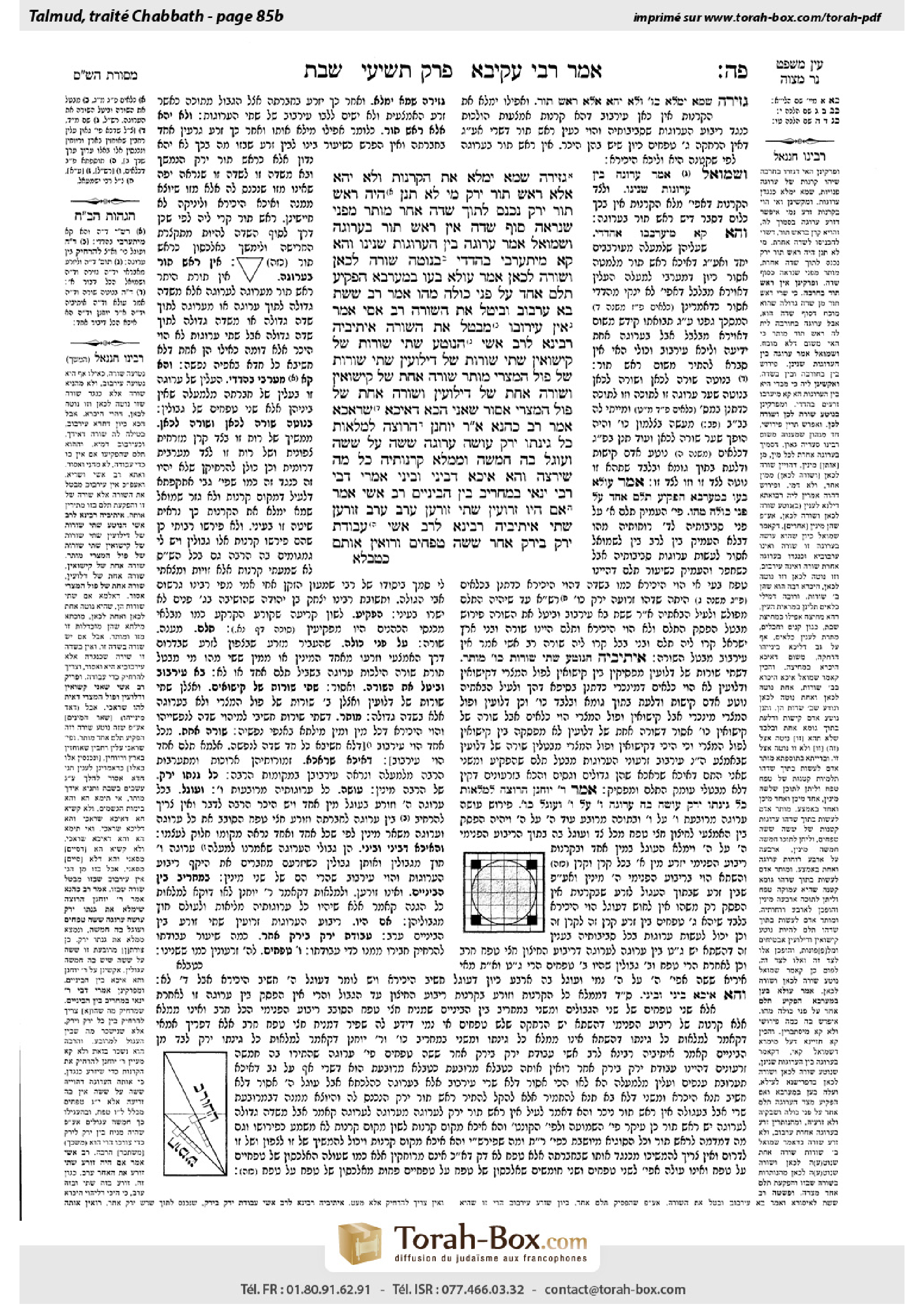
This page of Shabbat includes the Aramaic text, an English translation and an AI-generated French translation, alongside the scan above.
שבת פ״ה ב · Aramaic and Hebrew text
גְּזֵירָה שֶׁמָּא יְמַלֵּא אֶת הַקְּרָנוֹת. וְלֹא יְהֵא אֶלָּא רֹאשׁ תּוֹר יָרָק? מִי לָא תְּנַן: הָיָה רֹאשׁ תּוֹר יָרָק נִכְנָס לְתוֹךְ שָׂדֶה אַחֵר — מוּתָּר, מִפְּנֵי שֶׁנִּרְאֶה סוֹף שָׂדֶה! אֵין רֹאשׁ תּוֹר בַּעֲרוּגָה.
וּשְׁמוּאֵל אָמַר: עֲרוּגָה בֵּין הָעֲרוּגוֹת שָׁנִינוּ. וְהָא קָא מִיתְעָרְבִי בַּהֲדָדֵי! בְּנוֹטֶה שׁוּרָה לְכָאן וְשׁוּרָה לְכָאן.
אָמַר עוּלָּא, בְּעוֹ בְּמַעְרְבָא: הִפְקִיעַ תֶּלֶם אֶחָד עַל פְּנֵי כּוּלָּהּ, מַהוּ? אָמַר רַב שֵׁשֶׁת: בָּא עִרְבּוּב וּבִיטֵּל אֶת הַשּׁוּרָה. רַב אַסִּי אָמַר: אֵין עֵירוּבוֹ מְבַטֵּל אֶת הַשּׁוּרָה. אֵיתִיבֵיהּ רָבִינָא לְרַב אָשֵׁי: הַנּוֹטֵעַ שְׁתֵּי שׁוּרוֹת שֶׁל קִישּׁוּאִין, שְׁתֵּי שׁוּרוֹת שֶׁל דִּילּוּעִין, שְׁתֵּי שׁוּרוֹת שֶׁל פּוֹל הַמִּצְרִי — מוּתָּר. שׁוּרָה אַחַת שֶׁל קִישּׁוּאִין וְשׁוּרָה אַחַת שֶׁל דִּילּוּעִין וְשׁוּרָה אַחַת שֶׁל פּוֹל הַמִּצְרִי — אָסוּר! שָׁאנֵי הָכָא דְּאִיכָּא שְׁרָאכָא.
אָמַר רַב כָּהֲנָא אָמַר רַבִּי יוֹחָנָן: הָרוֹצֶה לְמַלֹּאות כׇּל גִּינָּתוֹ יָרָק — עוֹשֶׂה עֲרוּגָה שִׁשָּׁה עַל שִׁשָּׁה וְעוֹגֵל בָּהּ חֲמִשָּׁה, וּמְמַלֵּא קַרְנוֹתֶיהָ כׇּל מַה שֶּׁיִּרְצֶה.
וְהָא אִיכָּא דְּבֵינֵי וּבֵינֵי! אָמְרִי דְּבֵי רַבִּי יַנַּאי: בְּמַחֲרִיב בֵּין הַבֵּינַיִים. רַב אָשֵׁי אָמַר: אִם הָיוּ זְרוּעִין שְׁתִי — זוֹרְעָן עֵרֶב, עֵרֶב — זוֹרְעָן שְׁתִי. אֵיתִיבֵיהּ רָבִינָא לְרַב אָשֵׁי: עֲבוֹדַת יָרָק בְּיָרָק אַחֵר, שִׁשָּׁה טְפָחִים. וְרוֹאִין אוֹתָם
Shabbat 85b · English translation
Rather, Rav’s reasoning must be: It is a decree lest one will fill the corners after having first planted the garden bed, and thereby violate the prohibition of diverse kinds. The Gemara asks: And why should that matter, the legal status of the garden bed should merely be like a triangular [rosh tor] plot of vegetables. Didn’t we learn in a mishna: If a triangular plot of vegetables was protruding into another field, it is permitted; there, it is not considered a prohibited mixture of diverse kinds, because the end of the field is distinguishable. Based on the shapes of the two fields where they intersect, the demarcation between them is clear. And the Gemara answers: There is no leniency with regard to a triangular plot in a garden bed. This allowance with regard to a triangular section of one field jutting into another field applies only to a large field where the triangular shape can clearly be attributed to a different field, but in a small garden bed where the seeds are adjacent to one another, it is impossible to distinguish between the seeds.
And Shmuel said: When we learned in the mishna that one may plant five kinds of seeds within a garden bed without violating the prohibition of diverse kinds, we learned this even with regard to a garden bed among garden beds, not only in a solitary bed. The Gemara asks: Don’t the seeds become intermingled with one another? The Gemara answers: It is referring to a case where one inclines one row to here, in one direction, and one row to here, in a different direction (Me’iri). In that way they do not appear intermingled.
Ulla said: They raise a dilemma in the West, Eretz Yisrael: What is the halakha if one opened a single furrow across its entirety? Is it considered demarcation between the garden beds if one dug a furrow between two garden beds (ge’onim, Tosafot)? Rav Sheshet said: The intermingling of these garden beds comes and nullifies the row. The furrow is not considered to be a demarcation between the beds. Rav Asi said: Its intermingling does not disqualify the row. Ravina raised an objection to the opinion of Rav Ashi from a mishna: One who plants two rows of cucumbers and two rows of gourds and two rows of Egyptian beans, it is permitted because each of the species is distinct. However, if he plants one row of cucumbers and one row of gourds and one row of Egyptian beans, it is prohibited because in single rows there is no clear demarcation between the species. This indicates that a furrow between different species of seeds does not prevent intermingling between them. Rav Ashi replied: The case in that mishna is an exception. Here, it is different because there are branches that grow out from these species which become entangled with each other, nullifying the furrow between them. Other vegetables, whose branches do not become entangled, may be planted with a single furrow between them.
Rav Kahana said that Rabbi Yoḥanan said: One who wishes to fill his entire garden with vegetables and does not want to distance the rows of seeds from one another may make a garden bed that is six by six handbreadths and make five circles inside it (ge’onim, Rambam). He plants different species in the different circles and fills its corners with whatever additional species that he wants.
The Gemara asks: Aren’t there seeds between the circles, which intermingle with the species that are in the circles? The school of Rabbi Yannai say in response to this: This is referring to a case where one leaves the space in between them barren and does not plant there. Rav Ashi said: He may fill the entire bed with seeds, and demarcate between the different types of seeds in the following manner. If the circles were planted lengthwise, he plants the seeds in between widthwise; and if the circles were planted widthwise, he plants the seeds in between lengthwise. Ravina raised an objection to the opinion of Rav Ashi: We learned that the work space of a vegetable of one species, when planted with a vegetable of a different species, is six handbreadths. And one views them
Shabbat 85b · Traduction française (IA)
Le raisonnement de Rav doit plutôt être le suivant : c’est un décret, de peur que l’on ne remplisse les coins après avoir d’abord planté la planche de jardin, transgressant ainsi l’interdiction des mélanges d’espèces. La Guemara demande : Pourquoi cela devrait-il poser problème ? Le statut de la planche de jardin ne devrait-il pas simplement être celui d’une parcelle triangulaire [rosh tor] de légumes ? N’avons-nous pas appris dans une Michna : Si une parcelle triangulaire de légumes fait saillie dans un autre champ, cela est permis ; elle n’est alors pas considérée comme un mélange interdit d’espèces, car la limite du champ est discernable. La forme des deux champs à leur intersection rend leur démarcation claire. La Guemara répond : Cette tolérance concernant une parcelle triangulaire ne s’applique pas à une planche de jardin. La permission accordée lorsqu’une section triangulaire d’un champ empiète sur un autre champ ne vaut que pour un grand champ, où l’on peut clairement attribuer la forme triangulaire à un champ distinct. En revanche, dans une petite planche de jardin, où les graines sont côte à côte, il est impossible de les distinguer.
Et Shmuel a dit : Lorsque nous avons appris dans la Michna qu’on peut planter cinq sortes de graines dans une planche de jardin sans transgresser l’interdiction des mélanges d’espèces, nous avons appris que cela vaut même pour une planche située parmi d’autres planches de jardin, et pas seulement pour une planche isolée. La Guemara demande : Les graines ne se mélangent-elles pas les unes aux autres ? La Guemara répond : Il s’agit d’un cas où l’on incline une rangée dans une direction et une autre rangée dans une autre direction (Meïri). Ainsi, elles ne semblent pas entremêlées.
Oula a dit : En Occident, en Terre d’Israël, on soulève la question suivante : Quelle est la halakha si l’on a creusé un seul sillon sur toute la longueur de la parcelle ? Le sillon creusé entre deux planches de jardin est-il considéré comme une démarcation entre elles (ge’onim, Tossefot) ? Rav Sheshet a dit : L’entremêlement de ces planches de jardin annule la rangée ; le sillon n’est pas considéré comme une démarcation entre les planches. Rav Assi a dit : Leur entremêlement ne disqualifie pas la rangée. Ravina a objecté à l’opinion de Rav Ashi en citant une Michna : Celui qui plante deux rangées de concombres, deux rangées de courges et deux rangées de haricots d’Égypte peut le faire, car chaque espèce est distincte. En revanche, s’il plante une rangée de concombres, une rangée de courges et une rangée de haricots d’Égypte, cela est interdit, car, lorsqu’il n’y a qu’une rangée de chaque espèce, leur démarcation n’est pas nette. Cela indique qu’un sillon entre des espèces de graines différentes n’empêche pas leur entremêlement. Rav Ashi a répondu : Le cas de cette Michna fait exception. Ici, la situation est différente, car des branches poussent à partir de ces espèces et s’entremêlent, annulant ainsi le sillon qui les sépare. D’autres légumes, dont les branches ne s’entremêlent pas, peuvent être plantés avec un seul sillon entre eux.
Rav Kahana a dit au nom de Rabbi Yoḥanan : Celui qui souhaite remplir tout son jardin de légumes sans éloigner les rangées de graines les unes des autres peut aménager une planche de jardin de six sur six palmes et tracer cinq cercles à l’intérieur (ge’onim, Rambam). Il plante différentes espèces dans les différents cercles et remplit les coins avec les autres espèces qu’il souhaite.
La Guemara demande : N’y a-t-il pas des graines entre les cercles, qui se mélangent aux espèces plantées dans les cercles ? L’école de Rabbi Yannai répond : Il s’agit d’un cas où l’on laisse l’espace entre les cercles en friche et où l’on n’y plante rien. Rav Ashi a dit : On peut remplir toute la planche de graines et démarquer les différentes sortes de graines de la manière suivante : si les cercles sont plantés dans le sens de la longueur, on plante les graines entre eux dans le sens de la largeur ; et si les cercles sont plantés dans le sens de la largeur, on plante les graines entre eux dans le sens de la longueur. Ravina a objecté à l’opinion de Rav Ashi : Nous avons appris que l’espace nécessaire à un légume d’une espèce, lorsqu’il est planté à côté d’un légume d’une autre espèce, est de six palmes. Et l’on considère les deux
Traduction française générée par IA à partir de l’édition anglaise de Sefaria. Vérifie toujours un passage avec le texte source.
Text from Sefaria: William Davidson Edition - Vocalized Aramaic (CC BY NC); William Davidson Edition - English (CC BY NC).