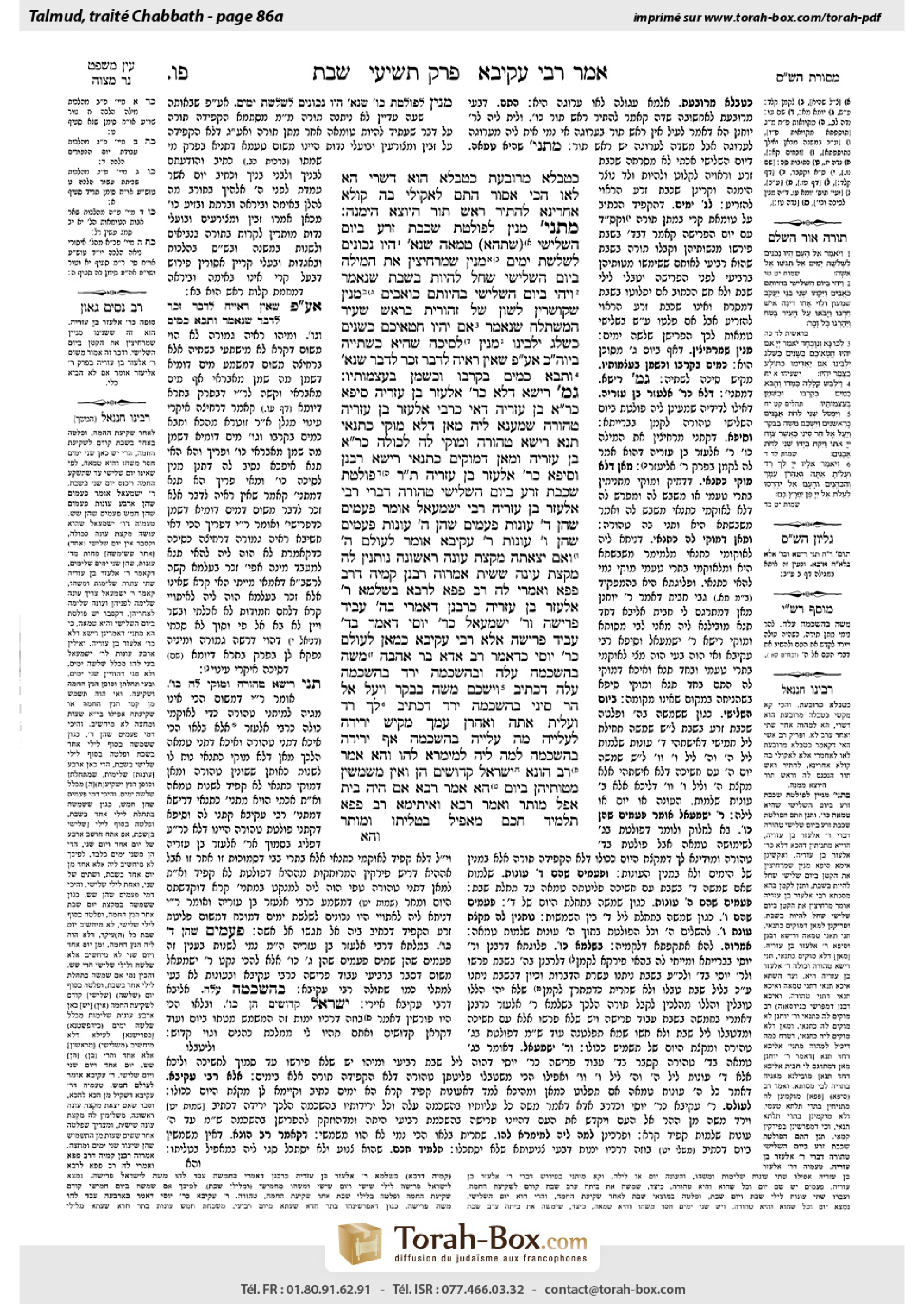
Shabbat 86a: Talmud study for Daf Yomi
Daf Yomi is the daily study of one Talmud folio. Explore 37 tractates with scans, Hebrew text, Sefaria English and AI-generated French translations where annotated.
Passage selection and English or AI-generated French translation are available where the scan has annotations. Daf Study is independent of Torah-Box and Sefaria.
Browse Shabbat · שבת · All tractatesShabbat 86a text and translations
This page of Shabbat includes the Aramaic text, an English translation and an AI-generated French translation, alongside the scan above.
שבת פ״ו א · Aramaic and Hebrew text
כְּטַבְלָא מְרוּבַּעַת. כְּטַבְלָא הוּא דִּשְׁרֵי, הָא לָאו הָכִי — אָסוּר! הָתָם לְאַקּוֹלֵי בָּהּ קוּלָּא אַחֲרִינָא, לְהַתִּיר רֹאשׁ תּוֹר הַיּוֹצֵא הֵימֶנָּה.
מַתְנִי׳ מִנַּיִן לְפוֹלֶטֶת שִׁכְבַת זֶרַע בַּיּוֹם הַשְּׁלִישִׁי שֶׁתְּהֵא טְמֵאָה? שֶׁנֶּאֱמַר: ״הֱיוּ נְכֹנִים לִשְׁלֹשֶׁת יָמִים״. מִנַּיִן שֶׁמַּרְחִיצִין אֶת הַמִּילָה בַּיּוֹם הַשְּׁלִישִׁי שֶׁחָל לִהְיוֹת בְּשַׁבָּת? שֶׁנֶּאֱמַר: ״וַיְהִי בַיּוֹם הַשְּׁלִישִׁי בִּהְיוֹתָם כֹּאֲבִים״. מִנַּיִן שֶׁקּוֹשְׁרִין לָשׁוֹן שֶׁל זְהוֹרִית בְּרֹאשׁ שָׂעִיר הַמִּשְׁתַּלֵּחַ? שֶׁנֶּאֱמַר: ״אִם יִהְיוּ חֲטָאֵיכֶם כַּשָּׁנִים כַּשֶּׁלֶג יַלְבִּינוּ״. מִנַּיִן לְסִיכָה שֶׁהִיא כִּשְׁתִיָּיה בְּיוֹם הַכִּפּוּרִים? אַף עַל פִּי שֶׁאֵין רְאָיָה לַדָּבָר זֵכֶר לַדָּבָר, שֶׁנֶּאֱמַר: ״וַתָּבֹא כַמַּיִם בְּקִרְבּוֹ וְכַשֶּׁמֶן בְּעַצְמוֹתָיו״.
גְּמָ׳ רֵישָׁא דְּלָא כְּרַבִּי אֶלְעָזָר בֶּן עֲזַרְיָה, סֵיפָא כְּרַבִּי אֶלְעָזָר בֶּן עֲזַרְיָה? דְּאִי כְּרַבִּי אֶלְעָזָר בֶּן עֲזַרְיָה — טְהוֹרָה שְׁמַעְנָא לֵיהּ. מַאן דְּלָא מוֹקֵי כְּתַנָּאֵי, תָּנֵא רֵישָׁא ״טְהוֹרָה״, וּמוֹקֵי לַהּ לְכוּלַּהּ כְּרַבִּי אֶלְעָזָר בֶּן עֲזַרְיָה, וּמַאן דְּמוֹקֵים כְּתַנָּאֵי, רֵישָׁא רַבָּנַן וְסֵיפָא כְּרַבִּי אֶלְעָזָר בֶּן עֲזַרְיָה.
תָּנוּ רַבָּנַן: פּוֹלֶטֶת שִׁכְבַת זֶרַע בְּיוֹם הַשְּׁלִישִׁי טְהוֹרָה, דִּבְרֵי רַבִּי אֶלְעָזָר בֶּן עֲזַרְיָה. רַבִּי יִשְׁמָעֵאל אוֹמֵר: פְּעָמִים שֶׁהֵן אַרְבַּע עוֹנוֹת, פְּעָמִים שֶׁהֵן חָמֵשׁ עוֹנוֹת, פְּעָמִים שֶׁהֵן שֵׁשׁ עוֹנוֹת. רַבִּי עֲקִיבָא אוֹמֵר: לְעוֹלָם חָמֵשׁ, וְאִם יָצָאתָה מִקְצָת עוֹנָה רִאשׁוֹנָה, נוֹתְנִין לָהּ מִקְצָת עוֹנָה שִׁשִּׁית.
אַמְרוּהָ רַבָּנַן קַמֵּיהּ דְּרַב פָּפָּא, וְאָמְרִי לַהּ רַב פָּפָּא לְרָבָא: בִּשְׁלָמָא רַבִּי אֶלְעָזָר בֶּן עֲזַרְיָה כְּרַבָּנַן — דְּאָמְרִי בְּחַמְשָׁא עֲבוּד פְּרִישָׁה, וְרַבִּי יִשְׁמָעֵאל כְּרַבִּי יוֹסֵי — דְּאָמַר בְּאַרְבְּעָה עֲבוּד פְּרִישָׁה, אֶלָּא רַבִּי עֲקִיבָא כְּמַאן? לְעוֹלָם כְּרַבִּי יוֹסֵי, כִּדְאָמַר רַב אַדָּא בַּר אַהֲבָה: מֹשֶׁה בְּהַשְׁכָּמָה עָלָה וּבְהַשְׁכָּמָה יָרַד.
בְּהַשְׁכָּמָה עָלָה, דִּכְתִיב: ״וַיַּשְׁכֵּם מֹשֶׁה בַבֹּקֶר וַיַּעַל אֶל הַר סִינַי״. בְּהַשְׁכָּמָה יָרַד, דִּכְתִיב: ״לֶךְ רֵד וְעָלִיתָ אַתָּה וְאַהֲרֹן עִמָּךְ״, מַקִּישׁ יְרִידָה לַעֲלִיָּיה: מָה עֲלִיָּיה בְּהַשְׁכָּמָה, אַף יְרִידָה בְּהַשְׁכָּמָה.
לְמָה לֵיהּ לְמֵימְרָא לְהוּ, וְהָא אָמַר רַב הוּנָא: יִשְׂרָאֵל קְדוֹשִׁים הֵן וְאֵין מְשַׁמְּשִׁין מִטּוֹתֵיהֶן בַּיּוֹם! הָא אָמַר רָבָא: אִם הָיָה בַּיִת אָפֵל — מוּתָּר. וְאָמַר רָבָא וְאִיתֵּימָא רַב פָּפָּא: תַּלְמִיד חָכָם מַאֲפִיל בְּטַלִּיתוֹ, וּמוּתָּר.
Shabbat 86a · English translation
as a square board. All of the halakhot of planting various species were stated with regard to a square-shaped garden bed. By inference: When it is like a square board, it is permitted; and when that is not the case, it is prohibited. Planting different species in horizontal and vertical rows without a space between the species is ineffective, even with circles. Rav Ashi replied: When the baraita says a square board, it does not mean that the only way to demarcate between different species is when the rows are in that configuration. Rather, it is to introduce a different leniency. The baraita came to permit a triangular plot that protrudes from it into another field. This means that a triangular protrusion into another field is considered a conspicuous demarcation only if the bed was square; in that case, no additional measures are necessary.
MISHNA: The mishna continues to cite a series of unrelated halakhot based upon biblical allusions. From where is it derived that a woman who discharges semen even on the third day after relations is ritually impure, just like one who touches semen (see Leviticus 15:17)? Because the semen remains fit for insemination, it can transmit impurity, as it is stated prior to the revelation at Sinai: “And he said to the people, prepare yourselves for three days, do not approach a woman” (Exodus 19:15). This three-day separation period ensured that even a woman who discharged semen would be pure. The mishna cites another halakha based on a biblical allusion: From where is it derived that one may wash the circumcision on the third day, meaning the third day after the circumcision, even if it occurs on Shabbat? As it is stated: “And it came to pass on the third day when they were in pain” (Genesis 34:25). The pain of circumcision lasts at least three days, and as long as the child is in pain he is considered to be in danger. The mishna cites another halakha with an allusion in the Bible: From where is it derived that one ties a scarlet strip of wool to the head of the scapegoat that is dispatched to Azazel? As it is stated: “If your sins be like scarlet, they will become white like snow” (Isaiah 1:18). Since the goat is offered to atone for sins, red wool is tied to its horns. The mishna cites another allusion. From where is it derived that smearing oil on one’s body is like drinking and is similarly prohibited on Yom Kippur? Although there is no proof for this, there is an allusion to it, as it is stated: “And it comes into his inward parts like water and like oil into his bones” (Psalms 109:18). The verse appears to equate smearing oil on one’s body with drinking water.
GEMARA: The Gemara comments on the halakhot cited in the mishna: The first clause in the mishna with regard to discharged semen is not in accordance with the opinion of Rabbi Elazar ben Azarya. The latter clause in the mishna with regard to circumcision is in accordance with the opinion of Rabbi Elazar ben Azarya. As, if one was to assert that the first clause is also in accordance with the opinion of Rabbi Elazar ben Azarya, we heard him say that in that case the woman is ritually pure. The Gemara explains: He who does not establish the mishna as reflecting the opinions of two tanna’im, has a variant reading of the mishna; he teaches the halakha in the first clause: The woman is ritually pure, and establishes the entire mishna in accordance with the opinion of Rabbi Elazar ben Azarya. And he who establishes the mishna as reflecting the opinions of two tanna’im, holds that the first clause is in accordance with the opinion of the Rabbis, and the latter clause is in accordance with the opinion of Rabbi Elazar ben Azarya.
The Gemara elaborates on the matter of a woman who discharges semen, citing that which the Sages taught in a baraita: A woman who discharges semen at any point on the third day is ritually pure; this is the statement of Rabbi Elazar ben Azarya. Rabbi Yishmael says: Even on the third day she is ritually impure. In addition, the only relevant tally is the number of days. The number of twelve-hour periods of night and day that passed is not relevant. Sometimes there are four twelve-hour periods that elapsed between cohabitation and discharge. If she had relations just before nightfall on Wednesday and discharged on Friday night at the beginning of Shabbat, it is considered as if three days passed, meaning Wednesday, Thursday and Friday; and four twelve-hour periods, meaning Wednesday night, Thursday day, Thursday night and Friday day. Sometimes there are five twelve-hour periods that elapsed, in a case where she discharged semen at the end of Friday night. Sometimes there are six twelve-hour periods that elapsed, if she had relations at the beginning of Tuesday night and discharged at the end of the third day. Rabbi Akiva says: The halakha is that it is always five twelve-hour periods. And if she had relations after part of the first period passed, she is given part of the sixth period to complete the requisite five twelve-hour periods, so that sixty hours will have elapsed between cohabitation and discharge.
The Rabbis said this before Rav Pappa, and some say that Rav Pappa said this to Rava: Granted, Rabbi Elazar ben Azarya holds in accordance with the opinion of the Rabbis, who say with regard to the revelation at Sinai that Moses instituted separation between husbands and wives on the fifth day of the week. Since everyone agrees that the Torah was given on Shabbat, husbands and wives were separated for two days. And Rabbi Yishmael holds in accordance with the opinion of Rabbi Yosei, who said that Moses instituted separation on the fourth day of the week, meaning that husbands and wives were separated for three days. However, in accordance with whose opinion did Rabbi Akiva state his opinion? Ritual impurity, in this case, is not based on the passage of days but on the passage of twelve-hour periods, which do not correspond to either opinion mentioned with regard to the revelation at Sinai. The Gemara answers: Actually, Rabbi Akiva holds in accordance with the opinion of Rabbi Yosei. However, his understanding is based on that which Rav Adda bar Ahava said: Moses ascended Mount Sinai early in the morning, and he descended early in the morning and related to them the mitzva of separation.
The Gemara explains the source of this opinion: He ascended Mount Sinai early in the morning, as it is written: “And Moses rose up early in the morning, and went up to Mount Sinai, as the Lord had commanded him” (Exodus 34:4). And he descended the mountain early in the morning, as it is written: “Go descend and you shall ascend together with Aaron” (Exodus 19:24). The Torah juxtaposes descent to ascent to establish that just as Moses’ ascent was early in the morning, so too, his descent was early in the morning. Moses told the people to separate in the early morning so that there would be five complete periods of separation over the course of the three days.
The Gemara asks: Why did he need to tell them to separate during the morning hours? Didn’t Rav Huna say: The Jewish people are holy and do not have relations during the day? It was not necessary to command them until night. The Gemara replies: It was necessary to tell them in the morning, as Rava said: If it was a dark house, it is permitted to have relations during the day. And similarly, Rava said, and some say that Rav Pappa said: A Torah scholar obscures the light in the room with his cloak and is thereby permitted to have relations during the day. Therefore, it was necessary to command the people to separate even during the daytime hours.
Shabbat 86a · Traduction française (IA)
comme une planche carrée. Toutes les halakhot relatives à la plantation de différentes espèces ont été énoncées à propos d’une plate-bande carrée. On en déduit que, lorsqu’elle a la forme d’une planche carrée, c’est permis, et que, dans le cas contraire, c’est interdit. Planter différentes espèces en rangées horizontales et verticales sans espace entre elles n’est pas efficace, même en disposant les rangées en cercle. Rav Ashi répondit : Lorsque la baraïta parle d’une planche carrée, cela ne signifie pas que la seule façon de séparer différentes espèces consiste à disposer les rangées selon cette configuration. Il s’agit plutôt d’introduire une autre facilité. La baraïta vient autoriser une parcelle triangulaire qui s’avance dans un autre champ. Cela signifie qu’une avancée triangulaire dans un autre champ n’est considérée comme une séparation bien visible que si la plate-bande était carrée ; dans ce cas, aucune mesure supplémentaire n’est nécessaire.
MICHNA : La Michna poursuit en citant une série de halakhot sans rapport entre elles, fondées sur des allusions bibliques. D’où apprend-on qu’une femme qui évacue du sperme, même le troisième jour après des rapports, est rituellement impure, tout comme celle qui touche du sperme (voir Lévitique 15:17) ? Puisque le sperme demeure apte à féconder, il peut transmettre l’impureté, comme il est dit avant la révélation au Sinaï : « Il dit au peuple : Tenez-vous prêts pendant trois jours, n’approchez pas une femme » (Exode 19:15). Cette période de séparation de trois jours garantissait que même une femme qui évacuerait du sperme resterait pure. La Michna cite une autre halakha fondée sur une allusion biblique : d’où apprend-on qu’on peut laver la circoncision le troisième jour, c’est-à-dire le troisième jour après la circoncision, même si cela tombe un Chabbat ? Car il est dit : « Or, le troisième jour, alors qu’ils étaient souffrants » (Genèse 34:25). La douleur de la circoncision dure au moins trois jours et, tant que l’enfant souffre, il est considéré comme étant en danger. La Michna cite une autre halakha à laquelle la Bible fait allusion : d’où apprend-on qu’on attache un fil de laine écarlate à la tête du bouc émissaire envoyé à Azazel ? Car il est dit : « Si vos péchés sont comme l’écarlate, ils deviendront blancs comme la neige » (Isaïe 1:18). Puisque le bouc est offert pour expier les péchés, on attache de la laine rouge à ses cornes. La Michna cite une autre allusion. D’où apprend-on que s’enduire le corps d’huile équivaut à boire et est pareillement interdit à Yom Kippour ? Bien qu’il n’y ait pas de preuve à cela, il y est fait allusion, comme il est dit : « Elle pénètre dans ses entrailles comme de l’eau, et dans ses os comme de l’huile » (Psaumes 109:18). Le verset semble assimiler le fait de s’enduire le corps d’huile au fait de boire de l’eau.
GUEMARA : La Guemara commente les halakhot citées dans la Michna : la première partie de la Michna, concernant le sperme évacué, n’est pas conforme à l’opinion de Rabbi Elazar ben Azarya. La dernière partie de la Michna, concernant la circoncision, est conforme à l’opinion de Rabbi Elazar ben Azarya. En effet, si l’on soutenait que la première partie est elle aussi conforme à l’opinion de Rabbi Elazar ben Azarya, nous l’avons entendu dire qu’en pareil cas la femme est rituellement pure. La Guemara explique : Celui qui ne considère pas que la Michna reflète les opinions de deux tannaïm possède une version différente de la Michna : il enseigne dans la première partie la halakha selon laquelle la femme est rituellement pure, et considère que toute la Michna est conforme à l’opinion de Rabbi Elazar ben Azarya. Celui qui considère que la Michna reflète les opinions de deux tannaïm estime que la première partie est conforme à l’opinion des Sages, et la dernière partie à celle de Rabbi Elazar ben Azarya.
La Guemara développe la question de la femme qui évacue du sperme, en citant ce que les Sages ont enseigné dans une baraïta : une femme qui évacue du sperme à n’importe quel moment du troisième jour est rituellement pure ; telle est l’opinion de Rabbi Elazar ben Azarya. Rabbi Yishmael dit : même le troisième jour, elle est rituellement impure. De plus, seul le nombre de jours compte. Le nombre de périodes de douze heures, de jour et de nuit, qui se sont écoulées n’est pas pertinent. Il arrive que quatre périodes de douze heures s’écoulent entre les rapports et l’évacuation. Si elle a eu des rapports juste avant la tombée de la nuit du mercredi et évacué du sperme le vendredi soir, au début de Chabbat, on considère que trois jours se sont écoulés, à savoir mercredi, jeudi et vendredi, ainsi que quatre périodes de douze heures, à savoir la nuit de mercredi, la journée de jeudi, la nuit de jeudi et la journée de vendredi. Il arrive que cinq périodes de douze heures se soient écoulées, si elle évacue du sperme à la fin de la nuit de vendredi. Il arrive que six périodes de douze heures se soient écoulées, si elle a eu des rapports au début de la nuit de mardi et évacué du sperme à la fin du troisième jour. Rabbi Akiva dit : la halakha est qu’il y a toujours cinq périodes de douze heures. Et si elle a eu des rapports après qu’une partie de la première période s’est écoulée, on lui accorde une partie de la sixième période pour compléter les cinq périodes de douze heures requises, de sorte que soixante heures se soient écoulées entre les rapports et l’évacuation.
Les Sages dirent cela devant Rav Pappa ; certains disent que Rav Pappa dit cela à Rava : il est compréhensible que Rabbi Elazar ben Azarya soit conforme à l’opinion des Sages, qui disent que, lors de la révélation au Sinaï, Moïse institua la séparation entre époux le cinquième jour de la semaine. Puisque tous s’accordent à dire que la Torah fut donnée un Chabbat, les époux furent séparés pendant deux jours. Et Rabbi Yishmael est conforme à l’opinion de Rabbi Yosei, qui dit que Moïse institua la séparation le quatrième jour de la semaine, c’est-à-dire que les époux furent séparés pendant trois jours. Cependant, à l’opinion de qui Rabbi Akiva se conforme-t-il ? Dans ce cas, l’impureté rituelle dépend non pas du nombre de jours écoulés, mais du nombre de périodes de douze heures écoulées, lesquelles ne correspondent à aucune des deux opinions mentionnées au sujet de la révélation au Sinaï. La Guemara répond : En réalité, Rabbi Akiva est conforme à l’opinion de Rabbi Yosei. Toutefois, il s’appuie sur ce que Rav Adda bar Ahava a dit : Moïse monta au mont Sinaï tôt le matin, puis en redescendit tôt le matin et leur enseigna la mitsva de la séparation.
La Guemara explique la source de cette opinion : il monta au mont Sinaï tôt le matin, comme il est écrit : « Moïse se leva de bon matin et monta sur le mont Sinaï, comme le Seigneur le lui avait ordonné » (Exode 34:4). Il descendit de la montagne tôt le matin, comme il est écrit : « Va, descends, puis tu monteras avec Aaron » (Exode 19:24). La Torah met en parallèle la descente et la montée pour établir que, de même que Moïse était monté tôt le matin, de même il était descendu tôt le matin. Moïse dit au peuple de se séparer dès le matin, afin qu’il y ait cinq périodes complètes de séparation au cours des trois jours.
La Guemara demande : Pourquoi devait-il leur dire de se séparer pendant les heures du matin ? Rav Houna n’a-t-il pas dit que le peuple juif est saint et n’a pas de rapports pendant la journée ? Il n’était donc pas nécessaire de le leur ordonner avant la nuit. La Guemara répond : Il fallait le leur dire le matin, comme Rava l’a dit : si la maison est sombre, il est permis d’avoir des rapports pendant la journée. Et de même, Rava l’a dit — certains disent que c’est Rav Pappa qui l’a dit — : un érudit en Torah assombrit la pièce avec son manteau et peut ainsi avoir des rapports pendant la journée. Il était donc nécessaire d’ordonner au peuple de s’abstenir même pendant les heures du jour.
Traduction française générée par IA à partir de l’édition anglaise de Sefaria. Vérifie toujours un passage avec le texte source.
Text from Sefaria: William Davidson Edition - Vocalized Aramaic (CC BY NC); William Davidson Edition - English (CC BY NC).