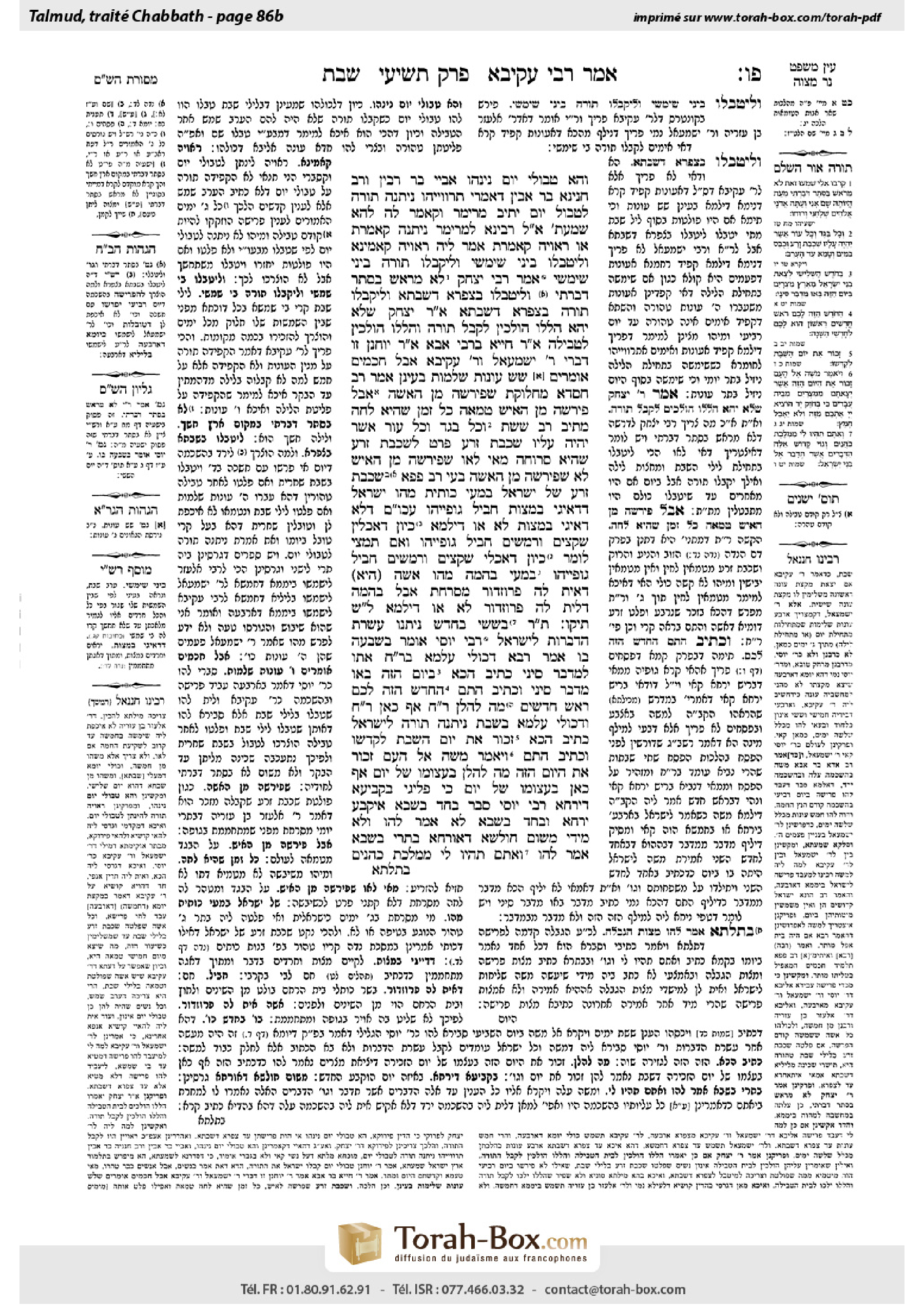
Shabbat 86b: Talmud study for Daf Yomi
Daf Yomi is the daily study of one Talmud folio. Explore 37 tractates with scans, Hebrew text, Sefaria English and AI-generated French translations where annotated.
Passage selection and English or AI-generated French translation are available where the scan has annotations. Daf Study is independent of Torah-Box and Sefaria.
Browse Shabbat · שבת · All tractatesShabbat 86b text and translations
This page of Shabbat includes the Aramaic text, an English translation and an AI-generated French translation, alongside the scan above.
שבת פ״ו ב · Aramaic and Hebrew text
וְהָא טְבוּלֵי יוֹם נִינְהוּ? אַבָּיֵי בַּר רָבִין וְרַב חֲנִינָא בַּר אָבִין דְאָמְרִי תַּרְוַויְיהוּ: נִיתְּנָה תּוֹרָה לִטְבוּל יוֹם. יָתֵיב מָרִימָר וְקָאָמַר לַהּ לְהָא שְׁמַעְתָּא. אֲמַר לֵיהּ רָבִינָא לְמָרִימָר: נִיתְּנָה קָאָמְרַתְּ, אוֹ רְאוּיָה קָאָמְרַתְּ? אֲמַר לֵיהּ: רְאוּיָה קָאָמֵינָא.
וְלִיטְבְּלוּ בֵּינֵי שִׁימְשֵׁי, וְלִיקַבְּלוּ תּוֹרָה בֵּינֵי שִׁימְשֵׁי? אָמַר רַבִּי יִצְחָק: ״לֹא מֵרֹאשׁ בַּסֵּתֶר דִּבַּרְתִּי״. וְלִיטְבְּלוּ בְּצַפְרָא דְשַׁבְּתָא, וְלִיקַבְּלוּ תּוֹרָה בְּצַפְרָא דְשַׁבְּתָא? אָמַר רַבִּי יִצְחָק: שֶׁלֹּא יְהֵא הַלָּלוּ הוֹלְכִין לְקַבֵּל תּוֹרָה וְהַלָּלוּ הוֹלְכִין לִטְבִילָה.
אָמַר רַבִּי חִיָּיא בְּרַבִּי אַבָּא אָמַר רַבִּי יוֹחָנָן: זוֹ דִּבְרֵי רַבִּי יִשְׁמָעֵאל וְרַבִּי עֲקִיבָא, אֲבָל חֲכָמִים אוֹמְרִים: שֵׁשׁ עוֹנוֹת שְׁלֵמוֹת בָּעֵינַן. אָמַר רַב חִסְדָּא: מַחֲלוֹקֶת שֶׁפֵּירְשָׁה מִן הָאִשָּׁה, אֲבָל פֵּירְשָׁה מִן הָאִישׁ — טְמֵאָה כׇּל זְמַן שֶׁהִיא לַחָה. מֵתִיב רַב שֵׁשֶׁת: ״וְכׇל בֶּגֶד וְכׇל עוֹר אֲשֶׁר יִהְיֶה עָלָיו שִׁכְבַת זָרַע״ — פְּרָט לְשִׁכְבַת זֶרַע שֶׁהִיא סְרוּחָה. מַאי לָאו שֶׁפֵּירְשָׁה מִן הָאִישׁ? לָא, שֶׁפֵּירְשָׁה מִן הָאִשָּׁה.
בָּעֵי רַב פָּפָּא: שִׁכְבַת זֶרַע שֶׁל יִשְׂרָאֵל בִּמְעֵי גוֹיָה מַהוּ? יִשְׂרָאֵל דִּדְאִיגִי בְּמִצְוֹת — חֲבִיל גּוּפַיְיהוּ, גּוֹיִם דְּלָא דְּאִיגִי בְּמִצְוֹת — לָא. אוֹ דִילְמָא: כֵּיוָן דְּאָכְלִין שְׁקָצִים וּרְמָשִׂים חֲבִיל גּוּפַיְיהוּ. וְאִם תִּמְצֵי לוֹמַר כֵּיוָן דְּאָכְלִי שְׁקָצִים וּרְמָשִׂים חֲבִיל גּוּפַיְיהוּ: בִּמְעֵי בְּהֵמָה מַהוּ? אִשָּׁה הִיא דְּאִית לַהּ פְּרוֹזְדוֹר — מַסְרְחָא, אֲבָל בְּהֵמָה דְּלֵית לַהּ פְּרוֹזְדוֹר — לָא, אוֹ דִילְמָא לָא שְׁנָא. תֵּיקוּ.
תָּנוּ רַבָּנַן: בְּשִׁשִּׁי בַּחֹדֶשׁ נִיתְּנוּ עֲשֶׂרֶת הַדִּבְּרוֹת לְיִשְׂרָאֵל. רַבִּי יוֹסֵי אוֹמֵר: בְּשִׁבְעָה בּוֹ. אָמַר רָבָא: דְּכוּלֵּי עָלְמָא בְּרֹאשׁ חֹדֶשׁ אֲתוֹ לְמִדְבָּר סִינַי. כְּתִיב הָכָא: ״בַּיּוֹם הַזֶּה בָּאוּ מִדְבַּר סִינָי״, וּכְתִיב הָתָם: ״הַחֹדֶשׁ הַזֶּה לָכֶם רֹאשׁ חֳדָשִׁים״ — מָה לְהַלָּן רֹאשׁ חֹדֶשׁ, אַף כָּאן רֹאשׁ חֹדֶשׁ. וּדְכוּלֵּי עָלְמָא, בְּשַׁבָּת נִיתְּנָה תּוֹרָה לְיִשְׂרָאֵל. כְּתִיב הָכָא: ״זָכוֹר אֶת יוֹם הַשַּׁבָּת לְקַדְּשׁוֹ״, וּכְתִיב הָתָם: ״וַיֹּאמֶר מֹשֶׁה אֶל הָעָם זָכוֹר אֶת הַיּוֹם הַזֶּה״ — מָה לְהַלָּן בְּעִצּוּמוֹ שֶׁל יוֹם, אַף כָּאן בְּעִצּוּמוֹ שֶׁל יוֹם. כִּי פְּלִיגִי בִּקְבִיעָא דְיַרְחָא: רַבִּי יוֹסֵי סָבַר — בְּחַד בְּשַׁבָּא אִיקְּבַע יַרְחָא, וּבְחַד בְּשַׁבָּא לָא אֲמַר לְהוּ וְלָא מִידֵּי מִשּׁוּם חוּלְשָׁא דְּאוֹרְחָא; בִּתְרֵי בְּשַׁבָּא אֲמַר לְהוּ: ״וְאַתֶּם תִּהְיוּ לִי מַמְלֶכֶת כֹּהֲנִים״;
Shabbat 86b · English translation
The Gemara asks: Didn’t some of the people have status of those who immersed themselves during the day when they received the Torah? Some of the women immersed themselves on Shabbat evening to purify themselves from the discharge of semen. Even after immersion, the purification process is not complete until sunset. It was Abaye bar Ravin and Rav Ḥanina bar Avin who both said in response: The Torah was given to those who immersed themselves during the day, and that in no way diminishes the magnitude of the revelation. The Gemara relates that Mareimar sat and stated this halakha. Ravina said to Mareimar: Did you say that the Torah was actually given to those who immersed themselves during the day, or did you say that it was fit to be given to those who immersed themselves during the day, but, in reality, it was not? He said to him: I said that the Torah was fit to be given, but in actuality the nation was ritually pure, and the women did not discharge semen on the third day.
The Gemara asks: And let them immerse during twilight on Shabbat eve and receive the Torah just after that during twilight. Why was it necessary to delay revelation until Shabbat morning? Rabbi Yitzḥak said that the verse said in that regard: “From the first, I did not speak in concealment” (Isaiah 48:16). God did not give the Torah under the cloak of night, but rather in the light of day. The Gemara asks: And let them immerse themselves on Shabbat morning and receive the Torah on Shabbat morning. In that case, according to all opinions, the period of separation could have begun one twelve-hour period later. Rabbi Yitzḥak said: This was not done so that there would not be a situation where these, one segment of the people, would be going to receive the Torah while those, another segment of the people, would be going to immerse themselves. Optimally, the entire nation should go to receive the Torah together.
Rabbi Ḥiyya, son of Rabbi Abba, said that Rabbi Yoḥanan said: These are the statements of Rabbi Yishmael and Rabbi Akiva. However, the Rabbis say: We require that six complete twelve-hour periods elapse between cohabitation and discharge. If a woman discharged semen less than seventy-two hours after having relations, the semen renders her ritually impure. Rav Ḥisda said: The dispute over how long semen renders one ritually impure is only with regard to semen that is discharged from a woman; however, if it is discharged from a man, e.g., it was on a garment, it is impure as long as it is moist, regardless of how much time passed since its discharge. Rav Sheshet raises an objection based on what was taught in a baraita: The Torah states: “And every garment, and every hide on which there is semen shall be immersed in water, and be impure until evening” (Leviticus 15:17). And the Sages taught: This excludes semen which is foul. What, is it not referring to semen discharged from a man, indicating that even moist semen becomes foul after a certain period of time and no longer transmits impurity? The Gemara rejects this: No, this halakha is referring to semen that was discharged from a woman.
Rav Pappa raised a dilemma: What is the halakha with regard to semen of a Jew in the womb of a gentile woman? Do we say that since Jews are concerned about fulfilling mitzvot, due to that concern, their body temperature is hot and semen that is not absorbed becomes foul faster, in contrast to gentiles who are not concerned about fulfilling mitzvot for whom that is not the case? Or, perhaps, since gentiles eat detestable creatures and creeping animals their body temperature is also hot? And if you say that since they eat detestable creatures and creeping animals, their body temperature is hot, another dilemma can be raised: What is the halakha with regard to semen of a Jew in the womb of an animal? Do we say that in a woman, who has a long corridor [perozdor] to her womb, the semen becomes foul; but in an animal, which does not have as long a corridor, it does not? Or perhaps it is not different, and the period of time that the semen renders one ritually impure is the same in both cases? No resolution was found for these dilemmas. Therefore, let them stand unresolved.
The Sages taught: On the sixth day of the month of Sivan, the Ten Commandments were given to the Jewish people. Rabbi Yosei says: On the seventh day of the month. Rava said: Everyone agrees that the Jews came to the Sinai desert on the New Moon, as it is written here: “In the third month after the children of Israel were gone forth out of the land of Egypt, the same day came they into the wilderness of Sinai” (Exodus 19:1), without elaborating what day it was. And it is written there: “This month shall be to you the beginning of months; it shall be the first month of the year to you” (Exodus 12:2). Just as there, the term “this” is referring to the New Moon, so too, here the term is referring to the New Moon. And similarly, everyone agrees that the Torah was given to the Jewish people on Shabbat, as it is written here in the Ten Commandments: “Remember the Shabbat day to keep it holy” (Exodus 20:8), and it is written there: “And Moses said to the people: Remember this day, in which you came out from Egypt, out of the house of bondage, for by strength of hand the Lord brought you out from this place; there shall be no leaven eaten” (Exodus 13:3). Just as there, the mitzva of remembrance was commanded on the very day of the Exodus, so too, here the mitzva of remembrance was commanded on the very day of Shabbat. Where Rabbi Yosei and the Sages disagree is with regard to the determination of the month, meaning which day of the week was established as the New Moon. Rabbi Yosei held: The New Moon was established on the first day of the week, and on the first day of the week He did not say anything to them due to the weariness caused by the journey. On the second day of the week, He said to them: “And you shall be to Me a kingdom of priests and a holy nation; these are the words that you shall speak to the children of Israel” (Exodus 19:6).
Shabbat 86b · Traduction française (IA)
La Guemara demande : Certains ne se trouvaient-ils pas dans la situation de ceux qui s’étaient immergés pendant la journée au moment où ils reçurent la Torah ? Certaines femmes s’étaient immergées le vendredi soir pour se purifier d’un écoulement de sperme. Même après l’immersion, le processus de purification n’est achevé qu’au coucher du soleil. Abaye bar Ravin et Rav Ḥanina bar Avin répondirent tous deux : La Torah fut donnée à des personnes qui s’étaient immergées pendant la journée, ce qui ne diminue en rien l’ampleur de la révélation. La Guemara rapporte que Mareimar s’assit et énonça cette halakha. Ravina dit à Mareimar : As-tu dit que la Torah avait effectivement été donnée à des personnes qui s’étaient immergées pendant la journée, ou as-tu dit qu’elle aurait pu leur être donnée, mais qu’en réalité elle ne le fut pas ? Il lui répondit : J’ai dit qu’elle aurait pu leur être donnée, mais qu’en réalité le peuple était en état de pureté rituelle et que les femmes n’avaient pas eu d’écoulement de sperme le troisième jour.
La Guemara demande : Qu’elles s’immergent au crépuscule du vendredi soir et reçoivent la Torah juste après, au crépuscule. Pourquoi était-il nécessaire de retarder la révélation jusqu’au matin du Chabbat ? Rabbi Yitzḥak dit que le verset dit à ce sujet : « Dès le commencement, je n’ai pas parlé en secret » (Isaïe 48:16). Dieu ne donna pas la Torah sous le voile de la nuit, mais en plein jour. La Guemara demande : Qu’elles s’immergent le matin du Chabbat et reçoivent la Torah ce même matin. Dans ce cas, selon toutes les opinions, la période de séparation aurait pu commencer douze heures plus tard. Rabbi Yitzḥak dit : Cela ne fut pas fait afin d’éviter que les uns, une partie du peuple, aillent recevoir la Torah tandis que les autres, une autre partie du peuple, iraient s’immerger. Dans l’idéal, tout le peuple devait aller recevoir la Torah ensemble.
Rabbi Ḥiyya, fils de Rabbi Abba, dit que Rabbi Yoḥanan dit : Ce sont les paroles de Rabbi Yishmael et de Rabbi Akiva. Mais les Sages disent : Il faut que six périodes complètes de douze heures s’écoulent entre le rapport sexuel et l’écoulement. Si une femme a un écoulement de sperme moins de soixante-douze heures après avoir eu des relations, ce sperme la rend rituellement impure. Rav Ḥisda dit : Le débat sur la durée pendant laquelle le sperme rend une personne rituellement impure ne concerne que le sperme qui s’écoule d’une femme ; en revanche, s’il s’écoule d’un homme, par exemple s’il se trouve sur un vêtement, il est impur tant qu’il est humide, quel que soit le temps écoulé depuis son écoulement. Rav Sheshet soulève une objection fondée sur ce qui a été enseigné dans une baraïta : La Torah dit : « Tout vêtement et toute peau sur lesquels il y a du sperme seront plongés dans l’eau et seront impurs jusqu’au soir » (Lévitique 15:17). Et les Sages ont enseigné : Cela exclut le sperme qui s’est corrompu. N’est-il pas question du sperme écoulé d’un homme, ce qui indique que même le sperme humide se corrompt après un certain temps et ne transmet alors plus l’impureté ? La Guemara rejette cette interprétation : Non, cette halakha concerne le sperme écoulé d’une femme.
Rav Pappa souleva une question : Quelle est la halakha concernant le sperme d’un Juif dans l’utérus d’une femme non juive ? Faut-il dire que, puisque les Juifs se soucient d’accomplir les mitsvot, cette préoccupation rend leur température corporelle élevée et le sperme non absorbé se corrompt plus rapidement, contrairement aux non-Juifs, qui ne se soucient pas d’accomplir les mitsvot et chez qui cela ne se produit pas ? Ou peut-être que, puisque les non-Juifs mangent des créatures répugnantes et des animaux rampants, leur température corporelle est, elle aussi, élevée ? Et si l’on dit que, puisqu’ils mangent des créatures répugnantes et des animaux rampants, leur température corporelle est élevée, on peut soulever une autre question : Quelle est la halakha concernant le sperme d’un Juif dans l’utérus d’un animal ? Faut-il dire que, chez une femme, dont l’utérus est relié à l’extérieur par un long conduit [perozdor], le sperme se corrompt, mais que chez un animal, qui n’a pas un conduit aussi long, il ne se corrompt pas ? Ou peut-être n’y a-t-il pas de différence et la durée pendant laquelle le sperme rend une personne rituellement impure est-elle la même dans les deux cas ? Aucune solution n’a été trouvée à ces questions. Elles restent donc sans réponse.
Les Sages ont enseigné : Le sixième jour du mois de Sivan, les Dix Commandements furent donnés au peuple juif. Rabbi Yosei dit : Le septième jour du mois. Rava dit : Tous s’accordent à dire que les Juifs arrivèrent dans le désert du Sinaï le jour de la Nouvelle Lune, comme il est écrit ici : « Le troisième mois après la sortie des enfants d’Israël du pays d’Égypte, ce jour-là, ils arrivèrent au désert du Sinaï » (Exode 19:1), sans préciser de quel jour il s’agissait. Et il est écrit là : « Ce mois-ci sera pour vous le commencement des mois ; il sera pour vous le premier des mois de l’année » (Exode 12:2). De même que là, le terme « ce » désigne la Nouvelle Lune, de même ici, le terme désigne la Nouvelle Lune. De même, tous s’accordent à dire que la Torah fut donnée au peuple juif un Chabbat, comme il est écrit ici, dans les Dix Commandements : « Souviens-toi du jour du Chabbat pour le sanctifier » (Exode 20:8), et il est écrit là : « Moïse dit au peuple : Souvenez-vous de ce jour où vous êtes sortis d’Égypte, de la maison d’esclavage, car c’est par la force de sa main que le Seigneur vous a fait sortir de ce lieu ; on ne mangera pas de pain levé » (Exode 13:3). De même que là, le commandement de se souvenir fut donné le jour même de la sortie d’Égypte, de même ici, le commandement de se souvenir fut donné le jour même du Chabbat. Le point sur lequel Rabbi Yosei et les Sages sont en désaccord concerne la détermination du mois, c’est-à-dire le jour de la semaine où la Nouvelle Lune fut fixée. Rabbi Yosei estimait que la Nouvelle Lune avait été fixée le premier jour de la semaine et que, ce premier jour, Il ne leur dit rien en raison de la fatigue causée par le voyage. Le deuxième jour de la semaine, Il leur dit : « Vous serez pour Moi un royaume de prêtres et une nation sainte ; voici les paroles que tu adresseras aux enfants d’Israël » (Exode 19:6).
Traduction française générée par IA à partir de l’édition anglaise de Sefaria. Vérifie toujours un passage avec le texte source.
Text from Sefaria: William Davidson Edition - Vocalized Aramaic (CC BY NC); William Davidson Edition - English (CC BY NC).