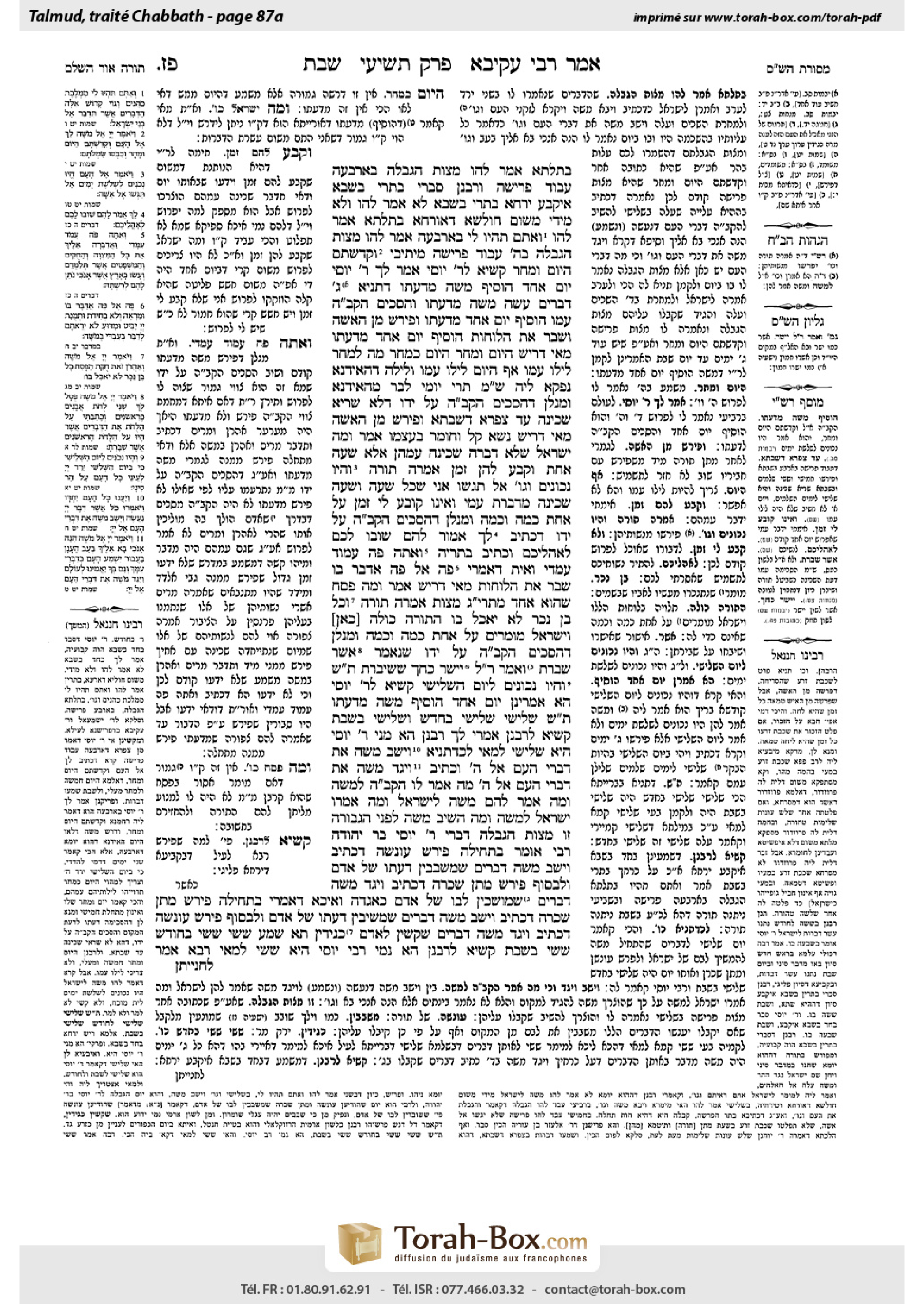
Shabbat 87a: Talmud study for Daf Yomi
Daf Yomi is the daily study of one Talmud folio. Explore 37 tractates with scans, Hebrew text, Sefaria English and AI-generated French translations where annotated.
Passage selection and English or AI-generated French translation are available where the scan has annotations. Daf Study is independent of Torah-Box and Sefaria.
Browse Shabbat · שבת · All tractatesShabbat 87a text and translations
This page of Shabbat includes the Aramaic text, an English translation and an AI-generated French translation, alongside the scan above.
שבת פ״ז א · Aramaic and Hebrew text
בִּתְלָתָא אֲמַר לְהוּ מִצְוַת הַגְבָּלָה; בְּאַרְבְּעָה עֲבוּד פְּרִישָׁה. וְרַבָּנַן סָבְרִי — בִּתְרֵי בְּשַׁבָּא אִיקְּבַע יַרְחָא, בִּתְרֵי בְּשַׁבָּא לָא אֲמַר לְהוּ וְלָא מִידֵּי מִשּׁוּם חוּלְשָׁא דְאוֹרְחָא; בִּתְלָתָא אֲמַר לְהוּ: ״וְאַתֶּם תִּהְיוּ לִי״; בְּאַרְבְּעָה אֲמַר לְהוּ מִצְוַת הַגְבָּלָה; בְּחַמְשָׁא עֲבוּד פְּרִישָׁה. מֵיתִיבִי: ״וְקִדַּשְׁתָּם הַיּוֹם וּמָחָר״, קַשְׁיָא לְרַבִּי יוֹסֵי!
אָמַר לְךָ רַבִּי יוֹסֵי: יוֹם אֶחָד הוֹסִיף מֹשֶׁה מִדַּעְתּוֹ. דְּתַנְיָא: שְׁלֹשָׁה דְּבָרִים עָשָׂה מֹשֶׁה מִדַּעְתּוֹ, וְהִסְכִּים הַקָּדוֹשׁ בָּרוּךְ הוּא עִמּוֹ. הוֹסִיף יוֹם אֶחָד מִדַּעְתּוֹ, וּפֵירַשׁ מִן הָאִשָּׁה, וְשָׁבַר אֶת הַלּוּחוֹת.
הוֹסִיף יוֹם אֶחָד מִדַּעְתּוֹ, מַאי דְּרַשׁ? ״הַיּוֹם וּמָחָר״ — הַיּוֹם כְּמָחָר. מָה לְמָחָר לֵילוֹ עִמּוֹ, אַף הַיּוֹם לֵילוֹ עִמּוֹ. וְלַיְלָה דְּהָאִידָּנָא נְפַק לֵיהּ, שְׁמַע מִינַּהּ תְּרֵי יוֹמֵי לְבַר מֵהָאִידָּנָא. וּמְנָלַן דְּהִסְכִּים הַקָּדוֹשׁ בָּרוּךְ הוּא עַל יָדוֹ — דְּלָא שְׁרַאי שְׁכִינָה עַד צַפְרָא דְשַׁבְּתָא.
וּפֵירַשׁ מִן הָאִשָּׁה, מַאי דְּרַשׁ? נָשָׂא קַל וָחוֹמֶר בְּעַצְמוֹ, אָמַר: וּמָה יִשְׂרָאֵל שֶׁלֹּא דִּבְּרָה שְׁכִינָה עִמָּהֶן אֶלָּא שָׁעָה אַחַת, וְקָבַע לָהֶן זְמַן, אָמְרָה תּוֹרָה: ״וְהָיוּ נְכֹנִים וְגוֹ׳ אַל תִּגְּשׁוּ״. אֲנִי, שֶׁכׇּל שָׁעָה וְשָׁעָה שְׁכִינָה מְדַבֶּרֶת עִמִּי, וְאֵינוֹ קוֹבֵעַ לִי זְמַן — עַל אַחַת כַּמָּה וְכַמָּה. וּמְנָלַן דְּהִסְכִּים הַקָּדוֹשׁ בָּרוּךְ הוּא עַל יָדוֹ? — דִּכְתִיב: ״לֵךְ אֱמֹר לָהֶם שׁוּבוּ לָכֶם לְאׇהֳלֵיכֶם״, וּכְתִיב בָּתְרֵיהּ: ״וְאַתָּה פֹּה עֲמֹד עִמָּדִי״. וְאִית דְּאָמְרִי: ״פֶּה אֶל פֶּה אֲדַבֶּר בּוֹ״.
שָׁבַר אֶת הַלּוּחוֹת, מַאי דְּרַשׁ? אָמַר: וּמָה פֶּסַח שֶׁהוּא אֶחָד מִתַּרְיָ״ג מִצְוֹת, אָמְרָה תּוֹרָה: ״וְכׇל בֶּן נֵכָר לֹא יֹאכַל בּוֹ״. הַתּוֹרָה כּוּלָּהּ [כָּאן] וְיִשְׂרָאֵל מְשׁוּמָּדִים — עַל אַחַת כַּמָּה וְכַמָּה. וּמְנָלַן דְּהִסְכִּים הַקָּדוֹשׁ בָּרוּךְ הוּא עַל יָדוֹ? — שֶׁנֶּאֱמַר: ״אֲשֶׁר שִׁבַּרְתָּ״, וְאָמַר רֵישׁ לָקִישׁ: יִישַׁר כֹּחֲךָ שֶׁשִּׁבַּרְתָּ.
תָּא שְׁמַע: ״וְהָיוּ נְכֹנִים לַיּוֹם הַשְּׁלִישִׁי״, קַשְׁיָא לְרַבִּי יוֹסֵי. הָא אָמְרִינַן יוֹם אֶחָד הוֹסִיף מֹשֶׁה מִדַּעְתּוֹ. תָּא שְׁמַע: ״שְׁלִישִׁי״ — שְׁלִישִׁי בַּחֹדֶשׁ וּשְׁלִישִׁי בַּשַּׁבָּת, קַשְׁיָא לְרַבָּנַן! אָמְרִי לָךְ רַבָּנַן: הָא מַנִּי — רַבִּי יוֹסֵי הִיא.
שְׁלִישִׁי לְמַאי? לְכִדְתַנְיָא: ״וַיָּשֶׁב מֹשֶׁה אֶת דִּבְרֵי הָעָם אֶל ה׳״, וּכְתִיב: ״וַיַּגֵּד מֹשֶׁה אֶת דִּבְרֵי הָעָם אֶל ה׳״.
מָה אָמַר לוֹ הַקָּדוֹשׁ בָּרוּךְ הוּא לְמֹשֶׁה, וּמָה אָמַר לָהֶם מֹשֶׁה לְיִשְׂרָאֵל, וּמָה אָמְרוּ יִשְׂרָאֵל לְמֹשֶׁה, וּמָה הֵשִׁיב מֹשֶׁה לִפְנֵי הַגְּבוּרָה? זוֹ מִצְוַת הַגְבָּלָה, דִּבְרֵי רַבִּי יוֹסֵי בַּר יְהוּדָה. רַבִּי אוֹמֵר: בַּתְּחִילָּה פֵּירֵשׁ עוֹנְשָׁהּ, דִּכְתִיב: ״וַיָּשֶׁב מֹשֶׁה״ — דְּבָרִים שֶׁמְּשַׁבְּבִין דַּעְתּוֹ שֶׁל אָדָם, וּלְבַסּוֹף פֵּירֵשׁ מַתַּן שְׂכָרָהּ, דִּכְתִיב: ״וַיַּגֵּד מֹשֶׁה״ — דְּבָרִים שֶׁמּוֹשְׁכִין לִבּוֹ שֶׁל אָדָם כְּאַגָּדָה. וְאִיכָּא דְאָמְרִי: בַּתְּחִילָּה פֵּירֵשׁ מַתַּן שְׂכָרָהּ, דִּכְתִיב: ״וַיָּשֶׁב מֹשֶׁה״ — דְּבָרִים שֶׁמְּשִׁיבִין דַּעְתּוֹ שֶׁל אָדָם, וּלְבַסּוֹף פֵּירֵשׁ עוֹנְשָׁהּ, דִּכְתִיב: ״וַיַּגֵּד מֹשֶׁה״ — דְּבָרִים שֶׁקָּשִׁין לָאָדָם כְּגִידִּין.
תָּא שְׁמַע: ״שִׁשִּׁי״ — שִׁשִּׁי בַּחוֹדֶשׁ, שִׁשִּׁי בַּשַּׁבָּת, קַשְׁיָא לְרַבָּנַן! הָא נָמֵי רַבִּי יוֹסֵי הִיא. שִׁשִּׁי לְמַאי? רָבָא אָמַר:
Shabbat 87a · English translation
On the third day of the week, God said to them the mitzva of setting boundaries around Mount Sinai. On the fourth day of the week, the husbands and wives separated from one another. And the Rabbis hold: On the second day of the week the New Moon was established, and on the second day of the week God did not say anything to them due to the weariness caused by their journey. On the third day of the week, God said to them: “And you shall be to Me a kingdom of priests and a holy nation; these are the words that you shall speak to the children of Israel” (Exodus 19:6). On the fourth day of the week, God said to them the mitzva of setting boundaries around Mount Sinai. On the fifth day of the week, the husbands and wives separated from one another. The Gemara raises an objection: Doesn’t the verse state: “And the Lord said to Moses: Go to the people and sanctify them today and tomorrow and let them wash their garments” (Exodus 19:10), indicating that the husbands and wives were separated for only two days? This is difficult according to the opinion of Rabbi Yosei, who said earlier that the separation was for three days.
The Gemara answers: Rabbi Yosei could have said to you: Moses added one day to the number of days that God commanded based on his own perception, as it was taught in a baraita: Moses did three things based on his own perception, and the Holy One, Blessed be He, agreed with him. He added one day to the days of separation before the revelation at Sinai based on his own perception. And he totally separated from his wife after the revelation at Sinai. And he broke the tablets following the sin of the Golden Calf.
The Gemara discusses these cases: He added one day based on his own perception. What source did he interpret that led him to do so? He reasoned that since the Holy One, Blessed be He, said: “Sanctify them today and tomorrow,” the juxtaposition of the two days teaches that today is like tomorrow; just as tomorrow the men and women will separate for that day and the night preceding it, so too, today requires separation for the day and the night preceding it. Since God spoke to him in the morning, and the night of that day already passed, Moses concluded: Derive from it that separation must be in effect for two days besides that day. Therefore, he extended the mitzva of separation by one day. And from where do we derive that the Holy One, Blessed be He, agreed with his interpretation? It is derived from the fact that the Divine Presence did not rest upon Mount Sinai until Shabbat morning, as Moses had determined.
And he totally separated from his wife after the revelation at Sinai. What source did he interpret that led him to do so? He reasoned an a fortiori inference by himself and said: If Israel, with whom the Divine Presence spoke only one time and God set a specific time for them when the Divine Presence would be revealed, and yet the Torah stated: “Prepare yourselves for three days, do not approach a woman” (Exodus 19:15); I, with whom the Divine Presence speaks all the time and God does not set a specific time for me, all the more so that I must separate from my wife. And from where do we derive that the Holy One, Blessed be He, agreed with him? As it is written after the revelation at Sinai: “Go say to them: Return to your tents” (Deuteronomy 5:26), meaning to your homes and wives. And afterward it is written that God told Moses: “And you, stand here with Me” (Deuteronomy 5:27), indicating that Moses was not allowed to return home, as he must constantly be prepared to receive the word of God. And some say a different source indicating that God agreed with his reasoning. When Aaron and Miriam criticized Moses’ separation from his wife, God said: “With him do I speak mouth to mouth, even manifestly, and not in dark speeches; and the similitude of the Lord does he behold; why then were you not afraid to speak against My servant, against Moses?” (Numbers 12:8). This indicates that God agreed with his reasoning.
And he broke the tablets following the sin of the Golden Calf. What source did he interpret that led him to do so? Moses said: With regard to the Paschal lamb, which is only one of six hundred and thirteen mitzvot, the Torah stated: “And the Lord said unto Moses and Aaron: This is the ordinance of the Paschal offering; no alien shall eat of it” (Exodus 12:43), referring not only to gentiles, but to apostate Jews as well. Regarding the tablets, which represented the entire Torah, and Israel at that moment were apostates, as they were worshipping the calf, all the more so are they not worthy of receiving the Torah. And from where do we derive that the Holy One, Blessed be He, agreed with his reasoning? As it is stated: “The first tablets which you broke [asher shibarta]” (Exodus 34:1), and Reish Lakish said: The word asher is an allusion to the phrase: May your strength be true [yishar koḥakha] due to the fact that you broke the tablets.
Come and hear an additional difficulty from the verse: “And be prepared for the third day, for on the third day God will descend onto Mount Sinai before the eyes of the entire nation” (Exodus 19:11). This indicates that God said that the Torah would be given on the third day after two days of separation. This is difficult according to the opinion of Rabbi Yosei. The Gemara answers: Didn’t we say that Moses added one day based on his own perception? Come and hear a proof against this from what was taught in a baraita. That which is stated in the Torah: “For on the third day,” means the third day of the month and the third day of the week. Apparently, the New Moon was on Sunday. This is difficult according to the opinion of the Rabbis. The Gemara answers: The Rabbis could have said to you: Whose is the opinion in this baraita? It is the opinion of Rabbi Yosei. Therefore, this baraita poses no difficulty to the opinion of the Rabbis.
According to the opinion of the Rabbis, that day was the third day of what reckoning? As it was taught in a baraita: It is written: “And Moses reported the words of the people to the Lord” (Exodus 19:8). And it is written immediately thereafter: “And God said to Moses: Behold I will come to you in a thick cloud so that the people will hear when I speak with you, and they will also believe in you forever. And Moses told the words of the people to the Lord” (Exodus 19:9).
The Gemara asks: What did the Holy One, Blessed be He, say to Moses, and what did Moses say to Israel, and what did Israel say to Moses, and what did Moses report to the Almighty? The verses do not elaborate on the content of God’s command to Moses, which Moses then told the people and which they accepted. It must be that this refers to the mitzva of setting boundaries, which Moses told the people and which they accepted. He then went back and reported to God that the people accepted the mitzva; this is the statement of Rabbi Yosei bar Yehuda. Rabbi Yehuda HaNasi says: At first, he explained the punishment and the hardship involved in receiving the Torah, as it is written: “And Moses reported [vayashev],” which is interpreted homiletically as: Matters that shatter [meshabbevin] (Rav Hai Gaon) a person’s mind; and, ultimately, he explained its reward, as it is written: “And Moses told [vayagged],” which is interpreted homiletically as: Matters that draw a person’s heart like aggada. And some say that at first, he explained its reward, as it is written: “And Moses reported,” which is interpreted homiletically as: Matters that restore [meshivin] and calm a person’s mind; and ultimately, he explained its punishment, as it is written: “And Moses told,” matters that are as difficult for a person as wormwood [gidin].
Come and hear a proof from that which was taught in a baraita: The sixth was the sixth day of the month and the sixth day of the week. This is also difficult according to the opinion of the Rabbis. The Gemara answers: This baraita is also according to the opinion of Rabbi Yosei. But if so, according to the opinion of the Rabbis, that day was the sixth day of what reckoning? Rava said:
Shabbat 87a · Traduction française (IA)
Le troisième jour de la semaine, Dieu leur ordonna la mitsva de délimiter le mont Sinaï. Le quatrième jour de la semaine, les maris et les femmes se séparèrent. Les Sages, quant à eux, soutiennent que la nouvelle lune fut fixée le deuxième jour de la semaine ; ce jour-là, Dieu ne leur dit rien en raison de la fatigue causée par leur voyage. Le troisième jour de la semaine, Dieu leur dit : « Vous serez pour Moi un royaume de prêtres et une nation sainte ; voilà les paroles que tu adresseras aux enfants d’Israël » (Exode 19, 6). Le quatrième jour de la semaine, Dieu leur ordonna la mitsva de délimiter le mont Sinaï. Le cinquième jour de la semaine, les maris et les femmes se séparèrent. La Guemara soulève une objection : le verset ne dit-il pas : « Le Seigneur dit à Moïse : Va vers le peuple, sanctifie-les aujourd’hui et demain, et qu’ils lavent leurs vêtements » (Exode 19, 10), ce qui indique que les maris et les femmes ne se séparèrent que pendant deux jours ? Cela pose une difficulté selon l’opinion de Rabbi Yosei, qui a dit précédemment que la séparation dura trois jours.
La Guemara répond : Rabbi Yosei aurait pu te dire que Moïse ajouta de son propre chef un jour au nombre de jours que Dieu avait ordonné, comme cela a été enseigné dans une baraïta : Moïse fit trois choses de son propre chef, et le Saint, béni soit-Il, fut d’accord avec lui. Il ajouta de son propre chef un jour aux jours de séparation précédant la révélation au Sinaï. Il se sépara complètement de sa femme après la révélation au Sinaï. Et il brisa les Tables à la suite de la faute du Veau d’or.
La Guemara examine ces cas. Il ajouta un jour de son propre chef. Quelle source interpréta-t-il pour en arriver là ? Il raisonna ainsi : puisque le Saint, béni soit-Il, avait dit : « Sanctifie-les aujourd’hui et demain », le rapprochement de ces deux jours enseigne qu’aujourd’hui est comme demain. De même que demain, les hommes et les femmes se sépareront pendant toute cette journée et la nuit qui la précède, de même, aujourd’hui exige une séparation pendant toute la journée et la nuit qui la précède. Comme Dieu lui avait parlé le matin et que la nuit de ce jour était déjà passée, Moïse en conclut qu’il fallait en déduire que la séparation devait être observée pendant deux jours en plus de ce jour. Il prolongea donc d’un jour la mitsva de séparation. Et d’où déduit-on que le Saint, béni soit-Il, approuva son interprétation ? Du fait que la Présence divine ne se posa sur le mont Sinaï que le matin de Chabbat, comme Moïse l’avait décidé.
Il se sépara complètement de sa femme après la révélation au Sinaï. Quelle source interpréta-t-il pour en arriver là ? Il établit de son propre chef un raisonnement a fortiori et dit : Si Israël, à qui la Présence divine ne parla qu’une seule fois et pour qui Dieu fixa un moment précis où la Présence divine se révélerait, devait pourtant, comme le dit la Torah, « se préparer pendant trois jours et ne pas s’approcher d’une femme » (Exode 19, 15), à plus forte raison moi, à qui la Présence divine parle constamment et pour qui Dieu ne fixe aucun moment précis, dois-je me séparer de ma femme. Et d’où déduit-on que le Saint, béni soit-Il, fut d’accord avec lui ? Car il est écrit après la révélation au Sinaï : « Va leur dire : Retournez à vos tentes » (Deutéronome 5, 26), c’est-à-dire chez vous, auprès de vos femmes. Puis il est écrit que Dieu dit à Moïse : « Quant à toi, reste ici auprès de Moi » (Deutéronome 5, 27), ce qui indique que Moïse ne pouvait pas rentrer chez lui, car il devait être constamment prêt à recevoir la parole de Dieu. Certains donnent une autre source indiquant que Dieu approuva son raisonnement. Quand Aaron et Miriam critiquèrent la séparation de Moïse d’avec sa femme, Dieu dit : « C’est bouche à bouche que Je lui parle, clairement et non par énigmes, et il contemple la ressemblance du Seigneur ; pourquoi donc n’avez-vous pas craint de parler contre Mon serviteur, contre Moïse ? » (Nombres 12, 8). Cela indique que Dieu approuva son raisonnement.
Il brisa les Tables à la suite de la faute du Veau d’or. Quelle source interpréta-t-il pour en arriver là ? Moïse dit : Au sujet de l’agneau pascal, qui n’est qu’une seule des six cent treize mitsvot, la Torah dit : « Le Seigneur dit à Moïse et à Aaron : Voici le statut de l’offrande pascale ; aucun étranger n’en mangera » (Exode 12, 43), ce qui désigne non seulement les non-Juifs, mais aussi les Juifs apostats. Quant aux Tables, qui représentaient toute la Torah, et alors qu’Israël était apostat à ce moment-là, puisqu’il adorait le veau, à plus forte raison Israël n’était-il pas digne de recevoir la Torah. Et d’où déduit-on que le Saint, béni soit-Il, approuva son raisonnement ? Car il est dit : « Les premières Tables que tu as brisées [asher shibarta] » (Exode 34, 1), et Reish Lakish a dit : Le mot asher fait allusion à l’expression : « Que ta force soit juste [yishar koḥakha] », parce que tu as brisé les Tables.
Une difficulté supplémentaire se présente à partir du verset : « Soyez prêts pour le troisième jour, car le troisième jour Dieu descendra sur le mont Sinaï aux yeux de tout le peuple » (Exode 19, 11). Cela indique que Dieu dit que la Torah serait donnée le troisième jour, après deux jours de séparation. Cela pose une difficulté selon l’opinion de Rabbi Yosei. La Guemara répond : N’avons-nous pas dit que Moïse ajouta un jour de son propre chef ? Une preuve contraire se présente à partir de ce qui a été enseigné dans une baraïta : l’expression « car le troisième jour », dans la Torah, désigne le troisième jour du mois et le troisième jour de la semaine. Apparemment, la nouvelle lune tombait un dimanche. Cela pose une difficulté selon l’opinion des Sages. La Guemara répond : Les Sages auraient pu te dire : De qui cette baraïta rapporte-t-elle l’opinion ? De Rabbi Yosei. Cette baraïta ne pose donc aucune difficulté à l’opinion des Sages.
Selon l’opinion des Sages, le troisième jour de quel décompte était-ce ? Car il a été enseigné dans une baraïta : Il est écrit : « Moïse rapporta au Seigneur les paroles du peuple » (Exode 19, 8). Et il est écrit immédiatement après : « Dieu dit à Moïse : Voici, Je vais venir à toi dans une épaisse nuée, afin que le peuple entende quand Je parlerai avec toi et qu’il ait aussi toujours foi en toi. Et Moïse rapporta au Seigneur les paroles du peuple » (Exode 19, 9).
La Guemara demande : Qu’est-ce que le Saint, béni soit-Il, dit à Moïse, qu’est-ce que Moïse dit à Israël, qu’est-ce qu’Israël répondit à Moïse, et que rapporta Moïse au Tout-Puissant ? Les versets ne précisent pas le contenu de l’ordre que Dieu donna à Moïse, que celui-ci transmit ensuite au peuple et que le peuple accepta. Il faut donc qu’il s’agisse de la mitsva de délimiter le mont Sinaï, que Moïse communiqua au peuple et que celui-ci accepta. Il retourna ensuite rapporter à Dieu que le peuple avait accepté la mitsva ; telle est l’opinion de Rabbi Yosei bar Yehuda. Rabbi Yehuda HaNasi dit : D’abord, il expliqua la punition et les difficultés liées à la réception de la Torah, comme il est écrit : « Moïse rapporta [vayashev] », expression interprétée homilétiquement comme désignant des paroles qui bouleversent [meshabbevin] (Rav Hai Gaon) l’esprit d’une personne ; puis, à la fin, il expliqua la récompense, comme il est écrit : « Moïse raconta [vayagged] », expression interprétée homilétiquement comme désignant des paroles qui attirent le cœur d’une personne, comme une aggada. Certains disent qu’il expliqua d’abord la récompense, comme il est écrit : « Moïse rapporta », expression interprétée homilétiquement comme désignant des paroles qui restaurent [meshivin] et apaisent l’esprit d’une personne ; puis, à la fin, il expliqua la punition, par des paroles aussi amères pour une personne que l’absinthe [gidin].
Une preuve se présente à partir de ce qui a été enseigné dans une baraïta : le sixième était le sixième jour du mois et le sixième jour de la semaine. Cela pose également une difficulté selon l’opinion des Sages. La Guemara répond : Cette baraïta aussi suit l’opinion de Rabbi Yosei. Mais alors, selon l’opinion des Sages, le sixième jour de quel décompte était-ce ? Rava dit :
Traduction française générée par IA à partir de l’édition anglaise de Sefaria. Vérifie toujours un passage avec le texte source.
Text from Sefaria: William Davidson Edition - Vocalized Aramaic (CC BY NC); William Davidson Edition - English (CC BY NC).