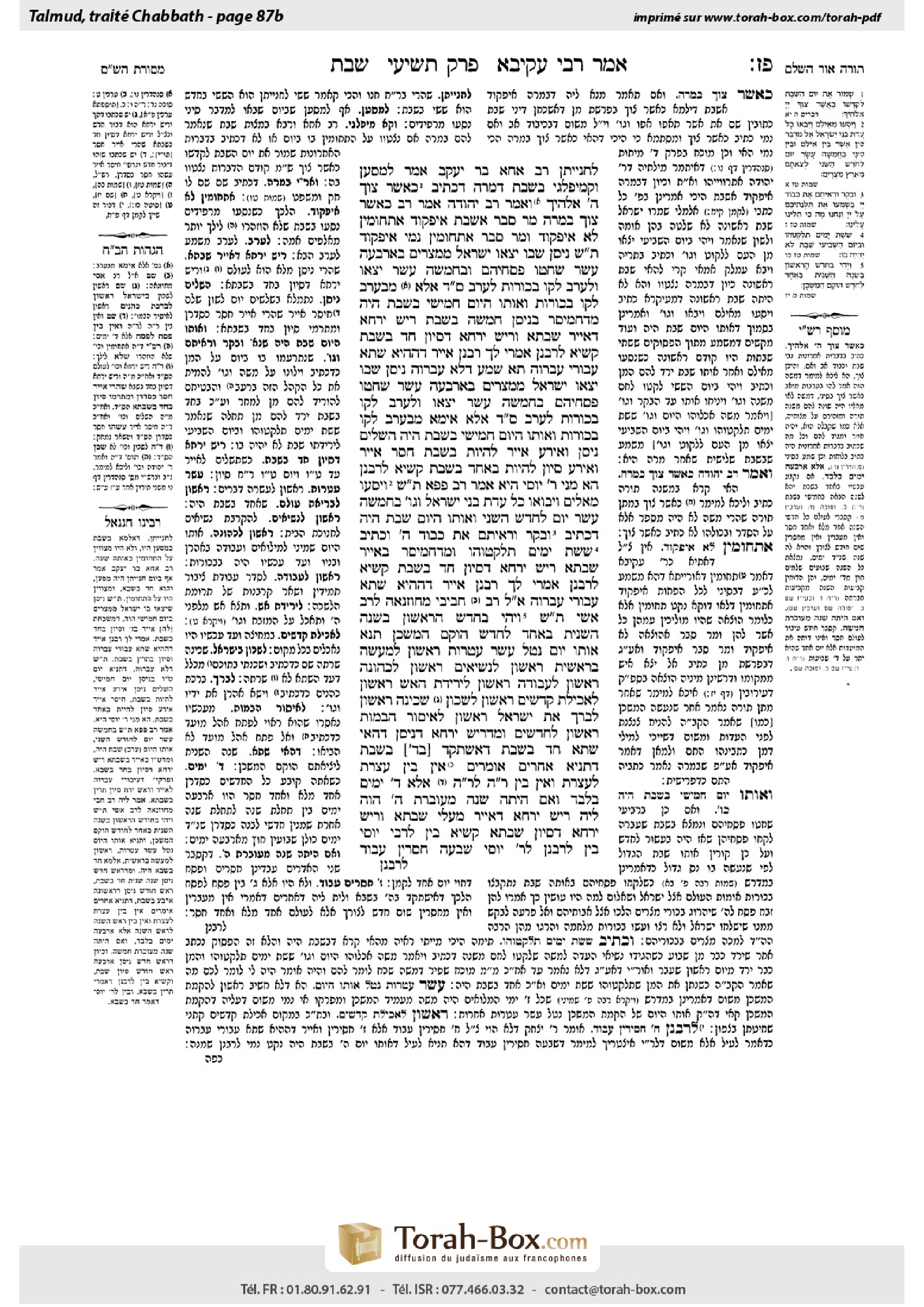
Shabbat 87b: Talmud study for Daf Yomi
Daf Yomi is the daily study of one Talmud folio. Explore 37 tractates with scans, Hebrew text, Sefaria English and AI-generated French translations where annotated.
Passage selection and English or AI-generated French translation are available where the scan has annotations. Daf Study is independent of Torah-Box and Sefaria.
Browse Shabbat · שבת · All tractatesShabbat 87b text and translations
This page of Shabbat includes the Aramaic text, an English translation and an AI-generated French translation, alongside the scan above.
שבת פ״ז ב · Aramaic and Hebrew text
לַחֲנִיָּיתָן, רַב אַחָא בַּר יַעֲקֹב אָמַר: לְמַסָּעָן. וְקָמִיפַּלְגִי בְּשַׁבָּת דְּמָרָה. דִּכְתִיב: ״כַּאֲשֶׁר צִוְּךָ ה׳ אֱלֹהֶיךָ״, וְאָמַר רַב יְהוּדָה אָמַר רַב: ״כַּאֲשֶׁר צִוְּךָ״ — בְּמָרָה. מָר סָבַר: אַשַּׁבָּת אִיפְּקוּד, אַתְּחוּמִין לָא אִיפְּקוּד. וּמָר סָבַר: אַתְּחוּמִין נָמֵי אִיפְּקוּד.
תָּא שְׁמַע: נִיסָן שֶׁבּוֹ יָצְאוּ יִשְׂרָאֵל מִמִּצְרַיִם, בְּאַרְבָּעָה עָשָׂר שָׁחֲטוּ פִּסְחֵיהֶם, וּבַחֲמִשָּׁה עָשָׂר יָצְאוּ, וְלָעֶרֶב לָקוּ בְּכוֹרוֹת. לָעֶרֶב סָלְקָא דַּעְתָּךְ?! אֶלָּא: מִבָּעֶרֶב לָקוּ בְּכוֹרוֹת, וְאוֹתוֹ הַיּוֹם חֲמִישִׁי בַּשַּׁבָּת הָיָה. מִדַּחֲמֵיסַר בְּנִיסָן חַמְשָׁא בְּשַׁבָּא, רֵישׁ יַרְחָא דְאִיָּיר שַׁבְּתָא, וְרֵישׁ יַרְחָא דְסִיוָן חַד בְּשַׁבָּת, קַשְׁיָא לְרַבָּנַן!
אָמְרִי לָךְ רַבָּנַן: אִיָּיר דְּהַהִיא שַׁתָּא עַבּוֹרֵי עַבְּרוּהּ. תָּא שְׁמַע דְּלָא עַבְּרוּהּ נִיסָן שֶׁבּוֹ יָצְאוּ יִשְׂרָאֵל מִמִּצְרַיִם: בְּאַרְבָּעָה עָשָׂר שָׁחֲטוּ פִּסְחֵיהֶם, בַּחֲמִשָּׁה עָשָׂר יָצְאוּ, וְלָעֶרֶב לָקוּ בְּכוֹרוֹת. לָעֶרֶב סָלְקָא דַּעְתָּךְ?! אֶלָּא אֵימָא: מִבָּעֶרֶב לָקוּ בְּכוֹרוֹת. וְאוֹתוֹ הַיּוֹם חֲמִישִׁי בַּשַּׁבָּת הָיָה. הִשְׁלִים נִיסָן וְאֵירַע אִיָּיר לִהְיוֹת בַּשַּׁבָּת.
חָסַר אִיָּיר, וְאֵירַע סִיוָן לִהְיוֹת בְּאֶחָד בַּשַּׁבָּת — קַשְׁיָא לְרַבָּנַן! הָא מַנִּי — רַבִּי יוֹסֵי הִיא.
אָמַר רַב פָּפָּא, תָּא שְׁמַע: ״וַיִּסְעוּ מֵאֵלִים וַיָּבֹאוּ כׇּל עֲדַת בְּנֵי יִשְׂרָאֵל וְגוֹ׳ בַּחֲמִשָּׁה עָשָׂר יוֹם לַחֹדֶשׁ הַשֵּׁנִי״. וְאוֹתוֹ הַיּוֹם שַׁבָּת הָיָה, דִּכְתִיב: ״וּבֹקֶר וּרְאִיתֶם אֶת כְּבוֹד ה׳״, וּכְתִיב: ״שֵׁשֶׁת יָמִים תִּלְקְטֻהוּ״. וּמִדַּחֲמֵיסַר בְּאִיָּיר שַׁבְּתָא, רֵישׁ יַרְחָא דְסִיוָן חַד בְּשַׁבָּא, קַשְׁיָא לְרַבָּנַן! אָמְרִי לָךְ רַבָּנַן: אִיָּיר דְּהַהִיא שַׁתָּא עַבּוֹרֵי עַבְּרוּהּ.
אֲמַר לֵיהּ רַב חֲבִיבִי מָחוֹזְנָאָה לְרַב אָשֵׁי, תָּא שְׁמַע: ״וַיְהִי בַּחֹדֶשׁ הָרִאשׁוֹן בַּשָּׁנָה הַשֵּׁנִית בְּאֶחָד לַחֹדֶשׁ הוּקַם הַמִּשְׁכָּן״ — תָּנָא, אוֹתוֹ יוֹם נָטַל עֶשֶׂר עֲטָרוֹת: רִאשׁוֹן לְמַעֲשֵׂה בְרֵאשִׁית; רִאשׁוֹן לַנְּשִׂיאִים; רִאשׁוֹן לַכְּהוּנָּה; רִאשׁוֹן לָעֲבוֹדָה; רִאשׁוֹן לִירִידַת הָאֵשׁ; רִאשׁוֹן לַאֲכִילַת קָדָשִׁים; רִאשׁוֹן לִשְׁכּוֹן שְׁכִינָה; רִאשׁוֹן לְבָרֵךְ אֶת יִשְׂרָאֵל; רִאשׁוֹן לְאִיסּוּר הַבָּמוֹת; רִאשׁוֹן לֶחֳדָשִׁים. וּמִדְּרֵישׁ יַרְחָא דְנִיסָן דְּהָא שַׁתָּא חַד בְּשַׁבָּא — דְּאֶשְׁתָּקַד בְּאַרְבְּעָה.
דְּתַנְיָא, אֲחֵרִים אוֹמְרִים: אֵין בֵּין עֲצֶרֶת לַעֲצֶרֶת וְאֵין בֵּין רֹאשׁ הַשָּׁנָה לְרֹאשׁ הַשָּׁנָה אֶלָּא אַרְבָּעָה יָמִים בִּלְבַד, וְאִם הָיְתָה שָׁנָה מְעוּבֶּרֶת — חֲמִשָּׁה. הֲוָה לֵיהּ רֵישׁ יַרְחָא דְאִיָּיר מַעֲלֵי שַׁבְּתָא, וְרֵישׁ יַרְחָא דְסִיוָן שַׁבְּתָא, קַשְׁיָא בֵּין לְרַבִּי יוֹסֵי בֵּין לְרַבָּנַן! לְרַבִּי יוֹסֵי שִׁבְעָה חֲסֵרִין עֲבוּד,
Shabbat 87b · English translation
the sixth day from their encampment. Rav Aḥa bar Ya’akov said: The sixth day from the start of their journey. They left Refidim and arrived and camped in the desert on the same Sunday. And Rava and Rav Aḥa bar Ya’akov disagree with regard to the mitzva of Shabbat commanded to the Jewish people at Mara, as it is written in the fourth commandment: “Observe the Shabbat day to keep it holy as the Lord your God commanded you” (Deuteronomy 5:11). And Rav Yehuda said that Rav said: As He commanded you in Mara, as it is stated: “There He made for him a statute and an ordinance, and there He proved him” (Exodus 15:25). Their dispute was: One Master held: They were commanded about Shabbat, but they were not commanded about Shabbat boundaries. Therefore, it was permitted to travel from Refidim on Shabbat, because the restriction of Shabbat boundaries was not yet in effect. And one Master held: They were also commanded about the boundaries, and therefore, it was prohibited to leave Refidim on Shabbat.
Come and hear an additional proof with regard to the day of the revelation at Sinai from what was taught in a baraita: In the month of Nisan during which the Jewish people left Egypt, on the fourteenth, they slaughtered their Paschal lambs; on the fifteenth, they left Egypt; and in the evening, the firstborn were stricken. The Gemara asks: Does it enter your mind to say that they were stricken in the evening? Was the Plague of the Firstborn after the Jews left Egypt? Rather, say that the evening before, the firstborn were stricken. And that day was the fifth day of the week. From the fact that the fifteenth of Nisan was a Thursday, the New Moon of Iyyar was Shabbat, as Nisan is typically thirty days long. And the New Moon of Sivan was on the first day of the week, as Iyyar is typically twenty-nine days long. This is difficult according to the opinion of the Rabbis, who hold that the New Moon of Sivan that year was on Monday.
The Gemara answers: The Rabbis could have said to you that a day was added to Iyyar that year and it was thirty days long. The New Moon was determined by testimony of witnesses who saw the new moon, together with astronomical calculations that the testimony was feasible. Therefore, Iyyar could be thirty days long. If that was the case, the New Moon of Sivan was on Monday. Come and hear an objection from what was taught in a different baraita that they did not add a day to Iyyar that year, as the Sages taught: In the month of Nisan during which the Jewish people left Egypt, on the fourteenth, they slaughtered their Paschal lambs; on the fifteenth, they left Egypt; and in the evening, the firstborn were stricken. The Gemara asks: Does it enter your mind to say that they were stricken in the evening? Was the Plague of the Firstborn after the Jews left Egypt? Rather, say that the evening before, the firstborn were stricken. And that day was the fifth day of the week. Nisan was complete, i.e., it was thirty days long, and the New Moon of Iyyar occurred on a Shabbat.
Iyyar was lacking, i.e., it was twenty-nine days long, and the New Moon of Sivan occurred on the first day of the week. This is difficult according to the opinion of the Rabbis. The Gemara answers: Whose is the opinion in this baraita? It is the opinion of Rabbi Yosei. Therefore, this baraita poses no difficulty to the opinion of the Rabbis.
Rav Pappa said: Come and hear a different proof from another verse, as it is stated: “And they took their journey from Elim, and all the congregation of the children of Israel came unto the wilderness of Sin, which is between Elim and Sinai, on the fifteenth day of the second month after their departing out of the land of Egypt” (Exodus 16:1). And that day was Shabbat, as it is written: “And in the morning, then you shall see the glory of the Lord; for He has heard your murmurings against the Lord; and what are we, that you murmur against us?” (Exodus 16:7). The next day the glory of God was revealed, and He told them that in the afternoon the manna and quail would begin to fall, and it is written: “Six days you shall gather it; but on the seventh day is Sabbath, there shall be none in it” (Exodus 16:26). Apparently, the first six days after this command were weekdays on which the manna fell, and the fifteenth of Iyyar was Shabbat. And from the fact that the fifteenth of Iyyar was Shabbat, the New Moon of Sivan was on the first day of the week. This is difficult according to the opinion of the Rabbis. The Gemara answers: According to the Rabbis, a day was added to Iyyar that year and it was thirty days long. Therefore, the New Moon of Sivan was on Monday.
Rav Ḥavivi from Ḥozena’a said to Rav Ashi: Come and hear a different proof from the following verse: “And it came to pass in the first month in the second year, on the first day of the month, that the Tabernacle was erected” (Exodus 40:17). It was taught: That day took ten crowns. It was the first day of Creation, meaning Sunday, the first day of the offerings brought by the princes, the first day of the priesthood, the first day of service in the Temple, the first time for the descent of fire onto the altar, the first time that consecrated foods were eaten, the first day of the resting of the Divine Presence upon the Jewish people, the first day that the Jewish people were blessed by the priests, and the first day of the prohibition to bring offerings on improvised altars. Once the Tabernacle was erected, it was prohibited to offer sacrifices elsewhere. And it was the first of the months. And from the fact that the New Moon of Nisan of that year was on the first day of the week, in the previous year, it was on the fourth day of the week.
As it was taught in a baraita, Aḥerim say: Between the festival of Assembly, i.e., Shavuot, of one year and the festival of Assembly of the following year, and similarly, between Rosh HaShana of one year and Rosh HaShana of the following year, there is only a difference of four days of the week. And if it was a leap year, there is a difference of five days between them. There are three hundred and fifty four days in a year, which are divided into twelve months, six months that are thirty days long and six months that are twenty-nine days long. If the New Moon of Nisan was on Wednesday, the New Moon of Iyyar was on Shabbat eve, and the New Moon of Sivan was on Shabbat. This is difficult both according to Rabbi Yosei, who holds that the New Moon of Sivan was on Sunday, and according to the Rabbis, who hold it was on Monday. The Gemara answers: Both Rabbi Yosei and the Rabbis disagree with Aḥerim. According to Rabbi Yosei, they established seven months that were lacking in the first year, i.e., seven months that were twenty-nine days long,
Shabbat 87b · Traduction française (IA)
le sixième jour à compter de leur campement. Rav Aḥa bar Ya’akov dit : le sixième jour à compter du début de leur voyage. Ils quittèrent Refidim, puis arrivèrent dans le désert et y campèrent le même dimanche. Rava et Rav Aḥa bar Ya’akov sont en désaccord au sujet de la mitsva du Chabbat ordonnée au peuple juif à Mara, comme il est écrit dans le quatrième commandement : « Observe le jour du Chabbat pour le sanctifier, comme l’Éternel, ton Dieu, te l’a ordonné » (Deutéronome 5, 11). Rav Yehouda a dit au nom de Rav : « Comme Il te l’a ordonné » à Mara, ainsi qu’il est dit : « Là, Il lui fixa un statut et une règle, et là, Il le mit à l’épreuve » (Exode 15, 25). Leur désaccord est le suivant : l’un des maîtres estime qu’ils reçurent l’ordre concernant le Chabbat, mais pas concernant les limites du Chabbat. Il leur était donc permis de quitter Refidim pendant le Chabbat, car l’interdiction de franchir les limites du Chabbat n’était pas encore en vigueur. L’autre maître estime qu’ils reçurent également l’ordre concernant ces limites ; il leur était donc interdit de quitter Refidim pendant le Chabbat.
Viens et entends une preuve supplémentaire concernant le jour de la révélation au Sinaï, tirée de ce qui fut enseigné dans une baraïta : Au mois de nissan pendant lequel le peuple juif quitta l’Égypte, le quatorzième jour, ils égorgèrent leurs agneaux pascals ; le quinzième jour, ils quittèrent l’Égypte ; et, le soir, les premiers-nés furent frappés. La Guemara demande : Est-il concevable de dire qu’ils furent frappés le soir ? La plaie des premiers-nés eut-elle lieu après que les Juifs eurent quitté l’Égypte ? Il faut plutôt dire que les premiers-nés furent frappés le soir précédent. Ce jour-là était le cinquième jour de la semaine. Puisque le quinze nissan était un jeudi, la nouvelle lune d’iyar tombait un Chabbat, car nissan compte généralement trente jours. Et la nouvelle lune de sivan tombait le premier jour de la semaine, puisque iyar compte généralement vingt-neuf jours. Cela pose une difficulté selon l’opinion des Rabbins, qui soutiennent que cette année-là, la nouvelle lune de sivan tombait un lundi.
La Guemara répond : Les Rabbins auraient pu te dire qu’un jour fut ajouté à iyar cette année-là, qui compta donc trente jours. La nouvelle lune était déterminée sur la base du témoignage de témoins qui l’avaient aperçue, ainsi que de calculs astronomiques établissant que ce témoignage était plausible. Iyar pouvait donc compter trente jours. Dans ce cas, la nouvelle lune de sivan tombait un lundi. Viens et entends une objection tirée de ce qui fut enseigné dans une autre baraïta, d’où il ressort qu’aucun jour ne fut ajouté à iyar cette année-là, comme l’enseignèrent les Sages : Au mois de nissan pendant lequel le peuple juif quitta l’Égypte, le quatorzième jour, ils égorgèrent leurs agneaux pascals ; le quinzième jour, ils quittèrent l’Égypte ; et, le soir, les premiers-nés furent frappés. La Guemara demande : Est-il concevable de dire qu’ils furent frappés le soir ? La plaie des premiers-nés eut-elle lieu après que les Juifs eurent quitté l’Égypte ? Il faut plutôt dire que les premiers-nés furent frappés le soir précédent. Ce jour-là était le cinquième jour de la semaine. Nissan était complet, c’est-à-dire qu’il comptait trente jours, et la nouvelle lune d’iyar tombait un Chabbat.
Iyar était incomplet, c’est-à-dire qu’il comptait vingt-neuf jours, et la nouvelle lune de sivan tombait le premier jour de la semaine. Cela pose une difficulté selon l’opinion des Rabbins. La Guemara répond : De qui cette baraïta exprime-t-elle l’opinion ? De Rabbi Yosei. Cette baraïta ne pose donc aucune difficulté à l’opinion des Rabbins.
Rav Pappa dit : Viens et entends une autre preuve tirée d’un autre verset, comme il est dit : « Ils partirent d’Élim, et toute la communauté des enfants d’Israël arriva au désert de Sin, qui est entre Élim et le Sinaï, le quinzième jour du deuxième mois après leur départ du pays d’Égypte » (Exode 16, 1). Ce jour-là était un Chabbat, comme il est écrit : « Et demain matin, vous verrez la gloire de l’Éternel, car Il a entendu vos murmures contre l’Éternel ; et que sommes-nous, pour que vous murmuriez contre nous ? » (Exode 16, 7). Le lendemain, la gloire de Dieu se révéla, et Il leur annonça que la manne et les cailles commenceraient à tomber dans l’après-midi. Il est écrit : « Vous en recueillerez pendant six jours ; mais le septième jour est un Chabbat, il n’y en aura pas » (Exode 16, 26). Il ressort apparemment de là que les six premiers jours après cet ordre étaient des jours de semaine où la manne tombait, et que le quinze iyar était un Chabbat. Puisque le quinze iyar était un Chabbat, la nouvelle lune de sivan tombait le premier jour de la semaine. Cela pose une difficulté selon l’opinion des Rabbins. La Guemara répond : Selon les Rabbins, un jour fut ajouté à iyar cette année-là, qui compta donc trente jours. La nouvelle lune de sivan tombait par conséquent un lundi.
Rav Ḥavivi de Ḥozena’a dit à Rav Ashi : Viens et entends une autre preuve tirée du verset suivant : « Le premier mois de la deuxième année, le premier jour du mois, le Tabernacle fut érigé » (Exode 40, 17). Il fut enseigné : Ce jour fut marqué par dix premières. Ce fut le premier jour de la Création, c’est-à-dire un dimanche ; le premier jour des offrandes apportées par les princes ; le premier jour de la prêtrise ; le premier jour du service dans le Temple ; la première fois que le feu descendit sur l’autel ; la première fois que des aliments consacrés furent consommés ; le premier jour où la Présence divine reposa sur le peuple juif ; le premier jour où le peuple juif fut béni par les prêtres ; et le premier jour de l’interdiction d’apporter des offrandes sur des autels improvisés. Une fois le Tabernacle érigé, il fut interdit d’offrir des sacrifices ailleurs. Ce fut aussi le premier jour du mois. Puisque la nouvelle lune de nissan cette année-là tombait le premier jour de la semaine, celle de l’année précédente tombait le quatrième jour de la semaine.
Comme il fut enseigné dans une baraïta, Aḥerim disent : Entre la fête de l’Assemblée, c’est-à-dire Chavouot, d’une année et la fête de l’Assemblée de l’année suivante, et de même entre Roch Hachana d’une année et Roch Hachana de l’année suivante, il n’y a qu’une différence de quatre jours de la semaine. S’il s’agissait d’une année embolismique, la différence entre les deux était de cinq jours. Une année compte trois cent cinquante-quatre jours, répartis en douze mois : six mois de trente jours et six mois de vingt-neuf jours. Si la nouvelle lune de nissan tombait un mercredi, celle d’iyar tombait un vendredi soir, et celle de sivan un Chabbat. Cela pose une difficulté aussi bien selon Rabbi Yosei, qui soutient que la nouvelle lune de sivan tombait un dimanche, que selon les Rabbins, qui soutiennent qu’elle tombait un lundi. La Guemara répond : Rabbi Yosei et les Rabbins sont tous deux en désaccord avec Aḥerim. Selon Rabbi Yosei, ils fixèrent sept mois incomplets la première année, c’est-à-dire sept mois de vingt-neuf jours,
Traduction française générée par IA à partir de l’édition anglaise de Sefaria. Vérifie toujours un passage avec le texte source.
Text from Sefaria: William Davidson Edition - Vocalized Aramaic (CC BY NC); William Davidson Edition - English (CC BY NC).