Shabbat 88a: Talmud study for Daf Yomi
Daf Yomi is the daily study of one Talmud folio. Explore 37 tractates with scans, Hebrew text, Sefaria English and AI-generated French translations where annotated.
Passage selection and English or AI-generated French translation are available where the scan has annotations. Daf Study is independent of Torah-Box and Sefaria.
Browse Shabbat · שבת · All tractatesShabbat 88a text and translations
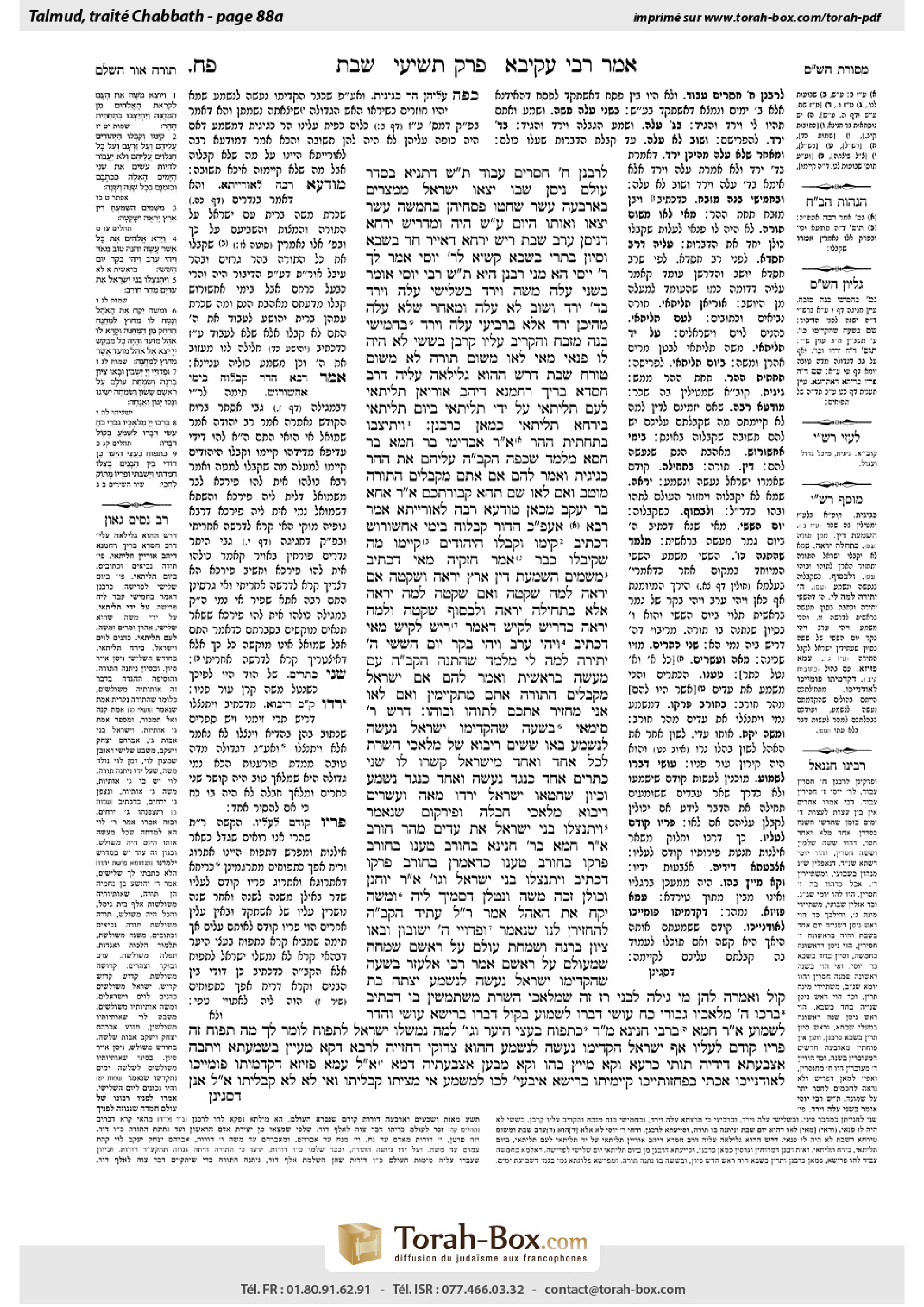
This page of Shabbat includes the Aramaic text, an English translation and an AI-generated French translation, alongside the scan above.
שבת פ״ח א · Aramaic and Hebrew text
לְרַבָּנַן שְׁמוֹנָה חֲסֵרִים עֲבוּד.
תָּא שְׁמַע, דְּתַנְיָא בְּ״סֵדֶר עוֹלָם״: נִיסָן שֶׁבּוֹ יָצְאוּ יִשְׂרָאֵל מִמִּצְרַיִם בְּאַרְבָּעָה עָשָׂר שָׁחֲטוּ פִּסְחֵיהֶן, בַּחֲמִשָּׁה עָשָׂר יָצְאוּ, וְאוֹתוֹ הַיּוֹם עֶרֶב שַׁבָּת הָיָה. וּמִדְּרֵישׁ יַרְחָא דְנִיסָן עֶרֶב שַׁבָּת — רֵישׁ יַרְחָא דְאִיָּיר חַד בְּשַׁבָּא, וְסִיוָן בִּתְרֵי בְּשַׁבָּא, קַשְׁיָא לְרַבִּי יוֹסֵי! אָמַר לָךְ רַבִּי יוֹסֵי: הָא מַנִּי — רַבָּנַן הִיא.
תָּא שְׁמַע, רַבִּי יוֹסֵי אוֹמֵר: בַּשֵּׁנִי עָלָה מֹשֶׁה וְיָרַד, בַּשְּׁלִישִׁי עָלָה וְיָרַד, בִּרְבִיעִי יָרַד וְשׁוּב לֹא עָלָה. וּמֵאַחַר שֶׁלֹּא עָלָה, מֵהֵיכָן יָרַד? אֶלָּא: בָּרְבִיעִי עָלָה וְיָרַד, בַּחֲמִישִׁי בָּנָה מִזְבֵּחַ וְהִקְרִיב עָלָיו קׇרְבָּן, בַּשִּׁשִּׁי לֹא הָיָה לוֹ פְּנַאי. מַאי לָאו, מִשּׁוּם תּוֹרָה?
לָא, מִשּׁוּם טוֹרַח שַׁבָּת. דְּרַשׁ הַהוּא גָּלִילָאָה עֲלֵיהּ דְּרַב חִסְדָּא: בְּרִיךְ רַחֲמָנָא דִּיהַב אוֹרְיָאן תְּלִיתַאי, לְעַם תְּלִיתַאי, עַל יְדֵי תְּלִיתַאי, בְּיוֹם תְּלִיתַאי, בְּיַרְחָא תְּלִיתַאי. כְּמַאן — כְּרַבָּנַן.
״וַיִּתְיַצְּבוּ בְּתַחְתִּית הָהָר״, אָמַר רַב אַבְדִּימִי בַּר חָמָא בַּר חַסָּא: מְלַמֵּד שֶׁכָּפָה הַקָּדוֹשׁ בָּרוּךְ הוּא עֲלֵיהֶם אֶת הָהָר כְּגִיגִית, וְאָמַר לָהֶם: אִם אַתֶּם מְקַבְּלִים הַתּוֹרָה מוּטָב, וְאִם לָאו — שָׁם תְּהֵא קְבוּרַתְכֶם. אָמַר רַב אַחָא בַּר יַעֲקֹב: מִכָּאן מוֹדָעָא רַבָּה לְאוֹרָיְיתָא. אָמַר רָבָא: אַף עַל פִּי כֵן הֲדוּר קַבְּלוּהָ בִּימֵי אֲחַשְׁוֵרוֹשׁ, דִּכְתִיב: ״קִיְּמוּ וְקִבְּלוּ הַיְּהוּדִים״ — קִיְּימוּ מַה שֶּׁקִּיבְּלוּ כְּבָר.
אָמַר חִזְקִיָּה, מַאי דִּכְתִיב: ״מִשָּׁמַיִם הִשְׁמַעְתָּ דִּין אֶרֶץ יָרְאָה וְשָׁקָטָה״, אִם יָרְאָה — לָמָּה שָׁקְטָה? וְאִם שָׁקְטָה — לָמָּה יָרְאָה? אֶלָּא בַּתְּחִילָּה יָרְאָה וּלְבַסּוֹף שָׁקְטָה. וְלָמָּה יָרְאָה? כִּדְרֵישׁ לָקִישׁ. דְּאָמַר רֵישׁ לָקִישׁ, מַאי דִּכְתִיב: ״וַיְהִי עֶרֶב וַיְהִי בֹקֶר יוֹם הַשִּׁשִּׁי״, ה׳ יְתֵירָה לָמָּה לִי? — מְלַמֵּד שֶׁהִתְנָה הַקָּדוֹשׁ בָּרוּךְ הוּא עִם מַעֲשֵׂה בְרֵאשִׁית וְאָמַר לָהֶם: אִם יִשְׂרָאֵל מְקַבְּלִים הַתּוֹרָה — אַתֶּם מִתְקַיְּימִין, וְאִם לָאו — אֲנִי מַחֲזִיר אֶתְכֶם לְתוֹהוּ וָבוֹהוּ.
דָּרַשׁ רַבִּי סִימַאי: בְּשָׁעָה שֶׁהִקְדִּימוּ יִשְׂרָאֵל ״נַעֲשֶׂה״ לְ״נִשְׁמָע״ בָּאוּ שִׁשִּׁים רִיבּוֹא שֶׁל מַלְאֲכֵי הַשָּׁרֵת, לְכׇל אֶחָד וְאֶחָד מִיִּשְׂרָאֵל קָשְׁרוּ לוֹ שְׁנֵי כְתָרִים, אֶחָד כְּנֶגֶד ״נַעֲשֶׂה״ וְאֶחָד כְּנֶגֶד ״נִשְׁמָע״. וְכֵיוָן שֶׁחָטְאוּ יִשְׂרָאֵל, יָרְדוּ מֵאָה וְעֶשְׂרִים רִיבּוֹא מַלְאֲכֵי חַבָּלָה וּפֵירְקוּם, שֶׁנֶּאֱמַר: ״וַיִּתְנַצְּלוּ בְנֵי יִשְׂרָאֵל אֶת עֶדְיָם מֵהַר חוֹרֵב״. אָמַר רַבִּי חָמָא בְּרַבִּי חֲנִינָא: בְּחוֹרֵב טָעֲנוּ, בְּחוֹרֵב פֵּרְקוּ. בְּחוֹרֵב טָעֲנוּ — כְּדַאֲמַרַן, בְּחוֹרֵב פֵּרְקוּ — דִּכְתִיב: ״וַיִּתְנַצְּלוּ בְנֵי יִשְׂרָאֵל וְגוֹ׳״. אָמַר רַבִּי יוֹחָנָן: וְכוּלָּן זָכָה מֹשֶׁה וּנְטָלָן. דִּסְמִיךְ לֵיהּ: ״וּמֹשֶׁה יִקַּח אֶת הָאֹהֶל״. אָמַר רֵישׁ לָקִישׁ: עָתִיד הַקָּדוֹשׁ בָּרוּךְ הוּא לְהַחֲזִירָן לָנוּ, שֶׁנֶּאֱמַר: ״וּפְדוּיֵי ה׳ יְשֻׁבוּן וּבָאוּ צִיּוֹן בְּרִנָּה וְשִׂמְחַת עוֹלָם עַל רֹאשָׁם״ — שִׂמְחָה שֶׁמֵּעוֹלָם עַל רֹאשָׁם.
אָמַר רַבִּי אֶלְעָזָר: בְּשָׁעָה שֶׁהִקְדִּימוּ יִשְׂרָאֵל ״נַעֲשֶׂה״ לְ״נִשְׁמָע״ יָצְתָה בַּת קוֹל וְאָמְרָה לָהֶן: מִי גִּלָּה לְבָנַי רָז זֶה שֶׁמַּלְאֲכֵי הַשָּׁרֵת מִשְׁתַּמְּשִׁין בּוֹ? דִּכְתִיב: ״בָּרְכוּ ה׳ מַלְאָכָיו גִּבֹּרֵי כֹחַ עֹשֵׂי דְבָרוֹ לִשְׁמֹעַ בְּקוֹל דְּבָרוֹ״ — בְּרֵישָׁא ״עֹשֵׂי״, וַהֲדַר ״לִשְׁמֹעַ״. אָמַר רַבִּי חָמָא בְּרַבִּי חֲנִינָא: מַאי דִּכְתִיב ״כְּתַפּוּחַ בַּעֲצֵי הַיַּעַר וְגוֹ׳״ — לָמָּה נִמְשְׁלוּ יִשְׂרָאֵל לְתַפּוּחַ, לוֹמַר לָךְ: מָה תַּפּוּחַ זֶה פִּרְיוֹ קוֹדֶם לְעָלָיו, אַף יִשְׂרָאֵל הִקְדִּימוּ ״נַעֲשֶׂה״ לְ״נִשְׁמָע״.
הָהוּא מִינָא דְּחַזְיֵיהּ לְרָבָא דְּקָא מְעַיֵּין בִּשְׁמַעְתָּא, וְיָתְבָה אֶצְבְּעָתָא דִידֵיהּ תּוּתֵי כַּרְעָא וְקָא מָיֵיץ בְּהוּ, וְקָא מַבְּעָן אֶצְבְּעָתֵיהּ דְּמָא. אֲמַר לֵיהּ: עַמָּא פְּזִיזָא, דְּקַדְּמִיתוּ פּוּמַּיְיכוּ לְאוּדְנַיְיכוּ, אַכַּתִּי בְּפַחְזוּתַיְיכוּ קָיְימִיתוּ. בְּרֵישָׁא אִיבַּעְיָא לְכוּ לְמִשְׁמַע, אִי מָצִיתוּ — קַבְּלִיתוּ, וְאִי לָא — לָא קַבְּלִיתוּ. אֲמַר לֵיהּ: אֲנַן
Shabbat 88a · English translation
and according to the Rabbis, they established eight months that were lacking.
The Gemara cites another objection. Come and hear that which was taught in a baraita in the anthology called Seder Olam: In the month of Nisan during which the Jewish people left Egypt, on the fourteenth they slaughtered their Paschal lambs, on the fifteenth they left Egypt, and that day was Shabbat eve. From the fact that the New Moon of Nisan was on Shabbat eve, we can infer that the New Moon of Iyyar was on the first day of the week, and the New Moon of Sivan was on the second day of the week. This is difficult according to the opinion of Rabbi Yosei, who holds that the New Moon of Sivan was on Sunday. The Gemara answers that Rabbi Yosei could have said to you: Whose is the opinion in this baraita? It is the opinion of the Rabbis. Therefore, this baraita poses no difficulty to the opinion of the Rabbi Yosei.
The Gemara cites another objection: Come and hear from that which was taught, that Rabbi Yosei says: On the second day of Sivan, Moses ascended Mount Sinai and descended. On the third day, he ascended and descended. On the fourth day, he descended and did not ascend Mount Sinai again until he was commanded along with all of the Jewish people. And the Gemara asks: How is it possible that he descended on the fourth day? Since he did not ascend, from where did he descend? Rather, this must be emended: On the fourth day, he ascended and descended. On the fifth day, he built an altar and sacrificed an offering. On the sixth day, he had no time. The Gemara asks: Is that not because he received the Torah on the sixth day of the month? Apparently, this baraita supports the opinion of the Rabbis.
The Gemara rejects this: No, he had no time due to the burden of preparing for Shabbat. The Gemara adds: A Galilean taught, while standing above Rav Ḥisda: Blessed is the all-Merciful One, Who gave the threefold Torah: Torah, Prophets, and Writings, to the three-fold nation: Priests, Levites, and Israelites, by means of a third-born: Moses, who followed Aaron and Miriam in birth order, on the third day of the separation of men and women, in the third month: Sivan. On whose opinion is this homily based? It is based on the opinion of the Rabbis, who hold that the Torah was given on the third day of separation and not on the fourth day.
The Gemara cites additional homiletic interpretations on the topic of the revelation at Sinai. The Torah says, “And Moses brought forth the people out of the camp to meet God; and they stood at the lowermost part of the mount” (Exodus 19:17). Rabbi Avdimi bar Ḥama bar Ḥasa said: the Jewish people actually stood beneath the mountain, and the verse teaches that the Holy One, Blessed be He, overturned the mountain above the Jews like a tub, and said to them: If you accept the Torah, excellent, and if not, there will be your burial. Rav Aḥa bar Ya’akov said: From here there is a substantial caveat to the obligation to fulfill the Torah. The Jewish people can claim that they were coerced into accepting the Torah, and it is therefore not binding. Rava said: Even so, they again accepted it willingly in the time of Ahasuerus, as it is written: “The Jews ordained, and took upon them, and upon their seed, and upon all such as joined themselves unto them” (Esther 9:27), and he taught: The Jews ordained what they had already taken upon themselves through coercion at Sinai.
Ḥizkiya said: What is the meaning of that which is written: “You caused sentence to be heard from heaven; the earth feared, and was silent” (Psalms 76:9)? If it was afraid, why was it silent; and if it was silent, why was it afraid? Rather, the meaning is: At first, it was afraid, and in the end, it was silent. “You caused sentence to be heard from heaven” refers to the revelation at Sinai. And why was the earth afraid? It is in accordance with the statement of Reish Lakish, as Reish Lakish said: What is the meaning of that which is written: “And there was evening and there was morning, the sixth day” (Genesis 1:31)? Why do I require the superfluous letter heh, the definite article, which does not appear on any of the other days? It teaches that the Holy One, Blessed be He, established a condition with the act of Creation, and said to them: If Israel accepts the Torah on the sixth day of Sivan, you will exist; and if they do not accept it, I will return you to the primordial state of chaos and disorder. Therefore, the earth was afraid until the Torah was given to Israel, lest it be returned to a state of chaos. Once the Jewish people accepted the Torah, the earth was calmed.
Rabbi Simai taught: When Israel accorded precedence to the declaration “We will do” over the declaration “We will hear,” 600,000 ministering angels came and tied two crowns to each and every member of the Jewish people, one corresponding to “We will do” and one corresponding to “We will hear.” And when the people sinned with the Golden Calf, 1,200,000 angels of destruction descended and removed them from the people, as it is stated in the wake of the sin of the Golden Calf: “And the children of Israel stripped themselves of their ornaments from Mount Horeb onward” (Exodus 33:6). Rabbi Ḥama, son of Rabbi Ḥanina, said: At Horeb they put on their ornaments, and at Horeb they removed them. The source for this is: At Horeb they put them on, as we have said; at Horeb they removed them, as it is written: “And the children of Israel stripped themselves of their ornaments from Mount Horeb.” Rabbi Yoḥanan said: And Moses merited all of these crowns and took them. What is the source for this? Because juxtaposed to this verse, it is stated: “And Moses would take the tent [ohel]” (Exodus 33:7). The word ohel is interpreted homiletically as an allusion to an aura or illumination [hila]. Reish Lakish said: In the future, the Holy One, Blessed be He, will return them to us, as it is stated: “And the ransomed of the Lord shall return, and come with singing unto Zion, and everlasting joy shall be upon their heads” (Isaiah 35:10). The joy that they once had will once again be upon their heads.
Rabbi Elazar said: When the Jewish people accorded precedence to the declaration “We will do” over “We will hear,” a Divine Voice emerged and said to them: Who revealed to my children this secret that the ministering angels use? As it is written: “Bless the Lord, you angels of His, you mighty in strength, that fulfill His word, hearkening unto the voice of His word” (Psalms 103:20). At first, the angels fulfill His word, and then afterward they hearken. Rabbi Ḥama, son of Rabbi Ḥanina, said: What is the meaning of that which is written: “As an apple tree among the trees of the wood, so is my beloved among the sons. Under its shadow I delighted to sit and its fruit was sweet to my taste” (Song of Songs 2:3)? Why were the Jewish people likened to an apple tree? It is to tell you that just as this apple tree, its fruit grows before its leaves, so too, the Jewish people accorded precedence to “We will do” over “We will hear.”
The Gemara relates that a heretic saw that Rava was immersed in studying halakha, and his fingers were beneath his leg and he was squeezing them, and his fingers were spurting blood. Rava did not notice that he was bleeding because he was engrossed in study. The heretic said to Rava: You impulsive nation, who accorded precedence to your mouths over your ears. You still bear your impulsiveness, as you act without thinking. You should listen first. Then, if you are capable of fulfilling the commands, accept them. And if not, do not accept them. He said to him: About us,
Shabbat 88a · Traduction française (IA)
et, selon les Rabbins, ils ont fixé huit mois de trente jours.
La Guemara soulève une autre objection. Viens et entends ce qui a été enseigné dans une baraïta de l’ouvrage intitulé Seder Olam : au mois de Nissan où le peuple juif sortit d’Égypte, ils immolèrent leurs agneaux pascals le quatorze, puis quittèrent l’Égypte le quinze, qui était une veille de Chabbat. Puisque la nouvelle lune de Nissan tombait une veille de Chabbat, on peut en déduire que la nouvelle lune d’Iyar tombait le premier jour de la semaine et celle de Sivan le deuxième jour de la semaine. Cela pose une difficulté selon l’opinion de Rabbi Yosei, qui soutient que la nouvelle lune de Sivan tombait un dimanche. La Guemara répond que Rabbi Yosei aurait pu te dire : De qui est l’opinion exprimée dans cette baraïta ? Des Rabbins. Par conséquent, cette baraïta ne pose aucune difficulté à l’opinion de Rabbi Yosei.
La Guemara soulève une autre objection : viens et entends ce qui a été enseigné, car Rabbi Yosei dit : le deuxième jour de Sivan, Moïse monta sur le mont Sinaï et en redescendit. Le troisième jour, il monta et redescendit. Le quatrième jour, il descendit et ne remonta pas sur le mont Sinaï avant d’en recevoir l’ordre avec tout le peuple juif. La Guemara demande : comment est-il possible qu’il soit descendu le quatrième jour ? Puisqu’il n’était pas monté, d’où serait-il descendu ? Il faut plutôt corriger le texte ainsi : le quatrième jour, il monta et descendit. Le cinquième jour, il bâtit un autel et offrit un sacrifice. Le sixième jour, il n’eut pas le temps. La Guemara demande : n’est-ce pas parce qu’il reçut la Torah le sixième jour du mois ? Apparemment, cette baraïta appuie l’opinion des Rabbins.
La Guemara rejette cette interprétation : non, il n’eut pas le temps en raison des préparatifs du Chabbat, qui l’accaparaient. La Guemara ajoute : un Galiléen enseigna, debout au-dessus de Rav Ḥisda : « Béni soit le Miséricordieux, qui a donné la Torah triple — la Torah, les Prophètes et les Écrits — à la nation triple — les prêtres, les Lévites et les Israélites — par l’intermédiaire du troisième-né, Moïse, qui venait après Aaron et Miriam dans l’ordre des naissances, le troisième jour de la séparation des hommes et des femmes, au troisième mois, Sivan. » Sur quelle opinion repose cette homélie ? Sur celle des Rabbins, qui soutiennent que la Torah fut donnée le troisième jour de la séparation, et non le quatrième.
La Guemara cite d’autres interprétations homilétiques concernant la révélation au Sinaï. La Torah dit : « Moïse fit sortir le peuple du camp à la rencontre de Dieu, et ils se tinrent au pied de la montagne » (Exode 19:17). Rabbi Avdimi bar Ḥama bar Ḥasa dit : en réalité, le peuple juif se tenait sous la montagne ; le verset enseigne que le Saint, béni soit-Il, renversa la montagne au-dessus des Juifs comme une cuve et leur dit : « Si vous acceptez la Torah, tant mieux ; sinon, ce sera là votre tombeau. » Rav Aḥa bar Ya’akov dit : il y a là une réserve majeure quant à l’obligation d’observer la Torah. Le peuple juif peut prétendre avoir été contraint d’accepter la Torah et que celle-ci ne le lie donc pas. Rava dit : malgré tout, ils l’acceptèrent de nouveau de plein gré à l’époque d’Assuérus, comme il est écrit : « Les Juifs établirent et prirent sur eux, sur leur descendance et sur tous ceux qui se joindraient à eux » (Esther 9:27). Et il enseigna : les Juifs établirent ce qu’ils avaient déjà pris sur eux sous la contrainte au Sinaï.
Ḥizkiya dit : que signifie ce qui est écrit : « Tu fis entendre le jugement depuis les cieux ; la terre eut peur et se tut » (Psaumes 76:9) ? Si elle avait peur, pourquoi se tut-elle ? Et si elle se tut, pourquoi avait-elle peur ? Il faut plutôt comprendre : au début, elle eut peur, puis elle se tut. « Tu fis entendre le jugement depuis les cieux » fait référence à la révélation au Sinaï. Et pourquoi la terre eut-elle peur ? Cela s’accorde avec l’enseignement de Reish Lakish, car Reish Lakish dit : que signifie ce qui est écrit : « Il y eut un soir et il y eut un matin, le sixième jour » (Genèse 1:31) ? Pourquoi ai-je besoin de la lettre hé, l’article défini superflu, qui n’apparaît dans la désignation d’aucun des autres jours ? Cela enseigne que le Saint, béni soit-Il, posa une condition à l’œuvre de la Création et leur dit : « Si Israël accepte la Torah le sixième jour de Sivan, vous subsisterez ; et s’il ne l’accepte pas, je vous ramènerai à l’état primordial de chaos et de désordre. » La terre eut donc peur jusqu’à ce que la Torah soit donnée à Israël, de crainte d’être ramenée à l’état de chaos. Une fois que le peuple juif eut accepté la Torah, la terre fut apaisée.
Rabbi Simai enseigna : lorsque Israël fit passer la déclaration « Nous ferons » avant la déclaration « Nous entendrons », six cent mille anges tutélaires vinrent attacher deux couronnes à chacun des membres du peuple juif : l’une correspondant à « Nous ferons », l’autre à « Nous entendrons ». Lorsque le peuple pécha avec le Veau d’or, un million deux cent mille anges de destruction descendirent et les leur retirèrent, comme il est dit à la suite du péché du Veau d’or : « Les enfants d’Israël se dépouillèrent de leurs ornements depuis le mont Horeb » (Exode 33:6). Rabbi Ḥama, fils de Rabbi Ḥanina, dit : à Horeb, ils mirent leurs ornements, et à Horeb, ils les retirèrent. La source en est la suivante : à Horeb, ils les mirent, comme nous l’avons dit ; à Horeb, ils les retirèrent, comme il est écrit : « Les enfants d’Israël se dépouillèrent de leurs ornements depuis le mont Horeb. » Rabbi Yoḥanan dit : Moïse mérita toutes ces couronnes et les prit. Quelle en est la source ? Juste après ce verset, il est écrit : « Et Moïse prenait la tente [ohel] » (Exode 33:7). Le mot ohel est interprété de façon homilétique comme une allusion à une aura ou à un rayonnement [hila]. Reish Lakish dit : à l’avenir, le Saint, béni soit-Il, nous les rendra, comme il est écrit : « Les rachetés de l’Éternel reviendront et arriveront à Sion avec des chants ; une joie éternelle sera sur leur tête » (Isaïe 35:10). La joie qu’ils avaient autrefois sera de nouveau sur leur tête.
Rabbi Elazar dit : lorsque le peuple juif fit passer la déclaration « Nous ferons » avant « Nous entendrons », une Voix divine se fit entendre et leur dit : « Qui a révélé à mes enfants ce secret qu’utilisent les anges tutélaires ? » Comme il est écrit : « Bénissez l’Éternel, vous, ses anges, puissants en force, qui exécutez sa parole en écoutant la voix de sa parole » (Psaumes 103:20). D’abord, les anges exécutent sa parole, puis ils écoutent. Rabbi Ḥama, fils de Rabbi Ḥanina, dit : que signifie ce qui est écrit : « Comme un pommier parmi les arbres de la forêt, ainsi est mon bien-aimé parmi les fils. J’ai pris plaisir à m’asseoir à son ombre, et son fruit était doux à mon goût » (Cantique des Cantiques 2:3) ? Pourquoi le peuple juif a-t-il été comparé à un pommier ? Pour t’enseigner que, de même que les fruits de ce pommier poussent avant ses feuilles, de même le peuple juif fit passer « Nous ferons » avant « Nous entendrons ».
La Guemara rapporte qu’un hérétique vit que Rava était plongé dans l’étude de la halakha, les doigts coincés sous sa jambe et comprimés, au point qu’ils saignaient. Rava ne remarquait pas qu’il saignait, tant il était absorbé par l’étude. Le hérétique lui dit : « Nation impulsive, vous qui avez fait passer votre bouche avant vos oreilles ! Vous êtes toujours aussi impulsifs, car vous agissez sans réfléchir. Vous auriez dû écouter d’abord ; ensuite, si vous étiez capables d’accomplir les commandements, vous les auriez acceptés. Sinon, vous ne les auriez pas acceptés. » Il lui dit : « À notre sujet… »
Traduction française générée par IA à partir de l’édition anglaise de Sefaria. Vérifie toujours un passage avec le texte source.
Text from Sefaria: William Davidson Edition - Vocalized Aramaic (CC BY NC); William Davidson Edition - English (CC BY NC).