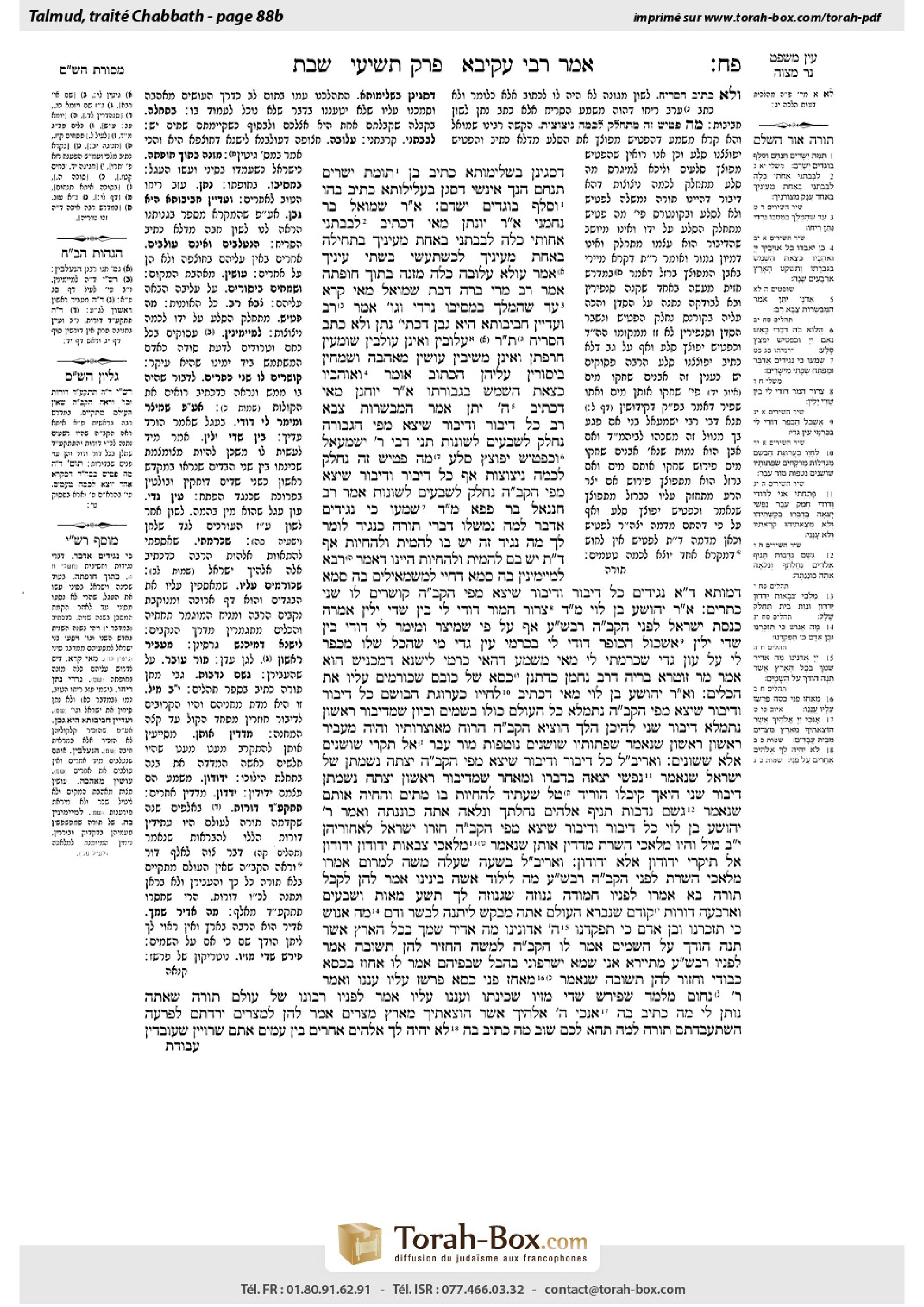
Shabbat 88b: Talmud study for Daf Yomi
Daf Yomi is the daily study of one Talmud folio. Explore 37 tractates with scans, Hebrew text, Sefaria English and AI-generated French translations where annotated.
Passage selection and English or AI-generated French translation are available where the scan has annotations. Daf Study is independent of Torah-Box and Sefaria.
Browse Shabbat · שבת · All tractatesShabbat 88b text and translations
This page of Shabbat includes the Aramaic text, an English translation and an AI-generated French translation, alongside the scan above.
שבת פ״ח ב · Aramaic and Hebrew text
דְּסָגֵינַן בִּשְׁלִימוּתָא כְּתִיב בַּן: ״תֻּמַּת יְשָׁרִים תַּנְחֵם״, הָנָךְ אִינָשֵׁי דְּסָגַן בַּעֲלִילוּתָא כְּתִיב בְּהוּ: ״וְסֶלֶף בּוֹגְדִים יְשָׁדֵּם״.
אָמַר רַבִּי שְׁמוּאֵל בַּר נַחְמָנִי אָמַר רַבִּי יוֹנָתָן: מַאי דִּכְתִיב ״לִבַּבְתִּנִי אֲחוֹתִי כַלָּה לִבַּבְתִּנִי בְּאַחַת מֵעֵינַיִךְ״ — בַּתְּחִילָּה בְּאַחַת מֵעֵינַיִךְ, לִכְשֶׁתַּעֲשִׂי — בִּשְׁתֵּי עֵינֶיךָ. אָמַר עוּלָּא: עֲלוּבָה כַּלָּה מְזַנָּה בְּתוֹךְ חוּפָּתָהּ. אָמַר רַב מָרִי בְּרַהּ דְּבַת שְׁמוּאֵל, מַאי קְרָא: ״עַד שֶׁהַמֶּלֶךְ בִּמְסִבּוֹ נִרְדִּי וְגוֹ׳״. אָמַר רַב: וַעֲדַיִין חַבִּיבוּתָא הִיא גַּבַּן, דִּכְתִיב ״נָתַן״, וְלָא כְּתִיב ״הִסְרִיחַ״. תָּנוּ רַבָּנַן: עֲלוּבִין וְאֵינָן עוֹלְבִין, שׁוֹמְעִין חֶרְפָּתָן וְאֵינָן מְשִׁיבִין, עוֹשִׂין מֵאַהֲבָה וּשְׂמֵחִין בְּיִסּוּרִין — עֲלֵיהֶן הַכָּתוּב אוֹמֵר: ״וְאֹהֲבָיו כְּצֵאת הַשֶּׁמֶשׁ בִּגְבֻרָתוֹ״.
אָמַר רַבִּי יוֹחָנָן: מַאי דִּכְתִיב ״ה׳ יִתֶּן אֹמֶר הַמְבַשְּׂרוֹת צָבָא רָב״ — כׇּל דִּיבּוּר וְדִיבּוּר שֶׁיָּצָא מִפִּי הַגְּבוּרָה נֶחֱלַק לְשִׁבְעִים לְשׁוֹנוֹת. תָּנֵי דְּבֵי רַבִּי יִשְׁמָעֵאל: ״וּכְפַטִּישׁ יְפֹצֵץ סָלַע״, מָה פַּטִּישׁ זֶה נֶחֱלָק לְכַמָּה נִיצוֹצוֹת — אַף כׇּל דִּיבּוּר וְדִיבּוּר שֶׁיָּצָא מִפִּי הַקָּדוֹשׁ בָּרוּךְ הוּא נֶחֱלַק לְשִׁבְעִים לְשׁוֹנוֹת. אָמַר רַב חֲנַנְאֵל בַּר פָּפָּא: מַאי דִּכְתִיב ״שִׁמְעוּ כִּי נְגִידִים אֲדַבֵּר״ — לָמָּה נִמְשְׁלוּ דִּבְרֵי תוֹרָה כְּנָגִיד, לוֹמַר לָךְ: מָה נָגִיד זֶה יֵשׁ בּוֹ לְהָמִית וּלְהַחֲיוֹת, אַף דִּבְרֵי תוֹרָה יֶשׁ בָּם לְהָמִית וּלְהַחֲיוֹת.
הַיְינוּ דְּאָמַר רָבָא: לַמַּיְימִינִין בָּהּ סַמָּא דְחַיֵּי, לְמַשְׂמְאִילִים בָּהּ סַמָּא דְמוֹתָא. דָּבָר אַחֵר: ״נְגִידִים״ — כׇּל דִּיבּוּר וְדִיבּוּר שֶׁיָּצָא מִפִּי הַקָּדוֹשׁ בָּרוּךְ הוּא קוֹשְׁרִים לוֹ שְׁנֵי כְתָרִים. אָמַר רַבִּי יְהוֹשֻׁעַ בֶּן לֵוִי: מַאי דִּכְתִיב: ״צְרוֹר הַמּוֹר דּוֹדִי לִי בֵּין שָׁדַי יָלִין״ — אָמְרָה כְּנֶסֶת יִשְׂרָאֵל לִפְנֵי הַקָּדוֹשׁ בָּרוּךְ הוּא: רִבּוֹנוֹ שֶׁל עוֹלָם אַף עַל פִּי שֶׁמֵּיצֵר וּמֵימֵר לִי דּוֹדִי — ״בֵּין שָׁדַי יָלִין״. ״אֶשְׁכֹּל הַכֹּפֶר דּוֹדִי לִי בְּכַרְמֵי עֵין גֶּדִי״ — מִי שֶׁהַכֹּל שֶׁלּוֹ מְכַפֵּר לִי עַל עֲוֹן גְּדִי שֶׁכָּרַמְתִּי לִי. מַאי מַשְׁמַע דְּהַאי ״כַּרְמֵי״ לִישָּׁנָא דְמִכְנַשׁ הוּא? אָמַר מָר זוּטְרָא בְּרֵיהּ דְּרַב נַחְמָן, כְּדִתְנַן: כִּסֵּא שֶׁל כּוֹבֵס שֶׁכּוֹרְמִים עָלָיו אֶת הַכֵּלִים.
וְאָמַר רַבִּי יְהוֹשֻׁעַ בֶּן לֵוִי, מַאי דִּכְתִיב: ״לְחָיָו כַּעֲרוּגַת הַבֹּשֶׂם״ — כׇּל דִּיבּוּר וְדִיבּוּר שֶׁיָּצָא מִפִּי הַקָּדוֹשׁ בָּרוּךְ הוּא נִתְמַלֵּא כָּל הָעוֹלָם כּוּלּוֹ בְּשָׂמִים. וְכֵיוָן שֶׁמִּדִּיבּוּר רִאשׁוֹן נִתְמַלֵּא, דִּיבּוּר שֵׁנִי לְהֵיכָן הָלַךְ? הוֹצִיא הַקָּדוֹשׁ בָּרוּךְ הוּא הָרוּחַ מֵאוֹצְרוֹתָיו וְהָיָה מַעֲבִיר רִאשׁוֹן רִאשׁוֹן, שֶׁנֶּאֱמַר: ״שִׂפְתוֹתָיו שׁוֹשַׁנִּים נוֹטְפוֹת מוֹר עֹבֵר״. (אַל תִּקְרֵי ״שׁוֹשַׁנִּים״, אֶלָּא ״שֶׁשּׁוֹנִים״).
וְאָמַר רַבִּי יְהוֹשֻׁעַ בֶּן לֵוִי: כׇּל דִּיבּוּר וְדִיבּוּר שֶׁיָּצָא מִפִּי הַקָּדוֹשׁ בָּרוּךְ הוּא יָצְתָה נִשְׁמָתָן שֶׁל יִשְׂרָאֵל, שֶׁנֶּאֱמַר: ״נַפְשִׁי יָצְאָה בְדַבְּרוֹ״. וּמֵאַחַר שֶׁמִּדִּיבּוּר רִאשׁוֹן יָצְתָה נִשְׁמָתָן, דִּיבּוּר שֵׁנִי הֵיאַךְ קִיבְּלוּ? — הוֹרִיד טַל שֶׁעָתִיד לְהַחֲיוֹת בּוֹ מֵתִים וְהֶחְיָה אוֹתָם, שֶׁנֶּאֱמַר: ״גֶּשֶׁם נְדָבוֹת תָּנִיף אֱלֹהִים נַחֲלָתְךָ וְנִלְאָה אַתָּה כוֹנַנְתָּהּ״. וְאָמַר רַבִּי יְהוֹשֻׁעַ בֶּן לֵוִי: כׇּל דִּיבּוּר וְדִיבּוּר שֶׁיָּצָא מִפִּי הַקָּדוֹשׁ בָּרוּךְ הוּא חָזְרוּ יִשְׂרָאֵל לַאֲחוֹרֵיהֶן שְׁנֵים עָשָׂר מִיל וְהָיוּ מַלְאֲכֵי הַשָּׁרֵת מְדַדִּין אוֹתָן, שֶׁנֶּאֱמַר: ״מַלְאֲכֵי צְבָאוֹת יִדֹּדוּן יִדֹּדוּן״ — אַל תִּיקְרֵי ״יִדֹּדוּן״, אֶלָּא ״יְדַדּוּן״.
וְאָמַר רַבִּי יְהוֹשֻׁעַ בֶּן לֵוִי: בְּשָׁעָה שֶׁעָלָה מֹשֶׁה לַמָּרוֹם אָמְרוּ מַלְאֲכֵי הַשָּׁרֵת לִפְנֵי הַקָּדוֹשׁ בָּרוּךְ הוּא: רִבּוֹנוֹ שֶׁל עוֹלָם, מַה לִּילוּד אִשָּׁה בֵּינֵינוּ? אָמַר לָהֶן: לְקַבֵּל תּוֹרָה בָּא. אָמְרוּ לְפָנָיו: חֶמְדָּה גְּנוּזָה שֶׁגְּנוּזָה לָךְ תְּשַׁע מֵאוֹת וְשִׁבְעִים וְאַרְבָּעָה דּוֹרוֹת קוֹדֶם שֶׁנִּבְרָא הָעוֹלָם, אַתָּה מְבַקֵּשׁ לִיתְּנָהּ לְבָשָׂר וָדָם? ״מָה אֱנוֹשׁ כִּי תִזְכְּרֶנּוּ וּבֶן אָדָם כִּי תִפְקְדֶנּוּ״? ״ה׳ אֲדֹנֵינוּ מָה אַדִּיר שִׁמְךָ בְּכׇל הָאָרֶץ אֲשֶׁר תְּנָה הוֹדְךָ עַל הַשָּׁמָיִם״!
אָמַר לוֹ הַקָּדוֹשׁ בָּרוּךְ הוּא לְמֹשֶׁה: הַחְזֵיר לָהֶן תְּשׁוּבָה. אָמַר לְפָנָיו: רִבּוֹנוֹ שֶׁל עוֹלָם, מִתְיָירֵא אֲנִי שֶׁמָּא יִשְׂרְפוּנִי בַּהֶבֶל שֶׁבְּפִיהֶם. אָמַר לוֹ: אֱחוֹז בְּכִסֵּא כְבוֹדִי וַחֲזוֹר לָהֶן תְּשׁוּבָה. שֶׁנֶּאֱמַר: ״מְאַחֵז פְּנֵי כִּסֵּא פַּרְשֵׁז עָלָיו עֲנָנוֹ״, וְאָמַר רַבִּי נַחוּם: מְלַמֵּד שֶׁפֵּירַשׂ שַׁדַּי מִזִּיו שְׁכִינָתוֹ וַעֲנָנוֹ עָלָיו. אָמַר לְפָנָיו: רִבּוֹנוֹ שֶׁל עוֹלָם, תּוֹרָה שֶׁאַתָּה נוֹתֵן לִי מָה כְּתִיב בָּהּ? ״אָנֹכִי ה׳ אֱלֹהֶיךָ אֲשֶׁר הוֹצֵאתִיךָ מֵאֶרֶץ מִצְרַיִם״. אָמַר לָהֶן: לְמִצְרַיִם יְרַדְתֶּם? לְפַרְעֹה הִשְׁתַּעְבַּדְתֶּם? תּוֹרָה לָמָּה תְּהֵא לָכֶם! שׁוּב: מָה כְּתִיב בָּהּ? ״לֹא יִהְיֶה לְךָ אֱלֹהִים אֲחֵרִים״. בֵּין הַגּוֹיִם אַתֶּם שְׁרוּיִין, שֶׁעוֹבְדִין
Shabbat 88b · English translation
who proceed wholeheartedly and with integrity, it is written: “The integrity of the upright will guide them” (Proverbs 11:3), whereas about those people who walk in deceit, it is written at the end of the same verse: “And the perverseness of the faithless will destroy them.”
Rabbi Shmuel bar Naḥamani said that Rabbi Yonatan said: What is the meaning of that which is written: “You have ravished my heart, my sister, my bride; you have ravished my heart with one of your eyes, with one bead of your necklace” (Song of Songs 4:9)? At first when you, the Jewish people, merely accepted the Torah upon yourselves it was with one of your eyes; however, when you actually perform the mitzvot it will be with both of your eyes. Ulla said with regard to the sin of the Golden Calf: Insolent is the bride who is promiscuous under her wedding canopy. Rav Mari, son of the daughter of Shmuel, said: What verse alludes to this? “While the king was still at his table my spikenard gave off its fragrance” (Song of Songs 1:12). Its pleasant odor dissipated, leaving only an offensive odor. Rav said: Nevertheless, it is apparent from the verse that the affection of the Holy One, Blessed be He, is still upon us, as it is written euphemistically as “gave off its fragrance,” and the verse did not write, it reeked. And the Sages taught: About those who are insulted and do not insult, who hear their shame and do not respond, who act out of love and are joyful in suffering, the verse says: “And they that love Him are as the sun going forth in its might” (Judges 5:31).
With regard to the revelation at Sinai, Rabbi Yoḥanan said: What is the meaning of that which is written: “The Lord gives the word; the women that proclaim the tidings are a great host” (Psalms 68:12)? It means that each and every utterance that emerged from the mouth of the Almighty divided into seventy languages, a great host. And, similarly, the school of Rabbi Yishmael taught with regard to the verse: “Behold, is My word not like fire, declares the Lord, and like a hammer that shatters a rock?” (Jeremiah 23:29). Just as this hammer breaks a stone into several fragments, so too, each and every utterance that emerged from the mouth of the Holy One, Blessed be He, divided into seventy languages. The Gemara continues in praise of the Torah. Rav Ḥananel bar Pappa said: What is the meaning of that which is written: “Listen, for I will speak royal things, and my lips will open with upright statements” (Proverbs 8:6)? Why are matters of Torah likened to a king? To teach you that just as this king has the power to kill and to grant life, so too, matters of Torah have the power to kill and to grant life.
And that is what Rava said: To those who are right-handed in their approach to Torah, and engage in its study with strength, good will, and sanctity, Torah is a drug of life, and to those who are left-handed in their approach to Torah, it is a drug of death. Alternatively, why are matters of Torah referred to as royal? Because to each and every utterance that emerged from the mouth of the Holy One, Blessed be He, two crowns are tied. Rabbi Yehoshua ben Levi said: What is the meaning of that which is written: “My beloved is to me like a bundle of myrrh that lies between my breasts” (Song of Songs 1:13)? The Congregation of Israel said before the Holy One, Blessed be He: Master of the Universe, even though my beloved, God, causes me suffering and bitterness, He still lies between my breasts. And Rabbi Yehoshua ben Levi interpreted the verse: “My beloved is to me like a cluster [eshkol] of henna [hakofer] in the vineyards of [karmei] Ein Gedi” (Song of Songs 1:14). He, Whom everything [shehakol] is His, forgives [mekhapper] me for the sin of the kid [gedi], i.e., the calf, that I collected [shekaramti] for myself. The Gemara explains: From where is it inferred that the word in this verse, karmei, is a term of gathering? Mar Zutra, son of Rav Naḥman, said that it is as we learned in a mishna: A launderer’s chair upon which one gathers [koremim] the garments.
And Rabbi Yehoshua ben Levi said: What is the meaning of that which is written: “His cheeks are as a bed of spices, as banks of sweet herbs, his lips are lilies dripping with flowing myrrh” (Song of Songs 5:13)? It is interpreted homiletically: From each and every utterance that emerged from His cheeks, i.e., the mouth of the Holy One, Blessed be He, the entire world was filled with fragrant spices. And since the world was already filled by the first utterance, where was there room for the spices of the second utterance to go? The Holy One, Blessed be He, brought forth wind from His treasuries and made the spices pass one at a time, leaving room for the consequences of the next utterance. As it is stated: “His lips are lilies [shoshanim] dripping with flowing myrrh.” Each and every utterance resulted in flowing myrrh. Do not read the word in the verse as shoshanim; rather, read it as sheshonim, meaning repeat. Each repeat utterance produced its own fragrance.
And Rabbi Yehoshua ben Levi said: From each and every utterance that emerged from the mouth of the Holy One, Blessed be He, the souls of the Jewish people left their bodies, as it is stated: “My soul departed when he spoke” (Song of Songs 5:6). And since their souls left their bodies from the first utterance, how did they receive the second utterance? Rather, God rained the dew upon them that, in the future, will revive the dead, and He revived them, as it is stated: “You, God, poured down a bountiful rain; when Your inheritance was weary You sustained it” (Psalms 68:10). And Rabbi Yehoshua ben Levi said: With each and every utterance that emerged from the mouth of the Holy One, Blessed be He, the Jewish people retreated in fear twelve mil, and the ministering angels walked them back toward the mountain, as it is stated: “The hosts of angels will scatter [yidodun]” (Psalms 68:13). Do not read the word as yidodun, meaning scattered; rather, read it as yedadun, they walked them.
And Rabbi Yehoshua ben Levi said: When Moses ascended on High to receive the Torah, the ministering angels said before the Holy One, Blessed be He: Master of the Universe, what is one born of a woman doing here among us? The Holy One, Blessed be He, said to them: He came to receive the Torah. The angels said before Him: The Torah is a hidden treasure that was concealed by You 974 generations before the creation of the world, and You seek to give it to flesh and blood? As it is stated: “The word which He commanded to a thousand generations” (Psalms 105:8). Since the Torah, the word of God, was given to the twenty-sixth generation after Adam, the first man, the remaining 974 generations must have preceded the creation of the world. “What is man that You are mindful of him and the son of man that You think of him?” (Psalms 8:5). Rather, “God our Lord, how glorious is Your name in all the earth that Your majesty is placed above the heavens” (Psalms 8:2). The rightful place of God’s majesty, the Torah, is in the heavens.
The Holy One, Blessed be He, said to Moses: Provide them with an answer as to why the Torah should be given to the people. Moses said before Him: Master of the Universe, I am afraid lest they burn me with the breath of their mouths. God said to him: Grasp My throne of glory for strength and protection, and provide them with an answer. And from where is this derived? As it is stated: “He causes him to grasp the front of the throne, and spreads His cloud over it” (Job 26:9), and Rabbi Naḥum said: This verse teaches that God spread the radiance of His presence and His cloud over Moses. Moses said before Him: Master of the Universe, the Torah that You are giving me, what is written in it? God said to him: “I am the Lord your God Who brought you out of Egypt from the house of bondage” (Exodus 20:2). Moses said to the angels: Did you descend to Egypt? Were you enslaved to Pharaoh? Why should the Torah be yours? Again Moses asked: What else is written in it? God said to him: “You shall have no other gods before Me” (Exodus 20:3). Moses said to the angels: Do you dwell among the nations who worship
Shabbat 88b · Traduction française (IA)
À propos de ceux qui avancent de tout leur cœur et avec intégrité, il est écrit : « L’intégrité des hommes droits les guidera » (Proverbes 11,3), tandis qu’à propos de ceux qui marchent dans la tromperie, la fin du même verset dit : « Et la perversité des traîtres les détruira. »
Rabbi Shmuel bar Naḥmani a dit au nom de Rabbi Yonatan : Quel est le sens de ce qui est écrit : « Tu as ravi mon cœur, ma sœur, ma fiancée ; tu as ravi mon cœur par un seul de tes yeux, par un seul joyau de ton collier » (Cantique des Cantiques 4,9) ? Au début, lorsque vous, le peuple juif, avez seulement accepté la Torah, ce fut d’un seul œil ; mais lorsque vous accomplirez effectivement les mitsvot, ce sera des deux yeux. À propos de la faute du Veau d’or, Ulla a dit : Quelle fiancée insolente, qui se livre à la débauche sous son dais nuptial ! Rav Mari, fils de la fille de Shmuel, a dit : Quel verset y fait allusion ? « Tandis que le roi était à sa table, mon nard exhalait son parfum » (Cantique des Cantiques 1,12). Son agréable parfum s’est dissipé, ne laissant qu’une odeur nauséabonde. Rav a dit : Pourtant, le verset montre que l’affection du Saint, béni soit-Il, demeure envers nous, car il est formulé par euphémisme : « exhalait son parfum », et le verset ne dit pas qu’il empestait. Et les Sages ont enseigné : À propos de ceux qui sont insultés sans insulter, qui entendent les injures dirigées contre eux sans répondre, qui agissent par amour et se réjouissent dans la souffrance, le verset dit : « Ceux qui L’aiment sont comme le soleil qui se lève dans toute sa puissance » (Juges 5,31).
À propos de la révélation au Sinaï, Rabbi Yoḥanan a dit : Quel est le sens de ce qui est écrit : « Le Seigneur donne la parole ; les femmes qui proclament la nouvelle forment une grande armée » (Psaumes 68,12) ? Cela signifie que chaque parole sortie de la bouche du Tout-Puissant s’est divisée en soixante-dix langues, formant une grande armée. De même, l’école de Rabbi Yishmael a enseigné à propos du verset : « Ma parole n’est-elle pas comme le feu, dit le Seigneur, et comme un marteau qui fracasse le rocher ? » (Jérémie 23,29) : de même que ce marteau brise une pierre en plusieurs morceaux, chaque parole sortie de la bouche du Saint, béni soit-Il, s’est divisée en soixante-dix langues. La Guemara poursuit en faisant l’éloge de la Torah. Rav Ḥananel bar Pappa a dit : Quel est le sens de ce qui est écrit : « Écoutez, car je parlerai de choses royales, et mes lèvres s’ouvriront pour dire des paroles droites » (Proverbes 8,6) ? Pourquoi les paroles de Torah sont-elles comparées à celles d’un roi ? Pour t’enseigner que, de même que ce roi a le pouvoir de tuer et de donner la vie, de même les paroles de Torah ont le pouvoir de tuer et de donner la vie.
Et c’est ce que Rava a dit : Pour ceux qui abordent la Torah de la main droite et l’étudient avec force, bonne volonté et sainteté, la Torah est un remède de vie ; pour ceux qui l’abordent de la main gauche, elle est un remède de mort. Autre explication : pourquoi les paroles de Torah sont-elles qualifiées de royales ? Parce qu’à chaque parole sortie de la bouche du Saint, béni soit-Il, deux couronnes sont attachées. Rabbi Yehoshua ben Levi a dit : Quel est le sens de ce qui est écrit : « Mon bien-aimé est pour moi comme un sachet de myrrhe qui repose entre mes seins » (Cantique des Cantiques 1,13) ? L’Assemblée d’Israël a dit devant le Saint, béni soit-Il : Maître de l’Univers, bien que mon bien-aimé, Dieu, me fasse souffrir et m’emplisse d’amertume, Il repose néanmoins entre mes seins. Et Rabbi Yehoshua ben Levi a interprété le verset : « Mon bien-aimé est pour moi comme une grappe [eshkol] de henné [hakofer] dans les vignes de [karmei] Ein Gedi » (Cantique des Cantiques 1,14). Celui à qui appartient tout [shehakol] me pardonne [mekhapper] la faute du chevreau [gedi], c’est-à-dire le veau, que j’ai rassemblé [shekaramti] pour moi. La Guemara explique : d’où déduit-on que le mot karmei dans ce verset désigne le rassemblement ? Mar Zutra, fils de Rav Naḥman, a dit que c’est comme nous l’avons appris dans une Michna : un siège de blanchisseur sur lequel on rassemble [koremim] les vêtements.
Et Rabbi Yehoshua ben Levi a dit : Quel est le sens de ce qui est écrit : « Ses joues sont comme un parterre d’aromates, comme des massifs d’herbes odorantes ; ses lèvres sont des lys d’où coule une myrrhe fluide » (Cantique des Cantiques 5,13) ? Le verset est interprété de manière homilétique : de chacune des paroles sorties de Ses joues, c’est-à-dire de la bouche du Saint, béni soit-Il, le monde entier s’est empli d’aromates parfumés. Et puisque le monde était déjà rempli dès la première parole, où pouvait-il y avoir de la place pour les aromates de la deuxième parole ? Le Saint, béni soit-Il, a fait sortir le vent de Ses trésors et a fait passer les aromates l’un après l’autre, laissant ainsi place aux effets de la parole suivante. Comme il est dit : « Ses lèvres sont des lys [shoshanim] d’où coule une myrrhe fluide. » Chaque parole a produit une myrrhe fluide. Ne lis pas dans le verset shoshanim ; lis plutôt sheshonim, qui signifie « répétées ». Chaque parole répétée a produit son propre parfum.
Et Rabbi Yehoshua ben Levi a dit : À chaque parole sortie de la bouche du Saint, béni soit-Il, les âmes du peuple juif ont quitté leur corps, comme il est dit : « Mon âme s’est retirée lorsqu’il parlait » (Cantique des Cantiques 5,6). Et puisque leurs âmes avaient quitté leur corps dès la première parole, comment ont-ils reçu la deuxième ? Dieu a plutôt fait tomber sur eux la rosée qui, à l’avenir, ressuscitera les morts, et Il les a ramenés à la vie, comme il est dit : « Dieu, Tu as répandu une pluie abondante ; lorsque Ton héritage était épuisé, Tu l’as soutenu » (Psaumes 68,10). Et Rabbi Yehoshua ben Levi a dit : À chaque parole sortie de la bouche du Saint, béni soit-Il, le peuple juif reculait de douze mil par crainte, et les anges de service le raccompagnaient vers la montagne, comme il est dit : « Les armées d’anges se dispersent [yidodun] » (Psaumes 68,13). Ne lis pas le mot yidodun, qui signifie « se dispersent » ; lis plutôt yedadun : « ils les raccompagnaient ».
Et Rabbi Yehoshua ben Levi a dit : Lorsque Moïse est monté dans les hauteurs pour recevoir la Torah, les anges de service ont dit devant le Saint, béni soit-Il : Maître de l’Univers, que fait ici parmi nous un être né d’une femme ? Le Saint, béni soit-Il, leur a dit : Il est venu recevoir la Torah. Les anges Lui ont dit : La Torah est un trésor caché, que Tu as dissimulé 974 générations avant la création du monde, et Tu cherches à la donner à un être de chair et de sang ? Comme il est dit : « La parole qu’Il a ordonnée à mille générations » (Psaumes 105,8). Puisque la Torah, la parole de Dieu, a été donnée à la vingt-sixième génération après Adam, le premier homme, les 974 générations restantes ont nécessairement précédé la création du monde. « Qu’est-ce que l’homme pour que Tu te souviennes de lui, et le fils de l’homme pour que Tu prennes garde à lui ? » (Psaumes 8,5). Au contraire : « Seigneur, notre Dieu, que Ton nom est glorieux sur toute la terre, Toi qui as placé Ta majesté au-dessus des cieux » (Psaumes 8,2). La place légitime de la majesté de Dieu, la Torah, est dans les cieux.
Le Saint, béni soit-Il, a dit à Moïse : Réponds-leur pour expliquer pourquoi la Torah doit être donnée au peuple. Moïse Lui a dit : Maître de l’Univers, je crains qu’ils ne me brûlent par le souffle de leur bouche. Dieu lui a dit : Saisis Mon trône de gloire pour te fortifier et te protéger, puis réponds-leur. Et d’où cela est-il déduit ? Comme il est dit : « Il saisit la face du trône et étend Son nuage au-dessus » (Job 26,9). Rabbi Naḥum a dit : Ce verset enseigne que Dieu a étendu sur Moïse le rayonnement de Sa présence et Son nuage. Moïse Lui a dit : Maître de l’Univers, que contient la Torah que Tu me donnes ? Dieu lui a dit : « Je suis le Seigneur ton Dieu, qui t’ai fait sortir d’Égypte, de la maison de servitude » (Exode 20,2). Moïse a dit aux anges : Êtes-vous descendus en Égypte ? Avez-vous été asservis à Pharaon ? Pourquoi la Torah devrait-elle vous appartenir ? Moïse a de nouveau demandé : Qu’y est-il écrit d’autre ? Dieu lui a dit : « Tu n’auras pas d’autres dieux devant Ma face » (Exode 20,3). Moïse a dit aux anges : Habitez-vous parmi les nations qui adorent
Traduction française générée par IA à partir de l’édition anglaise de Sefaria. Vérifie toujours un passage avec le texte source.
Text from Sefaria: William Davidson Edition - Vocalized Aramaic (CC BY NC); William Davidson Edition - English (CC BY NC).