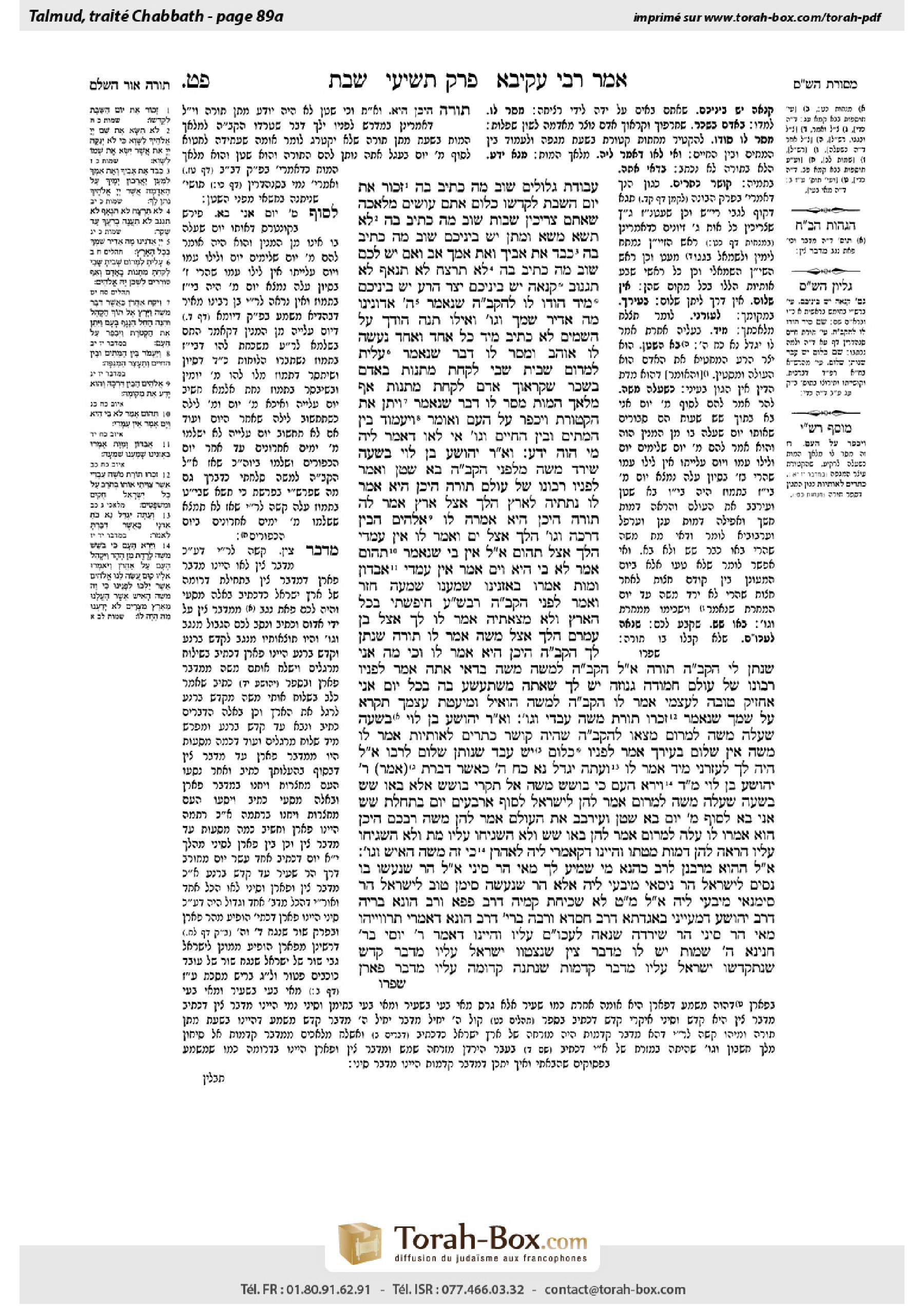
Shabbat 89a: Talmud study for Daf Yomi
Daf Yomi is the daily study of one Talmud folio. Explore 37 tractates with scans, Hebrew text, Sefaria English and AI-generated French translations where annotated.
Passage selection and English or AI-generated French translation are available where the scan has annotations. Daf Study is independent of Torah-Box and Sefaria.
Browse Shabbat · שבת · All tractatesShabbat 89a text and translations
This page of Shabbat includes the Aramaic text, an English translation and an AI-generated French translation, alongside the scan above.
שבת פ״ט א · Aramaic and Hebrew text
עֲבוֹדָה זָרָה? שׁוּב: מָה כְּתִיב בָּהּ? ״זָכוֹר אֶת יוֹם הַשַּׁבָּת לְקַדְּשׁוֹ״ — כְּלוּם אַתֶּם עוֹשִׂים מְלָאכָה, שֶׁאַתֶּם צְרִיכִין שְׁבוּת? שׁוּב: מָה כְּתִיב בָּהּ? ״לֹא תִשָּׂא״ — מַשָּׂא וּמַתָּן יֵשׁ בֵּינֵיכֶם? שׁוּב: מָה כְּתִיב בָּהּ? ״כַּבֵּד אֶת אָבִיךָ וְאֶת אִמֶּךָ״ — אָב וָאֵם יֵשׁ לָכֶם? שׁוּב: מָה כְּתִיב בָּהּ? ״לֹא תִּרְצָח״, ״לֹא תִּנְאָף״, ״לֹא תִּגְנֹב״. קִנְאָה יֵשׁ בֵּינֵיכֶם? יֵצֶר הָרָע יֵשׁ בֵּינֵיכֶם? מִיָּד הוֹדוּ לוֹ לְהַקָּדוֹשׁ בָּרוּךְ הוּא, שֶׁנֶּאֱמַר: ״ה׳ אֲדֹנֵינוּ מָה אַדִּיר שִׁמְךָ וְגוֹ׳״, וְאִילּוּ ״תְּנָה הוֹדְךָ עַל הַשָּׁמָיִם״ לָא כְּתִיב.
מִיָּד כׇּל אֶחָד וְאֶחָד נַעֲשָׂה לוֹ אוֹהֵב וּמָסַר לוֹ דָּבָר, שֶׁנֶּאֱמַר: ״עָלִיתָ לַמָּרוֹם שָׁבִיתָ שֶּׁבִי לָקַחְתָּ מַתָּנוֹת בָּאָדָם״ — בִּשְׂכַר שֶׁקְּרָאוּךְ ״אָדָם״, לָקַחְתָּ מַתָּנוֹת. אַף מַלְאַךְ הַמָּוֶת מָסַר לוֹ דָּבָר, שֶׁנֶּאֱמַר: ״וַיִּתֵּן אֶת הַקְּטֹרֶת וַיְכַפֵּר עַל הָעָם״, וְאוֹמֵר: ״וַיַּעֲמֹד בֵּין הַמֵּתִים וּבֵין הַחַיִּים וְגוֹ׳״ — אִי לָאו דַּאֲמַר לֵיהּ מִי הֲוָה יָדַע?
וְאָמַר רַבִּי יְהוֹשֻׁעַ בֶּן לֵוִי: בְּשָׁעָה שֶׁיָּרַד מֹשֶׁה מִלִּפְנֵי הַקָּדוֹשׁ בָּרוּךְ הוּא, בָּא שָׂטָן וְאָמַר לְפָנָיו: רִבּוֹנוֹ שֶׁל עוֹלָם, תּוֹרָה הֵיכָן הִיא? אָמַר לוֹ: נְתַתִּיהָ לָאָרֶץ. הָלַךְ אֵצֶל אֶרֶץ, אָמַר לָהּ: תּוֹרָה הֵיכָן הִיא? אָמְרָה לוֹ: ״אֱלֹהִים הֵבִין דַּרְכָּהּ וְגוֹ׳״. הָלַךְ אֵצֶל יָם, וְאָמַר לוֹ: ״אֵין עִמָּדִי״. הָלַךְ אֵצֶל תְּהוֹם, אָמַר לוֹ: ״אֵין בִּי״. שֶׁנֶּאֱמַר: ״תְּהוֹם אָמַר לֹא בִי הִיא וְיָם אָמַר אֵין עִמָּדִי״, ״אֲבַדּוֹן וָמָוֶת אָמְרוּ בְּאׇזְנֵינוּ שָׁמַעְנוּ שִׁמְעָהּ״. חָזַר וְאָמַר לִפְנֵי הַקָּדוֹשׁ בָּרוּךְ הוּא: רִבּוֹנוֹ שֶׁל עוֹלָם, חִיפַּשְׂתִּי בְּכׇל הָאָרֶץ וְלֹא מְצָאתִיהָ. אָמַר לוֹ: לֵךְ אֵצֶל בֶּן עַמְרָם.
הָלַךְ אֵצֶל מֹשֶׁה אָמַר לוֹ: תּוֹרָה שֶׁנָּתַן לְךָ הַקָּדוֹשׁ בָּרוּךְ הוּא הֵיכָן הִיא? אָמַר לוֹ: וְכִי מָה אֲנִי שֶׁנָּתַן לִי הַקָּדוֹשׁ בָּרוּךְ הוּא תּוֹרָה? אָמַר לוֹ הַקָּדוֹשׁ בָּרוּךְ הוּא לְמֹשֶׁה: מֹשֶׁה, בַּדַּאי אַתָּה?! אָמַר לְפָנָיו: רִבּוֹנוֹ שֶׁל עוֹלָם, חֶמְודָּה גְּנוּזָה יֵשׁ לְךָ שֶׁאַתָּה מִשְׁתַּעֲשֵׁעַ בָּהּ בְּכׇל יוֹם, אֲנִי אַחְזִיק טוֹבָה לְעַצְמִי? אָמַר לוֹ הַקָּדוֹשׁ בָּרוּךְ הוּא לְמֹשֶׁה: הוֹאִיל וּמִיעַטְתָּ עַצְמְךָ תִּקָּרֵא עַל שִׁמְךָ, שֶׁנֶּאֱמַר: ״זִכְרוּ תּוֹרַת מֹשֶׁה עַבְדִּי וְגוֹ׳״.
וְאָמַר רַבִּי יְהוֹשֻׁעַ בֶּן לֵוִי: בְּשָׁעָה שֶׁעָלָה מֹשֶׁה לַמָּרוֹם מְצָאוֹ לְהַקָּדוֹשׁ בָּרוּךְ הוּא שֶׁהָיָה קוֹשֵׁר כְּתָרִים לָאוֹתִיּוֹת. אָמַר לוֹ: מֹשֶׁה, אֵין שָׁלוֹם בְּעִירְךָ? אָמַר לְפָנָיו: כְּלוּם יֵשׁ עֶבֶד שֶׁנּוֹתֵן שָׁלוֹם לְרַבּוֹ? אָמַר לוֹ: הָיָה לְךָ לְעׇזְרֵנִי, מִיָּד אָמַר לוֹ: ״וְעַתָּה יִגְדַּל נָא כֹּחַ ה׳ כַּאֲשֶׁר דִּבַּרְתָּ״.
אָמַר רַבִּי יְהוֹשֻׁעַ בֶּן לֵוִי: מַאי דִּכְתִיב: ״וַיַּרְא הָעָם כִּי בֹשֵׁשׁ מֹשֶׁה״ — אַל תִּקְרֵי ״בּוֹשֵׁשׁ״, אֶלָּא ״בָּאוּ שֵׁשׁ״. בְּשָׁעָה שֶׁעָלָה מֹשֶׁה לַמָּרוֹם אָמַר לָהֶן לְיִשְׂרָאֵל: לְסוֹף אַרְבָּעִים יוֹם בִּתְחִלַּת שֵׁשׁ אֲנִי בָּא. לְסוֹף אַרְבָּעִים יוֹם בָּא שָׂטָן וְעִירְבֵּב אֶת הָעוֹלָם. אָמַר לָהֶן: מֹשֶׁה רַבְּכֶם הֵיכָן הוּא? אָמְרוּ לוֹ: עָלָה לַמָּרוֹם. אָמַר לָהֶן: בָּאוּ שֵׁשׁ, וְלֹא הִשְׁגִּיחוּ עָלָיו. מֵת, וְלֹא הִשְׁגִּיחוּ עָלָיו. הֶרְאָה לָהֶן דְּמוּת מִטָּתוֹ, וְהַיְינוּ דְּקָאָמְרִי לֵיהּ לְאַהֲרֹן: ״כִּי זֶה מֹשֶׁה הָאִישׁ וְגוֹ׳״.
אֲמַר לֵיהּ הָהוּא מֵרַבָּנַן לְרַב כָּהֲנָא: מִי שְׁמִיעַ לָךְ מַאי ״הַר סִינַי״? אֲמַר לֵיהּ: הַר שֶׁנַּעֲשׂוּ בּוֹ נִסִּים לְיִשְׂרָאֵל. ״הַר נִיסַּאי״ מִיבְּעֵי לֵיהּ! אֶלָּא: הַר שֶׁנַּעֲשָׂה סִימָן טוֹב לְיִשְׂרָאֵל. ״הַר סִימָנַאי״ מִיבְּעֵי לֵיהּ! אֲמַר לֵיהּ: מַאי טַעְמָא לָא שְׁכִיחַתְּ קַמֵּיהּ דְּרַב פָּפָּא וְרַב הוּנָא בְּרֵיהּ דְּרַב יְהוֹשֻׁעַ דִּמְעַיְּינִי בְּאַגָּדְתָּא? דְּרַב חִסְדָּא וְרַבָּה בְּרֵיהּ דְּרַב הוּנָא דְּאָמְרִי תַּרְוַויְיהוּ: מַאי ״הַר סִינַי״? הַר שֶׁיָּרְדָה שִׂנְאָה לְאֻמּוֹת הָעוֹלָם עָלָיו. וְהַיְינוּ דְּאָמַר רַבִּי יוֹסֵי בְּרַבִּי חֲנִינָא: חֲמִשָּׁה שֵׁמוֹת יֵשׁ לוֹ: מִדְבַּר צִין — שֶׁנִּצְטַוּוּ יִשְׂרָאֵל עָלָיו; מִדְבַּר קָדֵשׁ — שֶׁנִּתְקַדְּשׁוּ יִשְׂרָאֵל עָלָיו; מִדְבַּר קְדֵמוֹת — שֶׁנִּתְּנָה קְדוּמָה עָלָיו; מִדְבַּר פָּארָן —
Shabbat 89a · English translation
idols that you require this special warning? Again Moses asked: What else is written in it? The Holy One, Blessed be He, said to him: “Remember the Shabbat day to sanctify it” (Exodus 20:8). Moses asked the angels: Do you perform labor that you require rest from it? Again Moses asked: What else is written in it? “Do not take the name of the Lord your God in vain” (Exodus 20:7), meaning that it is prohibited to swear falsely. Moses asked the angels: Do you conduct business with one another that may lead you to swear falsely? Again Moses asked: What else is written in it? The Holy One, Blessed be He, said to him: “Honor your father and your mother” (Exodus 20:12). Moses asked the angels: Do you have a father or a mother that would render the commandment to honor them relevant to you? Again Moses asked: What else is written in it? God said to him: “You shall not murder, you shall not commit adultery, you shall not steal” (Exodus 20:13) Moses asked the angels: Is there jealousy among you, or is there an evil inclination within you that would render these commandments relevant? Immediately they agreed with the Holy One, Blessed be He, that He made the right decision to give the Torah to the people, and as it is stated: “God our Lord, how glorious is Your name in all the earth” (Psalms 8:10), while “that Your majesty is placed above the heavens” is not written because the angels agreed with God that it is appropriate to give the Torah to the people on earth.
Immediately, each and every one of the angels became an admirer of Moses and passed something to him, as it is stated: “You ascended on high, you took a captive, you took gifts on account of man, and even among the rebellious also that the Lord God might dwell there” (Psalms 68:19). The meaning of the verse is: In reward for the fact that they called you man, you are not an angel and the Torah is applicable to you, you took gifts from the angels. And even the Angel of Death gave him something, as Moses told Aaron how to stop the plague, as it is stated: “And he placed the incense, and he atoned for the people” (Numbers 17:12). And the verse says: “And he stood between the dead and the living, and the plague was stopped” (Numbers 17:13). If it were not that the Angel of Death told him this remedy, would he have known it?
And Rabbi Yehoshua ben Levi said: When Moses descended from standing before the Holy One, Blessed be He, with the Torah, Satan came and said before Him: Master of the Universe, where is the Torah?
He said to him: I have given it to the earth. He went to the earth, and said to it: Where is the Torah? It said to him: I do not know, as only: “God understands its way, and He knows its place” (Job 28:23).
He went to the sea and asked: Where is the Torah? And the sea said to him: “It is not with me.”
He went to the depths and asked: Where is the Torah? And the depths said to him: “It is not within me.” And from where is it derived that the sea and the depths answered him this way? As it is stated: “The depth said: It is not within me, and the sea said: It is not with me” (Job 28:14). “Destruction and death said: We heard a rumor of it with our ears” (Job 28:22).
Satan returned and said before the Holy One, Blessed be He: Master of the Universe, I searched for the Torah throughout all the earth and did not find it. He said to him: Go to Moses, son of Amram.
He went to Moses and said to him: The Torah that the Holy One, Blessed be He, gave you, where is it? Moses evaded the question and said to him: And what am I that the Holy One, Blessed be He, would have given me the Torah? I am unworthy. The Holy One, Blessed be He, said to Moses: Moses, are you a fabricator? Moses said before Him: Master of the Universe, You have a hidden treasure in which You delight every day, as it is stated: “And I was His delight every day, playing before Him at every moment” (Proverbs 8:30). Should I take credit for myself and say that You gave it to me? The Holy One, Blessed be He, said to Moses: Since you belittled yourself, the Torah will be called by your name, as it is stated: “Remember the Torah of Moses My servant to whom I commanded at Horeb laws and statutes for all of Israel” (Malachi 3:22).
And Rabbi Yehoshua ben Levi said: When Moses ascended on High, he found the Holy One, Blessed be He, tying crowns to letters. On the tops of certain letters there are ornamental crownlets. Moses said nothing, and God said to him: Moses, is there no greeting in your city? Do people not greet each other in your city? He said before Him: Does a servant greet his master? That would be disrespectful. He said to him: At least you should have assisted Me and wished Me success in My work. Immediately he said to Him: “And now, may the power of the Lord be great as you have spoken” (Numbers 14:17).
And Rabbi Yehoshua ben Levi said: What is the meaning of that which is written: “And the people saw that Moses delayed [boshesh] to come down from the mount” (Exodus 32:1)? Do not read the word in the verse as boshesh; rather, read it as ba’u shesh, six hours have arrived. When Moses ascended on High, he told the Jewish people: In forty days, at the beginning of six hours, I will come. After forty days, Satan came and brought confusion to the world by means of a storm, and it was impossible to ascertain the time. Satan said to the Jews: Where is your teacher Moses? They said to him: He ascended on High. He said to them: Six hours have arrived and he has not yet come. Surely he won’t. And they paid him no attention. Satan said to them: Moses died. And they paid him no attention. Ultimately, he showed them an image of his death-bed and an image of Moses’ corpse in a cloud. And that is what the Jewish people said to Aaron: “For this Moses, the man who brought us up out of the land of Egypt, we know not what has become of him” (Exodus 32:1).
One of the Sages said to Rav Kahana: Did you hear what is the reason that the mountain was called Mount Sinai? Rav Kahana said to him: It is because it is a mountain upon which miracles [nissim] were performed for the Jewish people. The Sage said to him: If so, it should have been called Mount Nisai, the mountain of miracles. Rather, Rav Kahana said to him: It is a mountain that was a good omen [siman] for the Jewish people. The Sage said to him: If so, it should have been called Har Simanai, the mountain of omens. Rav Kahana said to him: What is the reason that you do not frequent the school where you can study before Rav Pappa and Rav Huna, son of Rav Yehoshua, who study aggada? As Rav Ḥisda and Rabba, son of Rav Huna, both said: What is the reason it is called Mount Sinai? It is because it is a mountain upon which hatred [sina] for the nations of the world descended because they did not accept the Torah. And that is what Rabbi Yosei, son of Rabbi Ḥanina, said: The desert in which Israel remained for forty years has five names. Each name has a source and a rationale: The Zin Desert, because the Jewish people were commanded [nitztavu] in it; the Kadesh Desert, because the Jewish people were sanctified [nitkadshu] in it. The Kedemot Desert, because the ancient [keduma] Torah, which preceded the world, was given in it. The Paran Desert,
Shabbat 89a · Traduction française (IA)
des idoles, pour que vous ayez besoin de cet avertissement particulier ? Moïse demanda encore : Qu’est-il écrit d’autre dans la Torah ? Le Saint, béni soit-Il, lui dit : « Souviens-toi du jour du Chabbat pour le sanctifier » (Exode 20:8). Moïse demanda aux anges : Faites-vous des travaux, pour avoir besoin de vous en reposer ? Moïse demanda encore : Qu’est-il écrit d’autre dans la Torah ? « Tu ne prononceras pas le nom du Seigneur ton Dieu en vain » (Exode 20:7), c’est-à-dire qu’il est interdit de faire un faux serment. Moïse demanda aux anges : Faites-vous des affaires les uns avec les autres, susceptibles de vous amener à faire un faux serment ? Moïse demanda encore : Qu’est-il écrit d’autre dans la Torah ? Le Saint, béni soit-Il, lui dit : « Honore ton père et ta mère » (Exode 20:12). Moïse demanda aux anges : Avez-vous un père ou une mère, pour que le commandement de les honorer vous concerne ? Moïse demanda encore : Qu’est-il écrit d’autre dans la Torah ? Dieu lui dit : « Tu ne tueras pas, tu ne commettras pas d’adultère, tu ne voleras pas » (Exode 20:13). Moïse demanda aux anges : Y a-t-il de la jalousie parmi vous, ou un mauvais penchant en vous, qui rendrait ces commandements pertinents ? Aussitôt, ils convinrent tous que le Saint, béni soit-Il, avait pris la bonne décision en donnant la Torah au peuple, comme il est dit : « Seigneur notre Dieu, que ton nom est glorieux sur toute la terre » (Psaumes 8:10). En revanche, il n’est pas écrit : « Toi dont la majesté est placée au-dessus des cieux », car les anges convinrent avec Dieu qu’il convenait de donner la Torah aux hommes sur terre.
Aussitôt, chacun des anges se prit d’admiration pour Moïse et lui remit quelque chose, comme il est dit : « Tu es monté dans les hauteurs, tu as emmené des captifs, tu as reçu des présents en faveur des hommes ; même parmi les rebelles, afin que le Seigneur Dieu y réside » (Psaumes 68:19). Le verset signifie que, en récompense du fait qu’ils t’ont appelé homme — tu n’es pas un ange et la Torah te concerne —, tu as reçu des présents des anges. Même l’Ange de la Mort lui remit quelque chose, car Moïse indiqua à Aaron comment arrêter l’épidémie, comme il est dit : « Il plaça l’encens et fit expiation pour le peuple » (Nombres 17:12). Et le verset dit : « Il se tint entre les morts et les vivants, et l’épidémie fut arrêtée » (Nombres 17:13). Si l’Ange de la Mort ne lui avait pas indiqué ce remède, comment l’aurait-il connu ?
Et Rabbi Yehoshoua ben Lévi dit : Lorsque Moïse descendit après s’être tenu devant le Saint, béni soit-Il, avec la Torah, Satan vint et dit devant Lui : Maître de l’univers, où est la Torah ? Il lui dit : Je l’ai donnée à la terre. Satan alla auprès de la terre et lui demanda : Où est la Torah ? Elle lui répondit : Je ne sais pas, car seul « Dieu en comprend la voie et en connaît le lieu » (Job 28:23). Satan alla auprès de la mer et demanda : Où est la Torah ? La mer lui répondit : « Elle n’est pas chez moi. » Satan alla auprès des profondeurs et demanda : Où est la Torah ? Les profondeurs lui répondirent : « Elle n’est pas en moi. » D’où déduit-on que la mer et les profondeurs lui répondirent ainsi ? Comme il est dit : « La profondeur dit : “Elle n’est pas en moi”, et la mer dit : “Elle n’est pas chez moi” » (Job 28:14). « La Destruction et la Mort disent : “Nous en avons entendu parler de nos oreilles” » (Job 28:22). Satan revint et dit devant le Saint, béni soit-Il : Maître de l’univers, j’ai cherché la Torah sur toute la terre et je ne l’ai pas trouvée. Il lui dit : Va trouver Moïse, fils d’Amram.
Satan alla trouver Moïse et lui dit : La Torah que le Saint, béni soit-Il, t’a donnée, où est-elle ? Moïse éluda la question et lui répondit : Qui suis-je pour que le Saint, béni soit-Il, m’ait donné la Torah ? Je n’en suis pas digne. Le Saint, béni soit-Il, dit à Moïse : Moïse, es-tu un menteur ? Moïse lui répondit : Maître de l’univers, tu as un trésor caché dont tu te délectes chaque jour, comme il est dit : « J’étais chaque jour ses délices, jouant sans cesse devant lui » (Proverbes 8:30). Devrais-je m’en attribuer le mérite et dire que tu me l’as donnée ? Le Saint, béni soit-Il, dit à Moïse : Puisque tu t’es rabaissé, la Torah sera appelée de ton nom, comme il est dit : « Souviens-toi de la Torah de Moïse, mon serviteur, à qui j’ai ordonné, à Horeb, des lois et des statuts pour tout Israël » (Malachie 3:22).
Et Rabbi Yehoshoua ben Lévi dit : Lorsque Moïse monta dans les hauteurs, il trouva le Saint, béni soit-Il, qui ajoutait des couronnes aux lettres. Au sommet de certaines lettres se trouvent de petits ornements en forme de couronne. Moïse ne dit rien, et Dieu lui dit : Moïse, n’y a-t-il donc pas de salutations dans ta ville ? Les gens ne se saluent-ils pas dans ta ville ? Moïse lui répondit : Un serviteur salue-t-il son maître ? Ce serait irrespectueux. Dieu lui dit : Tu aurais au moins pu m’aider et me souhaiter de réussir dans mon ouvrage. Aussitôt, Moïse lui dit : « Et maintenant, que la puissance du Seigneur soit grande, comme tu l’as dit » (Nombres 14:17).
Et Rabbi Yehoshoua ben Lévi dit : Que signifie ce qui est écrit : « Le peuple vit que Moïse tardait [boshesh] à descendre de la montagne » (Exode 32:1) ? Ne lis pas dans le verset boshesh ; lis plutôt ba’u shesh : six heures se sont écoulées. Lorsque Moïse monta dans les hauteurs, il dit au peuple juif : Dans quarante jours, au début de la sixième heure, je reviendrai. Au bout de quarante jours, Satan vint et sema la confusion dans le monde au moyen d’une tempête, si bien qu’il était impossible de déterminer l’heure. Satan dit aux Juifs : Où est votre maître Moïse ? Ils lui répondirent : Il est monté dans les hauteurs. Satan leur dit : La sixième heure est arrivée et il n’est toujours pas revenu. Il ne reviendra certainement pas. Mais ils ne lui prêtèrent aucune attention. Satan leur dit : Moïse est mort. Mais ils ne lui prêtèrent aucune attention. Finalement, il leur montra l’image de son lit de mort et celle du cadavre de Moïse dans un nuage. C’est alors que le peuple juif dit à Aaron : « Quant à ce Moïse, l’homme qui nous a fait monter du pays d’Égypte, nous ne savons pas ce qui lui est arrivé » (Exode 32:1).
Un des Sages demanda à Rav Kahana : As-tu entendu pourquoi la montagne fut appelée mont Sinaï ? Rav Kahana lui répondit : Parce que c’est une montagne sur laquelle des miracles [nissim] furent accomplis pour le peuple juif. Le Sage lui dit : Dans ce cas, elle aurait dû être appelée mont Nisai, la montagne des miracles. Rav Kahana lui répondit : C’est plutôt une montagne qui fut de bon augure [siman] pour le peuple juif. Le Sage lui dit : Dans ce cas, elle aurait dû être appelée Har Simanai, la montagne des présages. Rav Kahana lui dit : Pourquoi ne fréquentes-tu pas l’école où tu pourrais étudier auprès de Rav Pappa et de Rav Houna, fils de Rav Yehoshoua, qui étudient l’aggada ? En effet, Rav Hisda et Rabba, fils de Rav Houna, ont tous deux dit : Pourquoi l’appelle-t-on mont Sinaï ? Parce que c’est une montagne sur laquelle la haine [sina] contre les nations du monde est descendue, car elles n’ont pas accepté la Torah. Et c’est ce qu’a dit Rabbi Yossi, fils de Rabbi Hanina : Le désert où Israël demeura quarante ans porte cinq noms. Chacun a une origine et une raison d’être : le désert de Tsine, parce que le peuple juif y reçut des commandements [nitztavu] ; le désert de Kadesh, parce que le peuple juif y fut sanctifié [nitkadshu] ; le désert de Kedemot, parce que la Torah ancienne [keduma], qui précédait le monde, y fut donnée. Le désert de Paran,
Traduction française générée par IA à partir de l’édition anglaise de Sefaria. Vérifie toujours un passage avec le texte source.
Text from Sefaria: William Davidson Edition - Vocalized Aramaic (CC BY NC); William Davidson Edition - English (CC BY NC).