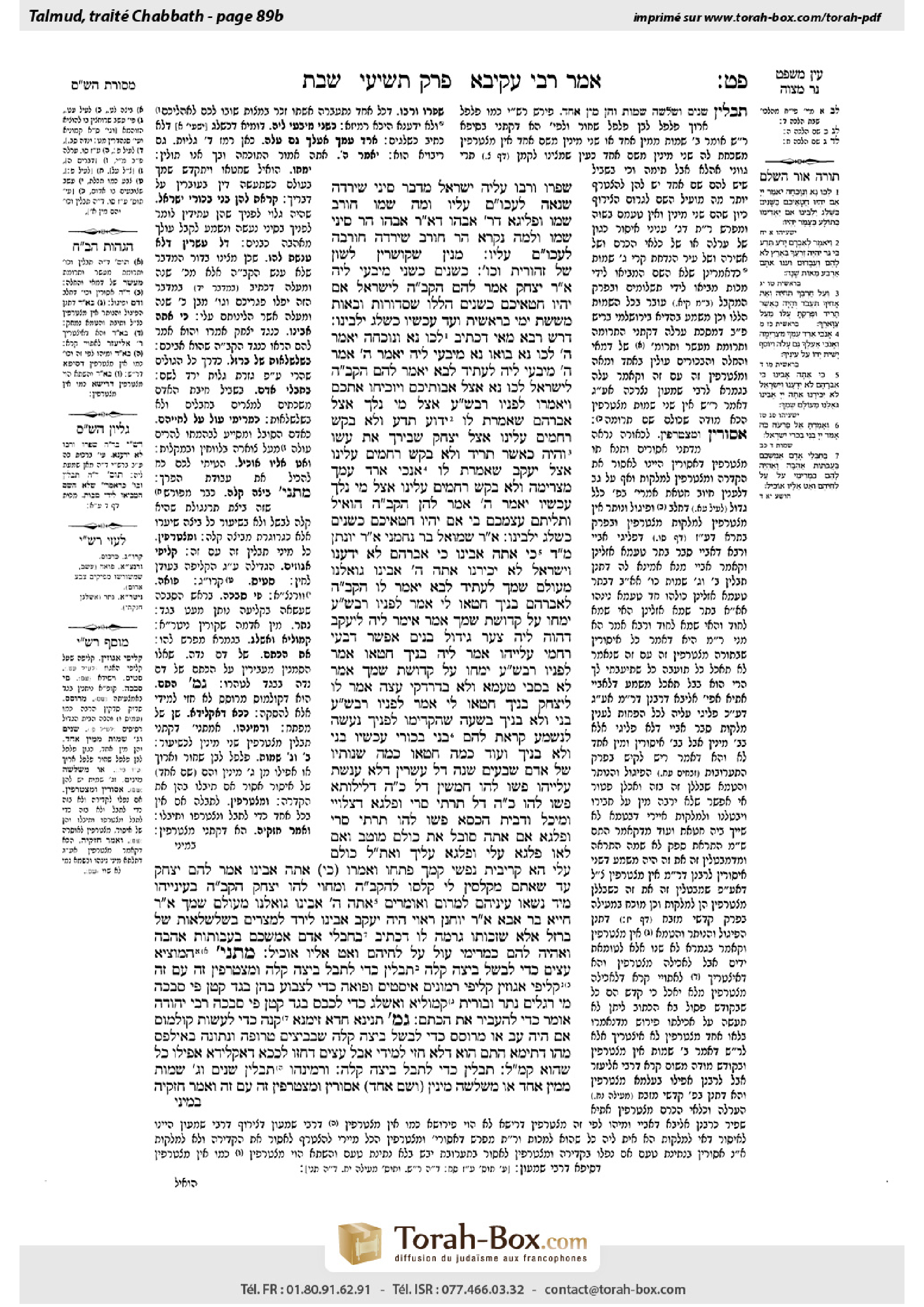
Shabbat 89b: Talmud study for Daf Yomi
Daf Yomi is the daily study of one Talmud folio. Explore 37 tractates with scans, Hebrew text, Sefaria English and AI-generated French translations where annotated.
Passage selection and English or AI-generated French translation are available where the scan has annotations. Daf Study is independent of Torah-Box and Sefaria.
Browse Shabbat · שבת · All tractatesShabbat 89b text and translations
This page of Shabbat includes the Aramaic text, an English translation and an AI-generated French translation, alongside the scan above.
שבת פ״ט ב · Aramaic and Hebrew text
שֶׁפָּרוּ וְרָבוּ יִשְׂרָאֵל עָלָיו; מִדְבַּר סִינַי — שֶׁיָּרְדָה שִׂנְאָה לְאוּמּוֹת הָעוֹלָם עָלָיו. וּמָה שְׁמוֹ? ״חוֹרֵב״ שְׁמוֹ. וּפְלִיגָא דְּרַבִּי אֲבָהוּ, דְּאָמַר רַבִּי אֲבָהוּ: ״הַר סִינַי״ שְׁמוֹ. וְלָמָּה נִקְרָא ״הַר חוֹרֵב״ — שֶׁיָּרְדָה חוֹרְבָּה לְאוּמּוֹת הָעוֹלָם עָלָיו.
מִנַּיִן שֶׁקּוֹשְׁרִין לָשׁוֹן שֶׁל זְהוֹרִית וְכוּ׳. ״כַּשָּׁנִים״? ״כַּשָּׁנִי״ מִיבְּעֵי לֵיהּ! אָמַר רַבִּי יִצְחָק, אָמַר לָהֶם הַקָּדוֹשׁ בָּרוּךְ הוּא לְיִשְׂרָאֵל: אִם יִהְיוּ חֲטָאֵיכֶם כַּשָּׁנִים הַלָּלוּ שֶׁסְּדוּרוֹת וּבָאוֹת מִשֵּׁשֶׁת יְמֵי בְּרֵאשִׁית וְעַד עַכְשָׁיו — כַּשֶּׁלֶג יַלְבִּינוּ. דָּרֵשׁ רָבָא, מַאי דִּכְתִיב: ״לְכוּ נָא וְנִוָּכְחָה יֹאמַר ה׳״ — ״לְכוּ נָא״? ״בּוֹאוּ נָא״ מִיבְּעֵי לֵיהּ! ״יֹאמַר ה׳״? ״אָמַר ה׳״ מִיבְּעֵי לֵיהּ! לֶעָתִיד לָבֹא יֹאמַר לָהֶם הַקָּדוֹשׁ בָּרוּךְ הוּא לְיִשְׂרָאֵל: לְכוּ נָא אֵצֶל אֲבוֹתֵיכֶם וְיוֹכִיחוּ אֶתְכֶם.
וְיֹאמְרוּ לְפָנָיו: רִבּוֹנוֹ שֶׁל עוֹלָם אֵצֶל מִי נֵלֵךְ? אֵצֶל אַבְרָהָם שֶׁאָמַרְתָּ לוֹ ״יָדֹעַ תֵּדַע״ וְלֹא בִּקֵּשׁ רַחֲמִים עָלֵינוּ?! אֵצֶל יִצְחָק שֶׁבֵּירַךְ אֶת עֵשָׂו ״וְהָיָה כַּאֲשֶׁר תָּרִיד״ וְלֹא בִּקֵּשׁ רַחֲמִים עָלֵינוּ?! אֵצֶל יַעֲקֹב שֶׁאָמַרְתָּ לוֹ ״אָנֹכִי אֵרֵד עִמְּךָ מִצְרַיְמָה״ וְלֹא בִּקֵּשׁ רַחֲמִים עָלֵינוּ?! אֵצֶל מִי נֵלֵךְ? עַכְשָׁיו ״יֹאמַר ה׳״. אָמַר לָהֶן הַקָּדוֹשׁ בָּרוּךְ הוּא: הוֹאִיל וּתְלִיתֶם עַצְמְכֶם בִּי — ״אִם יִהְיוּ חֲטָאֵיכֶם כַּשָּׁנִים כַּשֶּׁלֶג יַלְבִּינוּ״.
אָמַר רַבִּי שְׁמוּאֵל בַּר נַחְמָנִי אָמַר רַבִּי יוֹנָתָן: מַאי דִּכְתִיב: ״כִּי אַתָּה אָבִינוּ כִּי אַבְרָהָם לֹא יְדָעָנוּ וְיִשְׂרָאֵל לֹא יַכִּירָנוּ אַתָּה ה׳ אָבִינוּ גּוֹאֲלֵנוּ מֵעוֹלָם שְׁמֶךָ״ — לְעָתִיד לָבֹא יֹאמַר לוֹ הַקָּדוֹשׁ בָּרוּךְ הוּא לְאַבְרָהָם: בָּנֶיךָ חָטְאוּ לִי. אֹמֵר לְפָנָיו: רִבּוֹנוֹ שֶׁל עוֹלָם, יִמָּחוּ עַל קְדוּשַּׁת שְׁמֶךָ. אָמַר: אֵימַר לֵיהּ לְיַעֲקֹב דַּהֲוָה לֵיהּ צַעַר גִּידּוּל בָּנִים, אֶפְשָׁר דְּבָעֵי רַחֲמֵי עֲלַיְיהוּ. אֲמַר לֵיהּ: בָּנֶיךָ חָטְאוּ. אֹמֵר לְפָנָיו: רִבּוֹנוֹ שֶׁל עוֹלָם, יִמָּחוּ עַל קְדוּשַּׁת שְׁמֶךָ. אָמַר לָא בְּסָבֵי טַעְמָא וְלָא בְּדַרְדַּקֵּי עֵצָה. אֹמֵר לוֹ לְיִצְחָק: בָּנֶיךָ חָטְאוּ לִי. אֹמֵר לְפָנָיו: רִבּוֹנוֹ שֶׁל עוֹלָם, בָּנַי וְלֹא בָּנֶיךָ?! בְּשָׁעָה שֶׁהִקְדִּימוּ לְפָנֶיךָ ״נַעֲשֶׂה״ לְ״נִשְׁמָע״ קָרָאתָ לָהֶם ״בְּנִי בְכוֹרִי״, עַכְשָׁיו בָּנַי וְלֹא בָּנֶיךָ?!
וְעוֹד, כַּמָּה חָטְאוּ? כַּמָּה שְׁנוֹתָיו שֶׁל אָדָם — שִׁבְעִים שָׁנָה. דַּל עֶשְׂרִין דְּלָא עָנְשַׁתְּ עֲלַיְיהוּ — פָּשׁוּ לְהוּ חַמְשִׁין. דַּל עֶשְׂרִין וְחַמְשָׁה דְּלֵילָוָתָא — פָּשׁוּ לְהוּ עֶשְׂרִין וְחַמְשָׁה. דַּל תַּרְתֵּי סְרֵי וּפַלְגָא דְּצַלּוֹיֵי וּמֵיכַל וּדְבֵית הַכִּסֵּא — פָּשׁוּ לְהוּ תַּרְתֵּי סְרֵי וּפַלְגָא, אִם אַתָּה סוֹבֵל אֶת כּוּלָּם — מוּטָב, וְאִם לָאו — פַּלְגָא עֲלַי וּפַלְגָא עֲלָיךְ. וְאִם תִּמְצָא לוֹמַר כּוּלָּם עָלַי — הָא קָרֵיבִית נַפְשִׁי קַמָּךְ. פּוֹתְחִין וְאוֹמְרִין: ״כִּי אַתָּה אָבִינוּ״. אֹמֵר לָהֶם יִצְחָק: עַד שֶׁאַתֶּם מְקַלְּסִין לִי, קַלְּסוּ לְהַקָּדוֹשׁ בָּרוּךְ הוּא, וּמַחְוֵי לְהוּ יִצְחָק לְקוּדְשָׁא בְּרִיךְ הוּא בְּעֵינֵיהּ. מִיָּד נוֹשְׂאִים עֵינֵיהֶם לַמָּרוֹם וְאוֹמְרִים: ״אַתָּה ה׳ אָבִינוּ גּוֹאֲלֵנוּ מֵעוֹלָם שְׁמֶךָ״.
אָמַר רַבִּי חִיָּיא בַּר אַבָּא אָמַר רַבִּי יוֹחָנָן: רָאוּי הָיָה יַעֲקֹב אָבִינוּ לֵירֵד לְמִצְרַיִם בְּשַׁלְשְׁלָאוֹת שֶׁל בַּרְזֶל, אֶלָּא שֶׁזְּכוּתוֹ גָּרְמָה לוֹ, דִּכְתִיב: ״בְּחַבְלֵי אָדָם אֶמְשְׁכֵם בַּעֲבֹתוֹת אַהֲבָה וָאֶהְיֶה לָהֶם כִּמְרִימֵי עֹל עַל לְחֵיהֶם וְאַט אֵלָיו אוֹכִיל״.
מַתְנִי׳ הַמּוֹצִיא עֵצִים — כְּדֵי לְבַשֵּׁל בֵּיצָה קַלָּה. תַּבְלִין — כְּדֵי לְתַבֵּל בֵּיצָה קַלָּה. וּמִצְטָרְפִין זֶה עִם זֶה. קְלִיפֵּי אֱגוֹזִין, קְלִיפֵּי רִמּוֹנִים, אֶיסְטֵיס וּפוּאָה — כְּדֵי לִצְבּוֹעַ בָּהֶן בֶּגֶד קָטָן פִּי סְבָכָה. מֵי רַגְלַיִם, נֶתֶר וּבוֹרִית, קִמוֹלְיָא וְאַשְׁלָג — כְּדֵי לְכַבֵּס בֶּגֶד קָטָן פִּי סְבָכָה, רַבִּי יְהוּדָה אוֹמֵר: כְּדֵי לְהַעֲבִיר אֶת הַכֶּתֶם.
גְּמָ׳ תְּנֵינָא חֲדָא זִימְנָא! קָנֶה — כְּדֵי לַעֲשׂוֹת קוּלְמוֹס, אִם הָיָה עָב אוֹ מְרוּסָּס — כְּדֵי לְבַשֵּׁל בֵּיצָה קַלָּה שֶׁבַּבֵּיצִים, טְרוּפָה וּנְתוּנָה בָּאִילְפָּס. מַהוּ דְּתֵימָא: הָתָם הוּא דְּלָא חֲזֵי לְמִידֵּי, אֲבָל עֵצִים דַּחֲזוּ לְכַכָּא דְאַקְלִידָא אֲפִילּוּ כָּל שֶׁהוּא, קָא מַשְׁמַע לַן.
תַּבְלִין כְּדֵי לְתַבֵּל בֵּיצָה קַלָּה. וּרְמִינְהוּ: תַּבְלִין, שְׁנַיִם וּשְׁלֹשָׁה שֵׁמוֹת מִמִּין אֶחָד, אוֹ מִשְּׁלֹשָׁה מִינִין וְשֵׁם אֶחָד — אֲסוּרִין, וּמִצְטָרְפִין זֶה עִם זֶה. וְאָמַר חִזְקִיָּה:
Shabbat 89b · English translation
because the Jewish people were fruitful [paru] and multiplied in it; the Sinai Desert, because hatred descended upon the nations of the world on it, on the mountain on which the Jewish people received the Torah. And what is the mountain’s true name? Horeb is its name. And that disputes the opinion of Rabbi Abbahu, as Rabbi Abbahu said: Mount Sinai is its name. And why is it called Mount Horeb? It is because destruction [ḥurba] of the nations of the world descended upon it.
We learned in the mishna: From where is it derived that one ties a scarlet strip of wool to the scapegoat? As it says: “If your sins be like scarlet [kashanim], they will become white like snow” (Isaiah 1:18). The Gemara wonders at this: Why does the verse use the plural form: Kashanim? It should have used the singular form: Kashani. Rabbi Yitzḥak said that the Holy One, Blessed be He, said to the Jewish people: Even if your sins are as numerous as those years [kashanim] that have proceeded continuously from the six days of Creation until now, they will become white like snow. Rava taught: What is the meaning of that which is written: “Go please and let us reason together, the Lord will say” (Isaiah 1:18)? Why does the verse say: Go please? It should have said: Come please. And why does the verse say: The Lord will say? The prophet’s message is based on something that God already said. Therefore, the verse should have said: God said. Rather, the explanation of this verse is that in the future that will surely come, the Holy One, Blessed be He, will say to the Jewish people: Go please to your Patriarchs, and they will rebuke you.
And the Jewish people will say before Him: Master of the Universe, to whom shall we go? Shall we go to Abraham, to whom You said: “Know certainly that your seed shall be a stranger in a land that is not theirs, and shall serve them; and they shall afflict them four hundred years” (Genesis 15:13), and he did not ask for mercy on our behalf? Or perhaps we should go to Isaac, who blessed Esau and said: “And it shall come to pass when you shall break loose, that you shall shake his yoke from off your neck” (Genesis 27:40), and he did not ask for mercy on our behalf. Or perhaps we should go to Jacob, to whom You said: “I will go down to Egypt with you” (Genesis 46:4), and he did not ask for mercy on our behalf. And if so, to whom shall we go? Shall we go to our Patriarchs, who do not have mercy on us? Rather, now God Himself says what punishment we deserve. The Holy One, Blessed be He, said to them: Since you made yourselves dependent on Me, “If your sins be like scarlet, they will become white like snow.”
Apropos the Jewish people assessing their forefathers, the Gemara cites a related teaching. Rabbi Shmuel bar Naḥmani said that Rabbi Yonatan said: What is the meaning of that which is written: “For You are our Father; for Abraham knows us not, and Israel does not acknowledge us; You, Lord, are our Father, our Redeemer, everlasting is Your name” (Isaiah 63:16)? In the future that will surely come, the Holy One, Blessed be He, will say to Abraham: Your children have sinned against Me. Abraham will say before Him: Master of the Universe, if so, let them be eradicated to sanctify Your name. God said: I will say it to Jacob. Since he experienced the pain of raising children, perhaps he will ask for mercy on their behalf. He said to Jacob: Your children have sinned. Jacob said before Him: Master of the Universe, if so, let them be eradicated to sanctify Your name. The Holy One, Blessed be He, said: There is no reason in elders and no wisdom in youth. Neither Abraham nor Jacob knew how to respond properly. He said to Isaac: Your children have sinned against Me. Isaac said before Him: Master of the Universe, are they my children and not Your children? At Sinai, when they accorded precedence to “We will do” over “We will listen” before You, didn’t You call them, “My son, My firstborn son Israel” (Exodus 4:22)? Now that they have sinned, are they my children and not Your children?
And furthermore, how much did they actually sin? How long is a person’s life? Seventy years. Subtract the first twenty years of his life. One is not punished for sins committed then, as in heavenly matters, a person is only punished from age twenty. Fifty years remain for them. Subtract twenty-five years of nights, and twenty-five years remain for them. Subtract twelve and a half years during which one prays and eats and uses the bathroom, and twelve and a half years remain for them. If You can endure them all and forgive the sins committed during those years, excellent. And if not, half of the sins are upon me to bear and half upon You. And if You say that all of them, the sins of all twelve and a half years that remain, are upon me, I sacrificed my soul before You and You should forgive them due to my merit. The Jewish people began to say to Isaac: You are our father. Only Isaac defended the Jewish people as a father would and displayed compassion toward his children. Isaac said to them: Before you praise me, praise the Holy One, Blessed be He. And Isaac points to the Holy One, Blessed be He, before their eyes. Immediately they lifted their eyes to the heavens and say: “You, Lord, are our Father, our Redeemer, everlasting is Your name.”
And since the Gemara mentioned Jacob’s descent to Egypt, the Gemara cites that which Rabbi Ḥiyya bar Abba said that Rabbi Yoḥanan said: Our father Jacob should have gone down to Egypt in iron chains as would an exile against his will, as decreed by God and related to Abraham. However, his merit caused him to descend without suffering, as it is written: “I drew them with cords of man, with bands of love, and I was to them as they that take off the yoke on their jaws, and I fed them gently” (Hosea 11:4).
MISHNA: After an extended digression for a discussion of matters unrelated to the halakhot of Shabbat, this mishna resumes treatment of the halakhot of carrying from domain to domain on Shabbat. One who carries out wood on Shabbat is liable for a measure equivalent to the amount of wood necessary to cook an easily cooked egg. The measure that determines liability for carrying out spices is equivalent to that which is used to season an easily cooked egg. And all types of spices join together with one another to constitute the measure for liability. The measure that determines liability for carrying out nutshells, pomegranate peels, safflower, and madder, which are used to produce dyes, is equivalent to the amount that is used to dye a small garment placed atop a woman’s hairnet. The measure that determines liability for carrying out urine, natron, and borit, cimolian earth [Kimoleya], and potash, all of which are abrasive materials used for laundry, is equivalent to the amount that is used to launder a small garment placed atop a woman’s hairnet. And Rabbi Yehuda says: The measure that determines liability for these materials is equivalent to that which is used to remove a stain.
GEMARA: With regard to the measure of wood, the Gemara asks: Didn’t we already learn it once? As we learned in a mishna: The measure that determines liability for carrying out a reed is equivalent to that which is used to make a quill. And if the reed was thick and unfit for writing, or if it was fragmented, the measure that determines its liability is equivalent to that which is used to cook an egg most easily cooked, one that is already beaten and placed in a stew pot. The measure of firewood is clearly delineated. The Gemara answers: Still, this mishna is necessary. You might have said: There, the measure of the crushed reed reflects the fact that it is not suitable for anything other than kindling. However, regarding wood that is suitable to be used as a tooth of a key [aklida], the measure that determines its liability should be even any small amount. Therefore, it teaches us that wood is typically designated for burning, and that determines the measure for liability for carrying out wood on Shabbat.
We learned in the mishna that all types of spices join together with one another to constitute the measure equivalent to that which is used to season an easily cooked egg. The Gemara raises a contradiction from that which we learned elsewhere: Spices, which are prohibited due to two or three different prohibitions, e.g., one is prohibited due to orla, and one due to the prohibition of untithed produce, and they were all of a single species (Tosafot), or if they were of three different species, are prohibited, and they join together with each other to constitute a complete measure. And Ḥizkiya said:
Shabbat 89b · Traduction française (IA)
parce que le peuple juif y fut fécond [paru] et se multiplia ; le désert du Sinaï, parce que la haine s’abattit sur les nations du monde à cause de lui, sur la montagne où le peuple juif reçut la Torah. Et quel est le véritable nom de cette montagne ? Elle s’appelle Horeb. Cela contredit l’opinion de Rabbi Abbahou, car Rabbi Abbahou a dit : Elle s’appelle mont Sinaï. Et pourquoi l’appelle-t-on mont Horeb ? Parce que la destruction [ḥurba] des nations du monde s’abattit sur lui.
Nous avons appris dans la Michna : D’où déduit-on qu’on attache un fil de laine écarlate au bouc émissaire ? Comme il est dit : « Si vos péchés sont comme l’écarlate [kashanim], ils deviendront blancs comme la neige » (Isaïe 1,18). La Guemara s’interroge : Pourquoi le verset emploie-t-il la forme plurielle kashanim ? Il aurait dû employer la forme singulière kashani. Rabbi Yitzḥak dit que le Saint, béni soit-Il, a dit au peuple juif : Même si vos péchés sont aussi nombreux que ces années [kashanim] qui se sont écoulées sans interruption depuis les six jours de la Création jusqu’à maintenant, ils deviendront blancs comme la neige. Rava enseigna : Quel est le sens de ce qui est écrit : « Allons donc, raisonnons ensemble, dit le Seigneur » (Isaïe 1,18) ? Pourquoi le verset dit-il : « Allons donc » ? Il aurait dû dire : « Venez donc ». Et pourquoi le verset dit-il : « dit le Seigneur » ? Le message du prophète se fonde sur quelque chose que Dieu a déjà dit. Le verset aurait donc dû dire : « Dieu a dit ». L’explication de ce verset est plutôt la suivante : dans l’avenir assuré, le Saint, béni soit-Il, dira au peuple juif : Allez donc trouver vos Patriarches, et ils vous réprimanderont.
Et le peuple juif lui dira : Maître de l’Univers, vers qui devons-nous aller ? Devons-nous aller voir Abraham, à qui Tu as dit : « Sache bien que ta descendance séjournera dans un pays qui ne sera pas le sien, et qu’on la soumettra à l’esclavage et qu’on l’opprimera pendant quatre cents ans » (Genèse 15,13), et qui n’a pas demandé grâce en notre faveur ? Ou peut-être devons-nous aller voir Isaac, qui a béni Ésaü et lui a dit : « Et quand tu te libéreras, tu secoueras son joug de dessus ton cou » (Genèse 27,40), et qui n’a pas demandé grâce en notre faveur. Ou peut-être devons-nous aller voir Jacob, à qui Tu as dit : « Je descendrai en Égypte avec toi » (Genèse 46,4), et qui n’a pas demandé grâce en notre faveur. Alors, vers qui devons-nous aller ? Devons-nous aller voir nos Patriarches, qui n’ont pas pitié de nous ? Dieu lui-même dira plutôt maintenant quelle punition nous méritons. Le Saint, béni soit-Il, leur dit : Puisque vous vous en remettez à Moi, « si vos péchés sont comme l’écarlate, ils deviendront blancs comme la neige ».
À propos du peuple juif qui juge ses ancêtres, la Guemara cite un enseignement apparenté. Rabbi Shmuel bar Naḥmani a dit au nom de Rabbi Yonatan : Quel est le sens de ce qui est écrit : « Car Tu es notre Père ; Abraham ne nous connaît pas, et Israël ne nous reconnaît pas ; Toi, Seigneur, Tu es notre Père, notre Rédempteur, tel est depuis toujours Ton nom » (Isaïe 63,16) ? Dans l’avenir assuré, le Saint, béni soit-Il, dira à Abraham : Tes enfants ont péché contre Moi. Abraham lui dira : Maître de l’Univers, dans ce cas, qu’ils soient anéantis afin de sanctifier Ton nom. Dieu dira : Je vais le dire à Jacob. Puisqu’il a connu la peine d’élever des enfants, peut-être demandera-t-il grâce en leur faveur. Il dit à Jacob : Tes enfants ont péché. Jacob lui dit : Maître de l’Univers, dans ce cas, qu’ils soient anéantis afin de sanctifier Ton nom. Le Saint, béni soit-Il, dit : Il n’y a ni raison chez les anciens ni sagesse chez les jeunes. Ni Abraham ni Jacob n’ont su répondre comme il convenait. Il dit à Isaac : Tes enfants ont péché contre Moi. Isaac lui dit : Maître de l’Univers, sont-ils mes enfants et non les Tiens ? Au Sinaï, lorsqu’ils ont fait passer « Nous ferons » avant « Nous écouterons » devant Toi, ne les as-Tu pas appelés « Mon fils, Mon premier-né, Israël » (Exode 4,22) ? Maintenant qu’ils ont péché, seraient-ils mes enfants et non les Tiens ?
Et de plus, quelle a été l’ampleur réelle de leurs péchés ? Quelle est la durée de vie d’un homme ? Soixante-dix ans. Retranchez les vingt premières années de sa vie. On n’est pas puni pour les péchés commis alors, car, dans les affaires célestes, un homme n’est puni qu’à partir de l’âge de vingt ans. Il leur reste cinquante ans. Retranchez vingt-cinq ans de nuits : il leur reste vingt-cinq ans. Retranchez douze ans et demi, pendant lesquels on prie, on mange et on va aux toilettes : il leur reste douze ans et demi. Si Tu peux les supporter tous et pardonner les péchés commis durant ces années, tant mieux. Sinon, la moitié des péchés m’incombe et l’autre moitié T’incombe. Et si Tu dis que tous les péchés des douze ans et demi qui restent m’incombent, j’ai offert ma vie devant Toi ; pardonne-les donc en raison de mon mérite. Le peuple juif se mit à dire à Isaac : Tu es notre père. Isaac fut le seul à défendre le peuple juif comme un père le ferait et à témoigner de la compassion envers ses enfants. Isaac leur dit : Avant de me louer, louez le Saint, béni soit-Il. Et Isaac désigne le Saint, béni soit-Il, devant leurs yeux. Aussitôt, ils levèrent les yeux vers les cieux et dirent : « Toi, Seigneur, Tu es notre Père, notre Rédempteur, tel est depuis toujours Ton nom ».
Et puisque la Guemara a mentionné la descente de Jacob en Égypte, elle cite ce que Rabbi Ḥiyya bar Abba a dit au nom de Rabbi Yoḥanan : Notre père Jacob aurait dû descendre en Égypte en chaînes de fer, comme un exilé contre sa volonté, ainsi que Dieu l’avait décrété et annoncé à Abraham. Mais son mérite lui permit d’y descendre sans souffrir, comme il est écrit : « Je les attirais avec des liens humains, avec des cordes d’amour ; j’étais pour eux comme ceux qui soulèvent le joug de leurs mâchoires, et je leur donnais doucement à manger » (Osée 11,4).
MICHNA : Après une longue digression consacrée à des sujets sans rapport avec les halakhot de Chabbat, cette Michna reprend l’étude des halakhot du transport d’un domaine à un autre pendant Chabbat. Celui qui sort du bois pendant Chabbat est passible si la quantité équivaut à celle nécessaire pour faire cuire un œuf qui cuit facilement. La quantité déterminant la responsabilité pour le transport d’épices équivaut à celle utilisée pour assaisonner un œuf qui cuit facilement. Toutes les sortes d’épices s’additionnent entre elles pour atteindre la quantité déterminant la responsabilité. La quantité déterminant la responsabilité pour le transport de coquilles de noix, de peaux de grenade, de carthame et de garance, qui servent à produire des teintures, équivaut à celle utilisée pour teindre un petit vêtement placé sur le filet à cheveux d’une femme. La quantité déterminant la responsabilité pour le transport d’urine, de natron, de borit, de terre cimolienne [Kimoleya] et de potasse, qui sont tous des produits abrasifs servant à la lessive, équivaut à celle utilisée pour laver un petit vêtement placé sur le filet à cheveux d’une femme. Rabbi Yehouda dit : La quantité déterminant la responsabilité pour ces matières équivaut à celle qui sert à enlever une tache.
GUEMARA : Au sujet de la quantité de bois, la Guemara demande : Ne l’avons-nous pas déjà apprise ? Nous avons appris dans une Michna : La quantité déterminant la responsabilité pour le transport d’un roseau équivaut à celle qui sert à fabriquer une plume. Si le roseau était épais et impropre à l’écriture, ou s’il était fragmenté, la quantité déterminant la responsabilité équivaut à celle nécessaire pour cuire un œuf qui cuit le plus facilement, c’est-à-dire déjà battu et placé dans une marmite de ragoût. La quantité de bois de chauffage est clairement définie. La Guemara répond : Cette Michna est néanmoins nécessaire. On aurait pu dire : Là, la quantité concernant le roseau fragmenté reflète le fait qu’il ne convient à rien d’autre qu’à servir de petit bois. En revanche, pour du bois pouvant servir de dent de clé [aklida], la quantité déterminant la responsabilité devrait être le moindre morceau. Elle nous enseigne donc que le bois est généralement destiné à être brûlé, et que cela détermine la quantité entraînant la responsabilité pour le transport de bois pendant Chabbat.
Nous avons appris dans la Michna que toutes les sortes d’épices s’additionnent entre elles pour atteindre la quantité équivalant à celle qui sert à assaisonner un œuf qui cuit facilement. La Guemara soulève une contradiction à partir de ce que nous avons appris ailleurs : Des épices interdites en raison de deux ou trois interdictions différentes — par exemple, l’une est interdite au titre de l’orla, une autre en raison de l’interdiction des produits dont la dîme n’a pas été prélevée, et elles sont toutes d’une même espèce (Tosafot), ou bien elles sont de trois espèces différentes — sont interdites, et elles s’additionnent entre elles pour constituer une quantité complète. Et Ḥizkiya a dit :
Traduction française générée par IA à partir de l’édition anglaise de Sefaria. Vérifie toujours un passage avec le texte source.
Text from Sefaria: William Davidson Edition - Vocalized Aramaic (CC BY NC); William Davidson Edition - English (CC BY NC).