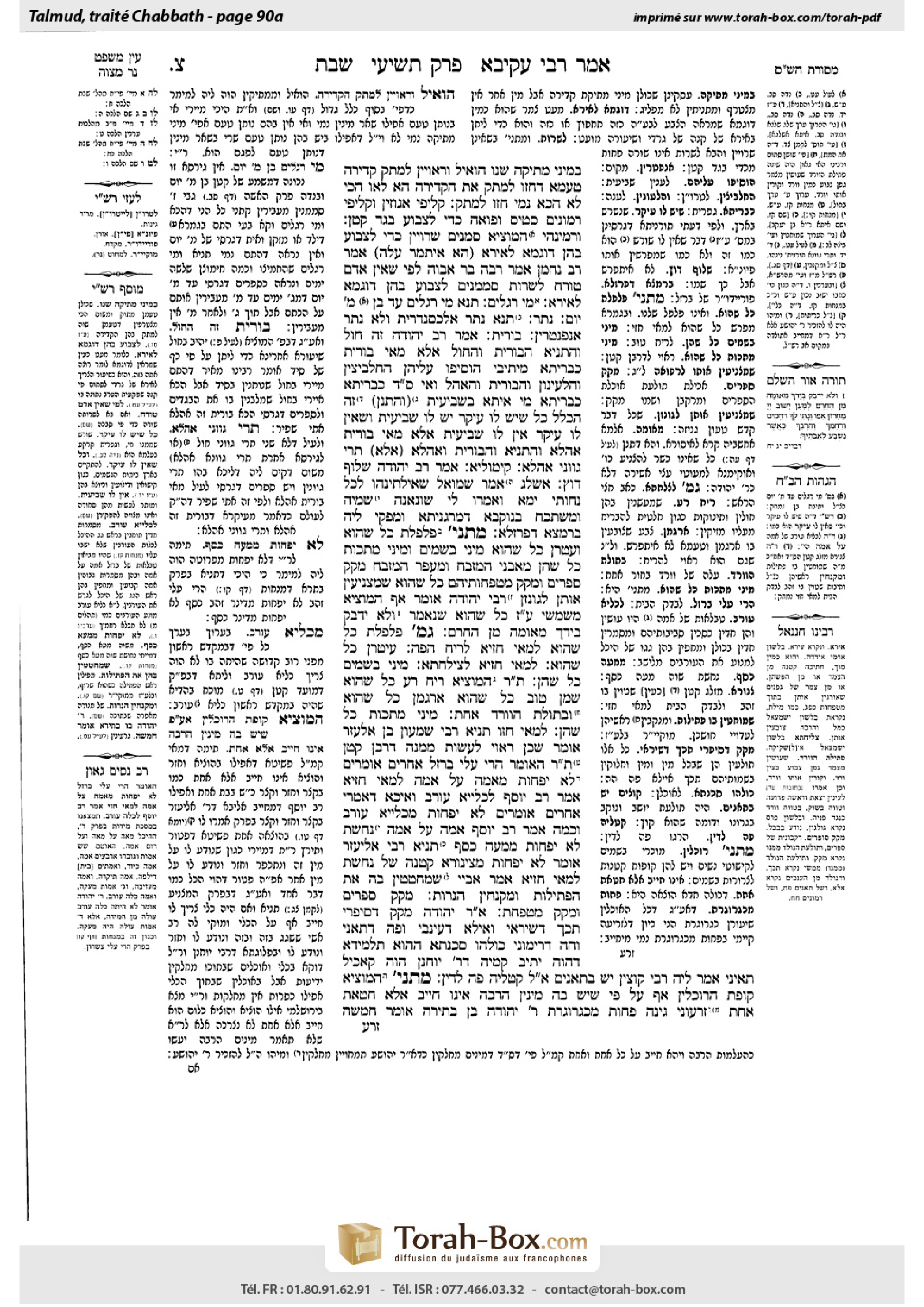
Shabbat 90a: Talmud study for Daf Yomi
Daf Yomi is the daily study of one Talmud folio. Explore 37 tractates with scans, Hebrew text, Sefaria English and AI-generated French translations where annotated.
Passage selection and English or AI-generated French translation are available where the scan has annotations. Daf Study is independent of Torah-Box and Sefaria.
Browse Shabbat · שבת · All tractatesShabbat 90a text and translations
This page of Shabbat includes the Aramaic text, an English translation and an AI-generated French translation, alongside the scan above.
שבת צ׳ א · Aramaic and Hebrew text
בְּמִינֵי מְתִיקָה שָׁנוּ, הוֹאִיל וּרְאוּיִין לְמַתֵּק קְדֵירָה. טַעְמָא דַּחֲזוּ לְמַתֵּק אֶת הַקְּדֵירָה, הָא לָאו הָכִי — לָא! הָכָא נָמֵי חֲזוּ לְמַתֵּק.
קְלִיפֵּי אֱגוֹזִין וּקְלִיפֵּי רִמּוֹנִים סְטֵיס וּפוּאָה — כְּדֵי לִצְבּוֹעַ בֶּגֶד קָטָן. וּרְמִינְהִי: הַמּוֹצִיא סַמָּנִים שְׁרוּיִין — כְּדֵי לִצְבּוֹעַ בָּהֶן דּוּגְמָא לְאִירָא! הָא אִיתְּמַר עֲלַהּ, אָמַר רַב נַחְמָן אָמַר רַבָּה בַּר אֲבוּהּ: לְפִי שֶׁאֵין אָדָם טוֹרֵחַ לִשְׁרוֹת סַמְמָנִים לִצְבּוֹעַ בָּהֶן דּוּגְמָא לְאִירָא.
מֵי רַגְלַיִם. תָּנָא: מֵי רַגְלַיִם עַד בֶּן אַרְבָּעִים יוֹם. נֶתֶר. תָּנָא: נֶתֶר אֲלֶכְּסַנְדְּרִית, וְלֹא נֶתֶר אַנְפַּנְטְרִין. בּוֹרִית. אָמַר רַב יְהוּדָה: זֶה חוֹל. וְהָתַנְיָא: הַבּוֹרִית וְהַחוֹל! אֶלָּא: מַאי בּוֹרִית — כַּבְרִיתָא.
מֵיתִיבִי, הוֹסִיפוּ עֲלֵיהֶן הַחַלְבֵּיצִין וְהַלְּעִינִין וְהַבּוֹרִית וְהָאָהָל. וְאִי סָלְקָא דַעְתָּךְ כַּבְרִיתָא, כַּבְרִיתָא מִי אִיתָא בִּשְׁבִיעִית?! וְהָתְנַן: זֶה הַכְּלָל, כׇּל שֶׁיֵּשׁ לוֹ עִיקָּר — יֵשׁ לוֹ שְׁבִיעִית, וְשֶׁאֵין לוֹ עִיקָּר — אֵין לוֹ שְׁבִיעִית! אֶלָּא מַאי בּוֹרִית — אַהֲלָא. וְהָתַנְיָא: בּוֹרִית וְאַהֲלָא! אֶלָּא תְּרֵי גַּוְונֵי אַהֲלָא.
קִימוֹלְיָא, אָמַר רַב יְהוּדָה: שְׁלוֹף דּוֹץ. אַשְׁלָג, אָמַר שְׁמוּאֵל: שְׁאֵילְתִּינְהוּ לְכֹל נָחוֹתֵי יַמָּא, וַאֲמַרוּ לִי ״שׁוּנָאגָא״ שְׁמֵיהּ, וּמִשְׁתְּכַח בְּנוּקְבָּא דְמַרְגָּנִיתָא, וּמַפְּקִי לֵיהּ בְּרִמְצָא דְפַרְזְלָא.
מַתְנִי׳ פִּלְפֶּלֶת — כׇּל שֶׁהוּא, וְעִטְרָן — כׇּל שֶׁהוּא. מִינֵי בְשָׂמִים וּמִינֵי מַתָּכוֹת — כׇּל שֶׁהֵן. מֵאַבְנֵי הַמִּזְבֵּחַ וּמֵעֲפַר הַמִּזְבֵּחַ, מְקַק סְפָרִים וּמְקַק מִטְפְּחוֹתֵיהֶם — כׇּל שֶׁהוּא, שֶׁמַּצְנִיעִין אוֹתָן לְגוֹנְזָן. רַבִּי יְהוּדָה אוֹמֵר: אַף הַמּוֹצִיא מְשַׁמְּשֵׁי עֲבוֹדָה זָרָה — כׇּל שֶׁהוּא, שֶׁנֶּאֱמַר: ״וְלֹא יִדְבַּק בְּיָדְךָ מְאוּמָה מִן הַחֵרֶם״.
גְּמָ׳ פִּלְפֶּלֶת כׇּל שֶׁהוּא לְמַאי חַזְיָא? לְרֵיחַ הַפֶּה. עִיטְרָן כׇּל שֶׁהוּא לְמַאי חֲזֵי? לְצִילְחֲתָא. מִינֵי בְּשָׂמִים — כׇּל שֶׁהֵן. תָּנוּ רַבָּנַן: הַמּוֹצִיא רֵיחַ רַע — כׇּל שֶׁהוּא. שֶׁמֶן טוֹב — כׇּל שֶׁהוּא. אַרְגָּמָן — כׇּל שֶׁהוּא. וּבְתוּלַת הַוֶּורֶד — אַחַת.
מִינֵי מַתָּכוֹת — כׇּל שֶׁהֵן. לְמַאי חֲזוּ? תַּנְיָא, רַבִּי שִׁמְעוֹן בֶּן אֶלְעָזָר אוֹמֵר: שֶׁכֵּן רָאוּי לַעֲשׂוֹת מִמֶּנָּה דׇּרְבָן קָטָן.
תָּנוּ רַבָּנַן: הָאוֹמֵר ״הֲרֵי עָלַי בַּרְזֶל״, אֲחֵרִים אוֹמְרִים: לֹא יִפְחוֹת מֵאַמָּה עַל אַמָּה. לְמַאי חַזְיָא? אָמַר רַב יוֹסֵף: לְכָלְיָיא עוֹרֵב. וְאִיכָּא דְאָמְרִי, אֲחֵרִים אוֹמְרִים: לֹא יִפְחוֹת מִכָּלְיָיא עוֹרֵב. וְכַמָּה? אָמַר רַב יוֹסֵף: אַמָּה עַל אַמָּה. נְחֹשֶׁת, לֹא יִפְחוֹת מִמָּעָה כֶּסֶף. תַּנְיָא רַבִּי אֱלִיעֶזֶר אוֹמֵר: לֹא יִפְחוֹת מִצִּינּוֹרָא קְטַנָּה שֶׁל נְחֹשֶׁת. לְמַאי חַזְיָא? אָמַר אַבָּיֵי: שֶׁמְּחַטְּטִין בָּהּ אֶת הַפְּתִילוֹת וּמְקַנְּחִין הַנֵּרוֹת.
מְקַק סְפָרִים וּמְקַק מִטְפָּחֹת. אָמַר רַבִּי יְהוּדָה: מְקָק דְּסִיפְרֵי, תְּכָךְ דְּשִׁירָאֵי, וְאַיְלָא דְעִינְבֵי, וּפָהּ דִּתְאֵנֵי, וְהָהּ דְּרִימּוֹנֵי — כּוּלְּהוּ סַכַּנְתָּא. הָהוּא תַּלְמִידָא דַּהֲוָה יָתֵיב קַמֵּיהּ דְּרַבִּי יוֹחָנָן, הֲוָה קָאָכֵיל תְּאֵינֵי. אֲמַר לֵיהּ: רַבִּי, קוֹצִין יֵשׁ בַּתְּאֵנִים? אֲמַר (לֵיהּ): קַטְלֵיהּ פָּהּ לְדֵין.
מַתְנִי׳ הַמּוֹצִיא קוּפַּת הָרוֹכְלִין, אַף עַל פִּי שֶׁיֵּשׁ בָּהּ מִינִין הַרְבֵּה — אֵינוֹ חַיָּיב אֶלָּא חַטָּאת אַחַת. זֵרְעוֹנֵי גִינָּה — פָּחוֹת מִכִּגְרוֹגֶרֶת. רַבִּי יְהוּדָה בֶּן בְּתִירָה אוֹמֵר: חֲמִשָּׁה.
Shabbat 90a · English translation
They taught this halakha in the case of sweet types, because they are fit to be mixed together to sweeten the food in a pot. The Gemara infers: The reason that they join together with one another is that they are suitable to sweeten the food in a pot together. However, if that is not so, then they do not join together with one another. Apparently, spices, in general, do not join together to constitute a complete measure. The Gemara answers: Here, too, the mishna is referring to a case where they are suitable to sweeten the food in a pot.
We learned in the mishna: The measure that determines liability for carrying out nutshells, pomegranate peels, safflower and madder, which are used to produce dyes, is equivalent to that which is used to dye a small garment that is placed atop a woman’s hairnet. And the Gemara raised a contradiction from what we learned elsewhere in a mishna: One who carries out herbs that were soaked in water is liable if he carried out a measure equivalent to the amount used to dye a sample the size of a stopper, for the shuttle of a loom. This refers to a small swath of wool that a weaver places on the loom, as a color sample. The herbs were soaked in water because this was how they were prepared for use as dyes. Apparently, according to this Gemara, the measure for liability is not the amount used to dye a small garment. The Gemara replies: Wasn’t it stated with regard to that mishna that Rav Naḥman said that Rabba bar Avuh said: In the case of soaked dyes, the measure for liability is smaller because a person does not go to the trouble to soak herbs just to dye a sample for the shuttle of a loom. He will only begin soaking herbs to dye a more significant garment. However, for herbs that are soaking and are ready for use as a dye, the measure for liability is smaller, i.e., sufficient to dye a sample.
The mishna mentioned abrasive materials used for laundry, among them urine. The Gemara clarifies the nature of the listed materials. The Sages taught in a baraita: The urine mentioned in the mishna is urine that is up to forty days old. After that, its acidity weakens, rendering it unsuitable for that purpose. With regard to the natron, the Sage taught in a baraita: This refers to Alexandrian natron from the city in Egypt, and not to natron from Anpantrin, which is of a different quality. With regard to the borit mentioned in the mishna, Rav Yehuda said: That is sand. The Gemara asks: Wasn’t it taught in a baraita: Borit and sand? Since both terms are listed, borit cannot be sand. Rather, what is borit? It is sulphur.
The Gemara raises an objection based on plants whose use is prohibited during the Sabbatical year. They added bulbs of ornithogalum and wormwood, and borit, and aloe. And if it would enter your mind to say that borit is sulphur, is there sulphur that is subject to the halakhot of the Sabbatical year? Didn’t we learn in a mishna that this is the principle: Anything that has a root and grows is subject to the halakhot of the Sabbatical year, and anything that does not have a root is not subject to the halakhot of the Sabbatical year. Rather, what is the borit? It is aloe. The Gemara asks: Wasn’t it taught in a baraita: And borit and aloe? Since both terms are listed, borit cannot be aloe. Rather, there are two types of aloe. One of them is called borit.
With regard to the cimolian earth mentioned in the mishna, Rav Yehuda said: This is the earth referred to as pull out stick in [shelof dotz]. With regard to the eshlag mentioned in the mishna, Shmuel said: I asked all of the seafarers with regard to the identity of eshlag, and they told me that it is called shonana, and can be found in the shell of the pearl, and is removed using an iron skewer.
MISHNA: The measure that determines liability for carrying out pepper on Shabbat is any amount. Similarly, the measure that determines liability for carrying out tar is any amount. The measure that determines liability for carrying out various kinds of perfumes and various kinds of metals is any amount. The measure that determines liability for carrying out stones of the altar or earth of the altar, sacred scrolls or their coverings that became tattered due to an insect called mekek that destroys scrolls, and mekek that destroys their coverings, is any amount. That is because people store them in order to bury them, due to their sanctity, and accord significance to even a small measure of those items. Rabbi Yehuda says: Even one who carries out accessories of idolatry on Shabbat is liable for carrying out any amount, as it is stated: “And there shall cleave nothing of the proscribed items to your hand” (Deuteronomy 13:18). Since even the smallest amount is prohibited and must be burned, any amount is significant.
GEMARA: The Gemara asks: For what use is any amount of pepper suited? The Gemara answers: For dispelling mouth odor. For what use is any amount of tar suited? It is suited for curing a headache. We learned in the mishna that one is liable for carrying out any amount of various kinds of perfumes on Shabbat. The Sages taught in a baraita: Even one who carries out an object with a foul odor on Shabbat for medicinal or similar purposes, is liable for carrying out any amount. The measure that determines liability for carrying out fine perfumed oil is any amount. The measure that determines liability for carrying out purple dye is any amount. The measure that determines liability for carrying out a virgin rosebud on Shabbat is one bud.
We learned in the mishna: The measure that determines liability for carrying out various kinds of metals is any amount. The Gemara asks: For what use is any amount of metal suited, that it renders one liable for carrying it out? It was taught in a baraita: Rabbi Shimon ben Elazar says: Because a small amount of iron is fit to make a small nail.
Since the Gemara is discussing the measure that determines liability for carrying out metal on Shabbat, it discusses the related halakhot of objects consecrated to the Temple. The Sages taught in a baraita: In the case of one who vows without specifying an amount, and says: It is incumbent upon me to donate iron to the Temple, Aḥerim say: He must donate no less than a cubit by a cubit of iron. The Gemara asks: For what use is metal that size suited? Rav Yosef said: For a raven impediment. The roof of the Temple was covered with iron surfaces with protruding nails to prevent ravens from perching there. And some say a slightly different version. Aḥerim say: He must donate no less than the iron necessary for a raven impediment. And how much iron is that? Rav Yosef said: A cubit by a cubit. One who vows to donate copper must donate no less than the value of a ma’a of silver. It was taught in a baraita that Rabbi Eliezer says: One must donate no less than the amount needed to forge a small copper hook. The Gemara asks: For what Temple use is that suited? Abaye said: They use it to scrape the wicks from the candelabrum, and clean the lamps with it.
We learned in the mishna: The measure that determines liability for carrying out sacred scrolls or their coverings that became tattered due to an insect called mekek that destroys scrolls, and another type of mekek that destroys their coverings, is any amount. Rabbi Yehuda said: These insects, the mekek that destroys scrolls, the tekhakh that attacks silk, and the ila that eats grapes, and the pe that eats figs, and the ha that eats pomegranates, all pose danger to one who swallows them. The Gemara relates: A certain student was sitting before Rabbi Yoḥanan and was eating figs. The student said to Rabbi Yoḥanan: My teacher, are there thorns in figs? Rabbi Yoḥanan said to him: The pe killed that fellow. The insect in the fig had punctured the student’s throat.
MISHNA: One who carries out a merchant’s basket, even if there are many types of spices and jewelry in it, is obligated to bring only one sin-offering, because he performed only one act of carrying out. The measure that determines liability for carrying out garden seeds on Shabbat is less than a fig-bulk. Rabbi Yehuda ben Beteira says: The measure for liability is five seeds.
Shabbat 90a · Traduction française (IA)
Ils ont enseigné cette halakha à propos des variétés sucrées, car elles peuvent être mélangées pour sucrer ensemble un mets dans une marmite. La Guemara en déduit que si elles s’ajoutent les unes aux autres, c’est parce qu’elles conviennent à sucrer ensemble un mets dans une marmite. Mais si ce n’est pas le cas, elles ne s’ajoutent pas les unes aux autres. Il semble donc que les épices, en général, ne s’additionnent pas pour constituer une mesure complète. La Guemara répond : ici aussi, la Michna parle d’un cas où elles conviennent à sucrer un mets dans une marmite.
Nous avons appris dans la Michna : la mesure qui rend passible celui qui transporte des coques de noix, des écorces de grenade, du carthame et de la garance, utilisés pour produire des teintures, est celle qui suffit à teindre un petit vêtement posé sur le filet à cheveux d’une femme. La Guemara soulève une contradiction à partir de ce que nous avons appris dans une autre Michna : celui qui transporte des herbes qui ont trempé dans l’eau est passible s’il en a transporté une quantité suffisante pour teindre un échantillon de la taille d’un bouchon, destiné à la navette d’un métier à tisser. Il s’agit d’une petite bande de laine que le tisserand place sur le métier à tisser comme échantillon de couleur. Les herbes ont trempé dans l’eau parce que c’est ainsi qu’on les préparait pour les utiliser comme teintures. Il ressort apparemment de cette Guemara que la mesure de responsabilité n’est pas la quantité nécessaire pour teindre un petit vêtement. La Guemara répond : N’a-t-il pas été dit à propos de cette Michna que Rav Naḥman a dit au nom de Rabba bar Avuh : dans le cas de teintures qui ont trempé, la mesure de responsabilité est plus petite, car on ne se donne pas la peine de faire tremper des herbes uniquement pour teindre un échantillon destiné à la navette d’un métier à tisser. On ne commence à faire tremper des herbes que pour teindre un vêtement plus important. En revanche, pour des herbes qui trempent déjà et sont prêtes à servir de teinture, la mesure de responsabilité est plus petite, c’est-à-dire qu’elle suffit à teindre un échantillon.
La Michna a mentionné des produits abrasifs utilisés pour la lessive, parmi lesquels l’urine. La Guemara précise la nature des produits énumérés. Les Sages ont enseigné dans une baraïta : l’urine mentionnée dans la Michna est une urine qui a jusqu’à quarante jours. Au-delà, son acidité s’affaiblit et elle ne convient plus à cet usage. À propos du natron, un Sage a enseigné dans une baraïta : il s’agit du natron d’Alexandrie, de la ville d’Égypte, et non du natron d’Anpantrin, qui est d’une qualité différente. À propos de la borit mentionnée dans la Michna, Rav Yehuda a dit : c’est du sable. La Guemara demande : N’a-t-il pas été enseigné dans une baraïta : la borit et le sable ? Puisque les deux termes sont énumérés, la borit ne peut pas être du sable. Alors, qu’est-ce que la borit ? C’est du soufre.
La Guemara soulève une objection à partir des plantes dont l’usage est interdit pendant l’année sabbatique. On y a ajouté les bulbes d’ornithogale et l’absinthe, ainsi que la borit et l’aloès. Or, si l’on pouvait envisager que la borit soit du soufre, le soufre serait-il soumis aux lois de l’année sabbatique ? N’avons-nous pas appris dans une Michna que voici le principe : tout ce qui a une racine et pousse est soumis aux lois de l’année sabbatique, et tout ce qui n’a pas de racine n’y est pas soumis. Alors, qu’est-ce que la borit ? C’est de l’aloès. La Guemara demande : N’a-t-il pas été enseigné dans une baraïta : la borit et l’aloès ? Puisque les deux termes sont énumérés, la borit ne peut pas être de l’aloès. Il existe plutôt deux sortes d’aloès. L’une d’elles s’appelle borit.
À propos de la terre cimolienne mentionnée dans la Michna, Rav Yehuda a dit : c’est la terre appelée « bâton à retirer » dans [shelof dotz]. À propos de l’eshlag mentionné dans la Michna, Shmuel a dit : j’ai interrogé tous les marins au sujet de l’identité de l’eshlag, et ils m’ont dit qu’il s’appelle shonana, qu’on le trouve dans la coquille de la perle et qu’on l’en extrait à l’aide d’une broche de fer.
MICHNA : La mesure qui rend passible celui qui transporte du poivre pendant Chabbat est n’importe quelle quantité. De même, la mesure qui rend passible celui qui transporte du goudron est n’importe quelle quantité. La mesure qui rend passible celui qui transporte diverses sortes de parfums et divers métaux est n’importe quelle quantité. La mesure qui rend passible celui qui transporte des pierres de l’autel ou de la terre de l’autel, des rouleaux sacrés ou leurs enveloppes déchiquetées par un insecte appelé mekek, qui détruit les rouleaux, ainsi que du mekek qui détruit leurs enveloppes, est n’importe quelle quantité. En effet, les gens les mettent de côté pour les enterrer en raison de leur sainteté, et accordent de l’importance même à une petite quantité de ces objets. Rabbi Yehuda dit : même celui qui transporte des accessoires de l’idolâtrie pendant Chabbat est passible pour n’importe quelle quantité, comme il est dit : « Que rien de ce qui est voué à l’anathème ne s’attache à ta main » (Deutéronome 13, 18). Puisque même la plus petite quantité est interdite et doit être brûlée, toute quantité est importante.
GUEMARA : La Guemara demande : À quel usage une quelconque quantité de poivre peut-elle servir ? La Guemara répond : à dissiper la mauvaise haleine. À quel usage une quelconque quantité de goudron peut-elle servir ? Elle convient pour soigner un mal de tête. Nous avons appris dans la Michna que celui qui transporte diverses sortes de parfums pendant Chabbat est passible pour n’importe quelle quantité. Les Sages ont enseigné dans une baraïta : même celui qui transporte pendant Chabbat un objet à l’odeur nauséabonde à des fins médicales ou pour un usage similaire est passible pour n’importe quelle quantité. La mesure qui rend passible celui qui transporte de l’huile parfumée fine est n’importe quelle quantité. La mesure qui rend passible celui qui transporte de la teinture pourpre est n’importe quelle quantité. La mesure qui rend passible celui qui transporte pendant Chabbat un bouton de rose encore fermé est un bouton.
Nous avons appris dans la Michna : la mesure qui rend passible celui qui transporte divers métaux est n’importe quelle quantité. La Guemara demande : À quel usage une quelconque quantité de métal peut-elle servir pour que celui qui la transporte soit passible ? Une baraïta enseigne : Rabbi Shimon ben Elazar dit qu’une petite quantité de fer peut servir à fabriquer un petit clou.
Puisque la Guemara traite de la mesure qui rend passible celui qui transporte du métal pendant Chabbat, elle aborde les halakhot connexes relatives aux objets consacrés au Temple. Les Sages ont enseigné dans une baraïta : dans le cas de celui qui fait un vœu sans préciser de quantité et dit : « Je m’engage à donner du fer au Temple », Aḥerim disent : il doit donner au minimum une coudée sur une coudée de fer. La Guemara demande : À quel usage une pièce de métal de cette taille peut-elle servir ? Rav Yosef a dit : à faire un dispositif anti-corbeaux. Le toit du Temple était couvert de plaques de fer munies de clous saillants pour empêcher les corbeaux de s’y poser. Certains transmettent une version légèrement différente. Aḥerim disent : il doit donner au minimum la quantité de fer nécessaire pour un dispositif anti-corbeaux. Et quelle quantité de fer cela représente-t-il ? Rav Yosef a dit : une coudée sur une coudée. Celui qui fait le vœu de donner du cuivre doit donner au minimum l’équivalent d’une ma’a d’argent. Une baraïta enseigne que Rabbi Eliezer dit : il faut donner au minimum la quantité nécessaire pour forger un petit crochet de cuivre. La Guemara demande : À quel usage peut-il servir au Temple ? Abaye a dit : on s’en sert pour gratter les mèches du candélabre et nettoyer les lampes.
Nous avons appris dans la Michna : la mesure qui rend passible celui qui transporte des rouleaux sacrés ou leurs enveloppes déchiquetées par un insecte appelé mekek, qui détruit les rouleaux, ainsi qu’un autre type de mekek qui détruit leurs enveloppes, est n’importe quelle quantité. Rabbi Yehuda a dit : ces insectes — le mekek qui détruit les rouleaux, le tekhakh qui s’attaque à la soie, l’ila qui mange le raisin, le pe qui mange les figues et le ha qui mange les grenades — sont tous dangereux pour celui qui les avale. La Guemara raconte : un certain élève était assis devant Rabbi Yoḥanan et mangeait des figues. L’élève dit à Rabbi Yoḥanan : « Mon maître, y a-t-il des épines dans les figues ? » Rabbi Yoḥanan lui dit : « Le pe a tué cet homme. » L’insecte présent dans la figue avait perforé la gorge de l’élève.
MICHNA : Celui qui transporte le panier d’un marchand, même s’il contient de nombreuses sortes d’épices et de bijoux, n’est tenu d’apporter qu’un seul sacrifice expiatoire, car il n’a accompli qu’un seul acte de transport. La mesure qui rend passible celui qui transporte des graines de jardin pendant Chabbat est inférieure au volume d’une figue. Rabbi Yehuda ben Beteira dit : la mesure de responsabilité est de cinq graines.
Traduction française générée par IA à partir de l’édition anglaise de Sefaria. Vérifie toujours un passage avec le texte source.
Text from Sefaria: William Davidson Edition - Vocalized Aramaic (CC BY NC); William Davidson Edition - English (CC BY NC).