Shevuot 10a: Talmud study for Daf Yomi
Daf Yomi is the daily study of one Talmud folio. Explore 37 tractates with scans, Hebrew text, Sefaria English and AI-generated French translations where annotated.
Passage selection and English or AI-generated French translation are available where the scan has annotations. Daf Study is independent of Torah-Box and Sefaria.
Browse Shevuot · שבועות · All tractatesShevuot 10a text and translations
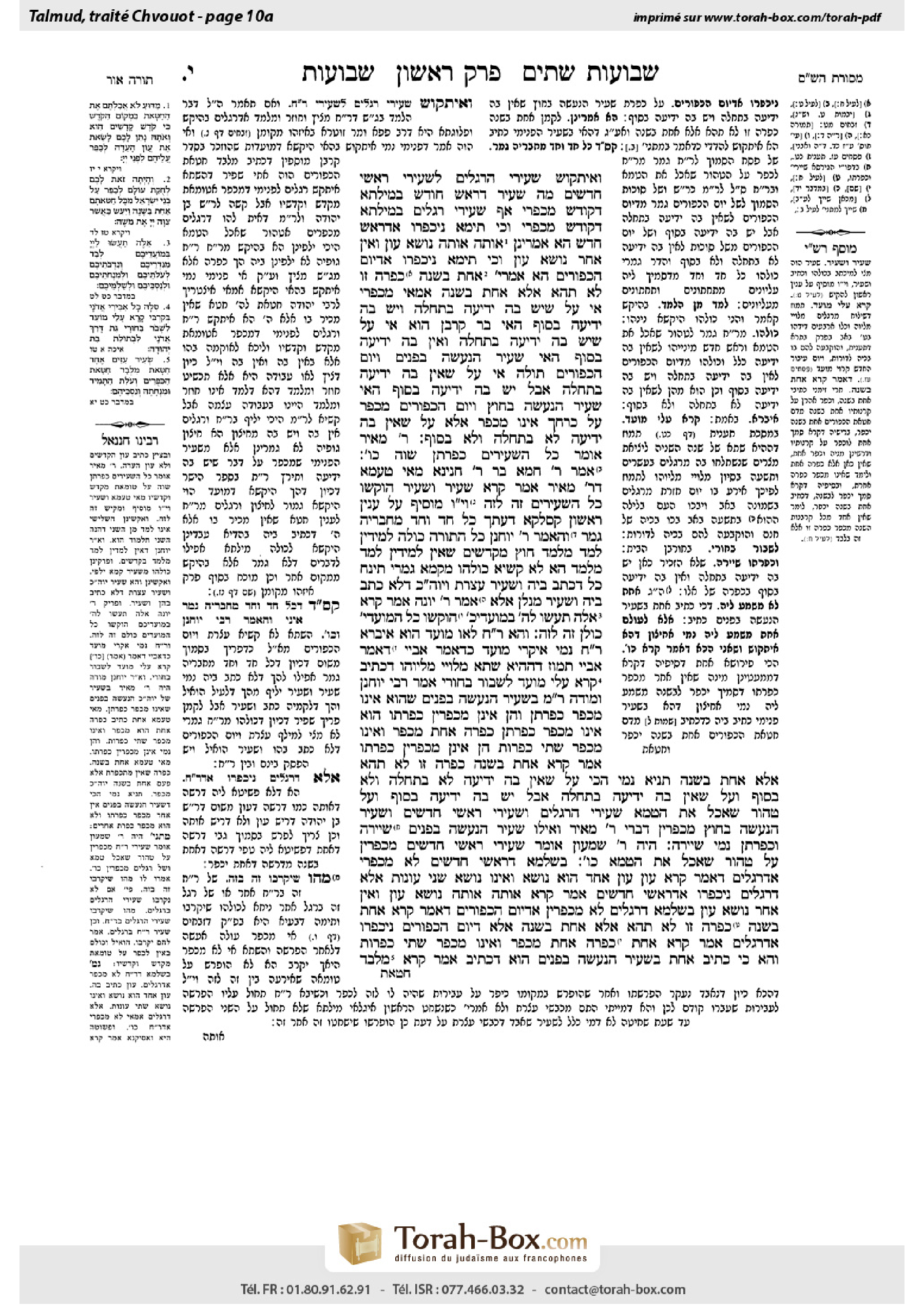
This page of Shevuot includes the Aramaic text, an English translation and an AI-generated French translation, alongside the scan above.
שבועות י׳ א · Aramaic and Hebrew text
וְאִיתַּקּוּשׁ שְׂעִירֵי הָרְגָלִים לִשְׂעִירֵי רָאשֵׁי חֳדָשִׁים; מָה שָׂעִיר דְּרֹאשׁ חוֹדֶשׁ בְּמִילְּתָא דְּקוֹדֶשׁ מְכַפְּרִי, אַף שְׂעִירֵי רְגָלִים בְּמִילְּתָא דְּקוֹדֶשׁ מְכַפְּרִי.
וְכִי תֵּימָא נִיכַפְּרוּ אַדְּרֹאשׁ חֹדֶשׁ – הָא אָמְרִינַן: ״אוֹתָהּ״ – אוֹתָהּ נוֹשֵׂא עָוֹן, וְאֵין אַחֵר נוֹשֵׂא עָוֹן.
וְכִי תֵּימָא נִיכַפְּרוּ אַדְּיוֹם הַכִּפּוּרִים – הָא אָמְרִינַן: ״אַחַת בַּשָּׁנָה״ – כַּפָּרָה זוֹ לֹא תְּהֵא אֶלָּא אַחַת בַּשָּׁנָה.
אַמַּאי מְכַפְּרִי?
אִי עַל שֶׁיֵּשׁ בָּהּ יְדִיעָה בַּתְּחִלָּה וְיֵשׁ בָּהּ יְדִיעָה בַּסּוֹף – הַאי בַּר קׇרְבָּן הוּא! אִי עַל שֶׁיֵּשׁ בָּהּ יְדִיעָה בַּתְּחִלָּה וְאֵין בָּהּ יְדִיעָה בַּסּוֹף – הַאי שָׂעִיר הַנַּעֲשֶׂה בִּפְנִים וְיוֹם הַכִּפּוּרִים תּוֹלֶה! אִי עַל שֶׁאֵין בָּהּ יְדִיעָה בַּתְּחִלָּה אֲבָל יֵשׁ בָּהּ יְדִיעָה בַּסּוֹף – הַאי שָׂעִיר הַנַּעֲשֶׂה בַּחוּץ וְיוֹם הַכִּפּוּרִים מְכַפֵּר!
עַל כׇּרְחָךְ, אֵינוֹ מְכַפֵּר אֶלָּא עַל שֶׁאֵין בָּהּ יְדִיעָה לֹא בַּתְּחִלָּה וְלֹא בַּסּוֹף.
רַבִּי מֵאִיר אוֹמֵר: כׇּל הַשְּׂעִירִים כַּפָּרָתָן שָׁוָה כּוּ׳.
אָמַר רַבִּי חָמָא בַּר רַבִּי חֲנִינָא: מַאי טַעְמָא דְּרַבִּי מֵאִיר? אָמַר קְרָא ״שְׂעִיר״–״וּשְׂעִיר״, הוּקְּשׁוּ כׇּל הַשְּׂעִירִים זֶה לָזֶה – וָי״ו מוֹסִיף עַל עִנְיָן רִאשׁוֹן.
קָסָלְקָא דַּעְתָּךְ כֹּל חַד וְחַד מֵחַבְרֵיהּ גָּמַר?! וְהָאָמַר רַבִּי יוֹחָנָן: כׇּל הַתּוֹרָה כּוּלָּהּ לְמֵידִין לָמֵד מִלָּמֵד, חוּץ מִקֳּדָשִׁים שֶׁאֵין לְמֵידִין לָמֵד מִלָּמֵד!
הָא לָא קַשְׁיָא, כּוּלְּהוּ מִקַּמָּא גָּמְרִי.
תִּינַח כֹּל דִּכְתִב בֵּיהּ ״וּשְׂעִיר״, עֲצֶרֶת וְיוֹם הַכִּפּוּרִים דְּלָא כְּתִב בֵּיהּ ״וּשְׂעִיר״ – מְנָלַן?
אֶלָּא אָמַר רַבִּי יוֹנָה, אָמַר קְרָא: ״אֵלֶּה תַּעֲשׂוּ לַה׳ בְּמוֹעֲדֵיכֶם״ – הוּקְּשׁוּ כׇּל הַמּוֹעֲדִים כּוּלָּן זֶה לָזֶה. וְהָא רֹאשׁ חֹדֶשׁ לָאו מוֹעֵד הוּא!
אִיבְרָא, רֹאשׁ חֹדֶשׁ נָמֵי אִיקְּרִי מוֹעֵד, כִּדְאָמַר אַבָּיֵי – דְּאָמַר אַבָּיֵי: תַּמּוּז דְּהַהִיא שַׁתָּא מַלּוֹיֵי מַלְּיוּהּוֹ, דִּכְתִיב: ״קָרָא עָלַי מוֹעֵד לִשְׁבֹּר בַּחוּרָי״.
אָמַר רַבִּי יוֹחָנָן: וּמוֹדֶה רַבִּי מֵאִיר בְּשָׂעִיר הַנַּעֲשֶׂה בִּפְנִים, שֶׁהוּא אֵינוֹ מְכַפֵּר כַּפָּרָתָן, וְהֵן אֵינָן מְכַפְּרִין כַּפָּרָתוֹ.
הוּא אֵינוֹ מְכַפֵּר כַּפָּרָתָן – כַּפָּרָה אַחַת מְכַפֵּר, וְאֵינוֹ מְכַפֵּר שְׁתֵּי כַּפָּרוֹת. הֵן אֵינָן מְכַפְּרִין כַּפָּרָתוֹ – אָמַר קְרָא ״אַחַת בַּשָּׁנָה״, כַּפָּרָה זוֹ לֹא תְּהֵא אֶלָּא אַחַת בַּשָּׁנָה.
תַּנְיָא נָמֵי הָכִי: עַל שֶׁאֵין בָּהּ יְדִיעָה לֹא בַּתְּחִלָּה וְלֹא בַּסּוֹף, וְעַל שֶׁאֵין בָּהּ יְדִיעָה בַּתְּחִלָּה אֲבָל יֵשׁ בָּהּ יְדִיעָה בַּסּוֹף, וְעַל טָהוֹר שֶׁאָכַל אֶת הַטָּמֵא – שְׂעִירֵי הָרְגָלִים וּשְׂעִירֵי רָאשֵׁי חֳדָשִׁים וְשָׂעִיר הַנַּעֲשֶׂה בַּחוּץ מְכַפְּרִין. דִּבְרֵי רַבִּי מֵאִיר.
וְאִילּוּ שָׂעִיר הַנַּעֲשֶׂה בִּפְנִים שַׁיְּירֵהּ, (וכפרתן) [וְכַפָּרָתוֹ] נָמֵי שַׁיְּירַהּ.
הָיָה רַבִּי שִׁמְעוֹן אוֹמֵר: שְׂעִירֵי רָאשֵׁי חֳדָשִׁים מְכַפְּרִין עַל טָהוֹר שֶׁאָכַל אֶת הַטָּמֵא כּוּ׳.
בִּשְׁלָמָא דְּרָאשֵׁי חֳדָשִׁים לָא מְכַפְּרִי אַדִּרְגָלִים, דְּאָמַר קְרָא: ״עֲוֹן״ – עָוֹן אֶחָד הוּא נוֹשֵׂא, וְאֵינוֹ נוֹשֵׂא שְׁנֵי עֲוֹנוֹת. אֶלָּא דִּרְגָלִים נִיכַפְּרוּ אַדְּרָאשֵׁי חֳדָשִׁים! אָמַר קְרָא: ״אוֹתָהּ״ – אוֹתָהּ נוֹשֵׂא עָוֹן, וְאֵין אַחֵר נוֹשֵׂא עָוֹן.
בִּשְׁלָמָא דִּרְגָלִים לָא מְכַפְּרִין אַדְּיוֹם הַכִּפּוּרִים, דְּאָמַר קְרָא ״אַחַת בַּשָּׁנָה״ – כַּפָּרָה זוֹ לֹא תְּהֵא אֶלָּא אַחַת בַּשָּׁנָה. אֶלָּא דְּיוֹם הַכִּפּוּרִים נִיכַפְּרוּ אַדִּרְגָלִים! אָמַר קְרָא ״אַחַת״ – כַּפָּרָה אַחַת מְכַפֵּר, וְאֵינוֹ מְכַפֵּר שְׁתֵּי כַּפָּרוֹת.
וְהָא כִּי כְּתִיב ״אַחַת״ – בְּשָׂעִיר הַנַּעֲשֶׂה בִּפְנִים הוּא דִּכְתִיב! אָמַר קְרָא: ״מִלְּבַד
Shevuot 10a · English translation
And through this additional “and,” the goats of the Festivals are juxtaposed with the goats of the New Moons, indicating that just as the goats of the New Moons atone for a case involving sacrificial food, i.e., where a ritually pure person partook of ritually impure sacrificial food, so too, the goats of the Festivals atone for a similar case involving sacrificial food, i.e., where a ritually impure person partook of ritually pure sacrificial food.
And if you would say: Let the goats of the Festivals atone for that which the goats of the New Moon are sacrificed, that is not possible. Didn’t we say above that the verse states with regard to the goat of the New Moon: “And He gave it to you to bear the sin of the congregation,” which indicates that it bears, i.e., atones for, that sin but another does not bear that sin?
And if you would say: Let the goats of the Festivals atone for that which the goat of Yom Kippur is brought, that is not possible. Didn’t we say above that the verse states with regard to the goat of Yom Kippur: “Aaron shall bring atonement upon its corners once a year” (Exodus 30:10)? The emphasis on “once a year” teaches that this atonement for this case should be only once a year.
The Gemara explains: It must be that the goats of the Festivals atone for cases of defiling of the Temple or its sacrificial foods in which one did not have awareness, neither at the beginning nor at the end, because if not, for what other matter involving sacrificial foods could they atone?
If you say they atone for cases in which one had awareness at the beginning and had awareness at the end, then one can counter that he is liable to bring an offering to atone for his transgression, and therefore the goats of the Festivals will not atone for him. If you say they atone for cases in which one had awareness at the beginning but did not have awareness at the end, then one can counter that the goat whose blood presentation is performed inside the Sanctuary and Yom Kippur itself suspend any punishment that he deserves until he becomes aware of his transgression. If you say they atone for cases in which one did not have awareness at the beginning but did have awareness at the end, then one can counter that the goat whose blood presentation is performed outside the Sanctuary and Yom Kippur itself atone.
Perforce, they atone only for cases in which one did not have awareness, neither at the beginning nor at the end.
§ The mishna teaches that Rabbi Meir says: The atonement effected by all the goats offered as part of the additional offerings, i.e., those of the New Moons, Festivals, and Yom Kippur, is the same. They all atone for various cases of the defiling of the Temple or its sacrificial foods.
Rabbi Ḥama bar Rabbi Ḥanina said: What is the reasoning of Rabbi Meir? With regard to the goat of the Festivals (Numbers, chapters 28–29) the verse could have simply stated: A goat, but instead it states: “And a goat,” which teaches that all the goats are juxtaposed, this one with that one, as the use of the term “and” teaches that the second matter adds to the first matter, and that all the goats effect a similar atonement as the first one listed, that of the New Moon.
The Gemara questions this interpretation: Initially it enters your mind to explain that the atonement effected by each and every one of the goats of the Festivals is derived from the atonement effected by the goat adjacent to it, i.e., the one mentioned in the passage immediately preceding it: The atonement effected by the Passover goat from the atonement effected by the goat of the New Moon and the atonement effected by the Shavuot goat from the atonement effected by the Passover goat and so forth. But this is difficult, as doesn’t Rabbi Yoḥanan say: With regard to the entire Torah, one derives a halakha derived via a juxtaposition from a halakha derived via a juxtaposition, except for halakhot concerning consecrated matters, where one does not derive a halakha derived via a juxtaposition from a halakha derived via a juxtaposition?
The Gemara answers: This is not difficult, because actually the atonement effected by all of the goats is derived directly from the atonement effected by the first goat, i.e., the goat of the New Moon.
The Gemara asks: Rabbi Ḥama bar Rabbi Ḥanina’s explanation works out well for all the goats with regard to which it is written: “And a goat,” but from where do we derive what the goats of Shavuot and Yom Kippur atone for, as with regard to them it is not written: And a goat, but simply: “A goat”?
Rather, Rabbi Yona says: The verse states at the end of the passage detailing the goats of the Festivals: “These shall you offer to the Lord on your Festivals” (Numbers 29:39); with this verse all the goats of the Festivals are juxtaposed, this one with that one, which indicates that they all atone for the same sins. The Gemara challenges: But the New Moon is not regarded as a Festival.
The Gemara refutes this: In truth, the New Moon is also called a Festival, in accordance with what Abaye says with regard to a different issue, as Abaye says: With regard to the month of Tammuz in that year during which the Jewish people sinned by accepting the slanderous report of the spies about Eretz Yisrael, the court made it a full month of thirty days, as it is written: “He proclaimed a festival to crush my young men” (Lamentations 1:15). Abaye understands the verse to mean that by extending the month of Tammuz by an extra day, by proclaiming that the thirtieth day should be celebrated as a New Moon in addition to the first day of the following month, it emerged that the acceptance of the spies’ report occurred on the ninth of Av, and not the eighth, thereby defining the ninth of Av as an ominous day for the Jewish people. From Abaye’s explanation it is apparent that the New Moon is also called a Festival.
The Gemara continues to analyze Rabbi Meir’s opinion: Rabbi Yoḥanan says: And even though he holds that all the goats offered as part of the additional offerings effect atonement for the same sin, Rabbi Meir concedes with regard to the goat whose blood presentation is performed inside the Sanctuary on Yom Kippur that it does not atone their atonement, i.e., does not atone for the sins that they atone for, and they do not atone its atonement.
He elaborates: It does not atone their atonement, because, as the Gemara derived from the verse: “Aaron shall bring atonement upon its corners once a year” (Exodus 30:10), the internal goat effects one atonement for only one case but cannot effect two atonements for two different cases. And they do not atone its atonement, because, as the Gemara explained, the verse states: “Aaron shall bring atonement upon its corners once a year.” The emphasis on the phrase “once a year” teaches that this atonement for the specific case that it atones for should be only once a year.
The Gemara adds: This qualification of Rabbi Meir’s opinion is also indicated by that which is taught in a baraita: For cases of the defiling of the Temple in which one did not have awareness, neither at the beginning nor at the end, and for cases in which one did not have awareness at the beginning but did have awareness at the end, and for a ritually pure person who partook of ritually impure sacrificial food, the goats of the Festivals and the goats of the New Moons and the goat whose blood presentation is performed outside the Sanctuary atone. This is the statement of Rabbi Meir.
The Gemara notes: But in delineating which offerings atone, Rabbi Meir omitted the goat whose blood presentation is performed inside the Sanctuary, and furthermore, when delineating their atonement, i.e., what cases they atone for, he also omitted it, i.e., he did not mention the cases that the internal goat atones for, which are the cases in which one had awareness at the beginning but did not have awareness at the end. Evidently, the atonement of the internal goat is substantively different from the atonement of the other goats.
§ The mishna teaches: Rabbi Shimon would say: The goats of the New Moons atone for a ritually pure person who unwittingly partook of ritually impure sacrificial food. And for defiling the Temple or its sacrificial foods, the goats of the Festivals atone for cases in which one did not have awareness, neither at the beginning nor at the end, and the goats of the additional offerings of Yom Kippur atone for cases in which one did not have awareness at the beginning but did have awareness at the end.
The Gemara challenges: Granted, the goats of the New Moons do not atone for that which the goats of Festivals atone, as the verse states with regard to the goat of the New Moon: “And he gave it to you to bear the sin of the congregation” (Leviticus 10:17), which indicates that it bears, i.e., atones for, one sin but does not bear two sins. But nevertheless, let the goats of the Festivals atone for that which the goats of New Moons atone. The Gemara responds: The verse states: “He gave it to you.” The emphasis on “it” teaches that it bears this sin, but no other offering bears this sin.
The Gemara challenges: Granted, the goats of the Festivals do not atone for that which the goats of Yom Kippur atone, as the verse states with regard to the goat of Yom Kippur: “Aaron shall bring atonement upon its corners once a year” (Exodus 30:10). The emphasis on the phrase “once a year” teaches that this atonement, i.e., the specific case it atones for, should be only once a year. But nevertheless, let the goats of Yom Kippur atone for that which the goats of the Festivals atone. The Gemara responds: The verse states: “Once a year,” which indicates that it effects one atonement for only one case but cannot effect two atonements for two different cases.
The Gemara challenges the use of these derivations: But when it states “once” in this verse, it is with regard to the goat whose blood presentation is performed inside the Sanctuary that it is written, so the derivations from it should have no bearing on the discussion concerning the external goat. The Gemara answers: The verse states: “One goat for a sin-offering aside from
Shevuot 10a · Traduction française (IA)
Grâce à ce « et » supplémentaire, les boucs des fêtes sont rapprochés des boucs des nouvelles lunes. Cela indique que, de même que les boucs des nouvelles lunes expient un cas concernant des aliments consacrés — celui où une personne rituellement pure a consommé des aliments consacrés rituellement impurs —, de même les boucs des fêtes expient un cas semblable concernant des aliments consacrés — celui où une personne rituellement impure a consommé des aliments consacrés rituellement purs.
Et si l’on disait que les boucs des fêtes expient le cas pour lequel le bouc de la nouvelle lune est offert, cela est impossible. N’avons-nous pas dit plus haut que le verset dit au sujet du bouc de la nouvelle lune : « Il vous l’a donné pour porter la faute de la communauté », ce qui indique qu’il porte, c’est-à-dire expie, cette faute, mais qu’un autre ne la porte pas ?
Et si l’on disait que les boucs des fêtes expient le cas pour lequel le bouc de Yom Kippour est offert, cela est impossible. N’avons-nous pas dit plus haut que le verset dit au sujet du bouc de Yom Kippour : « Aaron fera l’expiation sur ses angles une fois par an » (Exode 30, 10) ? L’insistance sur « une fois par an » enseigne que cette expiation, pour ce cas, ne doit avoir lieu qu’une fois par an.
La Guemara explique : Il faut donc que les boucs des fêtes expient les cas de souillure du Temple ou de ses aliments consacrés où la personne n’en a eu conscience ni au début ni à la fin ; sinon, pour quel autre cas concernant des aliments consacrés pourraient-ils expier ?
Si l’on dit qu’ils expient les cas où la personne en a eu conscience au début et à la fin, on peut objecter qu’elle est tenue d’apporter une offrande pour expier sa transgression ; les boucs des fêtes ne l’expieront donc pas. Si l’on dit qu’ils expient les cas où la personne en a eu conscience au début, mais pas à la fin, on peut objecter que le bouc dont le sang est présenté à l’intérieur du Sanctuaire et Yom Kippour lui-même suspendent toute peine encourue jusqu’à ce qu’elle prenne conscience de sa transgression. Si l’on dit qu’ils expient les cas où la personne n’en a pas eu conscience au début, mais en a eu conscience à la fin, on peut objecter que le bouc dont le sang est présenté à l’extérieur du Sanctuaire et Yom Kippour lui-même expient.
Il faut donc qu’ils expient uniquement les cas où la personne n’en a eu conscience ni au début ni à la fin.
§ La Michna enseigne que Rabbi Meïr dit : L’expiation opérée par tous les boucs offerts dans le cadre des offrandes supplémentaires, c’est-à-dire ceux des nouvelles lunes, des fêtes et de Yom Kippour, est la même. Ils expient tous différents cas de souillure du Temple ou de ses aliments consacrés.
Rabbi Ḥama bar Rabbi Ḥanina dit : Quel est le raisonnement de Rabbi Meïr ? À propos du bouc des fêtes (Nombres, chapitres 28–29), le verset aurait pu simplement dire : « Un bouc », mais il dit au lieu de cela : « Et un bouc ». Cela enseigne que tous les boucs sont rapprochés les uns des autres : l’emploi du terme « et » enseigne que le second élément s’ajoute au premier et que tous les boucs opèrent une expiation semblable à celle du premier mentionné, le bouc de la nouvelle lune.
La Guemara conteste cette interprétation : À première vue, on pourrait expliquer que l’expiation opérée par chacun des boucs des fêtes se déduit de celle opérée par le bouc qui le précède, c’est-à-dire celui qui est mentionné dans le passage immédiatement précédent : l’expiation opérée par le bouc de Pessaḥ se déduit de celle opérée par le bouc de la nouvelle lune, celle opérée par le bouc de Chavouot se déduit de celle opérée par le bouc de Pessaḥ, et ainsi de suite. Mais cela pose difficulté, car Rabbi Yoḥanan ne dit-il pas : Dans l’ensemble de la Torah, on déduit une halakha obtenue par rapprochement d’une halakha obtenue par rapprochement, à l’exception des halakhot concernant les choses consacrées, pour lesquelles on ne déduit pas une halakha obtenue par rapprochement d’une halakha obtenue par rapprochement ?
La Guemara répond : Il n’y a pas de difficulté, car, en réalité, l’expiation opérée par tous les boucs se déduit directement de celle opérée par le premier bouc, c’est-à-dire le bouc de la nouvelle lune.
La Guemara demande : L’explication de Rabbi Ḥama bar Rabbi Ḥanina convient pour tous les boucs au sujet desquels il est écrit : « Et un bouc », mais de quoi les boucs de Chavouot et de Yom Kippour expient-ils, puisque, à leur sujet, il n’est pas écrit « et un bouc », mais simplement « un bouc » ?
Rabbi Yona dit plutôt : Le verset dit à la fin du passage détaillant les boucs des fêtes : « Vous les offrirez au Seigneur lors de vos fêtes » (Nombres 29, 39). Par ce verset, tous les boucs des fêtes sont rapprochés les uns des autres, ce qui indique qu’ils expient tous les mêmes fautes. La Guemara objecte : Mais la nouvelle lune n’est pas considérée comme une fête.
La Guemara réfute cette objection : En vérité, la nouvelle lune est également appelée une fête, conformément à ce qu’Abayé dit à propos d’une autre question. Abayé dit que, le mois de Tammouz de l’année où le peuple juif pécha en acceptant le rapport calomnieux des explorateurs sur Eretz Israël, le tribunal le rendit complet, c’est-à-dire qu’il compta trente jours, comme il est écrit : « Il a proclamé une fête pour écraser mes jeunes hommes » (Lamentations 1, 15). Abayé comprend le verset ainsi : en prolongeant le mois de Tammouz d’un jour, en proclamant que le trentième jour devait être célébré comme une nouvelle lune, en plus du premier jour du mois suivant, il en résulta que le rapport des explorateurs fut accepté le neuf Av, et non le huit, faisant du neuf Av un jour néfaste pour le peuple juif. Il ressort de l’explication d’Abayé que la nouvelle lune est également appelée une fête.
La Guemara poursuit l’analyse de l’opinion de Rabbi Meïr : Rabbi Yoḥanan dit que, même s’il soutient que tous les boucs offerts dans le cadre des offrandes supplémentaires expient la même faute, Rabbi Meïr reconnaît, au sujet du bouc dont le sang est présenté à l’intérieur du Sanctuaire à Yom Kippour, qu’il n’expie pas ce qu’expient les autres, c’est-à-dire qu’il n’expie pas les fautes qu’ils expient, et que les autres n’expient pas ce qu’il expie.
Il précise : Le bouc intérieur n’expie pas ce qu’expient les autres, car, comme la Guemara l’a déduit du verset « Aaron fera l’expiation sur ses angles une fois par an » (Exode 30, 10), il opère une expiation pour un seul cas, mais ne peut pas opérer deux expiations pour deux cas différents. Les autres n’expient pas non plus ce qu’il expie, car, comme la Guemara l’a expliqué, le verset dit : « Aaron fera l’expiation sur ses angles une fois par an ». L’insistance sur l’expression « une fois par an » enseigne que cette expiation, pour le cas particulier qu’il expie, ne doit avoir lieu qu’une fois par an.
La Guemara ajoute que cette précision concernant l’opinion de Rabbi Meïr est également indiquée par ce qui est enseigné dans une baraïta : Pour les cas de souillure du Temple où la personne n’en a eu conscience ni au début ni à la fin, pour les cas où elle n’en a pas eu conscience au début, mais en a eu conscience à la fin, ainsi que pour le cas d’une personne rituellement pure qui a consommé des aliments consacrés rituellement impurs, les boucs des fêtes, les boucs des nouvelles lunes et le bouc dont le sang est présenté à l’extérieur du Sanctuaire expient. Telle est l’opinion de Rabbi Meïr.
La Guemara fait remarquer : En énumérant les offrandes qui expient, Rabbi Meïr a omis le bouc dont le sang est présenté à l’intérieur du Sanctuaire ; de plus, en précisant ce qu’elles expient, il l’a également omis, c’est-à-dire qu’il n’a pas mentionné les cas que le bouc intérieur expie, à savoir ceux où la personne en a eu conscience au début, mais pas à la fin. Il est donc évident que l’expiation du bouc intérieur diffère substantiellement de celle des autres boucs.
§ La Michna enseigne : Rabbi Shimon disait que les boucs des nouvelles lunes expient le cas d’une personne rituellement pure qui a consommé par inadvertance des aliments consacrés rituellement impurs. Quant à la souillure du Temple ou de ses aliments consacrés, les boucs des fêtes expient les cas où la personne n’en a eu conscience ni au début ni à la fin, et les boucs des offrandes supplémentaires de Yom Kippour expient les cas où elle n’en a pas eu conscience au début, mais en a eu conscience à la fin.
La Guemara objecte : Il est compréhensible que les boucs des nouvelles lunes n’expient pas ce qu’expient les boucs des fêtes, puisque le verset dit au sujet du bouc de la nouvelle lune : « Il vous l’a donné pour porter la faute de la communauté » (Lévitique 10, 17), ce qui indique qu’il porte, c’est-à-dire expie, une faute, mais pas deux. Néanmoins, que les boucs des fêtes expient ce qu’expient les boucs des nouvelles lunes ! La Guemara répond : Le verset dit : « Il vous l’a donné. » L’insistance sur « l’ » enseigne que c’est lui qui porte cette faute, mais qu’aucune autre offrande ne la porte.
La Guemara objecte : Il est compréhensible que les boucs des fêtes n’expient pas ce qu’expient les boucs de Yom Kippour, puisque le verset dit au sujet du bouc de Yom Kippour : « Aaron fera l’expiation sur ses angles une fois par an » (Exode 30, 10). L’insistance sur l’expression « une fois par an » enseigne que cette expiation, c’est-à-dire le cas particulier qu’il expie, ne doit avoir lieu qu’une fois par an. Néanmoins, que les boucs de Yom Kippour expient ce qu’expient les boucs des fêtes ! La Guemara répond : Le verset dit « une fois par an », ce qui indique qu’il opère une expiation pour un seul cas, mais ne peut pas opérer deux expiations pour deux cas différents.
La Guemara conteste le recours à ces déductions : Mais lorsque le verset dit « une fois », il s’agit du bouc dont le sang est présenté à l’intérieur du Sanctuaire ; ces déductions ne devraient donc avoir aucune incidence sur la discussion concernant le bouc extérieur. La Guemara répond : Le verset dit : « Un bouc en sacrifice expiatoire, en plus de
Traduction française générée par IA à partir de l’édition anglaise de Sefaria. Vérifie toujours un passage avec le texte source.
Text from Sefaria: William Davidson Edition - Vocalized Aramaic (CC BY NC); William Davidson Edition - English (CC BY NC).