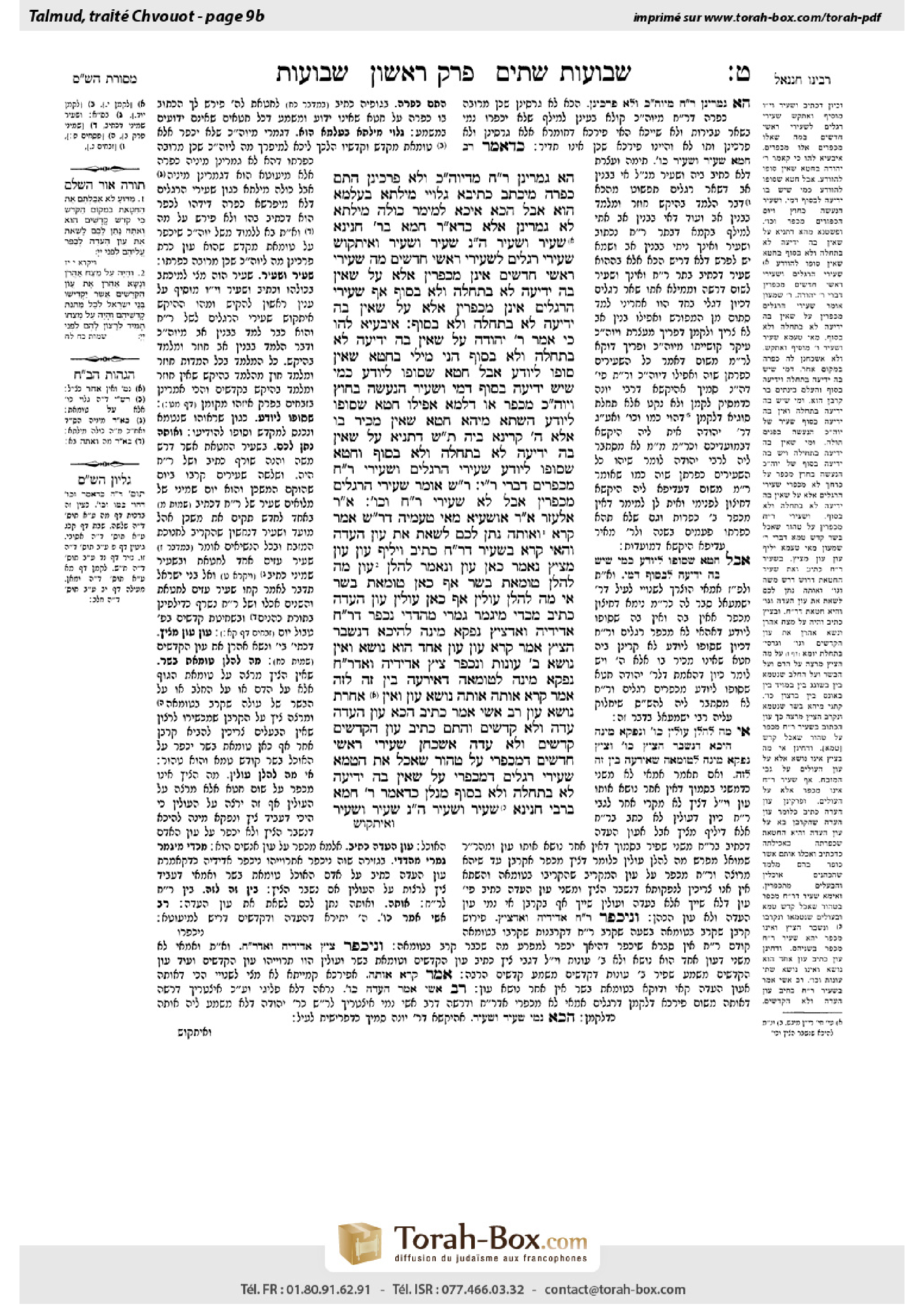
Shevuot 9b: Talmud study for Daf Yomi
Daf Yomi is the daily study of one Talmud folio. Explore 37 tractates with scans, Hebrew text, Sefaria English and AI-generated French translations where annotated.
Passage selection and English or AI-generated French translation are available where the scan has annotations. Daf Study is independent of Torah-Box and Sefaria.
Browse Shevuot · שבועות · All tractatesShevuot 9b text and translations
This page of Shevuot includes the Aramaic text, an English translation and an AI-generated French translation, alongside the scan above.
שבועות ט׳ ב · Aramaic and Hebrew text
הָא גָּמְרִינַן רֹאשׁ חֹדֶשׁ מִדְּיוֹם הַכִּפּוּרִים וְלָא פָּרְכִינַן; הָתָם – כַּפָּרָה מִיכְתָּב כְּתִיבָא, גַּלּוֹיֵי מִילְּתָא בְּעָלְמָא הוּא; אֲבָל הָכָא – אִיכָּא לְמֵימַר כּוּלַּהּ מִילְּתָא לָא גָּמְרִינַן!
אֶלָּא כִּדְאָמַר רַבִּי חָמָא בְּרַבִּי חֲנִינָא: ״שְׂעִיר״–״וּשְׂעִיר״; הָכָא נָמֵי ״שְׂעִיר״–״וּשְׂעִיר״, וְאִיתַּקּוּשׁ שְׂעִירֵי רְגָלִים לִשְׂעִירֵי רָאשֵׁי חֳדָשִׁים; מַה שְׂעִירֵי רָאשֵׁי חֳדָשִׁים אֵינָן מְכַפְּרִין אֶלָּא עַל שֶׁאֵין בָּהּ יְדִיעָה לֹא בַּתְּחִלָּה וְלֹא בַּסּוֹף, אַף שְׂעִירֵי הָרְגָלִים אֵינָן מְכַפְּרִין אֶלָּא עַל שֶׁאֵין בָּהּ יְדִיעָה לֹא בַּתְּחִלָּה וְלֹא בַּסּוֹף.
אִיבַּעְיָא לְהוּ: כִּי אָמַר רַבִּי יְהוּדָה עַל שֶׁאֵין בָּהּ יְדִיעָה לֹא בַּתְּחִלָּה וְלֹא בַּסּוֹף – הָנֵי מִילֵּי בְּחֵטְא שֶׁאֵין סוֹפוֹ לִיוָּדַע, אֲבָל חֵטְא שֶׁסּוֹפוֹ לִיוָּדַע – כְּמִי שֶׁיֵּשׁ יְדִיעָה בַּסּוֹף דָּמֵי, וְשָׂעִיר הַנַּעֲשֶׂה בַּחוּץ וְיוֹם הַכִּפּוּרִים מְכַפֵּר; אוֹ דִלְמָא אֲפִילּוּ חֵטְא שֶׁסּוֹפוֹ לִיוָּדַע – הַשְׁתָּא מִיהָא, חֵטְא שֶׁאֵין מַכִּיר בּוֹ אֶלָּא ה׳ קָרֵינָא בֵּיהּ?
תָּא שְׁמַע, דְּתַנְיָא: עַל שֶׁאֵין בָּהּ יְדִיעָה לֹא בַּתְּחִלָּה וְלֹא בַּסּוֹף, וְחֵטְא שֶׁסּוֹפוֹ לִיוָּדַע – שְׂעִירֵי הָרְגָלִים וּשְׂעִירֵי רָאשֵׁי חֳדָשִׁים מְכַפְּרִים. דִּבְרֵי רַבִּי יְהוּדָה.
רַבִּי שִׁמְעוֹן אוֹמֵר: שְׂעִירֵי הָרְגָלִים מְכַפְּרִין, אֲבָל לֹא שְׂעִירֵי רָאשֵׁי חֳדָשִׁים וְכוּ׳.
אָמַר רַבִּי אֶלְעָזָר אָמַר רַבִּי אוֹשַׁעְיָא: מַאי טַעְמֵיהּ דְּרַבִּי שִׁמְעוֹן? אָמַר קְרָא: ״וְאֹתָהּ נָתַן לָכֶם לָשֵׂאת אֶת עֲוֹן הָעֵדָה״, וְהַאי קְרָא בְּשָׂעִיר דְּרֹאשׁ חֹדֶשׁ כְּתִיב; וְיָלֵיף ״עָוֹן״–״עָוֹן״ מִצִּיץ – נֶאֱמַר כָּאן ״עֲוֹן״, וְנֶאֱמַר לְהַלָּן ״עֲוֹן״; מָה לְהַלָּן טוּמְאַת בָּשָׂר, אַף כָּאן טוּמְאַת בָּשָׂר.
אִי מָה לְהַלָּן עוֹלִין, אַף כָּאן עוֹלִין?! ״עֲוֹן הָעֵדָה״ כְּתִיב.
מִכְּדֵי מִיגְמָר גָּמְרִי מֵהֲדָדֵי; נְכַפַּר דְּרֹאשׁ חֹדֶשׁ אַדִּידֵיהּ וְאַדְּצִיץ – נָפְקָא מִינַּהּ לְהֵיכָא דְּנִשְׁבַּר הַצִּיץ! אָמַר קְרָא: ״עֲוֹן״ – עָוֹן אֶחָד הוּא נוֹשֵׂא, וְאֵין נוֹשֵׂא שְׁנֵי עֲוֹנוֹת.
וּנְכַפַּר צִיץ אַדִּידֵיהּ וְאַדְּרֹאשׁ חֹדֶשׁ – נָפְקָא מִינַּהּ לְטוּמְאָה דְּאֵירְעָה בֵּין זֶה לְזֶה! אָמַר קְרָא: ״אוֹתָהּ״ – אוֹתָהּ נוֹשֵׂא עָוֹן, וְאֵין אַחֶרֶת נוֹשֵׂא עָוֹן.
רַב אָשֵׁי אָמַר: כְּתִיב הָכָא ״עֲוֹן הָעֵדָה״ – עֵדָה וְלֹא קָדָשִׁים, וְהָתָם כְּתִיב ״עֲוֹן הַקֳּדָשִׁים״ – קָדָשִׁים וְלֹא עֵדָה.
אַשְׁכְּחַן שְׂעִירֵי רָאשֵׁי חֳדָשִׁים דִּמְכַפְּרִי עַל טָהוֹר שֶׁאָכַל אֶת הַטָּמֵא; שְׂעִירֵי רְגָלִים דִּמְכַפְּרִי עַל שֶׁאֵין בָּהּ יְדִיעָה לֹא בַּתְּחִלָּה וְלֹא בַּסּוֹף – מְנָלַן?
כִּדְאָמַר רַבִּי חָמָא בְּרַבִּי חֲנִינָא: ״שְׂעִיר״–״וּשְׂעִיר״, הָכָא נָמֵי ״שְׂעִיר״–״וּשְׂעִיר״,
Shevuot 9b · English translation
Don’t we derive the atonement of the goat of the New Moon through a comparison to the goat of Yom Kippur and we did not refute it by saying that the atonement of the goat of Yom Kippur is more extensive, that is not relevant: There, with regard to the goat of the New Moon, the basic fact that it provides atonement is written in the verse, as Rav Yehuda explains above, and the comparison to the goat of Yom Kippur is merely revealing a matter, i.e., it teaches in what way its atonement is limited. But here, with regard to the goats of the Festivals, the verse does not mention any details about atonement, so it is valid to say that we do not derive the entire matter from the comparison to the goat of Yom Kippur, as it provides a more extensive atonement.
Rather, the atonement of the goats of the Festivals is derived just as Rabbi Ḥama, son of Rabbi Ḥanina, says in explanation of the opinion of Rabbi Meir (10a): The matter is derived from the fact that with regard to the goat of the Festivals (see Numbers, chapters 28–29) the verses that mention the goat could have simply stated: A goat, but instead state: “And a goat.” Here too, the fact that the verse could have simply stated: A goat, but instead states: “And a goat,” indicates that the goats of the Festivals are juxtaposed with the goat of the New Moon, which are mentioned at the beginning of that passage, and teaches that they all effect a similar atonement. Just as the goats of the New Moon atone only for cases in which one did not have awareness, neither at the beginning nor at the end, so too, the goats of the Festivals atone only for cases in which one did not have awareness, neither at the beginning nor at the end.
A dilemma was raised before the Sages: When Rabbi Yehuda says that the goats of the New Moons and the Festivals atone for cases in which one did not have awareness, neither at the beginning nor at the end, does that statement apply only to a sin that will never eventually become known, e.g., where no one was present when the person became ritually impure, but with regard to a sin that will eventually become known, it is considered to be like a case of one who has awareness of his sin at the end, and therefore only the goat whose blood presentation is performed outside the Sanctuary and Yom Kippur itself atone for it? Or perhaps, even with regard to a sin that will eventually become known, right now, at least, before it becomes known, I can call it a sin of which only God is aware, and therefore the goats of the New Moons and the Festivals atone for it.
The Gemara concludes: Come and hear a resolution of this dilemma, as it is taught in a baraita: For a case in which one did not have awareness, neither at the beginning nor at the end, and it is a sin that will eventually become known, the goats of the Festivals and the goats of the New Moons atone. This is the statement of Rabbi Yehuda.
§ The mishna teaches: Rabbi Shimon says: The goats of the Festivals atone for a case in which one never had awareness of his transgression, but the goats of the New Moons do not. Rather, the latter atone for a ritually pure person who unwittingly partook of ritually impure sacrificial food.
The Gemara elaborates: Rabbi Elazar says that Rabbi Oshaya says: What is the reasoning of Rabbi Shimon? The verse states: “And He gave it to you to bear the sin of the congregation” (Leviticus 10:17), and this verse is written with regard to the goat of the New Moon. And its capacity to atone is derived from the frontplate through a verbal analogy between the words “sin” in this verse, and the word “sin” stated with regard to the frontplate. The verse there states: “And it shall be on Aaron’s forehead and Aaron will bear the sin of the sacred offerings” (Exodus 28:38). The verbal analogy teaches as follows: It is stated here, with regard to the goat of the New Moon: “Sin,” and it is stated there, with regard to the frontplate: “Sin.” Just as there, in the verse in Exodus, the atonement is for a sin involving the ritual impurity of sacrificial meat, i.e., where such meat is placed on the altar, so too here, in the verse in Leviticus, the atonement is for a sin involving the ritual impurity of sacrificial meat, i.e., where a ritually pure person partakes of it.
The Gemara asks: If the two cases are to be compared, then one could take the comparison further: Just as there, in the verse in Exodus, the atonement is only for meat that ascends upon the altar, so too here, in the verse in Leviticus, the atonement is only for meat that ascends upon the altar. The Gemara rejects this suggestion: It is written with regard to the goat of the New Moon: “To bear the sin of the congregation.” This indicates that it atones for the personal sin of partaking of sacrificial meat that was to be consumed by an individual, which became ritually impure.
The Gemara suggests: Now, the atonement of the goats of the New Moon and that of the frontplate are derived from one another by a verbal analogy. If so, let the goat of the New Moon atone for itself, i.e., for the cases that it normally atones for, and for that which the frontplate normally atones for, and the practical difference will be in a case where the frontplate was broken. The Gemara answers: The verse states with regard to the goat of the New Moon: “To bear the sin of the congregation,” which indicates that it bears, i.e., atones for, only one sin, but it does not bear two sins.
The Gemara suggests: But let the frontplate atone for itself, i.e., for those cases that it normally atones for, and for that which the goats of the New Moon normally atone for, and the practical difference will be in a case of the defiling of the Temple or its sacrificial foods that occurred between the goat offering of this New Moon and that New Moon which follows. The Gemara answers: The verse states with regard to the goat of the New Moon: “And He gave it to you to bear the sin of the congregation,” which indicates that it bears, i.e., atones for, that sin, but another does not bear that sin.
Rav Ashi states another proof for the opinion that each atones in a different case: It is stated here with regard to the goat of the New Moon: “The sin of the congregation,” which indicates that it atones for the sin of the congregation, but not for the sin involving sacred offerings. And there, with regard to the frontplate, it is written: “The sin of the sacred offerings,” which indicates that it atones for the sin involving sacred offerings, but not for the sin of the congregation.
The Gemara says: We found a source for Rabbi Shimon’s opinion about the goats of the New Moons, that they atone for a ritually pure person who partook of ritually impure sacrificial food. From where do we derive his opinion about the goats of the Festivals, that they atone for cases of the defiling of the Temple or its sacrificial foods in which one did not have awareness, neither at the beginning nor at the end?
The Gemara answers: It is derived just as Rabbi Ḥama, son of Rabbi Ḥanina, says, in explanation of the opinion of Rabbi Meir (10a): The fact that with regard to the goat of the Festivals the verses that mention the goats could have simply stated: A goat, but instead state: “And a goat,” teaches that the goats of the Festivals effect an atonement similar to that of the goat of the New Moon that is mentioned at the beginning of that passage. Here too, the fact that the verse could have simply stated: A goat, but instead states: “And a goat,” teaches that the goats of the Festivals effect an atonement similar to that of the goat of the New Moon, which is mentioned at the beginning of that passage.
Shevuot 9b · Traduction française (IA)
Ne déduisons-nous pas l’expiation du bouc de la nouvelle lune par comparaison avec le bouc de Yom Kippour, sans réfuter cette comparaison en disant que l’expiation du bouc de Yom Kippour est plus étendue ? Cela n’est pas pertinent : là, à propos du bouc de la nouvelle lune, le fait fondamental qu’il procure une expiation est écrit dans le verset, comme Rav Yehuda l’explique plus haut, et la comparaison avec le bouc de Yom Kippour ne fait que révéler un point, c’est-à-dire qu’elle enseigne en quoi son expiation est limitée. Mais ici, à propos des boucs des fêtes, le verset ne mentionne aucun détail concernant l’expiation ; il est donc légitime de dire que nous ne déduisons pas toute la question de la comparaison avec le bouc de Yom Kippour, puisque celui-ci procure une expiation plus étendue.
Mais l’expiation des boucs des fêtes se déduit comme le dit Rabbi Ḥama, fils de Rabbi Ḥanina, en expliquant l’opinion de Rabbi Meir (10a) : on la déduit du fait que, concernant le bouc des fêtes (voir Nombres, chapitres 28–29), les versets qui mentionnent le bouc auraient pu simplement dire : « Un bouc », mais disent plutôt : « Et un bouc ». Ici aussi, le fait que le verset aurait pu simplement dire : « Un bouc », mais dise plutôt : « Et un bouc », indique que les boucs des fêtes sont rapprochés du bouc de la nouvelle lune, mentionné au début de ce passage, et enseigne qu’ils procurent tous une expiation similaire. De même que les boucs des nouvelles lunes n’expient que les cas où la personne n’en avait connaissance ni au début ni à la fin, les boucs des fêtes n’expient eux aussi que les cas où la personne n’en avait connaissance ni au début ni à la fin.
Une question fut soulevée devant les Sages : lorsque Rabbi Yehuda dit que les boucs des nouvelles lunes et des fêtes expient les cas où la personne n’en avait connaissance ni au début ni à la fin, cette affirmation s’applique-t-elle uniquement à une faute qui ne sera jamais connue par la suite, par exemple lorsque personne n’était présent au moment où la personne est devenue rituellement impure ? Mais, s’agissant d’une faute qui finira par être connue, est-elle considérée comme un cas où la personne a connaissance de sa faute à la fin, de sorte que seuls le bouc dont le sang est aspergé à l’extérieur du Sanctuaire et Yom Kippour lui-même expient cette faute ? Ou peut-être que, même pour une faute qui finira par être connue, je peux, à tout le moins, la considérer pour l’instant, avant qu’elle ne soit connue, comme une faute dont Dieu seul a connaissance ; les boucs des nouvelles lunes et des fêtes l’expient donc.
La Guemara conclut : Écoutons une réponse à cette question, car il est enseigné dans une baraïta : les boucs des fêtes et les boucs des nouvelles lunes expient le cas où la personne n’en avait connaissance ni au début ni à la fin et où il s’agit d’une faute qui finira par être connue. Telle est la déclaration de Rabbi Yehuda.
§ La Michna enseigne : Rabbi Shimon dit : les boucs des fêtes expient le cas où la personne n’a jamais eu connaissance de sa transgression, mais les boucs des nouvelles lunes ne l’expient pas. Ces derniers expient plutôt le cas d’une personne rituellement pure qui a consommé par inadvertance des aliments consacrés rituellement impurs.
La Guemara développe : Rabbi Elazar dit au nom de Rabbi Oshaya : quel est le raisonnement de Rabbi Shimon ? Le verset dit : « Il vous l’a donné pour porter la faute de la communauté » (Lévitique 10:17), et ce verset est écrit à propos du bouc de la nouvelle lune. Sa capacité à expier est déduite du fronton, au moyen d’une analogie verbale entre le mot « faute » dans ce verset et le mot « faute » employé à propos du fronton. Le verset correspondant dit : « Il sera sur le front d’Aaron, et Aaron portera la faute des choses saintes » (Exode 28:38). L’analogie verbale enseigne ceci : il est dit ici, à propos du bouc de la nouvelle lune : « faute », et il est dit là, à propos du fronton : « faute ». De même que là, dans le verset de l’Exode, l’expiation concerne une faute liée à l’impureté rituelle de la viande consacrée, c’est-à-dire lorsque cette viande est déposée sur l’autel, de même ici, dans le verset du Lévitique, l’expiation concerne une faute liée à l’impureté rituelle de la viande consacrée, c’est-à-dire lorsqu’une personne rituellement pure en consomme.
La Guemara demande : si l’on doit comparer les deux cas, on pourrait pousser la comparaison plus loin : de même que là, dans le verset de l’Exode, l’expiation ne concerne que la viande qui monte sur l’autel, de même ici, dans le verset du Lévitique, l’expiation ne concernerait que la viande qui monte sur l’autel. La Guemara rejette cette suggestion : à propos du bouc de la nouvelle lune, il est écrit : « Pour porter la faute de la communauté ». Cela indique qu’il expie la faute personnelle consistant à consommer de la viande consacrée destinée à être consommée par un particulier et qui est devenue rituellement impure.
La Guemara suggère : à présent, l’expiation des boucs des nouvelles lunes et celle du fronton sont déduites l’une de l’autre au moyen d’une analogie verbale. Dans ce cas, que le bouc de la nouvelle lune expie pour lui-même, c’est-à-dire les cas qu’il expie habituellement, ainsi que ceux que le fronton expie habituellement ; la différence pratique apparaîtrait dans le cas où le fronton aurait été brisé. La Guemara répond : le verset dit à propos du bouc de la nouvelle lune : « Pour porter la faute de la communauté », ce qui indique qu’il porte, c’est-à-dire expie, une seule faute, mais qu’il n’en porte pas deux.
La Guemara suggère : mais que le fronton expie pour lui-même, c’est-à-dire les cas qu’il expie habituellement, ainsi que ceux que les boucs des nouvelles lunes expient habituellement ; la différence pratique apparaîtrait dans le cas où la profanation du Temple ou de ses aliments consacrés se serait produite entre l’offrande du bouc de cette nouvelle lune et celle de la nouvelle lune suivante. La Guemara répond : le verset dit à propos du bouc de la nouvelle lune : « Il vous l’a donné pour porter la faute de la communauté », ce qui indique qu’il porte, c’est-à-dire expie, cette faute, mais qu’un autre ne la porte pas.
Rav Ashi apporte une autre preuve à l’opinion selon laquelle chacun expie dans un cas différent : il est dit ici, à propos du bouc de la nouvelle lune : « La faute de la communauté », ce qui indique qu’il expie la faute de la communauté, mais non la faute liée aux choses saintes. Et là, à propos du fronton, il est écrit : « La faute des choses saintes », ce qui indique qu’il expie la faute liée aux choses saintes, mais non la faute de la communauté.
La Guemara dit : nous avons trouvé une source à l’opinion de Rabbi Shimon concernant les boucs des nouvelles lunes, selon laquelle ils expient le cas d’une personne rituellement pure qui a consommé de la viande consacrée rituellement impure. D’où déduisons-nous son opinion concernant les boucs des fêtes, selon laquelle ils expient les cas de profanation du Temple ou de ses aliments consacrés dont la personne n’avait connaissance ni au début ni à la fin ?
La Guemara répond : cela se déduit comme le dit Rabbi Ḥama, fils de Rabbi Ḥanina, en expliquant l’opinion de Rabbi Meir (10a) : le fait que, concernant le bouc des fêtes, les versets qui mentionnent les boucs auraient pu simplement dire : « Un bouc », mais disent plutôt : « Et un bouc », enseigne que les boucs des fêtes procurent une expiation semblable à celle du bouc de la nouvelle lune, mentionné au début de ce passage. Ici aussi, le fait que le verset aurait pu simplement dire : « Un bouc », mais dise plutôt : « Et un bouc », enseigne que les boucs des fêtes procurent une expiation semblable à celle du bouc de la nouvelle lune, mentionné au début de ce passage.
Traduction française générée par IA à partir de l’édition anglaise de Sefaria. Vérifie toujours un passage avec le texte source.
Text from Sefaria: William Davidson Edition - Vocalized Aramaic (CC BY NC); William Davidson Edition - English (CC BY NC).