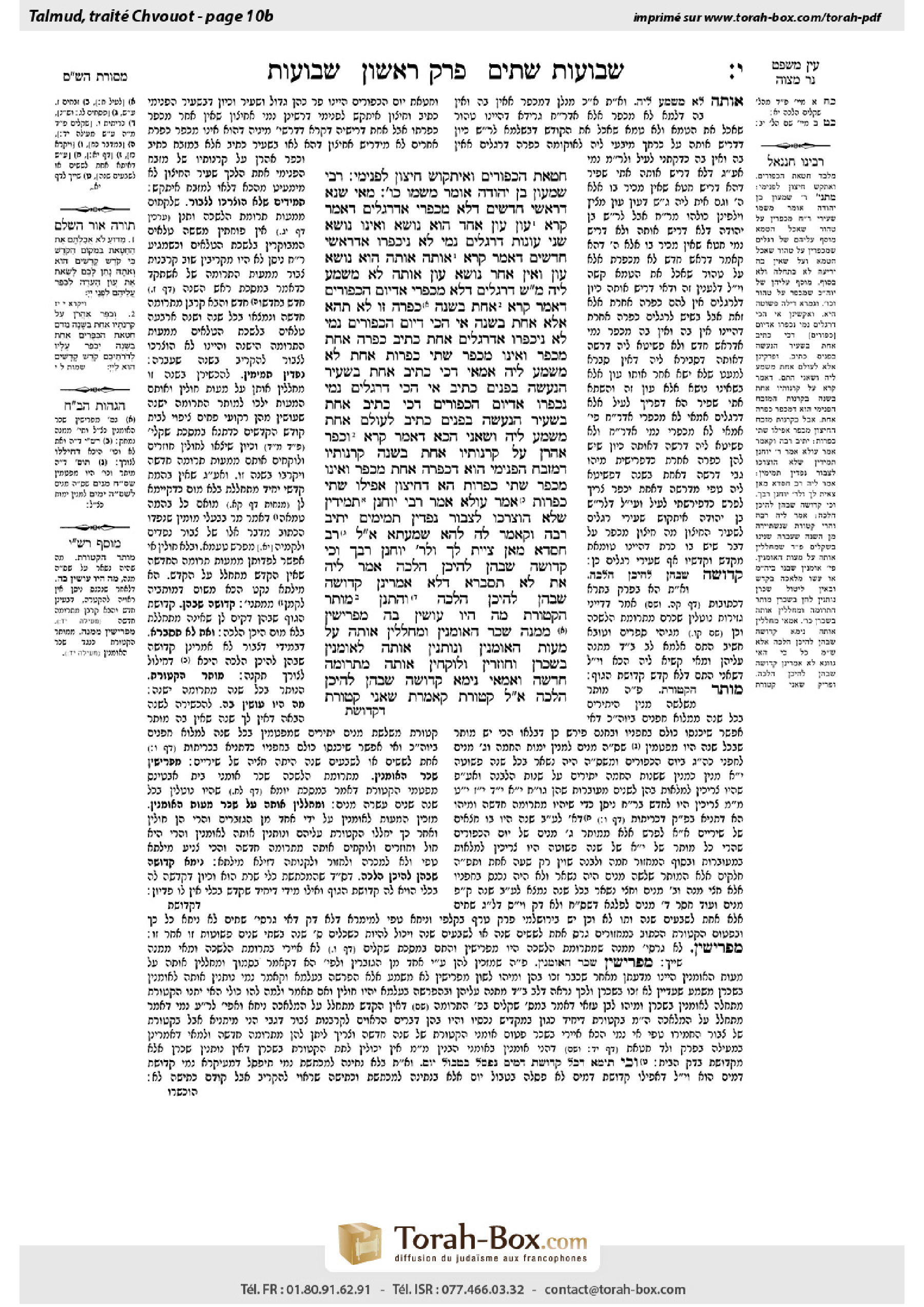
Shevuot 10b: Talmud study for Daf Yomi
Daf Yomi is the daily study of one Talmud folio. Explore 37 tractates with scans, Hebrew text, Sefaria English and AI-generated French translations where annotated.
Passage selection and English or AI-generated French translation are available where the scan has annotations. Daf Study is independent of Torah-Box and Sefaria.
Browse Shevuot · שבועות · All tractatesShevuot 10b text and translations
This page of Shevuot includes the Aramaic text, an English translation and an AI-generated French translation, alongside the scan above.
שבועות י׳ ב · Aramaic and Hebrew text
חַטַּאת הַכִּפּוּרִים״, וְאִיתַּקּוּשׁ חִיצוֹן לִפְנִימִי.
רַבִּי שִׁמְעוֹן בֶּן יְהוּדָה אוֹמֵר מִשְּׁמוֹ כּוּ׳.
מַאי שְׁנָא דְּרָאשֵׁי חֳדָשִׁים דְּלָא מְכַפְּרִי אַדִּרְגָלִים – דְּאָמַר קְרָא ״עֲוֹן״, עָוֹן אֶחָד הוּא נוֹשֵׂא וְאֵינוֹ נוֹשֵׂא שְׁנֵי עֲוֹנוֹת; דִּרְגָלִים נָמֵי לָא נִיכַפְּרוּ אַדְּרָאשֵׁי חֳדָשִׁים – דְּאָמַר קְרָא ״אוֹתָהּ״, אוֹתָהּ הוּא נוֹשֵׂא עָוֹן וְאֵין אַחֵר נוֹשֵׂא עָוֹן! ״אוֹתָהּ״ לֹא מַשְׁמַע לֵיהּ.
מַאי שְׁנָא דִּרְגָלִים דְּלָא מְכַפְּרִי אַדְּיוֹם הַכִּפּוּרִים – דְּאָמַר קְרָא ״אַחַת בַּשָּׁנָה״, כַּפָּרָה זוֹ לֹא תְּהֵא אֶלָּא אַחַת בַּשָּׁנָה; אִי הָכִי, דְּיוֹם הַכִּפּוּרִים נָמֵי לָא נִיכַפְּרוּ אַדִּרְגָלִים – ״אַחַת״ כְּתִיב, כַּפָּרָה אַחַת מְכַפֵּר וְאֵינוֹ מְכַפֵּר שְׁתֵּי כַּפָּרוֹת! ״אַחַת״ לָא מַשְׁמַע לֵיהּ.
אַמַּאי? דְּכִי כְּתִיב ״אַחַת״ – בְּשָׂעִיר הַנַּעֲשֶׂה בִּפְנִים כְּתִיב. אִי הָכִי, דִּרְגָלִים נָמֵי נְכַפְּרוּ אַדְּיוֹם הַכִּפּוּרִים, דְּכִי כְּתִיב ״אַחַת״ – בְּשָׂעִיר הַנַּעֲשֶׂה בִּפְנִים כְּתִיב!
לְעוֹלָם ״אַחַת״ מַשְׁמַע לֵיהּ; וְשָׁאנֵי הָכָא, דְּאָמַר קְרָא: ״וְכִפֶּר אַהֲרֹן עַל קַרְנֹתָיו אַחַת בַּשָּׁנָה״ – קַרְנוֹתָיו דְּמִזְבֵּחַ הַפְּנִימִי הוּא דְּכַפָּרָה אַחַת מְכַפֵּר וְאֵינוֹ מְכַפֵּר שְׁתֵּי כַּפָּרוֹת, הָא דְּחִיצוֹן אֲפִילּוּ שְׁתֵּי כַּפָּרוֹת.
אָמַר עוּלָּא אָמַר רַבִּי יוֹחָנָן: תְּמִידִין שֶׁלֹּא הוּצְרְכוּ לַצִּבּוּר, נִפְדִּין תְּמִימִים.
יָתֵיב רַבָּה וְקָאָמַר לַהּ לְהָא שְׁמַעְתָּא. אֲמַר לֵיהּ רַב חִסְדָּא: מַאן צָיֵית לָךְ וּלְרַבִּי יוֹחָנָן רַבָּךְ? וְכִי קְדוּשָּׁה שֶׁבָּהֶן לְהֵיכָן הָלְכָה?
אֲמַר לֵיהּ: אַתְּ לָא תִּסְבְּרַהּ דְּלָא אָמְרִינַן ״קְדוּשָּׁה שֶׁבָּהֶן לְהֵיכָן הָלְכָה״?! וְהָתְנַן: מוֹתַר הַקְּטוֹרֶת, מָה הָיוּ עוֹשִׂין בָּהּ? מַפְרִישִׁין מִמֶּנָּה שְׂכַר הָאוּמָּנִין, וּמְחַלְּלִין אוֹתָהּ עַל מְעוֹת הָאוּמָּנִין, וְנוֹתְנִין אוֹתָהּ לָאוּמָּנִין בִּשְׂכָרָן, וְחוֹזְרִין וְלוֹקְחִין אוֹתָהּ מִתְּרוּמָה חֲדָשָׁה.
וְאַמַּאי? נֵימָא: ״קְדוּשָּׁה שֶׁבָּהֶן לְהֵיכָן הָלְכָה״!
אֲמַר לֵיהּ: קְטוֹרֶת קָאָמְרַתְּ? שָׁאנֵי קְטוֹרֶת,
Shevuot 10b · English translation
the sin-offering of the atonements” (Numbers 29:11). “One goat for a sin-offering” is referring to the external goat, and “the sin-offering of the atonements” is referring to the internal goat. With this verse, the external goat is juxtaposed with the internal goat, and therefore the limitations imposed on the atonement of the internal goat are also to be applied to the external goat.
§ The mishna teaches: Rabbi Shimon ben Yehuda says in the name of Rabbi Shimon a version of his opinion that differs from that of the mishna above: The goats of the New Moons atone for a ritually pure person who unwittingly partook of ritually impure sacrificial food. The goats of the Festivals exceed them, as they atone both for a ritually pure person who partook of ritually impure sacrificial food and also atone for cases of defiling the Temple or its sacrificial foods where one did not have awareness, neither at the beginning nor at the end. The goats of Yom Kippur further exceed them, as they atone both for a ritually pure person who partook of ritually impure sacrificial food and for cases of defiling the Temple or its sacrificial foods in which one did not have awareness, neither at the beginning nor at the end; and they also atone for cases in which one did not have awareness at the beginning but did have awareness at the end.
The Gemara asks: What is different about the goats of the New Moons that they do not atone for that which the goats of the Festivals atone? The Gemara answers: As the verse states with regard to any one of the goats of the New Moons: “And He gave it to you to bear the sin of the congregation” (Leviticus 10:17), which teaches that it bears, i.e., atones for, one sin but does not bear two sins. The Gemara asks: If so, the goats of the Festivals should also not atone for that which the goats of the New Moons atone, as that same verse states: “And He gave it to you,” which indicates that it bears, i.e., atones for, that sin, but nothing else bears that sin. Why then does Rabbi Shimon ben Yehuda cite Rabbi Shimon as holding that the goats of the Festivals do atone for that which the goats of the New Moons atone? The Gemara answers: Rabbi Shimon does not learn anything from the word “it.” Accordingly, he holds that any one of the goats of the Festivals can atone for two different sins.
The Gemara asks further: What is different about the goats of the Festivals that they do not atone for that which the goats of Yom Kippur atone? As the verse states with regard to the goat of Yom Kippur: “Once a year” (Exodus 30:10), which teaches that this atonement for the specific case that it atones for should be only once a year, and therefore no other offering can atone for it. The Gemara challenges: If so, the goats of Yom Kippur should also not atone for that which the goats of the Festivals atone, as it is written: “Once a year,” which teaches that the goats effect one atonement for only one case but cannot effect two atonements for two cases. Why then does Rabbi Shimon ben Yehuda cite Rabbi Shimon as holding that the goats of Yom Kippur atone for everything that the goats of the Festivals atone for? The Gemara answers: Rabbi Shimon does not learn anything from the word “once.” Accordingly, he holds that the goats of Yom Kippur can atone for three different cases.
The Gemara asks: Why doesn’t he expound the word “once”? He does not expound it because when the word “once” is written, it is written with regard to the goat whose blood presentation is performed inside the Sanctuary, and so the halakha derived from that verse has no bearing on the capacity of the goat whose blood presentation is performed outside the Sanctuary to atone. The Gemara asks: If so, the goats of the Festivals also should atone for that which the goats of Yom Kippur atone, as when the phrase “once a year” is written, it is written with regard to the goat whose blood presentation is performed inside the Sanctuary, so the halakha derived from that verse has no bearing on whether another offering can atone for that which the external goat atones.
The Gemara answers: Actually, he does learn a halakha from the word “once,” and he holds that it also teaches about the capacity of the external goat to atone, as the Gemara explained above. But it is different here, with regard to the derivation that the goat cannot effect two atonements, as the verse states: “And Aaron shall bring atonement upon its corners once a year” (Exodus 30:10). The emphasis on “upon its corners” teaches that it is only with regard to the internal goat, whose blood presentation is performed upon the corners of the internal altar, that it effects one atonement for only one case but cannot effect two atonements for two different cases, but the external goat, whose blood presentation is performed upon the corners of the external altar, can effect even two different atonements.
§ Animals purchased with funds collected for public offerings may be sacrificed only during the fiscal year in which those funds were given. For this purpose, the fiscal year begins on the first of Nisan. Generally, once an animal has been consecrated as an offering, then even if for some reason it may no longer be sacrificed, it still cannot be redeemed unless it develops a blemish. Rabbi Yoḥanan teaches an exception to this halakha: Ulla says that Rabbi Yoḥanan says: Lambs consecrated for the daily offerings that were not needed by the public during the fiscal year in which they were purchased are redeemed, even if they are unblemished, and they may then be used for non-sacred purposes.
Rabba was sitting and reciting this halakha. Rav Ḥisda said to him: Who will listen to you and Rabbi Yoḥanan, your teacher, with regard to this halakha? Rav Ḥisda clarified: But the sanctity that was inherent in them, to where has it gone? Since these animals were consecrated as offerings, they should have been endowed with inherent sanctity. Only sanctity that inheres in an item’s value, i.e., an item consecrated to the Temple treasury, can be desacralized through redemption, but an item with inherent sanctity can never be desacralized.
Rabba said to him: Don’t you also hold that we do not say that the question: The sanctity that was inherent in them, to where has it gone, poses a difficulty? But didn’t we learn in a mishna (Shekalim 4:5): In any fiscal year, one may use only incense that was purchased with funds collected for that year. Accordingly, the mishna asks: With regard to the surplus incense that remained unused at the end of the fiscal year, what would the Temple treasurers do with it in order to render it usable for the following year? They would separate from the Temple treasury the wages for the artisans who worked for the Temple, and those funds would thereby be desacralized. And then they would desacralize the surplus incense by transferring its sanctity to that money that had been set aside for the artisans. Then, they would give the now-desacralized incense to the artisans as their wages, and finally, they would repurchase it with funds from the new collection carried out for the coming year.
Rabba explains the proof from the mishna: One could ask: But why should the method described work? Let us say: The sanctity that was inherent in the incense, to where has it gone? It cannot be removed by redeeming it. Perforce, even you must concede that this question does not pose a difficulty.
Rav Ḥisda said to him: Did you say that there is a proof from the halakhot of incense? One cannot compare incense to animals consecrated for the daily offerings, since incense is different,
Shevuot 10b · Traduction française (IA)
le sacrifice expiatoire des expiations » (Nombres 29,11). « Un bouc en sacrifice expiatoire » désigne le bouc extérieur, et « le sacrifice expiatoire des expiations » désigne le bouc intérieur. Par ce verset, le bouc extérieur est mis en parallèle avec le bouc intérieur ; par conséquent, les restrictions imposées à l’expiation du bouc intérieur s’appliquent également au bouc extérieur.
§ La Michna enseigne : Rabbi Shimon ben Yehouda rapporte au nom de Rabbi Shimon une version de son opinion qui diffère de celle de la Michna ci-dessus : les boucs des néoménies expient pour une personne rituellement pure qui a consommé par inadvertance des aliments consacrés rituellement impurs. Les boucs des fêtes ont une portée plus grande, car ils expient à la fois pour une personne rituellement pure qui a consommé des aliments consacrés rituellement impurs et pour les cas où l’on a rendu impur le Temple ou ses aliments consacrés sans en avoir conscience ni au début ni à la fin. Les boucs de Yom Kippour ont une portée encore plus grande : ils expient à la fois pour une personne rituellement pure qui a consommé des aliments consacrés rituellement impurs et pour les cas où l’on a rendu impur le Temple ou ses aliments consacrés sans en avoir conscience ni au début ni à la fin ; ils expient aussi les cas où l’on n’en avait pas conscience au début, mais où l’on en a eu conscience à la fin.
La Guemara demande : En quoi les boucs des néoménies diffèrent-ils, puisqu’ils n’expient pas ce qu’expient les boucs des fêtes ? La Guemara répond : le verset dit au sujet de chacun des boucs des néoménies : « Il vous l’a donné pour porter la faute de la communauté » (Lévitique 10,17), ce qui enseigne qu’il porte, c’est-à-dire expie, une faute, mais ne porte pas deux fautes. La Guemara demande : Dans ce cas, les boucs des fêtes ne devraient pas non plus expier ce qu’expient les boucs des néoménies, puisque ce même verset dit : « Il vous l’a donné », ce qui indique qu’il porte, c’est-à-dire expie, cette faute, mais que rien d’autre ne la porte. Pourquoi Rabbi Shimon ben Yehouda rapporte-t-il alors au nom de Rabbi Shimon que les boucs des fêtes expient ce qu’expient les boucs des néoménies ? La Guemara répond : Rabbi Shimon ne tire aucun enseignement du mot « le ». Il soutient donc que chacun des boucs des fêtes peut expier deux fautes différentes.
La Guemara demande encore : En quoi les boucs des fêtes diffèrent-ils, puisqu’ils n’expient pas ce qu’expient les boucs de Yom Kippour ? Le verset dit au sujet du bouc de Yom Kippour : « Une fois par an » (Exode 30,10), ce qui enseigne que l’expiation du cas précis qu’il expie ne peut avoir lieu qu’une fois par an ; aucune autre offrande ne peut donc expier ce cas. La Guemara objecte : Dans ce cas, les boucs de Yom Kippour ne devraient pas non plus expier ce qu’expient les boucs des fêtes, puisqu’il est écrit : « Une fois par an », ce qui enseigne que les boucs effectuent une seule expiation pour un seul cas, mais ne peuvent effectuer deux expiations pour deux cas. Pourquoi Rabbi Shimon ben Yehouda rapporte-t-il alors au nom de Rabbi Shimon que les boucs de Yom Kippour expient tout ce qu’expient les boucs des fêtes ? La Guemara répond : Rabbi Shimon ne tire aucun enseignement du mot « une fois ». Il soutient donc que les boucs de Yom Kippour peuvent expier trois cas différents.
La Guemara demande : Pourquoi ne tire-t-il pas d’enseignement du mot « une fois » ? Il ne le fait pas, car le mot « une fois » figure à propos du bouc dont le sang est aspergé à l’intérieur du Sanctuaire ; la halakha déduite de ce verset n’a donc aucune incidence sur la capacité du bouc dont le sang est aspergé à l’extérieur du Sanctuaire à expier. La Guemara demande : Dans ce cas, les boucs des fêtes devraient aussi expier ce qu’expient les boucs de Yom Kippour, puisque l’expression « une fois par an » figure à propos du bouc dont le sang est aspergé à l’intérieur du Sanctuaire ; la halakha déduite de ce verset n’a donc aucune incidence sur la possibilité qu’une autre offrande expie ce qu’expie le bouc extérieur.
La Guemara répond : En réalité, il tire une halakha du mot « une fois » et considère que celui-ci enseigne aussi quelque chose sur la capacité du bouc extérieur à expier, comme la Guemara l’a expliqué plus haut. Mais, ici, la déduction selon laquelle le bouc ne peut effectuer deux expiations est différente, car le verset dit : « Aaron fera l’expiation sur ses cornes une fois par an » (Exode 30,10). L’accent mis sur « sur ses cornes » enseigne que seul le bouc intérieur, dont le sang est aspergé sur les cornes de l’autel intérieur, effectue une seule expiation pour un seul cas, sans pouvoir effectuer deux expiations pour deux cas différents. En revanche, le bouc extérieur, dont le sang est aspergé sur les cornes de l’autel extérieur, peut effectuer même deux expiations différentes.
§ Les animaux achetés avec les fonds recueillis pour les offrandes publiques ne peuvent être sacrifiés que pendant l’exercice financier au cours duquel ces fonds ont été versés. À cette fin, l’exercice financier commence le premier Nissan. En règle générale, une fois qu’un animal a été consacré comme offrande, il ne peut plus être racheté, même si, pour une raison quelconque, il ne peut plus être sacrifié, à moins qu’il ne développe un défaut. Rabbi Yoḥanan enseigne une exception à cette halakha : Oulla dit que Rabbi Yoḥanan enseigne que les agneaux consacrés aux offrandes quotidiennes dont le public n’a pas eu besoin pendant l’exercice financier au cours duquel ils ont été achetés sont rachetés, même s’ils sont sans défaut ; ils peuvent alors être utilisés à des fins profanes.
Rabba était assis et enseignait cette halakha. Rav Ḥisda lui dit : Qui t’écoutera, toi et ton maître Rabbi Yoḥanan, sur cette halakha ? Rav Ḥisda précisa : Mais qu’est devenue la sainteté qui leur était intrinsèque ? Puisque ces animaux ont été consacrés comme offrandes, ils devraient être investis d’une sainteté intrinsèque. Seule une sainteté inhérente à la valeur d’un objet — c’est-à-dire celle d’un objet consacré au trésor du Temple — peut être levée par le rachat ; un objet doté d’une sainteté intrinsèque ne peut jamais être désacralisé.
Rabba lui dit : Toi aussi, ne soutiens-tu pas que la question « Qu’est devenue la sainteté qui leur était intrinsèque ? » ne constitue pas une difficulté ? Pourtant, nous avons appris dans une Michna (Shekalim 4,5) que, chaque exercice financier, on ne peut utiliser que de l’encens acheté avec les fonds recueillis pour cet exercice. La Michna demande donc : que faisaient les trésoriers du Temple de l’encens excédentaire resté inutilisé à la fin de l’exercice, afin de le rendre utilisable l’année suivante ? Ils prélevaient sur le trésor du Temple la somme destinée à payer les artisans qui travaillaient pour le Temple, et ces fonds étaient ainsi désacralisés. Puis ils désacralisaient l’encens excédentaire en transférant sa sainteté à cet argent mis de côté pour les artisans. Ensuite, ils donnaient aux artisans l’encens désormais désacralisé en guise de salaire, puis le rachetaient avec les fonds de la nouvelle collecte effectuée pour l’année à venir.
Rabba explique la preuve tirée de la Michna : on pourrait demander : pourquoi cette méthode devrait-elle fonctionner ? Demandons plutôt : qu’est devenue la sainteté intrinsèque de l’encens ? Elle ne peut être supprimée par le rachat. Il faut donc reconnaître que toi aussi, tu dois admettre que cette question ne constitue pas une difficulté.
Rav Ḥisda lui dit : As-tu invoqué les halakhot de l’encens comme preuve ? On ne peut pas comparer l’encens aux animaux consacrés aux offrandes quotidiennes, car l’encens est différent,
Traduction française générée par IA à partir de l’édition anglaise de Sefaria. Vérifie toujours un passage avec le texte source.
Text from Sefaria: William Davidson Edition - Vocalized Aramaic (CC BY NC); William Davidson Edition - English (CC BY NC).