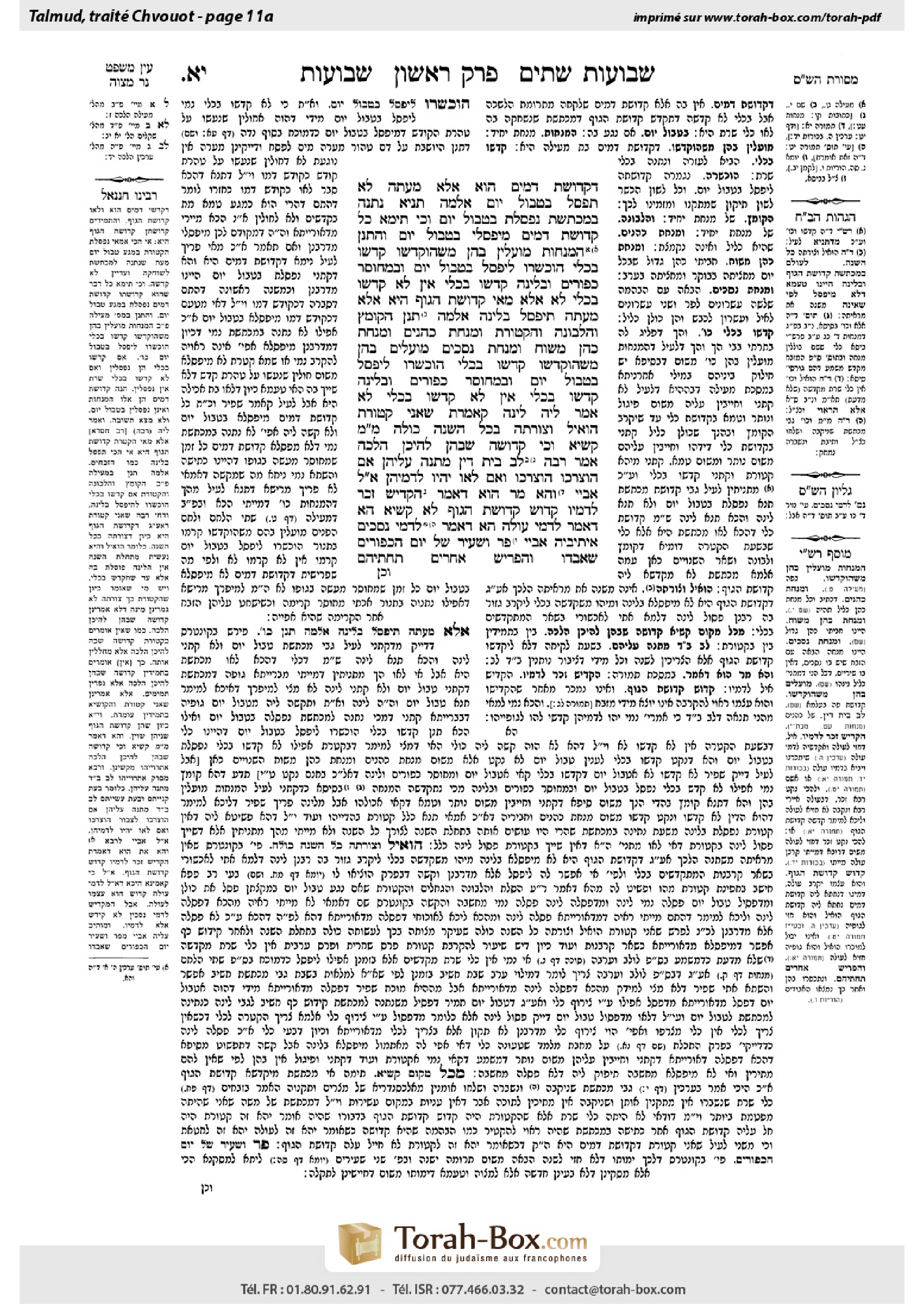
Shevuot 11a: Talmud study for Daf Yomi
Daf Yomi is the daily study of one Talmud folio. Explore 37 tractates with scans, Hebrew text, Sefaria English and AI-generated French translations where annotated.
Passage selection and English or AI-generated French translation are available where the scan has annotations. Daf Study is independent of Torah-Box and Sefaria.
Browse Shevuot · שבועות · All tractatesShevuot 11a text and translations
This page of Shevuot includes the Aramaic text, an English translation and an AI-generated French translation, alongside the scan above.
שבועות י״א א · Aramaic and Hebrew text
דִּקְדוּשַּׁת דָּמִים הוּא.
אֶלָּא מֵעַתָּה, לֹא תִּפָּסֵל בִּטְבוּל יוֹם! אַלְּמָה תַּנְיָא: נְתָנָהּ בְּמַכְתֶּשֶׁת – נִפְסֶלֶת בִּטְבוּל יוֹם?
וְכִי תֵּימָא כׇּל קְדוּשַּׁת דָּמִים מִיפַּסְלִי בִּטְבוּל יוֹם; וְהָתְנַן: הַמְּנָחוֹת, מוֹעֲלִין בָּהֶן מִשֶּׁהוּקְדְּשׁוּ; קָדְשׁוּ בִּכְלִי – הוּכְשְׁרוּ לִיפָּסֵל בִּטְבוּל יוֹם וּבִמְחוּסַּר כִּפּוּרִים וּבְלִינָה.
קָדְשׁוּ בִּכְלִי אִין, לֹא קָדְשׁוּ בִּכְלִי לָא!
אֶלָּא מַאי – קְדוּשַּׁת הַגּוּף הִיא?! אֶלָּא מֵעַתָּה, תִּיפָּסֵל בְּלִינָה! אַלְּמָה תְּנַן: הַקּוֹמֶץ וְהַלְּבוֹנָה וְהַקְּטוֹרֶת וּמִנְחַת כֹּהֲנִים וּמִנְחַת כֹּהֵן מָשׁוּחַ וּמִנְחַת נְסָכִים – מוֹעֲלִים בָּהֶן מִשֶּׁהוּקְדְּשׁוּ, קָדְשׁוּ בִּכְלִי – הוּכְשְׁרוּ לִיפָּסֵל בִּטְבוּל יוֹם וּבִמְחוּסַּר כִּפּוּרִים וּבְלִינָה.
קָדְשׁוּ בִּכְלִי – אִין, לֹא קָדְשׁוּ בִּכְלִי – לָא.
אֲמַר לֵיהּ: לִינָה קָאָמְרַתְּ? שָׁאנֵי קְטוֹרֶת, הוֹאִיל וְצוּרָתָהּ בְּכׇל הַשָּׁנָה כּוּלָּהּ.
מִכׇּל מָקוֹם קַשְׁיָא: וְכִי קְדוּשָּׁה שֶׁבָּהֶן לְהֵיכָן הָלְכָה? אָמַר רַבָּה: לֵב בֵּית דִּין מַתְנֶה עֲלֵיהֶן; אִם הוּצְרְכוּ הוּצְרְכוּ, וְאִם לָאו יִהְיוּ לִדְמֵיהֶן.
אֲמַר לֵיהּ אַבָּיֵי, וְהָא מָר הוּא דְּאָמַר: הִקְדִּישׁ זָכָר לְדָמָיו – קָדוֹשׁ קְדוּשַּׁת הַגּוּף! לָא קַשְׁיָא; הָא דְּאָמַר ״לִדְמֵי עוֹלָה״, הָא דְּאָמַר ״לִדְמֵי נְסָכִים״.
אֵיתִיבֵיהּ אַבָּיֵי: פַּר וְשָׂעִיר שֶׁל יוֹם הַכִּפּוּרִים שֶׁאָבְדוּ וְהִפְרִישׁ אֲחֵרִים תַּחְתֵּיהֶם,
Shevuot 11a · English translation
as it has only sanctity that inheres in its value. By contrast, animal offerings have inherent sanctity, which cannot be removed.
Rabba challenges Rav Ḥisda’s claim about incense: If that is so, it should not become disqualified through contact with one who was ritually impure who immersed that day but is still not regarded as fully pure until nightfall, as only items with inherent sanctity are disqualified in such a way. Why, then, is it taught in a baraita with regard to the incense: Once the priest has placed it in a mortar to grind it, it can be disqualified through contact with one who immersed that day?
Rabba deflects a possible challenge: And if you would say to defend your opinion that all items that have sanctity that inheres in their value are also disqualified through contact with one who immersed that day, that is not so. He explains: But didn’t we learn in a mishna (Me’ila 9a): With regard to the ingredients of the meal-offerings, one is liable for misusing them from when they are consecrated with sanctity that inheres in their value by the owner verbally dedicating them to the Temple? Once they are further consecrated with inherent sanctity by being placed in a service vessel, they become fit to be disqualified both through contact with one who immersed that day, and through contact with one who has not yet brought an atonement offering to complete the purification process, and through being left overnight.
Rabba explains the proof: From this mishna it is apparent that if the ingredients of the meal-offerings were consecrated with inherent sanctity by being placed in a service vessel, then, yes, they can be disqualified through contact with one who immersed that day, but if they were not consecrated by being placed in a service vessel, then they will not be disqualified through contact with one who immersed that day, as they have only sanctity that inheres in their value.
Rav Ḥisda responds: Rather, what do you say? Do you say that the surplus incense, which was only placed in a mortar but never in a service vessel, has inherent sanctity? But if that is so, it should be disqualified by being left overnight. Why, then, did we learn in a mishna (Me’ila 10a): With regard to the handful of the meal-offering that the priest takes to burn on the altar, the frankincense, the incense, the meal-offering of priests, the meal-offering of the anointed priest, i.e., High Priest, and the meal-offering of libations, one is liable for misusing them from when they are consecrated by verbally dedicating them for their purposes. Once they are further consecrated with inherent sanctity by being placed in a service vessel, they become fit to be disqualified both through contact with one who immersed that day, and through contact with one who has not yet brought an atonement offering to complete the purification process, and through being left overnight.
Rav Ḥisda explains the proof: From this mishna it is apparent that if these items were consecrated with inherent sanctity by being placed in a service vessel, then yes, they can be disqualified by being left overnight, but if they were not consecrated by being placed in a service vessel, then they will not be disqualified by being left overnight, as they have only sanctity that inheres in their value. Apparently, even after the incense has been placed in the mortar, it still does not have inherent sanctity.
Rabba said to him: Did you say that you can provide a proof from the disqualification that occurs as a result of an item’s being left overnight? One cannot do so, as incense is different, because even though it has inherent sanctity, it is not disqualified by being left overnight, since its form remains unchanged throughout the entire year, and the disqualification brought about by being left overnight applies only to a substance that spoils over time.
The Gemara notes: In any case, Rav Ḥisda’s initial question is still difficult: But the sanctity that was inherent in them, to where has it gone? Rabba said: With regard to the consecration of items for public offerings such as the daily offerings and incense, the court tacitly stipulates concerning them as follows: If they are ultimately required to be used as offerings that year, then they are required for that, and they should be consecrated as offerings. But if they are not required that year, then they are only to be consecrated for their value, i.e., for them to be sold and then for their proceeds to be used toward the purchase of offerings.
Abaye said to Rabba: But wasn’t it you, Master, who said: If one consecrated a male ram for its value, since that ram is itself fit to be brought as an offering, it is automatically consecrated with inherent sanctity? Accordingly, to what avail is the court’s stipulation? Since the items are fit to be used as offerings, they will automatically become consecrated with inherent sanctity, even if they are consecrated only for their value. Rabba answers: This is not difficult. This case, where the ram is automatically consecrated with inherent sanctity, is referring to a situation where the donor says that it should be consecrated for the value of a burnt-offering, for which the ram is itself suitable, whereas that case, of the court’s stipulation, is analogous to a situation where he says that a ram should be consecrated for the value of libations, for which the ram itself is not suitable and therefore is not automatically consecrated with inherent sanctity.
Abaye raised an objection to Rabba’s suggestion from that which is taught in a baraita: With regard to the bull and the goat of Yom Kippur that were lost, and one separated and sacrificed others in their stead,
Shevuot 11a · Traduction française (IA)
car elle n’a que la sainteté inhérente à sa valeur. À l’inverse, les offrandes animales possèdent une sainteté intrinsèque, qui ne peut être supprimée.
Rabba conteste l’affirmation de Rav Ḥisda au sujet de l’encens : si tel était le cas, il ne devrait pas être invalidé par le contact avec une personne rituellement impure qui s’est immergée ce jour-là, mais qui n’est considérée comme pleinement pure qu’à la tombée de la nuit, car seuls les objets dotés d’une sainteté intrinsèque sont invalidés de cette manière. Pourquoi est-il alors enseigné dans une baraïta au sujet de l’encens : dès que le prêtre l’a placé dans un mortier pour le broyer, il peut être invalidé par le contact avec une personne qui s’est immergée ce jour-là ?
Rabba écarte une objection possible : et si tu disais, pour défendre ton opinion, que tous les objets qui ont une sainteté inhérente à leur valeur sont également invalidés par le contact avec une personne qui s’est immergée ce jour-là, ce n’est pas le cas. Il explique : Mais n’avons-nous pas appris dans une Michna (Meïla 9a) : pour les ingrédients des offrandes végétales, on est passible pour leur usage profane dès qu’ils sont consacrés d’une sainteté inhérente à leur valeur, lorsque leur propriétaire les dédie verbalement au Temple ? Une fois qu’ils sont en outre dotés d’une sainteté intrinsèque, en étant placés dans un ustensile de service, ils peuvent être invalidés par le contact avec une personne qui s’est immergée ce jour-là, par le contact avec une personne qui n’a pas encore apporté de sacrifice expiatoire pour achever le processus de purification, ainsi que par le fait de passer la nuit.
Rabba explique la preuve : cette Michna montre que si les ingrédients des offrandes végétales étaient dotés d’une sainteté intrinsèque en étant placés dans un ustensile de service, alors, oui, ils peuvent être invalidés par le contact avec une personne qui s’est immergée ce jour-là ; mais s’ils n’étaient pas consacrés par leur placement dans un ustensile de service, ils ne seraient pas invalidés par le contact avec une personne qui s’est immergée ce jour-là, puisqu’ils n’ont qu’une sainteté inhérente à leur valeur.
Rav Ḥisda répond : Alors, que dis-tu ? Prétends-tu que le surplus d’encens, qui a été placé dans un mortier mais jamais dans un ustensile de service, possède une sainteté intrinsèque ? Mais si tel était le cas, il devrait être invalidé pour avoir passé la nuit. Pourquoi avons-nous alors appris dans une Michna (Meïla 10a) : pour la poignée de l’offrande végétale que le prêtre prélève pour la brûler sur l’autel, l’encens, l’offrande végétale des prêtres, l’offrande végétale du prêtre oint, c’est-à-dire du grand prêtre, et l’offrande végétale des libations, on est passible pour leur usage profane dès qu’ils sont consacrés par une dédicace verbale à cette fin. Une fois qu’ils sont en outre dotés d’une sainteté intrinsèque, en étant placés dans un ustensile de service, ils peuvent être invalidés par le contact avec une personne qui s’est immergée ce jour-là, par le contact avec une personne qui n’a pas encore apporté de sacrifice expiatoire pour achever le processus de purification, ainsi que par le fait de passer la nuit.
Rav Ḥisda explique la preuve : cette Michna montre que si ces objets étaient dotés d’une sainteté intrinsèque en étant placés dans un ustensile de service, alors, oui, ils peuvent être invalidés pour avoir passé la nuit ; mais s’ils n’étaient pas consacrés par leur placement dans un ustensile de service, ils ne seraient pas invalidés pour avoir passé la nuit, puisqu’ils n’ont qu’une sainteté inhérente à leur valeur. Il apparaît donc que même après avoir été placé dans le mortier, l’encens ne possède toujours pas de sainteté intrinsèque.
Rabba lui dit : As-tu dit que tu pouvais apporter une preuve à partir de l’invalidation due au fait qu’un objet passe la nuit ? On ne peut pas le faire, car l’encens est différent : même s’il possède une sainteté intrinsèque, il n’est pas invalidé pour avoir passé la nuit, puisque sa forme reste inchangée tout au long de l’année et que l’invalidation due au fait de passer la nuit ne s’applique qu’à une substance qui se détériore avec le temps.
La Guemara relève : Quoi qu’il en soit, la question initiale de Rav Ḥisda reste difficile : mais où est passée la sainteté qui leur était inhérente ? Rabba dit : lorsqu’il s’agit de la consécration d’objets destinés aux offrandes publiques, comme les offrandes quotidiennes et l’encens, le tribunal formule tacitement à leur sujet la condition suivante : s’ils doivent finalement être utilisés comme offrandes au cours de cette année, alors ils sont nécessaires à cette fin et doivent être consacrés comme offrandes. Mais s’ils ne sont pas nécessaires cette année-là, ils ne sont consacrés qu’en raison de leur valeur, c’est-à-dire pour être vendus et que le produit de la vente serve ensuite à acheter des offrandes.
Abaye dit à Rabba : Mais n’est-ce pas toi, Maître, qui as dit que si quelqu’un consacre un bélier mâle pour sa valeur, puisque ce bélier peut lui-même être offert, il acquiert automatiquement une sainteté intrinsèque ? À quoi sert donc la condition du tribunal ? Puisque les objets peuvent être utilisés comme offrandes, ils acquerront automatiquement une sainteté intrinsèque, même s’ils ne sont consacrés que pour leur valeur. Rabba répond : Il n’y a pas de difficulté. Le cas où le bélier acquiert automatiquement une sainteté intrinsèque concerne une situation où le donateur dit qu’il doit être consacré à hauteur de la valeur d’un holocauste, auquel le bélier lui-même convient ; l’autre cas, celui de la condition du tribunal, est analogue à une situation où il dit qu’un bélier doit être consacré à hauteur de la valeur des libations, auxquelles le bélier lui-même ne convient pas et n’acquiert donc pas automatiquement de sainteté intrinsèque.
Abaye soulève une objection contre la proposition de Rabba à partir de ce qui est enseigné dans une baraïta : au sujet du taureau et du bouc de Yom Kippour qui avaient été perdus, et dont on avait séparé d’autres animaux et offert ceux-ci à leur place,
Traduction française générée par IA à partir de l’édition anglaise de Sefaria. Vérifie toujours un passage avec le texte source.
Text from Sefaria: William Davidson Edition - Vocalized Aramaic (CC BY NC); William Davidson Edition - English (CC BY NC).