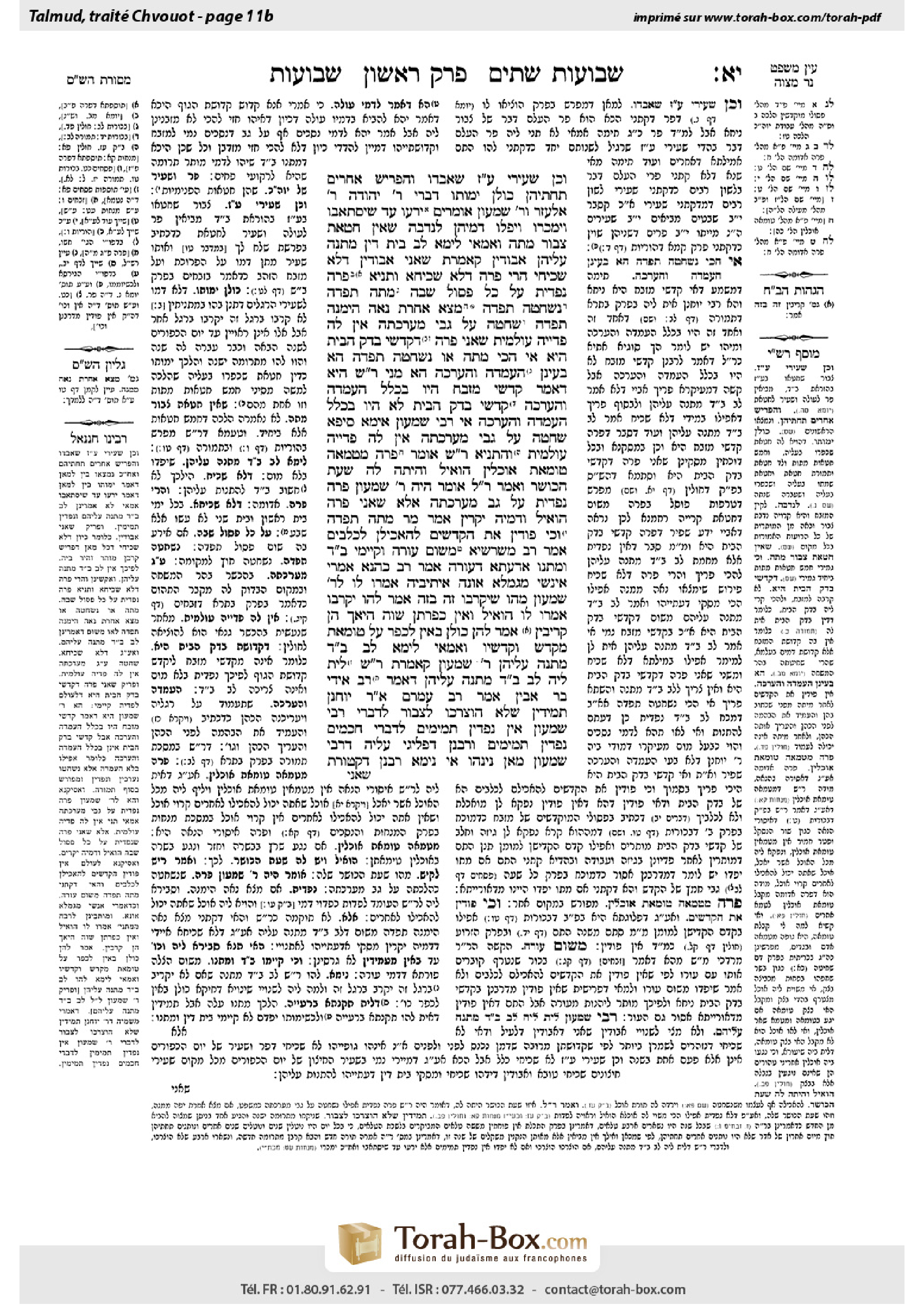
Shevuot 11b: Talmud study for Daf Yomi
Daf Yomi is the daily study of one Talmud folio. Explore 37 tractates with scans, Hebrew text, Sefaria English and AI-generated French translations where annotated.
Passage selection and English or AI-generated French translation are available where the scan has annotations. Daf Study is independent of Torah-Box and Sefaria.
Browse Shevuot · שבועות · All tractatesShevuot 11b text and translations
This page of Shevuot includes the Aramaic text, an English translation and an AI-generated French translation, alongside the scan above.
שבועות י״א ב · Aramaic and Hebrew text
וְכֵן שְׂעִירֵי עֲבוֹדָה זָרָה שֶׁאָבְדוּ וְהִפְרִישׁ אֲחֵרִים תַּחְתֵּיהֶן – כּוּלָּן יָמוּתוּ. דִּבְרֵי רַבִּי יְהוּדָה. רַבִּי אֶלְעָזָר וְרַבִּי שִׁמְעוֹן אוֹמְרִים: יִרְעוּ עַד שֶׁיִּסְתָּאֲבוּ, וְיִמָּכְרוּ וְיִפְּלוּ דְּמֵיהֶן לִנְדָבָה. שֶׁאֵין חַטַּאת צִבּוּר מֵתָה.
וְאַמַּאי? לֵימָא לֵב בֵּית דִּין מַתְנֶה עֲלֵיהֶן!
אֲבוּדִין קָאָמְרַתְּ? שָׁאנֵי אֲבוּדִין, דְּלָא שְׁכִיחִי.
הֲרֵי פָּרָה, דְּלָא שְׁכִיחָא, וְתַנְיָא: פָּרָה נִפְדֵּית עַל כׇּל פְּסוּל שֶׁבָּהּ – מֵתָה תִּפָּדֶה, נִשְׁחֲטָה תִּפָּדֶה, מָצָא אַחֶרֶת נָאָה הֵימֶנָּה תִּפָּדֶה. שְׁחָטָהּ עַל גַּבֵּי מַעֲרַכְתָּהּ – אֵין לָהּ פְּדִיָּיה עוֹלָמִית! שָׁאנֵי פָּרָה, דְּקׇדְשֵׁי בֶּדֶק הַבַּיִת הִיא.
אִי הָכִי, מֵתָה אוֹ נִשְׁחֲטָה תִּפָּדֶה?! הָא בָּעֵינַן הַעֲמָדָה וְהַעֲרָכָה! הָא מַנִּי – רַבִּי שִׁמְעוֹן הִיא, דְּאָמַר: קׇדְשֵׁי מִזְבֵּחַ הָיוּ בִּכְלַל הַעֲמָדָה וְהַעֲרָכָה, קׇדְשֵׁי בֶּדֶק הַבַּיִת לָא הָיוּ בִּכְלַל הַעֲמָדָה וְהַעֲרָכָה.
אִי רַבִּי שִׁמְעוֹן, אֵימָא סֵיפָא: שְׁחָטָהּ עַל גַּבֵּי מַעֲרַכְתָּהּ, אֵין לָהּ פְּדִיָּיה עוֹלָמִית.
וְהָתַנְיָא, רַבִּי שִׁמְעוֹן אוֹמֵר: פָּרָה מְטַמְּאָה טוּמְאַת אֳוכָלִין, הוֹאִיל וְהָיְתָה לָהּ שְׁעַת הַכּוֹשֶׁר; וְאָמַר רֵישׁ לָקִישׁ: אוֹמֵר הָיָה רַבִּי שִׁמְעוֹן, פָּרָה נִפְדֵּית עַל גַּב מַעֲרַכְתָּהּ!
אֶלָּא שָׁאנֵי פָּרָה, הוֹאִיל וְדָמֶיהָ יְקָרִין.
אָמַר מָר: מֵתָה תִּפָּדֶה. וְכִי פּוֹדִין אֶת הַקֳּדָשִׁים לְהַאֲכִילָן לִכְלָבִים?! אָמַר רַב מְשַׁרְשְׁיָא: מִשּׁוּם עוֹרָהּ. וְקָיְימִי בֵּית דִּין וּמַתְנוּ אַדַּעְתָּא דְּעוֹרָהּ?! אָמַר רַב כָּהֲנָא, אָמְרִי אִינָשֵׁי: מִגַּמְלָא אוּנַּהּ.
אֵיתִיבֵיהּ: אָמְרוּ לוֹ לְרַבִּי שִׁמְעוֹן, מַהוּ שֶׁיִּקְרְבוּ זֶה בָּזֶה? אָמַר לְהוּ: יִקְרְבוּ. אָמְרוּ לוֹ: הוֹאִיל וְאֵין כַּפָּרָתָן שָׁוָה, הֵיאַךְ הֵן קְרֵיבִין? אָמַר לָהֶן: כּוּלָּן בָּאִין לְכַפֵּר עַל טוּמְאַת מִקְדָּשׁ וְקָדָשָׁיו.
וְאַמַּאי? לֵימָא לֵב בֵּית דִּין מַתְנֶה עֲלֵיהֶן! רַבִּי שִׁמְעוֹן קָאָמְרַתְּ? רַבִּי שִׁמְעוֹן לֵית לֵיהּ לֵב בֵּית דִּין מַתְנֶה עֲלֵיהֶן. דְּאָמַר רַב אִידִי בַּר אָבִין, אָמַר רַב עַמְרָם, אָמַר רַבִּי יוֹחָנָן: תְּמִידִין שֶׁלֹּא הוּצְרְכוּ לַצִּבּוּר, לְדִבְרֵי רַבִּי שִׁמְעוֹן אֵין נִפְדִּין תְּמִימִים, לְדִבְרֵי חֲכָמִים נִפְדִּין תְּמִימִים.
וְרַבָּנַן דִּפְלִיגִי עֲלֵיהּ דְּרַבִּי שִׁמְעוֹן – מַאן נִינְהוּ? אִי נֵימָא רַבָּנַן דִּקְטוֹרֶת –
Shevuot 11b · English translation
and likewise, goats that were designated to atone for an act of unwitting public idol worship that were lost, and one separated and sacrificed others in their stead, in such cases, all of the lost animals, should they subsequently be found, shall be left to die. This is in accordance with the halakha that a sin-offering whose owner has already achieved atonement is left to die. This is the statement of Rabbi Yehuda. Rabbi Elazar and Rabbi Shimon say: They should graze until they become unfit by developing a blemish, and then they are sold and their proceeds are allocated for communal gift offerings. They are not left to die, because the halakha is that a communal sin-offering is not left to die.
Abaye explains his challenge: But why should it even be necessary to wait until the offerings develop a blemish? Let us say here also that the court tacitly stipulates concerning them, so that if it ultimately emerges that they were not needed, then they should have only sanctity that inheres in their value, and therefore it should be possible to redeem them even if they do not develop a blemish.
Rabba deflects the challenge: Did you say that there is a proof from the case of lost animals? Cases of lost animals are different, because they are not common. Therefore, the court does not stipulate concerning such an eventuality.
Abaye persists: But consider the case of a red heifer, which is not common, and yet it is taught in a baraita: A red heifer may be redeemed for any disqualification that occurs to it. If it died, it shall be redeemed; if it was slaughtered in an improper place, it shall be redeemed; if another was found that is choicer than it, it shall be redeemed. But once the priest has slaughtered it properly on its arrangement of wood on the Mount of Olives, it can no longer be redeemed. Presumably, the reason it may be redeemed if a choicer one is found is that the court tacitly stipulates that in such a case it should be consecrated with sanctity that inheres in its value. It is apparent that even in uncommon cases, the court makes such stipulations. Rabba rejects the proof: The red heifer is different, as in all cases it has only the sanctity of items consecrated for Temple maintenance, which inheres only in the item’s value, and so it can always be redeemed, even if still unblemished.
Abaye asks: If so, if it died or was slaughtered, how can it be redeemed? In order for an item to be redeemed, don’t we require that it first undergo the process of standing and valuation? The animal must be stood before a priest who then evaluates how much it should be redeemed for (see Leviticus 27:11–12), and a dead animal cannot stand. Rabba answers: In accordance with whose opinion is this? It is in accordance with the opinion of Rabbi Shimon, who says: Items consecrated to be offered on the altar were included in the requirement of standing and appraising, but items with the sanctity of items consecrated for Temple maintenance, such as the red heifer, were not included in the requirement of standing and appraising.
Abaye asks: If, as you claim, the baraita is in accordance with the opinion of Rabbi Shimon, then say and try to justify the latter clause, which states: Once the priest has slaughtered it properly on its arrangement of wood on the Mount of Olives, it can no longer be redeemed.
And this statement is not consistent with Rabbi Shimon’s opinion, as isn’t it taught in a baraita: Rabbi Shimon says that the meat of a red heifer that was slaughtered properly is susceptible to becoming ritually impure with the ritual impurity of food, even though it is prohibited to partake of it in its current state, since it had a time when it was fit to be eaten. And in explanation of when it was fit to be eaten, Reish Lakish says: Rabbi Shimon would say that a red heifer may be redeemed even while it is upon its arrangement of wood. It is considered fit to be eaten due to the potential to redeem it, which would allow one to then partake of it. It is apparent from Reish Lakish’s comment that the latter clause, and by logical extension, the rest of the baraita, is not in accordance with Rabbi Shimon’s opinion.
Rabba concedes therefore that the red heifer can be redeemed due to the fact that the court makes a stipulation with regard to it, but, nevertheless, he defends his opinion that they do not normally make a stipulation for uncommon cases: Rather, the case of a red heifer is different, since it is of great monetary value. Therefore, to avoid a great loss, the court makes a stipulation despite its being an uncommon case.
The Gemara interjects with a question concerning the baraita: The Master said in the baraita: If a red heifer died, it shall be redeemed. The Gemara asks: But may one redeem consecrated items in order to feed the meat from them to dogs? Certainly one may not. Nevertheless, the meat of a red heifer that died without being slaughtered is not suitable for any other purpose. Rav Mesharshiyya said: It is redeemed for the sake of its hide. The Gemara asks: But does the court stand and stipulate with its mind on the hide of the heifer, which is presumably of little value? Rav Kahana said: As people say in a popular adage: From a camel, even just its ear. Since a camel is so valuable, even the flesh of its ear is valuable and should be saved if possible. Similarly, the hide of a red heifer will also be valuable.
§ Abaye raised an objection to Rabba’s claim that the court tacitly stipulates concerning items consecrated for public offerings from the mishna (2b): The Rabbis said to Rabbi Shimon: What is the halakha with regard to whether goats consecrated for different days may be sacrificed, this one in place of that one? For example, if a goat was initially consecrated to be sacrificed as part of the Yom Kippur additional offerings, may it be sacrificed instead as part of the Festival additional offerings? Rabbi Shimon said to them: Such a goat may be sacrificed. They said to Rabbi Shimon: Since, according to you, their atonement is not the same, how could they possibly be sacrificed? Rabbi Shimon said to them: They can be interchanged, since ultimately all of them come to atone for the defiling of the Temple or its sacrificial foods.
Abaye explains the objection brought from the mishna: But according to Rabba, why did Rabbi Shimon give the reason he gave? Let Rabbi Shimon say instead that the court tacitly stipulates concerning them that they should be consecrated for the day on which they are ultimately brought. Rabba answers: Did you say a proof from a statement of Rabbi Shimon? Rabbi Shimon does not accept the principle that the court tacitly stipulates concerning them, as is apparent from that which Rav Idi bar Avin says that Rav Amram says that Rabbi Yoḥanan says: Concerning lambs consecrated for the daily offerings that were not needed by the public, according to the statement of Rabbi Shimon they are not redeemed if they are unblemished; according to the statement of the Rabbis they are redeemed, even if they are unblemished.
The Gemara asks: And the Rabbis who disagree with Rabbi Shimon and hold that the court does make such stipulations, who are they? Where is their opinion recorded? If we say that they are the Sages who ruled, in the mishna cited above (Shekalim 4:5), with regard to surplus incense that it may be redeemed,
Shevuot 11b · Traduction française (IA)
De même, les boucs désignés pour expier un acte d’idolâtrie collective commis par inadvertance et qui avaient été perdus, puis remplacés par d’autres boucs que l’on a séparés et sacrifiés à leur place : dans de tels cas, tous les animaux perdus, s’ils sont retrouvés par la suite, doivent être laissés à mourir. Cela découle de la halakha selon laquelle un sacrifice expiatoire dont le propriétaire a déjà obtenu l’expiation doit être laissé à mourir. Telle est l’opinion de Rabbi Yehouda. Rabbi Elazar et Rabbi Shimon disent : Ils doivent paître jusqu’à ce qu’ils deviennent impropres à l’usage à la suite de l’apparition d’un défaut ; ils sont alors vendus et le produit de leur vente est affecté aux offrandes volontaires de la communauté. Ils ne sont pas laissés à mourir, car la halakha veut qu’un sacrifice expiatoire communautaire ne soit pas laissé à mourir.
Abayé explique son objection : Mais pourquoi faudrait-il attendre que les offrandes développent un défaut ? Disons ici aussi que le tribunal formule tacitement à leur sujet une condition selon laquelle, s’il s’avère finalement qu’elles n’étaient pas nécessaires, elles n’auraient que la sainteté attachée à leur valeur ; il serait donc possible de les racheter même si elles ne développent pas de défaut.
Rabba écarte l’objection : Tu invoques comme preuve le cas des animaux perdus ? Le cas des animaux perdus est différent, car il est rare. Le tribunal ne formule donc pas de condition en prévision d’une telle éventualité.
Abayé insiste : Mais considère le cas de la vache rousse, qui est rare, et pourtant une baraïta enseigne : Une vache rousse peut être rachetée pour toute invalidité qui survient. Si elle meurt, elle sera rachetée ; si elle est abattue en un lieu impropre, elle sera rachetée ; si l’on en trouve une autre de meilleure qualité, elle sera rachetée. Mais dès que le prêtre l’a abattue conformément au rite, sur son bûcher du mont des Oliviers, elle ne peut plus être rachetée. On peut supposer que si elle peut être rachetée lorsqu’on en trouve une autre de meilleure qualité, c’est parce que le tribunal formule tacitement une condition : dans ce cas, elle ne sera consacrée que de la sainteté attachée à sa valeur. Il apparaît donc que même dans les cas rares, le tribunal formule de telles conditions. Rabba rejette cette preuve : le cas de la vache rousse est différent, car elle n’a, dans tous les cas, que la sainteté des biens consacrés à l’entretien du Temple, qui est attachée uniquement à leur valeur ; elle peut donc toujours être rachetée, même si elle est encore sans défaut.
Abayé demande : Si c’est ainsi, si elle est morte ou a été abattue, comment peut-on la racheter ? Pour qu’un bien puisse être racheté, ne faut-il pas d’abord le présenter et le faire évaluer ? L’animal doit être présenté à un prêtre, qui évalue la somme à payer pour le racheter (voir Lévitique 27, 11-12), et un animal mort ne peut pas être présenté. Rabba répond : De l’avis de qui cela est-il ? De l’avis de Rabbi Shimon, qui dit que les biens consacrés destinés à être offerts sur l’autel sont soumis à l’obligation d’être présentés et évalués, tandis que les biens ayant la sainteté des biens consacrés à l’entretien du Temple, comme la vache rousse, n’y sont pas soumis.
Abayé demande : Si, comme tu le prétends, la baraïta est conforme à l’opinion de Rabbi Shimon, explique donc la dernière clause, qui dit : Dès que le prêtre l’a abattue conformément au rite, sur son bûcher du mont des Oliviers, elle ne peut plus être rachetée.
Cette déclaration n’est pas conforme à l’opinion de Rabbi Shimon. N’est-il pas enseigné dans une baraïta que Rabbi Shimon dit que la viande d’une vache rousse abattue conformément au rite est susceptible de contracter l’impureté rituelle des aliments, bien qu’il soit interdit de la consommer dans son état actuel, puisqu’il fut un temps où elle était propre à la consommation ? Pour expliquer à quel moment elle était propre à la consommation, Reish Lakish dit : Rabbi Shimon affirmait qu’une vache rousse peut être rachetée même lorsqu’elle se trouve sur son bûcher. Elle est considérée comme propre à la consommation en raison de la possibilité de la racheter, ce qui permettrait ensuite de la consommer. Le propos de Reish Lakish montre que la dernière clause et, par extension logique, le reste de la baraïta ne sont pas conformes à l’opinion de Rabbi Shimon.
Rabba reconnaît donc que la vache rousse peut être rachetée parce que le tribunal formule une condition à son sujet. Il défend néanmoins son opinion selon laquelle le tribunal ne formule normalement pas de condition dans les cas rares : le cas de la vache rousse est différent, car elle a une grande valeur. Afin d’éviter une perte importante, le tribunal formule une condition malgré le caractère rare du cas.
La Guemara interrompt le raisonnement par une question sur la baraïta : Le maître a dit dans la baraïta : Si une vache rousse est morte, elle sera rachetée. La Guemara demande : Peut-on racheter des biens consacrés afin d’en donner la viande aux chiens ? Certainement pas. Pourtant, la viande d’une vache rousse morte sans avoir été abattue ne convient à aucun autre usage. Rav Mesharshiyya dit : Elle est rachetée pour sa peau. La Guemara demande : Mais le tribunal formule-t-il une condition en pensant à la peau de la vache, qui est vraisemblablement de peu de valeur ? Rav Kahana dit : Comme le dit un proverbe populaire : D’un chameau, même son oreille. Puisqu’un chameau a tant de valeur, même la chair de son oreille en a et mérite d’être préservée si possible. De même, la peau d’une vache rousse aura elle aussi de la valeur.
§ Abayé soulève une objection à l’affirmation de Rabba selon laquelle le tribunal formule tacitement une condition concernant les biens consacrés aux offrandes communautaires ; il la tire de la Michna (2b) : Les Sages dirent à Rabbi Shimon : Quelle est la halakha concernant la possibilité de sacrifier des boucs consacrés pour des jours différents, l’un à la place de l’autre ? Par exemple, un bouc consacré au départ pour être sacrifié dans le cadre des offrandes supplémentaires de Yom Kippour peut-il être sacrifié à la place de celui-ci dans le cadre des offrandes supplémentaires de la fête ? Rabbi Shimon leur dit : Un tel bouc peut être sacrifié. Les Sages dirent à Rabbi Shimon : Puisque, selon toi, leur pouvoir expiatoire n’est pas le même, comment pourraient-ils être sacrifiés l’un à la place de l’autre ? Rabbi Shimon leur dit : Ils peuvent être échangés, car, en définitive, ils viennent tous expier la souillure du Temple ou de ses aliments sacrificiels.
Abayé explique l’objection tirée de la Michna : Mais, selon Rabba, pourquoi Rabbi Shimon a-t-il donné cette raison ? Rabbi Shimon aurait plutôt dû dire que le tribunal formule tacitement à leur sujet une condition afin qu’ils soient consacrés pour le jour où ils seront finalement apportés. Rabba répond : Tu invoques comme preuve une déclaration de Rabbi Shimon ? Rabbi Shimon n’admet pas le principe selon lequel le tribunal formule tacitement une condition à leur sujet, comme le montre la déclaration suivante : Rav Idi bar Avin dit que Rav Amram dit que Rabbi Yoḥanan dit : Quant aux agneaux consacrés aux offrandes quotidiennes dont la communauté n’a pas eu besoin, selon Rabbi Shimon, ils ne sont pas rachetés s’ils sont sans défaut ; selon les Sages, ils sont rachetés même s’ils sont sans défaut.
La Guemara demande : Et qui sont les Sages qui s’opposent à Rabbi Shimon et soutiennent que le tribunal formule bien de telles conditions ? Où leur opinion est-elle consignée ? Si nous disons qu’il s’agit des Sages qui ont statué, dans la Michna citée plus haut (Shekalim 4:5), au sujet de l’encens excédentaire, qu’il peut être racheté,
Traduction française générée par IA à partir de l’édition anglaise de Sefaria. Vérifie toujours un passage avec le texte source.
Text from Sefaria: William Davidson Edition - Vocalized Aramaic (CC BY NC); William Davidson Edition - English (CC BY NC).