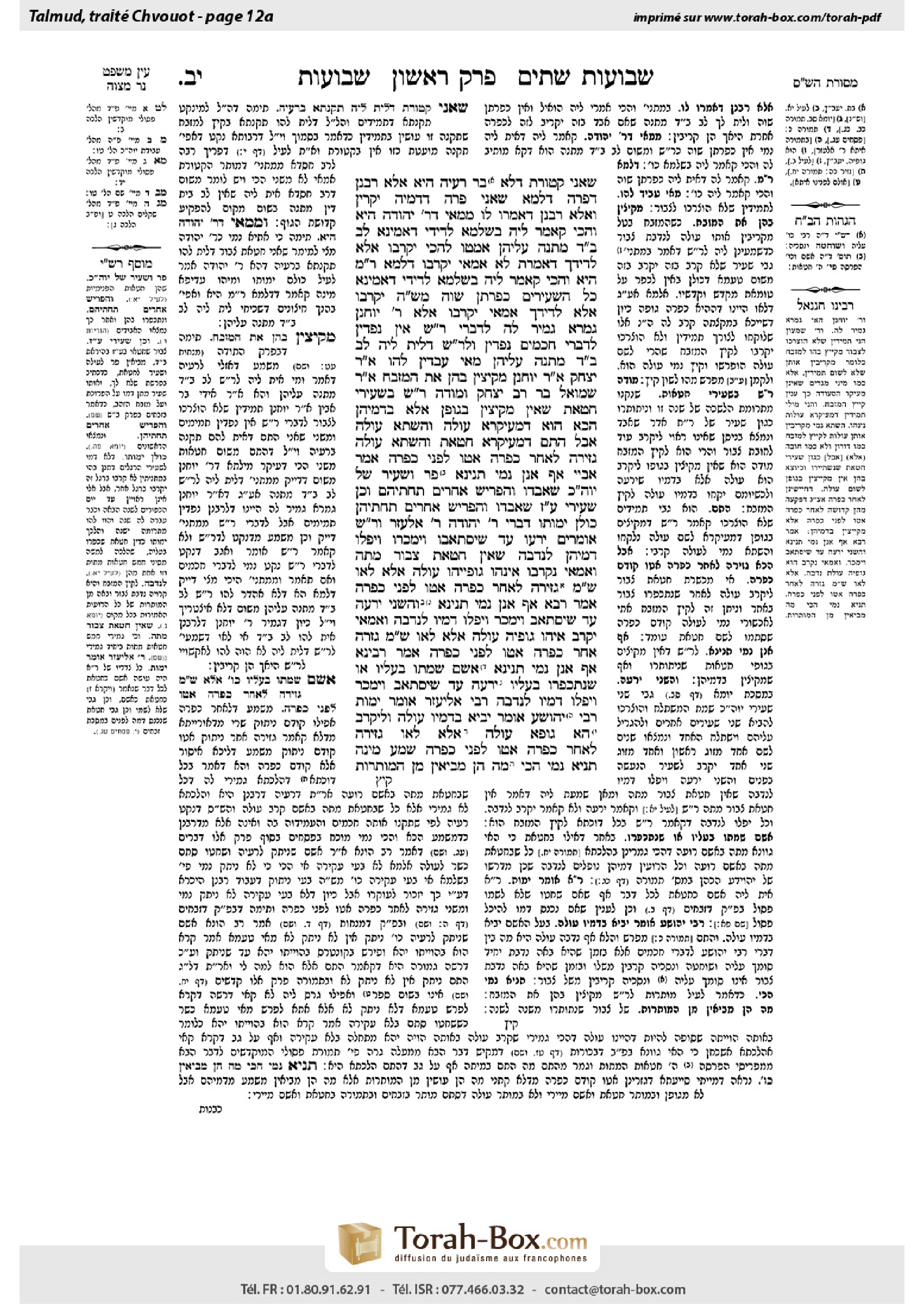
Shevuot 12a: Talmud study for Daf Yomi
Daf Yomi is the daily study of one Talmud folio. Explore 37 tractates with scans, Hebrew text, Sefaria English and AI-generated French translations where annotated.
Passage selection and English or AI-generated French translation are available where the scan has annotations. Daf Study is independent of Torah-Box and Sefaria.
Browse Shevuot · שבועות · All tractatesShevuot 12a text and translations
This page of Shevuot includes the Aramaic text, an English translation and an AI-generated French translation, alongside the scan above.
שבועות י״ב א · Aramaic and Hebrew text
שָׁאנֵי קְטוֹרֶת דְּלָא בַּר רְעִיָּה הִיא!
אֶלָּא רַבָּנַן דְּפָרָה – דִּלְמָא שָׁאנֵי פָּרָה דְּדָמֶיהָ יְקָרִין!
וְאֶלָּא רַבָּנַן דְּ״אָמְרוּ לוֹ״ –
מִמַּאי דְּרַבִּי יְהוּדָה הִיא – וְהָכִי קָאָמַר לֵיהּ: בִּשְׁלָמָא לְדִידִי דְּאָמֵינָא לֵב בֵּית דִּין מַתְנֶה עֲלֵיהֶן – אַמְּטוּ לְהָכִי יִקְרְבוּ; אֶלָּא לְדִידָךְ דְּאָמְרַתְּ לָא – אַמַּאי יִקְרְבוּ?
וְדִלְמָא רַבִּי מֵאִיר הִיא – וְהָכִי קָאָמַר לֵיהּ: בִּשְׁלָמָא לְדִידִי, דְּאָמֵינָא כׇּל הַשְּׂעִירִים כַּפָּרָתָן שָׁוָה – מִשּׁוּם הָכִי יִקְרְבוּ; אֶלָּא לְדִידָךְ, אַמַּאי יִקְרְבוּ?
אֶלָּא רַבִּי יוֹחָנָן גְּמָרָא גְּמִיר לַהּ: לְדִבְרֵי רַבִּי שִׁמְעוֹן – אֵין נִפְדִּין, לְדִבְרֵי חֲכָמִים – נִפְדִּין.
וּלְרַבִּי שִׁמְעוֹן דְּלֵית לֵיהּ לֵב בֵּית דִּין מַתְנֶה עֲלֵיהֶן, מַאי עָבְדִין לְהוּ? אָמַר רַבִּי יִצְחָק אָמַר רַבִּי יוֹחָנָן: מְקַיְּצִין בָּהֶן אֶת הַמִּזְבֵּחַ.
אָמַר רַבִּי שְׁמוּאֵל בַּר רַב יִצְחָק: וּמוֹדֶה רַבִּי שִׁמְעוֹן בִּשְׂעִירֵי חַטָּאת, שֶׁאֵין מְקַיְּצִין בְּגוּפָן אֶלָּא בִּדְמֵיהֶן.
הָכָא הוּא דְּמֵעִיקָּרָא עוֹלָה וְהַשְׁתָּא עוֹלָה; אֲבָל הָתָם דְּמֵעִיקָּרָא חַטָּאת וְהַשְׁתָּא עוֹלָה – גְּזֵירָה לְאַחַר כַּפָּרָה אַטּוּ לִפְנֵי כַפָּרָה.
אָמַר אַבָּיֵי: אַף אֲנַן נָמֵי תְּנֵינָא: פַּר וְשָׂעִיר שֶׁל יוֹם הַכִּפּוּרִים שֶׁאָבְדוּ וְהִפְרִישׁ אֲחֵרִים תַּחְתֵּיהֶם, וְכֵן שְׂעִירֵי עֲבוֹדָה זָרָה שֶׁאָבְדוּ וְהִפְרִישׁ אֲחֵרִים תַּחְתֵּיהֶן – כּוּלָּן יָמוּתוּ. דִּבְרֵי רַבִּי יְהוּדָה. רַבִּי אֶלְעָזָר וְרַבִּי שִׁמְעוֹן אוֹמְרִים: יִרְעוּ עַד שֶׁיִּסְתָּאֲבוּ, וְיִמָּכְרוּ וְיִפְּלוּ דְּמֵיהֶן לִנְדָבָה; שֶׁאֵין חַטַּאת צִבּוּר מֵתָה.
וְאַמַּאי? נִקְרְבוּ אִינְהוּ גּוּפַיְיהוּ עוֹלָה! אֶלָּא לָאו שְׁמַע מִינַּהּ: גְּזֵירָה לְאַחַר כַּפָּרָה אַטּוּ לִפְנֵי כַפָּרָה?
אָמַר רָבָא, אַף אֲנַן נָמֵי תְּנֵינָא: וְהַשֵּׁנִי יִרְעֶה עַד שֶׁיִּסְתָּאֵב, וְיִמָּכֵר וְיִפְּלוּ דָּמָיו לִנְדָבָה.
וְאַמַּאי? יִקְרַב אִיהוּ גּוּפֵיהּ עוֹלָה! אֶלָּא לָאו שְׁמַע מִינַּהּ: גְּזֵרָה אַחַר כַּפָּרָה אַטּוּ לִפְנֵי כַפָּרָה?
אָמַר רָבִינָא, אַף אֲנַן נָמֵי תְּנֵינָא: אָשָׁם שֶׁמֵּתוּ בְּעָלָיו אוֹ שֶׁנִּתְכַּפְּרוּ בְּעָלָיו – יִרְעֶה עַד שֶׁיִּסְתָּאֵב, וְיִמָּכֵר וְיִפְּלוּ דָּמָיו לִנְדָבָה. רַבִּי אֱלִיעֶזֶר אוֹמֵר: יָמוּת. רַבִּי יְהוֹשֻׁעַ אוֹמֵר: יָבִיא בְּדָמָיו עוֹלָה.
וְלִיקְרַב הָא גּוּפַאּ עוֹלָה! אֶלָּא לָאו גְּזֵירָה לְאַחַר כַּפָּרָה אַטּוּ לִפְנֵי כַּפָּרָה? שְׁמַע מִינַּהּ.
תַּנְיָא נָמֵי הָכִי: מָה הֵן מְבִיאִין מִן הַמּוֹתָרוֹת?
Shevuot 12a · English translation
no proof can be drawn from there, as incense is different, as it is not an entity that can be left to graze. The option that exists for animals to leave them to graze until they develop a blemish and then redeem them obviously cannot apply to incense. Therefore, it is reasonable that with regard to incense, since there is no other way to rectify it, all will concede that the court makes a stipulation.
Rather, say it is the opinion of the Sages who ruled, in the baraita cited above, with regard to the red heifer that it may be redeemed if a choicer one is found. The Gemara rejects this claim: Perhaps the case of a red heifer is different, since it is of great monetary value. To avoid a considerable loss, the court makes a stipulation despite it being an uncommon case.
Rather, say it is the opinion of the Sages that is introduced with the phrase: They said to him, in the mishna on 2b.
The Gemara asks: From where do you know that the tanna referred to as the Rabbis is Rabbi Yehuda and that this is what he is saying to Rabbi Shimon: Granted, according to my opinion, that I say that the court tacitly stipulates concerning offerings that their consecration is contingent upon their eventual use, it is due to this reason that they can be sacrificed on an occasion different from the one they were initially intended for; but according to your opinion, that you say that the court does not make such stipulations, why can they be sacrificed on an occasion different from the one they were initially intended for?
But perhaps the tanna referred to as the Rabbis is Rabbi Meir, and this is what he is saying to Rabbi Shimon: Granted, according to my opinion, that I say that the atonement effected by the goats of the additional offerings of all three occasions, i.e., those of the New Moons, Festivals, and Yom Kippur, is the same, it is due to this reason that they can be sacrificed on an occasion different from the one they were initially intended for. But according to your opinion, that they effect atonement for different cases of sin, why can they be sacrificed on an occasion different from the one they were initially intended for? Since it cannot be demonstrated that the Rabbis’ opinion is based on the assumption that the court makes stipulations with regard to communal offerings, no proof can be drawn from the mishna.
Rather, the opinion of the Rabbis cited by Rabbi Yoḥanan is not necessarily recorded elsewhere, but Rabbi Yoḥanan learned it through a tradition that lambs consecrated for the daily offerings that were not needed by the public, according to the statement of Rabbi Shimon, cannot be redeemed if they are unblemished, while according to the statement of the Rabbis, they may be redeemed, even if they are unblemished.
The Gemara asks: And according to the opinion of Rabbi Shimon, who does not hold that the court tacitly stipulates concerning those lambs that were consecrated for the daily offerings that remain unused at the end of the fiscal year, what is done with them? Rabbi Yitzḥak says that Rabbi Yoḥanan says: One supplements the offerings brought on the altar with them. Whenever there were no obligatory offerings to be brought upon the altar, supplementary offerings would be offered upon it in order that it should not remain idle.
Rabbi Shmuel bar Rav Yitzḥak says: And Rabbi Shimon concedes with regard to goats of communal sin-offerings that were lost and for which replacements were offered in their stead, that even should they later be found, one does not supplement the offerings of the altar with those animals themselves. Rather, supplementary offerings are purchased with their value, i.e., the sin-offerings should be left to graze until they develop a blemish, at which point they can be sold and the proceeds used to purchase supplementary offerings.
By Torah law, both communal burnt-offerings and sin-offerings that may no longer be offered for their intended purposes may be offered as supplementary burnt-offerings. Nevertheless, Rabbi Shimon draws a distinction between the two cases: Here, where from the outset the animal was intended to be used as a burnt-offering, i.e., for the daily-offering, and now the intention is to use it as a burnt-offering, i.e., for the supplementary offerings, the animal itself may be used. But there, where from the outset the animal was intended to be used as a sin-offering, and now the intention is to use it as a burnt-offering, there is a rabbinic decree rendering prohibited the use of the animal itself even after its atonement has already been effected by a replacement sin-offering, due to the concern that people will confuse it with a sin-offering before its atonement has been effected by a replacement sin-offering. Such a sin-offering may be brought only for its originally intended purpose.
Abaye said: We learn this in a baraita as well: With regard to the bull and the goat of Yom Kippur that were lost, and one separated and sacrificed others in their stead, and likewise, goats that were designated to atone for an act of unwitting public idol worship that were lost, and one separated and sacrificed others in their stead, in such cases, all of the original animals, if they are subsequently found, should be left to die. This is in accordance with the halakha that a sin-offering whose owner has already achieved atonement is left to die. This is the statement of Rabbi Yehuda. Rabbi Elazar and Rabbi Shimon say: They should graze until they become unfit, and then they are sold and their proceeds are allocated for communal gift offerings. They do not need to be left to die because the halakha is that a communal sin-offering is not left to die.
Abaye explains how this baraita supports Rav Shmuel bar Yitzḥak’s claim: But why do Rabbi Elazar and Rabbi Shimon say that the animal should be left to develop a blemish? Let these animals themselves be sacrificed as a supplementary burnt-offering. Rather, must one not conclude from the fact they did not offer this suggestion that there is a rabbinic decree rendering prohibited the use of the animal itself, even after its atonement has already been effected, due to the concern that people will confuse it with a sin-offering before its atonement has been effected?
Rava said: We learn this halakha in a mishna (Yoma 62a) as well: If after the lottery for the two Yom Kippur goats one of them dies, another pair is brought and a second lottery is performed. One becomes the counterpart of the remaining goat from the first pair, and the second, now-superfluous goat is left to graze until it becomes unfit; and then it is sold and the proceeds are allocated for communal gift offerings.
Rava explains how this mishna supports Rav Shmuel bar Yitzḥak’s claim: But why should the superfluous goat be left to develop a blemish? Let the animal itself be sacrificed as a supplementary burnt-offering. Rather, must one not conclude from the fact that the mishna does not offer this suggestion that there is a rabbinic decree rendering prohibited the use of the animal itself even after its atonement has already been effected, due to the concern that people will confuse it with a sin-offering before its atonement has been effected?
Ravina said: We learn this halakha in a mishna (Temura 20b) as well: A guilt-offering whose owner died, or that was lost and before it was subsequently found its owner achieved atonement through a replacement guilt-offering, should graze until it becomes unfit, and then it is sold and the proceeds are allocated for communal gift offerings. Rabbi Eliezer says: It should be left to die. Rabbi Yehoshua says: The owner of the guilt-offering should bring a burnt-offering with the proceeds of its sale.
Ravina explains how this mishna supports Rav Shmuel bar Yitzḥak’s claim: But why should it be left to develop a blemish? Let this animal itself be sacrificed as a supplementary burnt-offering. Rather, must one not conclude from the fact that the mishna does not offer this suggestion that there is a rabbinic decree rendering prohibited the use of the animal itself, even after its atonement has already been effected, due to the concern that people will confuse it with a sin-offering before its atonement has been effected? The Gemara affirms: Conclude from it that there is such a rabbinic decree.
Rabbi Yoḥanan explained that Rabbi Shimon holds that lambs that were consecrated for the daily offerings that remain unused at the end of the fiscal year are offered as supplementary offerings. The Gemara notes: This is also taught in a baraita: What type of offerings would they bring from the surplus lambs that were consecrated for the daily offerings?
Shevuot 12a · Traduction française (IA)
On ne peut en tirer aucune preuve, car l’encens est différent : ce n’est pas une entité que l’on puisse laisser paître. La possibilité de laisser les animaux paître jusqu’à ce qu’ils développent un défaut, puis de les racheter, ne peut évidemment pas s’appliquer à l’encens. Il est donc raisonnable que, pour l’encens, puisqu’il n’existe aucun autre moyen de remédier à la situation, tous admettent que le tribunal formule une condition.
Il faut plutôt dire qu’il s’agit de l’avis des Sages qui ont enseigné, dans la baraïta citée précédemment, au sujet de la vache rousse, qu’on peut la racheter si l’on en trouve une de meilleure qualité. La Guemara rejette cette proposition : peut-être le cas de la vache rousse est-il différent, puisqu’elle a une grande valeur monétaire. Pour éviter une perte considérable, le tribunal formule une condition, même dans un cas rare.
Il faut plutôt dire qu’il s’agit de l’avis des Sages, introduit par la formule « Ils lui dirent », dans la Michna en 2b.
La Guemara demande : D’où sais-tu que le tanna désigné par « les Rabbins » est Rabbi Yehouda, et que voici ce qu’il dit à Rabbi Shimon : « Certes, selon mon opinion, puisque je dis que le tribunal stipule tacitement, au sujet des offrandes, que leur consécration est subordonnée à leur utilisation ultérieure, c’est pour cette raison qu’elles peuvent être offertes à une occasion autre que celle à laquelle elles étaient initialement destinées. Mais selon ton opinion, puisque tu dis que le tribunal ne formule pas de telles conditions, pourquoi peuvent-elles être offertes à une occasion autre que celle à laquelle elles étaient initialement destinées ? »
Mais peut-être le tanna désigné par « les Rabbins » est-il Rabbi Meïr, et voici ce qu’il dit à Rabbi Shimon : « Certes, selon mon opinion, puisque je dis que l’expiation accomplie par les boucs des offrandes supplémentaires des trois occasions — les néoménies, les fêtes et Yom Kippour — est la même, c’est pour cette raison qu’ils peuvent être offerts à une occasion autre que celle à laquelle ils étaient initialement destinés. Mais selon ton opinion, puisqu’ils expient différentes catégories de fautes, pourquoi peuvent-ils être offerts à une occasion autre que celle à laquelle ils étaient initialement destinés ? » Puisqu’on ne peut pas démontrer que l’avis des Rabbins repose sur l’hypothèse que le tribunal formule des conditions au sujet des offrandes communautaires, on ne peut tirer aucune preuve de la Michna.
Il faut plutôt dire que l’avis des Rabbins cité par Rabbi Yoḥanan n’est pas nécessairement consigné ailleurs ; Rabbi Yoḥanan l’a appris par tradition : selon Rabbi Shimon, les agneaux consacrés aux offrandes quotidiennes dont le public n’a pas eu besoin ne peuvent pas être rachetés s’ils sont sans défaut, tandis que, selon les Rabbins, ils peuvent être rachetés, même s’ils sont sans défaut.
La Guemara demande : Et selon Rabbi Shimon, qui considère que le tribunal ne stipule pas tacitement au sujet des agneaux consacrés aux offrandes quotidiennes et restés inutilisés à la fin de l’année budgétaire, qu’en fait-on ? Rabbi Yitsḥak rapporte au nom de Rabbi Yoḥanan : on les utilise pour compléter les offrandes apportées sur l’autel. Chaque fois qu’il n’y avait pas d’offrandes obligatoires à apporter sur l’autel, on y offrait des offrandes supplémentaires afin qu’il ne reste pas inactif.
Rabbi Shmouel bar Rav Yitsḥak dit : Rabbi Shimon reconnaît que, dans le cas de boucs destinés à des sacrifices expiatoires communautaires qui ont été perdus et remplacés par d’autres offerts à leur place, même si les premiers sont retrouvés par la suite, on n’utilise pas ces animaux eux-mêmes pour compléter les offrandes de l’autel. On achète plutôt des offrandes supplémentaires avec leur valeur : autrement dit, on laisse les sacrifices expiatoires paître jusqu’à ce qu’ils développent un défaut ; ils peuvent alors être vendus, et le produit de leur vente sert à acheter des offrandes supplémentaires.
Selon la Torah écrite, les holocaustes communautaires comme les sacrifices expiatoires communautaires qui ne peuvent plus être offerts pour l’usage auquel ils étaient destinés peuvent être offerts comme holocaustes supplémentaires. Néanmoins, Rabbi Shimon distingue les deux cas : ici, l’animal était dès le départ destiné à servir d’holocauste, c’est-à-dire pour l’offrande quotidienne, et l’intention est maintenant de l’utiliser comme holocauste, c’est-à-dire pour les offrandes supplémentaires ; l’animal lui-même peut donc être utilisé. Là, en revanche, l’animal était dès le départ destiné à servir de sacrifice expiatoire, et l’intention est maintenant de l’utiliser comme holocauste : un décret rabbinique interdit alors d’utiliser l’animal lui-même, même après que l’expiation a déjà été accomplie par un sacrifice expiatoire de remplacement, par crainte que les gens ne le confondent avec un sacrifice expiatoire dont l’expiation n’a pas encore été accomplie par un sacrifice de remplacement. Un tel sacrifice expiatoire ne peut être offert que pour l’usage auquel il était initialement destiné.
Abayé dit : Nous apprenons aussi cette règle dans une baraïta : si le taureau et le bouc de Yom Kippour ont été perdus et que l’on en a consacré et offert d’autres à leur place, et de même si des boucs désignés pour expier un acte d’idolâtrie publique commis par inadvertance ont été perdus et que l’on en a consacré et offert d’autres à leur place, tous les animaux d’origine, s’ils sont retrouvés par la suite, doivent être laissés à mourir. Cela est conforme à la halakha selon laquelle un sacrifice expiatoire dont le propriétaire a déjà obtenu l’expiation doit être laissé à mourir. Telle est l’opinion de Rabbi Yehouda. Rabbi Elazar et Rabbi Shimon disent : on les laisse paître jusqu’à ce qu’ils deviennent impropres, puis on les vend et le produit de leur vente est affecté aux offrandes volontaires communautaires. Il n’est pas nécessaire de les laisser mourir, car la halakha veut qu’un sacrifice expiatoire communautaire ne soit pas laissé à mourir.
Abayé explique en quoi cette baraïta appuie l’affirmation de Rav Shmouel bar Yitsḥak : pourquoi Rabbi Elazar et Rabbi Shimon disent-ils qu’il faut laisser l’animal développer un défaut ? Que ces animaux eux-mêmes soient offerts comme holocaustes supplémentaires ! Ne faut-il pas plutôt conclure, du fait qu’ils n’ont pas proposé cette solution, qu’un décret rabbinique interdit d’utiliser l’animal lui-même, même après que l’expiation a déjà été accomplie, par crainte que les gens ne le confondent avec un sacrifice expiatoire dont l’expiation n’a pas encore été accomplie ?
Rava dit : Nous apprenons aussi cette halakha dans une Michna (Yoma 62a) : si, après le tirage au sort des deux boucs de Yom Kippour, l’un d’eux meurt, on apporte une autre paire et l’on procède à un second tirage au sort. L’un devient le correspondant du bouc restant de la première paire ; le second, désormais superflu, est laissé à paître jusqu’à ce qu’il devienne impropre. Il est alors vendu et le produit de sa vente est affecté aux offrandes volontaires communautaires.
Rava explique en quoi cette Michna appuie l’affirmation de Rav Shmouel bar Yitsḥak : pourquoi faut-il laisser le bouc superflu développer un défaut ? Que l’animal lui-même soit offert comme holocauste supplémentaire ! Ne faut-il pas plutôt conclure, du fait que la Michna ne propose pas cette solution, qu’un décret rabbinique interdit d’utiliser l’animal lui-même, même après que l’expiation a déjà été accomplie, par crainte que les gens ne le confondent avec un sacrifice expiatoire dont l’expiation n’a pas encore été accomplie ?
Ravina dit : Nous apprenons aussi cette halakha dans une Michna (Temoura 20b) : un sacrifice de culpabilité dont le propriétaire est mort, ou qui a été perdu et dont le propriétaire a obtenu l’expiation grâce à un sacrifice de culpabilité de remplacement avant qu’il ne soit retrouvé, doit être laissé à paître jusqu’à ce qu’il devienne impropre ; il est alors vendu et le produit de sa vente est affecté aux offrandes volontaires communautaires. Rabbi Eliezer dit : il doit être laissé à mourir. Rabbi Yehoshoua dit : le propriétaire du sacrifice de culpabilité doit apporter un holocauste avec le produit de sa vente.
Ravina explique en quoi cette Michna appuie l’affirmation de Rav Shmouel bar Yitsḥak : pourquoi faut-il le laisser développer un défaut ? Que cet animal lui-même soit offert comme holocauste supplémentaire ! Ne faut-il pas plutôt conclure, du fait que la Michna ne propose pas cette solution, qu’un décret rabbinique interdit d’utiliser l’animal lui-même, même après que l’expiation a déjà été accomplie, par crainte que les gens ne le confondent avec un sacrifice expiatoire dont l’expiation n’a pas encore été accomplie ? La Guemara confirme : conclus-en qu’il existe un tel décret rabbinique.
Rabbi Yoḥanan a expliqué que, selon Rabbi Shimon, les agneaux consacrés aux offrandes quotidiennes et restés inutilisés à la fin de l’année budgétaire sont offerts comme offrandes supplémentaires. La Guemara note : cela est également enseigné dans une baraïta : quel type d’offrandes apportait-on avec le surplus d’agneaux consacrés aux offrandes quotidiennes ?
Traduction française générée par IA à partir de l’édition anglaise de Sefaria. Vérifie toujours un passage avec le texte source.
Text from Sefaria: William Davidson Edition - Vocalized Aramaic (CC BY NC); William Davidson Edition - English (CC BY NC).