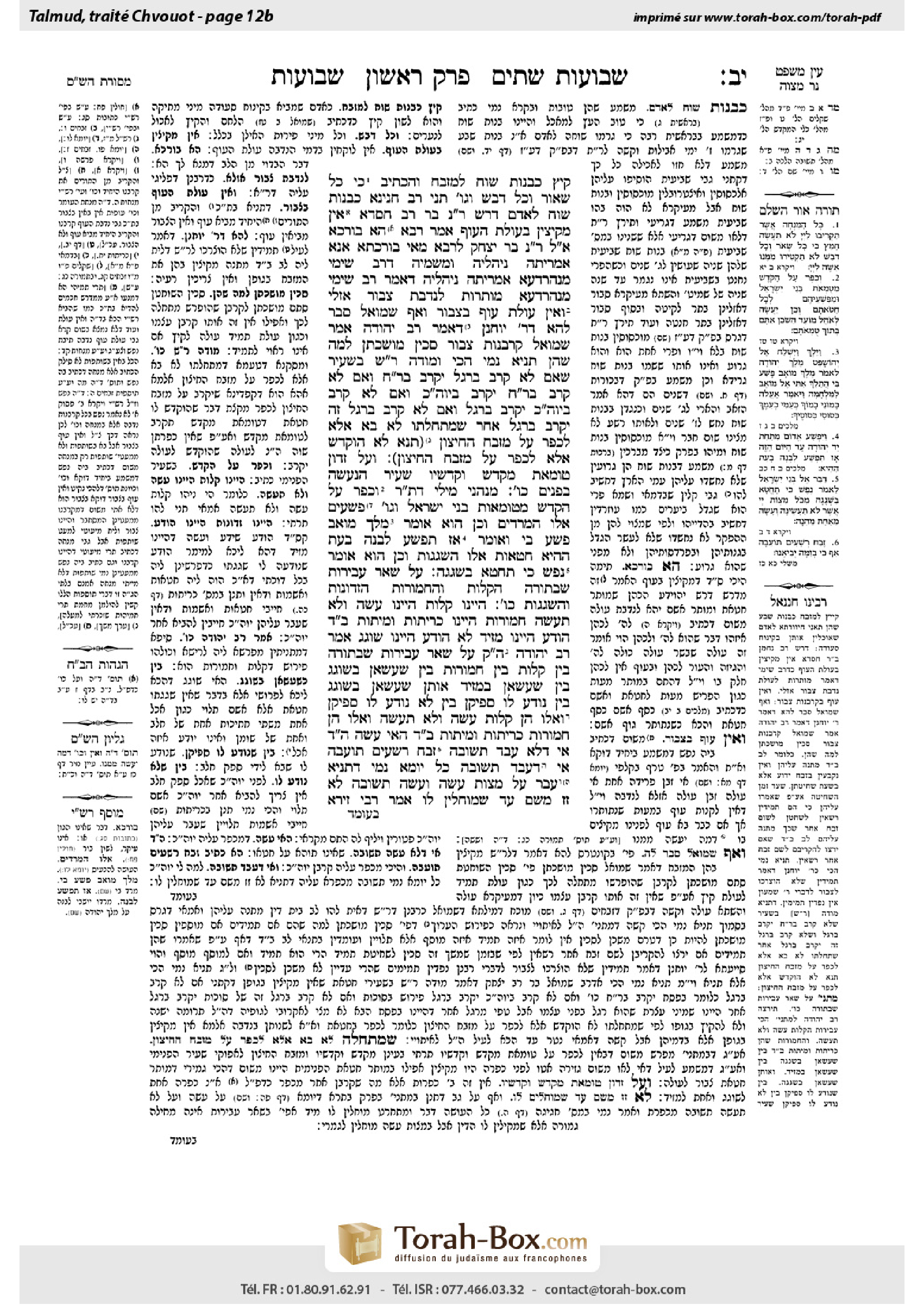
Shevuot 12b: Talmud study for Daf Yomi
Daf Yomi is the daily study of one Talmud folio. Explore 37 tractates with scans, Hebrew text, Sefaria English and AI-generated French translations where annotated.
Passage selection and English or AI-generated French translation are available where the scan has annotations. Daf Study is independent of Torah-Box and Sefaria.
Browse Shevuot · שבועות · All tractatesShevuot 12b text and translations
This page of Shevuot includes the Aramaic text, an English translation and an AI-generated French translation, alongside the scan above.
שבועות י״ב ב · Aramaic and Hebrew text
קַיִץ כִּבְנוֹת שׁוּחַ לַמִּזְבֵּחַ. וְהָכְתִיב: ״כִּי כׇל שְׂאֹר וְכׇל דְּבַשׁ וְגוֹ׳״! תָּנֵי רַב חֲנִינָא: כִּבְנוֹת שׁוּחַ לְאָדָם.
דָּרַשׁ רַב נַחְמָן בַּר רַב חִסְדָּא: אֵין מְקַיְּצִין בְּעוֹלַת הָעוֹף. אָמַר רָבָא: הָא בּוּרְכָא! אֲמַר לֵיהּ רַב נַחְמָן בַּר יִצְחָק לְרָבָא: מַאי בּוּרְכְתָא? אֲנָא אַמְרִיתַהּ נִיהֲלֵיהּ, וּמִשְּׁמֵיהּ דְּרַב שִׁימִי מִנְּהַרְדְּעָא אַמְרִיתַהּ נִיהֲלֵיהּ – דְּאָמַר רַב שִׁימִי מִנְּהַרְדְּעָא: מוֹתָרוֹת לְנִדְבַת צִבּוּר אָזְלִי, וְאֵין עוֹלַת עוֹף בְּצִבּוּר.
וְאַף שְׁמוּאֵל סָבַר לְהָא דְּרַבִּי יוֹחָנָן, דְּאָמַר רַב יְהוּדָה אָמַר שְׁמוּאֵל: קׇרְבְּנוֹת צִבּוּר – סַכִּין מוֹשַׁכְתָּן לְמַה שֶּׁהֵן.
תַּנְיָא נָמֵי הָכִי: וּמוֹדֶה רַבִּי שִׁמְעוֹן בְּשָׂעִיר, שֶׁאִם לֹא קָרַב בָּרֶגֶל יִקְרַב בְּרֹאשׁ חֹדֶשׁ, וְאִם לֹא קָרַב בְּרֹאשׁ חֹדֶשׁ יִקְרַב בְּיוֹם הַכִּפּוּרִים, וְאִם לֹא קָרַב בְּיוֹם הַכִּפּוּרִים יִקְרַב בָּרֶגֶל, וְאִם לֹא קָרַב בְּרֶגֶל זֶה יִקְרַב בְּרֶגֶל אַחֵר; שֶׁמִּתְּחִלָּתוֹ לֹא בָּא אֶלָּא לְכַפֵּר עַל מִזְבֵּחַ הַחִיצוֹן.
תָּנָא: לֹא הוּקְדַּשׁ אֶלָּא לְכַפֵּר עַל מִזְבֵּחַ הַחִיצוֹן.
וְעַל זְדוֹן טוּמְאַת מִקְדָּשׁ וְקָדָשָׁיו, שָׂעִיר הַנַּעֲשֶׂה בִּפְנִים כּוּ׳. מְנָהָנֵי מִילֵּי?
דְּתָנוּ רַבָּנַן: ״וְכִפֶּר עַל הַקֹּדֶשׁ מִטֻּמְאֹת בְּנֵי יִשְׂרָאֵל וְגוֹ׳״; פְּשָׁעִים – אֵלּוּ הַמְּרָדִים, וְכֵן הוּא אוֹמֵר: ״מֶלֶךְ מוֹאָב פָּשַׁע בִּי״, וְאוֹמֵר: ״אָז תִּפְשַׁע לִבְנָה בָּעֵת הַהִיא״. חַטָּאוֹת – אֵלּוּ הַשְּׁגָגוֹת, וְכֵן הוּא אוֹמֵר: ״נֶפֶשׁ כִּי תֶחֱטָא בִשְׁגָגָה״.
עַל שְׁאָר עֲבֵירוֹת שֶׁבְּתוֹרָה, הַקַּלּוֹת וְהַחֲמוּרוֹת, הַזְּדוֹנוֹת וְהַשְּׁגָגוֹת כּוּ׳.
הַיְינוּ קַלּוֹת הַיְינוּ עֲשֵׂה וְלֹא תַעֲשֶׂה! חֲמוּרוֹת – הַיְינוּ כָּרֵיתוֹת וּמִיתוֹת בֵּית דִּין! הוֹדַע – הַיְינוּ מֵזִיד! לֹא הוֹדַע – הַיְינוּ שׁוֹגֵג!
אָמַר רַב יְהוּדָה, הָכִי קָאָמַר: עַל שְׁאָר עֲבֵירוֹת שֶׁבַּתּוֹרָה – בֵּין קַלּוֹת בֵּין חֲמוּרוֹת, בֵּין שֶׁעֲשָׂאָן בְּשׁוֹגֵג בֵּין שֶׁעֲשָׂאָן בְּמֵזִיד. אוֹתָן שֶׁעֲשָׂאָן בְּשׁוֹגֵג – בֵּין נוֹדַע לוֹ סְפֵיקָן, בֵּין לֹא נוֹדַע לוֹ סְפֵיקָן. וְאֵלּוּ הֵן קַלּוֹת – עֲשֵׂה וְלֹא תַעֲשֶׂה, וְאֵלּוּ הֵן חֲמוּרוֹת – כָּרֵיתוֹת וּמִיתוֹת בֵּית דִּין.
הַאי עֲשֵׂה הֵיכִי דָמֵי? אִי דְּלָא עֲבַד תְּשׁוּבָה – ״זֶבַח רְשָׁעִים תּוֹעֵבָה״! אִי דַּעֲבַד תְּשׁוּבָה – כֹּל יוֹמָא נָמֵי, דְּתַנְיָא: עָבַר עַל מִצְוַת עֲשֵׂה וְעָשָׂה תְּשׁוּבָה, לָא זָז מִשָּׁם עַד שֶׁמּוֹחֲלִין לוֹ!
אָמַר רַבִּי זֵירָא:
Shevuot 12b · English translation
They would bring from them dessert, like white figs, for the altar. The Gemara asks: Are white figs ever offered on the altar? But isn’t it written: “For any leavening or fruit honey you shall not cause to go up in smoke as a fire-offering to the Lord” (Leviticus 2:11)? The term “fruit honey” includes all tree fruits. The Gemara answers: Rav Ḥanina teaches: The supplementary offerings are to the altar like white figs for a person.
The Gemara discusses what may be used for the supplementary offerings: Rav Naḥman bar Rav Ḥisda taught: One does not supplement the offerings of the altar with a bird burnt-offering. Rava said: This ruling is an absurdity [burkha]. Rav Naḥman bar Yitzḥak said to Rava: What is the absurdity? The ruling has a basis. I said this ruling to Rav Naḥman, and said it to him in the name of Rav Shimi of Neharde’a, as Rav Shimi of Neharde’a says: The surplus lambs that were consecrated for the daily offerings are allocated for communal gift offerings, and there is not a bird burnt-offering that is offered by the community.
The Gemara notes: And also Shmuel holds in accordance with this statement of Rabbi Yoḥanan, who taught that Rabbi Shimon holds that lambs consecrated for the daily offering that were not used are brought as supplementary offerings, even though they were not originally consecrated for that purpose, as Rav Yehuda says that Shmuel says: With regard to communal offerings, their consecration serves only to define which general category of offering they are included in, e.g., whether they are a sin-offering or burnt-offering, but it is the purpose for which they are ultimately slaughtered with a knife that defines what their precise nature is.
The Gemara notes: This is also taught in a baraita with regard to sin-offerings: And Rabbi Shimon concedes with regard to a goat consecrated to be used as part of the additional offerings on the pilgrimage Festivals that if it was not sacrificed on a pilgrimage Festival it can be sacrificed on a New Moon, and if was not sacrificed on a New Moon it can be sacrificed on Yom Kippur, and if it was not sacrificed on Yom Kippur it can be sacrificed on a pilgrimage Festival, and if it was not sacrificed on this pilgrimage Festival, it can be sacrificed on another pilgrimage Festival. This is because from the outset, by virtue of its consecration, it came only to atone by having its blood presented upon the external altar, but its precise nature is defined only by the purpose for which it is ultimately slaughtered.
Another baraita teaches the same ruling: It is taught: The sin-offering was consecrated only to atone by having its blood presented upon the external altar.
§ The mishna teaches: And for cases in which the defiling of the Temple or its sacrificial foods was carried out intentionally, the goat whose blood presentation is performed inside the Sanctuary on Yom Kippur, and Yom Kippur itself, atone. The Gemara asks: From where are these matters derived?
The Gemara answers: They are derived from a verse, as the Sages taught in a baraita: The verse states with regard to the High Priest sacrificing the internal goat of Yom Kippur: “And he shall effect atonement upon the Sanctuary from the impurities of the children of Israel and from their acts of rebellion, for all their sins” (Leviticus 16:16). The verse is referring to two categories of sin. The first category is acts of rebellion [pesha’im]; these are the rebellious sins, and so the verse states that King Jehoram of Israel said to King Jehoshaphat of Judah: “The king of Moab rebelled [pasha] against me” (II Kings 3:7). And the verse states with regard to a rebellion against Judah: “Then Libnah rebelled [tifsha] at that time” (II Kings 8:22). The second category is sins [ḥataot]; these are unwitting sins, and so the verse states: “If an individual person shall transgress [teḥeta] unwittingly” (Leviticus 4:2).
§ The mishna teaches: For all other transgressions that are stated in the Torah, whether they are the minor ones or the major ones, whether they were intentional or unwitting, whether one became aware of them before Yom Kippur or did not become aware of them until after Yom Kippur, whether they involve a positive mitzva or a prohibition, whether the transgressors are subject to excision from the World-to-Come [karet], or to one of the court-imposed death penalties, the scapegoat sent to Azazel on Yom Kippur atones.
The Gemara notes that the mishna appears repetitious: Minor ones are the same as a standard positive mitzva and prohibition, major ones are the same as transgressions that are subject to karet and to court-imposed death penalties, transgressions that one became aware of are the same as intentional transgressions, and transgressions that one did not become aware of are the same as unwitting transgressions.
Rav Yehuda said that this is what the mishna is saying: For all other transgressions that are stated in the Torah, whether they are the minor ones or the major ones, whether they were performed unwittingly or whether they were performed intentionally, they each have their own halakhot. For those that were performed unwittingly, in cases where there was an uncertainty whether the act was forbidden at all, atonement is effected whether the uncertainty with regard to the transgressions became known to him before Yom Kippur or whether the uncertainty with regard to them did not become known to him until after Yom Kippur. And these are the minor ones the mishna is referring to: A standard positive mitzva and a prohibition. And these are the major ones it is referring to: Transgressions that are subject to karet and to court-imposed death penalties.
The Gemara asks: What are the circumstances of this positive mitzva in the mishna? If it is a case where he did not repent, the offering cannot atone for him, as the verse states: “The sacrifice of the wicked is an abomination” (Proverbs 21:27). If he did repent, then why is the mishna referring to Yom Kippur? He will achieve atonement on any other day as well, as it is taught in a baraita: If one transgressed a positive mitzva and repented, he does not move from there until he is forgiven.
Rabbi Zeira said:
Shevuot 12b · Traduction française (IA)
On en apportait comme dessert pour l’autel, par exemple des figues blanches. La Guemara demande : Des figues blanches sont-elles jamais offertes sur l’autel ? N’est-il pas écrit : « Tu ne feras pas fumer de levain ni de miel de fruits en offrande consumée pour le Seigneur » (Lévitique 2:11) ? L’expression « miel de fruits » inclut tous les fruits des arbres. La Guemara répond : Rav Ḥanina enseigne que les offrandes supplémentaires sont pour l’autel ce que les figues blanches sont pour l’homme.
La Guemara examine ce qui peut être utilisé pour les offrandes supplémentaires. Rav Naḥman bar Rav Ḥisda enseigna : On ne complète pas les offrandes de l’autel au moyen d’un holocauste d’oiseau. Rava dit : « Cette décision est une absurdité [burkha]. » Rav Naḥman bar Yitzḥak dit à Rava : « En quoi est-ce absurde ? Cette décision repose sur un fondement. J’ai énoncé cette décision à Rav Naḥman en la lui attribuant à Rav Shimi de Neharde’a, car Rav Shimi de Neharde’a dit : Les agneaux excédentaires consacrés aux offrandes quotidiennes sont affectés aux offrandes volontaires communautaires, et la communauté n’offre pas d’holocauste d’oiseau. »
La Guemara relève que Shmuel aussi suit cette déclaration de Rabbi Yoḥanan, selon laquelle Rabbi Shimon considère que les agneaux consacrés à l’offrande quotidienne qui n’ont pas été utilisés sont apportés comme offrandes supplémentaires, bien qu’ils n’aient pas été consacrés à cette fin au départ. En effet, Rav Yehuda dit au nom de Shmuel : Pour les offrandes communautaires, la consécration sert uniquement à déterminer à quelle catégorie générale d’offrande elles appartiennent, par exemple s’il s’agit d’un sacrifice expiatoire ou d’un holocauste ; c’est toutefois la destination pour laquelle elles sont finalement abattues qui détermine leur nature précise.
La Guemara relève que cela est également enseigné dans une baraïta au sujet des sacrifices expiatoires : Rabbi Shimon reconnaît qu’un bouc consacré pour faire partie des offrandes supplémentaires des fêtes de pèlerinage, s’il n’a pas été sacrifié lors d’une fête de pèlerinage, peut l’être à la nouvelle lune ; s’il ne l’a pas été à la nouvelle lune, il peut l’être à Yom Kippour ; s’il ne l’a pas été à Yom Kippour, il peut l’être lors d’une fête de pèlerinage ; et s’il ne l’a pas été lors de cette fête de pèlerinage, il peut l’être lors d’une autre fête de pèlerinage. En effet, dès le départ, du fait de sa consécration, il n’était destiné qu’à expier par la présentation de son sang sur l’autel extérieur ; sa nature précise, cependant, n’est déterminée que par la destination pour laquelle il est finalement abattu.
Une autre baraïta enseigne la même règle : « Le sacrifice expiatoire n’a été consacré qu’afin d’expier par la présentation de son sang sur l’autel extérieur. »
§ La Michna enseigne : Dans les cas où la profanation du Temple ou de ses aliments sacrificiels a été commise intentionnellement, le bouc dont le sang est présenté à l’intérieur du Sanctuaire à Yom Kippour, ainsi que Yom Kippour lui-même, expient. La Guemara demande : De quelle source déduit-on ces principes ?
La Guemara répond que ces principes sont déduits d’un verset, comme les Sages l’ont enseigné dans une baraïta : Au sujet du Grand Prêtre qui sacrifie le bouc intérieur de Yom Kippour, le verset dit : « Il fera l’expiation sur le Sanctuaire pour les impuretés des enfants d’Israël et pour leurs actes de rébellion, pour tous leurs péchés » (Lévitique 16:16). Le verset fait référence à deux catégories de péché. La première est celle des actes de rébellion [pesha’im] : ce sont les péchés commis par rébellion. Ainsi, le verset rapporte que le roi Joram d’Israël dit au roi Josaphat de Juda : « Le roi de Moab s’est rebellé [pasha] contre moi » (II Rois 3:7). Et le verset dit au sujet d’une rébellion contre Juda : « Alors Livna se rebella [tifsha], à cette époque » (II Rois 8:22). La seconde catégorie est celle des péchés [ḥataot] : ce sont les péchés commis par inadvertance. Ainsi, le verset dit : « Si une personne commet une faute [teḥeta] par inadvertance » (Lévitique 4:2).
§ La Michna enseigne : Pour toutes les autres transgressions mentionnées dans la Torah, qu’elles soient mineures ou graves, commises intentionnellement ou par inadvertance, que l’on en ait pris connaissance avant Yom Kippour ou seulement après Yom Kippour, qu’elles concernent une mitsva positive ou une interdiction, et que leurs auteurs soient passibles du retranchement du Monde à venir [karet] ou de l’une des peines capitales prononcées par le tribunal, le bouc envoyé à Azazel à Yom Kippour expie.
La Guemara relève que la Michna semble répétitive : les fautes mineures correspondent à une mitsva positive ou à une interdiction ordinaire ; les fautes graves correspondent aux transgressions passibles du karet ou des peines capitales prononcées par le tribunal ; les transgressions dont on a pris connaissance correspondent aux transgressions intentionnelles ; et celles dont on n’a pas pris connaissance correspondent aux transgressions commises par inadvertance.
Rav Yehuda dit que voici ce que la Michna enseigne : Pour toutes les autres transgressions mentionnées dans la Torah, qu’elles soient mineures ou graves, commises par inadvertance ou intentionnellement, chacune obéit à ses propres règles. Pour celles qui ont été commises par inadvertance, dans les cas où l’on ne savait pas avec certitude si l’acte était interdit, l’expiation est accomplie que l’incertitude concernant ces transgressions lui soit devenue connue avant Yom Kippour ou qu’elle ne lui soit devenue connue qu’après Yom Kippour. Voici les fautes mineures dont parle la Michna : une mitsva positive ou une interdiction ordinaire. Et voici les fautes graves dont elle parle : les transgressions passibles du karet ou des peines capitales prononcées par le tribunal.
La Guemara demande : Dans quelles circonstances la Michna envisage-t-elle cette mitsva positive ? S’il ne s’est pas repenti, l’offrande ne peut pas expier pour lui, comme le dit le verset : « Le sacrifice des méchants est une abomination » (Proverbes 21:27). S’il s’est repenti, pourquoi la Michna mentionne-t-elle Yom Kippour ? Il obtiendra l’expiation n’importe quel autre jour également, comme l’enseigne une baraïta : Si quelqu’un a transgressé une mitsva positive et s’est repenti, il ne quitte pas les lieux avant d’avoir été pardonné.
Rabbi Zeira dit :
Traduction française générée par IA à partir de l’édition anglaise de Sefaria. Vérifie toujours un passage avec le texte source.
Text from Sefaria: William Davidson Edition - Vocalized Aramaic (CC BY NC); William Davidson Edition - English (CC BY NC).