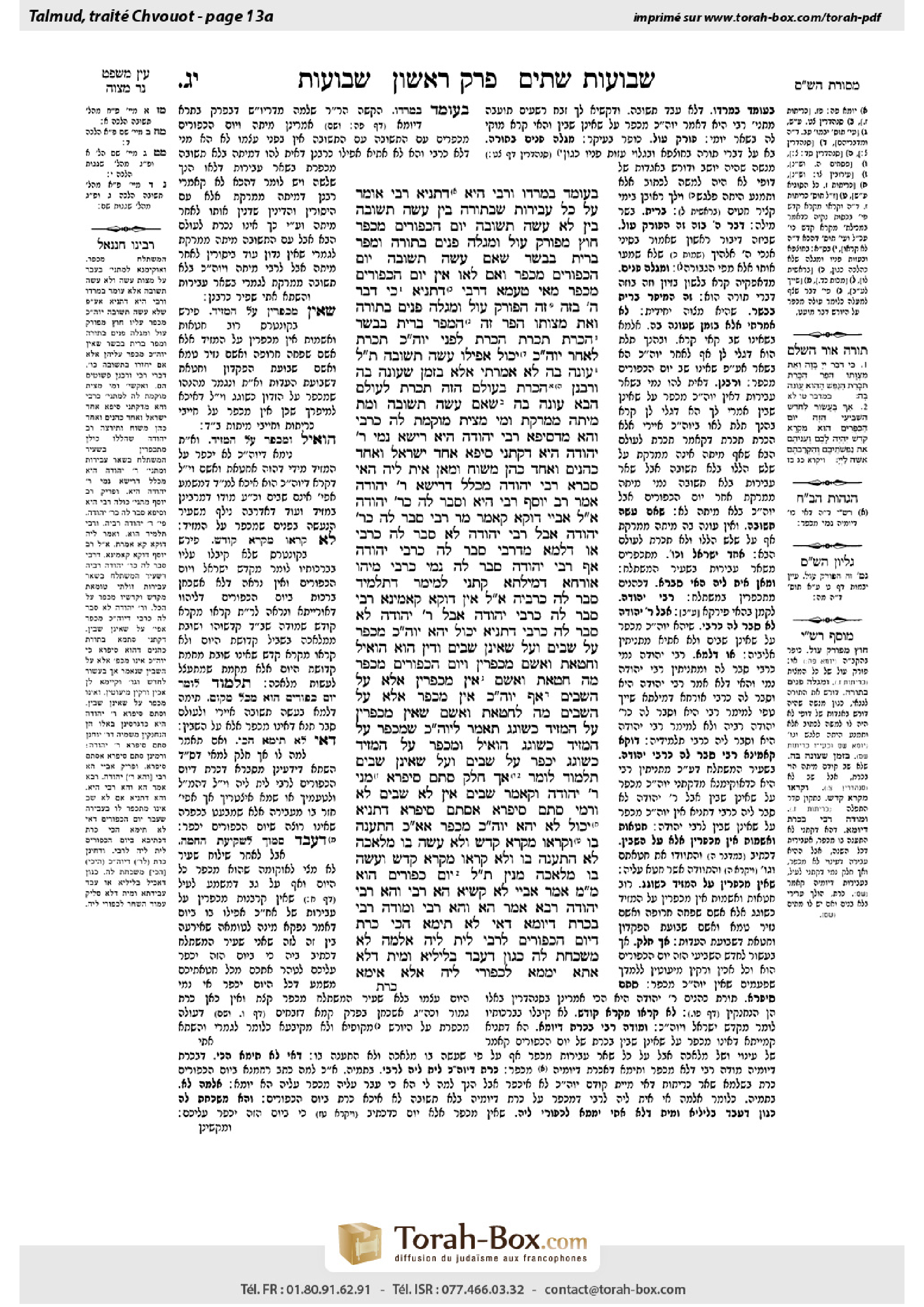
Shevuot 13a: Talmud study for Daf Yomi
Daf Yomi is the daily study of one Talmud folio. Explore 37 tractates with scans, Hebrew text, Sefaria English and AI-generated French translations where annotated.
Passage selection and English or AI-generated French translation are available where the scan has annotations. Daf Study is independent of Torah-Box and Sefaria.
Browse Shevuot · שבועות · All tractatesShevuot 13a text and translations
This page of Shevuot includes the Aramaic text, an English translation and an AI-generated French translation, alongside the scan above.
שבועות י״ג א · Aramaic and Hebrew text
בְּעוֹמֵד בְּמִרְדּוֹ, וְרַבִּי הִיא. דְּתַנְיָא: רַבִּי אוֹמֵר, עַל כׇּל עֲבֵירוֹת שֶׁבַּתּוֹרָה, בֵּין עָשָׂה תְּשׁוּבָה בֵּין לֹא עָשָׂה תְּשׁוּבָה – יוֹם הַכִּפּוּרִים מְכַפֵּר; חוּץ מִפּוֹרֵק עוֹל וּמְגַלֶּה פָּנִים בַּתּוֹרָה וּמֵפֵר בְּרִית בְּבָשָׂר – שֶׁאִם עָשָׂה תְּשׁוּבָה, יוֹם הַכִּפּוּרִים מְכַפֵּר; וְאִם לָאו, אֵין יוֹם הַכִּפּוּרִים מְכַפֵּר.
מַאי טַעְמָא דְּרַבִּי? דְּתַנְיָא: ״כִּי דְבַר ה׳ בָּזָה״ – זֶה הַפּוֹרֵק עוֹל וּמְגַלֶּה פָּנִים בַּתּוֹרָה. ״וְאֶת מִצְוָתוֹ הֵפֵר״ – זֶה הַמֵּפֵר בְּרִית בַּבָּשָׂר. ״הִכָּרֵת תִּכָּרֵת״ – הִכָּרֵת לִפְנֵי יוֹם הַכִּפּוּרִים, תִּכָּרֵת לְאַחַר יוֹם הַכִּפּוּרִים.
יָכוֹל אֲפִילּוּ עָשָׂה תְּשׁוּבָה? תַּלְמוּד לוֹמַר: ״עֲוֹנָהּ בָּהּ״ – לֹא אָמַרְתִּי אֶלָּא בִּזְמַן שֶׁעֲוֹנָהּ בָּהּ.
וְרַבָּנַן – ״הִכָּרֵת״ בָּעוֹלָם הַזֶּה, ״תִּכָּרֵת״ לָעוֹלָם הַבָּא, ״עֲוֹנָהּ בָּהּ״ – שֶׁאִם עָשָׂה תְּשׁוּבָה וָמֵת, מִיתָה מְמָרֶקֶת.
וּמִי מָצֵית מוֹקְמַתְּ לַהּ כְּרַבִּי?! וְהָא מִדְּסֵיפָא רַבִּי יְהוּדָה הִיא, רֵישָׁא נָמֵי רַבִּי יְהוּדָה הִיא! דְּקָתָנֵי סֵיפָא: אֶחָד יִשְׂרָאֵל וְאֶחָד כֹּהֲנִים וְאֶחָד כֹּהֵן מָשׁוּחַ; וּמַאן אִית לֵיהּ הַאי סְבָרָא – רַבִּי יְהוּדָה; מִכְּלָל דְּרֵישָׁא רַבִּי יְהוּדָה.
אָמַר רַב יוֹסֵף: רַבִּי הִיא, וְסָבַר לַהּ כְּרַבִּי יְהוּדָה.
אֲמַר לֵיהּ אַבָּיֵי: דַּוְקָא קָאָמַר מָר – רַבִּי סָבַר לַהּ כְּרַבִּי יְהוּדָה, אֲבָל רַבִּי יְהוּדָה לָא סָבַר לַהּ כְּרַבִּי? אוֹ דִלְמָא, מִדְּרַבִּי סָבַר לַהּ כְּרַבִּי יְהוּדָה, אַף רַבִּי יְהוּדָה סָבַר לַהּ נָמֵי כְּרַבִּי; מִיהוּ אוֹרְחָא דְמִילְּתָא קָתָנֵי – לְמֵימַר דְּתַלְמִיד סָבַר לַהּ כְּרַבֵּיהּ?
אֲמַר לֵיהּ: אִין, דַּוְקָא קָאָמֵינָא – רַבִּי סָבַר לַהּ כְּרַבִּי יְהוּדָה, אֲבָל רַבִּי יְהוּדָה לָא סָבַר לַהּ כְּרַבִּי.
דְּתַנְיָא: יָכוֹל יְהֵא יוֹם הַכִּפּוּרִים מְכַפֵּר עַל שָׁבִים וְעַל שֶׁאֵינָן שָׁבִים? וְדִין הוּא – הוֹאִיל וְחַטָּאת וְאָשָׁם מְכַפְּרִין, וְיוֹם הַכִּפּוּרִים מְכַפֵּר; מָה חַטָּאת וְאָשָׁם – אֵין מְכַפְּרִין אֶלָּא עַל הַשָּׁבִים, אַף יוֹם הַכִּפּוּרִים – אֵין מְכַפֵּר אֶלָּא עַל הַשָּׁבִים! מָה לְחַטָּאת וְאָשָׁם – שֶׁאֵין מְכַפְּרִין עַל הַמֵּזִיד כַּשּׁוֹגֵג; תֹּאמַר לְיוֹם הַכִּפּוּרִים – שֶׁמְּכַפֵּר עַל הַמֵּזִיד כַּשּׁוֹגֵג?!
הוֹאִיל וּמְכַפֵּר עַל הַמֵּזִיד כַּשּׁוֹגֵג, יְכַפֵּר עַל שָׁבִים וְעַל שֶׁאֵינָן שָׁבִים! תַּלְמוּד לוֹמַר: ״אַךְ״ – חָלַק.
סְתָם סִיפְרָא מַנִּי – רַבִּי יְהוּדָה; וְקָאָמַר: שָׁבִים אִין, לֹא שָׁבִים לָא.
וְרָמֵי סְתָם סִיפְרָא אַסְּתַם סִיפְרָא – דְּתַנְיָא: יָכוֹל לֹא יְהֵא יוֹם הַכִּפּוּרִים מְכַפֵּר, אֶלָּא אִם כֵּן הִתְעַנָּה בּוֹ, וּקְרָאוֹ מִקְרָא קֹדֶשׁ, וְלֹא עָשָׂה בּוֹ מְלָאכָה; לֹא הִתְעַנָּה בּוֹ, וְלֹא קְרָאוֹ מִקְרָא קֹדֶשׁ, וְעָשָׂה בּוֹ מְלָאכָה – מִנַּיִן? תַּלְמוּד לוֹמַר: ״יוֹם כִּפֻּרִים הוּא״ מִכׇּל מָקוֹם!
אָמַר אַבָּיֵי: לָא קַשְׁיָא; הָא רַבִּי, וְהָא רַבִּי יְהוּדָה.
רָבָא אָמַר: הָא וְהָא רַבִּי, וּמוֹדֶה רַבִּי בְּכָרֵת דְּיוֹמָא. דְּאִי לָא תֵּימָא הָכִי, כָּרֵת דְּיוֹם הַכִּפּוּרִים לְרַבִּי לֵית לֵיהּ.
אַלְּמָה לָא? מַשְׁכַּחַתְּ לַהּ – כְּגוֹן דַּעֲבַד בְּלֵילְיָא וּמִית, דְּלָא אֲתָא יְמָמָא לְכַפּוֹרֵי לֵיהּ!
אֶלָּא אֵימָא:
Shevuot 13a · English translation
The mishna is referring to a case where the person did not repent and persists in his rebellion, and it is in accordance with the opinion of Rabbi Yehuda HaNasi, that even for such a case Yom Kippur and the scapegoat will atone. As it is taught in a baraita: Rabbi Yehuda HaNasi says: For all transgressions that are stated in the Torah, whether one repented, or whether one did not repent, Yom Kippur atones, except for one who divests himself of the yoke of Heaven, by denying God’s existence, and one who reveals facets of the Torah that differ from its true meaning, and one who nullifies the covenant of circumcision of the flesh. For these, if one repented, Yom Kippur atones, and if not, Yom Kippur does not atone.
The Gemara asks: What is the reasoning of Rabbi Yehuda HaNasi? It is as it is taught in a baraita in interpretation of the verse: “For he scorned the word of the Lord and nullified His commandment; that person will be cut off [hikkaret tikkaret], his sin is upon him” (Numbers 15:31): “For he scorned the word of the Lord”; this is referring to one who divests himself of the yoke of Heaven and one who reveals facets of the Torah that differ from its true meaning. “And nullified His commandment”; this is referring to one who nullified the covenant of circumcision of the flesh. The use of the double verb form hikkaret tikkaret teaches that he will be cut off, i.e., he is liable to receive karet, before Yom Kippur, and he will still be cut off after Yom Kippur, as Yom Kippur does not atone for him.
One might have thought that this applies even if he repented. To counter this, the verse states: “His sin is upon him,” by which God indicates: I said that Yom Kippur does not atone for these sins only when his sin is still upon him, as he did not repent. It is apparent from this baraita that it is only for the three sins mentioned that Yom Kippur does not atone without repentance, but Yom Kippur atones for other sins even if one did not repent.
And with regard to the Rabbis who disagree with Rabbi Yehuda HaNasi, how do they interpret the verse? If someone commits one of the three sins mentioned, then he is cut off [hikkaret] from life in this world, and he will be cut off [tikkaret] in the World-to-Come. The phrase “His sin is upon him” teaches that if he repented and died, his death cleanses him of his sin.
The Gemara asks: And can you interpret the mishna to be in accordance with the opinion of Rabbi Yehuda HaNasi? But from the fact that the latter clause is in accordance with the opinion of Rabbi Yehuda, by inference, the first clause is also in accordance with the opinion of Rabbi Yehuda, but not of Rabbi Yehuda HaNasi, as the latter clause of the mishna teaches: Israelites and priests and the anointed priest, i.e., the High Priest, all equally achieve atonement from the scapegoat. And who accepts this reasoning? Rabbi Yehuda, as the Gemara will demonstrate. By inference, the first clause is also in accordance with the opinion of Rabbi Yehuda, not of Rabbi Yehuda HaNasi.
Rav Yosef said: It is possible that the entire mishna is in accordance with the opinion of Rabbi Yehuda HaNasi, and the latter clause does not pose a difficulty, because with regard to whether priests achieve atonement through the scapegoat, he holds in accordance with the opinion of Rabbi Yehuda.
Abaye said to him: Does the Master mean specifically what he is saying, i.e., that Rabbi Yehuda HaNasi holds in accordance with the opinion of Rabbi Yehuda with regard to whether the scapegoat atones for both Israelites and priest, but Rabbi Yehuda does not hold in accordance with the opinion of Rabbi Yehuda HaNasi with regard to atonement for one who did not repent? Or perhaps from the fact that Rabbi Yehuda HaNasi holds in accordance with the opinion of Rabbi Yehuda, it follows that Rabbi Yehuda also holds in accordance with the opinion of Rabbi Yehuda HaNasi, but the reason that Rav Yosef did not make this clear is that he teaches the matter in the manner in which it typically occurs, which is to say that a disciple, in this case, Rabbi Yehuda HaNasi, holds in accordance with the opinion of his teacher, i.e., Rabbi Yehuda.
Rav Yosef said to him: Yes, I mean specifically what I was saying: Rabbi Yehuda HaNasi holds in accordance with the opinion of Rabbi Yehuda, but Rabbi Yehuda does not hold in accordance with the opinion of Rabbi Yehuda HaNasi.
As it is taught in a baraita recorded in the Sifra: One might have thought that Yom Kippur would atone for those who repent and for those who do not repent, and this assertion is supported by the following logical inference: Although it would appear that since a sin-offering and a guilt-offering atone and Yom Kippur atones, it should follow that just as a sin-offering and a guilt-offering atone only for those who repent, so too, Yom Kippur atones only for those who repent, this comparison is flawed. One can claim: What is notable about a sin-offering and a guilt-offering? They are notable in that they do not atone for intentional sins like they do for unwitting sins. Can you say the same about Yom Kippur, which does atone for intentional sins as it does for unwitting sins?
The baraita continues: Since it is the case that the atonement of Yom Kippur is more far-reaching in that it atones for intentional sins as it does for unwitting sins, it follows that it should atone both for those who repent and for those who do not repent. To counter this, the verse states: “Yet on the tenth day of this seventh month it is Yom Kippur” (Leviticus 23:27). The word “yet” serves to divide and limit the atonement of Yom Kippur in that it atones only for those who repent.
Rav Yosef attributes the baraita to Rabbi Yehuda: Whose opinion is expressed by the unattributed baraitot in the Sifra? Rabbi Yehuda. And he says: For those who repent, yes, Yom Kippur atones, but for those who do not repent, Yom Kippur does not atone.
The Gemara asks: But raise a contradiction, setting one unattributed baraita in the Sifra, i.e., the one just cited, against another unattributed baraita in the Sifra, as in another baraita there it is taught: One might have thought that Yom Kippur would atone only if one fasted on it and declared it a holy convocation and did not perform labor on it. From where is it derived that even if one did not fast on it and did not declare it a holy convocation and performed labor on it, that it still atones? The verse states: “Yet on the tenth day of this seventh month it is Yom Kippur” (Leviticus 23:27). The additional emphasis on “it is” serves to teach that the day atones in any case. This baraita contradicts the one cited above that states clearly that Yom Kippur atones only for those who repent.
Abaye said: This is not difficult: This second baraita is in accordance with the opinion of Rabbi Yehuda HaNasi, and that first baraita is in accordance with the opinion of Rabbi Yehuda.
Rava said: Both this baraita and that baraita are in accordance with the opinion of Rabbi Yehuda HaNasi, who holds that Yom Kippur atones for those who do not repent, but even Rabbi Yehuda HaNasi concedes that with regard to avoiding the punishment of karet incurred for violating the day of Yom Kippur, Yom Kippur atones and one is not liable to be punished with karet only if one repented for the sin of violating the day of Yom Kippur. Perforce he must concede this point, as if you do not say so, then according to Rabbi Yehuda HaNasi, there would be no instance in which one would be liable to be punished with karet for violating Yom Kippur.
The Gemara questions this proof: Why not? You could find it in a case where he performed labor on the night of Yom Kippur and died that night, as in such a case, the daytime of Yom Kippur, which is the part of Yom Kippur that effects atonement, never came to atone for him.
Rather, say that Rava’s proof is as follows:
Shevuot 13a · Traduction française (IA)
La Michna vise le cas d’une personne qui ne s’est pas repentie et persiste dans sa rébellion ; elle suit l’opinion de Rabbi Yehouda HaNassi, selon laquelle, même dans un tel cas, Yom Kippour et le bouc émissaire apportent l’expiation. En effet, il est enseigné dans une baraïta : Rabbi Yehouda HaNassi dit : « Pour toutes les transgressions mentionnées dans la Torah, que l’on se soit repenti ou non, Yom Kippour apporte l’expiation, à l’exception de celui qui se défait du joug du Royaume des Cieux en niant l’existence de Dieu, de celui qui dévoile des interprétations de la Torah contraires à son véritable sens et de celui qui annule l’alliance de la circoncision de la chair. Pour ces fautes, si l’on s’est repenti, Yom Kippour apporte l’expiation ; si l’on ne s’est pas repenti, Yom Kippour n’apporte pas l’expiation. »
La Guemara demande : Quel est le raisonnement de Rabbi Yehouda HaNassi ? Il ressort de ce qui est enseigné dans une baraïta à propos du verset : « Car il a méprisé la parole de l’Éternel et a annulé Son commandement ; cette personne sera retranchée [hikkaret tikkaret], sa faute est sur elle » (Nombres 15:31) : « Car il a méprisé la parole de l’Éternel » désigne celui qui se défait du joug du Royaume des Cieux et celui qui dévoile des interprétations de la Torah contraires à son véritable sens. « Et a annulé Son commandement » désigne celui qui a annulé l’alliance de la circoncision de la chair. La forme verbale redoublée hikkaret tikkaret enseigne qu’il sera retranché, c’est-à-dire qu’il encourt le karet, avant Yom Kippour, et qu’il sera encore retranché après Yom Kippour, car Yom Kippour n’apporte pas l’expiation pour lui.
On aurait pu penser que cela s’applique même s’il s’était repenti. Pour écarter cette possibilité, le verset dit : « Sa faute est sur lui », par quoi Dieu indique : J’ai dit que Yom Kippour n’apporte pas l’expiation pour ces fautes seulement lorsque sa faute est encore sur lui, c’est-à-dire lorsqu’il ne s’est pas repenti. Il ressort de cette baraïta que Yom Kippour n’apporte l’expiation sans repentir que pour les trois fautes mentionnées ; pour les autres fautes, il apporte l’expiation même si l’on ne s’est pas repenti.
Et comment les Sages, qui sont en désaccord avec Rabbi Yehouda HaNassi, interprètent-ils le verset ? Si quelqu’un commet l’une des trois fautes mentionnées, il est retranché [hikkaret] de la vie dans ce monde, puis il sera retranché [tikkaret] dans le monde à venir. L’expression « Sa faute est sur lui » enseigne que, s’il s’est repenti puis est mort, sa mort le purifie de sa faute.
La Guemara demande : Peut-on interpréter la Michna conformément à l’opinion de Rabbi Yehouda HaNassi ? En effet, puisque la dernière partie suit l’opinion de Rabbi Yehouda, on peut en déduire que la première partie suit également l’opinion de Rabbi Yehouda, et non celle de Rabbi Yehouda HaNassi. La dernière partie de la Michna enseigne que les Israélites, les prêtres et le prêtre oint, c’est-à-dire le grand prêtre, obtiennent tous pareillement l’expiation grâce au bouc émissaire. Qui accepte ce raisonnement ? Rabbi Yehouda, comme la Guemara le montrera. On en déduit que la première partie suit également l’opinion de Rabbi Yehouda, et non celle de Rabbi Yehouda HaNassi.
Rav Yossef dit : Il est possible que toute la Michna suive l’opinion de Rabbi Yehouda HaNassi, et la dernière partie ne pose pas de difficulté, car, quant à savoir si les prêtres obtiennent l’expiation grâce au bouc émissaire, il partage l’opinion de Rabbi Yehouda.
Abayé lui dit : Le Maître veut-il dire précisément ce qu’il vient d’énoncer, à savoir que Rabbi Yehouda HaNassi partage l’opinion de Rabbi Yehouda quant à savoir si le bouc émissaire apporte l’expiation aux Israélites comme aux prêtres, mais que Rabbi Yehouda ne partage pas l’opinion de Rabbi Yehouda HaNassi concernant l’expiation de celui qui ne s’est pas repenti ? Ou bien faut-il comprendre que, puisque Rabbi Yehouda HaNassi partage l’opinion de Rabbi Yehouda, Rabbi Yehouda partage lui aussi l’opinion de Rabbi Yehouda HaNassi, mais que Rav Yossef ne l’a pas précisé parce qu’il présente la question de la manière habituelle, à savoir qu’un disciple — en l’occurrence, Rabbi Yehouda HaNassi — partage l’opinion de son maître, c’est-à-dire Rabbi Yehouda.
Rav Yossef lui dit : Oui, je veux dire précisément ce que j’ai dit : Rabbi Yehouda HaNassi partage l’opinion de Rabbi Yehouda, mais Rabbi Yehouda ne partage pas celle de Rabbi Yehouda HaNassi.
En effet, il est enseigné dans une baraïta consignée dans le Sifra : On aurait pu penser que Yom Kippour apporte l’expiation à ceux qui se repentent comme à ceux qui ne se repentent pas. Cette proposition est étayée par le raisonnement logique suivant : Il semble que, puisque le sacrifice expiatoire et le sacrifice de culpabilité apportent l’expiation, tout comme Yom Kippour, on devrait conclure que, de même que le sacrifice expiatoire et le sacrifice de culpabilité n’apportent l’expiation qu’à ceux qui se repentent, Yom Kippour ne l’apporte lui aussi qu’à ceux qui se repentent. Mais cette comparaison est erronée. On peut objecter : En quoi le sacrifice expiatoire et le sacrifice de culpabilité se distinguent-ils ? Ils se distinguent en ce qu’ils n’apportent pas l’expiation pour les fautes intentionnelles comme ils le font pour les fautes commises par inadvertance. Peut-on en dire autant de Yom Kippour, qui apporte l’expiation pour les fautes intentionnelles comme pour celles commises par inadvertance ?
La baraïta poursuit : Puisque l’expiation de Yom Kippour a une portée plus large, en ce qu’elle s’applique aux fautes intentionnelles comme à celles commises par inadvertance, il s’ensuit qu’elle devrait s’appliquer aussi bien à ceux qui se repentent qu’à ceux qui ne se repentent pas. Pour écarter cette possibilité, le verset dit : « Pourtant, le dixième jour de ce septième mois, c’est Yom Kippour » (Lévitique 23:27). Le mot « pourtant » sert à distinguer et à limiter l’expiation de Yom Kippour : elle ne s’applique qu’à ceux qui se repentent.
Rav Yossef attribue cette baraïta à Rabbi Yehouda : De qui les baraïtot anonymes du Sifra expriment-elles l’opinion ? De Rabbi Yehouda. Et il dit : Pour ceux qui se repentent, oui, Yom Kippour apporte l’expiation ; mais pour ceux qui ne se repentent pas, Yom Kippour n’apporte pas l’expiation.
La Guemara demande : Mais opposons une baraïta anonyme du Sifra, celle qui vient d’être citée, à une autre baraïta anonyme du Sifra. En effet, une autre baraïta y enseigne : On aurait pu penser que Yom Kippour n’apporte l’expiation que si l’on a jeûné ce jour-là, qu’on en a fait une sainte convocation et qu’on n’y a pas accompli de travail. D’où apprend-on que, même si l’on n’a pas jeûné ce jour-là, qu’on n’en a pas fait une sainte convocation et qu’on y a accompli du travail, il apporte néanmoins l’expiation ? Le verset dit : « Pourtant, le dixième jour de ce septième mois, c’est Yom Kippour » (Lévitique 23:27). L’accent mis sur « c’est » enseigne que ce jour apporte l’expiation dans tous les cas. Cette baraïta contredit celle citée précédemment, qui affirme clairement que Yom Kippour n’apporte l’expiation qu’à ceux qui se repentent.
Abayé dit : Il n’y a pas de difficulté : cette seconde baraïta suit l’opinion de Rabbi Yehouda HaNassi, et la première baraïta suit celle de Rabbi Yehouda.
Rava dit : Les deux baraïtot, celle-ci comme celle-là, suivent l’opinion de Rabbi Yehouda HaNassi, selon laquelle Yom Kippour apporte l’expiation même à ceux qui ne se repentent pas. Toutefois, même Rabbi Yehouda HaNassi concède que, pour échapper à la peine de karet encourue pour avoir profané Yom Kippour, Yom Kippour n’apporte l’expiation — et l’on n’encourt pas la peine de karet — que si l’on s’est repenti de la faute consistant à avoir profané Yom Kippour. Il doit nécessairement concéder ce point, car, si l’on ne dit pas cela, alors, selon Rabbi Yehouda HaNassi, il n’existerait aucun cas où l’on encourrait la peine de karet pour avoir profané Yom Kippour.
La Guemara conteste cette preuve : Pourquoi pas ? On peut envisager le cas où il a accompli un travail durant la nuit de Yom Kippour et est mort cette nuit-là. Dans un tel cas, le jour de Yom Kippour, qui est la partie de Yom Kippour qui apporte l’expiation, n’est jamais venu apporter l’expiation pour lui.
Il faut plutôt dire que la preuve de Rava est la suivante :
Traduction française générée par IA à partir de l’édition anglaise de Sefaria. Vérifie toujours un passage avec le texte source.
Text from Sefaria: William Davidson Edition - Vocalized Aramaic (CC BY NC); William Davidson Edition - English (CC BY NC).