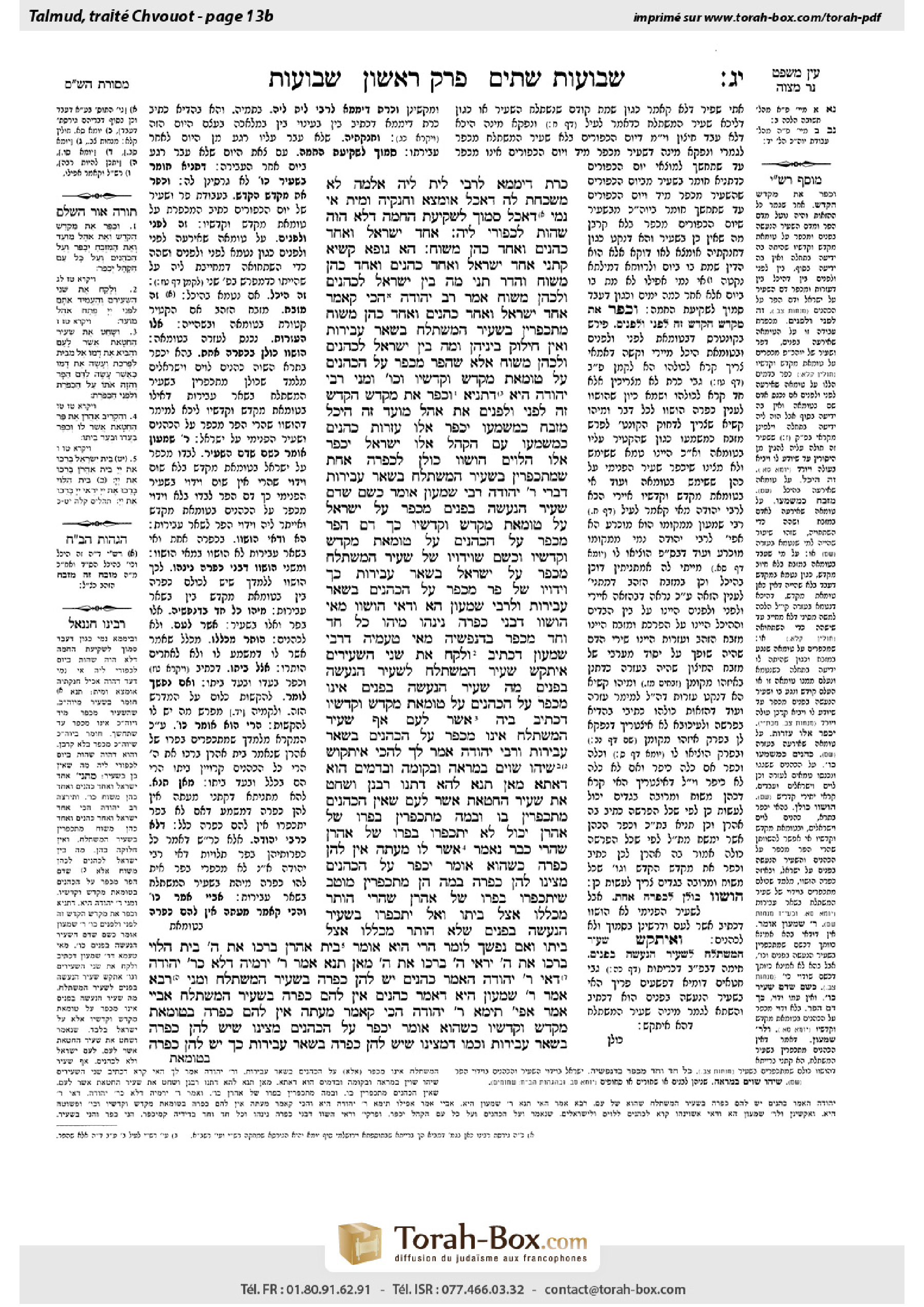
Shevuot 13b: Talmud study for Daf Yomi
Daf Yomi is the daily study of one Talmud folio. Explore 37 tractates with scans, Hebrew text, Sefaria English and AI-generated French translations where annotated.
Passage selection and English or AI-generated French translation are available where the scan has annotations. Daf Study is independent of Torah-Box and Sefaria.
Browse Shevuot · שבועות · All tractatesShevuot 13b text and translations
This page of Shevuot includes the Aramaic text, an English translation and an AI-generated French translation, alongside the scan above.
שבועות י״ג ב · Aramaic and Hebrew text
כָּרֵת דִּימָמָא לְרַבִּי לֵית לֵיהּ.
אַלְּמָה לָא? מַשְׁכַּחַתְּ לַהּ דַּאֲכַל אוּמְצָא וְחַנְקֵיהּ וּמִית; אִי נָמֵי דַּאֲכַל סָמוּךְ לִשְׁקִיעַת הַחַמָּה – דְּלָא הֲוָה שְׁהוּת לְכַפּוֹרֵי לֵיהּ!
אֶחָד יִשְׂרָאֵל וְאֶחָד כֹּהֲנִים וְאֶחָד כֹּהֵן מָשׁוּחַ.
הָא גּוּפַאּ קַשְׁיָא – קָתָנֵי: אֶחָד יִשְׂרָאֵל וְאֶחָד כֹּהֲנִים וְאֶחָד כֹּהֵן מָשׁוּחַ; וַהֲדַר תָּנֵי: מָה בֵּין יִשְׂרָאֵל לְכֹהֲנִים וּלְכֹהֵן מָשׁוּחַ! אָמַר רַב יְהוּדָה, הָכִי קָאָמַר: אֶחָד יִשְׂרָאֵל וְאֶחָד כֹּהֲנִים וְאֶחָד כֹּהֵן מָשׁוּחַ מִתְכַּפְּרִין בְּשָׂעִיר הַמִּשְׁתַּלֵּחַ בִּשְׁאָר עֲבֵירוֹת, וְאֵין חִילּוּק בֵּינֵיהֶן. וּמָה בֵּין יִשְׂרָאֵל לְכֹהֲנִים וּלְכֹהֵן מָשׁוּחַ? אֶלָּא שֶׁהַפָּר מְכַפֵּר עַל הַכֹּהֲנִים עַל טוּמְאַת מִקְדָּשׁ וְקָדָשָׁיו וְכוּ׳.
וּמַנִּי – רַבִּי יְהוּדָה הִיא. דְּתַנְיָא: ״וְכִפֶּר אֶת מִקְדַּשׁ הַקֹּדֶשׁ״ – זֶה לִפְנַי וְלִפְנִים; ״אֶת אֹהֶל מוֹעֵד״ – זֶה הֵיכָל; ״מִזְבֵּחַ״ – כְּמַשְׁמָעוֹ; ״יְכַפֵּר״ – אֵלּוּ עֲזָרוֹת; ״כֹּהֲנִים״ – כְּמַשְׁמָעוֹ; ״עַם הַקָּהָל״ – אֵלּוּ יִשְׂרָאֵל; ״יְכַפֵּר״ – אֵלּוּ הַלְוִיִּם;
הוּשְׁווּ כּוּלָּן לְכַפָּרָה אַחַת, שֶׁמִּתְכַּפְּרִין בְּשָׂעִיר הַמִּשְׁתַּלֵּחַ בִּשְׁאָר עֲבֵירוֹת. דִּבְרֵי רַבִּי יְהוּדָה.
רַבִּי שִׁמְעוֹן אוֹמֵר: כְּשֵׁם שֶׁדַּם שָׂעִיר הַנַּעֲשֶׂה בִּפְנִים מְכַפֵּר עַל יִשְׂרָאֵל עַל טוּמְאַת מִקְדָּשׁ וְקָדָשָׁיו, כָּךְ דַּם הַפָּר מְכַפֵּר עַל הַכֹּהֲנִים עַל טוּמְאַת מִקְדָּשׁ וְקָדָשָׁיו. וּכְשֵׁם שֶׁוִּידּוּיוֹ שֶׁל שָׂעִיר הַמִּשְׁתַּלֵּחַ מְכַפֵּר עַל יִשְׂרָאֵל בִּשְׁאָר עֲבֵירוֹת, כָּךְ וִידּוּיוֹ שֶׁל פָּר מְכַפֵּר עַל הַכֹּהֲנִים בִּשְׁאָר עֲבֵירוֹת.
וּלְרַבִּי שִׁמְעוֹן, הָא וַדַּאי הוּשְׁווּ! מַאי הוּשְׁווּ – דִּבְנֵי כַּפָּרָה נִינְהוּ; מִיהוּ כֹּל חַד וְחַד מְכַפַּר בִּדְנַפְשֵׁיהּ.
מַאי טַעְמֵיהּ דְּרַבִּי שִׁמְעוֹן? דִּכְתִיב: ״וְלָקַח אֶת שְׁנֵי הַשְּׂעִירִם״ – אִיתַּקַּשׁ שָׂעִיר הַמִּשְׁתַּלֵּחַ לְשָׂעִיר הַנַּעֲשֶׂה בִּפְנִים; מָה שָׂעִיר הַנַּעֲשֶׂה בִּפְנִים אֵינוֹ מְכַפֵּר עַל הַכֹּהֲנִים עַל טוּמְאַת מִקְדָּשׁ וְקָדָשָׁיו, דִּכְתִיב בֵּיהּ: ״אֲשֶׁר לָעָם״; אַף שָׂעִיר הַמִּשְׁתַּלֵּחַ אֵינוֹ מְכַפֵּר עַל הַכֹּהֲנִים בִּשְׁאָר עֲבֵירוֹת.
וְרַבִּי יְהוּדָה אָמַר לָךְ: לְהָכִי אִיתַּקּוּשׁ – שֶׁיִּהְיוּ שָׁוִים בְּמַרְאֶה וּבְקוֹמָה וּבְדָמִים הוּא דַּאֲתָא.
מַאן תְּנָא לְהָא דְּתָנוּ רַבָּנַן: ״וְשָׁחַט אֶת שְׂעִיר הַחַטָּאת אֲשֶׁר לָעָם״ – שֶׁאֵין הַכֹּהֲנִים מִתְכַּפְּרִין בּוֹ. וּבַמֶּה מִתְכַּפְּרִין? בְּפָרוֹ שֶׁל אַהֲרֹן.
יָכוֹל לֹא יִתְכַּפְּרוּ בְּפָרוֹ שֶׁל אַהֲרֹן; שֶׁהֲרֵי כְּבָר נֶאֱמַר: ״אֲשֶׁר לוֹ״ – מֵעַתָּה אֵין לָהֶן כַּפָּרָה? כְּשֶׁהוּא אוֹמֵר: ״יְכַפֵּר עַל הַכֹּהֲנִים״ – מָצִינוּ לָהֶן כַּפָּרָה.
בַּמָּה הֵן מִתְכַּפְּרִין? מוּטָב שֶׁיִּתְכַּפְּרוּ בְּפָרוֹ שֶׁל אַהֲרֹן – שֶׁהֲרֵי הוּתַּר מִכְּלָלוֹ אֵצֶל בֵּיתוֹ, וְאַל יִתְכַּפְּרוּ בְּשָׂעִיר הַנַּעֲשֶׂה בִּפְנִים – שֶׁלֹּא הוּתַּר מִכְּלָלוֹ אֵצֶל בֵּיתוֹ.
וְאִם נַפְשְׁךָ לוֹמַר – הֲרֵי הוּא אוֹמֵר: ״בֵּית אַהֲרֹן בָּרְכוּ אֶת ה׳, בֵּית הַלֵּוִי בָּרְכוּ אֶת ה׳, יִרְאֵי ה׳ בָּרְכוּ אֶת ה׳״.
מַאן תַּנָּא? אָמַר רַבִּי יִרְמְיָה: דְּלָא כְּרַבִּי יְהוּדָה; דְּאִי רַבִּי יְהוּדָה, הָאָמַר: ״כֹּהֲנִים יֵשׁ לָהֶן כַּפָּרָה בְּשָׂעִיר הַמִּשְׁתַּלֵּחַ״. וּמַנִּי? רָבָא אָמַר: רַבִּי שִׁמְעוֹן הִיא, דְּאָמַר: ״כֹּהֲנִים אֵין לָהֶם כַּפָּרָה בְּשָׂעִיר הַמִּשְׁתַּלֵּחַ״.
אַבָּיֵי אָמַר: אֲפִילּוּ תֵּימָא רַבִּי יְהוּדָה, הָכִי קָאָמַר: מֵעַתָּה אֵין לָהֶם כַּפָּרָה בְּטוּמְאַת מִקְדָּשׁ וְקָדָשָׁיו? כְּשֶׁהוּא אוֹמֵר: ״יְכַפֵּר עַל הַכֹּהֲנִים״, מָצִינוּ שֶׁיֵּשׁ לָהֶן כַּפָּרָה בִּשְׁאָר עֲבֵירוֹת; וּכְמוֹ דְּמָצִינוּ שֶׁיֵּשׁ לָהֶן כַּפָּרָה בִּשְׁאָר עֲבֵירוֹת, כָּךְ יֵשׁ לָהֶן כַּפָּרָה
Shevuot 13b · English translation
It must be that Rabbi Yehuda HaNasi concedes that Yom Kippur does not atone for one who violates the day itself and does not repent, as if you do not say so, according to Rabbi Yehuda HaNasi, there would be no instance in which a person would be liable to receive karet for violating Yom Kippur in the daytime.
The Gemara questions this proof: Why not? You could find it in a case where he ate a piece of meat, and while he was eating it choked him and he died, or in a case where he ate immediately before sunset at the end of the day. Even if one holds that Yom Kippur does atone for violations of the day itself, in these cases it could not, as there was no time after the violation for the day to atone for him, in the first case because he was already dead, and in the second case because it was no longer Yom Kippur.
§ The mishna (2b) states: Israelites and priests and the anointed priest, i.e., the High Priest, equally achieve atonement. What is the difference between Israelites, priests, and the anointed priest? The difference is only that the priests achieve atonement for their defiling of the Temple or its sacrificial foods through the bull that the High Priest offers on Yom Kippur, whereas the Israelites achieve atonement for their transgressions through the goats that are sacrificed on Yom Kippur.
The Gemara asks: This mishna itself is difficult, as it teaches: Both Israelites and priests and the anointed priest equally achieve atonement. But then it teaches: What is the difference between Israelites, priests, and the anointed priest? Rav Yehuda said that this is what the mishna is saying: Both Israelites and priests and the anointed priest equally achieve atonement through the scapegoat for transgressions other than the defiling of the Temple or its sacrificial foods, and in this regard there is no distinction between them. But what is the difference between Israelites, priests, and the anointed priest? The difference is only that the bull of the High Priest that he offers on Yom Kippur atones for the priests for their defiling of the Temple or its sacrificial foods, whereas the Israelites achieve atonement for their transgressions through the goats that are sacrificed on Yom Kippur.
And whose opinion is expressed by the mishna? It is Rabbi Yehuda, as it is taught in a baraita in exposition of the verse: “He shall bring atonement upon the sanctum of the sacred, and he shall effect atonement upon the Tent of Meeting and the altar, and upon the priests and upon all the people of the congregation shall he bring atonement” (Leviticus 16:33): “He shall bring atonement upon the sanctum of the sacred”; this is referring to the innermost sanctum, i.e., the Holy of Holies. “Upon the Tent of Meeting”; this is referring to the Sanctuary. “And the altar”; this is understood in accordance with its plain meaning. “He shall effect atonement”; this is referring to the Temple courtyards. “And upon the priests”; this is understood in accordance with its plain meaning. “And upon all the people”; these are the Israelites. “Shall he bring atonement”; this is referring to the Levites.
All of them are equated with regard to the fact that they are all atoned for through one atonement, i.e., that they are atoned for by the scapegoat for all transgressions other than the defiling of the Temple or its sacrificial foods. This is the statement of Rabbi Yehuda.
The baraita continues: Rabbi Shimon says: Just as the blood of the goat whose blood presentation is performed inside the Sanctuary atones for Israelites for their defiling of the Temple or its sacrificial foods, so too, the blood of the bull of the High Priest, whose blood presentation is also performed inside the Sanctuary, atones for the priests for their defiling of the Temple or its sacrificial foods. And just as the confession made over the scapegoat atones for Israelites for other transgressions, so too, the confession made over the bull atones for the priests for other transgressions. It is apparent from the baraita that it is only according to the opinion of Rabbi Yehuda that the scapegoat atones for both Israelites and priests.
The Gemara analyzes Rabbi Shimon’s opinion: And according to Rabbi Shimon, one can ask: Weren’t both Israelites and priests certainly equated in the verse in Leviticus? The Gemara explains: According to his opinion, in what way are they equated in the verse? They are equated in that they are all subject to atonement on Yom Kippur; but each one of the groups achieves atonement in its own way.
The Gemara asks: What is the reason of Rabbi Shimon, who holds that priests are not atoned for by the scapegoat? As it is written: “He shall take the two goats” (Leviticus 16:7); one is used for the scapegoat and the other for the internal goat. With this verse, the scapegoat is juxtaposed with the goat whose blood presentation is performed inside the Sanctuary. It teaches that just as the goat whose blood presentation is performed inside does not atone for the priests for their defiling of the Temple or its sacrificial foods, as it is written with regard to that goat: “The goat sin-offering of the people” (Leviticus 16:15), which indicates that it atones for Israelites and not for the priests, so too, the scapegoat does not atone for the priests for their other transgressions.
And as for Rabbi Yehuda, how does he understand the juxtaposition? He could have said to you: It is only for this reason that the goats are juxtaposed: The juxtaposition comes to teach that they should be similar in appearance and in height and in value. They are not similar in the atonement that they effect.
The Gemara asks: Who is the tanna who taught that which the Sages taught in a baraita: The verse states with regard to the internal goat: “He shall slaughter the goat sin-offering of the people” (Leviticus 16:15); the term “of the people” excludes Aaron and the priests, and therefore indicates that the priests do not achieve atonement through that goat. But then, through what do they achieve atonement? Presumably, through the bull of Aaron, i.e., the bull of the High Priest.
One might have thought that they would also not achieve atonement through the bull of Aaron, as it is already stated: “Aaron shall bring near his own bull sin-offering” (Leviticus 16:6), which indicates that it atones only for Aaron’s transgressions, not for the transgressions of others. And if that is so, then they do not have any means through which to achieve atonement. But when the verse states: “And he shall effect atonement…upon the priests” (Leviticus 16:33), we have clearly found that they do have a means of achieving atonement.
The baraita continues: Through which means then do they achieve atonement? Do they achieve it through the internal goat or the bull of Aaron? It is better to say that they achieve atonement through the bull of Aaron, as in any event, with regard to his household, an exception was made to its rule that it atones only for Aaron, and his household also achieves atonement from his bull. It is therefore not unreasonable to say that the priesthood should also achieve atonement from his bull. And one should not say that they achieve atonement through the goat whose blood presentation is performed inside the Sanctuary, as it is not found with regard to Aaron’s household that an exception was made to its rule that it atones for the people, as his household does not achieve atonement from the scapegoat.
And if it is your wish to say that this reasoning can be refuted, one can cite another proof, as the verse states: “House of Israel, bless the Lord; house of Aaron, bless the Lord; house of Levi, bless the Lord; those who fear the Lord, bless the Lord” (Psalms 135:19–20). It is apparent from this verse that “house of Aaron” is referring to all priests and not just to Aaron’s immediate household, and so it is reasonable that Aaron’s bull should atone for them.
The Gemara repeats its question about this baraita: Who is the tanna who taught this baraita? Rabbi Yirmeya says: It is not in accordance with the opinion of Rabbi Yehuda, as, if one suggests that it is in accordance with the opinion of Rabbi Yehuda, one can counter: Doesn’t he say that the priests have a means of atonement through the scapegoat, whereas the baraita indicates that they do not, as it states that if they do not achieve atonement through the bull of Aaron, then they do not have any means through which to achieve atonement? But then, whose opinion is expressed? Rava says: It is the opinion of Rabbi Shimon, who says that the priests do not have a means of achieving atonement through the scapegoat.
Abaye said: You may even say that the baraita is in accordance with the opinion of Rabbi Yehuda, and this is what it is saying: If that is so, that the priests do not achieve atonement through the bull of Aaron, then they do not have any means through which to achieve atonement for the defiling of the Temple or its sacrificial foods. When the verse states: “And he shall effect atonement…upon the priests,” we have clearly found that they do have a means of atonement for other transgressions. And it follows that just as we have found that they have a means of atonement for other transgressions, as Israelites do, so too, they must also have a means of atonement
Shevuot 13b · Traduction française (IA)
Il faut donc que Rabbi Yehouda HaNassi reconnaisse que Yom Kippour n’expie pas pour celui qui transgresse les interdits propres à ce jour sans se repentir. En effet, si l’on ne disait pas cela, selon Rabbi Yehouda HaNassi, il n’y aurait aucun cas où une personne serait passible de retranchement pour avoir transgressé les interdits de Yom Kippour pendant la journée.
La Guemara conteste cette preuve : pourquoi pas ? On pourrait envisager le cas où un homme mange un morceau de viande et s’étouffe pendant qu’il le mange, puis meurt ; ou celui où il mange juste avant le coucher du soleil, à la fin de la journée. Même si l’on soutient que Yom Kippour expie les transgressions commises ce jour-là, il ne pourrait pas l’exempter dans ces cas : dans le premier, parce qu’il était déjà mort, et dans le second, parce que Yom Kippour était déjà terminé.
§ La Michna (2b) enseigne : Les Israélites, les prêtres et le prêtre oint, c’est-à-dire le grand prêtre, obtiennent tous également l’expiation. Quelle est la différence entre les Israélites, les prêtres et le prêtre oint ? La seule différence est que les prêtres obtiennent l’expiation, pour avoir rendu impur le Temple ou ses aliments consacrés, grâce au taureau que le grand prêtre offre à Yom Kippour, tandis que les Israélites obtiennent l’expiation pour leurs transgressions grâce aux boucs sacrifiés à Yom Kippour.
La Guemara demande : Cette Michna elle-même est difficile, car elle enseigne : Les Israélites, les prêtres et le prêtre oint obtiennent tous également l’expiation. Mais elle enseigne ensuite : Quelle est la différence entre les Israélites, les prêtres et le prêtre oint ? Rav Yehouda explique que voici ce que dit la Michna : Les Israélites, les prêtres et le prêtre oint obtiennent tous également l’expiation grâce au bouc émissaire pour les transgressions autres que la souillure du Temple ou de ses aliments consacrés ; à cet égard, aucune distinction n’est faite entre eux. Mais quelle est la différence entre les Israélites, les prêtres et le prêtre oint ? La seule différence est que le taureau que le grand prêtre offre à Yom Kippour expie pour les prêtres qui ont rendu impur le Temple ou ses aliments consacrés, tandis que les Israélites obtiennent l’expiation pour leurs transgressions grâce aux boucs sacrifiés à Yom Kippour.
Et quelle opinion la Michna exprime-t-elle ? Celle de Rabbi Yehouda, comme on l’enseigne dans une baraïta, à propos du verset : « Il fera expiation pour le sanctuaire du Saint, pour la Tente d’assignation et l’autel, et pour les prêtres et tout le peuple de l’assemblée » (Lévitique 16:33) : « Il fera expiation pour le sanctuaire du Saint » désigne le sanctuaire intérieur, c’est-à-dire le Saint des saints. « Pour la Tente d’assignation » désigne le Sanctuaire. « Et l’autel » s’entend selon son sens littéral. « Il fera expiation » désigne les parvis du Temple. « Et pour les prêtres » s’entend selon son sens littéral. « Et tout le peuple » désigne les Israélites. « Il fera expiation » désigne les Lévites.
Tous sont assimilés en ce qu’ils obtiennent tous l’expiation par un seul et même moyen, c’est-à-dire grâce au bouc émissaire, pour toutes les transgressions autres que la souillure du Temple ou de ses aliments consacrés. Telle est l’opinion de Rabbi Yehouda.
La baraïta poursuit : Rabbi Shimon dit : De même que le sang du bouc dont le sang est présenté à l’intérieur du Sanctuaire expie pour les Israélites qui ont rendu impur le Temple ou ses aliments consacrés, de même le sang du taureau du grand prêtre, dont le sang est également présenté à l’intérieur du Sanctuaire, expie pour les prêtres qui ont rendu impur le Temple ou ses aliments consacrés. Et de même que la confession prononcée sur le bouc émissaire expie pour les Israélites pour leurs autres transgressions, de même la confession prononcée sur le taureau expie pour les prêtres pour leurs autres transgressions. Il ressort de la baraïta que seul, selon l’opinion de Rabbi Yehouda, le bouc émissaire expie à la fois pour les Israélites et pour les prêtres.
La Guemara examine l’opinion de Rabbi Shimon : selon Rabbi Shimon, on peut demander : les Israélites et les prêtres n’ont-ils pas tous deux été inclus dans le verset du Lévitique ? La Guemara explique : selon son opinion, en quoi le verset les assimile-t-il ? En ce qu’ils sont tous soumis à l’expiation à Yom Kippour ; mais chacun de ces groupes obtient l’expiation à sa manière.
La Guemara demande : Quel est le raisonnement de Rabbi Shimon, qui soutient que les prêtres n’obtiennent pas l’expiation grâce au bouc émissaire ? Il est écrit : « Il prendra les deux boucs » (Lévitique 16:7) ; l’un sert de bouc émissaire et l’autre est le bouc intérieur. Ce verset met le bouc émissaire en parallèle avec le bouc dont le sang est présenté à l’intérieur du Sanctuaire. Il enseigne que, de même que le bouc dont le sang est présenté à l’intérieur n’expie pas pour les prêtres qui ont rendu impur le Temple ou ses aliments consacrés — car il est écrit à son sujet : « le sacrifice expiatoire du peuple » (Lévitique 16:15), ce qui indique qu’il expie pour les Israélites et non pour les prêtres —, de même le bouc émissaire n’expie pas pour les prêtres au titre de leurs autres transgressions.
Et comment Rabbi Yehouda comprend-il cette mise en parallèle ? Il pourrait te répondre : les boucs ne sont mis en parallèle que pour enseigner qu’ils doivent se ressembler par leur apparence, leur taille et leur valeur. Ils ne se ressemblent pas quant à l’expiation qu’ils procurent.
La Guemara demande : Quel est le tanna qui a enseigné ce que les Sages ont enseigné dans une baraïta ? À propos du bouc intérieur, le verset dit : « Il égorgera le bouc, sacrifice expiatoire du peuple » (Lévitique 16:15) ; l’expression « du peuple » exclut Aaron et les prêtres et indique donc que les prêtres n’obtiennent pas l’expiation grâce à ce bouc. Mais par quel moyen obtiennent-ils alors l’expiation ? Vraisemblablement grâce au taureau d’Aaron, c’est-à-dire au taureau du grand prêtre.
On aurait pu penser qu’ils n’obtiendraient pas non plus l’expiation grâce au taureau d’Aaron, car il est déjà dit : « Aaron présentera son propre taureau expiatoire » (Lévitique 16:6), ce qui indique qu’il n’expie que pour les transgressions d’Aaron, et non pour celles d’autres personnes. Si tel était le cas, ils ne disposeraient d’aucun moyen d’obtenir l’expiation. Mais lorsque le verset dit : « Il fera expiation… pour les prêtres » (Lévitique 16:33), nous voyons clairement qu’ils disposent bien d’un moyen d’obtenir l’expiation.
La baraïta poursuit : Par quel moyen obtiennent-ils donc l’expiation ? Grâce au bouc intérieur ou au taureau d’Aaron ? Il vaut mieux dire qu’ils l’obtiennent grâce au taureau d’Aaron, puisque, de toute façon, la règle selon laquelle celui-ci n’expie que pour Aaron connaît une exception pour sa maisonnée, qui obtient elle aussi l’expiation grâce à son taureau. Il n’est donc pas déraisonnable de dire que les prêtres obtiennent eux aussi l’expiation grâce à son taureau. Et il ne faut pas dire qu’ils l’obtiennent grâce au bouc dont le sang est présenté à l’intérieur du Sanctuaire, car aucune exception à la règle selon laquelle ce bouc expie pour le peuple n’est attestée pour la maisonnée d’Aaron : celle-ci n’obtient pas l’expiation grâce au bouc émissaire.
Et si tu souhaites dire que ce raisonnement peut être réfuté, on peut citer une autre preuve, car le verset dit : « Maison d’Israël, bénissez le Seigneur ; maison d’Aaron, bénissez le Seigneur ; maison de Lévi, bénissez le Seigneur ; vous qui craignez le Seigneur, bénissez le Seigneur » (Psaumes 135:19–20). Il ressort de ce verset que l’expression « maison d’Aaron » désigne tous les prêtres, et pas seulement la maisonnée d’Aaron ; il est donc raisonnable que le taureau d’Aaron expie pour eux.
La Guemara répète sa question au sujet de cette baraïta : Quel est le tanna qui l’a enseignée ? Rabbi Yirmeya dit : Elle ne correspond pas à l’opinion de Rabbi Yehouda, car si l’on suggérait qu’elle correspond à son opinion, on pourrait objecter : ne dit-il pas que les prêtres disposent d’un moyen d’obtenir l’expiation grâce au bouc émissaire, alors que la baraïta indique le contraire, puisqu’elle dit que s’ils n’obtiennent pas l’expiation grâce au taureau d’Aaron, ils ne disposent d’aucun moyen de l’obtenir ? Mais quelle opinion exprime-t-elle alors ? Rava dit : c’est celle de Rabbi Shimon, qui dit que les prêtres ne disposent pas d’un moyen d’obtenir l’expiation grâce au bouc émissaire.
Abayé dit : On peut même dire que la baraïta correspond à l’opinion de Rabbi Yehouda, et voici ce qu’elle dit : si les prêtres n’obtiennent pas l’expiation grâce au taureau d’Aaron, ils ne disposent alors d’aucun moyen d’obtenir l’expiation pour la souillure du Temple ou de ses aliments consacrés. Lorsque le verset dit : « Il fera expiation… pour les prêtres », nous voyons clairement qu’ils disposent bien d’un moyen d’obtenir l’expiation pour les autres transgressions. Il s’ensuit que, de même que nous avons établi qu’ils disposent d’un moyen d’obtenir l’expiation pour les autres transgressions, comme les Israélites, de même ils doivent aussi disposer d’un moyen d’obtenir l’expiation
Traduction française générée par IA à partir de l’édition anglaise de Sefaria. Vérifie toujours un passage avec le texte source.
Text from Sefaria: William Davidson Edition - Vocalized Aramaic (CC BY NC); William Davidson Edition - English (CC BY NC).