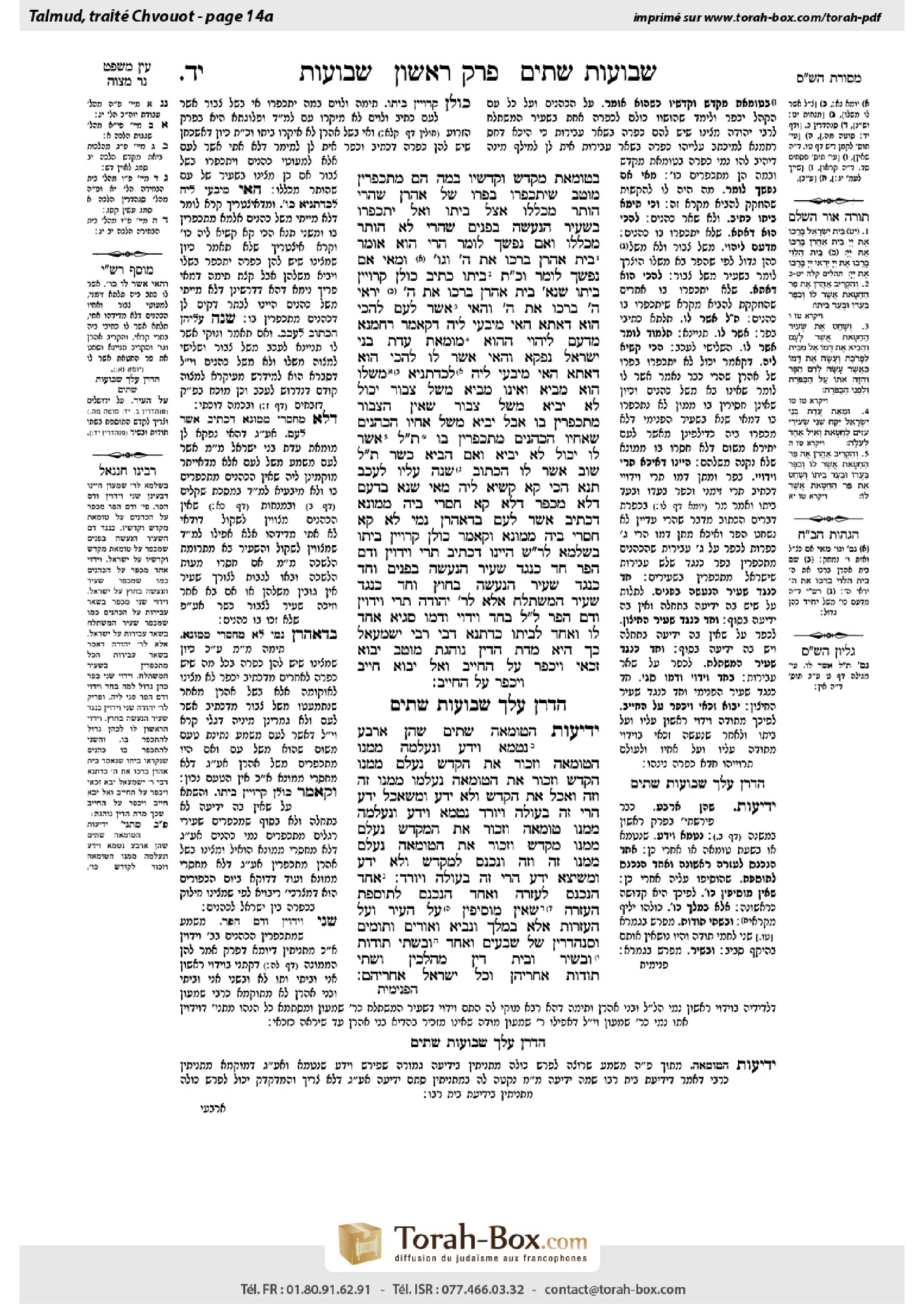
Shevuot 14a: Talmud study for Daf Yomi
Daf Yomi is the daily study of one Talmud folio. Explore 37 tractates with scans, Hebrew text, Sefaria English and AI-generated French translations where annotated.
Passage selection and English or AI-generated French translation are available where the scan has annotations. Daf Study is independent of Torah-Box and Sefaria.
Browse Shevuot · שבועות · All tractatesShevuot 14a text and translations
This page of Shevuot includes the Aramaic text, an English translation and an AI-generated French translation, alongside the scan above.
שבועות י״ד א · Aramaic and Hebrew text
בְּטוּמְאַת מִקְדָּשׁ וְקָדָשָׁיו. בַּמָּה הֵם מִתְכַּפְּרִין? מוּטָב שֶׁיִּתְכַּפְּרוּ בְּפָרוֹ שֶׁל אַהֲרֹן, שֶׁהֲרֵי הוּתַּר מִכְּלָלוֹ אֵצֶל בֵּיתוֹ; וְאַל יִתְכַּפְּרוּ בְּשָׂעִיר הַנַּעֲשֶׂה בִּפְנִים, שֶׁהֲרֵי לֹא הוּתַּר מִכְּלָלוֹ.
וְאִם נַפְשְׁךָ לוֹמַר – הֲרֵי הוּא אוֹמֵר: ״בֵּית אַהֲרֹן בָּרְכוּ אֶת ה׳ וְגוֹ׳״.
וּמַאי ״אִם נַפְשְׁךָ לוֹמַר״? וְכִי תֵּימָא ״בֵּיתוֹ״ כְּתִיב – כּוּלָּן קְרוּיִין ״בֵּיתוֹ״, שֶׁנֶּאֱמַר: ״בֵּית אַהֲרֹן בָּרְכוּ אֶת ה׳, יִרְאֵי ה׳ בָּרְכוּ אֶת ה׳״.
וְהַאי ״אֲשֶׁר לָעָם״ לְהָכִי הוּא דַּאֲתָא?! הַאי מִיבְּעֵי לֵיהּ דְּקָאָמַר רַחֲמָנָא: מִדְּעַם לֶיהֱוֵי! הָהוּא מִ״וּמֵאֵת עֲדַת בְּנֵי יִשְׂרָאֵל״ נָפְקָא.
וְהַאי ״אֲשֶׁר לוֹ״ – לְהָכִי הוּא דַּאֲתָא?! הַאי מִיבְּעֵי לֵיהּ לְכִדְתַנְיָא: מִשֶּׁלּוֹ הוּא מֵבִיא, וְאֵינוֹ מֵבִיא מִשֶּׁל צִבּוּר.
יָכוֹל לֹא יָבִיא מִשֶּׁל צִבּוּר, שֶׁאֵין הַצִּבּוּר מִתְכַּפְּרִין בּוֹ; אֲבָל יָבִיא מִשֶּׁל אֶחָיו הַכֹּהֲנִים, שֶׁאֶחָיו הַכֹּהֲנִים מִתְכַּפְּרִין בּוֹ? תַּלְמוּד לוֹמַר: ״אֲשֶׁר לוֹ״. יָכוֹל לֹא יָבִיא, וְאִם הֵבִיא כָּשֵׁר? תַּלְמוּד לוֹמַר שׁוּב ״אֲשֶׁר לוֹ״ – הַכָּתוּב שָׁנָה עָלָיו לְעַכֵּב.
תַּנָּא הָכִי קָא קַשְׁיָא לֵיהּ: מַאי שְׁנָא בִּדְעַם – דְּלָא מִכַּפְּרִי, דְּלָא קָא חָסְרִי בֵּיהּ מָמוֹנָא, דִּכְתִיב ״אֲשֶׁר לָעָם״; בִּדְאַהֲרֹן נָמֵי לָא קָא חָסְרִי בֵּיהּ מָמוֹנָא! וְקָאָמַר: כּוּלָּן קְרוּיִין ״בֵּיתוֹ״.
בִּשְׁלָמָא לְרַבִּי שִׁמְעוֹן, הַיְינוּ דִּכְתִיב תְּרֵי וִידּוּיִן וְדַם הַפָּר, חַד כְּנֶגֶד שָׂעִיר הַנַּעֲשֶׂה בִּפְנִים, וְחַד כְּנֶגֶד שָׂעִיר הַנַּעֲשֶׂה בַּחוּץ, וְחַד כְּנֶגֶד שָׂעִיר הַמִּשְׁתַּלֵּחַ;
אֶלָּא לְרַבִּי יְהוּדָה, תְּרֵי וִידּוּיִן וְדַם הַפָּר לְמָה לִי? בְּחַד וִידּוּי וְדָמוֹ סַגְיָא!
אֶחָד לוֹ, וְאֶחָד לְבֵיתוֹ. כִּדְתָנָא דְּבֵי רַבִּי יִשְׁמָעֵאל: כָּךְ הִיא מִדַּת הַדִּין נוֹהֶגֶת: מוּטָב יָבוֹא זַכַּאי וִיכַפֵּר עַל הַחַיָּיב, וְאַל יָבוֹא חַיָּיב וִיכַפֵּר עַל הַחַיָּיב.
הֲדַרַן עֲלָךְ שְׁבוּעוֹת שְׁתַּיִם
מַתְנִי׳ יְדִיעוֹת הַטּוּמְאָה שְׁתַּיִם שֶׁהֵן אַרְבַּע: נִטְמָא וְיָדַע, וְנֶעֶלְמָה מִמֶּנּוּ הַטּוּמְאָה וְזָכוּר אֶת הַקֹּדֶשׁ;
נֶעְלַם מִמֶּנּוּ הַקֹּדֶשׁ וְזָכוּר אֶת הַטּוּמְאָה; נֶעֶלְמוּ מִמֶּנּוּ זֶה וָזֶה; וְאָכַל אֶת הַקֹּדֶשׁ וְלֹא יָדַע, וּמִשֶּׁאָכַל יָדַע – הֲרֵי זֶה בְּעוֹלֶה וְיוֹרֵד.
נִטְמָא וְיָדַע, וְנֶעֶלְמָה מִמֶּנּוּ טוּמְאָה וְזָכוּר אֶת הַמִּקְדָּשׁ; נֶעְלַם מִמֶּנּוּ מִקְדָּשׁ וְזָכוּר אֶת הַטּוּמְאָה; נֶעְלַם מִמֶּנּוּ זֶה וָזֶה; וְנִכְנַס לַמִּקְדָּשׁ וְלֹא יָדַע, וּמִשֶּׁיָּצָא יָדַע – הֲרֵי זֶה בְּעוֹלֶה וְיוֹרֵד.
אֶחָד הַנִּכְנָס לָעֲזָרָה וְאֶחָד הַנִּכְנָס לְתוֹסֶפֶת הָעֲזָרָה, שֶׁאֵין מוֹסִיפִין עַל הָעִיר וְעַל הָעֲזָרוֹת אֶלָּא בְּמֶלֶךְ וְנָבִיא וְאוּרִים וְתוּמִּים וְסַנְהֶדְרִין שֶׁל שִׁבְעִים וְאֶחָד, וּבִשְׁתֵּי תּוֹדוֹת וּבְשִׁיר.
וּבֵית דִּין מְהַלְּכִין, וּשְׁתֵּי תּוֹדוֹת אַחֲרֵיהֶן, וְכׇל יִשְׂרָאֵל אַחֲרֵיהֶם.
Shevuot 14a · English translation
for their defiling of the Temple or its sacrificial foods. Through which means, then, do they achieve atonement for this? Is it through the internal goat or the bull of Aaron? It is better to say that they achieve atonement through the bull of Aaron, as in any event with regard to his household an exception was made to its rule that it atones only for Aaron. And one should not say that they achieve atonement through the goat whose blood presentation is performed inside the Sanctuary, as it is not found that with regard to Aaron’s household an exception was made to its rule.
And if it is your wish to say that this reasoning can be refuted, one can bring another proof, as it states: “House of Aaron, bless the Lord,” which is referring to all priests and not just to Aaron’s immediate household, and so it is reasonable that Aaron’s bull should atone for them.
The Gemara clarifies the last part of the baraita: And what possible refutation is the baraita referring to when it says: If it is your wish to say that this reasoning can be refuted? The Gemara explains: And if you would say of the preceding proof that it is incorrect to suggest that all priests achieve atonement from the bull of Aaron, as with regard to it the term: “His household” (Leviticus 16:6), is written, which suggests that it atones only for his immediate family, then this can be refuted, as all of the priests are collectively referred to as his household, as is evident from that which is stated: “House of Aaron, bless the Lord; house of Levi, bless the Lord, those who fear the Lord, bless the Lord.”
The Gemara questions some of the expositions of the baraita: And with regard to this phrase: “Goat of the people” (Leviticus 16:15), does it come to teach that which the baraita teaches, i.e., that the priests do not achieve atonement through it? But that phrase is necessary to teach that the Merciful One states that the goat must be purchased with funds collected from the people. The Gemara refutes this: That requirement is derived from the verse: “And from the assembly of the children of Israel he shall take two goats” (Leviticus 16:5).
The Gemara asks further: And with regard to this phrase: “His own bull sin-offering” (Leviticus 16:6), does it come to teach that which the baraita teaches, i.e., that it atones only for Aaron’s transgressions, not for the transgressions of others? But that phrase is necessary for that which is taught in a baraita: The High Priest brings, i.e., purchases, the bull from his own funds, but he does not bring it from funds collected from the public.
One might have thought that he does not bring it from funds collected from the public because the public does not achieve atonement through it, but he may bring it from funds belonging to his brethren the priests because his brethren the priests achieve atonement through it. To counter this, the verse states: “His own bull sin-offering,” to indicate that he must purchase it using only his own funds. One might have thought that he should not bring it from others’ funds, but nevertheless, if he did it would still be valid. To counter this, the verse again states “his own.” The verse repeats the phrase to render the requirement essential.
If both mentions of the phrase “his own” are necessary to teach about the ownership of the bull, how can the above baraita suggest that the phrase indicates that the bull atones only for the High Priest’s transgressions? The Gemara explains: This is what is difficult for the tanna of the baraita: What is different about the goat of the people that explains why it does not atone for the priests? The difference is that the priests did not forfeit any money over the purchase of it. Therefore, it does not atone for the priests, but only for the Israelites, as it is written with regard to the internal goat: “Of the people.” With regard to the bull of Aaron as well, the priests do not forfeit any money over the purchase of it, so it follows that they should not achieve atonement through it. And therefore, to explain why they do achieve atonement, the baraita states that all of the priests are collectively referred to as: His household.
§ The Gemara returns to its discussion of the dispute between Rabbi Yehuda and Rabbi Shimon. The Gemara asks: Granted, according to Rabbi Shimon, who holds that the priests do not achieve atonement through the scapegoat, that is why it is written in the Torah that two confessions are to be recited over the bull and that the blood of the bull is to be presented inside the Sanctuary: Of these three forms of atonement, one corresponds to the atonement provided by the goat whose blood presentation is performed inside the Sanctuary, one corresponds to the atonement provided by the goat whose blood presentation is performed outside the Sanctuary, and one corresponds to the atonement provided by the scapegoat.
But according to Rabbi Yehuda, who holds that the priests do achieve atonement through the scapegoat, why do I need the two confessions recited over the bull and the blood of the bull to be presented inside the Sanctuary? One confession over the bull and its blood being presented inside the Sanctuary would be sufficient.
The Gemara answers: Two confessions are necessary, one for the High Priest himself, and one for his household, i.e., the priests, as the school of Rabbi Yishmael taught: The High Priest must first confess his own transgressions and only afterward those of the priests, because that is how the attribute of justice functions: It is better that the innocent come and atone for the guilty, than that the guilty come and atone for the guilty. When the High Priest confesses the transgressions of those in his house, it is better that he already be considered innocent, having confessed and been absolved of his own transgressions.
MISHNA: With regard to cases of awareness of the defiling of the Temple by entering it while one is ritually impure, or defiling its sacrificial foods by partaking of them while one is ritually impure, there are two types that are actually four. How so? If one became ritually impure and he was aware that he was impure, but afterward his impurity was hidden from him, though he remembered that he was partaking of sacrificial food, which is forbidden to one who is in a state of ritual impurity; this is one of the four types of awareness of impurity.
If the fact that he was partaking of sacrificial food was hidden from him, though he remembered the ritual impurity that he had contracted; this is the second of the four types of awareness of impurity. And the same halakha applies if both this and that were hidden from him, both the fact that he was impure and the fact that he was partaking of sacrificial food. In all these cases, if he partook of the sacrificial food and was unaware either that he was impure, or that the food was sacrificial food, or both, and after he partook of it he became aware of that which he had forgotten, he is required to bring a sliding-scale offering. In this type of offering, the sinner sacrifices an animal, bird, or meal-offering, depending on his financial status.
And similarly with regard to entering the Temple: If one became ritually impure and he was aware that he was impure, but afterward his impurity was hidden from him, though he remembered that he was entering the Temple, which is prohibited for one who is in a state of ritual impurity; this is the third of the four types of awareness of impurity. If the fact that he was entering the Temple was hidden from him, though he remembered the ritual impurity that he had contracted; this is the fourth type of awareness of impurity. And the same halakha applies if both this and that were hidden from him, both the fact that he was impure and the fact that he was entering the Temple. In all these cases, if he entered the Temple and was unaware either that he was impure, or that he was entering the Temple, or both, and after he left he became aware of what was hidden from him, he is required to bring a sliding-scale offering.
As for the boundaries of the Temple with regard to the halakhot of impurity, the same halakha applies to one who enters the area that was part of the original Temple courtyard and to one who enters the later addition to the Temple courtyard, because the additional section is sanctified with the full sanctity of the Temple courtyard. The mishna notes: As, additions can be made to the city of Jerusalem or to the Temple courtyards only by a special body comprising the king, a prophet, the Urim VeTummim, and the Sanhedrin of seventy-one judges, and with two thanks-offerings and with a special song. Once the addition to the courtyard is made by this body and this process, it is given the full sanctity of the original courtyard area.
The mishna provides certain details of the consecration ceremony. And the court would move forward, and two thanks-offerings would be brought after them, and all of the Jewish people would follow behind them.
Shevuot 14a · Traduction française (IA)
pour avoir rendu impur le Temple ou ses aliments sacrificiels. Par quel moyen obtiennent-ils donc l’expiation pour cela ? Est-ce par le bouc intérieur ou par le taureau d’Aaron ? Il vaut mieux dire qu’ils obtiennent l’expiation par le taureau d’Aaron, car, de toute façon, une exception a été faite pour sa maison à la règle selon laquelle le taureau n’expie que pour Aaron. Il ne faut pas dire qu’ils obtiennent l’expiation par le bouc dont le sang est présenté à l’intérieur du Sanctuaire, car aucune exception à la règle n’a été faite pour la maison d’Aaron.
Et si l’on veut dire que ce raisonnement peut être réfuté, on peut apporter une autre preuve, car il est écrit : « Maison d’Aaron, bénissez l’Éternel », expression qui désigne tous les prêtres et non la seule famille proche d’Aaron. Il est donc raisonnable que le taureau d’Aaron expie pour eux.
La Guemara clarifie la dernière partie de la baraïta : quelle réfutation possible la baraïta vise-t-elle lorsqu’elle dit : « Si l’on veut dire que ce raisonnement peut être réfuté » ? La Guemara explique : on pourrait contester la preuve précédente en disant qu’il est inexact de suggérer que tous les prêtres obtiennent l’expiation par le taureau d’Aaron, car l’expression « sa maison » (Lévitique 16, 6) est employée à son sujet, ce qui laisse entendre que le taureau n’expie que pour sa famille proche. Mais on peut réfuter cette objection en disant que tous les prêtres sont collectivement désignés comme sa maison, comme le montre le verset : « Maison d’Aaron, bénissez l’Éternel ; maison de Lévi, bénissez l’Éternel ; vous qui craignez l’Éternel, bénissez l’Éternel. »
La Guemara met en question certaines des déductions de la baraïta : l’expression « bouc du peuple » (Lévitique 16, 15) vient-elle enseigner ce qu’enseigne la baraïta, à savoir que les prêtres n’obtiennent pas l’expiation par son intermédiaire ? Pourtant, cette expression est nécessaire pour enseigner que le Miséricordieux prescrit que le bouc doit être acheté avec des fonds recueillis auprès du peuple. La Guemara réfute cette objection : cette exigence se déduit du verset : « Il prendra de l’assemblée des enfants d’Israël deux boucs » (Lévitique 16, 5).
La Guemara demande encore : l’expression « son propre taureau expiatoire » (Lévitique 16, 6) vient-elle enseigner ce qu’enseigne la baraïta, à savoir que le taureau expie uniquement pour les transgressions d’Aaron, et non pour celles d’autrui ? Pourtant, cette expression est nécessaire à l’enseignement d’une baraïta : le Grand Prêtre apporte, c’est-à-dire achète, le taureau avec ses propres fonds et ne l’achète pas avec des fonds recueillis auprès du public.
On aurait pu penser qu’il ne l’achète pas avec des fonds recueillis auprès du public parce que le public n’obtient pas l’expiation par son intermédiaire, mais qu’il peut l’acheter avec les fonds de ses frères, les prêtres, puisque ceux-ci obtiennent l’expiation par son intermédiaire. Pour écarter cette possibilité, le verset dit : « son propre taureau expiatoire », indiquant qu’il doit l’acheter uniquement avec ses propres fonds. On aurait pu penser qu’il ne doit pas l’acheter avec les fonds d’autrui, mais que, s’il le faisait, le taureau serait néanmoins valide. Pour écarter cette possibilité, le verset répète « son propre ». Cette répétition rend cette exigence impérative.
Si les deux occurrences de l’expression « son propre » sont nécessaires pour enseigner à qui doit appartenir le taureau, comment la baraïta citée plus haut peut-elle suggérer que le taureau expie uniquement pour les transgressions du Grand Prêtre ? La Guemara explique : voici ce qui pose problème au tanna de la baraïta : qu’est-ce qui distingue le bouc du peuple et explique qu’il n’expie pas pour les prêtres ? Les prêtres n’ont pas contribué financièrement à son achat. C’est pourquoi il n’expie pas pour les prêtres, mais seulement pour les Israélites, comme le montre l’expression employée au sujet du bouc intérieur : « du peuple ». Pour le taureau d’Aaron aussi, les prêtres n’ont pas contribué financièrement à l’achat ; il s’ensuit donc qu’ils ne devraient pas obtenir l’expiation par son intermédiaire. Aussi, pour expliquer pourquoi ils l’obtiennent bel et bien, la baraïta dit que tous les prêtres sont collectivement désignés comme « sa maison ».
§ La Guemara revient à son examen de la controverse entre Rabbi Yehouda et Rabbi Shimon. Elle demande : cela se comprend selon Rabbi Shimon, qui soutient que les prêtres n’obtiennent pas l’expiation par le bouc émissaire ; voilà pourquoi la Torah prescrit deux confessions sur le taureau et la présentation du sang du taureau à l’intérieur du Sanctuaire. Parmi ces trois formes d’expiation, l’une correspond à celle procurée par le bouc dont le sang est présenté à l’intérieur du Sanctuaire, l’une à celle procurée par le bouc dont le sang est présenté à l’extérieur du Sanctuaire, et l’une à celle procurée par le bouc émissaire.
Mais selon Rabbi Yehouda, qui soutient que les prêtres obtiennent l’expiation par le bouc émissaire, pourquoi faut-il deux confessions sur le taureau et que le sang du taureau soit présenté à l’intérieur du Sanctuaire ? Une seule confession sur le taureau et la présentation de son sang à l’intérieur du Sanctuaire suffiraient.
La Guemara répond : deux confessions sont nécessaires, l’une pour le Grand Prêtre lui-même et l’autre pour sa maison, c’est-à-dire les prêtres. En effet, l’école de Rabbi Yishmaël a enseigné : le Grand Prêtre doit d’abord confesser ses propres transgressions, et seulement ensuite celles des prêtres, car tel est le fonctionnement de l’attribut de justice : mieux vaut que l’innocent vienne expier pour les coupables plutôt que les coupables viennent expier pour les coupables. Lorsque le Grand Prêtre confesse les transgressions des membres de sa maison, il vaut mieux qu’il soit déjà considéré comme innocent, après avoir confessé ses propres transgressions et en avoir été absous.
MICHNA : Concernant les cas où l’on prend conscience d’avoir rendu impur le Temple en y entrant alors qu’on était en état d’impureté rituelle, ou d’avoir rendu impurs ses aliments sacrificiels en les consommant alors qu’on était en état d’impureté rituelle, il existe deux catégories qui en font en réalité quatre. Comment cela ? Si quelqu’un est devenu impur rituellement et savait qu’il était impur, mais qu’ensuite il a oublié son impureté tout en se souvenant qu’il consommait un aliment sacrificiel, ce qui est interdit à celui qui se trouve en état d’impureté rituelle, cela constitue l’une des quatre catégories de prise de conscience de l’impureté.
Si le fait qu’il consommait un aliment sacrificiel lui a échappé, tout en se souvenant de l’impureté rituelle qu’il avait contractée, cela constitue la deuxième des quatre catégories de prise de conscience de l’impureté. La même halakha s’applique si ces deux faits lui ont échappé : qu’il était impur et qu’il consommait un aliment sacrificiel. Dans tous ces cas, s’il a consommé l’aliment sacrificiel sans savoir qu’il était impur, ou que l’aliment était sacrificiel, ou sans savoir ni l’un ni l’autre, puis qu’après l’avoir consommé il prend conscience de ce qu’il avait oublié, il doit apporter une offrande à valeur variable. Dans ce type d’offrande, le pécheur offre un animal, un oiseau ou une offrande de farine, selon sa situation financière.
De même, en ce qui concerne l’entrée dans le Temple : si quelqu’un est devenu impur rituellement et savait qu’il était impur, mais qu’ensuite il a oublié son impureté tout en se souvenant qu’il entrait dans le Temple, ce qui est interdit à celui qui se trouve en état d’impureté rituelle, cela constitue la troisième des quatre catégories de prise de conscience de l’impureté. Si le fait qu’il entrait dans le Temple lui a échappé, tout en se souvenant de l’impureté rituelle qu’il avait contractée, cela constitue la quatrième catégorie de prise de conscience de l’impureté. La même halakha s’applique si ces deux faits lui ont échappé : qu’il était impur et qu’il entrait dans le Temple. Dans tous ces cas, s’il est entré dans le Temple sans savoir qu’il était impur, ou qu’il entrait dans le Temple, ou sans savoir ni l’un ni l’autre, puis qu’après en être sorti il prend conscience de ce qui lui avait échappé, il doit apporter une offrande à valeur variable.
Quant aux limites du Temple en matière de halakhot d’impureté, la même halakha s’applique à celui qui entre dans la partie qui faisait partie de la cour originelle du Temple et à celui qui entre dans l’agrandissement ultérieur de cette cour, car la partie ajoutée est investie de toute la sainteté de la cour du Temple. La Michna précise : on ne peut agrandir la ville de Jérusalem ni les cours du Temple qu’avec l’autorisation d’un collège spécial composé du roi, d’un prophète, de l’Ourim veToummim et du Sanhédrin de soixante et onze juges, et au moyen de deux offrandes de reconnaissance et d’un chant particulier. Une fois l’agrandissement de la cour effectué par ce collège selon cette procédure, la partie ajoutée reçoit toute la sainteté de la cour originelle.
La Michna donne certains détails de la cérémonie de consécration. Le tribunal avançait, deux offrandes de reconnaissance étaient apportées à sa suite, et tout le peuple juif suivait derrière elles.
Traduction française générée par IA à partir de l’édition anglaise de Sefaria. Vérifie toujours un passage avec le texte source.
Text from Sefaria: William Davidson Edition - Vocalized Aramaic (CC BY NC); William Davidson Edition - English (CC BY NC).