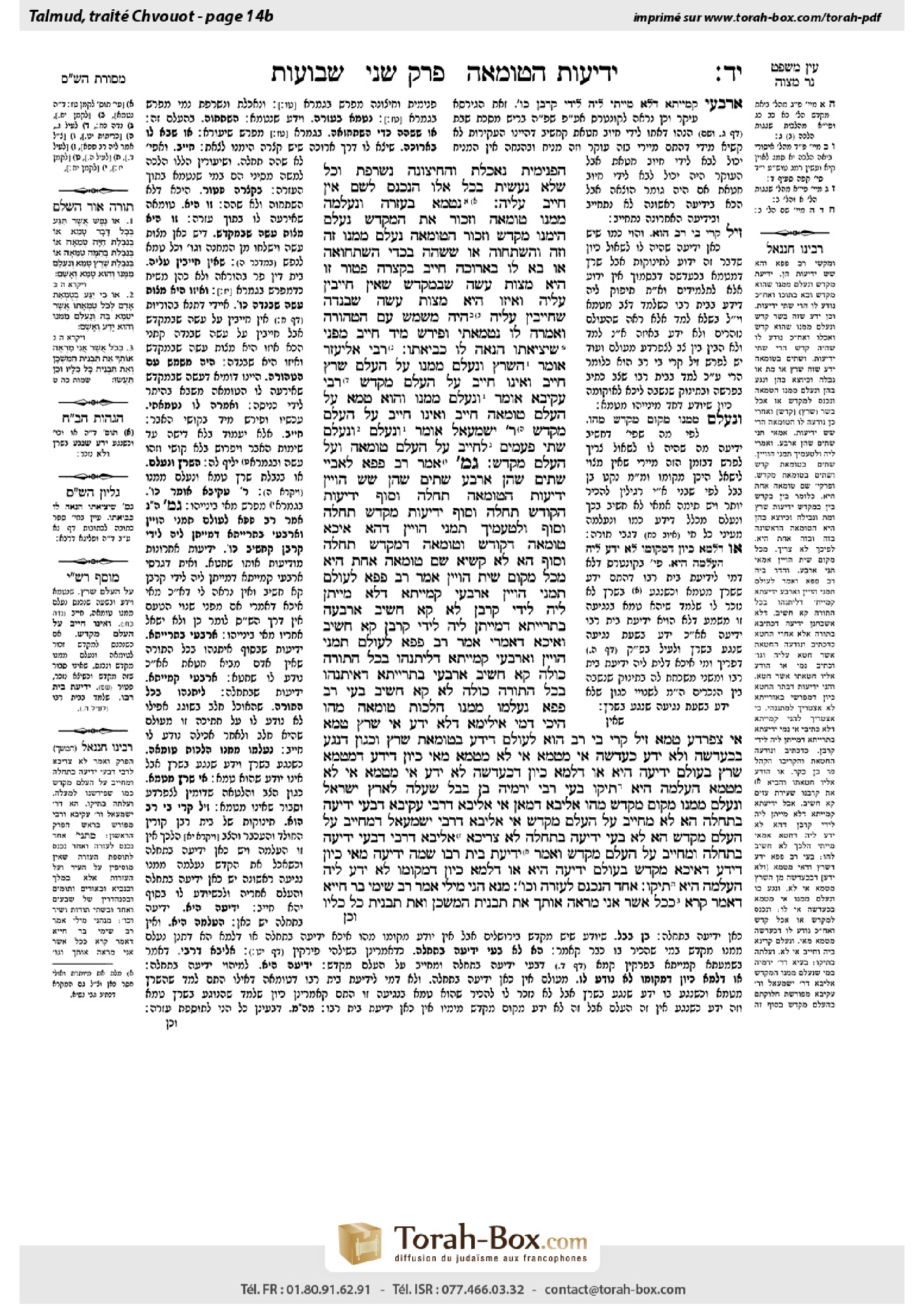
Shevuot 14b: Talmud study for Daf Yomi
Daf Yomi is the daily study of one Talmud folio. Explore 37 tractates with scans, Hebrew text, Sefaria English and AI-generated French translations where annotated.
Passage selection and English or AI-generated French translation are available where the scan has annotations. Daf Study is independent of Torah-Box and Sefaria.
Browse Shevuot · שבועות · All tractatesShevuot 14b text and translations
This page of Shevuot includes the Aramaic text, an English translation and an AI-generated French translation, alongside the scan above.
שבועות י״ד ב · Aramaic and Hebrew text
הַפְּנִימִית נֶאֱכֶלֶת, וְהַחִיצוֹנָה נִשְׂרֶפֶת. וְכׇל שֶׁלֹּא נַעֲשֵׂית בְּכׇל אֵלּוּ – הַנִּכְנָס לְשָׁם אֵין חַיָּיב עָלֶיהָ.
נִטְמָא בָּעֲזָרָה, וְנֶעֶלְמָה מִמֶּנּוּ טוּמְאָה וְזָכוּר אֶת הַמִּקְדָּשׁ; נֶעְלַם הֵימֶנּוּ מִקְדָּשׁ וְזָכוּר הַטּוּמְאָה; נֶעְלַם מִמֶּנּוּ זֶה וָזֶה; וְהִשְׁתַּחֲוָה אוֹ שֶׁשָּׁהָה בִּכְדֵי הִשְׁתַּחֲוָאָה אוֹ בָּא לוֹ בָּאֲרֻוכָּה – חַיָּיב. בַּקְּצָרָה – פָּטוּר.
זוֹ הִיא מִצְוַת עֲשֵׂה שֶׁבַּמִּקְדָּשׁ שֶׁאֵין חַיָּיבִין עָלֶיהָ.
וְאֵיזוֹ הִיא מִצְוַת עֲשֵׂה שֶׁבַּנִּדָּה שֶׁחַיָּיבִין עָלֶיהָ? הָיָה מְשַׁמֵּשׁ עִם הַטְּהוֹרָה וְאָמְרָה לוֹ ״נִטְמֵאתִי״, וּפֵירַשׁ מִיָּד – חַיָּיב, מִפְּנֵי שֶׁיְּצִיאָתוֹ הֲנָאָה לוֹ כְּבִיאָתוֹ.
רַבִּי אֱלִיעֶזֶר אוֹמֵר: ״הַשֶּׁרֶץ״ – ״וְנֶעְלַם מִמֶּנּוּ״, עַל הֶעְלֵם שֶׁרֶץ חַיָּיב, וְאֵינוֹ חַיָּיב עַל הֶעְלֵם מִקְדָּשׁ.
רַבִּי עֲקִיבָא אוֹמֵר: ״וְנֶעְלַם מִמֶּנּוּ וְהוּא טָמֵא״ – עַל הֶעְלֵם טוּמְאָה חַיָּיב, וְאֵינוֹ חַיָּיב עַל הֶעְלֵם מִקְדָּשׁ.
רַבִּי יִשְׁמָעֵאל אוֹמֵר: ״וְנֶעְלַם״ ״וְנֶעְלַם״ שְׁתֵּי פְּעָמִים, לְחַיֵּיב עַל הֶעְלֵם טוּמְאָה וְעַל הֶעְלֵם מִקְדָּשׁ.
גְּמָ׳ אָמַר רַב פָּפָּא לְאַבָּיֵי: שְׁתַּיִם שֶׁהֵן אַרְבַּע?! שְׁתַּיִם שֶׁהֵן שֵׁשׁ הָוְיָין – יְדִיעוֹת הַטּוּמְאָה תְּחִלָּה וָסוֹף, יְדִיעוֹת הַקּוֹדֶשׁ תְּחִלָּה וָסוֹף, יְדִיעוֹת מִקְדָּשׁ תְּחִלָּה וָסוֹף!
וּלְטַעְמָיךְ, תַּמְנֵי הָוְיָין – דְּהָא אִיכָּא טוּמְאָה דְּקוֹדֶשׁ וְטוּמְאָה דְּמִקְדָּשׁ תְּחִלָּה וָסוֹף!
הָא לָא קַשְׁיָא, שֵׁם טוּמְאָה אַחַת הִיא. מִכׇּל מָקוֹם שֵׁית הָוְיָין!
אָמַר רַב פָּפָּא: לְעוֹלָם תַּמְנֵי הָוְיָין, אַרְבְּעֵי קַמָּיָיתָא, דְּלָא מַיְיתַן לֵיהּ לִידֵי קׇרְבָּן – לָא קָא חָשֵׁיב; אַרְבְּעֵה בָּתְרָיָיתָא, דְּמַיְיתַן לֵיהּ לִידֵי קׇרְבָּן – קָא חָשֵׁיב.
וְאִיכָּא דְּאָמְרִי, אָמַר רַב פָּפָּא: לְעוֹלָם תַּמְנֵי הָוְיָין; וְאַרְבְּעֵי קַמָּיָיתָא, דְּלֵיתַנְהוּ בְּכׇל הַתּוֹרָה כּוּלָּהּ – קָא חָשֵׁיב; אַרְבְּעֵי בָּתְרָיָיתָא, דְּאִיתַנְהוּ בְּכׇל הַתּוֹרָה כּוּלָּהּ – לָא קָא חָשֵׁיב.
בָּעֵי רַב פָּפָּא: נֶעֶלְמוּ מִמֶּנּוּ הִלְכוֹת טוּמְאָה, מַהוּ? הֵיכִי דָמֵי? אִילֵּימָא דְּלָא יָדַע אִי שֶׁרֶץ טָמֵא אִי צְפַרְדֵּעַ טָמֵא – זִיל קְרִי בֵּי רַב הוּא!
לְעוֹלָם דְּיָדַע בְּטוּמְאַת שֶׁרֶץ; וּכְגוֹן דִּנְגַע בְּכַעֲדָשָׁה, וְלָא יָדַע כַּעֲדָשָׁה אִי מְטַמֵּא אִי לָא מְטַמֵּא. מַאי? כֵּיוָן דְּיָדַע דִּמְטַמֵּא שֶׁרֶץ בָּעוֹלָם – יְדִיעָה הִיא; אוֹ דִלְמָא, כֵּיוָן דְּכַעֲדָשָׁה לָא יָדַע אִי מְטַמֵּא אִי לָא מְטַמֵּא – הַעֲלָמָה הִיא? תֵּיקוּ.
בָּעֵי רַבִּי יִרְמְיָה: בֶּן בָּבֶל שֶׁעָלָה לְאֶרֶץ יִשְׂרָאֵל, וְנֶעְלַם מִמֶּנּוּ מְקוֹם מִקְדָּשׁ – מַהוּ?
אַלִּיבָּא דְּמַאן? אִי אַלִּיבָּא דְרַבִּי עֲקִיבָא דְּבָעֵי יְדִיעָה בַּתְּחִלָּה – הָא לָא מְחַיֵּיב עַל הֶעְלֵם מִקְדָּשׁ! אִי אַלִּיבָּא דְּרַבִּי יִשְׁמָעֵאל דִּמְחַיֵּיב עַל הֶעְלֵם מִקְדָּשׁ – הָא לָא בָּעֵי יְדִיעָה בַּתְּחִלָּה!
לָא צְרִיכָא; אַלִּיבָּא דְּרַבִּי – דְּבָעֵי יְדִיעָה בַּתְּחִלָּה, וּמְחַיֵּיב עַל הֶעְלֵם מִקְדָּשׁ, וְאָמַר יְדִיעַת בֵּית רַבּוֹ שְׁמָהּ יְדִיעָה. מַאי? כֵּיוָן דְּיָדַע דְּאִיכָּא מִקְדָּשׁ בָּעוֹלָם – יְדִיעָה הִיא; אוֹ דִלְמָא, כֵּיוָן דִּמְקוֹמוֹ לָא יְדַע לֵיהּ – הַעֲלָמָה הִיא? תֵּיקוּ.
אֶחָד הַנִּכְנָס לָעֲזָרָה וְכוּ׳. מְנָא הָנֵי מִילֵּי? אָמַר רַב שִׁימִי בַּר חִיָּיא, דְּאָמַר קְרָא: ״כְּכׇל אֲשֶׁר אֲנִי מַרְאֶה אוֹתְךָ, אֵת תַּבְנִית הַמִּשְׁכָּן וְאֵת תַּבְנִית כׇּל כֵּלָיו
Shevuot 14b · English translation
When they would reach the end of the place that they desired to consecrate, the inner thanks-offering would be eaten and the outer one would be burned. The details of this ceremony will be described in the Gemara. And with regard to any addition to the Temple that was not made with all these ceremonial procedures, one who enters there while ritually impure is not liable to bring an offering if his entry was unwitting, nor to be punished with karet, excision from the World-to-Come, if his entry was intentional.
The first part of the mishna discussed one who became ritually impure before entering the Temple. The mishna proceeds to consider a case involving one who was ritually pure when he entered the Temple but who became impure while in the Temple courtyard, and afterward, his impurity was hidden from him but he remembered that he was standing in the Temple, or the fact that he was standing in the Temple was hidden from him but he remembered his impurity, or both this fact and that fact were hidden from him. In all these cases, if he bowed down, or he tarried in the Temple courtyard long enough to bow down even though he did not actually bow, or he went out by way of a longer route when he could have taken a shorter route, he is liable to bring a sliding-scale offering. But if he left the Temple via the shortest way, he is exempt.
This mitzva that the ritually impure must be sent out of the Temple is the positive mitzva concerning the Temple for which, as is taught elsewhere in the Mishna (Horayot 8b), the Sanhedrin is not liable to bring an offering for an erroneous ruling. A communal bull sin-offering is brought because of the unwitting transgression of a prohibition involving an action by the Jewish people resulting from an erroneous halakhic decision handed down by the Sanhedrin. But if the Sanhedrin mistakenly ruled that one who became impure while in the Temple may leave by way of a longer route, they do not bring this offering, as it is brought only for an erroneous ruling on a matter that requires the bringing of a fixed sin-offering, and not a sliding-scale offering, for its unwitting violation.
And which is the positive mitzva with regard to a menstruating woman for which, as is taught in Horayot there, the Sanhedrin is liable to bring a bull offering for an erroneous ruling? If a man was engaging in intercourse with a ritually pure woman, and during the course of their act of intercourse she experienced menstrual bleeding and said to him: I have become impure, and unwittingly he immediately withdrew from her and did not wait until his penis became flaccid, he is liable to bring a sin-offering for engaging in intercourse with a menstruating woman, because his withdrawal from her is as pleasant to him as his entry. If the Sanhedrin mistakenly ruled that one may withdraw immediately, they bring a bull offering for their erroneous ruling.
Rabbi Eliezer says: With regard to the sliding-scale offering the verse states: “Or if a person touches any impure thing, whether it is the carcass of a non-kosher undomesticated animal, or the carcass of a non-kosher domesticated animal, or the carcass of a non-kosher creeping animal, and it is hidden from him” (Leviticus 5:2). A precise reading of this verse indicates that in a case where one has a lapse of awareness that he had contracted ritual impurity by touching a creeping animal, he is liable to bring a sliding-scale offering for having defiled the Temple or the sacrificial food, but he is not liable to bring such an offering in a case where he has a lapse of awareness that he is entering the Temple or partaking of sacrificial food.
Similarly, Rabbi Akiva says: The verse states: “And it is hidden from him, so that he is impure” (Leviticus 5:2), thereby teaching that in a case when one has a lapse of awareness that he had contracted ritual impurity, he is liable to bring a sliding-scale offering, but one is not liable to bring such an offering in a case when he has a lapse of awareness that he is entering the Temple or partaking of sacrificial food.
Rabbi Yishmael says: The verse states: “And it is hidden from him” (Leviticus 5:2), and it states: “And it is hidden from him” (Leviticus 5:3), twice, in order to render one liable to bring a sliding-scale offering both in a case where one has a lapse of awareness that he had contracted ritual impurity and in a case where one has a lapse of awareness that he is entering the Temple.
GEMARA: The mishna teaches that the halakhot concerning awareness of ritual impurity are two that are further subdivided into four. Rav Pappa said to Abaye: Are these actually two states of awareness that are subdivided into four? As the mishna lists them, they seem to be two that are subdivided into six: Awareness of the impurity at the beginning and at the end, awareness of the sacrificial food at the beginning and at the end, and awareness of the Temple at the beginning and at the end.
Abaye answered him: According to your reasoning, that you count all the various cases listed in the mishna, there are eight states of awareness, as there is also awareness of the impurity in connection with eating the sacrificial food, at the beginning and at the end, and awareness of the impurity in connection with entering the Temple, at the beginning and at the end. The mishna mentions awareness of the impurity both in the first clause, which discusses partaking of sacrificial food, and in the second clause, which discusses entering the Temple.
Rav Pappa refutes this: This is not difficult, as the status of ritual impurity carries one name in both cases: The person was aware that he had contracted ritual impurity and then it became hidden from him, and there is no reason to distinguish between impurity in connection with partaking of sacrificial food and impurity in connection with entering the Temple. Accordingly, Rav Pappa’s first question remains: In any case there are six states of awareness.
Rav Pappa said in answer to his own question: Actually, there are eight states of awareness, two of the impurity in connection with partaking of sacrificial food, two of the impurity in connection with entering the Temple, two of awareness of the sacrificial food, and two of awareness of the Temple, each pair having one awareness at the beginning and one at the end. But the first four states of awareness at the beginning do not in themselves bring the unwitting transgressor to liability to bring an offering, as if he does not reach awareness at the end, he will not have known that he transgressed. Therefore, the tanna does not count them. But the tanna does count the last four states of awareness, which bring the unwitting transgressor to the liability to bring an offering.
And there are those who say that Rav Pappa said as follows: Actually, there are eight states of awareness, and it is the first four states of awareness at the beginning, which are not found in the entire Torah, that the tanna counts. In all the other instances where one is liable to bring an offering for an unwitting transgression, it is not necessary that there be any awareness at the beginning. Since this is a novel requirement, the tanna counts these states of awareness. But the tanna does not count the last four states of awareness at the end, which are found also in the entire Torah, as a standard sin-offering is brought when one is made aware after the fact that he had transgressed.
The amora’im try to define the awareness of the impurity mentioned in the mishna. Rav Pappa raises a dilemma: If the halakhot of impurity became hidden from him, what is the halakha? Is he liable to bring a sliding-scale offering in such a situation? The Gemara asks: What are the circumstances of the case under discussion? If we say that he did not know whether a creeping animal is impure or pure or whether a frog is impure or pure, this is a topic that you could go learn in a children’s school. As these matters are explicitly recorded in the Torah, they can never be considered hidden.
Actually, Rav Pappa must have been asking about a case where he knew the essential halakha with regard to the ritual impurity of a creeping animal, and it is a case where he touched a portion of the animal that was of a lentil-bulk and he did not know the halakha concerning whether a portion that was of a lentil-bulk renders a person impure or does not render him impure. What is the halakha in such a case? The Gemara explains the two possibilities: Does one say that since he knows generally that a creeping animal renders a person impure, it is awareness? Or perhaps one says that since he does not know whether a portion that was of a lentil-bulk renders a person impure or does not render a person impure, it is considered hidden from him. The Gemara comments: The dilemma shall stand unresolved.
Rabbi Yirmeya raises a dilemma concerning the awareness of the Temple: If a Babylonian or a resident of another country ascended to Eretz Yisrael, and the site of the Temple was hidden from him, so that he unwittingly entered into the Temple in a state of ritual impurity, what is the halakha? Is he liable to bring a sliding-scale offering to atone for his offense, or not?
The Gemara clarifies: In accordance with whose opinion was this dilemma raised? If it was raised in accordance with the opinion of Rabbi Akiva, who requires that there be awareness at the beginning in order for one to become liable to bring an offering, that is difficult, as Rabbi Akiva does not deem one liable when he had a lapse of awareness that he was entering the Temple. And if the dilemma was raised in accordance with the opinion of Rabbi Yishmael, who deems one liable when he had a lapse of awareness that he was entering the Temple, that is difficult, as Rabbi Yishmael does not require that there be awareness at the beginning. According to both tanna’im, the dilemma is not relevant.
The Gemara explains: No, it is necessary to raise the dilemma only in accordance with the opinion of Rabbi Yehuda HaNasi, who requires awareness at the beginning and also deems one liable when he had a lapse of awareness that he was entering the Temple, and he also says that awareness that one gains in the house of his teacher is called awareness (see 5a). What is the halakha in such a case? The Gemara explains the two possibilities: Does one say that since he knows that there is a Temple someplace in the world, it is awareness? Or perhaps one says that since he does not know the precise location of the Temple, it is considered hidden from him. The Gemara comments: This dilemma shall stand unresolved.
§ The mishna teaches: The same halakha applies to one who enters the area that was part of the original Temple courtyard and to one who enters the later addition to the Temple courtyard, as additions can be made to the city of Jerusalem or to the Temple courtyards only by a special body comprising the king, a prophet, the Urim VeTummim, and the Sanhedrin of seventy-one judges, and with two thanks-offerings and with a special song. The Gemara asks: From where is this matter derived? Rav Shimi bar Ḥiyya said: As the verse states: “According to all that I show you, the form of the Tabernacle, and the form of all its vessels,
Shevuot 14b · Traduction française (IA)
Lorsqu’ils atteignaient la limite de l’endroit qu’ils souhaitaient consacrer, on mangeait l’offrande de remerciement intérieure et l’on brûlait l’offrande de remerciement extérieure. La Guemara décrira les détails de cette cérémonie. Quant à tout agrandissement du Temple qui n’a pas été réalisé selon l’ensemble de ces rites, celui qui y pénètre en état d’impureté rituelle n’est pas tenu d’apporter un sacrifice si son entrée était involontaire, et n’est pas passible de karet, l’excision du monde à venir, si son entrée était intentionnelle.
La première partie de la Michna traitait de celui qui était devenu rituellement impur avant d’entrer dans le Temple. La Michna examine ensuite le cas de celui qui était rituellement pur en entrant dans le Temple, mais qui est devenu impur dans la cour du Temple, puis a oublié son impureté tout en se rappelant qu’il se trouvait dans le Temple, ou a oublié qu’il se trouvait dans le Temple tout en se rappelant son impureté, ou a oublié les deux. Dans tous ces cas, s’il s’est prosterné, s’il est resté dans la cour du Temple assez longtemps pour se prosterner, même s’il ne l’a pas effectivement fait, ou s’il est sorti par un chemin plus long alors qu’il aurait pu en prendre un plus court, il est tenu d’apporter un sacrifice à valeur variable. Mais s’il a quitté le Temple par le chemin le plus court, il est quitte.
Cette mitsva consistant à faire sortir du Temple celui qui est rituellement impur est la mitsva positive relative au Temple pour laquelle, comme on l’enseigne ailleurs dans la Michna (Horayot 8b), le Sanhédrin n’est pas tenu d’apporter un sacrifice à la suite d’une décision erronée. Un taureau communautaire comme sacrifice expiatoire est apporté lorsque le peuple juif transgresse involontairement une interdiction impliquant un acte, à la suite d’une décision halakhique erronée rendue par le Sanhédrin. Mais si le Sanhédrin a enseigné par erreur que celui qui est devenu impur dans le Temple peut en sortir par un chemin plus long, ses membres n’apportent pas ce sacrifice, car celui-ci n’est apporté que pour une décision erronée portant sur une question dont la transgression involontaire impose un sacrifice expiatoire fixe, et non un sacrifice à valeur variable.
Et quelle est la mitsva positive relative à une femme menstruée pour laquelle, comme on l’enseigne là-bas dans Horayot, le Sanhédrin est tenu d’apporter un sacrifice de taureau à la suite d’une décision erronée ? Si un homme avait des rapports avec une femme rituellement pure et qu’au cours de leur rapport elle eut un saignement menstruel et lui dit : « Je suis devenue impure », et qu’il se retira aussitôt d’elle involontairement, sans attendre que son pénis devienne flasque, il est tenu d’apporter un sacrifice expiatoire pour avoir eu des rapports avec une femme menstruée, car son retrait lui est aussi agréable que sa pénétration. Si le Sanhédrin a enseigné par erreur qu’il est permis de se retirer immédiatement, ses membres apportent un sacrifice de taureau à la suite de leur décision erronée.
Rabbi Eliezer dit : Au sujet du sacrifice à valeur variable, le verset énonce : « Ou si une personne touche quelque chose d’impur, que ce soit la carcasse d’un animal sauvage non cachère, la carcasse d’un animal domestique non cachère ou la carcasse d’un animal rampant non cachère, et que cela lui soit caché » (Lévitique 5:2). Une lecture précise de ce verset indique que celui qui a oublié avoir contracté l’impureté rituelle en touchant un animal rampant est tenu d’apporter un sacrifice à valeur variable pour avoir rendu impur le Temple ou un aliment consacré, mais qu’il n’est pas tenu d’apporter un tel sacrifice s’il a oublié qu’il entrait dans le Temple ou qu’il consommait un aliment consacré.
De même, Rabbi Akiva dit : Le verset énonce : « Et cela lui est caché, de sorte qu’il est impur » (Lévitique 5:2), ce qui enseigne que celui qui a oublié avoir contracté l’impureté rituelle est tenu d’apporter un sacrifice à valeur variable, mais qu’il n’est pas tenu d’apporter un tel sacrifice s’il a oublié qu’il entrait dans le Temple ou qu’il consommait un aliment consacré.
Rabbi Yishmael dit : Le verset énonce « et cela lui est caché » (Lévitique 5:2), puis répète « et cela lui est caché » (Lévitique 5:3), afin de rendre passible d’un sacrifice à valeur variable aussi bien celui qui a oublié avoir contracté l’impureté rituelle que celui qui a oublié qu’il entrait dans le Temple.
GUEMARA : La Michna enseigne que les cas relatifs à la prise de conscience de l’impureté rituelle sont au nombre de deux, subdivisés en quatre. Rav Pappa dit à Abaye : S’agit-il vraiment de deux états de conscience subdivisés en quatre ? D’après la liste de la Michna, il semble qu’il s’agisse de deux états subdivisés en six : la prise de conscience de l’impureté au début et à la fin, celle de l’aliment consacré au début et à la fin, et celle du Temple au début et à la fin.
Abaye lui répondit : Selon ton raisonnement, si tu comptes tous les cas énumérés dans la Michna, il y a huit états de conscience, puisqu’il y a aussi la prise de conscience de l’impureté liée à la consommation de l’aliment consacré, au début et à la fin, ainsi que la prise de conscience de l’impureté liée à l’entrée dans le Temple, au début et à la fin. La Michna mentionne la prise de conscience de l’impureté aussi bien dans la première clause, qui traite de la consommation d’un aliment consacré, que dans la seconde, qui traite de l’entrée dans le Temple.
Rav Pappa réfute cette réponse : La difficulté n’en est pas une, car l’impureté rituelle porte le même nom dans les deux cas : la personne savait qu’elle avait contracté l’impureté rituelle, puis l’a oubliée, et il n’y a aucune raison de distinguer l’impureté liée à la consommation d’un aliment consacré de celle liée à l’entrée dans le Temple. La première question de Rav Pappa demeure donc : il y a, dans tous les cas, six états de conscience.
Rav Pappa répondit lui-même à sa question : En réalité, il y a huit états de conscience : deux concernant l’impureté liée à la consommation d’un aliment consacré, deux concernant l’impureté liée à l’entrée dans le Temple, deux concernant la prise de conscience de l’aliment consacré et deux concernant celle du Temple ; dans chaque paire, l’une a lieu au début et l’autre à la fin. Mais les quatre premiers états de conscience, ceux du début, ne rendent pas à eux seuls le transgresseur involontaire passible d’apporter un sacrifice, car s’il ne prend pas conscience de sa faute à la fin, il ne saura pas qu’il a transgressé. Le tanna ne les compte donc pas. En revanche, le tanna compte les quatre derniers états de conscience, qui rendent le transgresseur involontaire passible d’apporter un sacrifice.
Certains disent que Rav Pappa s’exprima ainsi : En réalité, il y a huit états de conscience, et le tanna compte les quatre premiers, ceux du début, qui ne se trouvent nulle part ailleurs dans toute la Torah. Dans tous les autres cas où l’on est tenu d’apporter un sacrifice pour une transgression involontaire, il n’est pas nécessaire qu’il y ait une prise de conscience au début. Comme il s’agit d’une exigence nouvelle, le tanna compte ces états de conscience. Mais le tanna ne compte pas les quatre derniers, ceux de la fin, qui se trouvent également dans toute la Torah, puisqu’un sacrifice expiatoire ordinaire est apporté lorsque l’on apprend après coup qu’on a transgressé.
Les amoraïm tentent de définir la prise de conscience de l’impureté mentionnée dans la Michna. Rav Pappa soulève une question : quelle est la halakha si les lois de l’impureté lui ont été cachées ? Est-il tenu, dans une telle situation, d’apporter un sacrifice à valeur variable ? La Guemara demande : Quelles sont les circonstances du cas envisagé ? Si l’on veut dire qu’il ne savait pas si un animal rampant est impur ou pur, ou si une grenouille est impure ou pure, c’est un sujet qu’il peut aller apprendre à l’école des enfants. Puisque ces règles sont explicitement consignées dans la Torah, elles ne peuvent jamais être considérées comme lui ayant été cachées.
En réalité, Rav Pappa devait interroger sur le cas d’un homme qui connaissait la règle fondamentale concernant l’impureté rituelle d’un animal rampant, mais qui avait touché une partie de l’animal de la taille d’une lentille et ignorait si une partie de cette taille rend une personne impure ou non. Quelle est la halakha dans ce cas ? La Guemara expose les deux possibilités : dira-t-on que, puisqu’il sait de manière générale qu’un animal rampant rend une personne impure, il s’agit d’une prise de conscience ? Ou peut-être dira-t-on que, puisqu’il ignore si une partie de la taille d’une lentille rend une personne impure, cela lui est considéré comme caché ? La Guemara conclut : la question reste sans réponse.
Rabbi Yirmeya soulève une question au sujet de la prise de conscience du Temple : si un Babylonien ou un habitant d’un autre pays montait en Eretz Israël et que l’emplacement du Temple lui était inconnu, si bien qu’il pénétra involontairement dans le Temple en état d’impureté rituelle, quelle est la halakha ? Est-il tenu d’apporter un sacrifice à valeur variable pour expier sa faute, ou non ?
La Guemara précise : Selon l’opinion de qui cette question a-t-elle été soulevée ? Si elle l’a été selon l’opinion de Rabbi Akiva, qui exige une prise de conscience au début pour rendre quelqu’un passible d’apporter un sacrifice, cela pose difficulté, car Rabbi Akiva ne rend pas passible celui qui a oublié qu’il entrait dans le Temple. Et si la question a été soulevée selon l’opinion de Rabbi Yishmael, qui rend passible celui qui a oublié qu’il entrait dans le Temple, cela pose difficulté, car Rabbi Yishmael n’exige pas de prise de conscience au début. Selon ces deux tannaïm, la question n’a donc pas lieu d’être.
La Guemara explique : Non, il était nécessaire de soulever cette question selon l’opinion de Rabbi Yehuda HaNasi, qui exige une prise de conscience au début et rend également passible celui qui a oublié qu’il entrait dans le Temple ; il affirme aussi qu’une prise de conscience acquise dans la maison de son maître est appelée prise de conscience (voir 5a). Quelle est la halakha dans ce cas ? La Guemara expose les deux possibilités : dira-t-on que, puisqu’il sait qu’il existe un Temple quelque part dans le monde, il s’agit d’une prise de conscience ? Ou peut-être dira-t-on que, puisqu’il ne connaît pas l’emplacement exact du Temple, cela lui est considéré comme caché ? La Guemara conclut : cette question reste sans réponse.
§ La Michna enseigne : La même halakha s’applique à celui qui entre dans la zone qui faisait partie de la cour originelle du Temple et à celui qui entre dans l’agrandissement ultérieur de la cour du Temple, car on ne peut agrandir la ville de Jérusalem ni les cours du Temple que par l’intervention d’un corps spécial composé du roi, d’un prophète, de l’Ourim et du Toumim et du Sanhédrin de soixante et onze juges, avec deux offrandes de remerciement et un chant particulier. La Guemara demande : D’où tire-t-on cette règle ? Rav Shimi bar Ḥiyya dit : Le verset énonce : « Selon tout ce que je te montre, le modèle du Tabernacle et le modèle de tous ses ustensiles,
Traduction française générée par IA à partir de l’édition anglaise de Sefaria. Vérifie toujours un passage avec le texte source.
Text from Sefaria: William Davidson Edition - Vocalized Aramaic (CC BY NC); William Davidson Edition - English (CC BY NC).