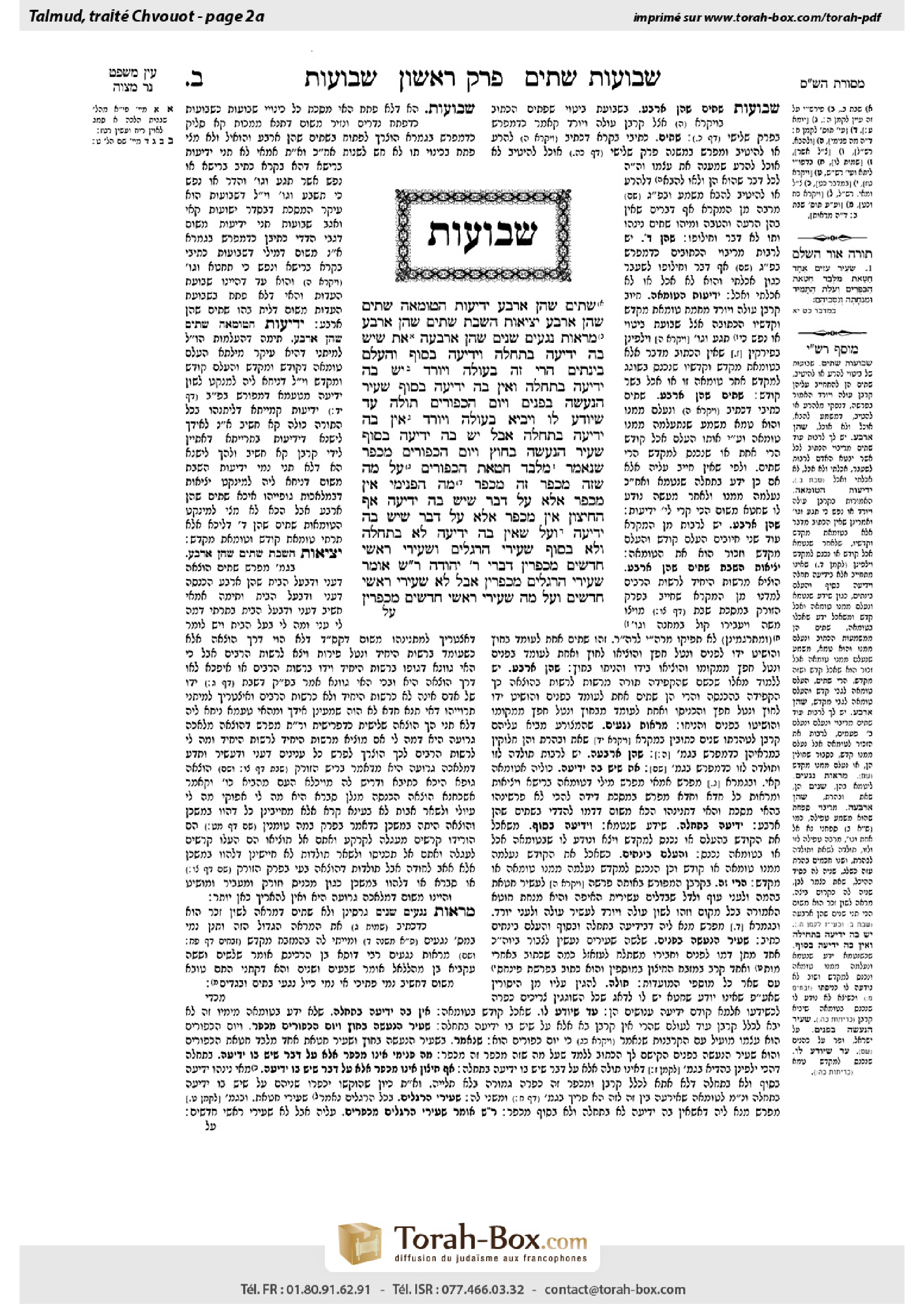
Shevuot 2a: Talmud study for Daf Yomi
Daf Yomi is the daily study of one Talmud folio. Explore 37 tractates with scans, Hebrew text, Sefaria English and AI-generated French translations where annotated.
Passage selection and English or AI-generated French translation are available where the scan has annotations. Daf Study is independent of Torah-Box and Sefaria.
Browse Shevuot · שבועות · All tractatesShevuot 2a text and translations
This page of Shevuot includes the Aramaic text, an English translation and an AI-generated French translation, alongside the scan above.
שבועות ב׳ א · Aramaic and Hebrew text
מַתְנִי׳ שְׁבוּעוֹת – שְׁתַּיִם שֶׁהֵן אַרְבַּע.
יְדִיעוֹת הַטּוּמְאָה – שְׁתַּיִם שֶׁהֵן אַרְבַּע.
יְצִיאוֹת הַשַּׁבָּת – שְׁתַּיִם שֶׁהֵן אַרְבַּע.
מַרְאוֹת נְגָעִים – שְׁנַיִם שֶׁהֵן אַרְבָּעָה.
אֶת שֶׁיֵּשׁ בָּהּ יְדִיעָה בַּתְּחִלָּה וִידִיעָה בַּסּוֹף וְהֶעְלֵם בֵּינָתַיִם – הֲרֵי זֶה בְּעוֹלֶה וְיוֹרֵד.
יֵשׁ בָּהּ יְדִיעָה בַּתְּחִלָּה וְאֵין בָּהּ יְדִיעָה בַּסּוֹף – שָׂעִיר הַנַּעֲשֶׂה בִּפְנִים וְיוֹם הַכִּפּוּרִים תּוֹלֶה, עַד שֶׁיִּוָּדַע לוֹ וְיָבִיא בְּעוֹלֶה וְיוֹרֵד.
אֵין בָּהּ יְדִיעָה בַּתְּחִלָּה אֲבָל יֵשׁ בָּהּ יְדִיעָה בַּסּוֹף – שָׂעִיר הַנַּעֲשֶׂה בַּחוּץ וְיוֹם הַכִּפּוּרִים מְכַפֵּר. שֶׁנֶּאֱמַר: ״מִלְּבַד חַטַּאת הַכִּפּוּרִים״ – עַל מַה שֶּׁזֶּה מְכַפֵּר, זֶה מְכַפֵּר; מַה הַפְּנִימִי אֵין מְכַפֵּר אֶלָּא עַל דָּבָר שֶׁיֵּשׁ בָּהּ יְדִיעָה, אַף הַחִיצוֹן אֵין מְכַפֵּר אֶלָּא עַל דָּבָר שֶׁיֵּשׁ בָּהּ יְדִיעָה.
וְעַל שֶׁאֵין בָּהּ יְדִיעָה לֹא בַּתְּחִלָּה וְלֹא בַּסּוֹף – שְׂעִירֵי הָרְגָלִים וּשְׂעִירֵי רָאשֵׁי חֳדָשִׁים מְכַפְּרִין, דִּבְרֵי רַבִּי יְהוּדָה. רַבִּי שִׁמְעוֹן אוֹמֵר: שְׂעִירֵי הָרְגָלִים מְכַפְּרִין, אֲבָל לֹא שְׂעִירֵי רָאשֵׁי חֳדָשִׁים. וְעַל מַה שְּׂעִירֵי רָאשֵׁי חֳדָשִׁים מְכַפְּרִין?
Shevuot 2a · English translation
MISHNA: With regard to oaths on an utterance of the lips, there are two types that are actually four types. The Torah specifies only two types of oaths whose violation renders one liable to bring a sliding-scale offering to atone for his transgression (see Leviticus 5:4): Where a person takes an oath to perform some action, and where he takes an oath to refrain from performing some action. With regard to both types, the Torah explicitly mentions liability only for an oath pertaining to one’s future behavior. Nevertheless, the Sages derive that one is also liable for a violation of both types of oaths when they pertain to one’s past behavior. Accordingly, although only two types are explicitly mentioned in the Torah, the Sages derive that there are actually four types.
The mishna lists similar groups of halakhot. With regard to cases of awareness of the defiling of the Temple by entering it while one is ritually impure, or defiling its sacrificial foods by partaking of them while one is ritually impure, there are two types that are actually four. It is prohibited for an impure person to enter the Temple (see Numbers 19:20) or to partake of its sacrificial foods (see Leviticus 7:19–20). If one transgressed either prohibition during a lapse of awareness, then upon becoming aware of his transgression, he is liable to bring a sliding-scale offering (see Leviticus 5:2). The Torah specifies that one is liable to bring the offering only in the case in which he had a lapse of awareness of the fact that he was impure. The Sages derive that one is liable not only in these two cases, but also where he was aware of his personal status but had a lapse of awareness concerning the identity of the place he was entering or the status of the foods he ate.
With regard to acts of carrying out that are prohibited on Shabbat, there are two types that are actually four. On Shabbat, it is prohibited to transfer an item from domain to domain. The Torah explicitly refers to only two cases, both of which involve an item being transferred from a private domain to a public domain: Where the transfer is made by a person who remains in the public domain, and where the transfer is made by a person who remains in the private domain. The Sages derive that liability is incurred in these cases also if the item is transferred from the public domain to the private domain. Although only two types are mentioned by the Torah, the Sages derive that there are actually four types.
With regard to shades of leprous marks on a person’s skin, there are two types that are actually four. The Torah specifies that if a leprous mark appears on a person’s skin, the afflicted person must undergo a process of purification and then bring various offerings. Part of the classification of these types of leprosy is based on their shade of white. Two types of marks are explicitly mentioned in the Torah, and the Sages derive that each of these two types has a secondary mark.
The mishna returns to the subject of defiling the Temple or its sacrificial foods. It elaborates on which offerings atone for different cases of defiling the Temple or its sacrificial foods: In cases in which one had awareness, i.e., he knew he was ritually impure and was aware of the sanctity of the Temple or foods involved at the beginning, i.e., before he transgressed, and had awareness at the end, i.e., after the transgression, but had a lapse of awareness of one of those two components in between, while he actually transgressed, this person is liable to bring a sliding-scale offering.
For cases in which one had awareness at the beginning, transgressed during a lapse of awareness, and still had no awareness at the end, the goat whose blood presentation is performed inside the Sanctuary on Yom Kippur, and Yom Kippur itself, suspend any punishment that he deserves until he becomes aware of his transgression; and then to achieve atonement he brings a sliding-scale offering.
For cases in which one did not have awareness at the beginning but had awareness at the end, the goat whose blood presentation is performed outside the Sanctuary, i.e., the goat of the additional offerings of Yom Kippur, and Yom Kippur itself, atone, as it is stated with regard to the offerings brought on Yom Kippur: “One goat for a sin-offering aside from the sin-offering of the atonements” (Numbers 29:11). The verse juxtaposes the internal and external goats together to teach that for that which this one atones, that one atones. Just as the internal goat, i.e., the one whose blood presentation is performed inside the Sanctuary, atones only for a case in which there was awareness of the components of the transgression at some point, i.e., at the beginning, so too, the external goat, i.e., the goat of the additional offerings of Yom Kippur, atones only for a case in which there was awareness at some point, i.e., at the end.
And for cases in which one did not have awareness, neither at the beginning nor at the end, the goats brought as sin-offerings for the additional offerings of the Festivals and the goats brought as sin-offerings for the additional offerings of the New Moons atone. This is the statement of Rabbi Yehuda. Rabbi Shimon says: The goats of the Festivals atone for cases in which one never had awareness of the transgression, but the goats of the New Moons do not. But if so, for what do the goats of the New Moons atone?
Shevuot 2a · Traduction française (IA)
MICHNA : En ce qui concerne les serments portant sur une parole prononcée, il y a deux catégories qui en constituent en réalité quatre. La Torah ne précise que deux catégories de serments dont la violation rend leur auteur passible d’apporter une offrande à valeur variable afin d’expier sa transgression (voir Lévitique 5:4) : lorsqu’une personne jure d’accomplir une action et lorsqu’elle jure de s’abstenir d’accomplir une action. Pour ces deux catégories, la Torah ne mentionne explicitement une responsabilité que pour un serment portant sur le comportement futur de la personne. Néanmoins, les Sages déduisent qu’on est également passible pour la violation de ces deux catégories de serments lorsqu’ils portent sur le comportement passé. Ainsi, bien que seules deux catégories soient explicitement mentionnées dans la Torah, les Sages déduisent qu’il y en a en réalité quatre.
La Michna énumère des groupes semblables de halakhot. En ce qui concerne les cas où l’on souille le Temple en y entrant en état d’impureté rituelle, ou où l’on souille ses aliments sacrificiels en les consommant en état d’impureté rituelle, il y a deux catégories qui en constituent en réalité quatre. Il est interdit à une personne impure d’entrer dans le Temple (voir Nombres 19:20) ou de consommer ses aliments sacrificiels (voir Lévitique 7:19–20). Si quelqu’un a transgressé l’une ou l’autre de ces interdictions alors qu’il n’en avait pas conscience, lorsqu’il prend conscience de sa transgression, il est passible d’apporter une offrande à valeur variable (voir Lévitique 5:2). La Torah précise qu’on n’est passible d’apporter cette offrande que dans le cas où l’on n’avait pas conscience de son état d’impureté. Les Sages déduisent qu’on en est passible non seulement dans ces deux cas, mais aussi lorsqu’on connaissait son propre état, mais n’avait pas conscience de l’identité du lieu où l’on entrait ou du statut des aliments que l’on consommait.
En ce qui concerne les actes de transfert interdits le Chabbat, il y a deux catégories qui en constituent en réalité quatre. Le Chabbat, il est interdit de transporter un objet d’un domaine à un autre. La Torah ne mentionne explicitement que deux cas, qui impliquent tous deux le transfert d’un objet d’un domaine privé vers un domaine public : le transfert effectué par une personne qui demeure dans le domaine public et celui effectué par une personne qui demeure dans le domaine privé. Les Sages déduisent que ces cas entraînent également une responsabilité lorsque l’objet est transféré du domaine public vers le domaine privé. Bien que seules deux catégories soient mentionnées dans la Torah, les Sages déduisent qu’il y en a en réalité quatre.
En ce qui concerne les nuances des marques lépreuses sur la peau d’une personne, il y a deux catégories qui en constituent en réalité quatre. La Torah précise que si une marque lépreuse apparaît sur la peau d’une personne, celle-ci doit suivre un processus de purification, puis apporter diverses offrandes. La classification de ces formes de lèpre repose notamment sur leur nuance de blanc. Deux types de marques sont explicitement mentionnés dans la Torah, et les Sages déduisent que chacun de ces deux types possède une marque secondaire.
La Michna revient au sujet de la souillure du Temple ou de ses aliments sacrificiels. Elle précise quelles offrandes expient les différents cas de souillure du Temple ou de ses aliments sacrificiels : dans les cas où la personne avait conscience au début, c’est-à-dire avant de transgresser, sachant qu’elle était en état d’impureté rituelle et connaissant la sainteté du Temple ou des aliments concernés, et où elle en avait conscience à la fin, c’est-à-dire après la transgression, mais où elle avait perdu conscience de l’un de ces deux éléments entre-temps, au moment même où elle transgressait, elle est passible d’apporter une offrande à valeur variable.
Dans les cas où la personne avait conscience au début, a transgressé alors qu’elle n’en avait pas conscience et n’en avait toujours pas conscience à la fin, le bouc dont le sang est aspergé à l’intérieur du Sanctuaire le jour de Yom Kippour, ainsi que Yom Kippour lui-même, suspendent toute peine qu’elle mérite jusqu’à ce qu’elle prenne conscience de sa transgression ; elle apporte alors une offrande à valeur variable pour obtenir l’expiation.
Dans les cas où la personne n’avait pas conscience au début, mais en avait conscience à la fin, le bouc dont le sang est aspergé à l’extérieur du Sanctuaire, c’est-à-dire le bouc des offrandes supplémentaires de Yom Kippour, ainsi que Yom Kippour lui-même, expient, comme il est dit à propos des offrandes apportées le jour de Yom Kippour : « Un bouc en sacrifice expiatoire, en plus du sacrifice expiatoire des expiations » (Nombres 29:11). Le verset rapproche le bouc intérieur et le bouc extérieur pour enseigner que ce pour quoi l’un expie, l’autre l’expie également. De même que le bouc intérieur, c’est-à-dire celui dont le sang est aspergé à l’intérieur du Sanctuaire, n’expie que dans un cas où la personne a eu conscience des éléments de la transgression à un moment donné, c’est-à-dire au début, de même le bouc extérieur, c’est-à-dire le bouc des offrandes supplémentaires de Yom Kippour, n’expie que dans un cas où la personne en a eu conscience à un moment donné, c’est-à-dire à la fin.
Et dans les cas où la personne n’a eu conscience de la transgression ni au début ni à la fin, les boucs apportés en sacrifices expiatoires pour les offrandes supplémentaires des fêtes et ceux apportés en sacrifices expiatoires pour les offrandes supplémentaires des nouvelles lunes expient. Telle est l’opinion de Rabbi Yehuda. Rabbi Shimon dit : Les boucs des fêtes expient les cas où la personne n’a jamais eu conscience de la transgression, mais les boucs des nouvelles lunes ne le font pas. Mais dans ce cas, qu’expient les boucs des nouvelles lunes ?
Traduction française générée par IA à partir de l’édition anglaise de Sefaria. Vérifie toujours un passage avec le texte source.
Text from Sefaria: William Davidson Edition - Vocalized Aramaic (CC BY NC); William Davidson Edition - English (CC BY NC).