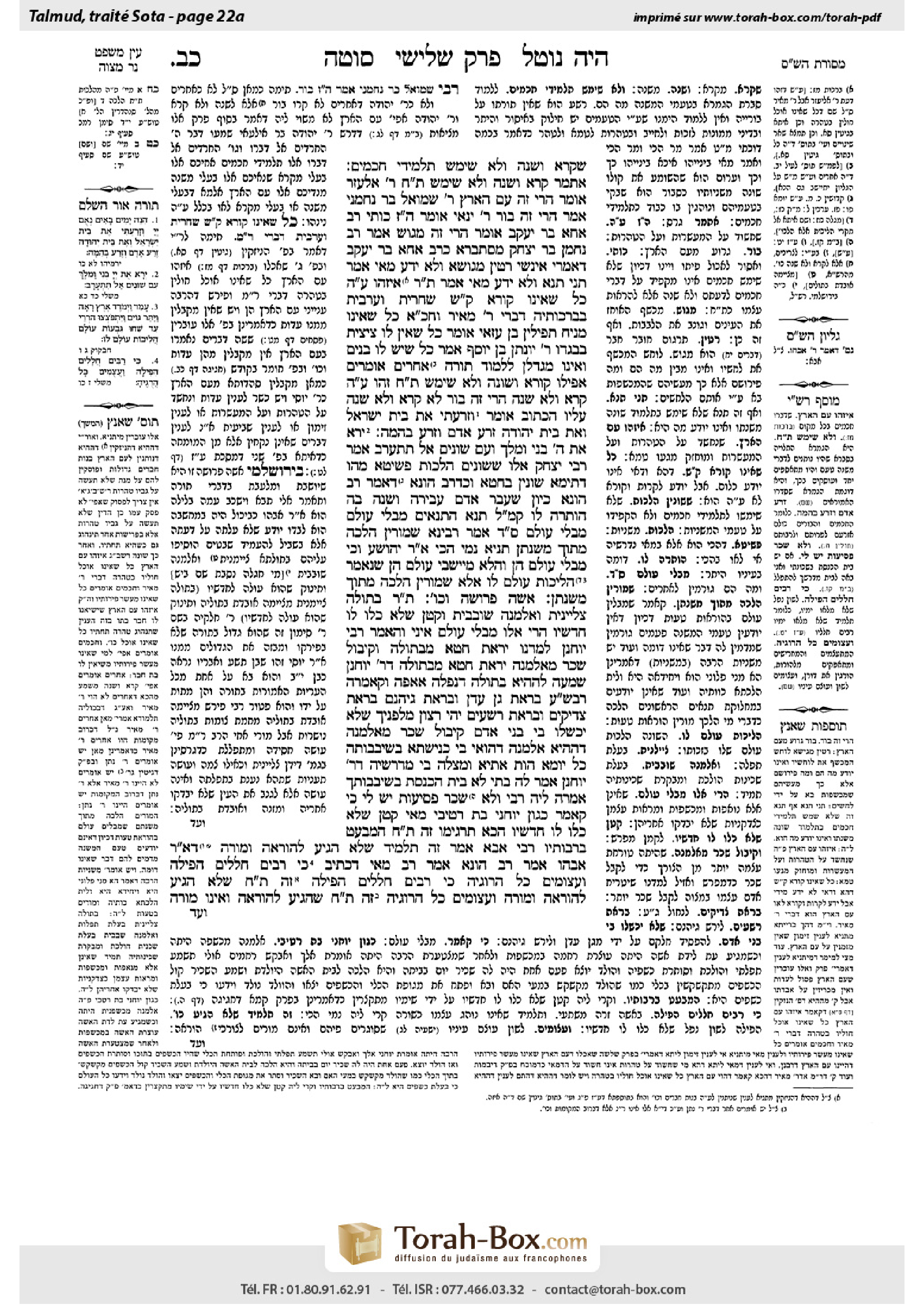
Sotah 22a: Talmud study for Daf Yomi
Daf Yomi is the daily study of one Talmud folio. Explore 37 tractates with scans, Hebrew text, Sefaria English and AI-generated French translations where annotated.
Passage selection and English or AI-generated French translation are available where the scan has annotations. Daf Study is independent of Torah-Box and Sefaria.
Browse Sotah · סוטה · All tractatesSotah 22a text and translations
This page of Sotah includes the Aramaic text, an English translation and an AI-generated French translation, alongside the scan above.
סוטה כ״ב א · Aramaic and Hebrew text
שֶׁקָּרָא וְשָׁנָה וְלֹא שִׁימֵּשׁ תַּלְמִידֵי חֲכָמִים.
אִתְּמַר: קָרָא וְשָׁנָה וְלֹא שִׁימֵּשׁ תַּלְמִידֵי חֲכָמִים, רַבִּי אֶלְעָזָר אוֹמֵר: הֲרֵי זֶה עַם הָאָרֶץ. רַבִּי שְׁמוּאֵל בַּר נַחְמָנִי אָמַר: הֲרֵי זֶה בּוּר. רַבִּי יַנַּאי אוֹמֵר: הֲרֵי זֶה כּוּתִי.
רַב אַחָא בַּר יַעֲקֹב אוֹמֵר: הֲרֵי זֶה מָגוֹשׁ. אָמַר רַב נַחְמָן בַּר יִצְחָק: מִסְתַּבְּרָא כְּרַב אַחָא בַּר יַעֲקֹב, דְּאָמְרִי אִינָשֵׁי: רָטֵין מָגוֹשָׁא וְלָא יָדַע מַאי אָמַר, תָּנֵי תַּנָּא וְלָא יָדַע מַאי אָמַר.
תָּנוּ רַבָּנַן: אֵיזֶהוּ עַם הָאָרֶץ? כֹּל שֶׁאֵינוֹ קוֹרֵא קְרִיאַת שְׁמַע שַׁחֲרִית וְעַרְבִית בְּבִרְכוֹתֶיהָ, דִּבְרֵי רַבִּי מֵאִיר. וַחֲכָמִים אוֹמְרִים: כֹּל שֶׁאֵינוֹ מַנִּיחַ תְּפִילִּין. בֶּן עַזַּאי אוֹמֵר: כֹּל שֶׁאֵין לוֹ צִיצִית בְּבִגְדוֹ. רַבִּי יוֹנָתָן בֶּן יוֹסֵף אָמַר: כֹּל שֶׁיֵּשׁ לוֹ בָּנִים וְאֵינוֹ מְגַדְּלָן לִלְמוֹד תּוֹרָה. אֲחֵרִים אוֹמְרִים: אֲפִילּוּ קוֹרֵא וְשׁוֹנֶה וְלֹא שִׁימֵּשׁ תַּלְמִידֵי חֲכָמִים — זֶהוּ עַם הָאָרֶץ.
קָרָא וְלֹא שָׁנָה — הֲרֵי זֶה בּוּר, לֹא קָרָא וְלֹא שָׁנָה — עָלָיו הַכָּתוּב אוֹמֵר: ״וְזָרַעְתִּי אֶת בֵּית יִשְׂרָאֵל וְאֶת בֵּית יְהוּדָה זֶרַע אָדָם וְזֶרַע בְּהֵמָה״.
״יְרָא אֶת ה׳ בְּנִי וָמֶלֶךְ עִם שׁוֹנִים אַל תִּתְעָרָב״, אָמַר רַבִּי יִצְחָק: אֵלּוּ שֶׁשּׁוֹנִים הֲלָכוֹת. פְּשִׁיטָא! מַהוּ דְּתֵימָא — שׁוֹנִין בְּחֵטְא, וְכִדְרַב הוּנָא. דְּאָמַר רַב הוּנָא: כֵּיוָן שֶׁעָבַר אָדָם עֲבֵירָה וְשָׁנָה בָּהּ — הוּתְּרָה לוֹ, קָא מַשְׁמַע לַן.
תָּנָא: הַתַּנָּאִים — מְבַלֵּי עוֹלָם. מְבַלֵּי עוֹלָם סָלְקָא דַּעְתָּךְ?! אָמַר רָבִינָא: שֶׁמּוֹרִין הֲלָכָה מִתּוֹךְ מִשְׁנָתָן. תַּנְיָא נָמֵי הָכִי, אָמַר רַבִּי יְהוֹשֻׁעַ: וְכִי מְבַלֵּי עוֹלָם הֵן? וַהֲלֹא מְיַישְּׁבֵי עוֹלָם הֵן, שֶׁנֶּאֱמַר: ״הֲלִיכוֹת עוֹלָם לוֹ״! אֶלָּא, שֶׁמּוֹרִין הֲלָכָה מִתּוֹךְ מִשְׁנָתָן.
אִשָּׁה פְּרוּשָׁה וְכוּ׳. תָּנוּ רַבָּנַן: בְּתוּלָה צַלְיָינִית, וְאַלְמָנָה שׁוֹבָבִית, וְקָטָן שֶׁלֹּא כָּלוּ לוֹ חֳדָשָׁיו — הֲרֵי אֵלּוּ מְבַלֵּי עוֹלָם.
אִינִי? וְהָאָמַר רַבִּי יוֹחָנָן: לָמַדְנוּ יִרְאַת חֵטְא מִבְּתוּלָה, וְקִיבּוּל שָׂכָר מֵאַלְמָנָה. יִרְאַת חֵטְא מִבְּתוּלָה — דְּרַבִּי יוֹחָנָן שַׁמְעַהּ לְהַהִיא בְּתוּלָה דְּנָפְלָה אַאַפַּהּ וְקָאָמְרָה: רִבּוֹנוֹ שֶׁל עוֹלָם, בָּרָאתָ גַּן עֵדֶן וּבָרָאתָ גֵּיהִנָּם, בָּרָאתָ צַדִּיקִים וּבָרָאתָ רְשָׁעִים. יְהִי רָצוֹן מִלְּפָנֶיךָ שֶׁלֹּא יִכָּשְׁלוּ בִּי בְּנֵי אָדָם.
קִיבּוּל שָׂכָר מֵאַלְמָנָה — דְּהָהִיא אַלְמָנָה דַּהֲוַאי בֵּי כְנִישְׁתָּא בְּשִׁיבָבוּתַהּ. כׇּל יוֹמָא הֲוָת אָתְיָא וּמְצַלָּה בֵּי מִדְרְשֵׁיהּ דְּרַבִּי יוֹחָנָן. אֲמַר לַהּ: בִּתִּי, לֹא בֵּית הַכְּנֶסֶת בְּשִׁיבָבוּתִיךְ? אֲמַרָה לֵיהּ: רַבִּי, וְלֹא שְׂכַר פְּסִיעוֹת יֵשׁ לִי?
כִּי קָאָמַר, כְּגוֹן יוֹחָנִי בַּת רְטִיבִי.
מַאי ״קָטָן שֶׁלֹּא כָּלוּ לוֹ חֳדָשָׁיו״? הָכָא תַּרְגִּימוּ: זֶה תַּלְמִיד חָכָם הַמְבַעֵט בְּרַבּוֹתָיו.
רַבִּי אַבָּא אָמַר: זֶה תַּלְמִיד שֶׁלֹּא הִגִּיעַ לְהוֹרָאָה וּמוֹרֶה. דְּאָמַר רַבִּי אֲבָהוּ אָמַר רַב הוּנָא אָמַר רַב: מַאי דִּכְתִיב ״כִּי רַבִּים חֲלָלִים הִפִּילָה וַעֲצוּמִים כׇּל הֲרוּגֶיהָ״. ״כִּי רַבִּים חֲלָלִים הִפִּילָה״ — זֶה תַּלְמִיד חָכָם שֶׁלֹּא הִגִּיעַ לְהוֹרָאָה וּמוֹרֶה. ״וַעֲצוּמִים כׇּל הֲרוּגֶיהָ״ — זֶה תַּלְמִיד חָכָם שֶׁהִגִּיעַ לְהוֹרָאָה וְאֵינוֹ מוֹרֶה.
Sotah 22a · English translation
is one who read the Written Torah and learned the Mishna but did not serve Torah scholars in order to learn the reasoning behind the halakhot. Since he believes himself knowledgeable, he issues halakhic rulings, but due to his lack of understanding he rules erroneously and is therefore considered wicked. His cunning is in his public display of knowledge, which misleads others into considering him a true Torah scholar.
It was stated: With regard to one who read the Written Torah and learned the Mishna but did not serve Torah scholars, Rabbi Elazar says: This person is an ignoramus. Rabbi Shmuel bar Naḥmani said: This person is a boor. Rabbi Yannai says: This person is comparable to a Samaritan, who follows the Written Torah but not the traditions of the Sages.
Rav Aḥa bar Ya’akov says: This person is comparable to a sorcerer [magosh], who uses his knowledge to mislead people. Rav Naḥman bar Yitzḥak said: It is reasonable to accept the opinion of Rav Aḥa bar Ya’akov, as people say proverbially: The sorcerer chants and does not know what he is saying; so too, the tanna teaches the Mishna and does not know what he is saying.
§ The Sages taught: Who is an ignoramus [am ha’aretz]? It is anyone who does not recite Shema in the morning and evening with its blessings; this is the statement of Rabbi Meir. And the Rabbis say: It is anyone who does not don phylacteries. Ben Azzai says: It is anyone who does not have ritual fringes on his garment. Rabbi Yonatan ben Yosef said: It is anyone who has sons and does not raise them to study Torah. Aḥerim say: Even if one reads the Written Torah and learns the Mishna but does not serve Torah scholars, he is an ignoramus.
If one read the Written Torah but did not learn the Mishna, he is a boor. With regard to one who did not read and did not learn at all, the verse states: “Behold, the days come, says the Lord, and I will sow the house of Israel and the house of Judah with the seed of man, and with the seed of beast” (Jeremiah 31:26). One who has not studied at all is comparable to a beast.
The verse states: “My son, fear the Lord and the king; and meddle not with those who are repeating” (Proverbs 24:21). Rabbi Yitzḥak says: These are individuals who repeatedly learn the halakhot but do not know the reasons behind them. The Gemara asks: Isn’t that obvious? How else could the verse be understood? The Gemara answers: He states this lest you say that the verse is referring to individuals who repeatedly commit sins, and this is in accordance with the words of Rav Huna, as Rav Huna says: Once a person committed a transgression and repeated it, in his eyes it became permitted for him. Since the verse could be interpreted in this manner, Rabbi Yitzḥak teaches us that the verse is referring to those who learn without understanding.
It was taught in a baraita: The tanna’im, who recite the tannaitic sources by rote, are individuals who erode the world. The Gemara is puzzled by this statement: Could it enter your mind that they are individuals who erode the world? Ravina says: This statement is referring to those who issue halakhic rulings based on their knowledge of mishnayot. This is also taught in a baraita: Rabbi Yehoshua said: Are they individuals who erode the world? Aren’t they settling the world, as it is stated: “His ways [halikhot] are eternal” (Habakkuk 3:6)? The Sages read the term halikhot as halakhot, inferring that one who learns halakhot attains eternal life. Rather, this is referring to those who issue halakhic rulings based on their knowledge of mishnayot.
§ The mishna states that an abstinent woman is among those who erode the world. The Sages taught: A maiden who prays constantly, and a neighborly [shovavit] widow who constantly visits her neighbors, and a child whose months of gestation were not completed, all these are people who erode the world.
The Gemara asks: Is that so? But didn’t Rabbi Yoḥanan say: We learned the meaning of fear of sin from a maiden, and the significance of receiving divine reward from a widow. The meaning of fear of sin can be learned from a maiden, as Rabbi Yoḥanan heard a certain maiden who fell on her face in prayer, and she was saying: Master of the Universe, You created the Garden of Eden and You created Gehenna, You created the righteous and You created the wicked. May it be Your will that men shall not stumble because of me and consequently go to Gehenna.
The significance of receiving divine reward can be learned from a widow, as there was a certain widow in whose neighborhood there was a synagogue, and despite this every day she went and prayed in the study hall of Rabbi Yoḥanan. Rabbi Yoḥanan said to her: My daughter, is there not a synagogue in your neighborhood? She said to him: My teacher, don’t I attain a reward for all the steps I take while walking to pray in the distant study hall?
The Gemara answers: When it is stated in the baraita that a maiden who prays constantly is one who erodes the world, it is referring, for example, to Yoḥani bat Retivi, who constantly prayed and pretended to be saintly but actually engaged in sorcery.
The Gemara asks: What is the meaning of a child whose months of gestation were not completed? Here, in Babylonia, they interpreted this as alluding to an imperfect, incomplete Torah scholar who scorns his teachers.
Rabbi Abba says: This is a student who has not yet attained the ability to issue halakhic rulings, and yet he issues rulings and is therefore compared to a prematurely born child. This is as Rabbi Abbahu says that Rav Huna says that Rav says: What is the meaning of that which is written: “For she has cast down many wounded; and a mighty host are all her slain” (Proverbs 7:26)? “For she has cast down [hippila] many wounded”; this is referring to a Torah scholar who has not yet attained the ability to issue rulings, and yet he issues rulings. “And a mighty host [ve’atzumim] are all her slain”; this is referring to a Torah scholar who has attained the ability to issue rulings, but does not issue rulings and prevents the masses from learning Torah properly.
Sotah 22a · Traduction française (IA)
Il s’agit de celui qui a lu la Torah écrite et étudié la Michna, mais qui n’a pas fréquenté les sages de la Torah afin d’apprendre le raisonnement qui sous-tend les halakhot. Se croyant savant, il rend des décisions halakhiques, mais, faute de compréhension, il se trompe et est donc considéré comme méchant. Sa ruse consiste à étaler publiquement son savoir, induisant les autres en erreur et les amenant à le prendre pour un véritable sage de la Torah.
Il a été enseigné : au sujet de celui qui a lu la Torah écrite et étudié la Michna, mais qui n’a pas fréquenté les sages de la Torah, Rabbi Elazar dit : cet homme est un ignorant. Rabbi Shmuel bar Naḥmani dit : cet homme est un rustre. Rabbi Yannai dit : cet homme est comparable à un Samaritain, qui suit la Torah écrite, mais non les traditions des Sages.
Rav Aḥa bar Ya’akov dit : cet homme est comparable à un sorcier [magosh], qui se sert de son savoir pour induire les gens en erreur. Rav Naḥman bar Yitzḥak dit : il est raisonnable d’accepter l’avis de Rav Aḥa bar Ya’akov, car on dit proverbialement : le sorcier récite ses incantations sans savoir ce qu’il dit ; de même, le tanna enseigne la Michna sans savoir ce qu’il dit.
§ Les Sages ont enseigné : qui est un ignorant [am ha’aretz] ? Quiconque ne récite pas le Chéma matin et soir avec ses bénédictions ; telle est l’opinion de Rabbi Meir. Et les Rabbins disent : quiconque ne met pas les phylactères. Ben Azzai dit : quiconque ne porte pas de franges rituelles sur son vêtement. Rabbi Yonatan ben Yosef dit : quiconque a des fils et ne les élève pas dans l’étude de la Torah. Aḥerim disent : même celui qui lit la Torah écrite et étudie la Michna, mais ne fréquente pas les sages de la Torah, est un ignorant.
Si quelqu’un a lu la Torah écrite, mais n’a pas étudié la Michna, c’est un rustre. Quant à celui qui n’a ni lu ni étudié, le verset dit : « Voici, les jours viennent, dit le Seigneur, où je sèmerai la maison d’Israël et la maison de Juda de semence humaine et de semence animale » (Jérémie 31:26). Celui qui n’a rien étudié est comparable à une bête.
Le verset dit : « Mon fils, crains le Seigneur et le roi ; ne te mêle pas à ceux qui répètent » (Proverbes 24:21). Rabbi Yitzḥak dit : il s’agit de personnes qui étudient et réétudient les halakhot, mais n’en connaissent pas les raisons. La Guemara demande : N’est-ce pas évident ? Comment pourrait-on comprendre autrement le verset ? La Guemara répond : Il l’enseigne de peur que tu ne dises que le verset parle de personnes qui commettent des fautes à répétition, conformément aux paroles de Rav Huna. Car Rav Huna dit : dès qu’une personne a commis une transgression et l’a répétée, celle-ci lui paraît permise. Puisque le verset pourrait être interprété de cette façon, Rabbi Yitzḥak nous apprend qu’il parle de ceux qui étudient sans comprendre.
Il a été enseigné dans une baraïta : les tannaïm qui récitent par cœur les sources tannaitiques sont des personnes qui détruisent le monde. La Guemara s’étonne de cette affirmation : Peut-il te venir à l’esprit qu’ils détruisent le monde ? Ravina dit : cette affirmation parle de ceux qui rendent des décisions halakhiques sur la base de leur connaissance des Michnayot. Cela est également enseigné dans une baraïta : Rabbi Yehoshua a dit : S’agirait-il de personnes qui détruisent le monde ? Ne contribuent-ils pas plutôt à l’établissement du monde, comme il est dit : « Ses voies [halikhot] sont éternelles » (Habacuc 3:6) ? Les Sages lisent le terme halikhot comme halakhot, et en déduisent que celui qui étudie les halakhot accède à la vie éternelle. Il s’agit donc plutôt de ceux qui rendent des décisions halakhiques sur la base de leur connaissance des Michnayot.
§ La Michna affirme qu’une femme abstinente fait partie de ceux qui détruisent le monde. Les Sages ont enseigné : une jeune fille qui prie constamment, une veuve sociable [shovavit] qui rend sans cesse visite à ses voisines, et un enfant dont la gestation n’est pas arrivée à terme sont tous des personnes qui détruisent le monde.
La Guemara demande : Est-ce vraiment le cas ? Rabbi Yoḥanan n’a-t-il pas dit : nous avons appris d’une jeune fille ce qu’est la crainte de la faute, et d’une veuve ce que signifie recevoir une récompense divine ? On peut apprendre d’une jeune fille ce qu’est la crainte de la faute, car Rabbi Yoḥanan entendit une certaine jeune fille prosternée en prière dire : Maître de l’Univers, Tu as créé le jardin d’Éden et Tu as créé la Géhenne ; Tu as créé les justes et Tu as créé les méchants. Puisse-t-il être Ta volonté que les hommes ne trébuchent pas à cause de moi et ne finissent pas ainsi en Géhenne.
On peut apprendre d’une veuve ce que signifie recevoir une récompense divine, car il y avait une certaine veuve dans le quartier de laquelle se trouvait une synagogue ; pourtant, chaque jour, elle se rendait prier dans la maison d’étude de Rabbi Yoḥanan. Rabbi Yoḥanan lui dit : Ma fille, n’y a-t-il pas une synagogue dans ton quartier ? Elle lui répondit : Mon maître, ne mérité-je pas une récompense pour tous les pas que je fais en allant prier dans cette maison d’étude éloignée ?
La Guemara répond : lorsque la baraïta dit qu’une jeune fille qui prie constamment est une personne qui détruit le monde, elle vise, par exemple, Yoḥani bat Retivi, qui priait sans cesse et feignait la piété, mais pratiquait en réalité la sorcellerie.
La Guemara demande : que signifie l’expression « un enfant dont la gestation n’est pas arrivée à terme » ? Ici, en Babylonie, on l’interprétait comme une allusion à un sage de la Torah imparfait, incomplet, qui méprise ses maîtres.
Rabbi Abba dit : il s’agit d’un étudiant qui n’a pas encore acquis la capacité de rendre des décisions halakhiques et qui, pourtant, en rend ; il est donc comparé à un enfant né prématurément. C’est comme Rabbi Abbahu qui rapporte que Rav Huna a dit au nom de Rav : que signifie ce qui est écrit : « Car elle a fait tomber de nombreux blessés, et une puissante armée, tous ses tués » (Proverbes 7:26) ? « Car elle a fait tomber [hippila] de nombreux blessés » : cela désigne un sage de la Torah qui n’a pas encore acquis la capacité de rendre des décisions, et qui, pourtant, en rend. « Et une puissante armée [ve’atzumim], tous ses tués » : cela désigne un sage de la Torah qui a acquis la capacité de rendre des décisions, mais n’en rend pas et empêche les masses d’étudier correctement la Torah.
Traduction française générée par IA à partir de l’édition anglaise de Sefaria. Vérifie toujours un passage avec le texte source.
Text from Sefaria: William Davidson Edition - Vocalized Aramaic (CC BY NC); William Davidson Edition - English (CC BY NC).