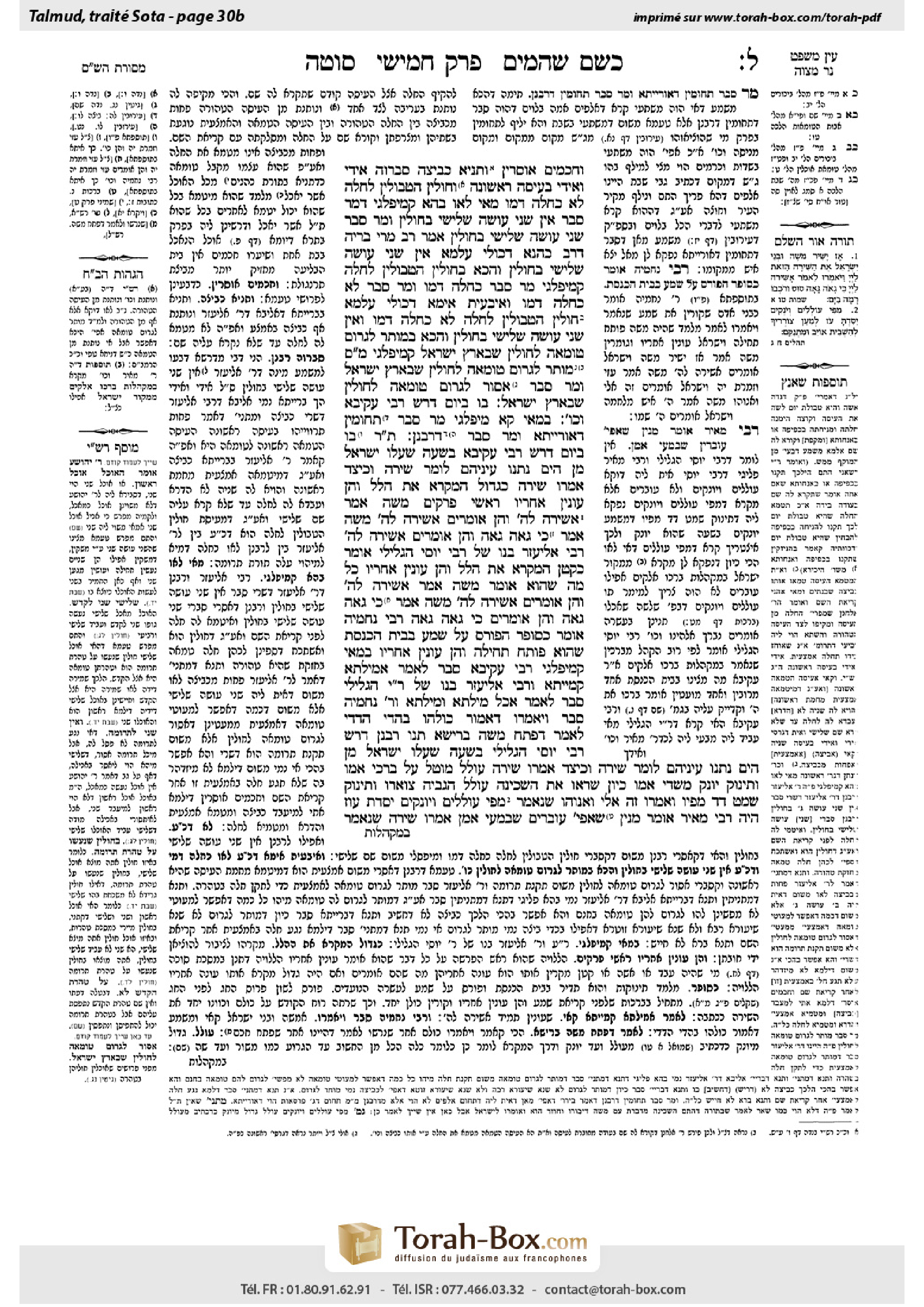
Sotah 30b: Talmud study for Daf Yomi
Daf Yomi is the daily study of one Talmud folio. Explore 37 tractates with scans, Hebrew text, Sefaria English and AI-generated French translations where annotated.
Passage selection and English or AI-generated French translation are available where the scan has annotations. Daf Study is independent of Torah-Box and Sefaria.
Browse Sotah · סוטה · All tractatesSotah 30b text and translations
This page of Sotah includes the Aramaic text, an English translation and an AI-generated French translation, alongside the scan above.
סוטה ל׳ ב · Aramaic and Hebrew text
וַחֲכָמִים אוֹסְרִין.
וְתַנְיָא כְּבֵיצָה.
סַבְרוּהָ אִידֵּי וְאִידֵּי בְּעִיסָּה רִאשׁוֹנָה, וְחוּלִּין הַטְּבוּלִין לְחַלָּה לָא כְּחַלָּה דָּמוּ.
מַאי לָאו בְּהָא קָמִיפַּלְגִי, דְּמָר סָבַר: אֵין שֵׁנִי עוֹשֶׂה שְׁלִישִׁי בְּחוּלִּין,
וּמָר סָבַר: שֵׁנִי עוֹשֶׂה שְׁלִישִׁי בְּחוּלִּין.
אָמַר רַב מָרִי בְּרֵיהּ דְּרַב כָּהֲנָא: דְּכוּלֵּי עָלְמָא אֵין שֵׁנִי עוֹשֶׂה שְׁלִישִׁי בְּחוּלִּין, וְהָכָא בְּחוּלִּין הַטְּבוּלִין לְחַלָּה קָמִיפַּלְגִי. מָר סָבַר: כְּחַלָּה דָּמוּ, וּמָר סָבַר: לָא כְּחַלָּה דָּמוּ.
וְאִיבָּעֵית אֵימָא: דְּכוּלֵּי עָלְמָא חוּלִּין הַטְּבוּלִין לְחַלָּה לָא כְּחַלָּה דָּמוּ, וְאֵין שֵׁנִי עוֹשֶׂה שְׁלִישִׁי בְּחוּלִּין, וְהָכָא בְּמוּתָּר לִגְרוֹם טוּמְאָה לְחוּלִּין שֶׁבְּאֶרֶץ יִשְׂרָאֵל קָמִיפַּלְגִי.
מָר סָבַר: מוּתָּר לִגְרוֹם טוּמְאָה לְחוּלִּין שֶׁבְּאֶרֶץ יִשְׂרָאֵל, וּמָר סָבַר: אָסוּר לִגְרוֹם טוּמְאָה לְחוּלִּין שֶׁבְּאֶרֶץ יִשְׂרָאֵל.
בּוֹ בַּיּוֹם דָּרַשׁ רַבִּי עֲקִיבָא וְכוּ׳.
בְּמַאי קָא מִיפַּלְגִי? מָר סָבַר: תְּחוּמִין דְּאוֹרָיְיתָא, וּמָר סָבַר: דְּרַבָּנַן.
תָּנוּ רַבָּנַן, בּוֹ בַּיּוֹם דָּרַשׁ רַבִּי עֲקִיבָא: בְּשָׁעָה שֶׁעָלוּ יִשְׂרָאֵל מִן הַיָּם, נָתְנוּ עֵינֵיהֶם לוֹמַר שִׁירָה. וְכֵיצַד אָמְרוּ שִׁירָה — כְּגָדוֹל הַמַּקְרֶא אֶת הַלֵּל, וְהֵן עוֹנִין אַחֲרָיו רָאשֵׁי פְרָקִים. מֹשֶׁה אָמַר ״אָשִׁירָה לַה׳״, וְהֵן אוֹמְרִים ״אָשִׁירָה לַה׳״, מֹשֶׁה אָמַר ״כִּי גָאֹה גָּאָה״ וְהֵן אוֹמְרִים ״אָשִׁירָה לַה׳״.
רַבִּי אֱלִיעֶזֶר בְּנוֹ שֶׁל רַבִּי יוֹסֵי הַגְּלִילִי אוֹמֵר: כְּקָטָן הַמַּקְרֶא אֶת הַלֵּל, וְהֵן עוֹנִין אַחֲרָיו כׇּל מָה שֶׁהוּא אוֹמֵר. מֹשֶׁה אָמַר ״אָשִׁירָה לַה׳״ וְהֵן אוֹמְרִים ״אָשִׁירָה לַה׳״, מֹשֶׁה אָמַר ״כִּי גָאֹה גָּאָה״, וְהֵן אוֹמְרִים ״כִּי גָאֹה גָּאָה״.
רַבִּי נְחֶמְיָה אוֹמֵר: כְּסוֹפֵר הַפּוֹרֵס עַל שְׁמַע בְּבֵית הַכְּנֶסֶת, שֶׁהוּא פּוֹתֵחַ תְּחִילָּה וְהֵן עוֹנִין אַחֲרָיו.
בְּמַאי קָמִיפַּלְגִי — רַבִּי עֲקִיבָא סָבַר: ״לֵאמֹר״, אַמִּילְּתָא קַמַּיְיתָא.
וְרַבִּי אֱלִיעֶזֶר בְּנוֹ שֶׁל רַבִּי יוֹסֵי הַגְּלִילִי סָבַר: ״לֵאמֹר״ — אַכֹּל מִילְּתָא וּמִילְּתָא, וְרַבִּי נְחֶמְיָה סָבַר: ״וַיֹּאמְרוּ״ — דַּאֲמוּר כּוּלְּהוּ בַּהֲדֵי הֲדָדֵי, ״לֵאמֹר״ — דִּפְתַח מֹשֶׁה בְּרֵישָׁא.
תָּנוּ רַבָּנַן, דָּרַשׁ רַבִּי יוֹסֵי הַגְּלִילִי: בְּשָׁעָה שֶׁעָלוּ יִשְׂרָאֵל מִן הַיָּם נָתְנוּ עֵינֵיהֶם לוֹמַר שִׁירָה. וְכֵיצַד אָמְרוּ שִׁירָה — עוֹלָל מוּטָּל עַל בִּרְכֵּי אִמּוֹ, וְתִינוֹק יוֹנֵק מִשְּׁדֵי אִמּוֹ. כֵּיוָן שֶׁרָאוּ אֶת הַשְּׁכִינָה, עוֹלָל הִגְבִּיהַּ צַוָּארוֹ, וְתִינוֹק שָׁמַט דַּד מִפִּיו, וְאָמְרוּ ״זֶה אֵלִי וְאַנְוֵהוּ״, שֶׁנֶּאֱמַר: ״מִפִּי עוֹלְלִים וְיֹנְקִים יִסַּדְתָּ עֹז״.
הָיָה רַבִּי מֵאִיר אוֹמֵר: מִנַּיִן שֶׁאֲפִילּוּ עוּבָּרִים שֶׁבִּמְעֵי אִמָּן אָמְרוּ שִׁירָה — שֶׁנֶּאֱמַר:
Sotah 30b · English translation
And the Rabbis prohibit separating ḥalla in this manner.
And it is taught in a baraita that Rabbi Eliezer even allows the ritually pure dough placed in the middle to be as large as an egg-bulk, even though dough of that size is susceptible to the halakhot of ritual impurity.
The Gemara now explains the reasoning of those who tried to prove from here that Rabbi Eliezer is of the opinion that second-degree ritual impurity cannot impart third-degree ritual impurity upon non-sacred items: They assumed that both this mishna and this baraita are referring to cases where the dough is of first-degree impurity. And furthermore, they assumed that all the tanna’im agree that non-sacred food that is untithed with regard to the obligation to separate ḥalla, as its ḥalla has not yet been separated, is not treated like ḥalla as far as its ability to contract third-degree ritual impurity. Rather, it is regarded as generic non-sacred food, which is susceptible only to second-degree impurity.
Based on these assumptions the Gemara explains how these authorities understood the tannaitic dispute: What, is it not clear that Rabbi Eliezer and the Rabbis disagree with regard to the following matter: One Sage, Rabbi Eliezer, holds that an item of second-degree impurity cannot impart third-degree impurity to non-sacred items. Therefore, there is no problem placing an egg-bulk of pure dough in the middle, as although it will touch the impure dough and will thereby contract second-degree impurity, nevertheless it is unable to transmit impurity to the pure dough.
And one Sage, i.e., the Rabbis, holds that an item of second-degree impurity can impart third-degree ritual impurity to non-sacred items. They therefore prohibit placing an egg-bulk of dough in the middle, as it will assume second-degree impurity status, which, in their opinion, can impart third-degree impurity status upon the pure dough.
Rav Mari, son of Rav Kahana, said that the dispute can be understood differently: Everyone agrees that an item of second-degree ritual impurity cannot impart third-degree ritual impurity to non-sacred items. But here, the dispute concerns another matter, as they disagree with regard to the status of non-sacred food that is untithed vis-à-vis ḥalla, as its ḥalla has not yet been separated. One Sage, i.e., the Rabbis, holds that it is treated like ḥalla with regard to its ability to contract third-degree impurity, and one Sage, Rabbi Eliezer, holds that it is not treated like ḥalla and cannot contract third-degree impurity. Therefore, he permits separating ḥalla in this manner.
And if you wish, say instead that they disagree with regard to a different issue: Everyone agrees that non-sacred food that is untithed with regard to ḥalla is not treated like ḥalla and cannot contract third-degree impurity, and that an item of second-degree ritual impurity cannot impart third-degree ritual impurity to non-sacred items. But here, they disagree with regard to whether or not it is permitted to cause ritual impurity to non-sacred food that is in Eretz Yisrael.
One Sage, Rabbi Eliezer, holds that it is permitted to cause impurity to non-sacred food that is in Eretz Yisrael. Therefore, since the dough placed in the middle cannot impart third-degree ritual impurity status upon the dough designated for ḥalla, there is no reason to prohibit doing so. And one Sage, i.e., the Rabbis, holds that it is prohibited to cause impurity to non-sacred food that is in Eretz Yisrael. Therefore, although the dough of the ritually pure batch will not become impure, nevertheless the Rabbis prohibit separating ḥalla in this manner, as causing the dough in the middle to become impure is prohibited.
§ It is stated in the mishna: On that same day Rabbi Akiva interpreted one of the contradictory verses with regard to the amount of land surrounding the Levite cities as teaching that one may not travel beyond a two-thousand-cubit radius around his city limits on Shabbat. Rabbi Eliezer, son of Rabbi Yosei HaGelili, on the other hand, interprets the contradictory verses as referring to different types of land left for the Levites around their cities.
The Gemara asks: With regard to what halakhic matter do they disagree? The Gemara answers: One Sage, Rabbi Akiva, holds that the halakha of Shabbat boundaries is mandated by Torah law, as he bases it on a verse; and one Sage, Rabbi Eliezer, son of Rabbi Yosei HaGelili, holds that the halakha of Shabbat boundaries is mandated by rabbinic law, and he therefore derives other matters from the verse.
§ The Sages taught: On that same day Rabbi Akiva taught that at the time that the Jewish people ascended from the split sea they set their eyes on reciting a song of gratitude to God. And how did they recite the song? In the same manner as an adult man reciting hallel on behalf of a congregation, as his reading enables all who hear to fulfill their obligation, and the congregation listening merely recite after him the chapter headings of hallel. So too, by the sea, Moses said: “I will sing unto the Lord” (Exodus 15:1), and the people said after Moses: “I will sing unto the Lord.” Moses continued and said: “For He is highly exalted” (Exodus 15:1), and they said once again the chapter heading: “I will sing unto the Lord.”
Rabbi Eliezer, son of Rabbi Yosei HaGelili, says: The Jewish people sang just like a minor boy reciting hallel and the congregation who hear him repeat after him all that he says, word for word, as hearing the recital of a minor is insufficient for fulfilling one’s obligation. So too, by the sea, Moses said: “I will sing unto the Lord” (Exodus 15:1), and the people said after Moses: “I will sing to the Lord.” Moses said: “For He is highly exalted,” and they said after him the same words: “For He is highly exalted.”
Rabbi Neḥemya says: They sang the song of the sea like a scribe, a cantor, who recites aloud the introductory prayers and blessings before Shema in the synagogue; as he begins by saying the first words of the blessing, and they repeat after him the initial words and continue reciting the rest of Shema together with him in unison. So too, in the song of the sea, Moses began and then everyone recited the entire song together with him.
The Gemara asks: With regard to what do they disagree? The Gemara answers that they disagree with regard to the interpretation of the verse: “Then Moses and the children of Israel sang this song unto the Lord, and said, saying” (Exodus 15:1). Rabbi Akiva holds that the word “saying,” which indicates that the people sang after Moses, is referring only to the first words of the song, which the people continually repeated: “I will sing unto the Lord” (Exodus 15:1).
And Rabbi Eliezer, son of Rabbi Yosei HaGelili, holds that the word “saying” is referring to every single word, as they would repeat after Moses every word. And Rabbi Neḥemya holds that the phrase “and they said” (Exodus 15:1) indicates that everyone recited the song of the sea together, and the word “saying” means that Moses began singing the song first; and then the rest of the people sang the beginning after him and they all continued in unison.
§ The Sages taught in a baraita that Rabbi Yosei HaGelili taught: At the time that the Jewish people ascended from the sea they resolved to sing a song of gratitude to God. And how did they recite this song? If a baby was lying on his mother’s lap or an infant was nursing from his mother’s breasts, once they saw the Divine Presence, the baby straightened his neck and the infant dropped the breast from his mouth, and they recited: “This is my God and I will glorify Him” (Exodus 15:2). As it is stated: “Out of the mouths of babies and sucklings You have founded strength” (Psalms 8:3).
Rabbi Meir would say: From where is it derived that even fetuses in their mother’s womb recited the song at the sea? As it is stated:
Sotah 30b · Traduction française (IA)
Et les Sages interdisent de prélever la ḥalla de cette manière.
Et une baraïta enseigne que Rabbi Eliezer permet même que la pâte rituellement pure placée au milieu ait le volume d’un œuf, bien qu’une pâte de cette taille soit susceptible de contracter l’impureté rituelle.
La Guemara explique à présent le raisonnement de ceux qui ont tenté de prouver, à partir de là, que Rabbi Eliezer estime qu’une impureté de deuxième degré ne peut pas transmettre une impureté de troisième degré à des aliments profanes. Ils ont supposé que cette Michna et cette baraïta concernent toutes deux des cas où la pâte est atteinte d’une impureté de premier degré. Ils ont en outre supposé que tous les tannaïm conviennent qu’un aliment profane dont la ḥalla n’a pas encore été prélevée n’est pas considéré comme de la ḥalla pour ce qui est de sa capacité à contracter une impureté de troisième degré. Il est plutôt considéré comme un aliment profane ordinaire, qui n’est susceptible que de l’impureté de deuxième degré.
Sur la base de ces suppositions, la Guemara explique ainsi la manière dont ces autorités comprenaient le désaccord entre les tannaïm : n’est-il pas clair que Rabbi Eliezer et les Sages sont en désaccord sur le point suivant ? Rabbi Eliezer estime qu’une chose atteinte d’une impureté de deuxième degré ne peut pas transmettre une impureté de troisième degré à des aliments profanes. Il n’y a donc aucun problème à placer au milieu une pâte pure du volume d’un œuf : même si elle touche la pâte impure et contracte ainsi une impureté de deuxième degré, elle ne peut néanmoins pas transmettre l’impureté à la pâte pure.
L’autre Sage, c’est-à-dire les Sages, estime qu’une chose atteinte d’une impureté de deuxième degré peut transmettre une impureté rituelle de troisième degré à des aliments profanes. Ils interdisent donc de placer au milieu une pâte du volume d’un œuf, car celle-ci atteindra le statut d’impureté de deuxième degré, laquelle peut, selon eux, conférer le statut d’impureté de troisième degré à la pâte pure.
Rav Mari, fils de Rav Kahana, dit que le désaccord peut être compris autrement : tous conviennent qu’une impureté rituelle de deuxième degré ne peut pas transmettre une impureté rituelle de troisième degré à des aliments profanes. Mais ici, le désaccord porte sur une autre question : ils ne s’accordent pas sur le statut d’un aliment profane dont la ḥalla n’a pas encore été prélevée. Un Sage, c’est-à-dire les Sages, estime qu’il est considéré comme de la ḥalla quant à sa capacité à contracter une impureté de troisième degré, tandis que l’autre Sage, Rabbi Eliezer, estime qu’il n’est pas considéré comme de la ḥalla et ne peut pas contracter une impureté de troisième degré. Il permet donc de prélever la ḥalla de cette manière.
Et, si tu le souhaites, dis plutôt qu’ils sont en désaccord sur une autre question : tous conviennent qu’un aliment profane dont la ḥalla n’a pas encore été prélevée n’est pas considéré comme de la ḥalla et ne peut pas contracter une impureté de troisième degré, et qu’une impureté rituelle de deuxième degré ne peut pas transmettre une impureté rituelle de troisième degré à des aliments profanes. Mais ici, leur désaccord porte sur la question de savoir s’il est permis ou non de rendre rituellement impur un aliment profane qui se trouve en Eretz Israël.
Rabbi Eliezer estime qu’il est permis de rendre impur un aliment profane qui se trouve en Eretz Israël. Par conséquent, puisque la pâte placée au milieu ne peut pas conférer le statut d’impureté rituelle de troisième degré à la pâte destinée à la ḥalla, il n’y a aucune raison de l’interdire. L’autre Sage, c’est-à-dire les Sages, estime qu’il est interdit de rendre impur un aliment profane qui se trouve en Eretz Israël. Par conséquent, même si la pâte du lot rituellement pur ne devient pas impure, les Sages interdisent néanmoins de prélever la ḥalla de cette manière, car il est interdit de rendre impure la pâte placée au milieu.
§ Il est dit dans la Michna : le même jour, Rabbi Akiva interpréta l’un des versets contradictoires concernant les terres entourant les villes des Lévites comme enseignant qu’on ne peut pas, le Chabbat, dépasser une distance de deux mille coudées à partir des limites de sa ville. Rabbi Eliezer, fils de Rabbi Yosei HaGelili, interprète quant à lui les versets contradictoires comme faisant référence aux différents types de terrains laissés aux Lévites autour de leurs villes.
La Guemara demande : Sur quelle question halakhique sont-ils en désaccord ? La Guemara répond : Rabbi Akiva estime que les limites du Chabbat sont prescrites par la Torah, puisqu’il fonde cette règle sur un verset ; Rabbi Eliezer, fils de Rabbi Yosei HaGelili, estime que les limites du Chabbat relèvent de la loi rabbinique et tire donc du verset d’autres enseignements.
§ Les Sages ont enseigné : le même jour, Rabbi Akiva enseigna qu’au moment où le peuple juif sortit de la mer fendue, il se prépara à réciter un chant de gratitude envers Dieu. Et comment récita-t-il ce chant ? À la manière d’un homme adulte récitant le hallel au nom d’une assemblée : sa récitation permet à tous ceux qui l’entendent de s’acquitter de leur obligation, tandis que l’assemblée qui l’écoute ne fait que répéter après lui les titres des chapitres du hallel. De même, au bord de la mer, Moïse dit : « Je chanterai à l’Éternel » (Exode 15,1), et le peuple répéta après lui : « Je chanterai à l’Éternel ». Moïse poursuivit : « Car Il s’est élevé avec majesté » (Exode 15,1), et le peuple répéta une nouvelle fois le titre du chapitre : « Je chanterai à l’Éternel ».
Rabbi Eliezer, fils de Rabbi Yosei HaGelili, dit : le peuple juif chanta comme un jeune garçon récitant le hallel, l’assemblée qui l’écoute répétant après lui tout ce qu’il dit, mot pour mot, car entendre la récitation d’un mineur ne suffit pas pour s’acquitter de son obligation. De même, au bord de la mer, Moïse dit : « Je chanterai à l’Éternel » (Exode 15,1), et le peuple répéta après lui : « Je chanterai à l’Éternel ». Moïse dit : « Car Il s’est élevé avec majesté », et le peuple répéta après lui les mêmes mots : « Car Il s’est élevé avec majesté ».
Rabbi Neḥemya dit : ils chantèrent le cantique de la mer comme un chantre récitant à haute voix les prières et bénédictions introductives précédant le Chéma à la synagogue : il commence par prononcer les premiers mots de la bénédiction, puis les fidèles répètent ces premiers mots après lui et poursuivent avec lui, à l’unisson, le reste du Chéma. De même, pour le cantique de la mer, Moïse commença, puis tous récitèrent le cantique entier avec lui.
La Guemara demande : Sur quoi sont-ils en désaccord ? La Guemara répond qu’ils divergent dans leur interprétation du verset : « Alors Moïse et les enfants d’Israël chantèrent ce cantique à l’Éternel, et ils dirent, en disant » (Exode 15,1). Rabbi Akiva estime que le mot « disant », qui indique que le peuple chantait après Moïse, ne se rapporte qu’aux premiers mots du chant, que le peuple répétait sans cesse : « Je chanterai à l’Éternel » (Exode 15,1).
Rabbi Eliezer, fils de Rabbi Yosei HaGelili, estime que le mot « disant » se rapporte à chaque mot : ils répétaient après Moïse chacun de ses mots. Rabbi Neḥemya, quant à lui, estime que l’expression « et ils dirent » (Exode 15,1) indique que tous récitèrent ensemble le cantique de la mer, tandis que le mot « disant » signifie que Moïse commença à chanter le cantique ; ensuite, le reste du peuple en chanta le début après lui, puis tous poursuivirent à l’unisson.
§ Les Sages ont enseigné dans une baraïta que Rabbi Yosei HaGelili enseignait : au moment où le peuple juif sortit de la mer, il résolut de chanter un chant de gratitude envers Dieu. Et comment récita-t-il ce chant ? Si un bébé était couché sur les genoux de sa mère ou si un nourrisson tétait au sein de sa mère, dès qu’ils virent la Présence divine, le bébé redressa le cou et le nourrisson lâcha le sein de sa bouche ; ils récitèrent alors : « Voici mon Dieu et je Le glorifierai » (Exode 15,2). Comme il est dit : « Par la bouche des bébés et des nourrissons, Tu as fondé la force » (Psaumes 8,3).
Rabbi Meir disait : D’où déduit-on que même les fœtus dans le ventre de leur mère récitèrent le chant au bord de la mer ? Comme il est dit :
Traduction française générée par IA à partir de l’édition anglaise de Sefaria. Vérifie toujours un passage avec le texte source.
Text from Sefaria: William Davidson Edition - Vocalized Aramaic (CC BY NC); William Davidson Edition - English (CC BY NC).