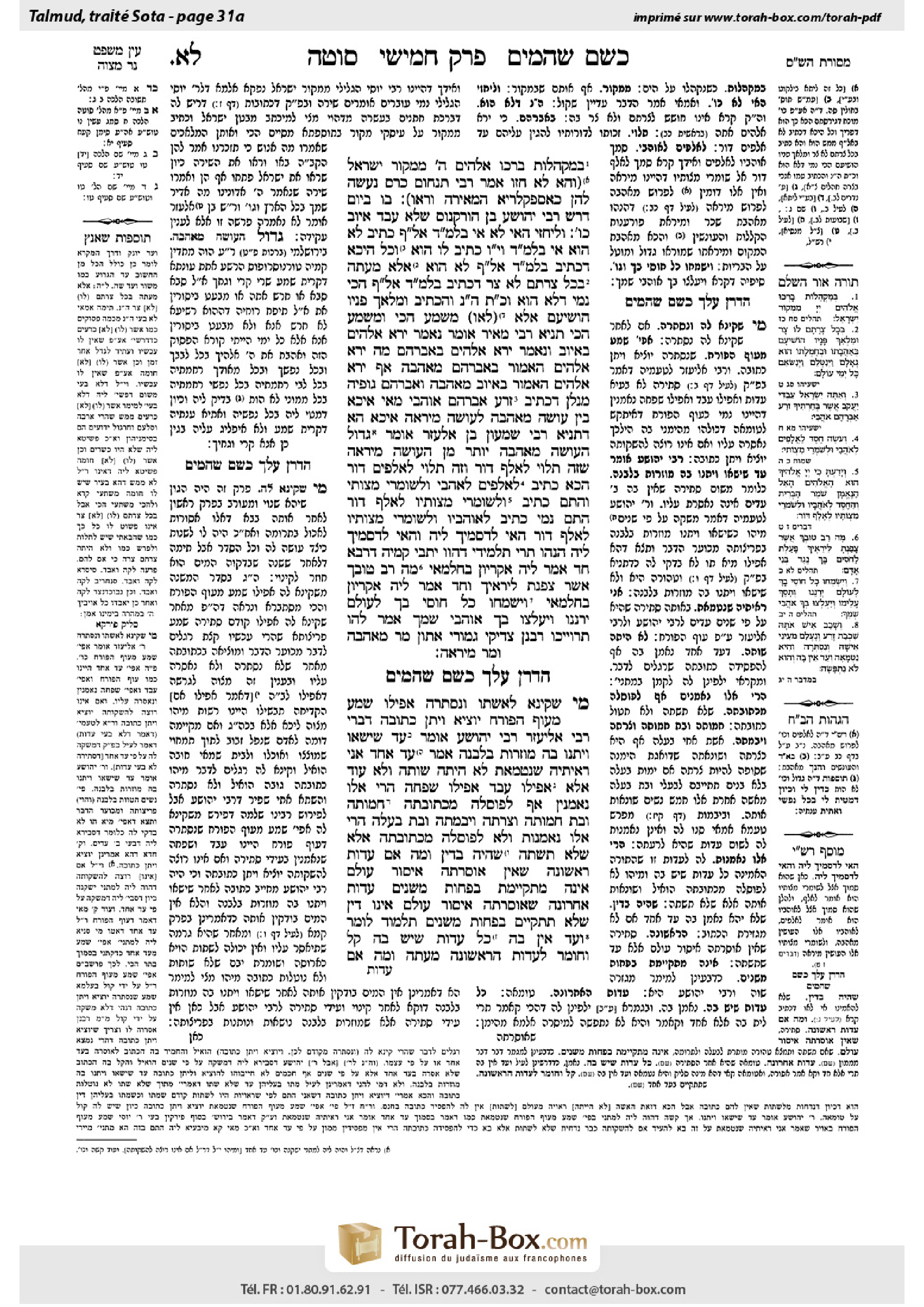
Sotah 31a: Talmud study for Daf Yomi
Daf Yomi is the daily study of one Talmud folio. Explore 37 tractates with scans, Hebrew text, Sefaria English and AI-generated French translations where annotated.
Passage selection and English or AI-generated French translation are available where the scan has annotations. Daf Study is independent of Torah-Box and Sefaria.
Browse Sotah · סוטה · All tractatesSotah 31a text and translations
This page of Sotah includes the Aramaic text, an English translation and an AI-generated French translation, alongside the scan above.
סוטה ל״א א · Aramaic and Hebrew text
״בְּמַקְהֵלוֹת בָּרְכוּ אֱלֹהִים ה׳ מִמְּקוֹר יִשְׂרָאֵל״.
וְהָא לָא חֲזוֹ? אָמַר רַבִּי תַּנְחוּם: כָּרֵס נַעֲשָׂה לָהֶן כְּאַסְפַּקְלַרְיָא הַמְּאִירָה וְרָאוּ.
בּוֹ בַּיּוֹם דָּרַשׁ רַבִּי יְהוֹשֻׁעַ בֶּן הוּרְקָנוֹס שֶׁלֹּא עָבַד אִיּוֹב כּוּ׳. וְלִיחְזֵי הַאי ״לֹא״, אִי בְּלָמֶד אָלֶף כְּתִיב — ״לֹא״ הוּא, אִי בְּלָמֶד וָיו כְּתִיב — ״לוֹ״ הוּא?
וְכׇל הֵיכָא דִּכְתִיב בְּלָמֶד אָלֶף, ״לֹא״ הוּא? אֶלָּא מֵעַתָּה ״בְּכׇל צָרָתָם לֹא צָר״, דִּכְתִיב בְּלָמֶד אָלֶף, הָכִי נָמֵי דְּ״לֹא״ הוּא?
וְכִי תֵּימָא הָכִי נָמֵי, וְהָכְתִיב ״וּמַלְאַךְ פָּנָיו הוֹשִׁיעָם״! אֶלָּא לָאו, מַשְׁמַע הָכִי וּמַשְׁמַע הָכִי.
תַּנְיָא, רַבִּי מֵאִיר אוֹמֵר: נֶאֱמַר ״יְרֵא אֱלֹהִים״ בְּאִיּוֹב, וְנֶאֱמַר ״יְרֵא אֱלֹהִים״ בְּאַבְרָהָם, מָה ״יְרֵא אֱלֹהִים״ הָאָמוּר בְּאַבְרָהָם — מֵאַהֲבָה, אַף ״יְרֵא אֱלֹהִים״ הָאָמוּר בְּאִיּוֹב — מֵאַהֲבָה.
וְאַבְרָהָם גּוּפֵיהּ מְנָלַן — דִּכְתִיב ״זֶרַע אַבְרָהָם אֹהֲבִי״.
מַאי אִיכָּא בֵּין עוֹשֶׂה מֵאַהֲבָה לְעוֹשֶׂה מִיִּרְאָה? אִיכָּא הָא דְּתַנְיָא, רַבִּי שִׁמְעוֹן בֶּן אֶלְעָזָר אוֹמֵר: גָּדוֹל הָעוֹשֶׂה מֵאַהֲבָה יוֹתֵר מִן הָעוֹשֶׂה מִיִּרְאָה, שֶׁזֶּה תָּלוּי לְאֶלֶף דּוֹר. וְזֶה תָּלוּי לְאַלְפַּיִם דּוֹר.
הָכָא כְּתִיב: ״לַאֲלָפִים לְאֹהֲבַי וּלְשֹׁמְרֵי מִצְוֹתָי״, וְהָתָם כְּתִיב: ״וּלְשֹׁמְרֵי מִצְוֹתָיו לְאֶלֶף דּוֹר״.
הָתָם נָמֵי כְּתִיב ״לְאֹהֲבָיו וּלְשֹׁמְרֵי מִצְוֹתָיו לְאֶלֶף דּוֹר״!
הַאי לְדִסְמִיךְ לֵיהּ וְהַאי לְדִסְמִיךְ לֵיהּ.
הָנְהוּ תְּרֵי תַּלְמִידֵי דַּהֲווֹ יָתְבִי קַמֵּיהּ דְּרָבָא, חַד אָמַר לֵיהּ אַקְרְיוּן בְּחֶלְמַאי: ״מָה רַב טוּבְךָ אֲשֶׁר צָפַנְתָּ לִּירֵאֶיךָ״, וְחַד אָמַר לֵיהּ: אַקְרְיוּן בְּחֶלְמַאי ״וְיִשְׂמְחוּ כׇל חוֹסֵי בָךְ לְעוֹלָם יְרַנֵּנוּ וְיַעְלְצוּ בְךָ אֹהֲבֵי שְׁמֶךָ״. אֲמַר לְהוּ: תַּרְוַיְיכוּ רַבָּנַן צַדִּיקֵי גְּמוּרֵי אַתּוּן. מָר מֵאַהֲבָה, וּמָר מִיִּרְאָה.
הֲדַרַן עֲלָךְ כְּשֵׁם שֶׁהַמַּיִם
מִי שֶׁקִּינֵּא לְאִשְׁתּוֹ וְנִסְתְּרָה, אֲפִילּוּ שָׁמַע מֵעוֹף הַפּוֹרֵחַ — יוֹצִיא וְיִתֵּן כְּתוּבָּה, דִּבְרֵי רַבִּי אֱלִיעֶזֶר.
רַבִּי יְהוֹשֻׁעַ אוֹמֵר: עַד שֶׁיִּשְׂאוּ וְיִתְּנוּ בָּהּ מוֹזְרוֹת בַּלְּבָנָה.
אָמַר עֵד אֶחָד ״אֲנִי רְאִיתִיהָ שֶׁנִּטְמֵאת״ — לֹא הָיְתָה שׁוֹתָה. וְלֹא עוֹד, אֶלָּא אֲפִילּוּ עֶבֶד אֲפִילּוּ שִׁפְחָה — הֲרֵי אֵלּוּ נֶאֱמָנִין אַף לְפוֹסְלָהּ מִכְּתוּבָּתָהּ.
חֲמוֹתָהּ וּבַת חֲמוֹתָהּ וְצָרָתָהּ וִיבִמְתָּהּ וּבַת בַּעְלָהּ — הֲרֵי אֵלּוּ נֶאֱמָנוֹת. וְלֹא לְפוֹסְלָהּ מִכְּתוּבָּתָהּ, אֶלָּא שֶׁלֹּא תִּשְׁתֶּה.
שֶׁהָיָה בַּדִּין: וּמָה אִם עֵדוּת רִאשׁוֹנָה, שֶׁאֵין אוֹסַרְתָּהּ אִיסּוּר עוֹלָם — אֵינָהּ מִתְקַיֶּימֶת בְּפָחוֹת מִשְּׁנַיִם, עֵדוּת אַחֲרוֹנָה, שֶׁאוֹסַרְתָּהּ אִיסּוּר עוֹלָם — אֵינוֹ דִּין שֶׁלֹּא תִּתְקַיֵּים בְּפָחוֹת מִשְּׁנַיִם?
תַּלְמוּד לוֹמַר: ״וְעֵד אֵין בָּהּ״, כׇּל עֵדוּת שֶׁיֵּשׁ בָּהּ.
וְקַל וָחוֹמֶר לְעֵדוּת הָרִאשׁוֹנָה מֵעַתָּה: וּמָה אִם
Sotah 31a · English translation
“In full assemblies, bless God, the Lord, you that are from the source of Israel” (Psalms 68:27), indicating that even children that are in the “source,” i.e., their mother’s womb, blessed God when they gathered at the sea.
The Gemara asks: But the fetuses could not see, so how could they have honestly said: “This is my God and I will glorify him”? Rabbi Tanḥum says: Their mother’s stomach was transformed for them like luminous crystal [aspaklarya], and they saw through it.
§ On that same day Rabbi Yehoshua ben Hyrcanus taught that Job served the Holy One, Blessed be He, only out of love, as it is stated: “Though He will slay me, still I will trust in Him [lo]” (Job 13:15). The mishna continues that the word lo in the verse is ambiguous as to whether it is indicative of Job expressing his yearning for God or his lack thereof. The Gemara asks: Let us see whether this word lo is written lamed alef, and therefore its meaning is: I will not trust, or whether it is written lamed vav, according to which its meaning is: I trust in Him. Why is there room for doubt with regard to the meaning of the verse?
The Gemara counters: But is it true that anywhere that the word lo is written lamed alef, its meaning is: Not? If that is so, then in the verse: “In all their affliction He was [lo] afflicted” (Isaiah 63:9), where the word lo is written lamed alef, so too, does it mean: Not, i.e., God was not afflicted in the afflictions of the Jewish people?
And if you would say that indeed that is the meaning of the verse, but isn’t it written in the continuation of that same verse: “And the angel of His Presence saved them,” which clearly indicates that God was concerned with their afflictions? Evidently, the word lo in that verse means: “In all their affliction He was afflicted.” Rather, is it not clear that lamed alef sometimes indicates this and sometimes indicates that? Therefore, the mishna had to derive the proper meaning of the word from another verse.
It is taught in a baraita (Tosefta 6:1) that Rabbi Meir says: It is stated with regard to Job that he was “God-fearing” (Job 1:1), and it is stated with regard to Abraham that he was “God-fearing” (Genesis 22:12). Just as the description “God-fearing,” which is stated with regard to Abraham, is referring to Abraham’s fearing God out of love, so too, the description “God-fearing” that is stated with regard to Job indicates that Job feared God out of love.
The Gemara asks: And with regard to Abraham himself, from where do we derive that he acted out of a sense of love? As it is written: “The offspring of Abraham who loved Me” (Isaiah 41:8).
The Gemara asks: What difference is there between one who performs mitzvot out of love and one who performs mitzvot out of fear? The Gemara answers: There is that which is taught in a baraita that Rabbi Shimon ben Elazar says: Greater is the one who performs mitzvot out of love than the one who performs mitzvot out of fear, as with regard to this one who acts out of fear, his merits endure for one thousand generations, and with regard to that one who serves God out of love, his merits endure for two thousand generations.
Proof of this assertion is that here it is written: “And showing mercy unto thousands of generations of those who love Me and keep My commandments” (Exodus 20:5), indicating that merits can last for thousands of generations for those who act out of love, and there it is written: “Know therefore that the Lord your God, He is God; the faithful God, Who keeps the covenant and mercy with those who love Him and keep His commandments for a thousand generations” (Deuteronomy 7:9). The first verse indicates that those who act out of love retain their merits for thousands of generations, whereas the second verse, which mentions only one thousand generations of merit, is referring to the merits of those who keep God’s mitzvot out of fear.
The Gemara asks: But there also, in the second verse, it is written: “The faithful God, Who keeps the covenant and mercy with those who love Him and keep His commandments for a thousand generations” (Deuteronomy 7:9). Why is the verse interpreted specifically with regard to those who worship God out of fear, yet it is written that they keep His mitzvot out of love? Both types of people seem to be indicated in both verses.
The Gemara answers: That verse, which mentions one thousand generations, is understood as referring to that which is adjacent to it. The phrase “for a thousand generations” is understood as referring those who perform mitzvot out of fear, as it is written immediately preceding the phrase “and keep His commandments,” which does not mention love. And this verse, which mentions thousands of generations, is understood as referring to that which is adjacent to it: “Unto thousands of generations of those who love Me.”
It happened that there were these two students who were sitting before Rava, and one said to him: It was read to me in my dream: “How abundant is Your goodness, which You have laid up for those who fear You” (Psalms 31:20). And one said to Rava: It was read to me in my dream: “So shall all those who take refuge in You rejoice; they will forever shout for joy, and You will shelter them; let them also who love Your name exult in You” (Psalms 5:12). Rava said to them: You are both completely righteous Sages. One Sage, the second dreamer, serves God out of love, and one Sage, the first dreamer, serves God out of fear. Each Sage’s dream corresponded to his manner of serving God.
MISHNA: In the case of one who warned his wife not to seclude herself with a particular man and she subsequently secluded herself with the man she was warned about, even if he heard about it from a flying bird, or any other source whatsoever, he must divorce his wife. However, he must still grant her the money accorded to her by her marriage contract because there is no actual proof of her seclusion with the man in question. This is the statement of Rabbi Eliezer, who, as quoted in the first mishna of the tractate (2a), holds that there is no necessity for witnesses to testify with regard to the seclusion, and the woman becomes forbidden to her husband even in the absence of witnesses, by the husband’s word alone.
Rabbi Yehoshua disagrees, as he did in the mishna (2a), and says: He does not divorce his wife in the absence of witnesses until the gossiping women who sit and spin thread by the light of the moon begin to discuss her behavior, as they share the gossip of the town. The Gemara earlier (6b) taught that a woman whose infidelity became subject to this public discussion can no longer be tested by the bitter water of a sota. Consequently, she must get divorced.
The mishna continues to list various possible testimonies concerning such acts of seclusion. If one witness said: I saw that she became defiled during her seclusion by engaging in sexual intercourse with that other man, she does not drink the bitter water, but rather, he divorces her immediately. And furthermore, even if the one who testified was a slave or a maidservant, neither of whom is generally regarded as a valid witness, they are deemed credible to testify to the wife’s adultery even to the extent that their testimony disqualifies her from receiving her marriage contract and prevents her from drinking the bitter water.
The mishna continues by listing women whose testimony is only partially accepted concerning this matter: Her mother-in-law, and her mother in-law’s daughter, and her rival wife, i.e., a second wife of the husband, and her yevama, i.e., her husband’s brother’s wife, and her husband’s daughter, all of whom are generally not deemed credible if they say anything incriminating pertaining to this woman due to the tumultuous relationships these women often have. They are all deemed credible to testify concerning the woman’s defilement while in seclusion, but are not deemed credible to the extent that their testimony will disqualify her from receiving her marriage contract; rather, it is deemed credible to the extent that she will not drink of the bitter water of a sota.
This ruling allowing one witness’s testimony with regard to defilement needs to be stated, as, by right, it should not have been deemed credible based on the following a fortiori inference: And just as if with regard to the first testimony concerning seclusion, which does not forbid her with an irrevocable prohibition, as the woman can be found innocent permitting her again to her husband by drinking the bitter water, is not established with fewer than two witnesses, since according to the mishna the testimony of seclusion requires two witnesses, then with regard to the final testimony concerning defilement, which forbids her to her husband with an irrevocable prohibition, is it not logical that it should also not be established with fewer than two witnesses?
Therefore, to counter this derivation, the verse states: “And there be no witness against her” (Numbers 5:13), teaching that any testimony with regard to defilement that there is against her is sufficient, and two witnesses are not required.
The Mishnah asks: And from now that it is established that one witness suffices to testify with regard to defilement, an a fortiori inference can be made with regard to the first testimony of seclusion: And just as if
Sotah 31a · Traduction française (IA)
« Dans les assemblées réunies, bénissez Dieu, le Seigneur, vous qui êtes issus de la source d’Israël » (Psaumes 68:27), ce qui indique que même les enfants qui se trouvaient dans la « source », c’est-à-dire dans le ventre de leur mère, bénirent Dieu lorsqu’ils se rassemblèrent au bord de la mer.
La Guemara demande : Mais les fœtus ne pouvaient pas voir ; comment ont-ils donc pu dire sincèrement : « Voici mon Dieu, et je le glorifierai » ? Rabbi Tanḥum dit : Le ventre de leur mère fut transformé pour eux en un cristal lumineux [aspaklarya], à travers lequel ils virent.
§ Ce même jour, Rabbi Yehoshua ben Hyrcanus enseigna que Job ne servit le Saint, béni soit-Il, que par amour, comme il est dit : « Même s’Il me tue, j’aurai confiance en Lui [lo] » (Job 13:15). La Michna poursuit en indiquant que le mot lo, dans ce verset, peut être compris de deux façons : il peut exprimer le désir de Job de se rapprocher de Dieu ou son absence de désir. La Guemara demande : Voyons si ce mot lo s’écrit avec un lamed alef, auquel cas il signifie : « Je n’aurai pas confiance », ou avec un lamed vav, auquel cas il signifie : « J’ai confiance en Lui ». Pourquoi le sens du verset est-il donc incertain ?
La Guemara objecte : Mais est-il vrai que partout où le mot lo s’écrit avec un lamed alef, il signifie « non » ? Si tel est le cas, dans le verset : « Dans toute leur détresse, Il était [lo] dans la détresse » (Isaïe 63:9), où le mot lo s’écrit avec un lamed alef, cela signifie-t-il également « non », c’est-à-dire que Dieu n’était pas affligé par les détresses du peuple juif ?
Et si tu dis que c’est effectivement le sens du verset, n’est-il pas écrit dans la suite de ce même verset : « Et l’ange de Sa Présence les sauva », ce qui indique clairement que Dieu se souciait de leurs détresses ? Il apparaît donc que le mot lo, dans ce verset, signifie : « Dans toute leur détresse, Il était dans la détresse. » N’est-il donc pas clair que le lamed alef peut parfois avoir ce sens et parfois l’autre ? La Michna devait donc déduire le sens correct du mot d’un autre verset.
Il est enseigné dans une baraïta (Tosefta 6:1) que Rabbi Meïr dit : Il est dit à propos de Job qu’il était « craignant Dieu » (Job 1:1), et il est dit à propos d’Abraham qu’il était « craignant Dieu » (Genèse 22:12). De même que l’expression « craignant Dieu », employée à propos d’Abraham, fait référence à la crainte de Dieu par amour, de même l’expression « craignant Dieu », employée à propos de Job, indique que Job craignait Dieu par amour.
La Guemara demande : Et à propos d’Abraham lui-même, d’où savons-nous qu’il agissait par amour ? Comme il est écrit : « La descendance d’Abraham, qui m’a aimé » (Isaïe 41:8).
La Guemara demande : Quelle différence y a-t-il entre celui qui accomplit les mitsvot par amour et celui qui les accomplit par crainte ? La Guemara répond : La baraïta suivante l’enseigne : Rabbi Shimon ben Elazar dit que celui qui accomplit les mitsvot par amour est supérieur à celui qui les accomplit par crainte. En effet, les mérites de celui qui agit par crainte perdurent pendant mille générations, tandis que ceux de celui qui sert Dieu par amour perdurent pendant deux mille générations.
La preuve en est qu’il est écrit ici : « et qui use de bonté envers des milliers de générations de ceux qui m’aiment et qui gardent mes commandements » (Exode 20:5), ce qui indique que les mérites de ceux qui agissent par amour peuvent durer des milliers de générations ; et il est écrit là : « Sache donc que l’Éternel ton Dieu, c’est Dieu, le Dieu fidèle, qui garde l’alliance et la bonté envers ceux qui l’aiment et qui gardent ses commandements, jusqu’à mille générations » (Deutéronome 7:9). Le premier verset indique que ceux qui agissent par amour conservent leurs mérites pendant des milliers de générations, tandis que le second verset, qui ne mentionne qu’un millier de générations de mérites, fait référence aux mérites de ceux qui accomplissent les mitsvot de Dieu par crainte.
La Guemara demande : Mais là aussi, dans le second verset, il est écrit : « le Dieu fidèle, qui garde l’alliance et la bonté envers ceux qui l’aiment et qui gardent ses commandements, jusqu’à mille générations » (Deutéronome 7:9). Pourquoi interpréter le verset comme faisant spécifiquement référence à ceux qui servent Dieu par crainte, alors qu’il est écrit qu’ils accomplissent ses mitsvot par amour ? Les deux catégories de personnes semblent être désignées dans les deux versets.
La Guemara répond : Ce verset, qui mentionne mille générations, est compris comme se rapportant à ce qui le précède immédiatement. L’expression « jusqu’à mille générations » est comprise comme faisant référence à ceux qui accomplissent les mitsvot par crainte, car elle précède immédiatement l’expression « et qui gardent ses commandements », qui ne mentionne pas l’amour. Et ce verset, qui mentionne des milliers de générations, est compris comme se rapportant à ce qui le précède immédiatement : « envers des milliers de générations de ceux qui m’aiment ».
Il arriva que deux élèves étaient assis devant Rava. L’un lui dit : Dans mon rêve, on m’a lu : « Que ta bonté est grande, celle que tu réserves à ceux qui te craignent » (Psaumes 31:20). L’autre dit à Rava : Dans mon rêve, on m’a lu : « Que tous ceux qui se réfugient en toi se réjouissent, qu’ils poussent des cris de joie à jamais, et que tu les abrites ; que ceux qui aiment ton nom exultent en toi » (Psaumes 5:12). Rava leur dit : Vous êtes tous deux des sages parfaitement justes. L’un des sages, celui qui a fait le second rêve, sert Dieu par amour, et l’autre, celui qui a fait le premier rêve, sert Dieu par crainte. Le rêve de chacun des sages correspondait à sa manière de servir Dieu.
MICHNA : Si un homme a averti sa femme de ne pas s’isoler avec un homme en particulier et qu’elle s’est ensuite isolée avec l’homme contre lequel il l’avait mise en garde, même s’il l’a appris par un oiseau de passage ou par toute autre source, il doit divorcer de sa femme. Toutefois, il doit lui verser la somme prévue par son contrat de mariage, car il n’existe aucune preuve véritable qu’elle se soit isolée avec l’homme en question. Telle est la déclaration de Rabbi Eliezer, qui soutient, comme cela a été cité dans la première Michna du traité (2a), qu’il n’est pas nécessaire que des témoins attestent l’isolement : la femme devient interdite à son mari même en l’absence de témoins, sur la seule parole du mari.
Rabbi Yehoshua n’est pas d’accord, comme dans la Michna (2a), et dit : En l’absence de témoins, il ne divorce pas de sa femme avant que les femmes médisantes, qui s’assoient et filent au clair de lune, ne commencent à parler de son comportement, puisqu’elles colportent les commérages de la ville. La Guemara a enseigné plus tôt (6b) qu’une femme dont l’infidélité est devenue l’objet de discussions publiques ne peut plus être mise à l’épreuve par les eaux amères d’une sota. Elle doit donc être répudiée.
La Michna poursuit en énumérant différents témoignages possibles concernant de tels actes d’isolement. Si un témoin a dit : « J’ai vu qu’elle s’est souillée pendant son isolement en ayant des relations sexuelles avec cet autre homme », elle ne boit pas les eaux amères ; son mari la divorce immédiatement. De plus, même si le témoin est un esclave ou une servante — dont aucun n’est généralement considéré comme un témoin valide —, ils sont jugés crédibles pour témoigner de l’adultère de l’épouse, au point que leur témoignage la prive de la somme prévue par son contrat de mariage et l’empêche de boire les eaux amères.
La Michna poursuit en énumérant les femmes dont le témoignage n’est accepté que partiellement sur cette question : sa belle-mère, la fille de sa belle-mère, sa rivale, c’est-à-dire une seconde épouse du mari, sa yevama, c’est-à-dire la femme du frère de son mari, et la fille de son mari. En règle générale, elles ne sont pas jugées crédibles si elles disent quelque chose à charge contre cette femme, en raison des relations souvent conflictuelles qu’elles entretiennent avec elle. Elles sont toutes jugées crédibles pour témoigner de la souillure de la femme pendant son isolement, mais leur témoignage n’est pas jugé crédible au point de la priver de la somme prévue par son contrat de mariage ; il est plutôt jugé crédible au point qu’elle ne boive pas les eaux amères d’une sota.
Il est nécessaire d’énoncer cette règle qui autorise le témoignage d’un seul témoin concernant la souillure, car, en toute rigueur, son témoignage n’aurait pas dû être jugé crédible, d’après le raisonnement a fortiori suivant : si, pour le premier témoignage, concernant l’isolement — qui n’entraîne pas une interdiction irrévocable, puisqu’une femme peut être reconnue innocente et de nouveau autorisée à vivre avec son mari après avoir bu les eaux amères —, il faut au moins deux témoins, car, selon la Michna, le témoignage concernant l’isolement exige deux témoins, alors, pour le témoignage final, concernant la souillure, qui l’interdit irrévocablement à son mari, n’est-il pas logique qu’il faille également au moins deux témoins ?
Par conséquent, pour réfuter cette déduction, le verset dit : « et qu’il n’y ait pas de témoin contre elle » (Nombres 5:13), enseignant que tout témoignage à charge concernant la souillure suffit et qu’il n’est pas nécessaire d’avoir deux témoins.
La Michna demande : Et maintenant qu’il est établi qu’un seul témoin suffit pour témoigner de la souillure, on peut faire un raisonnement a fortiori au sujet du premier témoignage, concernant l’isolement : si
Traduction française générée par IA à partir de l’édition anglaise de Sefaria. Vérifie toujours un passage avec le texte source.
Text from Sefaria: William Davidson Edition - Vocalized Aramaic (CC BY NC); William Davidson Edition - English (CC BY NC).