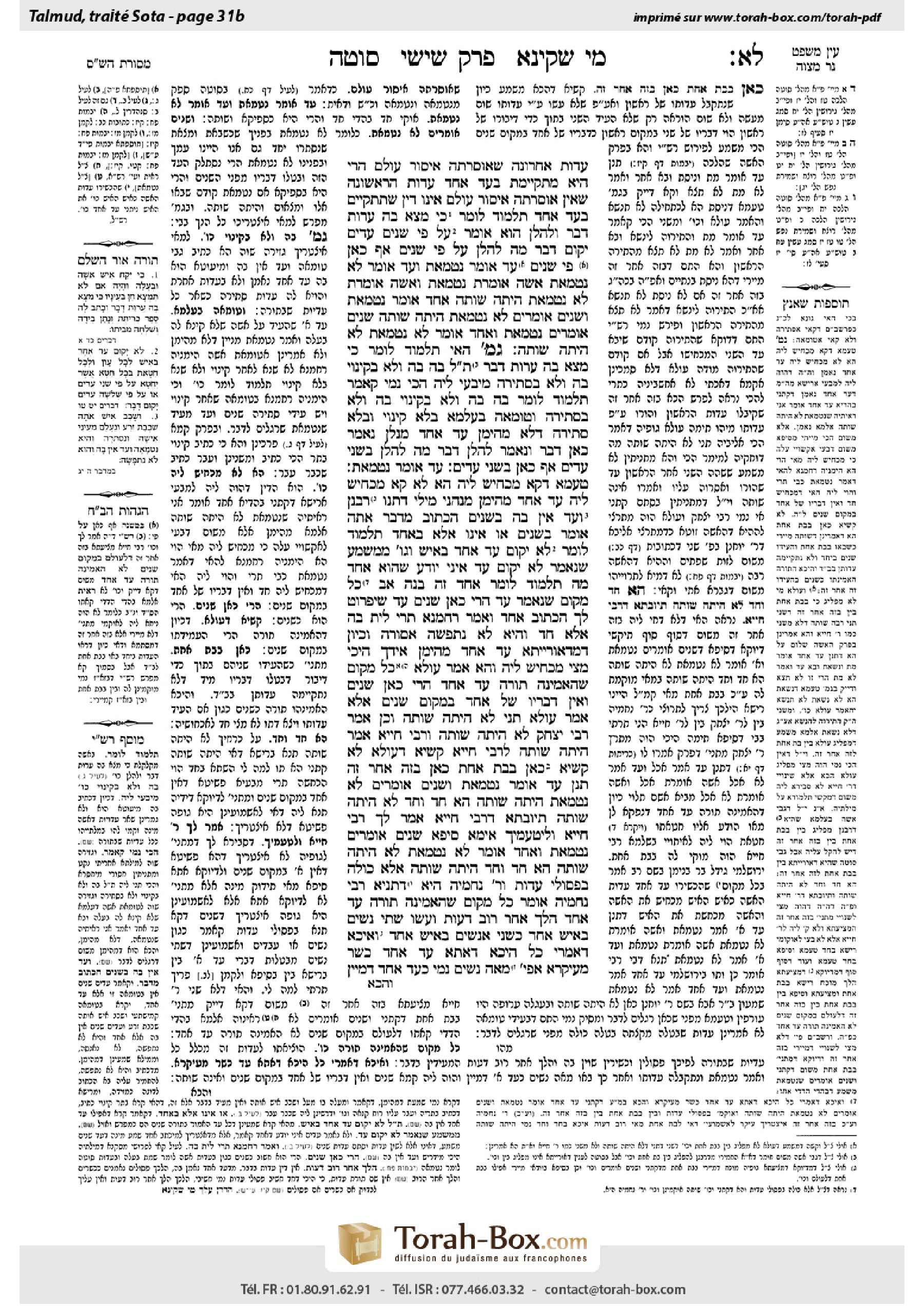
Sotah 31b: Talmud study for Daf Yomi
Daf Yomi is the daily study of one Talmud folio. Explore 37 tractates with scans, Hebrew text, Sefaria English and AI-generated French translations where annotated.
Passage selection and English or AI-generated French translation are available where the scan has annotations. Daf Study is independent of Torah-Box and Sefaria.
Browse Sotah · סוטה · All tractatesSotah 31b text and translations
This page of Sotah includes the Aramaic text, an English translation and an AI-generated French translation, alongside the scan above.
סוטה ל״א ב · Aramaic and Hebrew text
עֵדוּת אַחֲרוֹנָה שֶׁאוֹסַרְתָּהּ אִיסּוּר עוֹלָם — הֲרֵי הִיא מִתְקַיֶּימֶת בְּעֵד אֶחָד, עֵדוּת הָרִאשׁוֹנָה שֶׁאֵין אוֹסַרְתָּהּ אִיסּוּר עוֹלָם — אֵינוֹ דִּין שֶׁתִּתְקַיֵּים בְּעֵד אֶחָד?
תַּלְמוּד לוֹמַר: ״כִּי מָצָא בָהּ עֶרְוַת דָּבָר״, וּלְהַלָּן הוּא אוֹמֵר: ״עַל פִּי שְׁנֵי עֵדִים ... יָקוּם דָּבָר״, מָה לְהַלָּן עַל פִּי שְׁנַיִם — אַף כָּאן פִּי שְׁנַיִם.
עֵד אוֹמֵר ״נִטְמֵאת״ וְעֵד אוֹמֵר ״לֹא נִטְמֵאת״, אִשָּׁה אוֹמֶרֶת ״נִטְמֵאת״ וְאִשָּׁה אוֹמֶרֶת ״לֹא נִטְמֵאת״ — הָיְתָה שׁוֹתָה.
אֶחָד אוֹמֵר ״נִטְמֵאת״ וּשְׁנַיִם אוֹמְרִים ״לֹא נִטְמֵאת״ — הָיְתָה שׁוֹתָה. שְׁנַיִם אוֹמְרִים ״נִטְמֵאת״ וְאֶחָד אוֹמֵר ״לֹא נִטְמֵאת״ — לֹא הָיְתָה שׁוֹתָה.
גְּמָ׳ הַאי תַּלְמוּד לוֹמַר ״כִּי מָצָא בָהּ עֶרְוַת דָּבָר״,
תַּלְמוּד לוֹמַר ״בָּהּ״ — בָּהּ וְלֹא בְּקִינּוּי, בָּהּ וְלֹא בִּסְתִירָה מִיבְּעֵי לֵיהּ!
הָכִי נָמֵי קָאָמַר: תַּלְמוּד לוֹמַר ״בָּהּ״ — בָּהּ וְלֹא בְּקִינּוּי, בָּהּ וְלֹא בִּסְתִירָה.
וְטוּמְאָה בְּעָלְמָא בְּלֹא קִינּוּי וּבְלֹא סְתִירָה, דְּלָא מְהֵימַן עֵד אֶחָד מְנָלַן? נֶאֱמַר כָּאן ״דָּבָר״, וְנֶאֱמַר לְהַלָּן ״דָּבָר״. מָה לְהַלָּן בִּשְׁנֵי עֵדִים — אַף כָּאן בִּשְׁנֵי עֵדִים.
עֵד אוֹמֵר נִטְמֵאת. טַעְמָא דְּקָא מַכְחֵישׁ לֵיהּ, הָא לָא קָא מַכְחֵישׁ לֵיהּ — עֵד אֶחָד מְהֵימַן,
מְנָהָנֵי מִילֵּי? דְּתָנוּ רַבָּנַן: ״וְעֵד אֵין בָּהּ״ — בִּשְׁנַיִם הַכָּתוּב מְדַבֵּר.
אַתָּה אוֹמֵר בִּשְׁנַיִם, אוֹ אֵינוֹ אֶלָּא בְּאֶחָד — תַּלְמוּד לוֹמַר: ״לֹא יָקוּם עֵד אֶחָד בְּאִישׁ וְגוֹ׳״.
מִמַּשְׁמַע שֶׁנֶּאֱמַר ״לֹא יָקוּם עֵד״, אֵינִי יוֹדֵעַ שֶׁהוּא אֶחָד, מָה תַּלְמוּד לוֹמַר ״אֶחָד״ — זֶה בָּנָה אָב: כׇּל מָקוֹם שֶׁנֶּאֱמַר ״עֵד״ — הֲרֵי כָּאן שְׁנַיִם, עַד שֶׁיִּפְרוֹט לְךָ הַכָּתוּב ״אֶחָד״.
וְאָמַר רַחֲמָנָא: תְּרֵי לֵית בַּהּ אֶלָּא חַד, ״וְהִיא לֹא נִתְפָּשָׂה״ — אֲסוּרָה.
וְכֵיוָן דְּמִדְּאוֹרָיְיתָא עֵד אֶחָד מְהֵימַן, אִידַּךְ הֵיכִי מָצֵי מַכְחֵישׁ לֵיהּ? וְהָא אָמַר עוּלָּא: כׇּל מָקוֹם שֶׁהֶאֱמִינָה תּוֹרָה עֵד אֶחָד, הֲרֵי כָּאן שְׁנַיִם, וְאֵין דְּבָרָיו שֶׁל אֶחָד בִּמְקוֹם שְׁנַיִם!
אֶלָּא אָמַר עוּלָּא, תְּנִי: לֹא הָיְתָה שׁוֹתָה. וְכֵן אָמַר רַבִּי יִצְחָק: לֹא הָיְתָה שׁוֹתָה. וְרַבִּי חִיָּיא אָמַר: הָיְתָה שׁוֹתָה.
לְרַבִּי חִיָּיא קַשְׁיָא דְּעוּלָּא. לָא קַשְׁיָא: כָּאן בְּבַת אַחַת. כָּאן בְּזֶה אַחַר זֶה.
תְּנַן: עֵד אוֹמֵר ״נִטְמֵאת״ וּשְׁנַיִם אוֹמְרִים ״לֹא נִטְמֵאת״ — הָיְתָה שׁוֹתָה. הָא חַד וְחַד — לֹא הָיְתָה שׁוֹתָה, תְּיוּבְתָּא דְּרַבִּי חִיָּיא!
אָמַר לָךְ רַבִּי חִיָּיא: וְלִיטַעְמָיךְ, אֵימָא סֵיפָא: שְׁנַיִם אוֹמְרִים ״נִטְמֵאת״ וְאֶחָד אוֹמֵר ״לֹא נִטְמֵאת״ — לֹא הָיְתָה שׁוֹתָה. הָא חַד וְחַד — הָיְתָה שׁוֹתָה.
אֶלָּא, כּוּלַּהּ בִּפְסוּלֵי עֵדוּת, וְרַבִּי נְחֶמְיָה הִיא. דְּתַנְיָא, רַבִּי נְחֶמְיָה אוֹמֵר: כׇּל מָקוֹם שֶׁהֶאֱמִינָה תּוֹרָה עֵד אֶחָד — הַלֵּךְ אַחַר רוֹב דֵּעוֹת, וְעָשׂוּ שְׁתֵּי נָשִׁים בְּאִישׁ אֶחָד כִּשְׁנֵי אֲנָשִׁים בְּאִישׁ אֶחָד.
וְאִיכָּא דְאָמְרִי: כׇּל הֵיכָא דַּאֲתָא עֵד אֶחָד כָּשֵׁר מֵעִיקָּרָא — אֲפִילּוּ מֵאָה נָשִׁים נָמֵי כְּעֵד אֶחָד דָּמְיָין.
Sotah 31b · English translation
concerning the final testimony of defilement, which forbids her with an irrevocable prohibition, yet it is established by one witness, then with regard to the first testimony, which does not forbid her with an irrevocable prohibition, is it not logical that it should be established with only one witness?
Therefore, to counter this derivation, the verse states: “When a man takes a wife, and marries her, and it comes to pass, if she finds no favor in his eyes, because he has found some unseemly matter [davar] in her” (Deuteronomy 24:1), and there, in the laws concerning monetary matters, it states: “At the mouth of two witnesses, or at the mouth of three witnesses, shall a matter [davar] be established” (Deuteronomy 19:15), teaching that just as the “matter” stated there is established “at the mouth of two witnesses,” so too, here the “matter” of her seclusion must be established “at the mouth of two witnesses.”
The mishna discusses the halakha in a case where two single witnesses contradict each other concerning her defilement. If one witness says: She was defiled, and another witness says: She was not defiled, or similarly in the case of those normally disqualified from bearing witness, if one woman says: She was defiled, and another woman says: She was not defiled, she would drink the bitter water of a sota, due to the uncertainty engendered by the contradictory testimonies.
Similarly, if one witness says: She was defiled, and two witnesses say: She was not defiled, she would drink the bitter water. However, if two would say: She was defiled, and one says: She was not defiled, the testimony of the two witnesses is accepted and she would not drink the bitter water, and the husband must divorce her.
GEMARA: The Gemara questions why the mishna proves the need for two witnesses to testify about the seclusion based upon the verbal analogy of “matter” and “matter,” if there is an explicit source in the Torah stating that two witnesses are required. This reason is given by the mishna: The verse states: “When a man takes a wife, and marries her, and it comes to pass, if she finds no favor in his eyes, because he has found some unseemly matter [davar] in her” (Deuteronomy 24:1), which through a verbal analogy based on the word “davar” teaches the need for two witnesses, seems to be superfluous.
As, the mishna should have said in its place: The verse states: “She was defiled secretly and there was no witness [ed] against her [bah]” (Numbers 5:13), which is explained to mean there were not two witnesses, but only one, who testified concerning her defilement. One can infer from the term “bah,” which could also be understood as: With regard to it, that in this matter of defilement one witness suffices, but not with regard to the warning. Additionally, one can infer: With regard to it, but not with regard to the seclusion. Therefore, there must be two witnesses to testify about both the warning and seclusion.
The Gemara answers: That is also what the tanna of the mishna is saying. The source for the halakha that there is a requirement for two witnesses to testify about the seclusion is that the verse states: With regard to it, that in this matter of defilement one witness suffices, but not with regard to the warning. With regard to it, but not with regard to the seclusion.
The Gemara continues to explain the mishna: And concerning an ordinary accusation of defilement without a previous warning and without an act of seclusion with another man, from where do we derive that a single witness is not deemed credible? It is for this halakha that the mishna cites the verbal analogy: It is stated here: “Because he has found some unseemly matter [davar] in her” (Deuteronomy 24:1), and it is stated there concerning monetary matters: “At the mouth of two witnesses, or at the mouth of three witnesses, shall a matter [davar] be established” (Deuteronomy 19:15). Just as the “matter” stated there with regard to monetary matters is clarified specifically by the testimony of two witnesses, so too, here with regard to adultery the “matter” of her defilement must be established by the testimony of at least two witnesses.
§ The mishna taught: If one witness says: She was defiled, and another witness says: She was not defiled, she drinks the bitter water of a sota. The Gemara infers from this statement in the mishna that the reason the woman would drink the bitter water in this case is specifically because the second witness refutes his testimony, but if a second witness did not refute his testimony, then a single witness would be relied upon in this case and the woman would be forbidden to her husband forever.
From where are these matters derived? As the Sages taught in reference to the verse describing the circumstances in which a woman defiled through an act of adultery becomes prohibited to her husband, which states: “And a man lie with her carnally…and there be no witness [ed] against her” (Numbers 5:13); the verse is speaking of a lack of two witnesses. When the verse refers to the lack of an ed, written in the singular, it actually indicates that there are not two witnesses against her, but only one, as the baraita will now explain.
The baraita continues and asks: Do you say that the verse refers only to a case where there was not even one witness to the act of sexual intercourse, as the singular usage of the word ed would seem to indicate? The baraita now proves that the singular usage notwithstanding, elsewhere the word ed is used to indicate two witnesses, as the verse states: “One witness [ed] shall not rise up against a man for any iniquity or any sin that he sins; at the mouth of two witnesses, or at the mouth of three witnesses, shall a matter be established” (Deuteronomy 19:15).
The baraita infers a general principle from this verse by asking: By inference from that which is stated in the verse, even with the omission of the word “one”: “A witness shall not rise up against a man” (Deuteronomy 19:15), do I not know that it is referring to one witness, as the verse is written in the singular form? What is the meaning when the verse states explicitly: “One witness,” being that it is obviously referring to only one witness? The baraita answers: This established a paradigm for the principle that every place where the word “witness [ed]” is stated in the Torah without specifying a number, there are two witnesses here, until the verse specifies that it is referring to only one witness, by writing the word “one.”
The baraita returns to discuss the verse concerning a sota. And the Merciful One states: “There was no witness [ed] against her,” which therefore means that: There are not two witnesses to the sexual intercourse that could testify with regard to her, rather there is only one witness. The baraita completes its interpretation: Further in the verse it states: “And she was not taken in the act” (Numbers 5:13), indicating that the verse is referring to a case in which it is known that the woman had not been raped. This knowledge is based on the testimony of only one witness, as the verse had already stated that there were not two witnesses, and since one witness saw her willingly engage in sexual intercourse with another man, she is forbidden to her husband.
The Gemara asks: But since the baraita taught that by Torah law one witness is deemed credible to state that the woman is defiled, how can the other witness who denies the wife’s infidelity refute him with his conflicting testimony and enable the woman to drink the bitter water instead of becoming forbidden outright to her husband? But doesn’t Ulla say: Wherever the Torah relies on one witness, there is the equivalent of the testimony of two witnesses here. Consequently, the testimony of the contradicting witness should be insignificant, as the statement of one witness has no standing in a place where it is contradicted by two witnesses, for the witness testifying about her infidelity is deemed credible as if two witnesses had testified.
Rather, Ulla said: Teach the mishna in the following way: If one witness says: She was defiled, and another witness says: She was not defiled, she would not drink the bitter water. And likewise, Rabbi Yitzḥak said: She would not drink. But Rabbi Ḥiyya says in line with the standard text of the mishna: She would drink the bitter water even in the case of a contradiction between two single witnesses with regard to her infidelity.
The Gemara asks: But for Rabbi Ḥiyya, how will he respond to the same difficulty due to the teaching of Ulla, who explained that when a single witness is deemed credible he is considered as two and cannot be contradicted by a single witness to the contrary? The Gemara answers: This is not difficult: Here, the mishna is discussing a case where both witnesses arrived in court and testified simultaneously, thereby canceling each other out. But there, Ulla’s principle, that whenever a single witness’s testimony is accepted it is considered as two and cannot be contradicted by a single witness testifying to the contrary, is referring to a case in which the two conflicting witnesses came to court and testified one after the other.
But we learned in the mishna above that if one witness says: She was defiled, and two say: She was not defiled, she would drink the bitter water. The Gemara deduces from here: The implications of this statement are that the woman drinks only because the testimony of the incriminating witness was contradicted by two witnesses, but if there was one witness saying she was defiled and only one witness saying the opposite, she would not drink; this is a conclusive refutation of the opinion of Rabbi Ḥiyya.
The Gemara answers: Rabbi Ḥiyya could have said to you: And according to your reasoning that she would not drink, say the latter clause of the mishna, which states: If two witnesses say: She was defiled, and one says: She was not defiled, the testimony of the two witnesses is accepted and she would not drink the bitter water. But you should deduce from here that if there was one witness testifying to her defilement and one witness stating the opposite, she would drink the bitter water. This inference is in line with Rabbi Ḥiyya’s explanation, and contradicts the inference from the previous clause.
The Gemara explains: Rather, the correct understanding is that the entire mishna is not dealing with valid witnesses, and stating an obvious halakha in order to enable an inference, but with people who are disqualified from giving testimony, and is teaching us a novel ruling. And the mishna is in accordance with the opinion of Rabbi Neḥemya. As it is taught in a baraita (Tosefta Yevamot 14:1) that Rabbi Neḥemya says: Wherever the Torah relies on one witness, follow the majority of opinions. In other words, if the testimonies of two disqualified witnesses conflict, the court rules in accordance with the version supported by more witnesses, whether or not they are qualified to testify. And the Sages established that the testimony of two women, who are usually disqualified from testifying, when they testify in opposition to one man, should be like that of two men against one man, and the court will rule in accordance with the testimony of the two women.
And some say that Rabbi Neḥemya actually stated something different: And there are those who say a different version of Rabbi Neḥemya’s approach: Anywhere that one valid witness came initially, even one hundred women who later contradict him are considered like one witness, and do not override his testimony.
Sotah 31b · Traduction française (IA)
Concernant le témoignage final de souillure, qui lui interdit irrévocablement son mari, il suffit pourtant d’un seul témoin. À plus forte raison, le premier témoignage, qui ne lui interdit pas irrévocablement son mari, ne devrait-il pas être établi par un seul témoin ?
Par conséquent, pour réfuter cette déduction, le verset dit : « Lorsqu’un homme prend une femme et l’épouse, et qu’il arrive que celle-ci ne trouve pas grâce à ses yeux, parce qu’il a découvert en elle quelque chose d’inconvenant [davar] » (Deutéronome 24, 1). Or, à propos des affaires pécuniaires, il est dit : « C’est sur la déclaration de deux témoins ou sur la déclaration de trois témoins qu’une affaire [davar] sera établie » (Deutéronome 19, 15). Cela enseigne que, de même que l’« affaire » mentionnée là est établie « sur la déclaration de deux témoins », de même, ici, l’« affaire » de son isolement doit être établie « sur la déclaration de deux témoins ».
La Michna traite de la halakha dans le cas où deux témoins isolés se contredisent au sujet de sa souillure. Si un témoin dit : « Elle a été souillée », et qu’un autre dit : « Elle n’a pas été souillée », ou, de même, dans le cas de personnes habituellement inaptes à témoigner, si une femme dit : « Elle a été souillée », et qu’une autre dit : « Elle n’a pas été souillée », elle boit les eaux amères de la sota, en raison de l’incertitude créée par les témoignages contradictoires.
De même, si un témoin dit : « Elle a été souillée », et que deux témoins disent : « Elle n’a pas été souillée », elle boit les eaux amères. En revanche, si deux témoins disent : « Elle a été souillée », et qu’un seul dit : « Elle n’a pas été souillée », le témoignage des deux témoins est retenu ; elle ne boit pas les eaux amères et son mari doit divorcer d’elle.
GUEMARA : La Guemara demande pourquoi la Michna prouve, par l’analogie verbale entre « affaire » et « affaire », qu’il faut deux témoins pour attester l’isolement, alors qu’il existe dans la Torah une source explicite indiquant que deux témoins sont requis. Le motif donné par la Michna — le verset dit : « Lorsqu’un homme prend une femme et l’épouse, et qu’il arrive que celle-ci ne trouve pas grâce à ses yeux, parce qu’il a découvert en elle quelque chose d’inconvenant [davar] » (Deutéronome 24, 1) — semble superflu, puisqu’une analogie verbale fondée sur le mot « davar » enseigne qu’il faut deux témoins.
En effet, la Michna aurait dû dire à cet endroit : Le verset dit : « Elle a été souillée en secret, sans qu’il y ait de témoin [ed] contre elle [bah] » (Nombres 5, 13). On explique que cela signifie qu’il n’y avait pas deux témoins, mais seulement un, qui a témoigné de sa souillure. On peut déduire du terme « bah », qui peut aussi s’entendre comme « à son sujet », que, dans cette affaire de souillure, un seul témoin suffit, mais pas pour la mise en garde. De plus, on peut déduire : à son sujet, mais pas au sujet de l’isolement. Il faut donc deux témoins pour attester à la fois la mise en garde et l’isolement.
La Guemara répond : C’est également ce que dit le tanna de la Michna. La source de la halakha selon laquelle deux témoins doivent attester l’isolement est la suivante : le verset dit « à son sujet », c’est-à-dire que, dans cette affaire de souillure, un seul témoin suffit, mais pas pour la mise en garde ; « à son sujet », mais pas au sujet de l’isolement.
La Guemara poursuit l’explication de la Michna : Et concernant une accusation ordinaire de souillure, sans mise en garde préalable ni acte d’isolement avec un autre homme, d’où déduisons-nous qu’un témoin isolé n’est pas cru ? C’est pour cette halakha que la Michna cite l’analogie verbale : il est dit ici : « Parce qu’il a découvert en elle quelque chose d’inconvenant [davar] » (Deutéronome 24, 1), et il est dit là, à propos des affaires pécuniaires : « C’est sur la déclaration de deux témoins ou sur la déclaration de trois témoins qu’une affaire [davar] sera établie » (Deutéronome 19, 15). De même que l’« affaire » mentionnée là, à propos des affaires pécuniaires, est établie précisément par le témoignage de deux témoins, de même, ici, en matière d’adultère, l’« affaire » de sa souillure doit être établie par le témoignage d’au moins deux témoins.
§ La Michna enseigne : Si un témoin dit : « Elle a été souillée », et qu’un autre dit : « Elle n’a pas été souillée », elle boit les eaux amères de la sota. La Guemara déduit de cette déclaration de la Michna que la femme boirait les eaux amères dans ce cas précisément parce que le second témoin réfute le témoignage du premier. Mais si aucun second témoin ne réfutait son témoignage, on se fierait alors à un témoin isolé dans ce cas, et la femme serait définitivement interdite à son mari.
D’où déduisons-nous ces principes ? Les Sages ont enseigné au sujet du verset décrivant les circonstances dans lesquelles une femme souillée par un acte d’adultère devient interdite à son mari. Le verset dit : « Qu’un homme ait couché avec elle charnellement… et qu’il n’y ait pas de témoin [ed] contre elle » (Nombres 5, 13) ; il s’agit de l’absence de deux témoins. Lorsque le verset évoque l’absence d’un ed, écrit au singulier, cela indique en réalité qu’il n’y a pas deux témoins contre elle, mais un seul, comme la baraïta va l’expliquer.
La baraïta poursuit et demande : Veux-tu dire que le verset ne parle que d’un cas où il n’y avait même pas un seul témoin de l’acte sexuel, comme le singulier du mot ed semblerait l’indiquer ? La baraïta prouve maintenant que, malgré son emploi au singulier, le mot ed désigne ailleurs deux témoins, comme le dit le verset : « Un témoin [ed] ne se lèvera pas contre un homme pour quelque faute ou quelque péché qu’il ait commis ; c’est sur la déclaration de deux témoins ou sur la déclaration de trois témoins qu’une affaire sera établie » (Deutéronome 19, 15).
La baraïta déduit de ce verset un principe général en demandant : À partir de ce qui est dit dans le verset, même sans le mot « un » — « Un témoin ne se lèvera pas contre un homme » (Deutéronome 19, 15) — ne sais-je pas qu’il s’agit d’un seul témoin, puisque le verset est formulé au singulier ? Que signifie donc le fait que le verset précise explicitement « un témoin », alors qu’il est évident qu’il ne peut s’agir que d’un seul témoin ? La baraïta répond : Cela établit le principe suivant : partout où le mot « témoin [ed] » apparaît dans la Torah sans que le nombre soit précisé, il s’agit de deux témoins, jusqu’à ce que le verset indique qu’il n’est question que d’un seul témoin en employant le mot « un ».
La baraïta revient au verset concernant une sota. Le Miséricordieux dit : « Il n’y avait pas de témoin [ed] contre elle », ce qui signifie qu’il n’y avait pas deux témoins de la relation sexuelle susceptibles de témoigner à son sujet, mais seulement un. La baraïta achève son interprétation : Plus loin dans le verset, il est dit : « Et elle n’a pas été prise sur le fait » (Nombres 5, 13), ce qui indique que le verset parle d’un cas où l’on sait que la femme n’a pas été violée. Cette connaissance repose sur le témoignage d’un seul témoin, puisque le verset a déjà indiqué qu’il n’y avait pas deux témoins ; et comme un témoin l’a vue avoir volontairement une relation sexuelle avec un autre homme, elle est interdite à son mari.
La Guemara demande : Mais puisque la baraïta a enseigné que, selon la Torah, un témoin isolé est cru lorsqu’il déclare que la femme est souillée, comment l’autre témoin, qui nie l’infidélité de l’épouse, peut-il le réfuter par son témoignage contradictoire et permettre ainsi à la femme de boire les eaux amères, plutôt que de devenir immédiatement interdite à son mari ? Or, Oula ne dit-il pas : Partout où la Torah se fie à un seul témoin, celui-ci équivaut ici au témoignage de deux témoins ? Par conséquent, le témoignage du témoin qui le contredit devrait être sans effet, car le témoignage d’un seul témoin ne saurait avoir de poids là où il est contredit par deux témoins : le témoin qui atteste son infidélité est cru comme si deux témoins avaient témoigné.
Mais Oula a dit : Enseigne la Michna ainsi : Si un témoin dit : « Elle a été souillée », et qu’un autre dit : « Elle n’a pas été souillée », elle ne boit pas les eaux amères. De même, Rabbi Yitsḥak a dit : Elle ne boit pas. Mais Rabbi Ḥiyya dit, conformément au texte habituel de la Michna : Elle boit les eaux amères, même dans le cas où deux témoins isolés se contredisent au sujet de son infidélité.
La Guemara demande : Mais comment Rabbi Ḥiyya répondra-t-il à la même difficulté fondée sur l’enseignement d’Oula, qui explique que lorsqu’un témoin isolé est cru, il est considéré comme deux témoins et ne peut être contredit par un seul témoin ? La Guemara répond : Il n’y a pas de difficulté. Ici, la Michna parle d’un cas où les deux témoins se sont présentés au tribunal et ont témoigné simultanément, annulant ainsi leurs témoignages respectifs. Mais là, le principe d’Oula — selon lequel, chaque fois que le témoignage d’un seul témoin est accepté, celui-ci est considéré comme deux témoins et ne peut être contredit par un seul témoin qui témoigne du contraire — concerne un cas où les deux témoins en désaccord se sont présentés au tribunal et ont témoigné l’un après l’autre.
Mais nous avons appris dans la Michna ci-dessus que, si un témoin dit : « Elle a été souillée », et que deux témoins disent : « Elle n’a pas été souillée », elle boit les eaux amères. La Guemara en déduit que la femme ne boit que parce que le témoignage qui l’accuse a été contredit par deux témoins. Mais s’il y avait un témoin disant qu’elle a été souillée et un seul témoin disant le contraire, elle ne boirait pas. C’est une réfutation décisive de l’opinion de Rabbi Ḥiyya.
La Guemara répond : Rabbi Ḥiyya aurait pu te dire : Selon ton raisonnement, si elle ne boit pas, considère la clause suivante de la Michna, qui dit : Si deux témoins disent : « Elle a été souillée », et qu’un seul dit : « Elle n’a pas été souillée », le témoignage des deux témoins est retenu et elle ne boit pas les eaux amères. Or, il faudrait en déduire que si un témoin atteste qu’elle a été souillée et qu’un autre affirme le contraire, elle boit les eaux amères. Cette déduction correspond à l’explication de Rabbi Ḥiyya et contredit celle tirée de la clause précédente.
La Guemara explique : En réalité, toute la Michna ne traite pas de témoins aptes à témoigner et n’énonce pas une halakha évidente afin de permettre une déduction ; elle traite de personnes inaptes à témoigner et nous enseigne une règle nouvelle. La Michna est conforme à l’opinion de Rabbi Neḥemya. En effet, il est enseigné dans une baraïta (Tossefta Yevamot 14, 1) que Rabbi Neḥemya dit : Partout où la Torah se fie à un seul témoin, suivez l’avis majoritaire. Autrement dit, si les témoignages de deux témoins inaptes se contredisent, le tribunal statue selon la version soutenue par le plus grand nombre de témoins, qu’ils soient aptes à témoigner ou non. Les Sages ont établi que le témoignage de deux femmes, habituellement inaptes à témoigner, lorsqu’elles témoignent contre un homme, équivaut à celui de deux hommes contre un homme ; le tribunal statue donc selon le témoignage des deux femmes.
Et certains disent que Rabbi Neḥemya a en réalité formulé une autre règle. Selon une autre version de son approche : chaque fois qu’un témoin apte a témoigné le premier, même cent femmes qui le contredisent par la suite sont considérées comme un seul témoin et ne prévalent pas sur son témoignage.
Traduction française générée par IA à partir de l’édition anglaise de Sefaria. Vérifie toujours un passage avec le texte source.
Text from Sefaria: William Davidson Edition - Vocalized Aramaic (CC BY NC); William Davidson Edition - English (CC BY NC).