Sotah 32a: Talmud study for Daf Yomi
Daf Yomi is the daily study of one Talmud folio. Explore 37 tractates with scans, Hebrew text, Sefaria English and AI-generated French translations where annotated.
Passage selection and English or AI-generated French translation are available where the scan has annotations. Daf Study is independent of Torah-Box and Sefaria.
Browse Sotah · סוטה · All tractatesSotah 32a text and translations
This page of Sotah includes the Aramaic text, an English translation and an AI-generated French translation, alongside the scan above.
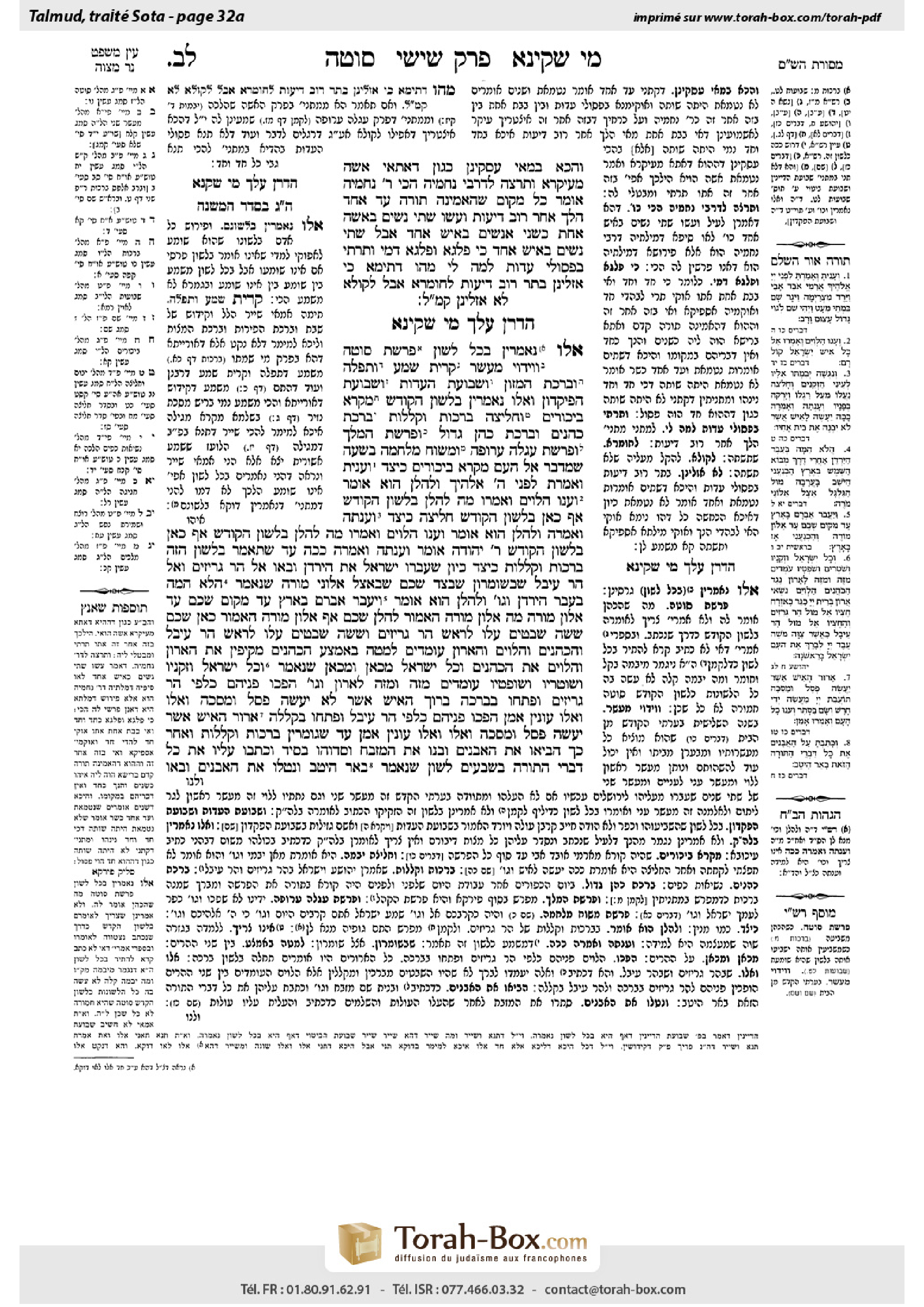
סוטה ל״ב א · Aramaic and Hebrew text
וְהָכָא בְּמַאי עָסְקִינַן — כְּגוֹן דַּאֲתַאי אִשָּׁה מֵעִיקָּרָא.
וְתָרְצַהּ לִדְרַבִּי נְחֶמְיָה הָכִי, רַבִּי נְחֶמְיָה אוֹמֵר: כׇּל מָקוֹם שֶׁהֶאֱמִינָה תּוֹרָה עֵד אֶחָד — הַלֵּךְ אַחַר רוֹב דֵּיעוֹת, וְעָשׂוּ שְׁתֵּי נָשִׁים בְּאִשָּׁה אַחַת כִּשְׁנֵי אֲנָשִׁים בְּאִישׁ אֶחָד. אֲבָל שְׁתֵּי נָשִׁים בְּאִישׁ אֶחָד — כִּי פַּלְגָא וּפַלְגָא דָּמֵי.
וְתַרְתֵּי בִּפְסוּלֵי עֵדוּת לְמָה לִי? מַהוּ דְּתֵימָא: כִּי אָזְלִינַן בָּתַר רוֹב דֵּיעוֹת לְחוּמְרָא, אֲבָל לְקוּלָּא לָא אָזְלִינַן, קָא מַשְׁמַע לַן.
הֲדַרַן עֲלָךְ מִי שֶׁקִּינֵּא
אֵלּוּ נֶאֱמָרִין בְּכׇל לָשׁוֹן: פָּרָשַׁת סוֹטָה, וּוִידּוּי מַעֲשֵׂר, קְרִיַּת שְׁמַע, וּתְפִלָּה, וּבִרְכַּת הַמָּזוֹן, וּשְׁבוּעַת הָעֵדוּת, וּשְׁבוּעַת הַפִּיקָּדוֹן.
וְאֵלּוּ נֶאֱמָרִין בִּלְשׁוֹן הַקּוֹדֶשׁ: מִקְרָא בִּיכּוּרִים, וַחֲלִיצָה, בְּרָכוֹת וּקְלָלוֹת, בִּרְכַּת כֹּהֲנִים, וּבִרְכַּת כֹּהֵן גָּדוֹל, וּפָרָשַׁת הַמֶּלֶךְ, וּפָרָשַׁת עֶגְלָה עֲרוּפָה, וּמְשׁוּחַ מִלְחָמָה בְּשָׁעָה שֶׁמְּדַבֵּר אֶל הָעָם.
מִקְרָא בִּיכּוּרִים כֵּיצַד? ״וְעָנִיתָ וְאָמַרְתָּ לִפְנֵי ה׳ אֱלֹהֶיךָ״, וּלְהַלָּן הוּא אוֹמֵר: ״וְעָנוּ הַלְוִיִּם וְאָמְרוּ״. מָה לְהַלָּן בִּלְשׁוֹן הַקּוֹדֶשׁ — אַף כָּאן בִּלְשׁוֹן הַקּוֹדֶשׁ.
חֲלִיצָה כֵּיצַד? ״וְעָנְתָה וְאָמְרָה״, וּלְהַלָּן הוּא אוֹמֵר: ״וְעָנוּ הַלְוִיִּם וְאָמְרוּ״. מָה לְהַלָּן בִּלְשׁוֹן הַקּוֹדֶשׁ — אַף כָּאן בִּלְשׁוֹן הַקּוֹדֶשׁ.
רַבִּי יְהוּדָה אוֹמֵר: ״וְעָנְתָה וְאָמְרָה כָּכָה״ — עַד שֶׁתֹּאמַר בַּלָּשׁוֹן הַזֶּה.
בְּרָכוֹת וּקְלָלוֹת כֵּיצַד? כֵּיוָן שֶׁעָבְרוּ יִשְׂרָאֵל אֶת הַיַּרְדֵּן וּבָאוּ אֶל הַר גְּרִיזִים וְאֶל הַר עֵיבָל שֶׁבְּשׁוֹמְרוֹן, שֶׁבְּצַד שְׁכֶם, שֶׁבְּאֵצֶל אֵלוֹנֵי מוֹרֶה. שֶׁנֶּאֱמַר: ״הֲלֹא הֵמָּה בְּעֵבֶר הַיַּרְדֵּן וְגוֹ׳״, וּלְהַלָּן הוּא אוֹמֵר: ״וַיַּעֲבֹר אַבְרָם בָּאָרֶץ עַד מְקוֹם שְׁכֶם עַד אֵלוֹן מוֹרֶה״. מָה אֵלוֹן מוֹרֶה הָאָמוּר לְהַלָּן — שְׁכֶם, אַף אֵלוֹן מוֹרֶה הָאָמוּר כָּאן — שְׁכֶם.
שִׁשָּׁה שְׁבָטִים עָלוּ לְרֹאשׁ הַר גְּרִיזִים וְשִׁשָּׁה שְׁבָטִים עָלוּ לְרֹאשׁ הַר עֵיבָל, וְהַכֹּהֲנִים וְהַלְוִיִּם וְהָאָרוֹן עוֹמְדִים לְמַטָּה בָּאֶמְצַע. הַכֹּהֲנִים מַקִּיפִין אֶת הָאָרוֹן, וְהַלְוִיִּם אֶת הַכֹּהֲנִים, וְכׇל יִשְׂרָאֵל מִכָּאן וּמִכָּאן, שֶׁנֶּאֱמַר: ״וְכׇל יִשְׂרָאֵל וּזְקֵנָיו וְשֹׁטְרִים וְשֹׁפְטָיו עוֹמְדִים מִזֶּה וּמִזֶּה לָאָרוֹן וְגוֹ׳״.
הָפְכוּ פְּנֵיהֶם כְּלַפֵּי הַר גְּרִיזִים וּפָתְחוּ בִּבְרָכָה: ״בָּרוּךְ הָאִישׁ אֲשֶׁר לֹא יַעֲשֶׂה פֶסֶל וּמַסֵּכָה״, וְאֵלּוּ וָאֵלּוּ עוֹנִין ״אָמֵן״. הָפְכוּ פְּנֵיהֶם כְּלַפֵּי הַר עֵיבָל וּפָתְחוּ בִּקְלָלָה: ״אָרוּר הָאִישׁ אֲשֶׁר יַעֲשֶׂה פֶסֶל וּמַסֵּכָה״, וְאֵלּוּ וָאֵלּוּ עוֹנִין ״אָמֵן״, עַד שֶׁגּוֹמְרִין בְּרָכוֹת וּקְלָלוֹת.
וְאַחַר כָּךְ הֵבִיאוּ אֶת הָאֲבָנִים, וּבָנוּ אֶת הַמִּזְבֵּחַ, וְסָדוּהוּ בְּסִיד, וְכָתְבוּ עָלָיו אֶת כׇּל דִּבְרֵי הַתּוֹרָה בְּשִׁבְעִים לָשׁוֹן. שֶׁנֶּאֱמַר: ״בַּאֵר הֵיטֵב״. וְנָטְלוּ אֶת הָאֲבָנִים, וּבָאוּ
Sotah 32a · English translation
And with what are we dealing here in the mishna? A case where a woman, who is generally disqualified from bearing witness, came initially, and testified that the woman committed adultery, and two witnesses say that she did not.
And according to this interpretation you must amend the statement of Rabbi Neḥemya so that it reads like this: Rabbi Neḥemya says: Wherever the Torah relies on one witness, follow the majority of opinions. And the Sages established that two women against one woman are like two men against one man. But two women in opposition to one man that is a valid witness, is like half of a pair of witnesses and a half of a pair of witnesses, and the mishna did not address that case.
The Gemara poses a question on these two interpretations of the mishna: And why do I need two cases in the mishna to teach the halakha that the majority opinion of those disqualified from bearing witness is followed? The Gemara explains: It is necessary, lest you say that when we follow the majority opinion in the case of invalid witnesses, this is to be stringent to force the woman to drink the bitter water, e.g., if one witness said that she committed adultery and two said that she did not, but to be lenient and absolve her from having to drink the water we do not follow the majority opinion, and she would still drink the water even if there is one witness saying that she did not commit adultery, therefore the mishna teaches us that there is no difference in this regard, and the majority opinion is followed in any case.
MISHNA: These are recited in any language, not specifically Hebrew: The portion of the warning and the oath administered by the priest to a woman suspected by her husband of having been unfaithful [sota]; and the declaration of tithes, which occurs after the third and the sixth years of the seven-year Sabbatical cycle, when one declares that he has given his tithes appropriately; Shema; and the Amida prayer; and Grace after Meals; and an oath of testimony, where one takes an oath that he does not have any testimony to provide on a given issue; and an oath on a deposit, where one takes an oath that he does not have possession of another’s deposit.
And these are recited only in the sacred tongue, Hebrew: The recitation of the verses that one recounts when bringing the first fruits to the Temple; and the recitations which form an element of the ritual through which a yavam frees a yevama of her levirate bonds [ḥalitza]; the blessings and curses that were spoken on Mount Gerizim and Mount Ebal; the Priestly Benediction; and the blessing on the Torah recited by the High Priest on Yom Kippur; and the portion of the Torah read by the king at the assembly on Sukkot at the conclusion of the Sabbatical Year; and the portion recited during the ritual of a heifer whose neck is broken, when a person is found killed in an area that is between two cities, and the murderer is unknown; and the speech of a priest who is anointed for war when he addresses the nation before going out to battle.
How is it derived that the recitation when bringing the first fruits is recited specifically in Hebrew? When the Torah discusses this mitzva it states: “And you shall speak and say before the Lord your God” (Deuteronomy 26:5), and below, in the discussion of the blessings and curses, it states: “And the Levites shall speak and say” (Deuteronomy 27:14). Just as there, the Levites speak in the sacred tongue, so too here, the recitation is in the sacred tongue.
How is it derived that the recitation at a ḥalitza ceremony must be in Hebrew? The verse in the Torah portion discussing ḥalitza states: “And she shall speak and say” (Deuteronomy 25:9), and below it states: “And the Levites shall speak and say” (Deuteronomy 27:14). Just as there, the Levites speak in the sacred tongue, so too here, the recitation is in the sacred tongue.
Rabbi Yehuda says: This can be derived from a different word in the verse: “And she shall speak and say: So shall it be done to the man that does not build up his brother’s house” (Deuteronomy 25:9). The word “so” indicates that her statement is ineffective unless she says it in these exact words.
How did the ceremony of the blessings and curses take place? When the Jewish people crossed the Jordan River they came to Mount Gerizim and Mount Ebal, which are in Samaria alongside the city of Shechem, which is near the oaks of Moreh, as it is stated: “Are they not beyond the Jordan, behind the way of the going down of the sun, in the land of the Canaanites that dwell in the Arabah, over against Gilgal, beside the oaks of Moreh?” (Deuteronomy 11:30), and there it states: “And Abram passed through the land until the place of Shechem, until the oaks of Moreh” (Genesis 12:6). Just as the oaks of Moreh mentioned there with regard to Abraham are close to Shechem, so too, the oaks of Moreh mentioned here are close to Shechem.
Six tribes ascended to the top of Mount Gerizim and six tribes ascended to the top of Mount Ebal, and the priests and the Levites and the Ark were standing at the bottom in the middle, between the two mountains. The priests were surrounding the Ark and the Levites were surrounding the priests, and all the rest of the Jewish people were standing on the mountains on this side and on that side, as it is stated: “And all Israel, and their elders and officers, and their judges, stood on this side of the Ark and on that side before the priests the Levites that bore the Ark of the Covenant of the Lord” (Joshua 8:33).
The Levites then turned to face Mount Gerizim and opened with the blessing: Blessed be the man who does not make a graven or molten image (see Deuteronomy 27:15), and these people and those people, i.e., the two groups standing on either mountain, answered: Amen. Then they turned to face Mount Ebal and opened with the curse: “Cursed be the man who makes a graven or molten image” (Deuteronomy 27:15), and these people and those people answered: Amen. They continued in this manner until they completed reciting all of the blessings and curses.
And afterward they brought the stones as commanded in the Torah, and they built the altar and plastered it with plaster, and they wrote on it all of the words of the Torah in seventy languages, as it is stated: “And you shall write on the stones all the words of this law clearly elucidated” (Deuteronomy 27:8), indicating that it was to be written in every language. And they then took the stones from there and came
Sotah 32a · Traduction française (IA)
De quel cas traite ici la Michna ? D’une femme, généralement inapte à témoigner, qui s’est présentée la première et a témoigné que la femme avait commis l’adultère, tandis que deux témoins affirment qu’elle ne l’a pas commis.
Selon cette interprétation, il faut donc reformuler la déclaration de Rabbi Neḥemya comme suit : Rabbi Neḥemya dit : « Partout où la Torah s’en remet à un seul témoin, on suit l’avis majoritaire. » Les Sages ont établi que deux femmes opposées à une femme équivalent à deux hommes opposés à un homme. Mais deux femmes opposées à un homme qui est un témoin valable équivalent à une moitié de paire de témoins opposée à une autre moitié de paire de témoins ; la Michna n’a pas traité ce cas.
La Guemara soulève une question à propos de ces deux interprétations de la Michna : pourquoi faut-il deux cas dans la Michna pour enseigner la halakha selon laquelle on suit l’avis majoritaire des personnes inaptes à témoigner ? La Guemara explique : c’est nécessaire, de peur que tu dises que, lorsque nous suivons l’avis majoritaire dans le cas de témoins invalides, c’est pour appliquer une rigueur et obliger la femme à boire les eaux amères — par exemple, si un témoin dit qu’elle a commis l’adultère et que deux disent qu’elle ne l’a pas commis —, mais que nous ne suivons pas l’avis majoritaire pour appliquer une indulgence et la dispenser de boire les eaux ; elle devrait donc tout de même les boire, même si un témoin affirme qu’elle n’a pas commis l’adultère. La Michna nous enseigne donc qu’il n’y a pas de différence à cet égard et que, dans tous les cas, on suit l’avis majoritaire.
MICHNA : Voici les textes qui peuvent être récités dans n’importe quelle langue, et pas nécessairement en hébreu : le passage de l’avertissement et du serment que le prêtre fait prêter à une femme que son mari soupçonne d’infidélité [sota] ; la déclaration des dîmes, faite après la troisième et la sixième année du cycle sabbatique de sept ans, lorsqu’on déclare avoir prélevé correctement ses dîmes ; le Chéma ; la prière de la Amida ; la bénédiction après les repas ; le serment de témoignage, par lequel on jure n’avoir aucun témoignage à fournir sur une question donnée ; et le serment relatif à un dépôt, par lequel on jure ne pas détenir le dépôt d’autrui.
Et voici les textes qui ne peuvent être récités qu’en langue sainte, l’hébreu : les versets que l’on récite lorsqu’on apporte les prémices au Temple ; les formules qui font partie du rituel par lequel un yavam libère une yevama de son lien de lévirat [ḥalitza] ; les bénédictions et les malédictions prononcées sur le mont Garizim et le mont Ébal ; la bénédiction sacerdotale ; la bénédiction sur la Torah récitée par le grand prêtre à Yom Kippour ; le passage de la Torah lu par le roi lors de l’assemblée à Souccot, à la fin de l’année sabbatique ; le passage récité lors du rituel de la génisse dont on brise la nuque, lorsqu’on trouve une personne assassinée dans une région située entre deux villes et que le meurtrier est inconnu ; et le discours adressé au peuple avant le départ au combat par le prêtre oint pour la guerre.
Comment déduit-on que la récitation faite lors de l’apport des prémices doit se faire précisément en hébreu ? À propos de cette mitsva, la Torah dit : « Tu parleras et tu diras devant l’Éternel ton Dieu » (Deutéronome 26:5), et plus loin, à propos des bénédictions et des malédictions, elle dit : « Les Lévites parleront et diront » (Deutéronome 27:14). De même que là, les Lévites parlent en langue sainte, de même ici, la récitation se fait en langue sainte.
Comment déduit-on que la récitation lors de la cérémonie de ḥalitza doit se faire en hébreu ? Dans le passage de la Torah consacré à la ḥalitza, le verset dit : « Elle parlera et dira » (Deutéronome 25:9), et plus loin, il est dit : « Les Lévites parleront et diront » (Deutéronome 27:14). De même que là, les Lévites parlent en langue sainte, de même ici, la récitation se fait en langue sainte.
Rabbi Yehuda dit : on peut le déduire d’un autre mot du verset : « Elle parlera et dira : Ainsi sera-t-il fait à l’homme qui ne bâtit pas la maison de son frère » (Deutéronome 25:9). Le mot « ainsi » indique que sa déclaration n’est valable que si elle la prononce exactement en ces termes.
Comment s’est déroulée la cérémonie des bénédictions et des malédictions ? Lorsque le peuple juif traversa le Jourdain, il arriva au mont Garizim et au mont Ébal, situés en Samarie, près de la ville de Sichem, elle-même proche des chênes de Moré, comme il est dit : « Ne sont-ils pas au-delà du Jourdain, derrière la route du couchant, dans le pays des Cananéens qui habitent la Arava, en face de Guilgal, près des chênes de Moré ? » (Deutéronome 11:30). Et il est dit là : « Abram traversa le pays jusqu’au lieu de Sichem, jusqu’aux chênes de Moré » (Genèse 12:6). De même que les chênes de Moré mentionnés là, à propos d’Abraham, se trouvent près de Sichem, de même les chênes de Moré mentionnés ici se trouvent près de Sichem.
Six tribus montèrent au sommet du mont Garizim et six tribus montèrent au sommet du mont Ébal. Les prêtres, les Lévites et l’Arche se tenaient en bas, au milieu, entre les deux montagnes. Les prêtres entouraient l’Arche et les Lévites entouraient les prêtres ; tout le reste du peuple juif se tenait sur les montagnes, de part et d’autre, comme il est dit : « Tout Israël, ses anciens, ses officiers et ses juges se tenaient de part et d’autre de l’Arche, en face des prêtres lévites qui portaient l’Arche de l’alliance de l’Éternel » (Josué 8:33).
Les Lévites se tournèrent alors vers le mont Garizim et commencèrent par la bénédiction : « Béni soit l’homme qui ne fait pas d’idole sculptée ou moulée » (voir Deutéronome 27:15) ; les uns et les autres, c’est-à-dire les deux groupes se tenant sur chacune des montagnes, répondirent : « Amen. » Puis ils se tournèrent vers le mont Ébal et commencèrent par la malédiction : « Maudit soit l’homme qui fait une idole sculptée ou moulée » (Deutéronome 27:15) ; les uns et les autres répondirent : « Amen. » Ils continuèrent ainsi jusqu’à avoir achevé de réciter toutes les bénédictions et les malédictions.
Ensuite, ils apportèrent les pierres comme la Torah l’avait ordonné, bâtirent l’autel et le recouvrirent de plâtre, puis y inscrivirent toutes les paroles de la Torah en soixante-dix langues, comme il est dit : « Tu écriras sur les pierres toutes les paroles de cette loi, clairement exposées » (Deutéronome 27:8), ce qui indique qu’elles devaient être écrites dans toutes les langues. Puis ils emportèrent les pierres de là et se rendirent
Traduction française générée par IA à partir de l’édition anglaise de Sefaria. Vérifie toujours un passage avec le texte source.
Text from Sefaria: William Davidson Edition - Vocalized Aramaic (CC BY NC); William Davidson Edition - English (CC BY NC).