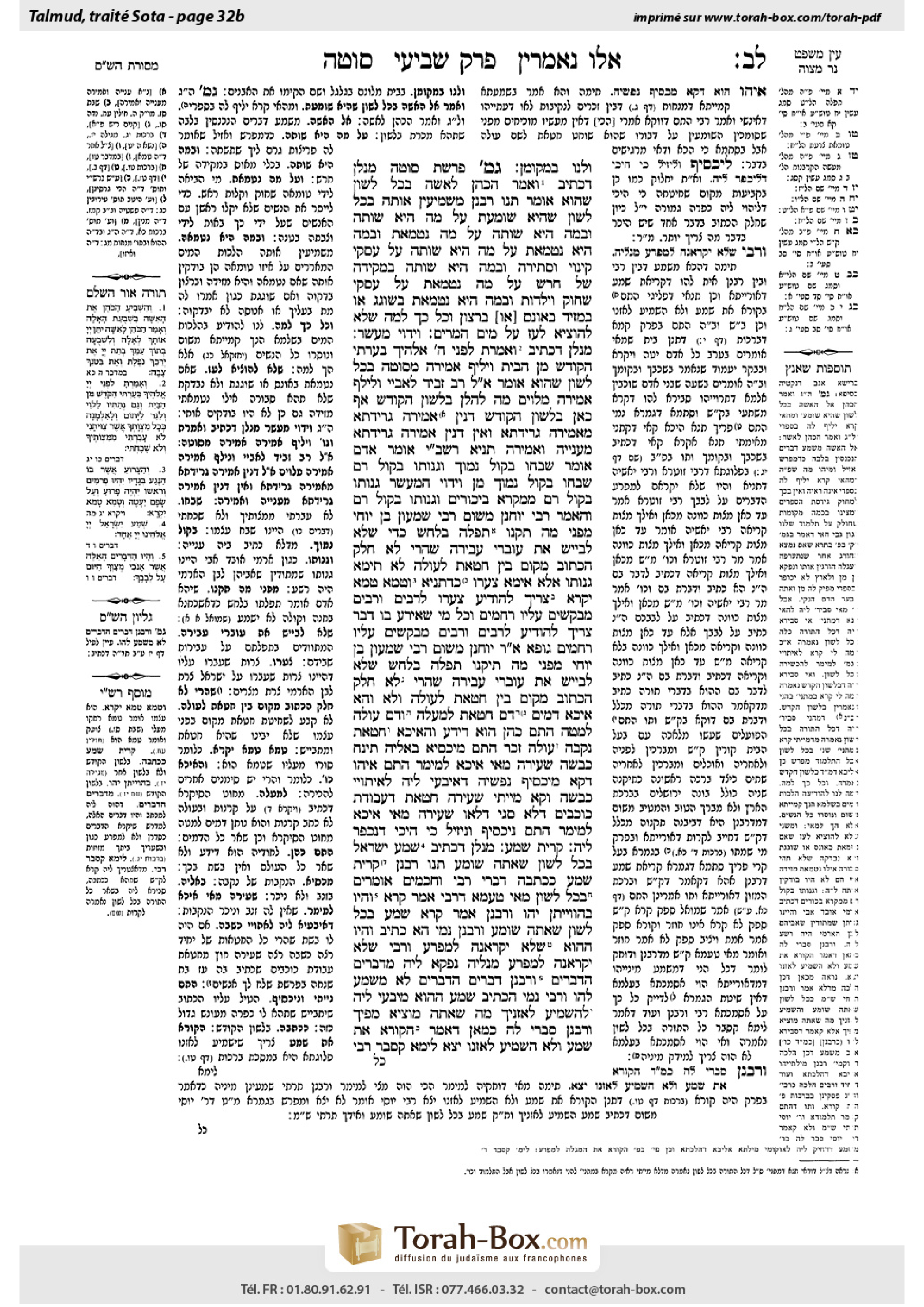
Sotah 32b: Talmud study for Daf Yomi
Daf Yomi is the daily study of one Talmud folio. Explore 37 tractates with scans, Hebrew text, Sefaria English and AI-generated French translations where annotated.
Passage selection and English or AI-generated French translation are available where the scan has annotations. Daf Study is independent of Torah-Box and Sefaria.
Browse Sotah · סוטה · All tractatesSotah 32b text and translations
This page of Sotah includes the Aramaic text, an English translation and an AI-generated French translation, alongside the scan above.
סוטה ל״ב ב · Aramaic and Hebrew text
וְלָנוּ בִּמְקוֹמָן.
גְּמָ׳ פָּרָשַׁת סוֹטָה מְנָלַן? — דִּכְתִיב: ״וְאָמַר הַכֹּהֵן לָאִשָּׁה״ — בְּכׇל לָשׁוֹן שֶׁהוּא אוֹמֵר.
תָּנוּ רַבָּנַן: מַשְׁמִיעִין אוֹתָהּ בְּכׇל לָשׁוֹן שֶׁהִיא שׁוֹמַעַת, עַל מָה הִיא שׁוֹתָה, וּבַמָּה הִיא שׁוֹתָה. עַל מָה נִטְמֵאת, וּבַמָּה הִיא נִטְמֵאת.
עַל מָה הִיא שׁוֹתָה — עַל עִסְקֵי קִינּוּי וּסְתִירָה, וּבַמָּה הִיא שׁוֹתָה — בִּמְקִידָּה שֶׁל חֶרֶשׂ.
עַל מָה נִטְמֵאת — עַל עִסְקֵי שְׂחוֹק וְיַלְדוּת. וּבַמָּה הִיא נִטְמֵאת — בְּשׁוֹגֵג אוֹ בְּמֵזִיד, בְּאוֹנֶס [אוֹ] בְּרָצוֹן. וְכׇל כָּךְ לָמָּה — שֶׁלֹּא לְהוֹצִיא לַעַז עַל מַיִם הַמָּרִים.
וִידּוּי מַעֲשֵׂר מְנָלַן? דִּכְתִיב: ״וְאָמַרְתָּ לִפְנֵי ה׳ אֱלֹהֶיךָ בִּעַרְתִּי הַקֹּדֶשׁ מִן הַבַּיִת״, וְיָלֵיף אֲמִירָה מִסּוֹטָה — בְּכׇל לָשׁוֹן שֶׁהוּא אוֹמֵר.
אֲמַר לֵיהּ רַב זְבִיד לְאַבָּיֵי, וְלֵילַף אֲמִירָה מִלְּוִיִּם: מָה לְהַלָּן בִּלְשׁוֹן הַקּוֹדֶשׁ — אַף כָּאן בִּלְשׁוֹן הַקּוֹדֶשׁ!
דָּנִין ״אֲמִירָה״ גְּרֵידְתָּא מֵ״אֲמִירָה״ גְּרֵידְתָּא, וְאֵין דָּנִין ״אֲמִירָה״ גְּרֵידְתָּא, מֵ״עֲנִיָּיה״ וַ״אֲמִירָה״.
תַּנְיָא, רַבִּי שִׁמְעוֹן בֶּן יוֹחַי אוֹמֵר: אָדָם אוֹמֵר שִׁבְחוֹ בְּקוֹל נָמוּךְ וּגְנוּתוֹ בְּקוֹל רָם.
שִׁבְחוֹ בְּקוֹל נָמוּךְ — מִן וִידּוּי הַמַּעֲשֵׂר. גְּנוּתוֹ בְּקוֹל רָם — מִמִּקְרָא בִּיכּוּרִים.
וּגְנוּתוֹ בְּקוֹל רָם?! וְהָאָמַר רַבִּי יוֹחָנָן מִשּׁוּם רַבִּי שִׁמְעוֹן בֶּן יוֹחַי: מִפְּנֵי מָה תִּקְּנוּ תְּפִלָּה בְּלַחַשׁ, כְּדֵי שֶׁלֹּא לְבַיֵּישׁ אֶת עוֹבְרֵי עֲבֵירָה. שֶׁהֲרֵי לֹא חָלַק הַכָּתוּב מָקוֹם בֵּין חַטָּאת לְעוֹלָה!
לָא תֵּימָא גְּנוּתוֹ, אֶלָּא אֵימָא צַעֲרוֹ. כִּדְתַנְיָא: ״וְטָמֵא טָמֵא יִקְרָא״ — צָרִיךְ לְהוֹדִיעַ צַעֲרוֹ לָרַבִּים, וְרַבִּים מְבַקְּשִׁים עָלָיו רַחֲמִים. וְכׇל מִי שֶׁאֵירַע בּוֹ דָּבָר צָרִיךְ לְהוֹדִיעַ לָרַבִּים, וְרַבִּים מְבַקְּשִׁים עָלָיו רַחֲמִים.
גּוּפָא, אָמַר רַבִּי יוֹחָנָן מִשּׁוּם רַבִּי שִׁמְעוֹן בֶּן יוֹחַי: מִפְּנֵי מָה תִּיקְּנוּ תְּפִלָּה בְּלַחַשׁ — שֶׁלֹּא לְבַיֵּישׁ אֶת עוֹבְרֵי עֲבֵירָה. שֶׁהֲרֵי לֹא חָלַק הַכָּתוּב מָקוֹם בֵּין חַטָּאת לְעוֹלָה.
וְלָא? וְהָא אִיכָּא דָּמִים: דַּם חַטָּאת לְמַעְלָה, וְדַם עוֹלָה לְמַטָּה! הָתָם כֹּהֵן הוּא דְּיָדַע.
וְהָאִיכָּא: חַטָּאת נְקֵבָה, עוֹלָה זָכָר! הָתָם מִיכַּסְּיָא בְּאַלְיָה.
תִּינַח כִּבְשָׂה, שְׂעִירָה מַאי אִיכָּא לְמֵימַר? הָתָם אִיהוּ דְּקָא מַיכְסֵיף נַפְשֵׁיהּ, דְּאִיבְּעִי לֵיהּ לְאֵיתוֹיֵי כִּבְשָׂה וְקָא מַיְיתֵי שְׂעִירָה.
חַטָּאת דַּעֲבוֹדָה זָרָה דְּלָא סַגִּי דְּלָאו שְׂעִירָה, מַאי אִיכָּא לְמֵימַר? הָתָם, נִיכְּסִיף וְנֵיזִיל כִּי הֵיכִי דְּנִכַּפַּר לֵיהּ.
קְרִיַּת שְׁמַע מְנָלַן? דִּכְתִיב ״שְׁמַע יִשְׂרָאֵל״, בְּכׇל לָשׁוֹן שֶׁאַתָּה שׁוֹמֵעַ.
תָּנוּ רַבָּנַן: קְרִיַּת שְׁמַע כִּכְתָבָהּ, דִּבְרֵי רַבִּי. וַחֲכָמִים אוֹמְרִים: בְּכׇל לָשׁוֹן.
מַאי טַעְמָא דְּרַבִּי? אָמַר קְרָא: ״וְהָיוּ״ — בַּהֲווֹיָיתָן יְהוּ.
וְרַבָּנַן? אָמַר קְרָא ״שְׁמַע״, בְּכׇל לָשׁוֹן שֶׁאַתָּה שׁוֹמֵעַ.
וְרַבָּנַן נָמֵי, הָא כְּתִיב ״וְהָיוּ״! הַהוּא שֶׁלֹּא יִקְרָאֶנָּה לְמַפְרֵעַ.
וְרַבִּי, שֶׁלֹּא יִקְרָאֶנָּה לְמַפְרֵעַ מְנָלֵיהּ? נָפְקָא לַהּ מִ״דְּבָרִים״ ״הַדְּבָרִים״. וְרַבָּנַן, ״דְּבָרִים״ ״הַדְּבָרִים״ לָא מַשְׁמַע לְהוּ.
וְרַבִּי נָמֵי, הָכְתִיב ״שְׁמַע״! הַהוּא מִיבְּעֵי לֵיהּ: לְהַשְׁמִיעַ לְאָזְנֶיךָ מָה שֶׁאַתָּה מוֹצִיא מִפִּיךָ. וְרַבָּנַן סָבְרִי לַהּ כְּמַאן דְּאָמַר: הַקּוֹרֵא אֶת שְׁמַע וְלֹא הִשְׁמִיעַ לְאׇזְנוֹ — יָצָא.
לֵימָא קָסָבַר רַבִּי
Sotah 32b · English translation
to Gilgal and slept in their lodging place.
GEMARA: From where do we derive that the portion of the warning and the oath administered by the priest to a sota can be recited in any language? As it is written: “And the priest shall say to the woman” (Numbers 5:21), which indicates: In any language that he speaks.
The Sages taught (Tosefta 2:1): The priest informs the sota in any language that she can hear and understand for what reason she must drink the bitter water of a sota, and from what vessel she will drink, on account of what actions she is considered to be defiled and in what way she defiled herself.
For what reason must she drink the bitter water? She must drink it on account of the matter of the warning given to her by her husband, and her subsequent seclusion. And from what vessel does she drink? She drinks from a mekeida, a simple vessel, of clay.
On account of what actions is she considered to be defiled? It is on account of matters of levity and immaturity. And in what way did she defile herself? The priest must explain to her that there is a difference between whether she acted unwittingly or intentionally, and whether she acted due to circumstances beyond her control, or whether she acted willingly. And why does all of this need to be explained to her? In order not to cast aspersions on the bitter water of a sota, as, if she committed adultery unwittingly or due to circumstances beyond her control, the water will not affect her.
From where do we derive that the declaration of tithes may be recited in any language? As it is written: “Then you shall say before the Lord your God: I have put away the hallowed things out of my house” (Deuteronomy 26:13). And derive a verbal analogy from the saying mentioned in this verse, and the saying mentioned in the verse with regard to a sota (Numbers 5:21), that one is permitted to recite the declaration of tithes in any language that he speaks.
Rav Zevid said to Abaye: But let us derive a verbal analogy from the saying mentioned in the verse: “And the Levites shall speak and say” (Deuteronomy 27:14). Just as there, the Levites recited the blessings and curses in the sacred tongue, so too here, one must recite the declaration of tithes in the sacred tongue.
Abaye answered: One derives a verbal analogy from the term saying in a verse where the word “say” appears alone and another instance where the word saying appears alone. And one does not derive a verbal analogy from the word saying when it appears alone, as it does in the verse about the declaration of tithes, and in a verse that mentions speaking and saying, such as the verse concerning the Levites.
The distinction between merely saying, and speaking and saying, is significant, as it is taught in a baraita that Rabbi Shimon ben Yoḥai says: A person should say his own praise in a soft voice, and say that which is to his discredit in a loud voice.
That one should say his praise in a soft voice is derived from the portion of the declaration of tithes, where one declares that he has acted appropriately, and the verse does not state: And you shall speak. That one should say that which is to his discredit in a loud voice is derived from the recitation of the first fruits, concerning which the verse states: “And you shall speak and say” (Deuteronomy 26:5), i.e., it should be recited loudly. The portion recited when bringing the first fruits details the hardships that the Jewish people suffered and denigrates Laban the Aramean, who is a progenitor of the Jewish people.
The Gemara asks: But should one really say that which is to his discredit in a loud voice? But didn’t Rabbi Yoḥanan say in the name of Rabbi Shimon bar Yoḥai himself: For what reason did the Sages institute that the Amida prayer should be recited in a whisper? So as not to embarrass transgressors who confess their transgressions during their prayer. There is proof that transgressors should not be embarrassed, as the verse detailing where different offerings are slaughtered does not differentiate between the place where a sin-offering is slaughtered and the place where a burnt-offering is slaughtered, so that it will not be recognized when one is bringing a sin-offering and the sinner will not be embarrassed. This shows that one should also say that which is to his discredit quietly.
The Gemara corrects the previous statement: Do not say that one should say that which is to his discredit in a loud voice; rather, say that one should publicize his pain in a loud voice. As it is taught in a baraita: It is derived from the verse: “And will cry: Impure, impure” (Leviticus 13:45), that a leper must publicize the fact that he is ritually impure. He must announce his pain to the masses, and the masses will pray for mercy on his behalf. And similarly, anyone to whom a painful matter happens must announce it to the masses, and the masses will pray for mercy on his behalf.
The Gemara returns to the aforementioned matter itself: Rabbi Yoḥanan said in the name of Rabbi Shimon bar Yoḥai: For what reason did the Sages institute that prayer should be said in a whisper? It is so as not to embarrass transgressors, as the verse does not differentiate between the place where a sin-offering is slaughtered and the place where a burnt-offering is slaughtered.
The Gemara asks: But is there really no differentiation between the places where a burnt-offering and a sin-offering are sacrificed? But isn’t there a difference with regard to the place where the blood is sprinkled, as the blood of a sin-offering is sprinkled above, on the upper half of the altar, and the blood of a burnt-offering is sprinkled below, on its lower half? The Gemara answers: There, the priest is the one who knows what offering it is, but other people who are not standing there do not know.
The Gemara asks: But isn’t there a visibly apparent difference between the two offerings, as a sin-offering is female and a burnt-offering is male? The Gemara answers: There, in the case of a sin-offering, its genitals are covered by the tail and therefore the gender of the animal is not plainly obvious.
The Gemara asks: That works out well if one brings a female lamb for a sin-offering, as its long tail covers its genitals. However, if one brings a female goat, which does not have a long tail, what can be said? The Gemara answers: If one brings a female goat, there he is the one who embarrasses himself, as he should have brought a female lamb if he wanted to hide the fact that he sinned, and instead he brought a female goat. It is therefore not necessary to be concerned about his embarrassment.
The Gemara asks: With regard to a sin-offering that is brought for idol worship, for which it does not suffice to bring any animal that is not a female goat, as it is explicitly stated that in that case one must bring a female goat as a sin-offering, what can be said? The Gemara answers: There, due to the severity of the sin, let him go and be embarrassed, so that his sin will be atoned for through his embarrassment as well.
§ The Gemara continues its discussion of the recitations that can be stated in any language. From where do we derive that Shema may be recited in any language? As it is written: “Hear, O Israel” (Deuteronomy 6:4), which is homiletically interpreted to mean that it can be recited in any language that you can hear and understand.
The Sages taught (Tosefta 7:7): Shema must be recited in Hebrew as it is written; this is the statement of Rabbi Yehuda HaNasi. And the Rabbis say: It may be recited in any language.
The Gemara asks: What is the reason for the opinion of Rabbi Yehuda HaNasi? The verse states: “And these words, which I command you this day, will be upon your heart” (Deuteronomy 6:6). “Will be” means as they are, so shall they be. They should remain unchanged, in their original language.
The Gemara asks further: And what is the reason for the opinion of the Rabbis? The Gemara answers: The verse states: “Hear, O Israel” (Deuteronomy 6:4), which they explain to mean that Shema must be understood. Therefore, one may recite Shema in any language that you can hear and understand.
The Gemara asks: But according to the Rabbis as well, isn’t it written: “And these words will be”? The Gemara answers: From that it is derived that one may not recite it out of order. One may not begin reciting Shema from the end, but only in the order in which it is written.
The Gemara asks: And from where does Rabbi Yehuda HaNasi derive the halakha that one may not recite it out of order? The Gemara answers: Rabbi Yehuda HaNasi derives it from an additional emphasis in the verse “And the words [hadevarim], which I command you this day, will be upon your heart.” The verse could have conveyed the same idea had it written: Words, without the definite article. However, it says the words, employing the definite article, teaching that it must be recited in the specific order in which it is written. And the Rabbis do not learn anything from the difference between “words” and “the words.”
The Gemara asks: But according to Rabbi Yehuda HaNasi as well, isn’t the word “hear” written? The Gemara answers: He requires that for the halakha that you must have your ears hear that which comes out of your mouth, i.e., one must recite Shema audibly so he hears it while reciting it. And from where do the Rabbis derive that one must recite Shema audibly? The Rabbis do not accept this literal interpretation of the word Shema. Rather, they hold according to the one who says: One who recites Shema in a manner inaudible to his own ears has fulfilled his obligation. The Rabbis therefore interpret the word “hear” as referring to the language that one uses.
The Gemara asks: Shall we say that Rabbi Yehuda HaNasi holds
Sotah 32b · Traduction française (IA)
à Guilgal et dormirent dans leur lieu de campement.
GUEMARA : D’où déduisons-nous que le passage de l’avertissement et du serment que le prêtre fait prononcer à une sota peut être récité dans n’importe quelle langue ? Car il est écrit : « Le prêtre dira à la femme » (Nombres 5:21), ce qui indique qu’il peut le dire dans toute langue qu’il parle.
Les Sages ont enseigné (Tossefta 2:1) : Le prêtre explique à la sota, dans toute langue qu’elle peut entendre et comprendre, pour quelle raison elle doit boire l’eau amère de la sota, de quel récipient elle boira, à cause de quels actes elle est considérée comme souillée et de quelle manière elle s’est souillée.
Pour quelle raison doit-elle boire l’eau amère ? Elle doit la boire en raison de l’avertissement que son mari lui a adressé et de l’isolement qui s’est ensuivi. De quel récipient boit-elle ? Elle boit dans une mekeida, un récipient ordinaire en terre cuite.
À cause de quels actes est-elle considérée comme souillée ? À cause d’actes de légèreté et d’immaturité. Et de quelle manière s’est-elle souillée ? Le prêtre doit lui expliquer que la situation diffère selon qu’elle a agi involontairement ou intentionnellement, sous l’effet de circonstances indépendantes de sa volonté ou de son plein gré. Et pourquoi faut-il lui expliquer tout cela ? Afin de ne pas jeter le discrédit sur l’eau amère de la sota, car si elle a commis l’adultère involontairement ou sous l’effet de circonstances indépendantes de sa volonté, l’eau n’aura pas d’effet sur elle.
D’où déduisons-nous que la déclaration des dîmes peut être récitée dans n’importe quelle langue ? Car il est écrit : « Alors tu diras devant l’Éternel ton Dieu : J’ai retiré de ma maison les choses consacrées » (Deutéronome 26:13). On établit une analogie verbale entre le terme « dire » employé dans ce verset et celui qui figure dans le verset concernant une sota (Nombres 5:21), afin d’établir qu’il est permis de réciter la déclaration des dîmes dans toute langue que l’on parle.
Rav Zevid dit à Abaye : Mais déduisons une analogie verbale à partir du terme « dire » dans le verset : « Les Lévites parleront et diront » (Deutéronome 27:14). De même que là, les Lévites ont récité les bénédictions et les malédictions dans la langue sacrée, de même ici, il faut réciter la déclaration des dîmes dans la langue sacrée.
Abaye répondit : On établit une analogie verbale entre le terme « dire » employé seul dans un verset et ce même terme employé seul dans un autre verset. En revanche, on n’établit pas d’analogie verbale entre le terme « dire » employé seul, comme dans le verset sur la déclaration des dîmes, et un verset qui mentionne à la fois « parler » et « dire », comme celui qui concerne les Lévites.
La distinction entre le simple fait de dire et le fait de parler puis de dire est importante, comme l’enseigne une baraïta : Rabbi Shimon ben Yoḥai dit : Une personne doit dire à voix basse ce qui la met en valeur, et à voix haute ce qui la discrédite.
On déduit qu’il faut dire à voix basse ce qui nous met en valeur du passage de la déclaration des dîmes, où l’on déclare avoir agi comme il convient et où le verset ne dit pas : « Et tu parleras ». On déduit qu’il faut dire à voix haute ce qui nous discrédite de la récitation des prémices, à propos de laquelle le verset dit : « Tu parleras et tu diras » (Deutéronome 26:5), c’est-à-dire qu’elle doit être récitée à voix haute. Le passage récité lors de l’apport des prémices détaille les épreuves endurées par le peuple juif et dénigre Laban l’Araméen, qui est un ancêtre du peuple juif.
La Guemara demande : Mais faut-il vraiment dire à voix haute ce qui nous discrédite ? Rabbi Yoḥanan n’a-t-il pas dit au nom de Rabbi Shimon bar Yoḥai lui-même : Pour quelle raison les Sages ont-ils institué que la prière de la Amida soit récitée à voix basse ? Afin de ne pas faire honte aux transgresseurs qui confessent leurs fautes dans leur prière. Il est prouvé qu’il ne faut pas faire honte aux transgresseurs, car le verset qui précise les lieux où les différentes offrandes sont égorgées ne distingue pas le lieu où l’on égorge le sacrifice expiatoire de celui où l’on égorge l’holocauste, afin que l’on ne reconnaisse pas qu’une personne apporte un sacrifice expiatoire et que le pécheur n’en ait pas honte. Cela montre qu’il faut également dire à voix basse ce qui nous discrédite.
La Guemara rectifie la déclaration précédente : Ne dis pas qu’il faut dire à voix haute ce qui nous discrédite ; dis plutôt qu’il faut faire connaître sa souffrance à voix haute. Comme l’enseigne une baraïta : On déduit du verset « Il criera : Impur ! Impur ! » (Lévitique 13:45) que le lépreux doit faire savoir qu’il est rituellement impur. Il doit annoncer sa souffrance à la foule, et celle-ci priera pour que la miséricorde divine lui soit accordée. De même, quiconque est frappé par une épreuve douloureuse doit l’annoncer à la foule, et celle-ci priera pour que la miséricorde divine lui soit accordée.
La Guemara revient à la question elle-même : Rabbi Yoḥanan a dit au nom de Rabbi Shimon bar Yoḥai : Pour quelle raison les Sages ont-ils institué que la prière soit récitée à voix basse ? Afin de ne pas faire honte aux transgresseurs, puisque le verset ne distingue pas le lieu où l’on égorge le sacrifice expiatoire de celui où l’on égorge l’holocauste.
La Guemara demande : N’y a-t-il vraiment aucune distinction entre les lieux où l’on offre l’holocauste et le sacrifice expiatoire ? N’y a-t-il pas une différence concernant l’endroit où le sang est aspergé ? Le sang du sacrifice expiatoire est aspergé en haut, sur la moitié supérieure de l’autel, tandis que celui de l’holocauste est aspergé en bas, sur sa moitié inférieure. La Guemara répond : Dans ce cas, c’est le prêtre qui sait de quelle offrande il s’agit, mais les autres personnes, qui ne se tiennent pas là, ne le savent pas.
La Guemara demande : Mais la différence entre les deux offrandes n’est-elle pas visible, puisque le sacrifice expiatoire est une femelle et l’holocauste un mâle ? La Guemara répond : Dans le cas du sacrifice expiatoire, ses organes génitaux sont cachés par la queue ; le sexe de l’animal n’est donc pas clairement visible.
La Guemara demande : Cela convient si l’on apporte une agnelle comme sacrifice expiatoire, car sa longue queue lui couvre les organes génitaux. Mais que dire si l’on apporte une chèvre, qui n’a pas de longue queue ? La Guemara répond : Si l’on apporte une chèvre, c’est alors la personne elle-même qui se fait honte, car si elle voulait cacher le fait qu’elle a péché, elle aurait dû apporter une agnelle ; or elle a apporté une chèvre. Il n’est donc pas nécessaire de se préoccuper de la honte qu’elle pourrait éprouver.
La Guemara demande : Que dire du sacrifice expiatoire apporté pour l’idolâtrie, pour lequel il ne suffit pas d’apporter un animal autre qu’une chèvre, puisqu’il est explicitement indiqué qu’il faut alors apporter une chèvre comme sacrifice expiatoire ? La Guemara répond : Dans ce cas, en raison de la gravité de la faute, qu’il aille donc être humilié, afin que sa faute soit également expiée par cette humiliation.
§ La Guemara poursuit son examen des récitations qui peuvent être faites dans n’importe quelle langue. D’où déduisons-nous que le Chéma peut être récité dans n’importe quelle langue ? Car il est écrit : « Écoute, Israël » (Deutéronome 6:4), interprété de manière homilétique ainsi : il peut être récité dans toute langue que l’on peut entendre et comprendre.
Les Sages ont enseigné (Tossefta 7:7) : Le Chéma doit être récité en hébreu, conformément à son texte écrit ; telle est la position de Rabbi Yehouda HaNassi. Et les Sages disent : Il peut être récité dans n’importe quelle langue.
La Guemara demande : Quelle est la raison de l’opinion de Rabbi Yehouda HaNassi ? Le verset dit : « Et ces paroles que je t’ordonne aujourd’hui seront dans ton cœur » (Deutéronome 6:6). « Seront » signifie : telles qu’elles sont, ainsi elles resteront. Elles ne doivent pas être modifiées et doivent demeurer dans leur langue d’origine.
La Guemara demande encore : Et quelle est la raison de l’opinion des Sages ? La Guemara répond : Le verset dit : « Écoute, Israël » (Deutéronome 6:4), ce qu’ils interprètent ainsi : le Chéma doit être compris. Par conséquent, on peut réciter le Chéma dans toute langue que l’on peut entendre et comprendre.
La Guemara demande : Mais pour les Sages également, n’est-il pas écrit : « Et ces paroles seront » ? La Guemara répond : On en déduit qu’on ne peut pas le réciter dans le désordre. On ne peut pas commencer à réciter le Chéma par la fin ; il faut le réciter dans l’ordre où il est écrit.
La Guemara demande : Et d’où Rabbi Yehouda HaNassi déduit-il la halakha selon laquelle on ne peut pas le réciter dans le désordre ? Rabbi Yehouda HaNassi la déduit d’une précision supplémentaire dans le verset : « Et les paroles [hadevarim] que je t’ordonne aujourd’hui seront dans ton cœur. » Le verset aurait transmis la même idée en disant « paroles », sans article défini. Or il dit « les paroles », avec l’article défini, enseignant qu’il faut les réciter dans l’ordre précis où elles sont écrites. Et les Sages ne tirent aucun enseignement de la différence entre « paroles » et « les paroles ».
La Guemara demande : Mais pour Rabbi Yehouda HaNassi également, le mot « écoute » n’est-il pas écrit ? La Guemara répond : Il en a besoin pour établir la halakha selon laquelle les oreilles doivent entendre ce qui sort de la bouche ; autrement dit, il faut réciter le Chéma à voix audible, de sorte qu’on s’entende le réciter. Et d’où les Sages déduisent-ils qu’il faut réciter le Chéma à voix audible ? Les Sages n’acceptent pas cette interprétation littérale du mot « écoute ». Ils suivent plutôt l’opinion selon laquelle celui qui récite le Chéma d’une manière inaudible à ses propres oreilles a rempli son obligation. Les Sages interprètent donc le mot « écoute » comme se rapportant à la langue employée.
La Guemara demande : Faut-il en conclure que Rabbi Yehouda HaNassi estime
Traduction française générée par IA à partir de l’édition anglaise de Sefaria. Vérifie toujours un passage avec le texte source.
Text from Sefaria: William Davidson Edition - Vocalized Aramaic (CC BY NC); William Davidson Edition - English (CC BY NC).