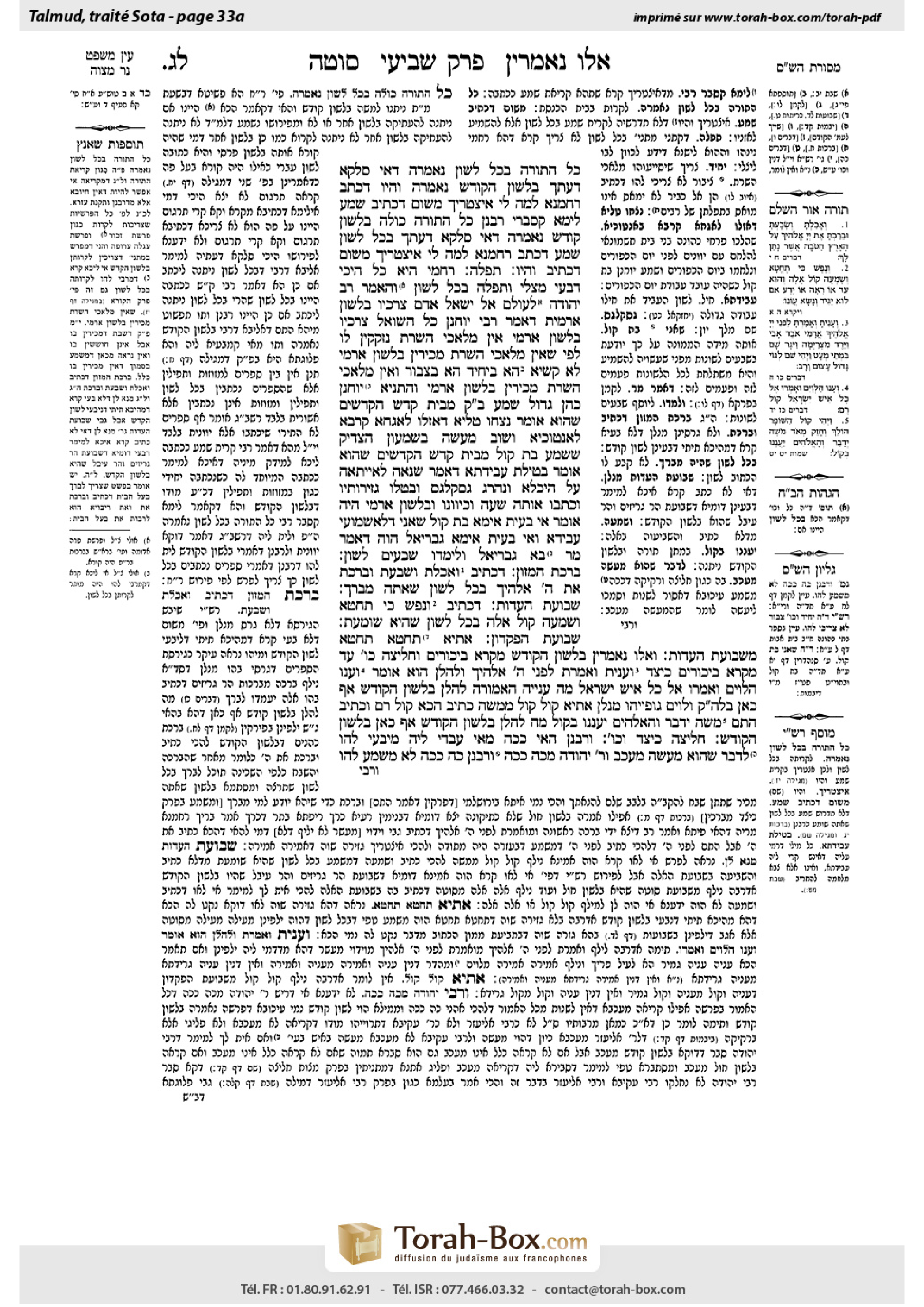
Sotah 33a: Talmud study for Daf Yomi
Daf Yomi is the daily study of one Talmud folio. Explore 37 tractates with scans, Hebrew text, Sefaria English and AI-generated French translations where annotated.
Passage selection and English or AI-generated French translation are available where the scan has annotations. Daf Study is independent of Torah-Box and Sefaria.
Browse Sotah · סוטה · All tractatesSotah 33a text and translations
This page of Sotah includes the Aramaic text, an English translation and an AI-generated French translation, alongside the scan above.
סוטה ל״ג א · Aramaic and Hebrew text
כׇּל הַתּוֹרָה בְּכׇל לָשׁוֹן נֶאֶמְרָה, דְּאִי סָלְקָא דַּעְתָּךְ בִּלְשׁוֹן הַקּוֹדֶשׁ נֶאֶמְרָה, ״וְהָיוּ״ דִּכְתַב רַחֲמָנָא, לְמָה לִי?
אִיצְטְרִיךְ, מִשּׁוּם דִּכְתִיב ״שְׁמַע״.
לֵימָא קָסָבְרִי רַבָּנַן כׇּל הַתּוֹרָה כּוּלָּהּ בִּלְשׁוֹן קוֹדֶשׁ נֶאֶמְרָה, דְּאִי סָלְקָא דַּעְתָּךְ בְּכׇל לָשׁוֹן — ״שְׁמַע״ דִּכְתַב רַחֲמָנָא לְמָה לִי?
אִיצְטְרִיךְ, מִשּׁוּם דִּכְתִיב ״וְהָיוּ״.
תְּפִלָּה: רַחֲמֵי הִיא, כׇּל הֵיכִי דְּבָעֵי מְצַלֵּי.
וּתְפִלָּה בְּכׇל לָשׁוֹן? וְהָאָמַר רַב יְהוּדָה: לְעוֹלָם אַל יִשְׁאַל אָדָם צְרָכָיו בִּלְשׁוֹן אֲרָמִית, דְּאָמַר רַבִּי יוֹחָנָן: כׇּל הַשּׁוֹאֵל צְרָכָיו בִּלְשׁוֹן אֲרַמִּי — אֵין מַלְאֲכֵי הַשָּׁרֵת נִזְקָקִין לוֹ, לְפִי שֶׁאֵין מַלְאֲכֵי הַשָּׁרֵת מַכִּירִין בִּלְשׁוֹן אֲרַמִּי!
לָא קַשְׁיָא: הָא — בְּיָחִיד, הָא — בְּצִבּוּר.
וְאֵין מַלְאֲכֵי הַשָּׁרֵת מַכִּירִין בִּלְשׁוֹן אֲרַמִּי? וְהָתַנְיָא: יוֹחָנָן כֹּהֵן גָּדוֹל שָׁמַע בַּת קוֹל מִבֵּית קֹדֶשׁ הַקֳּדָשִׁים שֶׁהוּא אוֹמֵר: נְצַחוּ טָלַיָּא דַּאֲזַלוּ לַאֲגָחָא קְרָבָא לְאַנְטוֹכְיָא. וְשׁוּב מַעֲשֶׂה בְּשִׁמְעוֹן הַצַּדִּיק שֶׁשָּׁמַע בַּת קוֹל מִבֵּית קֹדֶשׁ הַקֳּדָשִׁים שֶׁהוּא אוֹמֵר: בְּטֵילַת עֲבִידְתָּא דַּאֲמַר שָׂנְאָה לְאַיְיתָאָה עַל הֵיכְלָא וְנֶהֱרַג גַּסְקַלְגָּס וּבָטְלוּ גְּזֵירוֹתָיו. וְכָתְבוּ אוֹתָהּ שָׁעָה, וְכִיוְּונוּ. וּבְלָשׁוֹן אֲרַמִּי הָיָה אוֹמֵר!
אִי בָּעֵית אֵימָא: בַּת קוֹל שָׁאנֵי, דִּלְאַשְׁמוֹעֵי עֲבִידָא. וְאִי בָּעֵית אֵימָא: גַּבְרִיאֵל הֲוָה. דְּאָמַר מָר: בָּא גַּבְרִיאֵל וְלִימְּדוֹ שִׁבְעִים לָשׁוֹן.
בִּרְכַּת הַמָּזוֹן — דִּכְתִיב: ״וְאָכַלְתָּ וְשָׂבָעְתָּ וּבֵרַכְתָּ אֶת ה׳ אֱלֹהֶיךָ״ — בְּכׇל לָשׁוֹן שֶׁאַתָּה מְבָרֵךְ.
שְׁבוּעַת הָעֵדוּת — דִּכְתִיב: ״וְנֶפֶשׁ כִּי תֶחֱטָא וְשָׁמְעָה קוֹל אָלָה״ — בְּכׇל לָשׁוֹן שֶׁהִיא שׁוֹמַעַת.
שְׁבוּעַת הַפִּקָּדוֹן — אָתְיָא ״תֶּחְטָא״ ״תֶּחְטָא״ מִשְּׁבוּעַת הָעֵדוּת.
וְאֵלּוּ נֶאֱמָרִין בִּלְשׁוֹן הַקּוֹדֶשׁ: מִקְרָא בִּיכּוּרִים וַחֲלִיצָה כּוּ׳, עַד מִקְרָא בִּיכּוּרִים כֵּיצַד ״וְעָנִיתָ וְאָמַרְתָּ לִפְנֵי ה׳ אֱלֹהֶיךָ״, וּלְהַלָּן הוּא אוֹמֵר ״וְעָנוּ הַלְוִיִּם וְאָמְרוּ אֶל כׇּל אִישׁ יִשְׂרָאֵל״, מָה ״עֲנִיָּיה״ הָאֲמוּרָה לְהַלָּן בִּלְשׁוֹן הַקּוֹדֶשׁ — אַף כָּאן בִּלְשׁוֹן הַקּוֹדֶשׁ.
וּלְוִיִּם גּוּפַיְיהוּ מְנָלַן? אָתְיָא ״קוֹל״ ״קוֹל״ מִמֹּשֶׁה. כְּתִיב הָכָא ״קוֹל רָם״, וּכְתִיב הָתָם: ״מֹשֶׁה יְדַבֵּר וְהָאֱלֹהִים יַעֲנֶנּוּ בְקוֹל״, מָה לְהַלָּן בִּלְשׁוֹן הַקּוֹדֶשׁ, אַף כָּאן בִּלְשׁוֹן הַקּוֹדֶשׁ.
חֲלִיצָה כֵּיצַד וְכוּ׳. וְרַבָּנַן, הַאי ״כָּכָה״ מַאי עָבְדִי לֵיהּ? מִיבְּעֵי לְהוּ, לְדָבָר שֶׁהוּא מַעֲשֶׂה מְעַכֵּב.
וְרַבִּי יְהוּדָה מִ״כֹּה״, ״כָּכָה״. וְרַבָּנַן, ״כֹּה״ ״כָּכָה״ לָא מַשְׁמַע לְהוּ.
Sotah 33a · English translation
that the entire Torah may be recited in any language, as, if it should enter your mind to say that the entire Torah may be recited only in the sacred tongue and not in any other language, why do I need that which the Merciful One writes: “And these words, which I command you this day, will be”? If in fact it is prohibited for one to recite any portion of the Torah in a language other than Hebrew, then prohibiting the recitation of Shema in a language other than Hebrew is superfluous. Since the Torah specifically requires Shema to be recited in Hebrew, it must be because the rest of the Torah may be recited in any language.
The Gemara rejects this suggestion: This is not unquestionably so, as the phrase “and these words, which I command you this day, will be” is necessary in this case because “hear” is also written. Had it not said “and these words, which I command you this day, will be,” it would have been derived from the word “hear” that Shema may be recited in any language, in accordance with the opinion of the Rabbis. Therefore, the phrase “and these words, which I command you this day, will be” is necessary.
The Gemara asks: Shall we say that the Rabbis hold that the entire Torah may be recited only in the sacred tongue and not in any other language? As, if it should enter your mind to say that the Torah may be recited in any language, why do I need that which the Merciful One writes: “Hear”? It is permitted for one to recite the entire Torah in any language, rendering a specific requirement with regard to Shema superfluous.
The Gemara rejects this: The word “hear” is necessary in any case, because “and these words, which I command you this day, will be” is also written. Had it not been for the word “hear,” the Rabbis would have understood that it is prohibited to recite Shema in any other language, in accordance with the opinion of Rabbi Yehuda HaNasi. Therefore, the word “hear” is necessary.
§ It is stated in the mishna that the Amida prayer may be recited in any language. The reason for this is that since prayer is a request for divine mercy, one may pray in any way that one desires.
The Gemara asks: But may prayer really be recited in any language? But didn’t Rav Yehuda say: A person should never request in the Aramaic language that his needs be met, as Rabbi Yoḥanan said that with regard to anyone who requests in the Aramaic language that his needs be met, the ministering angels do not attend to him, as the ministering angels are not familiar [makkirin] with the Aramaic language?
The Gemara answers: This is not difficult, as that statement of Rabbi Yoḥanan is referring to the prayer of an individual, who needs the support of the angels, whereas this statement of the mishna is referring to communal prayer.
The Gemara asks: And are the ministering angels not familiar with the Aramaic language? But isn’t it taught in a baraita (Tosefta 13:5): Yoḥanan the High Priest heard a Divine Voice emerging from the House of the Holy of Holies that was saying: The youth who went to wage war in Antokhya have been victorious. And there was another incident involving Shimon HaTzaddik, who heard a Divine Voice emerging from the House of the Holy of Holies that was saying: The decree that the enemy intended to bring against the Temple is annulled, and Gaskalgas, Caligula, has been killed and his decrees have been voided. And people wrote down that time that the Divine Voice was heard, and later found that it matched exactly the moment that Caligula was killed. The Gemara concludes: And this Divine Voice was speaking in the Aramaic language.
The Gemara answers: If you wish, say that the Divine Voice is different, as its purpose is to communicate a message, and therefore it also communicates in Aramaic. And if you wish, say instead that it was the angel Gabriel, as the Master said with regard to Joseph: Gabriel came and taught him seventy languages, as he knows all of the languages, as opposed to the other angels, who do not.
§ It is stated in the mishna that Grace after Meals may be recited in any language. As it is written: “And you shall eat, and be satisfied, and bless the Lord your God” (Deuteronomy 8:10). The word “bless” is homiletically interpreted to mean: In any language that you bless.
It is stated in the mishna that an oath of testimony may be said in any language, as it is written: “And if anyone sins, in that he heard the voice of adjuration” (Leviticus 5:1). The emphasis on hearing in the verse is interpreted to mean that it can be recited in any language that a person hears, i.e., understands.
It is stated in the mishna that an oath on a deposit may be taken in any language. This is derived by means of a verbal analogy from the word “sins” (Leviticus 5:21) that appears in the portion of an oath on a deposit, and the word “sins” (Leviticus 5:1) that is mentioned in the portion of an oath of testimony.
§ It is stated in the mishna: And these are recited only in the sacred tongue: The recitation of the verses that one recounts when bringing the first fruits to the Temple; and ḥalitza… How is it derived that the recitation when bringing the first fruits is recited specifically in Hebrew? When the Torah discusses this mitzva it states: “And you shall speak and say before the Lord your God” (Deuteronomy 26:5), and below, in the discussion of the blessings and curses, it states: “And the Levites shall speak and say to all the men of Israel” (Deuteronomy 27:14). Just as there, in the portion of the Levites, they speak in the sacred tongue, so too here, in the portion of the first fruits, the recitation is in the sacred tongue.
The Gemara asks: And from where do we derive that the Levites themselves answered in Hebrew? The Gemara answers: It is derived from a verbal analogy between the word “voice” that appears here, in the portion of the blessings and curses, and the word “voice” in the verse that relates to Moses. It is written here: “With a loud voice” (Deuteronomy 27:14), and it is written there: “Moses spoke, and God answered him by a voice” (Exodus 19:19). Just as there, the Ten Commandments were stated in the sacred tongue, so too here, the Levites spoke in the sacred tongue.
It is stated in the mishna: How is it derived that the recitation at a ḥalitza ceremony must be in Hebrew? The verse states: “And she shall speak and say: So shall it be done to the man that doth not build up his brother’s house” (Deuteronomy 25:9). Rabbi Yehuda derives this halakha from the phrase: “And she shall speak and say: So” (Deuteronomy 25:9). The Gemara asks: And what do the Rabbis do with, i.e., how do they interpret, this word “so”? They require it to teach that any matter detailed in the portion that is an action is indispensable to the ḥalitza ceremony, as the verse states: “So shall it be done.” However, the other aspects of the ritual, e.g., the recitations, are not indispensable, and in their absence the ritual is valid after the fact.
And Rabbi Yehuda derives this halakha from the fact that the verse could have used the shorter form of the word so [ko], and instead uses the longer form of the word so [kakha]. He therefore derives both halakhot from this word. And the Rabbis do not learn anything from the difference between ko and kakha.
Sotah 33a · Traduction française (IA)
que toute la Torah peut être récitée dans n’importe quelle langue. En effet, si l’on pouvait penser que toute la Torah ne peut être récitée que dans la langue sainte, et dans aucune autre langue, pourquoi le Miséricordieux aurait-il écrit : « Et ces paroles que je t’ordonne aujourd’hui seront » ? Si, en réalité, il est interdit de réciter quelque partie que ce soit de la Torah dans une autre langue que l’hébreu, il serait superflu d’interdire la récitation du Chéma dans une autre langue que l’hébreu. Puisque la Torah exige expressément que le Chéma soit récité en hébreu, c’est nécessairement parce que le reste de la Torah peut être récité dans n’importe quelle langue.
La Guemara rejette cette suggestion : ce n’est pas nécessairement le cas, car l’expression « et ces paroles que je t’ordonne aujourd’hui seront » est nécessaire ici, puisqu’il est également écrit « écoute ». Si l’expression « et ces paroles que je t’ordonne aujourd’hui seront » n’était pas écrite, on aurait déduit du mot « écoute » que le Chéma peut être récité dans n’importe quelle langue, conformément à l’avis des Rabbins. L’expression « et ces paroles que je t’ordonne aujourd’hui seront » est donc nécessaire.
La Guemara demande : Faut-il en déduire que, selon les Rabbins, toute la Torah ne peut être récitée que dans la langue sainte, et dans aucune autre langue ? En effet, si l’on pouvait penser que la Torah peut être récitée dans n’importe quelle langue, pourquoi le Miséricordieux aurait-il écrit « écoute » ? Il est permis de réciter toute la Torah dans n’importe quelle langue ; une exigence particulière concernant le Chéma serait donc superflue.
La Guemara rejette cette interprétation : le mot « écoute » est nécessaire dans tous les cas, car il est également écrit « et ces paroles que je t’ordonne aujourd’hui seront ». Sans le mot « écoute », les Rabbins auraient compris qu’il est interdit de réciter le Chéma dans une autre langue, conformément à l’avis de Rabbi Yehouda HaNassi. Le mot « écoute » est donc nécessaire.
§ La Michna enseigne que la prière de la Amida peut être récitée dans n’importe quelle langue. En effet, puisque la prière est une demande de miséricorde divine, on peut prier comme on le souhaite.
La Guemara demande : Mais la prière peut-elle vraiment être récitée dans n’importe quelle langue ? Rav Yehouda n’a-t-il pas dit : Une personne ne doit jamais demander en araméen que ses besoins soient satisfaits, car Rabbi Yoḥanan a dit que les anges de service ne prêtent pas attention à quiconque demande en araméen que ses besoins soient satisfaits, puisqu’ils ne connaissent pas [makkirin] la langue araméenne ?
La Guemara répond : Il n’y a pas de difficulté, car la déclaration de Rabbi Yoḥanan concerne la prière d’un particulier, qui a besoin du soutien des anges, tandis que l’enseignement de la Michna concerne la prière de la communauté.
La Guemara demande : Les anges de service ne connaissent-ils donc pas l’araméen ? N’est-il pas enseigné dans une baraïta (Tosefta 13:5) : Yoḥanan le Grand Prêtre entendit une Voix divine sortir du Saint des Saints, qui disait : « Les jeunes gens partis faire la guerre à Antokhya ont remporté la victoire. » Il y eut un autre événement concernant Shimon HaTzaddik, qui entendit une Voix divine sortir du Saint des Saints, qui disait : « Le décret que l’ennemi voulait faire appliquer contre le Temple est annulé, et Gaskalgas, Caligula, a été tué et ses décrets ont été abrogés. » On nota l’heure à laquelle la Voix divine avait été entendue, puis on constata qu’elle correspondait exactement au moment où Caligula avait été tué. La Guemara conclut : cette Voix divine s’exprimait en araméen.
La Guemara répond : Si tu veux, dis que la Voix divine fait exception, car elle a pour but de transmettre un message et s’exprime donc aussi en araméen. Et si tu veux, dis plutôt qu’il s’agissait de l’ange Gabriel, car le Maître a enseigné au sujet de Joseph : Gabriel vint et lui enseigna soixante-dix langues ; il connaît donc toutes les langues, contrairement aux autres anges, qui ne les connaissent pas.
§ La Michna enseigne que la bénédiction après le repas peut être récitée dans n’importe quelle langue. En effet, il est écrit : « Tu mangeras, tu seras rassasié et tu béniras l’Éternel ton Dieu » (Deutéronome 8:10). Le mot « béniras » est interprété par exégèse comme signifiant : dans n’importe quelle langue dans laquelle tu bénis.
La Michna enseigne qu’un serment de témoignage peut être prononcé dans n’importe quelle langue, car il est écrit : « Si quelqu’un pèche en entendant la voix de l’adjuration » (Lévitique 5:1). L’accent mis dans le verset sur le fait d’entendre est interprété ainsi : le serment peut être prononcé dans toute langue qu’une personne entend, c’est-à-dire comprend.
La Michna enseigne qu’un serment concernant un dépôt peut être prêté dans n’importe quelle langue. Cela se déduit par une analogie verbale entre le mot « pèche » (Lévitique 5:21), qui figure dans le passage concernant le serment relatif à un dépôt, et le mot « pèche » (Lévitique 5:1), qui figure dans le passage concernant le serment de témoignage.
§ La Michna enseigne : Voici ce qui doit être récité uniquement dans la langue sainte : la récitation des versets que l’on dit lorsqu’on apporte les prémices au Temple, ainsi que la ḥalitsa… Comment déduit-on que la récitation faite lors de l’apport des prémices doit se faire précisément en hébreu ? Lorsque la Torah traite de cette mitsva, elle dit : « Tu parleras et tu diras devant l’Éternel ton Dieu » (Deutéronome 26:5) ; et plus loin, dans le passage concernant les bénédictions et les malédictions, elle dit : « Les Lévites parleront et diront à tous les hommes d’Israël » (Deutéronome 27:14). De même que là, dans le passage concernant les Lévites, ils parlent dans la langue sainte, de même ici, dans le passage concernant les prémices, la récitation se fait dans la langue sainte.
La Guemara demande : Et d’où déduit-on que les Lévites eux-mêmes répondirent en hébreu ? La Guemara répond : On le déduit par une analogie verbale entre le mot « voix », qui figure ici, dans le passage concernant les bénédictions et les malédictions, et le mot « voix » dans le verset relatif à Moïse. Il est écrit ici : « D’une voix forte » (Deutéronome 27:14), et il est écrit là : « Moïse parlait, et Dieu lui répondait par une voix » (Exode 19:19). De même que là, les Dix Commandements furent énoncés dans la langue sainte, de même ici, les Lévites parlèrent dans la langue sainte.
La Michna enseigne : Comment déduit-on que la récitation lors de la cérémonie de ḥalitsa doit se faire en hébreu ? Le verset dit : « Elle parlera et dira : Ainsi sera fait à l’homme qui ne bâtit pas la maison de son frère » (Deutéronome 25:9). Rabbi Yehouda déduit cette halakha de l’expression : « Elle parlera et dira : ainsi » (Deutéronome 25:9). La Guemara demande : Et que font les Rabbins de ce mot « ainsi », c’est-à-dire comment l’interprètent-ils ? Ils en ont besoin pour enseigner que tout élément décrit dans le passage comme une action est indispensable à la cérémonie de ḥalitsa, comme le dit le verset : « Ainsi sera fait. » En revanche, les autres aspects du rituel, par exemple les récitations, ne sont pas indispensables ; en leur absence, le rituel reste valable a posteriori.
Et Rabbi Yehouda déduit cette halakha du fait que le verset aurait pu employer la forme plus courte du mot « ainsi » [ko], mais qu’il emploie plutôt la forme plus longue du mot « ainsi » [kakha]. Il déduit donc les deux halakhot de ce mot. Les Rabbins, quant à eux, ne tirent aucun enseignement de la différence entre ko et kakha.
Traduction française générée par IA à partir de l’édition anglaise de Sefaria. Vérifie toujours un passage avec le texte source.
Text from Sefaria: William Davidson Edition - Vocalized Aramaic (CC BY NC); William Davidson Edition - English (CC BY NC).