Sotah 33b: Talmud study for Daf Yomi
Daf Yomi is the daily study of one Talmud folio. Explore 37 tractates with scans, Hebrew text, Sefaria English and AI-generated French translations where annotated.
Passage selection and English or AI-generated French translation are available where the scan has annotations. Daf Study is independent of Torah-Box and Sefaria.
Browse Sotah · סוטה · All tractatesSotah 33b text and translations
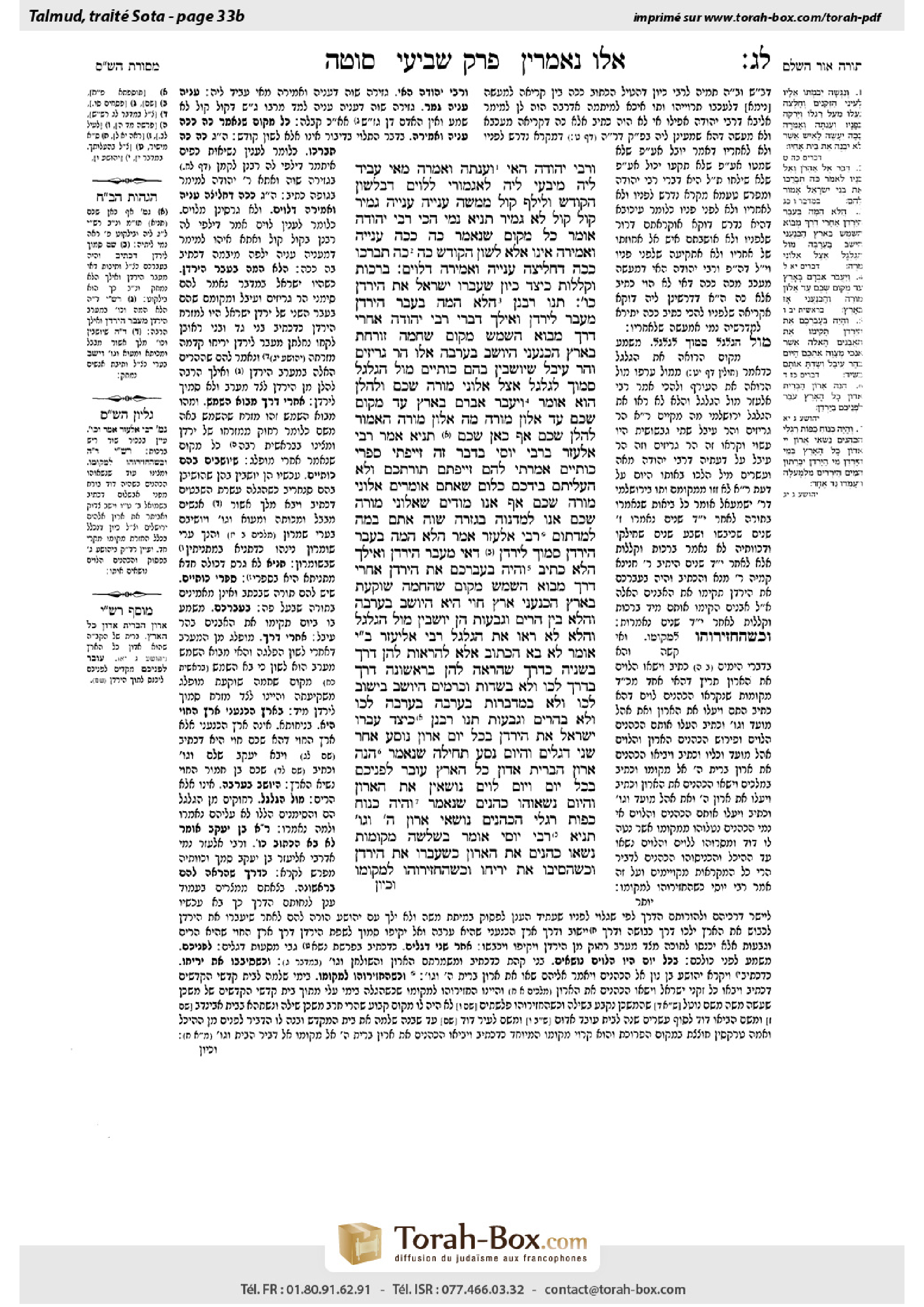
This page of Sotah includes the Aramaic text, an English translation and an AI-generated French translation, alongside the scan above.
סוטה ל״ג ב · Aramaic and Hebrew text
וְרַבִּי יְהוּדָה, הַאי ״וְעָנְתָה וְאָמְרָה״, מַאי עָבֵיד לֵיהּ? מִיבְּעֵי לֵיהּ לְאַגְמוֹרֵי לִלְוִיִּם, דְּבִלְשׁוֹן הַקּוֹדֶשׁ.
וְלֵילַף ״קוֹל״ מִמֹּשֶׁה? ״עֲנִיָּיה״ ״עֲנִיָּיה״ גְּמִיר, ״קוֹל״ ״קוֹל״ לָא גְּמִיר.
תַּנְיָא נָמֵי הָכִי, רַבִּי יְהוּדָה אוֹמֵר: כׇּל מָקוֹם שֶׁנֶּאֱמַר ״כֹּה״, ״כָּכָה״, ״עֲנִיָּיה״, וַ״אֲמִירָה״ — אֵינוֹ אֶלָּא לְשׁוֹן הַקּוֹדֶשׁ. ״כֹּה״ — ״כֹּה תְבָרְכוּ״. ״כָּכָה״ דַּחֲלִיצָה. ״עֲנִיָּיה״ וַ״אֲמִירָה״ דִּלְוִיִּם.
בְּרָכוֹת וּקְלָלוֹת כֵּיצַד? כֵּיוָן שֶׁעָבְרוּ יִשְׂרָאֵל אֶת הַיַּרְדֵּן כּוּ׳. תָּנוּ רַבָּנַן: ״הֲלֹא הֵמָּה בְּעֵבֶר הַיַּרְדֵּן״, מֵעֵבֶר לַיַּרְדֵּן וְאֵילָךְ, דִּבְרֵי רַבִּי יְהוּדָה. ״אַחֲרֵי דֶּרֶךְ מְבוֹא הַשֶּׁמֶשׁ״ — מְקוֹם שֶׁחַמָּה זוֹרַחַת.
״בְּאֶרֶץ הַכְּנַעֲנִי הַיּוֹשֵׁב בָּעֲרָבָה״ — אֵלּוּ הַר גְּרִיזִים וְהַר עֵיבָל, שֶׁיּוֹשְׁבִין בָּהֶם כּוּתִיִּים. ״מוּל הַגִּלְגָּל״ — סָמוּךְ לַגִּלְגָּל, ״אֵצֶל אֵלוֹנֵי מֹרֶה״ — שְׁכֶם. וּלְהַלָּן הוּא אוֹמֵר: ״וַיַּעֲבֹר אַבְרָם בָּאָרֶץ עַד מְקוֹם שְׁכֶם עַד אֵלוֹן מוֹרֶה״, מָה אֵלוֹן מוֹרֶה הָאָמוּר לְהַלָּן — שְׁכֶם, אַף כָּאן — שְׁכֶם.
תַּנְיָא, אָמַר רַבִּי אֶלְעָזָר בְּרַבִּי יוֹסֵי: בְּדָבָר זֶה זִיַּיפְתִּי סִפְרֵי כוּתִיִּים. אָמַרְתִּי לָהֶם: זִיַּיפְתֶּם תּוֹרַתְכֶם, וְלֹא הֶעֱלִיתֶם בְּיֶדְכֶם כְּלוּם. שֶׁאַתֶּם אוֹמְרִים אֵלוֹנֵי מוֹרֶה שְׁכֶם, אַף אָנוּ מוֹדִים שֶׁאֵלוֹנֵי מוֹרֶה שְׁכֶם. אָנוּ לְמַדְנוּהָ בִּגְזֵרָה שָׁוָה, אַתֶּם בַּמֶּה לְמַדְתֶּום?
רַבִּי אֶלְעָזָר אָמַר: ״הֲלֹא הֵמָּה בְּעֵבֶר הַיַּרְדֵּן״ — סָמוּךְ לַיַּרְדֵּן, דְּאִי מֵעֵבֶר הַיַּרְדֵּן וְאֵילָךְ, הֲלֹא כְּתִיב: ״וְהָיָה בְּעׇבְרְכֶם אֶת הַיַּרְדֵּן״.
״אַחֲרֵי דֶּרֶךְ מְבוֹא הַשֶּׁמֶשׁ״ — מָקוֹם שֶׁהַחַמָּה שׁוֹקַעַת. ״בְּאֶרֶץ הַכְּנַעֲנִי״, אֶרֶץ חִוִּי הִיא!
״הַיּוֹשֵׁב בָּעֲרָבָה״ — וַהֲלֹא בֵּין הָרִים וּגְבָעוֹת הֵן יוֹשְׁבִין! ״מוּל הַגִּלְגָּל״ — וַהֲלֹא לֹא רָאוּ אֶת הַגִּלְגָּל!
רַבִּי אֱלִיעֶזֶר בֶּן יַעֲקֹב אוֹמֵר: לֹא בָּא הַכָּתוּב אֶלָּא לְהַרְאוֹת לָהֶן דֶּרֶךְ בַּשְּׁנִיָּה כְּדֶרֶךְ שֶׁהֶרְאָה לָהֶן בָּרִאשׁוֹנָה. ״דֶּרֶךְ״ — בַּדֶּרֶךְ לֵכוּ, וְלֹא בְּשָׂדוֹת וּכְרָמִים. ״הַיּוֹשֵׁב״ — בַּיִּשּׁוּב לֵכוּ, וְלֹא בְּמִדְבָּרוֹת. ״בָּעֲרָבָה״ — בַּעֲרָבָה לֵכוּ, וְלֹא בְּהָרִים וּגְבָעוֹת.
תָּנוּ רַבָּנַן: כֵּיצַד עָבְרוּ יִשְׂרָאֵל אֶת הַיַּרְדֵּן? בְּכׇל יוֹם אָרוֹן נוֹסֵעַ אַחַר שְׁנֵי דְגָלִים, וְהַיּוֹם נָסַע תְּחִילָּה, שֶׁנֶּאֱמַר: ״הִנֵּה אֲרוֹן הַבְּרִית אֲדוֹן כׇּל הָאָרֶץ עֹבֵר לִפְנֵיכֶם״. בְּכׇל יוֹם וָיוֹם לְוִיִּם נוֹשְׂאִין אֶת הָאָרוֹן, וְהַיּוֹם נְשָׂאוּהוּ כֹּהֲנִים, שֶׁנֶּאֱמַר: ״וְהָיָה כְּנוֹחַ כַּפּוֹת רַגְלֵי הַכֹּהֲנִים נוֹשְׂאֵי אֲרוֹן ה׳ וְגוֹ׳״.
תַּנְיָא, רַבִּי יוֹסֵי אוֹמֵר: בִּשְׁלֹשָׁה מְקוֹמוֹת נָשְׂאוּ כֹּהֲנִים אֶת הָאָרוֹן: כְּשֶׁעָבְרוּ אֶת הַיַּרְדֵּן, וּכְשֶׁהֵסֵיבּוּ אֶת יְרִיחוֹ, וּכְשֶׁהֶחְזִירוּהוּ לִמְקוֹמוֹ.
Sotah 33b · English translation
The Gemara asks: And what does Rabbi Yehuda do with this verse: “And she shall speak and say,” from which the Rabbis derive that the recitation at the ḥalitza ritual must be in Hebrew? The Gemara answers: He requires it in order to teach with regard to the Levites that they spoke in the sacred tongue. Whereas the Rabbis derive that the ḥalitza ritual is performed in Hebrew from a verbal analogy between the verses concerning ḥalitza and the verses about the Levites, Rabbi Yehuda derives that the Levites spoke in Hebrew due to this same verbal analogy, with ḥalitza serving as the source.
The Gemara asks: But let Rabbi Yehuda derive that the Levites spoke in Hebrew from a verbal analogy between the word “voice” that is written with regard to the Levites (Deuteronomy 27:14) and the word “voice” in the verse about Moses (Exodus 19:19). The Gemara answers: He learned the verbal analogy between “speak” and “speak” from his teacher, and he did not learn the verbal analogy between “voice” and “voice” from his teacher.
That is also taught in a baraita: Rabbi Yehuda says: Every place where it is stated in the Torah: “So [ko],” or: “So [kakha],” or where the language of speaking and saying is used, it is referring only to the sacred tongue. The word ko appears in the context of the Priestly Benediction: “So [ko] you shall bless the children of Israel” (Numbers 6:23). Kakha appears in the context of the ḥalitza ceremony (Deuteronomy 25:9). The language of speaking and saying appears in relation to the Levites.
§ It is stated in the mishna: How did the ceremony of the blessings and curses take place? When the Jewish people crossed the Jordan River, etc. The Sages taught: When the Jewish people were in Transjordan, the location of Mount Gerizim and Mount Ebal was described to them as follows: “Are they not beyond the Jordan, behind the way of the coming of the sun, in the land of the Canaanites that dwell in the Arabah, over against Gilgal, beside the oaks of Moreh?” (Deuteronomy 11:30). “Are they not beyond the Jordan” means farther west, beyond the Jordan River; this is the statement of Rabbi Yehuda. “Behind the way of the coming of the sun”; this is referring to the place where the sun rises, i.e., the east. In other words, they are at a distance from the Jordan River, which is in the east.
“In the land of the Canaanites that dwell in the Arabah”; this is referring to Mount Gerizim and Mount Ebal, where the Samaritans now live. “Over against Gilgal”; this means near Gilgal. “Beside the oaks of Moreh”; this is referring to Shechem. And from where is it derived that this is Shechem? There, with regard to Abraham, the verse states: “And Abram passed through the land until the place of Shechem, until the oaks of Moreh” (Genesis 12:6). Just as the oaks of Moreh stated there are identified as Shechem, so too here, they are Shechem.
It is taught in a baraita that Rabbi Elazar, son of Rabbi Yosei, said: In this matter, I proved the falsehood of the books of the Samaritans. I said to them: You forged your Torah by making additions to it, and you have not gained anything from it, as, you say that the oaks of Moreh is referring to Shechem, and we too concede that the oaks of Moreh is referring to Shechem. However, we derived this by means of a verbal analogy between verses. You, who do not use verbal analogies, how did you derive it?
Rabbi Elazar disagrees with Rabbi Yehuda and says: “Are they not beyond the Jordan” means near the Jordan River, as, if it meant farther west beyond the Jordan, isn’t it written: “And it shall be when you have passed over the Jordan, that you shall set up these stones which I command you this day, on Mount Ebal” (Deuteronomy 27:4)? This implies that Mount Ebal was near the location where the Jewish people crossed the Jordan.
“Behind the way of the coming of the sun,” according to Rabbi Elazar, is referring to the place where the sun sets, in the west. This is distant from Shechem, which is in the center of Eretz Yisrael. Furthermore, the verse states: “In the land of the Canaanites,” and Shechem is located in the land of the Hivites (see Genesis 34:2).
Similarly, the phrase “that dwell in the Arabah” cannot be a description of the mountains known as Mount Gerizim and Mount Ebal that are next to Shechem; aren’t they situated among mountains and hills? The description “over against Gilgal” is also difficult; they could not see Gilgal from Shechem, as it is far away. Rather, according to Rabbi Elazar, Mount Gerizim and Mount Ebal mentioned in the Torah are located closer to the Jordan River. They are not the mountains known by the same names that are located near Shechem.
Rabbi Eliezer ben Ya’akov says: The verse does not come to establish the location of Mount Gerizim and Mount Ebal. Rather, it comes to show the Jewish people the way the second time, when they were entering the land of Canaan, like the way He showed them the first time, when they left Egypt and a pillar of cloud went before them and made the terrain easier to transverse. The purpose of the verse is to instruct the Jewish people how to enter the land of Canaan with relative ease, despite the absence of the pillar of cloud. The word “way” instructs them to go along a pre-established way, and not in fields and vineyards. The phrase “that dwell” instructs them to go in settled areas and not in the wilderness. “In the Arabah,” which means plain, teaches them to go in the plains and not over mountains and hills.
§ The Sages taught (Tosefta 8:1): How did the Jewish people cross the Jordan? Every day the Ark would travel behind the two flags of Judah and Reuben, but on that day the Ark traveled in front, as it is stated: “Behold, the Ark of the Covenant of the Lord of all the earth is passing before you” (Joshua 3:11). On every other day, the Levites would carry the Ark, but on this day the priests carried it, as is stated: “And when the soles of the feet of the priests that bear the Ark of the Lord, the Lord of all the earth, shall rest” (Joshua 3:13).
It is taught in a baraita (Tosefta 8:2) that Rabbi Yosei says: In three different places the priests carried the Ark. They carried it when the Jewish people crossed the Jordan, and when they surrounded Jericho (Joshua 6:6), and when they returned it to its proper place in the Holy of Holies during the reign of King Solomon (I Kings 8:6).
Sotah 33b · Traduction française (IA)
La Guemara demande : Que fait Rabbi Yehouda de ce verset : « Elle parlera et dira », dont les Rabbins déduisent que la récitation du rituel de la ḥalitsa doit se faire en hébreu ? La Guemara répond : Il en a besoin pour enseigner que les Lévites parlaient dans la langue sacrée. Alors que les Rabbins déduisent que le rituel de la ḥalitsa doit se dérouler en hébreu par une analogie verbale entre les versets relatifs à la ḥalitsa et ceux concernant les Lévites, Rabbi Yehouda déduit par cette même analogie verbale que les Lévites parlaient en hébreu, la ḥalitsa servant de source.
La Guemara demande : Mais Rabbi Yehouda ne peut-il pas déduire que les Lévites parlaient en hébreu par une analogie verbale entre le mot « voix », écrit à propos des Lévites (Deutéronome 27,14), et le mot « voix » dans le verset concernant Moïse (Exode 19,19) ? La Guemara répond : Il a appris de son maître l’analogie verbale entre « parler » et « parler », mais il n’a pas appris de son maître celle entre « voix » et « voix ».
Cela est également enseigné dans une baraïta : Rabbi Yehouda dit : Partout où la Torah dit « ainsi [ko] » ou « ainsi [kakha] », ou emploie les termes « parler » et « dire », il s’agit de la langue sacrée. Le mot ko apparaît dans le contexte de la bénédiction sacerdotale : « Ainsi [ko], vous bénirez les enfants d’Israël » (Nombres 6,23). Le mot kakha apparaît dans le contexte du rituel de la ḥalitsa (Deutéronome 25,9). Les termes « parler » et « dire » apparaissent à propos des Lévites.
§ La Michna dit : Comment se déroulait la cérémonie des bénédictions et des malédictions ? Lorsque le peuple juif traversa le Jourdain, etc. Les Sages enseignent : Lorsque le peuple juif se trouvait en Transjordanie, on lui décrivit ainsi l’emplacement du mont Garizim et du mont Ébal : « Ne sont-ils pas au-delà du Jourdain, derrière la route du soleil levant, dans le pays des Cananéens qui habitent la Arava, en face de Guilgal, près des chênes de Moré ? » (Deutéronome 11,30). « Ne sont-ils pas au-delà du Jourdain » signifie à l’ouest, de l’autre côté du Jourdain ; telle est la position de Rabbi Yehouda. « Derrière la route du soleil levant » désigne l’endroit où le soleil se lève, c’est-à-dire l’est. Autrement dit, les montagnes sont éloignées du Jourdain, qui se trouve à l’est.
« Dans le pays des Cananéens qui habitent la Arava » désigne le mont Garizim et le mont Ébal, où vivent aujourd’hui les Samaritains. « En face de Guilgal » signifie près de Guilgal. « Près des chênes de Moré » désigne Sichem. Et d’où déduit-on qu’il s’agit de Sichem ? À propos d’Abraham, le verset dit : « Abram traversa le pays jusqu’au lieu de Sichem, jusqu’aux chênes de Moré » (Genèse 12,6). De même que les chênes de Moré mentionnés là sont identifiés à Sichem, de même, ici, il s’agit de Sichem.
Une baraïta enseigne que Rabbi Eléazar, fils de Rabbi Yossi, a dit : Sur ce point, j’ai démontré la fausseté des livres des Samaritains. Je leur ai dit : Vous avez falsifié votre Torah en y ajoutant des éléments, mais cela ne vous a rien apporté, car vous dites que les chênes de Moré désignent Sichem, et nous aussi, nous reconnaissons que les chênes de Moré désignent Sichem. Cependant, nous l’avons déduit au moyen d’une analogie verbale entre des versets. Vous, qui ne recourez pas aux analogies verbales, comment l’avez-vous déduit ?
Rabbi Eléazar n’est pas d’accord avec Rabbi Yehouda et dit : « Ne sont-ils pas au-delà du Jourdain » signifie près du Jourdain, car si cela signifiait à l’ouest, de l’autre côté du Jourdain, n’est-il pas écrit : « Et lorsque vous aurez traversé le Jourdain, vous dresserez ces pierres que je vous ordonne aujourd’hui, sur le mont Ébal » (Deutéronome 27,4) ? Cela implique que le mont Ébal se trouvait près de l’endroit où le peuple juif traversa le Jourdain.
Selon Rabbi Eléazar, « derrière la route du soleil levant » désigne l’endroit où le soleil se couche, à l’ouest. Cet endroit est éloigné de Sichem, qui se trouve au centre d’Eretz Israël. En outre, le verset dit : « Dans le pays des Cananéens », alors que Sichem se trouve dans le pays des Hivites (voir Genèse 34,2).
De même, l’expression « qui habitent la Arava » ne peut pas décrire les montagnes appelées mont Garizim et mont Ébal, situées près de Sichem : ne sont-elles pas au milieu de montagnes et de collines ? La description « en face de Guilgal » pose également problème : on ne pouvait pas voir Guilgal depuis Sichem, car cette ville est éloignée. Selon Rabbi Eléazar, le mont Garizim et le mont Ébal mentionnés dans la Torah se trouvent plutôt plus près du Jourdain. Ce ne sont pas les montagnes portant les mêmes noms qui se trouvent près de Sichem.
Rabbi Eliezer ben Yaakov dit : Le verset ne vise pas à établir l’emplacement du mont Garizim et du mont Ébal. Il vient plutôt indiquer au peuple juif le chemin à suivre une seconde fois, lorsqu’il entrait dans le pays de Canaan, comme Dieu le lui avait indiqué la première fois, lorsqu’il avait quitté l’Égypte : une colonne de nuée le précédait et rendait le terrain plus facile à traverser. Le verset a pour but d’indiquer au peuple juif comment entrer relativement facilement dans le pays de Canaan, malgré l’absence de la colonne de nuée. Le mot « chemin » lui indique de suivre une voie déjà tracée, et non de passer par des champs et des vignes. L’expression « qui habitent » lui indique de passer par des zones habitées et non par le désert. « Dans la Arava », qui signifie plaine, lui enseigne de traverser les plaines et non les montagnes et les collines.
§ Les Sages enseignent (Tosefta 8,1) : Comment le peuple juif traversa-t-il le Jourdain ? Chaque jour, l’Arche marchait derrière les deux bannières de Juda et de Réouven, mais ce jour-là, elle marchait devant, comme il est dit : « Voici que l’Arche de l’alliance du Seigneur de toute la terre passe devant vous » (Josué 3,11). Les autres jours, les Lévites portaient l’Arche, mais ce jour-là, ce furent les prêtres qui la portèrent, comme il est dit : « Lorsque la plante des pieds des prêtres qui portent l’Arche du Seigneur, le Seigneur de toute la terre, se posera » (Josué 3,13).
Une baraïta enseigne (Tosefta 8,2) que Rabbi Yossi dit : En trois circonstances, les prêtres portèrent l’Arche. Ils la portèrent lorsque le peuple juif traversa le Jourdain, lorsqu’il fit le tour de Jéricho (Josué 6,6), et lorsqu’ils la remirent à sa place, dans le Saint des Saints, sous le règne du roi Salomon (I Rois 8,6).
Traduction française générée par IA à partir de l’édition anglaise de Sefaria. Vérifie toujours un passage avec le texte source.
Text from Sefaria: William Davidson Edition - Vocalized Aramaic (CC BY NC); William Davidson Edition - English (CC BY NC).