Sotah 34a: Talmud study for Daf Yomi
Daf Yomi is the daily study of one Talmud folio. Explore 37 tractates with scans, Hebrew text, Sefaria English and AI-generated French translations where annotated.
Passage selection and English or AI-generated French translation are available where the scan has annotations. Daf Study is independent of Torah-Box and Sefaria.
Browse Sotah · סוטה · All tractatesSotah 34a text and translations
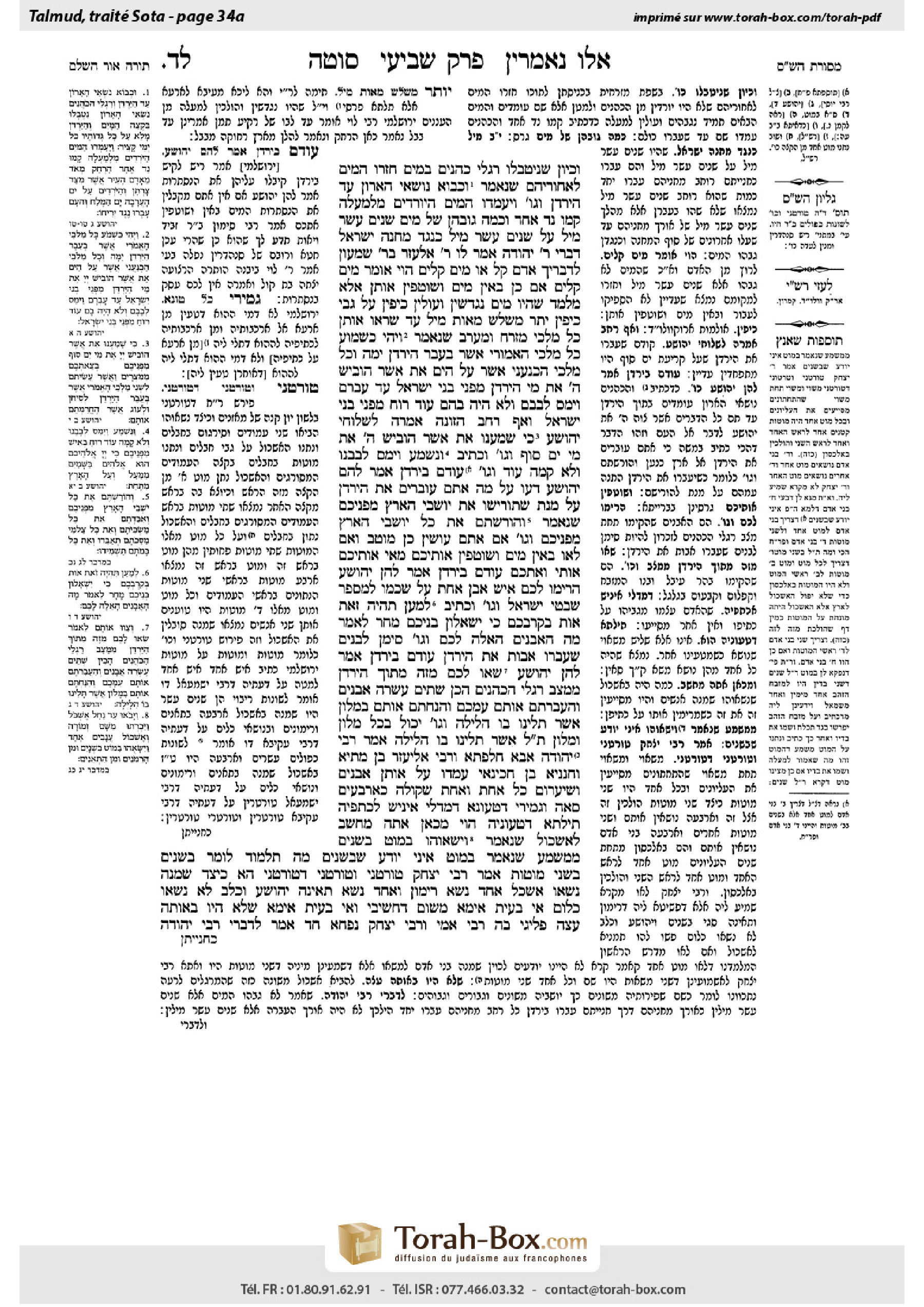
This page of Sotah includes the Aramaic text, an English translation and an AI-generated French translation, alongside the scan above.
סוטה ל״ד א · Aramaic and Hebrew text
וְכֵיוָן שֶׁנִּיטְבְּלוּ רַגְלֵי כֹהֲנִים בַּמַּיִם, חָזְרוּ הַמַּיִם לַאֲחוֹרֵיהֶם, שֶׁנֶּאֱמַר: ״וּכְבוֹא נוֹשְׂאֵי הָאָרוֹן עַד הַיַּרְדֵּן וְגוֹ׳ וַיַּעַמְדוּ הַמַּיִם הַיֹּרְדִים מִלְמַעְלָה קָמוּ נֵד אֶחָד״. וְכַמָּה גּוֹבְהָן שֶׁל מַיִם — שְׁנֵים עָשָׂר מִיל עַל שְׁנֵים עָשָׂר מִיל, כְּנֶגֶד מַחֲנֵה יִשְׂרָאֵל. דִּבְרֵי רַבִּי יְהוּדָה.
אָמַר לוֹ רַבִּי אֶלְעָזָר בְּרַבִּי שִׁמְעוֹן: לִדְבָרֶיךָ, אָדָם קַל, אוֹ מַיִם קַלִּים? הֱוֵי אוֹמֵר: מַיִם קַלִּים. אִם כֵּן, בָּאִין מַיִם וְשׁוֹטְפִין אוֹתָן!
אֶלָּא מְלַמֵּד שֶׁהָיוּ מַיִם נִגְדָּשִׁין וְעוֹלִין כִּיפִּין עַל גַּבֵּי כִּיפִּין, יָתֵר מִשְּׁלֹשׁ מֵאוֹת מִיל, עַד שֶׁרָאוּ אוֹתָן כׇּל מַלְכֵי מִזְרָח וּמַעֲרָב, שֶׁנֶּאֱמַר: ״וַיְהִי כִשְׁמֹעַ כׇּל מַלְכֵי הָאֱמֹרִי אֲשֶׁר בְּעֵבֶר הַיַּרְדֵּן יָמָּה וְכׇל מַלְכֵי הַכְּנַעֲנִי אֲשֶׁר עַל הַיָּם אֵת אֲשֶׁר הוֹבִישׁ ה׳ אֶת מֵי הַיַּרְדֵּן מִפְּנֵי בְנֵי יִשְׂרָאֵל עַד עׇבְרָם וַיִּמַּס לְבָבָם וְלֹא הָיָה בָם עוֹד רוּחַ מִפְּנֵי בְּנֵי יִשְׂרָאֵל״.
וְאַף רָחָב הַזּוֹנָה אָמְרָה לִשְׁלוּחֵי יְהוֹשֻׁעַ ״כִּי שָׁמַעְנוּ אֵת אֲשֶׁר הוֹבִישׁ ה׳ אֶת מֵי יַם סוּף וְגוֹ׳״, וּכְתִיב: ״וַנִּשְׁמַע וַיִּמַּס לְבָבֵנוּ וְלֹא קָמָה עוֹד וְגוֹ׳״.
עוֹדָם בַּיַּרְדֵּן אָמַר לָהֶם יְהוֹשֻׁעַ: דְּעוּ עַל מָה אַתֶּם עוֹבְרִים אֶת הַיַּרְדֵּן — עַל מְנָת שֶׁתּוֹרִישׁוּ אֶת יוֹשְׁבֵי הָאָרֶץ מִפְּנֵיכֶם, שֶׁנֶּאֱמַר: ״וְהוֹרַשְׁתֶּם אֶת כׇּל יוֹשְׁבֵי הָאָרֶץ מִפְּנֵיכֶם וְגוֹ׳״. אִם אַתֶּם עוֹשִׂין כֵּן — מוּטָב. וְאִם לָאו, בָּאִין מַיִם וְשׁוֹטְפִין אוֹתִיכֶם. מַאי ״אוֹתִיכֶם״ — אוֹתִי וְאֶתְכֶם.
עוֹדָם בַּיַּרְדֵּן אָמַר לָהֶן יְהוֹשֻׁעַ: ״הָרִימוּ לָכֶם אִישׁ אֶבֶן אַחַת עַל שִׁכְמוֹ לְמִסְפַּר שִׁבְטֵי יִשְׂרָאֵל וְגוֹ׳״, וּכְתִיב: ״לְמַעַן תִּהְיֶה זֹאת אוֹת בְּקִרְבְּכֶם כִּי יִשְׁאָלוּן בְּנֵיכֶם מָחָר לֵאמֹר מָה הָאֲבָנִים הָאֵלֶּה לָכֶם וְגוֹ׳״, סִימָן לַבָּנִים שֶׁעָבְרוּ אָבוֹת אֶת הַיַּרְדֵּן.
עוֹדָם בַּיַּרְדֵּן אָמַר לָהֶן יְהוֹשֻׁעַ: ״שְׂאוּ לָכֶם מִזֶּה מִתּוֹךְ הַיַּרְדֵּן מִמַּצַּב רַגְלֵי הַכֹּהֲנִים הָכִין שְׁתֵּים עֶשְׂרֵה אֲבָנִים וְהַעֲבַרְתֶּם אוֹתָם עִמָּכֶם וְהִנַּחְתֶּם אוֹתָם בַּמָּלוֹן אֲשֶׁר תָּלִינוּ בוֹ הַלַּיְלָה וְגוֹ׳״. יָכוֹל בְּכׇל מָלוֹן וּמָלוֹן — תַּלְמוּד לוֹמַר: ״אֲשֶׁר תָּלִינוּ בוֹ הַלָּיְלָה״.
אָמַר רַבִּי יְהוּדָה: אַבָּא חֲלַפְתָּא וְרַבִּי אֱלִיעֶזֶר בֶּן מַתְיָא וַחֲנַנְיָא בֶּן חֲכִינַאי עָמְדוּ עַל אוֹתָן אֲבָנִים, וְשִׁיעֲרוּם כׇּל אַחַת וְאַחַת שְׁקוּלָה כְּאַרְבָּעִים סְאָה. וּגְמִירִי דִּטְעוּנָא דְּמַדְלֵי אִינִישׁ לְכַתְפֵּיהּ — תִּילְתָּא דִּטְעוּנֵיהּ הָוֵי.
מִכָּאן אַתָּה מְחַשֵּׁב לָאֶשְׁכּוֹל, שֶׁנֶּאֱמַר: ״וַיִּשָּׂאֻהוּ בַמּוֹט בִּשְׁנָיִם״. מִמַּשְׁמַע שֶׁנֶּאֱמַר ״בַּמּוֹט״, אֵינִי יוֹדֵעַ שֶׁבִּשְׁנַיִם? מָה תַּלְמוּד לוֹמַר ״בִּשְׁנָיִם״ — בִּשְׁנֵי מוֹטוֹת.
אָמַר רַבִּי יִצְחָק: טוּרְטָנֵי, וְטוּרְטָנֵי דְטוּרְטָנֵי, הָא כֵּיצַד? שְׁמֹנָה נָשְׂאוּ אֶשְׁכֹּל, אֶחָד נָשָׂא רִימּוֹן, וְאֶחָד נָשָׂא תְּאֵינָה. יְהוֹשֻׁעַ וְכָלֵב לֹא נָשְׂאוּ כְּלוּם. אִי בָּעֵית אֵימָא מִשּׁוּם דַּחֲשִׁיבִי. וְאִי בָּעֵית אֵימָא שֶׁלֹּא הָיוּ בְּאוֹתָהּ עֵצָה.
פְּלִיגִי בַּהּ רַבִּי אַמֵּי וְרַבִּי יִצְחָק נַפָּחָא. חַד אָמַר: לְדִבְרֵי רַבִּי יְהוּדָה —
Sotah 34a · English translation
And once the feet of the priests were immersed in the water of the Jordan River, the water flowed backward, as it is stated: “And when those carrying the Ark came to the Jordan and the feet of the priests that bore the ark were dipped in the brink of the water, for the Jordan overflows all its banks all the time of harvest; and the waters that came down from above stood, and rose up in one heap” (Joshua 3:15–16). And what was the height of the water? Twelve mil by twelve mil, parallel to the size of the camp of the Jewish people who were passing through the Jordan. This is the statement of Rabbi Yehuda.
Rabbi Elazar, son of Rabbi Shimon, said to him: According to your statement, does a person move faster or does water move faster? You must say that water moves faster than a person. If that is so, then before the camp of Israel crossed the river the water would come and drown them, as, after the water rose up to a height of twelve mil it then began flowing normally again.
Rather, this teaches that the water gathered and rose in heaps upon heaps to a height of more than three hundred mil, until all the kings of the East and West saw it, as it is stated: “And it came to pass, when all the kings of the Amorites, that were beyond the Jordan westward, and all the kings of the Canaanites, that were by the sea, heard that the Lord had dried up the waters of the Jordan from before the children of Israel, until they were passed over, that their heart melted, neither was there spirit in them anymore, because of the children of Israel” (Joshua 5:1).
And even Rahab the prostitute said to Joshua’s messengers: “For we have heard how the Lord dried up the water of the Red Sea before you” (Joshua 2:10). And it is written: “And as soon as we had heard it, our hearts melted, neither did there remain any more spirit in any man, because of you” (Joshua 2:11). Evidently, the Canaanites were still terrified due to the splitting of the Red Sea, although that had taken place years earlier and in a distant location. It is understood from here how terrified they became when a similar miracle occurred close to where they lived.
While the Jewish people were still in the Jordan, Joshua said to them: Know for what purpose you are crossing the Jordan. It is in order to drive out the inhabitants of the land from before you, as it is stated: “And you shall drive out all the inhabitants of the land from before you” (Numbers 33:52). If you will do so, then all is well, but if not, water will come and drown otikhem. The Gemara asks: What is the meaning of the word otikhem? The Gemara explains: It is a combination of the words me [oti] and you [etkhem].
While they were still in the Jordan, Joshua said to them: “Pick up every man of you a stone upon his shoulder, according to the number of the tribes of the children of Israel” (Joshua 4:5). And it is written: “That this may be a sign among you, that when your children ask in time to come, saying: What do you mean by these stones?” (Joshua 4:6). This will be a sign for the children that their ancestors crossed the Jordan.
While they were still in the Jordan, Joshua said to them: “Take out of the midst of the Jordan, out of the place where the priests’ feet stood, twelve stones made ready, and carry them over with you, and lay them down in the lodging place, where you shall lodge this night” (Joshua 4:3). One might have thought that they were required to place these stones at each and every lodging place where they stayed. Therefore, the verse states: “Where you shall lodge this night,” meaning only on that night.
Rabbi Yehuda says: Abba Ḥalafta, and Rabbi Eliezer ben Matya, and Ḥananya ben Ḥakhinai stood on those same stones that the Jewish people took from the Jordan, and they measured them and found that each and every one weighed about forty se’a. And it is learned as a tradition that a load that one can lift onto his shoulders is one-third of the weight of the load that he can carry when others load it onto him.
From here you can calculate the size of the cluster of grapes that the spies carried together from Eretz Yisrael, as it is stated: “And they carried it upon a pole between two” (Numbers 13:23). From the fact that it is stated that they carried the cluster of grapes “on a pole” do I not know that it was carried by two people? That is the only way it can be carried on a pole. What is the meaning when the verse states: “Between two”? It means that the spies carried it on two poles, and four people carried the cluster of grapes together. From here it can be deduced that the weight of the cluster was 480 se’a.
Rabbi Yitzḥak said: They were configured like upper rods of scales [turtanei] that are balanced on the lower rods of scales, i.e., there were not two but four poles. How so? Eight of the spies carried the cluster of grapes, one of them carried a pomegranate, and one carried a fig. Joshua and Caleb did not carry anything. Why did Joshua and Caleb not carry anything? If you wish, say that it is because they were more prominent than the others and it was beneath their dignity to carry such a load. And if you wish, say instead that they did not take part in the wicked counsel of the spies, as the cluster of grapes was brought by the spies to scare the people.
§ Rabbi Ami and Rabbi Yitzḥak Nappaḥa disagree with regard to the dispute between the tanna’im as to the height of the water when the Jewish people crossed the Jordan. One says: According to the statement of Rabbi Yehuda, that the water stood at the height of twelve mil,
Sotah 34a · Traduction française (IA)
Et lorsque les pieds des prêtres furent plongés dans les eaux du Jourdain, l’eau reflua, comme il est dit : « Lorsque ceux qui portaient l’Arche arrivèrent au Jourdain et que les pieds des prêtres qui portaient l’Arche furent plongés au bord de l’eau — or le Jourdain déborde sur toutes ses rives pendant toute la période de la moisson — les eaux qui descendaient d’en haut s’arrêtèrent et s’élevèrent en une seule masse » (Josué 3,15-16). Quelle était la hauteur de l’eau ? Douze mil sur douze mil, correspondant à la taille du camp du peuple juif qui traversait le Jourdain. Telle est la déclaration de Rabbi Yehuda.
Rabbi Elazar, fils de Rabbi Shimon, lui dit : « Selon tes propos, qui se déplace plus vite, un homme ou l’eau ? Tu dois reconnaître que l’eau se déplace plus vite qu’un homme. Si tel est le cas, avant que le camp d’Israël ait traversé le fleuve, l’eau serait venue les noyer, car, après s’être élevée à une hauteur de douze mil, elle se serait remise à couler normalement. »
Mais cela enseigne que l’eau s’amoncela en tas sur des tas et s’éleva à une hauteur de plus de trois cents mil, jusqu’à ce que tous les rois de l’Orient et de l’Occident la voient, comme il est dit : « Lorsque tous les rois des Amoréens qui étaient au-delà du Jourdain, vers l’ouest, et tous les rois des Cananéens qui étaient au bord de la mer apprirent que l’Éternel avait asséché les eaux du Jourdain devant les enfants d’Israël jusqu’à ce qu’ils l’aient traversé, leur cœur se liquéfia et il ne resta plus en eux aucun courage, à cause des enfants d’Israël » (Josué 5,1).
Même Rahab la prostituée dit aux messagers de Josué : « Car nous avons entendu comment l’Éternel a asséché devant vous les eaux de la mer des Joncs » (Josué 2,10). Et il est écrit : « Dès que nous l’avons entendu, notre cœur s’est liquéfié et il n’est plus resté aucun courage chez aucun homme, à cause de vous » (Josué 2,11). Il est donc évident que les Cananéens étaient encore terrifiés par la séparation de la mer des Joncs, bien que celle-ci eût eu lieu des années auparavant et dans un lieu éloigné. On comprend ainsi à quel point ils furent terrifiés lorsqu’un miracle semblable se produisit près de chez eux.
Alors que le peuple juif se trouvait encore dans le Jourdain, Josué leur dit : « Sachez dans quel but vous traversez le Jourdain. C’est pour chasser de devant vous les habitants du pays », comme il est dit : « Vous chasserez tous les habitants du pays de devant vous » (Nombres 33,52). Si vous le faites, tout ira bien ; sinon, l’eau viendra vous noyer, otikhem. La Guemara demande : Que signifie le mot otikhem ? La Guemara explique : C’est une combinaison des mots me [oti] et vous [etkhem].
Alors qu’ils se trouvaient encore dans le Jourdain, Josué leur dit : « Que chacun de vous prenne une pierre sur son épaule, selon le nombre des tribus des enfants d’Israël » (Josué 4,5). Et il est écrit : « Afin que cela soit un signe parmi vous, lorsque vos enfants demanderont à l’avenir : “Que signifient pour vous ces pierres ?” » (Josué 4,6). Ce sera un signe pour les enfants, leur rappelant que leurs ancêtres ont traversé le Jourdain.
Alors qu’ils se trouvaient encore dans le Jourdain, Josué leur dit : « Prenez du milieu du Jourdain, de l’endroit où se tenaient les pieds des prêtres, douze pierres préparées ; emportez-les avec vous et déposez-les au lieu où vous passerez la nuit » (Josué 4,3). On aurait pu penser qu’ils devaient déposer ces pierres dans chacun des lieux où ils passeraient la nuit. C’est pourquoi le verset précise : « Là où vous passerez la nuit », c’est-à-dire uniquement cette nuit-là.
Rabbi Yehuda dit : Abba Ḥalafta, Rabbi Eliezer ben Matya et Ḥananya ben Ḥakhinai se tinrent sur ces mêmes pierres que le peuple juif avait prises dans le Jourdain ; ils les mesurèrent et constatèrent que chacune pesait environ quarante séa. La tradition enseigne qu’une charge qu’un homme peut soulever sur ses épaules représente le tiers du poids d’une charge que d’autres peuvent lui charger sur les épaules.
À partir de là, on peut calculer le poids de la grappe de raisins que les explorateurs emportèrent ensemble depuis Eretz Israël, comme il est dit : « Ils la portèrent sur une perche, à deux » (Nombres 13,23). Puisqu’il est dit qu’ils portèrent la grappe de raisins « sur une perche », ne sait-on pas qu’elle était portée par deux personnes ? C’est la seule manière de la porter sur une perche. Que signifie alors l’expression du verset « à deux » ? Cela signifie que les explorateurs la portèrent sur deux perches et que quatre hommes portèrent ensemble la grappe de raisins. On peut en déduire que la grappe pesait 480 séa.
Rabbi Yitzḥak dit : Les perches étaient disposées comme les tiges supérieures d’une balance [turtanei], en équilibre sur les tiges inférieures ; autrement dit, il n’y avait pas deux perches, mais quatre. Comment cela ? Huit des explorateurs portèrent la grappe de raisins, l’un porta une grenade et un autre une figue. Josué et Caleb ne portèrent rien. Pourquoi Josué et Caleb ne portèrent-ils rien ? Si tu le souhaites, dis que c’est parce qu’ils étaient plus éminents que les autres et qu’il était indigne d’eux de porter une telle charge. Si tu le souhaites, dis plutôt qu’ils ne prirent pas part au mauvais conseil des explorateurs, car les explorateurs avaient apporté la grappe de raisins pour effrayer le peuple.
§ Rabbi Ami et Rabbi Yitzḥak Nappaḥa sont en désaccord au sujet de la controverse entre les tannaïm concernant la hauteur de l’eau lorsque le peuple juif traversa le Jourdain. L’un dit : selon Rabbi Yehuda, l’eau s’éleva à une hauteur de douze mil,
Traduction française générée par IA à partir de l’édition anglaise de Sefaria. Vérifie toujours un passage avec le texte source.
Text from Sefaria: William Davidson Edition - Vocalized Aramaic (CC BY NC); William Davidson Edition - English (CC BY NC).