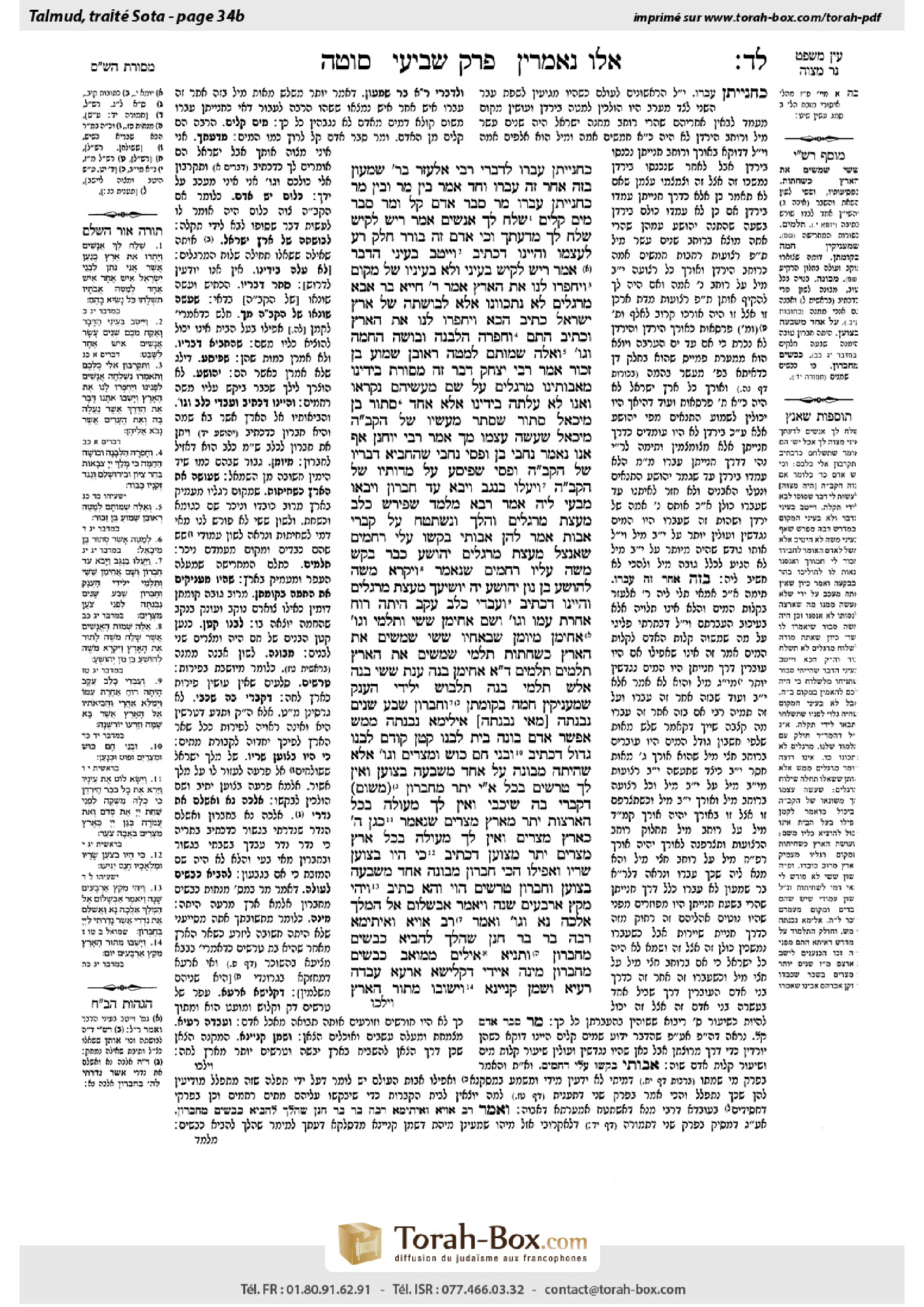
Sotah 34b: Talmud study for Daf Yomi
Daf Yomi is the daily study of one Talmud folio. Explore 37 tractates with scans, Hebrew text, Sefaria English and AI-generated French translations where annotated.
Passage selection and English or AI-generated French translation are available where the scan has annotations. Daf Study is independent of Torah-Box and Sefaria.
Browse Sotah · סוטה · All tractatesSotah 34b text and translations
This page of Sotah includes the Aramaic text, an English translation and an AI-generated French translation, alongside the scan above.
סוטה ל״ד ב · Aramaic and Hebrew text
כַּחֲנִיָּיתָן עָבְרוּ. לְדִבְרֵי רַבִּי אֶלְעָזָר בְּרַבִּי שִׁמְעוֹן — בְּזֶה אַחַר זֶה עָבְרוּ.
וְחַד אָמַר: בֵּין מָר וּבֵין מָר כַּחֲנִיָּיתָן עָבְרוּ. מָר סָבַר: אָדָם קַל, וּמָר סָבַר: מַיִם קַלִּים.
״שְׁלַח לְךָ אֲנָשִׁים״, אָמַר רֵישׁ לָקִישׁ: ״שְׁלַח לְךָ״ — מִדַּעְתֶּךָ. וְכִי אָדָם זֶה בּוֹרֵר חֵלֶק רַע לְעַצְמוֹ? וְהַיְינוּ דִּכְתִיב: ״וַיִּיטַב בְּעֵינַי הַדָּבָר״. אָמַר רֵישׁ לָקִישׁ: ״בְּעֵינַי״, וְלֹא בְּעֵינָיו שֶׁל מָקוֹם.
״וְיַחְפְּרוּ לָנוּ אֶת הָאָרֶץ״, אָמַר רַבִּי חִיָּיא בַּר אַבָּא: מְרַגְּלִים לֹא נִתְכַּוְּונוּ אֶלָּא לְבוֹשְׁתָּהּ שֶׁל אֶרֶץ יִשְׂרָאֵל. כְּתִיב הָכָא: ״וְיַחְפְּרוּ לָנוּ אֶת הָאָרֶץ״, וּכְתִיב הָתָם: ״וְחָפְרָה הַלְּבָנָה וּבוֹשָׁה הַחַמָּה וְגוֹ׳״.
״וְאֵלֶּה שְׁמוֹתָם לְמַטֵּה רְאוּבֵן שַׁמּוּעַ בֶּן זַכּוּר״, אָמַר רַבִּי יִצְחָק: דָּבָר זֶה מָסוֹרֶת בְּיָדֵינוּ מֵאֲבוֹתֵינוּ: מְרַגְּלִים עַל שֵׁם מַעֲשֵׂיהֶם נִקְרְאוּ. וְאָנוּ לֹא עָלְתָה בְּיָדֵינוּ אֶלָּא אֶחָד: ״סְתוּר בֶּן מִיכָאֵל״, ״סְתוּר״ — שֶׁסָּתַר מַעֲשָׂיו שֶׁל הַקָּדוֹשׁ בָּרוּךְ הוּא. ״מִיכָאֵל״ — שֶׁעָשָׂה עַצְמוֹ מָךְ.
אָמַר רַבִּי יוֹחָנָן, אַף אָנוּ נֹאמַר: ״נַחְבִּי בֶּן וׇפְסִי״, ״נַחְבִּי״ — שֶׁהֶחְבִּיא דְּבָרָיו שֶׁל הַקָּדוֹשׁ בָּרוּךְ הוּא. ״וׇפְסִי״ — שֶׁפִּיסַּע עַל מִדּוֹתָיו שֶׁל הַקָּדוֹשׁ בָּרוּךְ הוּא.
״וַיַּעֲלוּ בַנֶּגֶב וַיָּבֹא עַד חֶבְרוֹן״ — ״וַיָּבֹאוּ״ מִבְּעֵי לֵיהּ? אָמַר רָבָא: מְלַמֵּד שֶׁפֵּירַשׁ כָּלֵב מֵעֲצַת מְרַגְּלִים, וְהָלַךְ וְנִשְׁתַּטַּח עַל קִבְרֵי אָבוֹת. אָמַר לָהֶן: אֲבוֹתַי! בִּקְּשׁוּ עָלַי רַחֲמִים שֶׁאֶנָּצֵל מֵעֲצַת מְרַגְּלִים.
יְהוֹשֻׁעַ כְּבָר בִּקֵּשׁ מֹשֶׁה עָלָיו רַחֲמִים, שֶׁנֶּאֱמַר: ״וַיִּקְרָא מֹשֶׁה לְהוֹשֵׁעַ בִּן נוּן יְהוֹשֻׁעַ״, יָהּ יוֹשִׁיעֲךָ מֵעֲצַת מְרַגְּלִים. וְהַיְינוּ דִּכְתִיב: ״וְעַבְדִּי כָלֵב עֵקֶב הָיְתָה רוּחַ אַחֶרֶת עִמּוֹ וְגוֹ׳״.
״וְשָׁם אֲחִימַן שֵׁשַׁי וְתַלְמַי וְגוֹ׳״, ״אֲחִימַן״ — מְיוּמָּן שֶׁבְּאֶחָיו, ״שֵׁשַׁי״ — שֶׁמֵּשִׂים אֶת הָאָרֶץ כִּשְׁחִתוֹת, ״תַּלְמַי״ — שֶׁמֵּשִׂים אֶת הָאָרֶץ תְּלָמִים תְּלָמִים.
דָּבָר אַחֵר: אֲחִימַן בָּנָה עֲנָת, שֵׁשַׁי בָּנָה אָלֻשׁ, תַּלְמַי בָּנָה תַּלְבּוּשׁ. ״יְלִידֵי הָעֲנָק״ — שֶׁמַּעֲנִיקִין חַמָּה בְּקוֹמָתָן.
״וְחֶבְרוֹן שֶׁבַע שָׁנִים נִבְנְתָה״. מַאי ״נִבְנְתָה״? אִילֵימָא נִבְנְתָה מַמָּשׁ, אֶפְשָׁר אָדָם בּוֹנֶה בַּיִת לִבְנוֹ קָטָן קוֹדֶם לִבְנוֹ גָּדוֹל?! דִּכְתִיב: ״וּבְנֵי חָם כּוּשׁ וּמִצְרַיִם וְגוֹ׳״.
אֶלָּא שֶׁהָיְתָה מְבוּנָּה עַל אֶחָד מִשִּׁבְעָה בְּצוֹעַן. וְאֵין לְךָ טְרָשִׁים בְּכׇל אֶרֶץ יִשְׂרָאֵל יָתֵר מֵחֶבְרוֹן, מִשּׁוּם דְּקָבְרִי בָּהּ שָׁיכְבֵי. וְאֵין לְךָ מְעוּלָּה בְּכׇל הָאֲרָצוֹת יָתֵר מֵאֶרֶץ מִצְרַיִם, שֶׁנֶּאֱמַר: ״כְּגַן ה׳ כְּאֶרֶץ מִצְרַיִם״, וְאֵין לְךָ מְעוּלָּה בְּכׇל אֶרֶץ מִצְרַיִם יָתֵר מִצּוֹעַן, דִּכְתִיב: ״כִּי הָיוּ בְצֹעַן שָׂרָיו״, וַאֲפִילּוּ הָכִי חֶבְרוֹן מְבוּנָּה אֶחָד מִשִּׁבְעָה בְּצוֹעַן.
וְחֶבְרוֹן טְרָשִׁים הֲוַי? וְהָא כְּתִיב: ״וַיְהִי מִקֵּץ אַרְבָּעִים שָׁנָה וַיֹּאמֶר אַבְשָׁלוֹם אֶל הַמֶּלֶךְ אֵלְכָה נָּא וְגוֹ׳״, וְאָמַר רַב אַוְיָא וְאִיתֵּימָא רַבָּה בַּר בַּר חָנָן: שֶׁהָלַךְ לְהָבִיא כְּבָשִׂים מֵחֶבְרוֹן. וְתַנְיָא, אֵילִים מִמּוֹאָב, כְּבָשִׂים מֵחֶבְרוֹן! מִינַּהּ, אַיְּידֵי דִּקְלִישָׁא אַרְעָא, עָבְדָה רִעְיָא וְשַׁמִּן קִנְיָינָא.
״וַיָּשֻׁבוּ מִתּוּר הָאָרֶץ
Sotah 34b · English translation
the Jewish people crossed in the same formation as they camped. It was necessary for the water to stand only twelve mil high to allow for the entire encampment to pass through the Jordan. According to the statement of Rabbi Elazar, son of Rabbi Shimon, who said the water stood at a height of over three hundred mil, the water had to reach these heights to allow for enough time for everyone to cross the Jordan, as they crossed one after the other.
And one says: According to both this Sage and that Sage, they crossed in the same formation as they camped. However, one Sage, Rabbi Yehuda, holds that a person moves faster than water, and one Sage, Rabbi Elazar son of Rabbi Shimon, holds that water moves faster than a person does.
§ Since the Gemara mentioned the cluster of grapes that the spies brought back from Eretz Yisrael, it continues discussing the story of the spies. It is stated in the Torah that God told Moses: “Send you men” (Numbers 13:2). Reish Lakish says: “Send you” means that you should send them at your own discretion and not as a divine command. As, if it were a divine command, does a person choose a bad portion for himself? Since God knew the nature of these spies and that they would ultimately slander the land, He certainly would not have sent them Himself. And this is the meaning of that which is written in the passage where Moses retold the story of the spies: “And it was good in my eyes” (Deuteronomy 1:23), and Reish Lakish says: The implication of these words is that it seemed good “in my eyes,” but not in the eyes of the Omnipresent.
The Torah relates that the people asked Moses to send spies so “that they may search the land for us” (Deuteronomy 1:22). Rabbi Ḥiyya bar Abba says: When the Jewish people asked to send spies, their intention was only to shame Eretz Yisrael. It is written here: “That they may search [veyaḥperu] the land for us,” and it is written there: “Then the moon will be embarrassed [veḥafera], and the sun will be ashamed” (Isaiah 24:23).
The Torah states with regard to the spies: “And these were their names: Of the tribe of Reuben, Shammua the son of Zaccur” (Numbers 13:4). Rabbi Yitzḥak says: This statement that follows is a tradition of ours that was passed down to us from our ancestors: The spies were named after their actions, but we have obtained the interpretation of only one name, the name of “Sethur the son of Michael” (Numbers 13:13). He is called Sethur, as he hid [satar] the actions of the Holy One, Blessed be He. In other words, he ignored the miracles that God performed for the Jewish people in Egypt and in the wilderness. He is called Michael, as he made Him, God, appear weak [makh] by saying that there was not enough food in the land for everyone.
Rabbi Yoḥanan says: We can also say an interpretation of the name: “Nahbi the son of Vophsi” (Numbers 13:14): He is called Nahbi, as he concealed [heḥbi] the statement of the Holy One, Blessed be He, that the land is good, by delivering a distorted description of it. He is called Vophsi, as he stomped [pisse’a] on the attributes of the Holy One, Blessed be He, i.e., he did not believe in His promise to give Eretz Yisrael to the Jewish people.
It is also stated with regard to the spies: “And they went up into the south, and he came to Hebron” (Numbers 13:22). Why is the phrase “and he came” written in the singular form? The verse should have said: And they came. Rava says: This teaches that Caleb separated himself from the counsel of the other spies and went and prostrated himself on the graves of the forefathers in Hebron. He said to them: My forefathers, pray for mercy for me so that I will be saved from the counsel of the spies.
The Gemara explains: Joshua did not go to the graves of the forefathers because Moses had already prayed for mercy for him, as it is stated: “And Moses called Hoshea son of Nun Joshua [Yehoshua]” (Numbers 13:16), meaning: God will save you [Ya yoshiakha] from the counsel of the spies. And this is the meaning of that which is written: “But My servant Caleb, because he had another spirit with him, and has followed Me fully, him will I bring into the land where into he went” (Numbers 14:24), which implies that Caleb changed his mind over time. Joshua, however, was opposed to the intentions of the other spies from the outset.
The verse continues to state about Hebron: “And Ahiman, Sheshai, and Talmai, the children of Anak, were there” (Numbers 13:22). Ahiman was called by this name because he was the most skilled [meyumman] among his brothers. Sheshai was called by his name because he would turn the land that he treaded upon into ditches [sheḥatot] due to his large dimensions. Talmai was called this because he would turn the land that he treaded upon into furrows upon furrows [telamim] due to his weight.
Alternatively, their names signify another matter: Ahiman is the one who built the city of Anat. Sheshai built the city of Alush. Talmai built the city of Talbush. The verse describes them as “the children of Anak” because they were so tall and large that it appeared as if they were wearing [ma’anikin] the sun as a necklace due to their height.
The continuation of the verse states: “Now Hebron was built seven years [shanim] before Zoan of Egypt [Mitzrayim]” (Numbers 13:22). The Gemara asks: What is the meaning of the phrase “was built”? If we say that it was actually built seven years before Zoan, would a person build a house for his younger son before he builds one for his older son? Canaan was the youngest son of Ham, as it is written: “And the sons of Ham: Cush, and Mizraim, and Put, and Canaan” (Genesis 10:6). How then could Hebron, a city in the land of Canaan, have been built before Zoan, a city in the land of Egypt, occupied by the descendants of Mizraim?
Rather, the meaning of the verse is that Hebron was seven times more fruitful [mevunna] than Zoan. And there is no stonier land in Eretz Yisrael than Hebron. This is evident because they would bury the dead there, just as the forefathers were buried there. This was done only in land that was not suitable for agriculture. And of all the lands, there is none of a higher quality than the land of Egypt, as it is stated: “Like the garden of the Lord, like the land of Egypt” (Genesis 13:10). And there was no higher-quality land in all of the land of Egypt than Zoan, as it is written with regard to Pharaoh’s ministers, who would certainly have lived on the finest land in the country: “For his princes are in Zoan” (Isaiah 30:4). And even so, Hebron was seven times more fruitful than Zoan.
The Gemara asks: But is the land in Hebron in fact stony? But isn’t it written: “And it came to pass at the end of forty years, that Absalom said to the king: I pray, let me go and pay my vow, which I have vowed to the Lord, in Hebron” (II Samuel 15:7)? And Rav Avya says, and some say that it was Rabba bar bar Ḥanan: This means that Absalom went to bring sheep specifically from Hebron. And it is taught in a baraita (Tosefta, Menaḥot 9:3): One must bring the choicest animals to the Temple as offerings. Rams are brought from Moab, and sheep are brought from Hebron. This indicates that Hebron has rich land where fat and healthy sheep are raised. The Gemara answers: From this very source it can be proven that Hebron is not suitable for agriculture. Since the earth there is thin, it produces only grass for grazing and fattens the livestock.
The verse states: “And they returned from spying out the land at the end of forty days.
Sotah 34b · Traduction française (IA)
Le peuple juif traversa selon le même dispositif que celui de son campement. Il suffisait que l’eau s’élève à douze mil pour permettre à tout le camp de traverser le Jourdain. Selon l’opinion de Rabbi Elazar, fils de Rabbi Shimon, qui affirme que l’eau s’éleva à plus de trois cents mil, elle devait atteindre une telle hauteur afin de laisser suffisamment de temps à tous pour traverser le Jourdain, puisqu’ils passaient les uns après les autres.
Et l’on peut dire que, selon les deux Sages, ils traversèrent selon le même dispositif que celui de leur campement. Toutefois, l’un des Sages, Rabbi Yehouda, estime qu’une personne se déplace plus vite que l’eau, tandis que l’autre, Rabbi Elazar fils de Rabbi Shimon, estime que l’eau se déplace plus vite qu’une personne.
§ Puisque la Guemara a mentionné la grappe de raisin rapportée d’Eretz Israël par les explorateurs, elle poursuit le récit de leur histoire. La Torah rapporte que Dieu dit à Moïse : « Envoie pour toi des hommes » (Nombres 13:2). Reish Lakish dit : « Envoie pour toi » signifie que tu dois les envoyer à ta discrétion, et non sur ordre divin. En effet, s’il s’agissait d’un ordre divin, une personne choisirait-elle pour elle-même une mauvaise part ? Puisque Dieu connaissait la nature de ces explorateurs et savait qu’ils finiraient par dénigrer le pays, Il ne les aurait certainement pas envoyés Lui-même. Tel est le sens de ce qui est écrit dans le passage où Moïse raconte de nouveau l’histoire des explorateurs : « Cela me parut bon » (Deutéronome 1:23). Et Reish Lakish dit : Ces mots impliquent que cela parut bon « à mes yeux », mais pas aux yeux du Tout-Puissant.
La Torah rapporte que le peuple demanda à Moïse d’envoyer des explorateurs afin qu’« ils explorent le pays pour nous » (Deutéronome 1:22). Rabbi Ḥiyya bar Abba dit : Lorsque le peuple juif demanda à envoyer des explorateurs, son intention était uniquement de couvrir Eretz Israël de honte. Il est écrit ici : « afin qu’ils explorent [veyaḥperu] le pays pour nous », et il est écrit là : « Alors la lune sera couverte de honte [veḥafera] et le soleil sera honteux » (Isaïe 24:23).
La Torah dit au sujet des explorateurs : « Voici leurs noms : pour la tribu de Ruben, Shammua, fils de Zaccur » (Nombres 13:4). Rabbi Yitzḥak dit : Ce qui suit est une tradition que nous avons reçue de nos ancêtres : les explorateurs portaient des noms correspondant à leurs actes, mais nous n’avons obtenu l’interprétation que d’un seul nom, celui de « Sethur, fils de Michael » (Nombres 13:13). Il est appelé Sethur parce qu’il a dissimulé [satar] les actes du Saint, béni soit-Il. Autrement dit, il a ignoré les miracles que Dieu avait accomplis pour le peuple juif en Égypte et dans le désert. Il est appelé Michael parce qu’il L’a, Lui, fait paraître faible [makh], en disant que le pays ne contenait pas assez de nourriture pour tous.
Rabbi Yoḥanan dit : Nous pouvons également interpréter le nom « Nahbi, fils de Vophsi » (Nombres 13:14) : il est appelé Nahbi parce qu’il a caché [heḥbi] la parole du Saint, béni soit-Il, selon laquelle le pays est bon, en en donnant une description déformée. Il est appelé Vophsi parce qu’il a piétiné [pisse’a] les attributs du Saint, béni soit-Il, c’est-à-dire qu’il n’a pas cru à Sa promesse de donner Eretz Israël au peuple juif.
Il est également dit au sujet des explorateurs : « Ils montèrent par le sud, et il arriva à Hébron » (Nombres 13:22). Pourquoi l’expression « il arriva » est-elle au singulier ? Le verset aurait dû dire : « Ils arrivèrent ». Rava dit : Cela enseigne que Caleb se sépara des projets des autres explorateurs, se rendit aux tombeaux des patriarches à Hébron et se prosterna. Il leur dit : « Mes ancêtres, implorez la miséricorde en ma faveur afin que je sois sauvé des projets des explorateurs. »
La Guemara explique : Josué ne se rendit pas aux tombeaux des patriarches, car Moïse avait déjà imploré la miséricorde en sa faveur, comme il est dit : « Moïse appela Hoshéa, fils de Noun, Josué [Yehoshua] » (Nombres 13:16), ce qui signifie : « Que Dieu te sauve [Ya yoshiakha] des projets des explorateurs. » Tel est le sens de ce qui est écrit : « Mais mon serviteur Caleb, parce qu’un autre esprit était en lui et qu’il m’a pleinement suivi, je le ferai entrer dans le pays où il est allé » (Nombres 14:24), ce qui implique que Caleb changea d’avis avec le temps. Josué, en revanche, s’opposa aux intentions des autres explorateurs dès le départ.
Le verset poursuit au sujet d’Hébron : « Ahiman, Sheshaï et Talmaï, les enfants d’Anaq, s’y trouvaient » (Nombres 13:22). Ahiman était appelé ainsi parce qu’il était le plus habile [meyumman] de ses frères. Sheshaï était appelé ainsi parce que, du fait de sa grande taille, il transformait en fossés [sheḥatot] le sol sur lequel il marchait. Talmaï était appelé ainsi parce que, du fait de son poids, il transformait le sol sur lequel il marchait en sillons après sillons [telamim].
Autre interprétation : leurs noms désignent autre chose. Ahiman est celui qui construisit la ville d’Anat. Sheshaï construisit la ville d’Alush. Talmaï construisit la ville de Talbush. Le verset les décrit comme « les enfants d’Anaq » parce qu’ils étaient si grands et si corpulents qu’on aurait dit qu’ils portaient [ma’anikin] le soleil en collier, tant ils étaient hauts.
La suite du verset dit : « Or Hébron avait été bâtie sept ans [shanim] avant Tsoan d’Égypte [Mitzrayim] » (Nombres 13:22). La Guemara demande : Que signifie l’expression « avait été bâtie » ? Si l’on dit qu’elle avait réellement été bâtie sept ans avant Tsoan, un homme bâtirait-il une maison pour son fils cadet avant d’en bâtir une pour son fils aîné ? Canaan était le fils cadet de Ham, comme il est écrit : « Les fils de Ham : Koush, Mitsraïm, Pout et Canaan » (Genèse 10:6). Comment Hébron, ville située au pays de Canaan, aurait-elle donc pu être bâtie avant Tsoan, ville du pays d’Égypte, occupé par les descendants de Mitsraïm ?
Il faut plutôt comprendre le verset ainsi : Hébron était sept fois plus fertile [mevunna] que Tsoan. Or, il n’est pas de sol plus pierreux en Eretz Israël que celui d’Hébron. Cela se voit au fait qu’on y enterrait les morts, comme les patriarches y furent enterrés. On ne faisait cela que dans un sol impropre à l’agriculture. Et parmi tous les pays, il n’en est aucun de meilleure qualité que le pays d’Égypte, comme il est dit : « Comme le jardin du Seigneur, comme le pays d’Égypte » (Genèse 13:10). Et, dans tout le pays d’Égypte, aucun sol n’était de meilleure qualité que celui de Tsoan, comme il est écrit au sujet des ministres de Pharaon, qui vivaient certainement sur les meilleures terres du pays : « Car ses princes sont à Tsoan » (Isaïe 30:4). Et pourtant, Hébron était sept fois plus fertile que Tsoan.
La Guemara demande : Mais le sol d’Hébron est-il réellement pierreux ? N’est-il pas écrit : « Au bout de quarante ans, Absalom dit au roi : Permets-moi, je te prie, de partir et de m’acquitter à Hébron du vœu que j’ai fait au Seigneur » (II Samuel 15:7) ? Rav Avya dit — et certains disent que c’était Rabba bar bar Ḥanan : Cela signifie qu’Absalom se rendit précisément à Hébron pour y prendre des moutons. Et il est enseigné dans une baraïta (Tosefta, Menaḥot 9:3) : Il faut apporter au Temple les meilleurs animaux pour les offrandes. Les béliers sont apportés de Moab et les moutons d’Hébron. Cela indique qu’Hébron possède des terres riches, où l’on élève des moutons gras et vigoureux. La Guemara répond : Cette source même permet de prouver qu’Hébron ne convient pas à l’agriculture. Comme la terre y est maigre, elle ne produit que de l’herbe pour le pâturage, ce qui engraisse le bétail.
Le verset dit : « Ils revinrent de l’exploration du pays au bout de quarante jours. »
Traduction française générée par IA à partir de l’édition anglaise de Sefaria. Vérifie toujours un passage avec le texte source.
Text from Sefaria: William Davidson Edition - Vocalized Aramaic (CC BY NC); William Davidson Edition - English (CC BY NC).