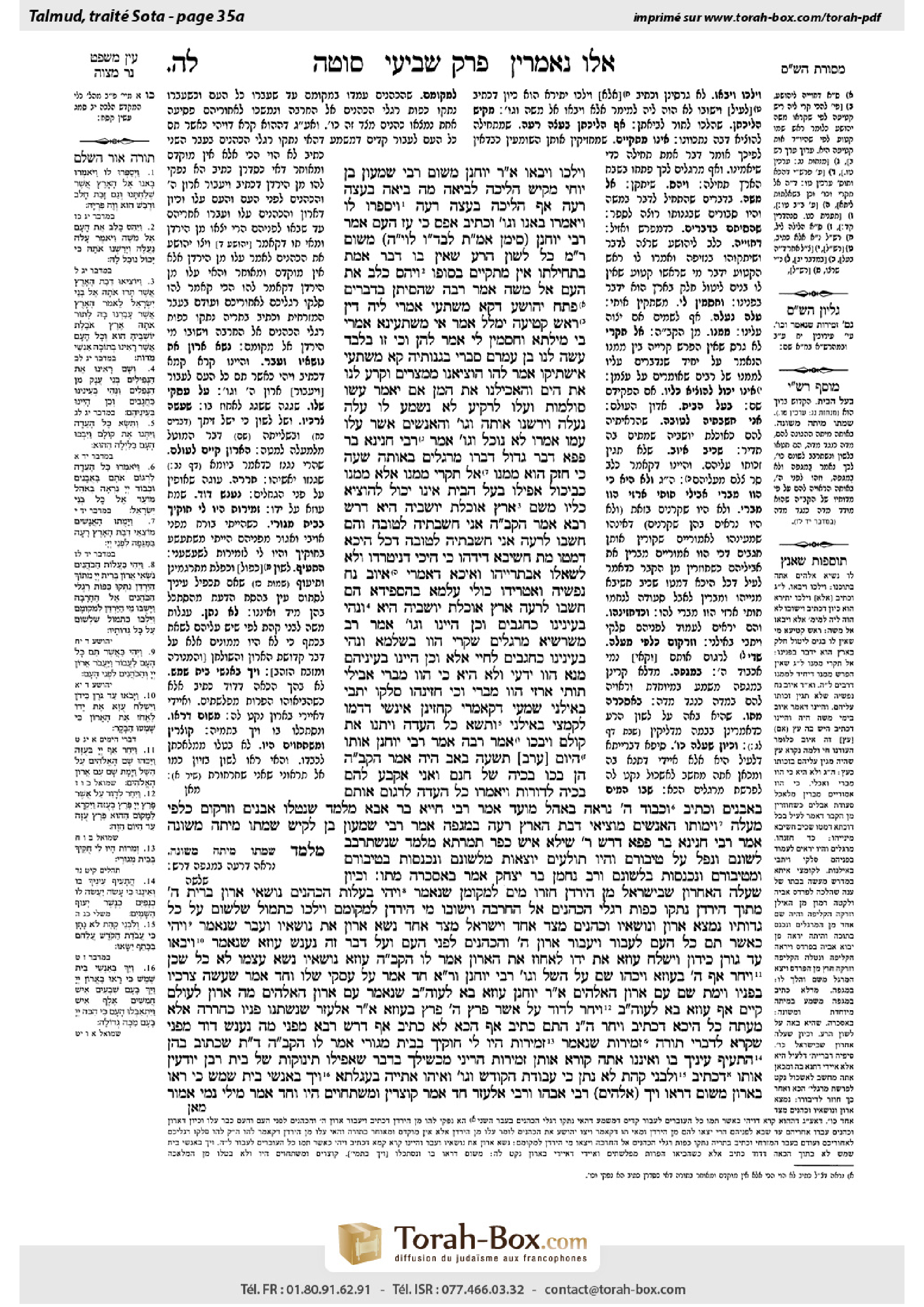
Sotah 35a: Talmud study for Daf Yomi
Daf Yomi is the daily study of one Talmud folio. Explore 37 tractates with scans, Hebrew text, Sefaria English and AI-generated French translations where annotated.
Passage selection and English or AI-generated French translation are available where the scan has annotations. Daf Study is independent of Torah-Box and Sefaria.
Browse Sotah · סוטה · All tractatesSotah 35a text and translations
This page of Sotah includes the Aramaic text, an English translation and an AI-generated French translation, alongside the scan above.
סוטה ל״ה א · Aramaic and Hebrew text
וַיֵּלְכוּ וַיָּבֹאוּ״. אָמַר רַבִּי יוֹחָנָן מִשּׁוּם רַבִּי שִׁמְעוֹן בֶּן יוֹחַי: מַקֵּישׁ הֲלִיכָה לְבִיאָה, מָה בִּיאָה — בְּעֵצָה רָעָה, אַף הֲלִיכָה — בְּעֵצָה רָעָה.
״וַיְסַפְּרוּ לוֹ וַיֹּאמְרוּ בָּאנוּ וְגוֹ׳״, וּכְתִיב: ״אֶפֶס כִּי עַז הָעָם״, אָמַר רַבִּי יוֹחָנָן (סִימָן אֱמֶת לְבַדּוֹ לְוִיָּה) מִשּׁוּם רַבִּי מֵאִיר: כָּל לָשׁוֹן הָרַע שֶׁאֵין בּוֹ דְּבַר אֱמֶת בִּתְחִילָּתוֹ — אֵין מִתְקַיֵּים בְּסוֹפוֹ.
״וַיַּהַס כָּלֵב אֶת הָעָם אֶל מֹשֶׁה״, אָמַר רַבָּה: שֶׁהִסִּיתָן בִּדְבָרִים.
פָּתַח יְהוֹשֻׁעַ, דְּקָא מִשְׁתַּעֵי אָמְרִי לֵיהּ: דֵּין רֵאשׁ קְטִיעָה יְמַלֵּל?
אָמַר: אִי מִשְׁתַּעֵינָא — אָמְרִי בִּי מִילְּתָא וְחָסְמִין לִי. אָמַר לָהֶן: וְכִי זוֹ בִּלְבַד עָשָׂה לָנוּ בֶּן עַמְרָם? סָבְרִי בִּגְנוּתֵיהּ קָא מִשְׁתַּעֵי, אִישְׁתִּיקוּ.
אֲמַר לְהוּ: הוֹצִיאָנוּ מִמִּצְרַיִם, וְקָרַע לָנוּ אֶת הַיָּם, וְהֶאֱכִילָנוּ אֶת הַמָּן. אִם יֹאמַר ״עֲשׂוּ סוּלָּמוֹת וַעֲלוּ לָרָקִיעַ״ לֹא נִשְׁמַע לוֹ? ״עָלֹה נַעֲלֶה וְיָרַשְׁנוּ אֹתָהּ וְגוֹ׳״.
״וְהָאֲנָשִׁים אֲשֶׁר עָלוּ עִמּוֹ אָמְרוּ לֹא נוּכַל וְגוֹ׳״. אָמַר רַבִּי חֲנִינָא בַּר פָּפָּא: דָּבָר גָּדוֹל דִּבְּרוּ מְרַגְּלִים בְּאוֹתָהּ שָׁעָה. ״כִּי חָזָק הוּא מִמֶּנּוּ״, אַל תִּקְרֵי ״מִמֶּנּוּ״, אֶלָּא ״מִמֵּנוֹ״ — כִּבְיָכוֹל אֲפִילּוּ בַּעַל הַבַּיִת אֵינוֹ יָכוֹל לְהוֹצִיא כֵּלָיו מִשָּׁם.
״אֶרֶץ אֹכֶלֶת יוֹשְׁבֶיהָ הִיא״, דָּרֵשׁ רָבָא, אָמַר הַקָּדוֹשׁ בָּרוּךְ הוּא: אֲנִי חֲשַׁבְתִּיהָ לְטוֹבָה, וְהֵם חָשְׁבוּ לְרָעָה. אֲנִי חֲשַׁבְתִּיהָ לְטוֹבָה — דְּכׇל הֵיכָא דִּמְטוֹ, מִת חֲשִׁיבָא דִּידְהוּ כִּי הֵיכִי דְּנִיטַּרְדוּ וְלָא לְשַׁאֲלוּ אַבָּתְרַיְיהוּ. וְאִיכָּא דְּאָמְרִי: אִיּוֹב נָח נַפְשֵׁיהּ, וְאִטְּרִידוּ כּוּלֵּי עָלְמָא בְּהֶסְפֵּידָא, הֵם חָשְׁבוּ לְרָעָה, ״אֶרֶץ אֹכֶלֶת יוֹשְׁבֶיהָ הִיא״.
״וַנְּהִי בְעֵינֵינוּ כַּחֲגָבִים וְכֵן הָיִינוּ וְגוֹ׳״, אָמַר רַב מְשַׁרְשְׁיָא: מְרַגְּלִים שַׁקָּרֵי הֲווֹ, בִּשְׁלָמָא ״וַנְּהִי בְּעֵינֵינוּ כַּחֲגָבִים״ — לְחַיֵּי, אֶלָּא ״וְכֵן הָיִינוּ בְּעֵינֵיהֶם״, מְנָא הֲווֹ יָדְעִי?
וְלָא הִיא, כִּי הֲווֹ מַבְרִי אֲבֵילֵי — תּוּתֵי אַרְזֵי הֲווֹ מַבְרִי, וְכִי חֲזִינְהוּ, סְלִקוּ יָתְבִי בְּאִילָנֵי, שָׁמְעִי דְּקָאָמְרִי: קָחָזֵינַן אִינָשֵׁי דְּדָמוּ לְקַמְצֵי בְּאִילָנֵי.
״וַתִּשָּׂא כׇּל הָעֵדָה וַיִּתְּנוּ אֶת קוֹלָם וַיִּבְכּוּ״, אָמַר רַבָּה אָמַר רַבִּי יוֹחָנָן: אוֹתוֹ הַיּוֹם עֶרֶב תִּשְׁעָה בְּאָב הָיָה, אָמַר הַקָּדוֹשׁ בָּרוּךְ הוּא: הֵן בָּכוּ בְּכִיָּה שֶׁל חִנָּם וַאֲנִי אֶקְבַּע לָהֶם בְּכִיָּה לְדוֹרוֹת.
״וַיֹּאמְרוּ כׇּל הָעֵדָה לִרְגּוֹם אֹתָם בָּאֲבָנִים״, וּכְתִיב: ״וְכָבוֹד ה׳ נִרְאָה בְּאֹהֶל מוֹעֵד״, אָמַר רַבִּי חִיָּיא בַּר אַבָּא: מְלַמֵּד שֶׁנָּטְלוּ אֲבָנִים וּזְרָקוּם כְּלַפֵּי מַעְלָה.
״וַיָּמֻתוּ הָאֲנָשִׁים מוֹצִאֵי דִבַּת הָאָרֶץ רָעָה בַּמַּגֵּפָה״, אָמַר רַבִּי שִׁמְעוֹן בֶּן לָקִישׁ: שֶׁמֵּתוּ מִיתָה מְשׁוּנָּה. אָמַר רַבִּי חֲנִינָא בַּר פָּפָּא, דָּרֵשׁ רַבִּי שֵׁילָא אִישׁ כְּפַר תְּמַרְתָּא: מְלַמֵּד שֶׁנִּשְׁתַּרְבֵּב לְשׁוֹנָם וְנָפַל עַל טִיבּוּרָם, וְהָיוּ תּוֹלָעִים יוֹצְאוֹת מִלְּשׁוֹנָם וְנִכְנָסוֹת בְּטִיבּוּרָם, וּמִטִּיבּוּרָם וְנִכְנָסוֹת בִּלְשׁוֹנָם. וְרַב נַחְמָן בַּר יִצְחָק אָמַר: בְּאַסְכָּרָה מֵתוּ.
וְכֵיוָן שֶׁעָלָה הָאַחֲרוֹן שֶׁבְּיִשְׂרָאֵל מִן הַיַּרְדֵּן חָזְרוּ מַיִם לִמְקוֹמָן, שֶׁנֶּאֱמַר: ״וַיְהִי בַּעֲלוֹת הַכֹּהֲנִים נֹשְׂאֵי אֲרוֹן בְּרִית ה׳ מִתּוֹךְ הַיַּרְדֵּן נִתְּקוּ כַּפּוֹת רַגְלֵי הַכֹּהֲנִים אֶל הֶחָרָבָה וַיָּשֻׁבוּ מֵי הַיַּרְדֵּן לִמְקוֹמָם וַיֵּלְכוּ כִתְמוֹל שִׁלְשׁוֹם עַל כׇּל גְּדוֹתָיו״,
נִמְצָא אָרוֹן וְנוֹשְׂאָיו וְכֹהֲנִים מִצַּד אֶחָד, וְיִשְׂרָאֵל מִצַּד אֶחָד. נָשָׂא אָרוֹן אֶת נוֹשְׂאָיו וְעָבַר, שֶׁנֶּאֱמַר: ״וַיְהִי כַּאֲשֶׁר תַּם כׇּל הָעָם לַעֲבֹר וַיַּעֲבֹר אֲרוֹן ה׳ וְהַכֹּהֲנִים לִפְנֵי הָעָם״.
וְעַל דָּבָר זֶה נֶעֱנַשׁ עוּזָּא, שֶׁנֶּאֱמַר: ״וַיָּבֹאוּ עַד גֹּרֶן כִּידֹן וַיִּשְׁלַח עֻזָּא אֶת יָדוֹ לֶאֱחֹז אֶת הָאָרוֹן״, אָמַר לוֹ הַקָּדוֹשׁ בָּרוּךְ הוּא: עוּזָּא, נוֹשְׂאָיו נָשָׂא, עַצְמוֹ לֹא כׇּל שֶׁכֵּן!
״וַיִּחַר אַף ה׳ בְּעֻזָּה וַיַּכֵּהוּ שָׁם עַל הַשַּׁל וְגוֹ׳״. רַבִּי יוֹחָנָן וְרַבִּי אֶלְעָזָר, חַד אָמַר: עַל עִסְקֵי שָׁלוּ. וְחַד אָמַר: שֶׁעָשָׂה צְרָכָיו בְּפָנָיו.
״וַיָּמׇת שָׁם עִם אֲרוֹן הָאֱלֹהִים״, אָמַר רַבִּי יוֹחָנָן: עוּזָּא בָּא לָעוֹלָם הַבָּא, שֶׁנֶּאֱמַר: ״עִם אֲרוֹן הָאֱלֹהִים״ — מָה אָרוֹן לְעוֹלָם קַיָּים, אַף עוּזָּא בָּא לָעוֹלָם הַבָּא.
״וַיִּחַר לְדָוִד עַל אֲשֶׁר פָּרַץ ה׳ פֶּרֶץ בְּעֻזָּה״, אָמַר רַבִּי אֶלְעָזָר: שֶׁנִּשְׁתַּנּוּ פָּנָיו כַּחֲרָרָה.
אֶלָּא מֵעַתָּה כׇּל הֵיכָא דִּכְתִיב ״וַיִּחַר״, הָכִי נָמֵי?! הָתָם כְּתִיב ״אַף״, הָכָא לָא כְּתִיב ״אַף״.
דָּרֵשׁ רָבָא: מִפְּנֵי מָה נֶעֱנַשׁ דָּוִד — מִפְּנֵי שֶׁקָּרָא לְדִבְרֵי תוֹרָה ״זְמִירוֹת״, שֶׁנֶּאֱמַר: ״זְמִרוֹת הָיוּ לִי חֻקֶּיךָ בְּבֵית מְגוּרָי״.
אָמַר לוֹ הַקָּדוֹשׁ בָּרוּךְ הוּא: דִּבְרֵי תוֹרָה שֶׁכָּתוּב בָּהֶן ״הֲתָעִיף עֵינֶיךָ בּוֹ וְאֵינֶנּוּ״, אַתָּה קוֹרֵא אוֹתָן זְמִירוֹת?! הֲרֵינִי מַכְשִׁילְךָ בְּדָבָר שֶׁאֲפִילּוּ תִּינוֹקוֹת שֶׁל בֵּית רַבָּן יוֹדְעִין אוֹתוֹ, דִּכְתִיב: ״וְלִבְנֵי קְהָת לֹא נָתָן כִּי עֲבֹדַת הַקֹּדֶשׁ וְגוֹ׳״, וְאִיהוּ אַתְיֵיהּ בַּעֲגַלְתָּא.
״וַיַּךְ בְּאַנְשֵׁי בֵית שֶׁמֶשׁ כִּי רָאוּ בַּאֲרוֹן״, מִשּׁוּם דְּרָאוּ ״וַיַּךְ״ אֱלֹהִים? רַבִּי אֲבָהוּ וְרַבִּי אֶלְעָזָר, חַד אָמַר: קוֹצְרִין וּמִשְׁתַּחֲוִים הָיוּ, וְחַד אָמַר: מִילֵּי נָמֵי אֲמוּר.
Sotah 35a · English translation
And they went and they came” (Numbers 13:25–26). Rabbi Yoḥanan says in the name of Rabbi Shimon ben Yoḥai: This verse likens their going to their coming. Just as their coming back was with wicked counsel, so too, their going to Eretz Yisrael was with wicked counsel.
The Torah states: “And they told him, and said: We came to the land to which you sent us, and it also flows with milk and honey” (Numbers 13:27), and then it is written: “However the people that dwell in the land are fierce” (Numbers 13:28). Why did the spies praise the land and then slander it? Rabbi Yoḥanan says three statements in the name of Rabbi Meir, represented by the mnemonic device: Truth, alone, borrowing. The first statement answers this question: Any slander that does not begin with a truthful statement ultimately does not stand, i.e., it is not accepted by others.
The verse states: “And Caleb stilled [vayyahas] the people toward Moses” (Numbers 13:30). Rabba says: This means that he persuaded them [hesitan] with his words. Vayyahas and hesitan share the same root in Hebrew.
How did he do so? Joshua began to address the people, and as he was speaking they said to him: Should this person, who has a severed head, as he has no children, speak to the people about entering Eretz Yisrael?
Caleb said to himself: If I speak they will also say something about me and stop me from speaking. He began to speak and said to them: And is this the only thing that the son of Amram, Moses, has done to us? They thought that he wanted to relate something to the discredit of Moses, and they were silent.
He then said to them: He took us out of Egypt, and split the sea for us, and fed us the manna. If he says to us: Build ladders and climb to the heavens, should we not listen to him? “We should go up at once,” even to the heavens, “and possess it” (Numbers 13:30).
The verses continue: “But the men that went up with him said: We are not able to go up against the people; as they are stronger than us” (Numbers 13:31). Rabbi Ḥanina bar Pappa says: The spies said a serious statement at that moment. When they said: “They are stronger,” do not read the phrase as: Stronger than us [mimmennu], but rather read it as: Stronger than Him [mimmennu], meaning that even the Homeowner, God, is unable to remove His belongings from there, as it were. The spies were speaking heresy and claiming that the Canaanites were stronger than God Himself.
The spies said: “It is a land that consumes its inhabitants” (Numbers 13:32). Rava taught: The Holy One, Blessed be He, said: I intended the land to appear to consume its inhabitants for their own good, but they considered this proof that the land was bad. I intended it for their good by causing many people to die there so that anywhere that the spies arrived, the most important of them died, so that the Canaanites would be preoccupied with mourning and would not inquire about them. And there are those who say that God caused Job to die at that time, and everyone in Canaan was preoccupied with his eulogy, and did not pay attention to the spies. However, the spies considered this proof that the land was bad and said: “It is a land that consumes its inhabitants.”
The spies said: “And we were like grasshoppers in our own eyes, and so were we in their eyes” (Numbers 13:33). Rav Mesharshiyya says: The spies were liars. Granted, to say: “We were like grasshoppers in our own eyes,” is well, but to say: “And so were we in their eyes,” from where could they have known this?
The Gemara responds: But that is not so, as when the Canaanites were having the mourners’ meal, they had the meal beneath cedar trees, and when the spies saw them they climbed up the trees and sat in them. From there they heard the Canaanites saying: We see people who look like grasshoppers in the trees.
The verse states: “And all the congregation lifted up their voice and cried” (Numbers 14:1). Rabba says that Rabbi Yoḥanan says: That day was the eve of the Ninth of Av, and the Holy One, Blessed be He, said: On that day they wept a gratuitous weeping, so I will establish that day for them as a day of weeping for the future generations.
The verse states: “But all the congregation bade stone them with stones” (Numbers 14:10), and it is written immediately afterward: “When the glory of the Lord appeared in the Tent of Meeting” (Numbers 14:10). Rabbi Ḥiyya bar Abba says: This teaches that they took stones and threw them upward as if to throw them at God.
The verse states: “And those men who brought out an evil report of the land, died by the plague before the Lord” (Numbers 14:37). Rabbi Shimon ben Lakish says: This means that they died an unusual death. Rabbi Ḥanina bar Pappa says that Rabbi Sheila Ish Kefar Temarta taught: This teaches that their tongues were stretched out from their mouths and fell upon their navels, and worms were crawling out of their tongues and entering their navels, and worms were likewise coming out of their navels and entering their tongues. This is the painful death that they suffered. And Rav Naḥman bar Yitzḥak says: They died of diphtheria, which causes one to choke to death.
§ The Gemara returns to discuss the entry of the Jewish people into Eretz Yisrael. And once the last one of the Jewish people ascended out of the Jordan, the water returned to its place, as it is stated: “And it came to pass, as the priests that bore the Ark of the Covenant of the Lord came up out of the midst of the Jordan, as soon as the soles of the priests’ feet were drawn up unto the dry ground, that the waters of the Jordan returned to their place, and went over all its banks, as it had before” (Joshua 4:18). The Gemara understands that the priests who carried the Ark stood in the water until all of the Jewish people passed through the Jordan. Once all the Jewish people had reached the other side of the Jordan, the priests stepped back from the water and the Jordan returned to its natural state.
It follows that the Ark and its bearers and the priests were on one side of the Jordan, the east side, and the rest of the Jewish people were on the other side, the west side. Subsequently, the Ark carried its bearers in the air and crossed the Jordan, as it is stated: “When all the people were completely passed over, the Ark of the Lord passed on, and the priests, before the people” (Joshua 4:11).
And over this matter Uzzah was punished for not taking proper care of the Ark, as it is stated: “And when they came to the threshing floor of Chidon, Uzzah put forth his hand to hold the Ark; for the oxen stumbled” (I Chronicles 13:9). The Holy One, Blessed be He, said to him: Uzzah, the Ark carried its bearers when it crossed the Jordan; all the more so is it not clear that it can carry itself?
§ The verse states: “And the anger of the Lord was kindled against Uzzah; and God smote him there for his error [hashal]” (II Samuel 6:7). Rabbi Yoḥanan and Rabbi Elazar disagreed over the interpretation of this verse. One says: God smote him for his forgetfulness [shalo], because he did not remember that the Ark can carry itself. And one says: God smote him because he lifted the edges [shulayyim] of his garment in front of the Ark and relieved himself in its presence.
The verse states: “And he died there with the Ark of God” (II Samuel 6:7). Rabbi Yoḥanan says: Uzzah entered the World-to-Come, as it is stated: “With the Ark of God.” Just as the Ark exists forever, so too, Uzzah entered the World-to-Come.
The verse states: “And David was displeased [vayyiḥar] because the Lord had broken forth upon Uzzah” (II Samuel 6:8). Rabbi Elazar says: Vayyiḥar means that his face changed colors and darkened like baked bread [ḥarara] from displeasure.
The Gemara questions this statement: If that is so, anywhere that the word vayyiḥar is written, including when it is referring to God, should it be interpreted this way as well? The Gemara answers: There, it is written: “And the anger of the Lord was kindled [vayyiḥar af ]” (II Samuel 6:7), whereas here, the anger [af ] is not written, but only vayyiḥar. Therefore it is interpreted differently.
Rava taught: For what reason was David punished with Uzzah’s death? He was punished because he called matters of Torah: Songs, as it is stated: “Your statutes have been my songs in the house of my pilgrimage” (Psalms 119:54).
The Holy One, Blessed be He, said to him: Matters of Torah are so difficult and demanding that it is written: “Will you set your eyes upon it? It is gone” (Proverbs 23:5), i.e., one whose eyes stray from the Torah even for a moment will forget it, and you call them songs? For this reason I will cause you to stumble in a matter that even schoolchildren know, as it is written with regard to the wagons brought to the Tabernacle: “And to the descendants of Kohath he did not give, because the service of the holy things belongs to them; they carry them upon their shoulders” (Numbers 7:9). And although the Ark clearly must be carried on people’s shoulders, David erred and brought it in a wagon.
§ When the Philistines returned the Ark during the period of Samuel, it is stated: “And He smote of the men of Beit Shemesh because they had gazed upon the Ark of the Lord” (I Samuel 6:19). The Gemara asks: Because they gazed upon it, God smote them? Why did their action warrant this punishment? Rabbi Abbahu and Rabbi Elazar disagreed with regard to the interpretation of the verse. One says that they were punished because they were reaping their crops and prostrating themselves at the same time; they did not stop working in reverence for the Ark. And one says that they also spoke denigrating words:
Sotah 35a · Traduction française (IA)
« Ils partirent et revinrent » (Nombres 13,25-26). Rabbi Yoḥanan dit au nom de Rabbi Shimon ben Yoḥai : Ce verset met leur départ en parallèle avec leur retour. De même que leur retour fut motivé par un mauvais dessein, leur départ vers Eretz Israël le fut également.
La Torah dit : « Ils lui firent leur rapport et dirent : Nous sommes allés dans le pays où tu nous as envoyés ; il ruisselle aussi de lait et de miel » (Nombres 13,27), puis il est écrit : « Cependant, le peuple qui habite le pays est puissant » (Nombres 13,28). Pourquoi les explorateurs ont-ils loué le pays avant de le dénigrer ? Rabbi Yoḥanan rapporte au nom de Rabbi Meïr trois enseignements, réunis dans le moyen mnémotechnique : vérité, seul, emprunt. Le premier répond à cette question : Tout propos diffamatoire qui ne commence pas par une affirmation véridique finit par ne pas être accepté par les autres.
Le verset dit : « Caleb fit taire [vayyahas] le peuple en faveur de Moïse » (Nombres 13,30). Rabba dit que cela signifie qu’il les persuada [hesitan] par ses paroles. Vayyahas et hesitan ont la même racine en hébreu.
Comment s’y prit-il ? Josué commença à s’adresser au peuple et, pendant qu’il parlait, ils lui dirent : « Cet homme, qui a la tête tranchée puisqu’il n’a pas d’enfants, devrait-il parler au peuple de l’entrée en Eretz Israël ? »
Caleb se dit : « Si je parle, ils diront aussi quelque chose à mon sujet et m’empêcheront de parler. » Il prit la parole et leur dit : « Est-ce là la seule chose que le fils d’Amram, Moïse, ait faite pour nous ? » Ils pensèrent qu’il allait raconter quelque chose à la décharge de Moïse, et se turent.
Il leur dit alors : « Il nous a fait sortir d’Égypte, a fendu la mer pour nous et nous a nourris de la manne. S’il nous disait : “Construisez des échelles et montez jusqu’aux cieux”, ne devrions-nous pas l’écouter ? “Montons immédiatement” (Nombres 13,30), même jusqu’aux cieux, “et prenons-en possession.” »
Les versets poursuivent : « Mais les hommes qui étaient montés avec lui dirent : Nous ne pouvons pas monter contre ce peuple, car il est plus fort que nous » (Nombres 13,31). Rabbi Ḥanina bar Pappa dit : À ce moment-là, les explorateurs prononcèrent une parole grave. Lorsqu’ils dirent : « Ils sont plus forts », ne lis pas l’expression comme « plus forts que nous » [mimmennu], mais plutôt comme « plus forts que Lui » [mimmennu], c’est-à-dire que même le Maître de la maison, Dieu, est incapable, pour ainsi dire, de retirer ses biens de là. Les explorateurs proféraient une hérésie et prétendaient que les Cananéens étaient plus puissants que Dieu lui-même.
Les explorateurs dirent : « C’est un pays qui dévore ses habitants » (Nombres 13,32). Rava enseigna : Le Saint, béni soit-Il, dit : « J’avais voulu que le pays semble dévorer ses habitants pour leur bien, mais ils y ont vu la preuve que le pays était mauvais. J’avais voulu leur bien en faisant mourir beaucoup de gens là-bas, afin que, partout où les explorateurs arriveraient, les personnes les plus importantes meurent. Ainsi, les Cananéens seraient occupés à faire leur deuil et ne chercheraient pas à savoir qui étaient les explorateurs. » Certains disent que Dieu fit mourir Job à ce moment-là et que tout le monde en Canaan fut occupé à ses funérailles, sans prêter attention aux explorateurs. Mais ceux-ci y virent la preuve que le pays était mauvais et dirent : « C’est un pays qui dévore ses habitants. »
Les explorateurs dirent : « Nous étions à nos propres yeux comme des sauterelles, et nous l’étions aussi à leurs yeux » (Nombres 13,33). Rav Mesharshiyya dit : Les explorateurs étaient des menteurs. Il est plausible qu’ils aient dit : « Nous étions à nos propres yeux comme des sauterelles » ; mais comment pouvaient-ils savoir qu’ils l’étaient aussi à leurs yeux ?
La Guemara répond : Ce n’est pas le cas, car lorsque les Cananéens prenaient leur repas de deuil, ils le faisaient sous des cèdres. Quand les explorateurs les virent, ils grimpèrent aux arbres et s’y assirent. De là, ils entendirent les Cananéens dire : « Nous voyons des gens qui ressemblent à des sauterelles dans les arbres. »
Le verset dit : « Toute l’assemblée éleva la voix et poussa des cris » (Nombres 14,1). Rabba dit au nom de Rabbi Yoḥanan : Ce jour-là était la veille du neuf Av, et le Saint, béni soit-Il, dit : « Ce jour-là, ils ont pleuré sans raison ; je ferai donc de ce jour un jour de pleurs pour les générations futures. »
Le verset dit : « Toute l’assemblée parla de les lapider » (Nombres 14,10), et il est écrit immédiatement après : « La gloire du Seigneur apparut dans la Tente de la Rencontre » (Nombres 14,10). Rabbi Ḥiyya bar Abba dit : Cela enseigne qu’ils prirent des pierres et les lancèrent vers le haut, comme s’ils voulaient les jeter contre Dieu.
Le verset dit : « Ces hommes qui avaient propagé un rapport défavorable sur le pays moururent frappés par le fléau, devant le Seigneur » (Nombres 14,37). Rabbi Shimon ben Lakish dit : Cela signifie qu’ils moururent d’une mort inhabituelle. Rabbi Ḥanina bar Pappa rapporte que Rabbi Sheila Ish Kefar Temarta enseigna : Cela nous apprend que leur langue sortit de leur bouche et retomba sur leur nombril ; des vers sortaient de leur langue et entraient dans leur nombril, tandis que d’autres vers sortaient de leur nombril et entraient dans leur langue. Telle fut la mort douloureuse qu’ils subirent. Rav Naḥman bar Yitzḥak dit : Ils moururent de diphtérie, une maladie qui provoque la mort par suffocation.
§ La Guemara revient sur l’entrée du peuple juif en Eretz Israël. Lorsque le dernier des membres du peuple juif fut sorti du Jourdain, les eaux reprirent leur place, comme il est dit : « Lorsque les prêtres qui portaient l’Arche de l’Alliance du Seigneur sortirent du milieu du Jourdain, dès que la plante des pieds des prêtres eut atteint la terre ferme, les eaux du Jourdain reprirent leur place et débordèrent sur toutes ses rives, comme auparavant » (Josué 4,18). La Guemara comprend que les prêtres qui portaient l’Arche restèrent dans l’eau jusqu’à ce que tout le peuple juif ait traversé le Jourdain. Une fois que tous eurent atteint l’autre rive, les prêtres s’éloignèrent de l’eau et le Jourdain reprit son cours naturel.
Il s’ensuit que l’Arche, ceux qui la portaient et les prêtres se trouvaient d’un côté du Jourdain, à l’est, tandis que le reste du peuple juif se trouvait de l’autre côté, à l’ouest. Ensuite, l’Arche porta ceux qui la portaient dans les airs et traversa le Jourdain, comme il est dit : « Lorsque tout le peuple eut entièrement traversé, l’Arche du Seigneur passa, ainsi que les prêtres, devant le peuple » (Josué 4,11).
C’est à propos de cet épisode qu’Ouzza fut puni pour ne pas avoir pris soin de l’Arche comme il convenait, comme il est dit : « Lorsqu’ils arrivèrent à l’aire de Kidôn, Ouzza tendit la main pour retenir l’Arche, car les bœufs avaient trébuché » (I Chroniques 13,9). Le Saint, béni soit-Il, lui dit : « Ouzza, l’Arche porta ceux qui la portaient lorsqu’elle traversa le Jourdain ; à plus forte raison peut-elle se porter elle-même, n’est-ce pas évident ? »
§ Le verset dit : « La colère du Seigneur s’enflamma contre Ouzza, et Dieu le frappa là à cause de son erreur [hashal] » (II Samuel 6,7). Rabbi Yoḥanan et Rabbi Elazar sont en désaccord sur l’interprétation de ce verset. Selon l’un, Dieu le frappa pour son oubli [shalo], parce qu’il ne se souvenait pas que l’Arche pouvait se porter elle-même. Selon l’autre, Dieu le frappa parce qu’il avait relevé les pans [shulayyim] de son vêtement devant l’Arche et s’était soulagé en sa présence.
Le verset dit : « Il mourut là, auprès de l’Arche de Dieu » (II Samuel 6,7). Rabbi Yoḥanan dit : Ouzza entra dans le Monde futur, comme il est dit : « auprès de l’Arche de Dieu ». De même que l’Arche existe à jamais, Ouzza entra lui aussi dans le Monde futur.
Le verset dit : « David fut mécontent [vayyiḥar] parce que le Seigneur s’était déchaîné contre Ouzza » (II Samuel 6,8). Rabbi Elazar dit : Vayyiḥar signifie que son visage changea de couleur et s’assombrit comme du pain cuit [ḥarara], sous l’effet de son mécontentement.
La Guemara objecte : Si tel est le cas, partout où le mot vayyiḥar apparaît, y compris lorsqu’il se rapporte à Dieu, ne faudrait-il pas aussi l’interpréter ainsi ? La Guemara répond : Là, il est écrit : « La colère du Seigneur s’enflamma [vayyiḥar af] » (II Samuel 6,7), tandis qu’ici, le mot « colère » [af] n’est pas écrit ; seul figure vayyiḥar. Il faut donc l’interpréter différemment.
Rava enseigna : Pour quelle raison David fut-il puni par la mort d’Ouzza ? Il fut puni parce qu’il qualifia les paroles de Torah de chants, comme il est dit : « Tes lois ont été mes chants dans la demeure où je séjourne » (Psaumes 119,54).
Le Saint, béni soit-Il, lui dit : « Les paroles de Torah sont si difficiles et exigeantes qu’il est écrit : “Poseras-tu les yeux sur elle ? Elle n’est plus là” (Proverbes 23,5), c’est-à-dire que celui qui détourne les yeux de la Torah ne serait-ce qu’un instant l’oubliera. Et toi, tu les appelles des chants ? Pour cette raison, je ferai en sorte que tu trébuches sur un point que même les écoliers connaissent, comme il est écrit au sujet des charrettes apportées au Tabernacle : “Il n’en donna pas aux descendants de Kehath, car le service des choses saintes leur incombait : ils les portaient sur leurs épaules” (Nombres 7,9). Bien que l’Arche doive manifestement être portée sur les épaules, David se trompa et la fit transporter sur une charrette. »
§ Lorsque les Philistins rendirent l’Arche à l’époque de Samuel, il est dit : « Il frappa parmi les hommes de Beit Shémesh, parce qu’ils avaient regardé l’Arche du Seigneur » (I Samuel 6,19). La Guemara demande : Dieu les frappa-t-il parce qu’ils avaient regardé l’Arche ? En quoi leur acte méritait-il une telle punition ? Rabbi Abbahu et Rabbi Elazar sont en désaccord sur l’interprétation du verset. Selon l’un, ils furent punis parce qu’ils moissonnaient leurs récoltes tout en se prosternant : ils n’avaient pas interrompu leur travail par révérence pour l’Arche. Selon l’autre, ils prononcèrent aussi des paroles dénigrantes :
Traduction française générée par IA à partir de l’édition anglaise de Sefaria. Vérifie toujours un passage avec le texte source.
Text from Sefaria: William Davidson Edition - Vocalized Aramaic (CC BY NC); William Davidson Edition - English (CC BY NC).