Sotah 35b: Talmud study for Daf Yomi
Daf Yomi is the daily study of one Talmud folio. Explore 37 tractates with scans, Hebrew text, Sefaria English and AI-generated French translations where annotated.
Passage selection and English or AI-generated French translation are available where the scan has annotations. Daf Study is independent of Torah-Box and Sefaria.
Browse Sotah · סוטה · All tractatesSotah 35b text and translations
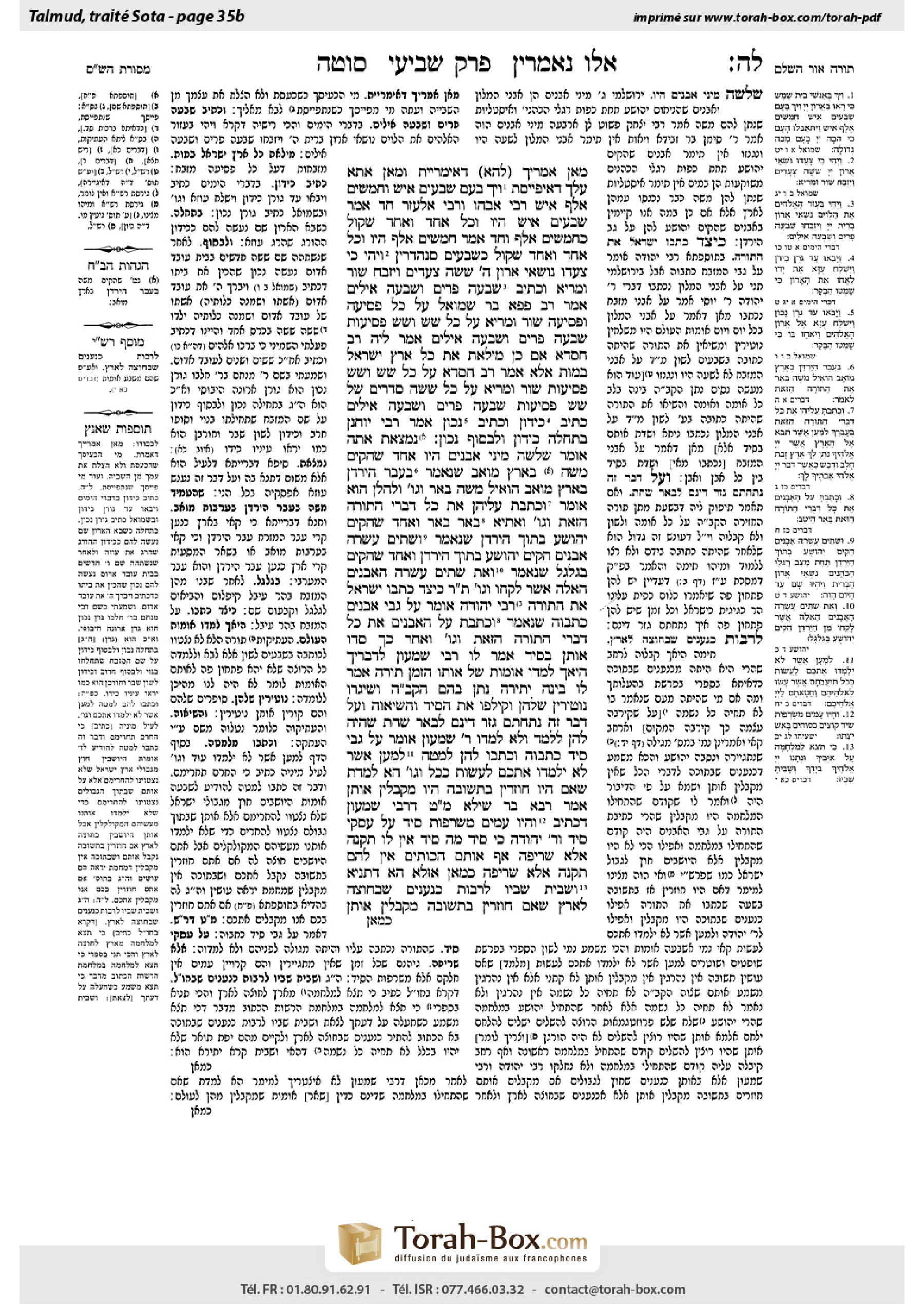
This page of Sotah includes the Aramaic text, an English translation and an AI-generated French translation, alongside the scan above.
סוטה ל״ה ב · Aramaic and Hebrew text
מַאן אַמְרְיָךְ (לְהָא) דְּאִימָּרַיְיתְּ וּמַאן אֲתָא עֲלָךְ דְּאִיפַּיַּיסְתְּ.
״וַיַּךְ בָּעָם שִׁבְעִים אִישׁ חֲמִשִּׁים אֶלֶף אִישׁ״, רַבִּי אֲבָהוּ וְרַבִּי אֶלְעָזָר, חַד אָמַר: שִׁבְעִים אִישׁ הָיוּ, וְכׇל אֶחָד וְאֶחָד שָׁקוּל כַּחֲמִשִּׁים אֶלֶף. וְחַד אָמַר: חֲמִשִּׁים אֶלֶף הָיוּ, וְכׇל אֶחָד וְאֶחָד שָׁקוּל כְּשִׁבְעִים סַנְהֶדְרִין.
״וַיְהִי כִּי צָעֲדוּ נֹשְׂאֵי אֲרוֹן ה׳ שִׁשָּׁה צְעָדִים וַיִּזְבַּח שׁוֹר וּמְרִיא״, וּכְתִיב ״שִׁבְעָה פָרִים וְשִׁבְעָה אֵילִים״. אָמַר רַב פָּפָּא בַּר שְׁמוּאֵל: עַל כׇּל פְּסִיעָה וּפְסִיעָה שׁוֹר וּמְרִיא, עַל כׇּל שֵׁשׁ וְשֵׁשׁ פְּסִיעוֹת שִׁבְעָה פָרִים וְשִׁבְעָה אֵילִים.
אֲמַר לֵיהּ רַב חִסְדָּא: אִם כֵּן, מִילֵּאתָ אֶת כׇּל אֶרֶץ יִשְׂרָאֵל בָּמוֹת! אֶלָּא אָמַר רַב חִסְדָּא: עַל כׇּל שֵׁשׁ וְשֵׁשׁ פְּסִיעוֹת — שׁוֹר וּמְרִיא, עַל כׇּל שִׁשָּׁה סְדָרִים שֶׁל שֵׁשׁ פְּסִיעוֹת — שִׁבְעָה פָרִים וְשִׁבְעָה אֵילִים.
כְּתִיב ״כִּידֹן״, וּכְתִיב ״נָכוֹן״. אָמַר רַבִּי יוֹחָנָן: בַּתְּחִלָּה כִּידוֹן, וּלְבַסּוֹף נָכוֹן.
נִמְצֵאתָ אַתָּה אוֹמֵר שְׁלֹשָׁה מִינֵי אֲבָנִים הָיוּ: אֶחָד שֶׁהֵקִים מֹשֶׁה בְּאֶרֶץ מוֹאָב, שֶׁנֶּאֱמַר: ״בְּעֵבֶר הַיַּרְדֵּן בְּאֶרֶץ מוֹאָב הוֹאִיל מֹשֶׁה בֵּאֵר וְגוֹ׳״, וּלְהַלָּן הוּא אוֹמֵר: ״וְכָתַבְתָּ עֲלֵיהֶן אֶת כׇּל דִּבְרֵי הַתּוֹרָה הַזֹּאת וְגוֹ׳״, וְאָתְיָא ״בֵּאֵר״ ״בֵּאֵר״.
וְאֶחָד שֶׁהֵקִים יְהוֹשֻׁעַ בְּתוֹךְ הַיַּרְדֵּן, שֶׁנֶּאֱמַר: ״וּשְׁתֵּים עֶשְׂרֵה אֲבָנִים הֵקִים יְהוֹשֻׁעַ בְּתוֹךְ הַיַּרְדֵּן״. וְאֶחָד שֶׁהֵקִים בַּגִּלְגָּל, שֶׁנֶּאֱמַר: ״וְאֵת שְׁתֵּים עֶשְׂרֵה הָאֲבָנִים הָאֵלֶּה אֲשֶׁר לָקְחוּ וְגוֹ׳״.
תָּנוּ רַבָּנַן: כֵּיצַד כָּתְבוּ יִשְׂרָאֵל אֶת הַתּוֹרָה? רַבִּי יְהוּדָה אוֹמֵר: עַל גַּבֵּי אֲבָנִים כְּתָבוּהָ, שֶׁנֶּאֱמַר: ״וְכָתַבְתָּ עַל הָאֲבָנִים אֶת כׇּל דִּבְרֵי הַתּוֹרָה הַזֹּאת וְגוֹ׳״, וְאַחַר כָּךְ סָדוּ אוֹתָן בְּסִיד.
אָמַר לוֹ רַבִּי שִׁמְעוֹן: לִדְבָרֶיךָ, הֵיאַךְ לָמְדוּ אוּמּוֹת הָעוֹלָם תּוֹרָה? אָמַר לוֹ: בִּינָה יְתֵירָה נָתַן בָּהֶם הַקָּדוֹשׁ בָּרוּךְ הוּא, וְשִׁיגְּרוּ נוֹטֵירִין שֶׁלָּהֶן, וְקִילְּפוּ אֶת הַסִּיד וְהִשִּׂיאוּהָ. וְעַל דָּבָר זֶה נִתְחַתֵּם גְּזַר דִּינָם לִבְאֵר שַׁחַת, שֶׁהָיָה לָהֶן לִלְמֹד וְלֹא לָמְדוּ.
רַבִּי שִׁמְעוֹן אוֹמֵר: עַל גַּבֵּי סִיד כְּתָבוּהָ, וְכָתְבוּ לָהֶן לְמַטָּה ״יְלַמְּדוּ אֶתְכֶם לַעֲשׂוֹת כְּכֹל וְגוֹ׳״. הָא לָמַדְתָּ שֶׁאִם הָיוּ חוֹזְרִין בִּתְשׁוּבָה — הָיוּ מְקַבְּלִין אוֹתָן.
אָמַר רָבָא בַּר שֵׁילָא: מַאי טַעְמָא דְּרַבִּי שִׁמְעוֹן דִּכְתִיב: ״וְהָיוּ עַמִּים מִשְׂרְפוֹת סִיד״ — עַל עִסְקֵי סִיד.
וְרַבִּי יְהוּדָה: כִּי סִיד, מָה סִיד אֵין לוֹ תַּקָּנָה אֶלָּא שְׂרֵיפָה — אַף אוּמּוֹת הָעוֹלָם אֵין לָהֶם תַּקָּנָה אֶלָּא שְׂרֵיפָה.
כְּמַאן אָזְלָא הָא דְּתַנְיָא ״וְשָׁבִיתָ שִׁבְיוֹ״ — לְרַבּוֹת כְּנַעֲנִים שֶׁבְּחוּצָה לָאָרֶץ, שֶׁאִם חוֹזְרִין בִּתְשׁוּבָה מְקַבְּלִין אוֹתָן?
Sotah 35b · English translation
Who angered you, i.e., the Ark, so much that you became so angry that you gave yourself into captivity? And who came to you to appease you?
The verse states: “And He smote of the people seventy men, fifty thousand men” (I Samuel 6:19). Rabbi Abbahu and Rabbi Elazar disagree over the interpretation of the verse. One says that there were seventy men, and each and every one of them was equivalent to fifty thousand men. And one says that there were fifty thousand men, and each and every one was equivalent to the seventy men in the Sanhedrin.
With regard to David’s journey with the Ark to Jerusalem, the verse states: “And when they who carried the Ark of the Lord had gone six paces, he sacrificed an ox and a fatling” (II Samuel 6:13). And it is written elsewhere that he sacrificed “seven oxen and seven rams” (I Chronicles 15:26). Rav Pappa bar Shmuel says: For each and every step David took, he sacrificed an ox and a fatling, and for every six steps that he took, he sacrificed seven oxen and seven rams.
Rav Ḥisda said to him: If that is so, and he sacrificed an offering for every step that he took, you have filled all of Eretz Yisrael with altars, as they had to build a new altar for each offering. Rather, Rav Ḥisda said: For every six steps he sacrificed an ox and a fatling, and for every six sets of six steps he sacrificed seven oxen and seven rams.
It is written that Uzzah died “when they came to the threshing floor of Chidon” (I Chronicles 13:9), and elsewhere it is written that it was “the threshing floor of Nacon” (II Samuel 6:6). Rabbi Yoḥanan says: At first the Ark was similar to a javelin [kidon], as it caused Uzzah’s death. But ultimately, after the people asked for forgiveness, it was established [nakhon], i.e., placed, in the house of Obed Edom, where it was a source of blessing.
§ The Gemara returns to the discussion of how the Ark was brought into Eretz Yisrael. You are found saying that there were three sets of stones. One is a set that Moses erected in the land of Moab, as it is stated: “Beyond the Jordan, in the land of Moab, Moses took upon himself to expound [be’er] this law, saying” (Deuteronomy 1:5). And it states there with regard to the mitzva to erect the stones on Mount Ebal: “And you shall write on the stones all the words of this law clearly elucidated [ba’er]” (Deuteronomy 27:8). It is derived through a verbal analogy between the word “be’er” that appears with regard to Moses, and the word “ba’er” that appears with regard to the mitzva to write the Torah on the stones on Mount Ebal that Moses also wrote down the Torah on stones.
And there is one set that Joshua erected in the Jordan, as it is stated: “Joshua also set up twelve stones in the midst of the Jordan, in the place where the feet of the priests that bore the Ark of the Covenant stood, and they are there to this day” (Joshua 4:9). And there is one set that Joshua erected in Gilgal, as it is stated: “And these twelve stones, which they took out of the Jordan, Joshua set up in Gilgal” (Joshua 4:20).
The Sages taught: How did the Jewish people write the Torah? Rabbi Yehuda says: They wrote it on stones, as it is stated: “And you shall write on the stones all the words of this law” (Deuteronomy 27:8). And afterward they plastered them over with plaster.
Rabbi Shimon said to him: According to your statement that they plastered over the writing, how did the nations of the world study Torah? He said to him: The Holy One, Blessed be He, granted them an extra degree of understanding, and they sent their scribes [noteirin], and they peeled off the plaster and copied it down. And on account of this matter their decree to be sent to the pit of destruction was sealed, as once the Torah was in their possession they should have studied it, and they did not study.
Rabbi Shimon says: That is not what happened. Rather, the Jewish people wrote the text of the Torah on top of the plaster, and they wrote below for the gentiles to read that the verse commands the Jewish people to destroy the gentile inhabitants of Eretz Yisrael: “Lest they teach you to do like all their abominations” (Deuteronomy 20:18). You derive from the fact that they wrote this verse that if the gentiles who lived in Eretz Israel would have repented, the Jews would have accepted them, i.e., allowed them to live in Eretz Yisrael.
Rava bar Sheila said: What is the reason for the opinion of Rabbi Shimon? As it is written: “And the peoples shall be as the burnings of plaster” (Isaiah 33:12). This is homiletically interpreted to mean that the nations were punished on account of matters of plaster, i.e., they did not study the Torah that was written on plaster.
The Gemara asks: And how does Rabbi Yehuda, who holds that the Torah was not written on plaster, interpret this verse? The Gemara answers: He explains that the gentiles are like plaster; just as plaster has no remedy but burning, i.e., it is created by burning stone, so too, the nations of the world have no remedy other than burning in Gehenna.
In accordance with whose opinion is that which is taught in a baraita: The verse states: “When you go forth to battle against your enemies, and the Lord your God delivers them into your hands, and you take them captive” (Deuteronomy 21:10), implying that there is no obligation to destroy them, to include not only gentiles who are not Canaanites, but even Canaanites that are living outside of Eretz Yisrael, as, if they repent, they are accepted and allowed to live in Eretz Yisrael.
Sotah 35b · Traduction française (IA)
Qui t’a tant irritée, c’est-à-dire l’Arche, pour que tu te mettes dans une telle colère et te livres à la captivité ? Et qui est venu auprès de toi pour t’apaiser ?
Le verset dit : « Il frappa parmi le peuple soixante-dix hommes, cinquante mille hommes » (I Samuel 6:19). Rabbi Abbahou et Rabbi Elazar divergent sur l’interprétation du verset. Selon l’un, il y avait soixante-dix hommes, chacun d’eux équivalant à cinquante mille hommes. Selon l’autre, il y avait cinquante mille hommes, chacun équivalant aux soixante-dix hommes du Sanhédrin.
Au sujet du voyage de David avec l’Arche vers Jérusalem, le verset dit : « Lorsque ceux qui portaient l’Arche du Seigneur eurent fait six pas, il sacrifia un bœuf et un veau gras » (II Samuel 6:13). Ailleurs, il est écrit qu’il sacrifia « sept bœufs et sept béliers » (I Chroniques 15:26). Rav Pappa bar Shmuel dit : À chacun des pas que faisait David, il sacrifiait un bœuf et un veau gras, et tous les six pas, il sacrifiait sept bœufs et sept béliers.
Rav Ḥisda lui dit : Si tel est le cas, s’il sacrifiait une offrande à chacun de ses pas, tu aurais couvert tout Eretz Yisrael d’autels, puisqu’il aurait fallu construire un nouvel autel pour chaque offrande. Rav Ḥisda dit plutôt : Tous les six pas, il sacrifiait un bœuf et un veau gras, et tous les six groupes de six pas, il sacrifiait sept bœufs et sept béliers.
Il est écrit qu’Ouzza mourut « lorsqu’ils arrivèrent à l’aire de battage de Chidon » (I Chroniques 13:9), et ailleurs, qu’il s’agissait de « l’aire de battage de Nacon » (II Samuel 6:6). Rabbi Yoḥanan dit : Au début, l’Arche ressemblait à un javelot [kidon], car elle causa la mort d’Ouzza. Mais finalement, après que le peuple eut demandé pardon, elle fut établie [nakhon], c’est-à-dire placée, dans la maison d’Obed-Edom, où elle fut une source de bénédiction.
§ La Guemara revient à la discussion sur la manière dont l’Arche fut introduite en Eretz Yisrael. On en vient donc à dire qu’il y eut trois ensembles de pierres. L’un fut dressé par Moïse dans le pays de Moab, comme il est dit : « Au-delà du Jourdain, dans le pays de Moab, Moïse entreprit d’exposer [be’er] cette loi, en disant » (Deutéronome 1:5). Et il est dit là, au sujet de la mitsva de dresser les pierres sur le mont Ebal : « Tu écriras sur les pierres toutes les paroles de cette loi, clairement expliquées [ba’er] » (Deutéronome 27:8). On déduit, par analogie verbale entre le mot « be’er », employé au sujet de Moïse, et le mot « ba’er », employé au sujet de la mitsva d’écrire la Torah sur les pierres du mont Ebal, que Moïse écrivit lui aussi la Torah sur des pierres.
Un autre ensemble fut dressé par Josué dans le Jourdain, comme il est dit : « Josué dressa aussi douze pierres au milieu du Jourdain, à l’endroit où se tenaient les pieds des prêtres qui portaient l’Arche de l’Alliance, et elles y sont encore aujourd’hui » (Josué 4:9). Et un autre ensemble fut dressé par Josué à Guilgal, comme il est dit : « Quant à ces douze pierres qu’ils avaient retirées du Jourdain, Josué les dressa à Guilgal » (Josué 4:20).
Les Sages ont enseigné : Comment le peuple juif écrivit-il la Torah ? Rabbi Yehouda dit : Il l’écrivit sur des pierres, comme il est dit : « Tu écriras sur les pierres toutes les paroles de cette loi » (Deutéronome 27:8). Puis il les recouvrit de plâtre.
Rabbi Shimon lui dit : Selon tes propos, puisqu’ils recouvrirent l’écriture, comment les nations du monde étudièrent-elles la Torah ? Il lui répondit : Le Saint, béni soit-Il, leur accorda une faculté de compréhension supplémentaire, et elles envoyèrent leurs scribes [noteirin], qui retirèrent le plâtre et en copièrent le texte. C’est à cause de cela que leur décret les vouant au puits de destruction fut scellé : une fois la Torah en leur possession, elles auraient dû l’étudier, mais elles ne l’étudièrent pas.
Rabbi Shimon dit : Ce n’est pas ainsi que les choses se passèrent. Le peuple juif écrivit plutôt le texte de la Torah sur le plâtre, et écrivit en dessous, à l’intention des non-Juifs, que le verset ordonne au peuple juif de détruire les habitants non juifs d’Eretz Yisrael : « De peur qu’ils ne vous apprennent à commettre toutes leurs abominations » (Deutéronome 20:18). On déduit du fait qu’ils écrivirent ce verset que si les non-Juifs qui vivaient en Eretz Yisrael s’étaient repentis, les Juifs les auraient acceptés, c’est-à-dire qu’ils les auraient autorisés à vivre en Eretz Yisrael.
Rava bar Sheila dit : Quelle est la raison de l’opinion de Rabbi Shimon ? Car il est écrit : « Les peuples seront comme la chaux qui brûle » (Isaïe 33:12). Ce verset est interprété par homilétique ainsi : les nations furent punies à cause du plâtre, c’est-à-dire qu’elles n’étudièrent pas la Torah écrite sur le plâtre.
La Guemara demande : Et comment Rabbi Yehouda, qui soutient que la Torah ne fut pas écrite sur du plâtre, interprète-t-il ce verset ? La Guemara répond : Il explique que les non-Juifs sont comme le plâtre. De même que le plâtre n’a d’autre remède que d’être brûlé, c’est-à-dire qu’il est fabriqué en brûlant de la pierre, de même les nations du monde n’ont d’autre remède que d’être brûlées dans la Géhenne.
Selon l’opinion de qui est l’enseignement d’une baraïta ? Le verset dit : « Lorsque tu partiras en guerre contre tes ennemis, que le Seigneur ton Dieu les livrera entre tes mains et que tu les réduiras en captivité » (Deutéronome 21:10), ce qui implique qu’il n’y a pas d’obligation de les détruire. Cela inclut non seulement les non-Juifs qui ne sont pas des Cananéens, mais aussi les Cananéens qui vivent hors d’Eretz Yisrael : s’ils se repentent, ils sont acceptés et autorisés à vivre en Eretz Yisrael.
Traduction française générée par IA à partir de l’édition anglaise de Sefaria. Vérifie toujours un passage avec le texte source.
Text from Sefaria: William Davidson Edition - Vocalized Aramaic (CC BY NC); William Davidson Edition - English (CC BY NC).