Sotah 6a: Talmud study for Daf Yomi
Daf Yomi is the daily study of one Talmud folio. Explore 37 tractates with scans, Hebrew text, Sefaria English and AI-generated French translations where annotated.
Passage selection and English or AI-generated French translation are available where the scan has annotations. Daf Study is independent of Torah-Box and Sefaria.
Browse Sotah · סוטה · All tractatesSotah 6a text and translations
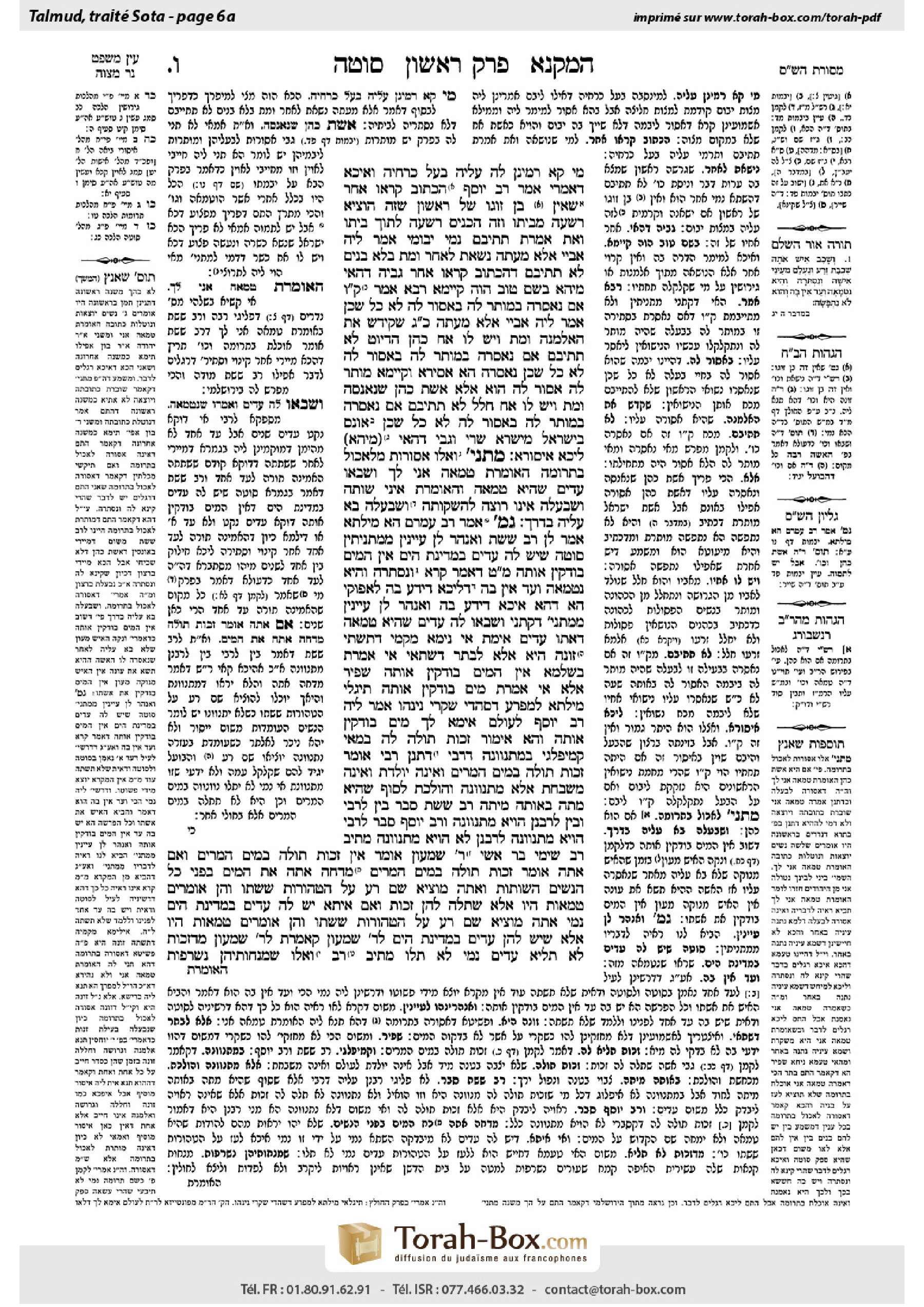
This page of Sotah includes the Aramaic text, an English translation and an AI-generated French translation, alongside the scan above.
סוטה ו׳ א · Aramaic and Hebrew text
מִי קָא רָמֵינַן לַהּ עֲלֵיהּ בְּעַל כֻּרְחֵיהּ?
וְאִיכָּא דְּאָמְרִי, אָמַר רַב יוֹסֵף: הַכָּתוּב קְרָאוֹ ״אַחֵר״, שֶׁאֵין בֶּן זוּגוֹ שֶׁל רִאשׁוֹן. שֶׁזֶּה הוֹצִיא רְשָׁעָה מִבֵּיתוֹ, וְזֶה הִכְנִיס רְשָׁעָה לְתוֹךְ בֵּיתוֹ, וְאַתְּ אָמְרַתְּ תִּתְיַבֵּם נָמֵי יַבּוֹמֵי?!
אֲמַר לֵיהּ אַבָּיֵי: אֶלָּא מֵעַתָּה, נִשֵּׂאת לְאַחֵר וּמֵת בְּלֹא בָּנִים — לֹא תִּתְיַבֵּם, דְּהַכָּתוּב קְרָאוֹ ״אַחֵר״! גַּבֵּיהּ דְּהַאי מִיהָא בְּשֵׁם טוֹב הֲוָה קָיְימָא.
רָבָא אָמַר, קַל וָחוֹמֶר: אִם נֶאֶסְרָה בַּמּוּתָּר לָהּ — בָּאָסוּר לָהּ לֹא כׇּל שֶׁכֵּן?
אֲמַר לֵיהּ אַבָּיֵי: אֶלָּא מֵעַתָּה, כֹּהֵן גָּדוֹל שֶׁקִּידֵּשׁ אֶת הָאַלְמָנָה וָמֵת, וְיֵשׁ לוֹ אָח כֹּהֵן הֶדְיוֹט, לֹא תִּתְיַבֵּם: אִם נֶאֶסְרָה בַּמּוּתָּר לָהּ — בָּאָסוּר לָהּ לֹא כׇּל שֶׁכֵּן?!
נֶאֶסְרָה?! הָא אֲסִירָא וְקָיְימָא! מוּתָּר לָהּ?! אָסוּר לָהּ הוּא!
אֶלָּא: אֵשֶׁת כֹּהֵן שֶׁנֶּאֶנְסָה וָמֵת, וְיֵשׁ לוֹ אָח חָלָל — לֹא תִּתְיַבֵּם. אִם נֶאֶסְרָה בַּמּוּתָּר לָהּ — בָּאָסוּר לָהּ לֹא כׇּל שֶׁכֵּן?!
אוֹנֶס בְּיִשְׂרָאֵל מִישְׁרֵא שְׁרֵי, וְגַבֵּי דְּהַאי מִיהָא לֵיכָּא אִיסּוּרָא.
מַתְנִי׳ וְאֵלּוּ אֲסוּרוֹת מִלֶּאֱכוֹל בִּתְרוּמָה: הָאוֹמֶרֶת ״טְמֵאָה אֲנִי לָךְ״, וְשֶׁבָּאוּ עֵדִים שֶׁהִיא טְמֵאָה, וְהָאוֹמֶרֶת ״אֵינִי שׁוֹתָה״, וְשֶׁבַּעְלָהּ אֵינוֹ רוֹצֶה לְהַשְׁקוֹתָהּ, וְשֶׁבַּעְלָהּ בָּא עָלֶיהָ בַּדֶּרֶךְ.
גְּמָ׳ אָמַר רַב עַמְרָם: הָא מִילְּתָא אֲמַר לַן רַב שֵׁשֶׁת, וְאַנְהַר לַן עַיְינִין מִמַּתְנִיתִין: סוֹטָה שֶׁיֵּשׁ לָהּ עֵדִים בִּמְדִינַת הַיָּם — אֵין הַמַּיִם בּוֹדְקִין אוֹתָהּ. מַאי טַעְמָא? דְּאָמַר קְרָא ״וְנִסְתְּרָה וְהִיא נִטְמָאָה וְעֵד אֵין בָּהּ״, דְּלֵיכָּא דְּיָדַע בָּהּ. לְאַפּוֹקֵי הָא, דְּהָא אִיכָּא דְּיָדַע בָּהּ.
וְאַנְהַר לַן עַיְינִין מִמַּתְנִיתִין, דְּקָתָנֵי: וְשֶׁבָּאוּ לָהּ עֵדִים שֶׁהִיא טְמֵאָה. דַּאֲתוּ עֵדִים אֵימַת? אִי נֵימָא מִקַּמֵּי דְּתִשְׁתֵּי — זוֹנָה הִיא!
אֶלָּא לְבָתַר דִּשְׁתַאי. אִי אָמְרַתְּ בִּשְׁלָמָא אֵין הַמַּיִם בּוֹדְקִין אוֹתָהּ — שַׁפִּיר. אֶלָּא אִי אָמְרַתְּ מַיִם בּוֹדְקִין אוֹתָהּ — תִּיגַּלֵּי מִילְּתָא לְמַפְרֵעַ דְּסָהֲדֵי שַׁקָּרֵי נִינְהוּ!
אֲמַר לֵיהּ רַב יוֹסֵף: לְעוֹלָם אֵימָא לְךָ מַיִם בּוֹדְקִין אוֹתָהּ, וְהָא — אֵימוֹר זְכוּת תּוֹלָה לָהּ.
בְּמַאי קָמִיפַּלְגִי — בְּמִתְנַוְּונָה דְּרַבִּי. דִּתְנַן, רַבִּי אוֹמֵר: זְכוּת תּוֹלָה בַּמַּיִם הַמָּרִים, וְאֵינָהּ יוֹלֶדֶת וְאֵינָהּ מַשְׁבַּחַת, אֶלָּא מִתְנַוְּונָה וְהוֹלֶכֶת, לְסוֹף שֶׁהִיא מֵתָה בְּאוֹתָהּ מִיתָה.
רַב שֵׁשֶׁת סָבַר: בֵּין לְרַבִּי וּבֵין לְרַבָּנַן הָוְיָא מִתְנַוְּונָה. וְרַב יוֹסֵף סָבַר: לְרַבִּי הָוְיָא מִתְנַוְּונָה, לְרַבָּנַן לָא הָוְיָא מִתְנַוְּונָה.
מֵתִיב רַב שִׁימִי בַּר אָשֵׁי, רַבִּי שִׁמְעוֹן אוֹמֵר: אֵין זְכוּת תּוֹלָה בַּמַּיִם הַמָּרִים. וְאִם אַתָּה אוֹמֵר זְכוּת תּוֹלָה בַּמַּיִם הַמָּרִים — מְדַחֶה אַתָּה אֶת הַמַּיִם בִּפְנֵי כׇּל הַנָּשִׁים הַשּׁוֹתוֹת. וְאַתָּה מוֹצִיא שֵׁם רַע עַל הַטְּהוֹרוֹת שֶׁשָּׁתוּ, וְהֵן אוֹמְרִים: טְמֵאוֹת הָיוּ, אֶלָּא שֶׁתָּלָה לָהֶן זְכוּת.
וְאִם אִיתָא יֵשׁ לָהּ עֵדִים בִּמְדִינַת הַיָּם נָמֵי: אַתָּה מוֹצִיא שֵׁם רַע עַל הַטְּהוֹרוֹת שֶׁשָּׁתוּ, וְהֵן אוֹמְרִים: טְמֵאוֹת הָיוּ, אֶלָּא שֶׁיֵּשׁ לָהֶן עֵדִים בִּמְדִינַת הַיָּם!
לְרַבִּי שִׁמְעוֹן קָאָמְרַתְּ? לְרַבִּי שִׁמְעוֹן, מִדִּזְכוּת לָא תָּלְיָא — עֵדִים נָמֵי לָא תָּלוּ.
מֵתִיב רַב: וְאֵלּוּ שֶׁמִּנְחוֹתֵיהֶן נִשְׂרָפוֹת,
Sotah 6a · English translation
Do we impose on him an obligation to marry her against his will? Unlike levirate marriage, there is no obligation for another man to marry her. Therefore, the verse is not instructing him to do so.
And there are those who say that Rav Yosef said differently: The verse calls a man who marries a woman after she was divorced from her first husband due to suspicion of adultery “another man,” as the verse states: “And she departs out of his house and goes and becomes another man’s wife” (Deuteronomy 24:2). This indicates that one who subsequently marries her is not a peer of her first husband because this one, the first husband, removed an evil woman from his house, and that one brought an evil woman into his house. There is an implied criticism of the second husband in the verse; and yet you say that the verse instructs that she should also enter into levirate marriage.
Abaye said to him: If that is so, then if she married another man and he died without children, then she should not enter into levirate marriage with the brother of her second husband even if she did not commit adultery during the second marriage, since the verse calls the second husband “another man,” which excluded the possibility of levirate marriage. Rav Yosef answered Abaye: With regard to that one, i.e., this second husband, at least she remained with a good name. Since she did not engage in illicit behavior during her second marriage, she can enter into levirate marriage with the brother of her second husband.
Rava says a different reason why a sota cannot enter into levirate marriage: This prohibition can be deduced through an a fortiori inference: If, due to the suspicion of adultery, she becomes forbidden to the one who was previously permitted to her, i.e., her first husband, then with regard to one who was forbidden to her, i.e., the husband’s brother, is it not all the more so that she remains forbidden to him?
Abaye said to him: If that is so, if this a fortiori reasoning is the basis of the prohibition against her entering into levirate marriage, then in the case of a High Priest who betrothed a widow, which he is prohibited from doing, and he died before the marriage took place, and he has a brother who is a common priest, who is permitted to marry a widow, she should still not be permitted to enter into levirate marriage with him, since the same inference can be stated: If she becomes forbidden to the one who was permitted to her, i.e., her husband the High Priest, who was prohibited from marrying a widow, then with regard to one who was forbidden to her, i.e., his brother, the common priest who wishes to enter into levirate marriage with her, is it not all the more so that she should be forbidden?
The Gemara refutes this inference. In the case of the High Priest, can one say: She becomes forbidden? But she was forbidden to him and remains forbidden to him. She did not become forbidden to her husband, the High Priest, due to the marriage. Furthermore, in the case of the High Priest, can one say: Permitted to her? But the High Priest is forbidden to her always. Therefore, the case of the High Priest does not serve as a refutation of the a fortiori inference.
Rather, the refutation is as follows: In the case of a priest’s wife who was raped, who becomes forbidden to her husband, and then her husband dies; and he has a brother who is a priest disqualified due to flawed lineage [ḥalal], who is not bound by the restrictions on marriage given to a priest, then she should not be permitted to enter into levirate marriage with him. If she becomes forbidden to the one who was permitted to her, i.e., her husband the priest, then with regard to one who was forbidden to her, i.e., her brother-in-law, is it not all the more so that she remains forbidden to him?
The Gemara answers: Nevertheless, this a fortiori inference is not applicable here because a raped woman is completely permitted to an Israelite. Therefore, a married woman raped by another man may remain with her Israelite husband. And with regard to this person, i.e., the brother of the deceased, who is a ḥalal, in any event there is no prohibition. The fact that the woman was forbidden to her ḥalal brother-in-law while she was married to her husband is immaterial. This is because, had she been raped while she was married to the ḥalal, it would not render her forbidden to him, as he has the status of an Israelite with regard to marriage. Consequently, this case cannot be compared to the case of the mishna, as a woman who commits adultery is forbidden to any husband, not only a priest.
MISHNA: And these are women who, despite being married to priests, are prohibited from partaking of teruma due to suspicion of adultery: A woman who says to her husband: I am defiled to you, i.e., she admitted to having committed adultery with another man; and in a case where witnesses came forth and testified that she is defiled; and a woman who says after a warning and seclusion: I will not drink the bitter water of a sota; and in a case where her husband does not want to force her to drink the water even after she secluded herself with another man after his warning; and in a case where her husband engaged in sexual intercourse with her on the way to bringing her to the Temple to drink the bitter water, as in such a case the water will not be effective in evaluating whether she was unfaithful, due to the husband’s own prohibited act.
GEMARA: Rav Amram says: Rav Sheshet told us this matter, and he enlightened our eyes for us by citing support for his statement from the mishna: In the case of a sota for whom there are witnesses concerning her in a country overseas, who can testify that she engaged in sexual intercourse, the bitter water of a sota does not evaluate whether or not she was unfaithful. Although she committed adultery, the water evaluates her fidelity only when there is no possibility of proving her guilt in court. What is the reason for this? It is as the verse states: “And a man lie with her carnally, and it was hidden from the eyes of her husband, and she was defiled secretly, and there was no witness against her” (Numbers 5:13). This indicates that the bitter water is given only when there is no one who knows about her action, to the exclusion of the case of this woman who is not given the bitter water, as there are those who know about her.
And Rav Sheshet enlightened our eyes for us by adducing support for his ruling from the mishna, as it teaches: And where witnesses came forth and testified that she is defiled, this is one of the women who can no longer partake of teruma, Rav Sheshet asks: This is a case where the witnesses came when? If we say that they came before she drank, then what is novel about the fact that it is prohibited for her to partake of teruma? She is a woman who had sexual relations with a man forbidden to her by the Torah [zona], as she is a confirmed adulteress, and it is obviously prohibited for her to partake of teruma.
Rav Sheshet answers: Rather, it must be referring to a case where the witnesses testified after she already drank. Granted, if you say that the bitter water of a sota does not evaluate her in a case where there are witnesses elsewhere who can testify with regard to her infidelity, it is well. But if you say that the water evaluates her in a case where there are witnesses elsewhere who can testify with regard to her infidelity, then it should be revealed retroactively that they are false witnesses, as the fact that she survived the drinking of the bitter water would indicate that she never committed adultery.
Rav Yosef said to Rav Sheshet: Actually, I will say to you that the bitter water evaluates her in a case where there are witnesses elsewhere who can testify with regard to her infidelity. Nevertheless, the fact that the woman survived the drinking of the water does not prove her innocence, and one can say that this woman who already drank had merit that delayed the punishment for her. According to some opinions, if an unfaithful woman has certain merits, she will not die immediately upon drinking the water. Therefore, if witnesses were to testify to her infidelity after she drank the water without dying, it is not clear that their testimony is false.
The Gemara explains: With regard to what principle do Rav Sheshet and Rav Yosef disagree? With regard to whether she deteriorates [mitnavvena], as explained by Rabbi Yehuda HaNasi, as we learned in a mishna (22a): Rabbi Yehuda HaNasi says: Merit delays punishment with regard to the bitter water of a sota. Even if a woman actually committed adultery, she will not die immediately due to the merit that she has. But she will not give birth, and she will not improve in terms of her physical condition after having drunk the bitter water. Rather, she will progressively deteriorate until she ultimately dies in the same manner of death as suffered by a sota who drank the bitter water without having merit.
Rav Sheshet holds: Both according to the opinion of Rabbi Yehuda HaNasi and according to the opinion of the Rabbis, who disagree with him, she begins to deteriorate despite her merit. Therefore, if she doesn’t begin to deteriorate immediately, the witnesses who testified subsequent to her drinking must be false witnesses. And Rav Yosef holds: Only according to the opinion of Rabbi Yehuda HaNasi is it so that she begins to deteriorate when she has merit. According to the opinion of the Rabbis, she does not begins to deteriorate. Therefore, Rav Yosef explains that the mere fact that she survived the drinking of the bitter water and didn’t begin deteriorating does not prove that the testimony was false.
Rav Shimi bar Ashi raises an objection from the aforementioned mishna (22a), which also teaches that Rabbi Shimon says: Merit does not delay punishment with regard to the bitter water of a sota, and if you say that merit delays punishment with regard to the bitter water, then you push aside the deterrent force of the bitter water before all the women who must drink it, as guilty women will rely on their merit to protect them from the immediate consequences. And furthermore, you defame the untainted women who drank and survived. People will not view this as proof of their innocence, and they will say: They are defiled, but their merit delayed the punishment for them.
After quoting the statement of Rabbi Shimon, Rav Shimi bar Ashi now explains his objection: And if it is so that the bitter water of a sota does not evaluate the faithfulness of a women about whom there are witnesses in a country overseas, then the same claim can be made as well: You defame the untainted women who drank and survived. People will not view this as proof of their innocence, and they will say: They are defiled, but there are witnesses about them in a country overseas.
The Gemara responds: Do you say this according to the opinion of Rabbi Shimon? Indeed, according to Rabbi Shimon, from the same logic that merit does not delay punishment, witnesses in a country overseas do not delay it either, and Rav Sheshet would concede that his statement would not be accepted by Rabbi Shimon.
Rav raises an objection from the latter clause of the mishna there (22a), which teaches: And these are the sota women whose meal-offerings are burned and not offered on the altar:
Sotah 6a · Traduction française (IA)
Lui impose-t-on de l’épouser contre son gré ? À la différence du mariage léviratique, aucun autre homme n’est tenu de l’épouser. Le verset ne lui ordonne donc pas de le faire.
Certains disent que Rav Yosef a formulé une autre explication : le verset qualifie d’« autre homme » celui qui épouse une femme après qu’elle a été répudiée par son premier mari en raison d’un soupçon d’adultère, comme il est dit : « Elle sort de sa maison, s’en va et devient la femme d’un autre homme » (Deutéronome 24:2). Cela indique que celui qui l’épouse par la suite n’est pas l’égal de son premier mari, car celui-ci a chassé de sa maison une femme mauvaise, tandis que celui-là en a fait entrer une dans la sienne. Le verset porte donc implicitement un reproche contre le second mari ; et pourtant, tu dis que le verset ordonne qu’elle entre elle aussi en lévirat.
Abaye lui dit : Si tel est le cas, lorsqu’elle épouse un autre homme et que celui-ci meurt sans enfant, elle ne devrait pas entrer en lévirat avec le frère de son second mari, même si elle n’a pas commis d’adultère au cours de ce second mariage, puisque le verset appelle le second mari « un autre homme », ce qui exclut la possibilité du lévirat. Rav Yosef répondit à Abaye : En ce qui concerne cet homme-là, c’est-à-dire ce second mari, elle a au moins conservé une bonne réputation. Comme elle n’a pas eu de conduite illicite pendant son second mariage, elle peut entrer en lévirat avec le frère de son second mari.
Rava donne une autre raison pour laquelle une sota ne peut pas entrer en lévirat : cette interdiction se déduit a fortiori. Si, en raison du soupçon d’adultère, elle devient interdite à celui qui lui était auparavant permis, c’est-à-dire son premier mari, à plus forte raison reste-t-elle interdite à celui qui lui était interdit, c’est-à-dire le frère de son mari.
Abaye lui dit : Si tel est le cas, si ce raisonnement a fortiori fonde l’interdiction d’entrer en lévirat, alors, lorsqu’un grand prêtre a fiancé une veuve, ce qu’il lui est interdit de faire, puis meurt avant que le mariage ait lieu, et qu’il a un frère, prêtre ordinaire, qui est autorisé à épouser une veuve, elle ne devrait pas non plus être autorisée à entrer en lévirat avec lui. En effet, le même raisonnement s’applique : si elle devient interdite à celui qui lui était permis, c’est-à-dire son mari, le grand prêtre, qui avait interdiction d’épouser une veuve, à plus forte raison devrait-elle être interdite à celui qui lui était interdit, c’est-à-dire son frère, le prêtre ordinaire qui souhaite entrer en lévirat avec elle.
La Guemara réfute ce raisonnement. Dans le cas du grand prêtre, peut-on dire qu’elle devient interdite ? Elle lui était déjà interdite et le demeure. Le mariage ne l’a pas rendue interdite à son mari, le grand prêtre. En outre, dans le cas du grand prêtre, peut-on dire qu’il lui était permis ? Le grand prêtre lui est toujours interdit. Par conséquent, le cas du grand prêtre ne réfute pas le raisonnement a fortiori.
La réfutation est plutôt la suivante : dans le cas de la femme d’un prêtre qui a été violée, et qui devient interdite à son mari, puis dont le mari meurt, si celui-ci a un frère prêtre disqualifié en raison d’une ascendance défectueuse [ḥalal], qui n’est pas soumis aux restrictions matrimoniales imposées aux prêtres, elle ne devrait pas être autorisée à entrer en lévirat avec lui. Si elle devient interdite à celui qui lui était permis, c’est-à-dire son mari, le prêtre, à plus forte raison reste-t-elle interdite à celui qui lui était interdit, c’est-à-dire son beau-frère.
La Guemara répond : néanmoins, ce raisonnement a fortiori ne s’applique pas ici, car une femme violée est entièrement permise à un Israélite. Ainsi, une femme mariée violée par un autre homme peut rester avec son mari israélite. Quant à cet homme, c’est-à-dire le frère du défunt, qui est un ḥalal, il n’existe de toute façon aucune interdiction. Le fait que la femme ait été interdite à son beau-frère ḥalal tant qu’elle était mariée à son mari n’a pas d’importance. En effet, si elle avait été violée alors qu’elle était mariée au ḥalal, cela ne l’aurait pas rendue interdite à celui-ci, puisqu’en matière de mariage il a le statut d’un Israélite. Par conséquent, ce cas ne peut pas être comparé à celui de la Michna, car une femme adultère est interdite à tout mari, et pas seulement à un prêtre.
MICHNA : Voici les femmes qui, bien qu’étant mariées à des prêtres, n’ont pas le droit de consommer la terouma en raison d’un soupçon d’adultère : une femme qui dit à son mari : « Je te suis interdite », c’est-à-dire qu’elle avoue avoir commis un adultère avec un autre homme ; un cas où des témoins se présentent et attestent qu’elle est interdite ; une femme qui, après avoir été avertie puis s’être isolée, dit : « Je ne boirai pas l’eau amère de la sota » ; un cas où son mari ne veut pas la contraindre à boire l’eau, même après qu’elle s’est isolée avec un autre homme à la suite de son avertissement ; et un cas où son mari a eu des relations sexuelles avec elle alors qu’il la conduisait au Temple pour qu’elle boive l’eau amère, car dans une telle situation l’eau ne peut déterminer si elle lui a été infidèle, en raison de l’acte interdit commis par le mari lui-même.
GUEMARA : Rav Amram dit : Rav Sheshet nous a enseigné cette règle et nous a éclairés en citant la Michna à l’appui de son propos : dans le cas d’une sota au sujet de laquelle il existe des témoins dans un pays d’outre-mer, capables d’attester qu’elle a eu des relations sexuelles, l’eau amère de la sota ne permet pas de déterminer si elle a été infidèle ou non. Même si elle a commis un adultère, l’eau ne vérifie sa fidélité que lorsqu’il n’est pas possible de prouver sa culpabilité devant un tribunal. Pour quelle raison ? Comme le dit le verset : « Un homme couche charnellement avec elle, et cela est caché aux yeux de son mari ; elle se souille en secret, et il n’y a pas de témoin contre elle » (Nombres 5:13). Cela indique que l’eau amère n’est donnée que lorsqu’il n’y a personne qui connaît son acte ; le cas de cette femme, à qui l’on ne fait pas boire l’eau amère puisqu’il existe des personnes qui savent ce qu’elle a fait, en est exclu.
Rav Sheshet nous a également éclairés en citant la Michna à l’appui de sa décision, car elle enseigne : « Et dans un cas où des témoins se présentent et attestent qu’elle est interdite. » C’est l’une des femmes qui ne peuvent plus consommer la terouma. Rav Sheshet demande : Quand les témoins se sont-ils présentés ? Si l’on dit qu’ils sont venus avant qu’elle ne boive, qu’y a-t-il de nouveau dans le fait qu’il lui soit interdit de consommer la terouma ? Elle est une femme qui a eu des relations sexuelles avec un homme qui lui est interdit par la Torah [zona], puisqu’elle est une adultère avérée, et il va de soi qu’elle n’a pas le droit de consommer la terouma.
Rav Sheshet répond : il faut plutôt parler d’un cas où les témoins ont témoigné après qu’elle a déjà bu. Certes, si l’on dit que l’eau amère de la sota ne permet pas de déterminer sa fidélité lorsqu’il existe ailleurs des témoins capables de témoigner de son infidélité, cela convient. Mais si l’on dit que l’eau permet de déterminer sa fidélité même lorsqu’il existe ailleurs des témoins capables de témoigner de son infidélité, il devrait être révélé rétrospectivement que ce sont de faux témoins, puisque le fait qu’elle ait survécu après avoir bu l’eau amère indiquerait qu’elle n’a jamais commis d’adultère.
Rav Yosef dit à Rav Sheshet : En réalité, je te dirai que l’eau amère permet de déterminer sa fidélité même lorsqu’il existe ailleurs des témoins capables de témoigner de son infidélité. Néanmoins, le fait que la femme ait survécu après avoir bu l’eau ne prouve pas son innocence ; on peut dire que cette femme, qui a déjà bu, possédait un mérite qui a retardé sa punition. Selon certains avis, si une femme infidèle possède certains mérites, elle ne meurt pas immédiatement après avoir bu l’eau. Par conséquent, si des témoins attestent de son infidélité après qu’elle a bu l’eau sans mourir, il n’est pas certain que leur témoignage soit mensonger.
La Guemara explique : sur quel principe Rav Sheshet et Rav Yosef sont-ils en désaccord ? Sur la question de savoir si elle dépérit [mitnavvena], comme l’a expliqué Rabbi Yehouda HaNassi, ainsi que nous l’avons appris dans une Michna (22a) : Rabbi Yehouda HaNassi dit que le mérite retarde la punition dans le cas de l’eau amère de la sota. Même si une femme a effectivement commis un adultère, le mérite qu’elle possède fait qu’elle ne meurt pas immédiatement. Mais elle ne met pas d’enfant au monde et son état physique ne s’améliore pas après qu’elle a bu l’eau amère. Au contraire, elle dépérit progressivement, jusqu’à mourir finalement de la même manière qu’une sota ayant bu l’eau amère sans posséder de mérite.
Rav Sheshet soutient que, selon l’avis de Rabbi Yehouda HaNassi comme selon celui des Rabbins, qui sont en désaccord avec lui, elle commence à dépérir malgré son mérite. Par conséquent, si elle ne commence pas immédiatement à dépérir, les témoins qui ont témoigné après qu’elle a bu sont nécessairement de faux témoins. Rav Yosef, lui, soutient que seule la position de Rabbi Yehouda HaNassi veut qu’elle commence à dépérir lorsqu’elle possède un mérite. Selon les Rabbins, elle ne commence pas à dépérir. Rav Yosef explique donc que le simple fait qu’elle ait survécu après avoir bu l’eau amère et qu’elle n’ait pas commencé à dépérir ne prouve pas que le témoignage était mensonger.
Rav Shimi bar Ashi soulève une objection à partir de la Michna citée précédemment (22a), qui enseigne également que Rabbi Shimon dit : le mérite ne retarde pas la punition dans le cas de l’eau amère de la sota. Si tu dis que le mérite retarde la punition dans le cas de l’eau amère, tu affaiblis alors son effet dissuasif aux yeux de toutes les femmes qui doivent la boire, car les femmes coupables compteront sur leur mérite pour les protéger des conséquences immédiates. En outre, tu portes atteinte à la réputation des femmes innocentes qui ont bu et ont survécu. Les gens ne verront pas cela comme une preuve de leur innocence et diront : « Elles sont souillées, mais leur mérite a retardé leur punition. »
Après avoir cité la déclaration de Rabbi Shimon, Rav Shimi bar Ashi explique maintenant son objection : si l’eau amère de la sota ne permet pas de vérifier la fidélité d’une femme au sujet de laquelle il existe des témoins dans un pays d’outre-mer, on peut également avancer la même objection : tu portes atteinte à la réputation des femmes innocentes qui ont bu et ont survécu. Les gens ne verront pas cela comme une preuve de leur innocence et diront : « Elles sont souillées, mais il existe des témoins à leur sujet dans un pays d’outre-mer. »
La Guemara répond : dis-tu cela selon l’avis de Rabbi Shimon ? En effet, selon Rabbi Shimon, par le même raisonnement selon lequel le mérite ne retarde pas la punition, des témoins se trouvant dans un pays d’outre-mer ne la retardent pas non plus ; Rav Sheshet reconnaîtrait que sa déclaration ne serait pas acceptée par Rabbi Shimon.
Rav soulève une objection à partir de la dernière partie de la Michna qui s’y trouve (22a), laquelle enseigne : « Voici les femmes sota dont les offrandes de farine sont brûlées et ne sont pas offertes sur l’autel : »
Traduction française générée par IA à partir de l’édition anglaise de Sefaria. Vérifie toujours un passage avec le texte source.
Text from Sefaria: William Davidson Edition - Vocalized Aramaic (CC BY NC); William Davidson Edition - English (CC BY NC).