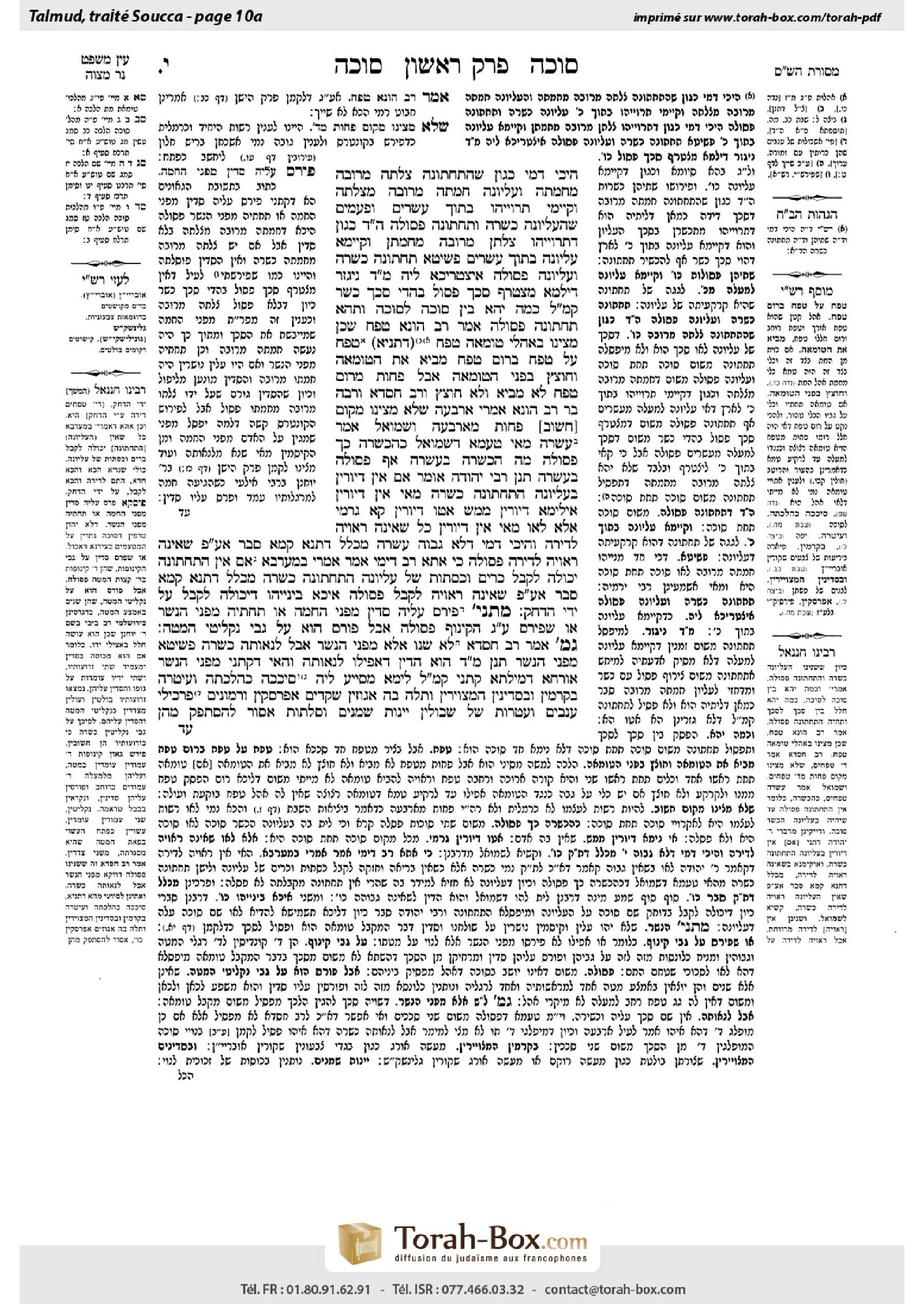
Sukkah 10a: Talmud study for Daf Yomi
Daf Yomi is the daily study of one Talmud folio. Explore 37 tractates with scans, Hebrew text, Sefaria English and AI-generated French translations where annotated.
Passage selection and English or AI-generated French translation are available where the scan has annotations. Daf Study is independent of Torah-Box and Sefaria.
Browse Sukkah · סוכה · All tractatesSukkah 10a text and translations
This page of Sukkah includes the Aramaic text, an English translation and an AI-generated French translation, alongside the scan above.
סוכה י׳ א · Aramaic and Hebrew text
הֵיכִי דָּמֵי? כְּגוֹן שֶׁהַתַּחְתּוֹנָה צִלָּתָהּ מְרוּבָּה מֵחַמָּתָהּ, וְעֶלְיוֹנָה חֲמָתָהּ מְרוּבָּה מִצִּלָּתָהּ, וְקָיְימִי תַּרְוַיְיהוּ בְּתוֹךְ עֶשְׂרִים.
וּפְעָמִים שֶׁהָעֶלְיוֹנָה כְּשֵׁרָה וְתַחְתּוֹנָה פְּסוּלָה הֵיכִי דָּמֵי? כְּגוֹן דְּתַרְוַיְיהוּ צִלָּתָן מְרוּבָּה מֵחֲמָתָן, וְקָיְימָא עֶלְיוֹנָה בְּתוֹךְ עֶשְׂרִים.
פְּשִׁיטָא! תַּחְתּוֹנָה כְּשֵׁרָה וְעֶלְיוֹנָה פְּסוּלָה אִיצְטְרִיכָא לֵיהּ. מַהוּ דְּתֵימָא: נִיגְזַר דִּילְמָא מִצְטָרֵף סְכָךְ פָּסוּל בַּהֲדֵי סְכָךְ כָּשֵׁר, קָא מַשְׁמַע לַן.
כַּמָּה יְהֵא בֵּין סוּכָּה לְסוּכָּה. וּתְהֵא תַּחְתּוֹנָה פְּסוּלָה?
אָמַר רַב הוּנָא: טֶפַח, שֶׁכֵּן מָצִינוּ בְּאׇהֳלֵי טוּמְאָה טֶפַח. (דְּתַנְיָא:) טֶפַח עַל טֶפַח בְּרוּם טֶפַח — מֵבִיא אֶת הַטּוּמְאָה, וְחוֹצֵץ בִּפְנֵי הַטּוּמְאָה. אֲבָל פָּחוֹת מֵרוּם טֶפַח — לֹא מֵבִיא, וְלֹא חוֹצֵץ.
וְרַב חִסְדָּא וְרַבָּה בַּר רַב הוּנָא אָמְרִי: אַרְבָּעָה, שֶׁלֹּא מָצִינוּ מָקוֹם [חָשׁוּב] פָּחוֹת מֵאַרְבָּעָה.
וּשְׁמוּאֵל אָמַר: עֲשָׂרָה. מַאי טַעְמָא דִּשְׁמוּאֵל — כְּהֶכְשֵׁרָהּ כָּךְ פְּסוּלָהּ. מָה הֶכְשֵׁרָהּ בַּעֲשָׂרָה, אַף פְּסוּלָהּ בַּעֲשָׂרָה.
תְּנַן, רַבִּי יְהוּדָה אוֹמֵר: אִם אֵין דָּיוֹרִין בָּעֶלְיוֹנָה — הַתַּחְתּוֹנָה כְּשֵׁרָה.
מַאי אֵין דָּיוֹרִין? אִילֵּימָא דָּיוֹרִין מַמָּשׁ: אַטּוּ דָּיוֹרִין קָא גָרְמִי? אֶלָּא לָאו, מַאי אֵין דָּיוֹרִין — כׇּל שֶׁאֵינָהּ רְאוּיָה לְדִירָה, וְהֵיכִי דָּמֵי? דְּלָא גְּבוֹהָה עֲשָׂרָה. מִכְּלָל דְּתַנָּא קַמָּא סָבַר אַף עַל פִּי שֶׁאֵינָהּ רְאוּיָה לְדִירָה פְּסוּלָה.
כִּי אֲתָא רַב דִּימִי, אֲמַר, אָמְרִי בְּמַעְרְבָא: אִם אֵין הַתַּחְתּוֹנָה יְכוֹלָה לְקַבֵּל כָּרִים וּכְסָתוֹת שֶׁל עֶלְיוֹנָה — הַתַּחְתּוֹנָה כְּשֵׁרָה.
מִכְּלָל דְּתַנָּא קַמָּא סָבַר אַף עַל פִּי שֶׁאֵינָהּ רְאוּיָה לְקַבֵּל פְּסוּלָה?
אִיכָּא בֵּינַיְיהוּ דִּיכוֹלָה לְקַבֵּל עַל יְדֵי הַדְּחָק.
מַתְנִי׳ פֵּירַס עָלֶיהָ סָדִין מִפְּנֵי הַחַמָּה, אוֹ תַּחְתֶּיהָ מִפְּנֵי הַנֶּשֶׁר, אוֹ שֶׁפֵּירַס עַל גַּבֵּי הַקִּינוֹף — פְּסוּלָה. אֲבָל פּוֹרֵס הוּא עַל גַּבֵּי נַקְלִיטֵי הַמִּטָּה.
גְּמָ׳ אָמַר רַב חִסְדָּא: לֹא שָׁנוּ אֶלָּא מִפְּנֵי הַנֶּשֶׁר. אֲבָל לְנָאוֹתָהּ — כְּשֵׁרָה. פְּשִׁיטָא, מִפְּנֵי הַנֶּשֶׁר תְּנַן! מַהוּ דְּתֵימָא: הוּא הַדִּין דַּאֲפִילּוּ לְנָאוֹתָהּ, וְהַאי דְּקָתָנֵי מִפְּנֵי הַנֶּשֶׁר — אוֹרְחָא דְמִילְּתָא קָתָנֵי, קָא מַשְׁמַע לַן.
לֵימָא מְסַיַּיע לֵיהּ: סִיכְּכָהּ כְּהִלְכָתָהּ וְעִיטְּרָהּ בִּקְרָמִין וּבִסְדִינִין הַמְצוּיָּרִין, וְתָלָה בָּהּ אֱגוֹזִין שְׁקֵדִים אֲפַרְסְקִין וְרִמּוֹנִים, פַּרְכִּילֵי עֲנָבִים וַעֲטָרוֹת שֶׁל שִׁבּוֹלִין, יֵינוֹת שְׁמָנִים וּסְלָתוֹת — אָסוּר לְהִסְתַּפֵּק מֵהֶן
Sukkah 10a · English translation
What are the circumstances? It is in a case where in the lower sukka, its shade is greater than its sunlight, rendering the sukka fit, and in the upper sukka, its sunlight is greater than its shade and it is therefore insignificant, and the roofing of both is within twenty cubits of the ground.
And there are times when the upper sukka is fit and the lower sukka is unfit. What are the circumstances? It is in a case where in both sukkot their shade is greater than their sunlight, and the roofing of the upper sukka is within twenty cubits of the roofing of the lower one. In this case the upper sukka is fit, while the lower sukka is a sukka beneath a sukka and is unfit.
The Gemara asks: This is obvious. There is nothing novel in any of these scenarios. The Gemara answers: It was necessary for the tanna to mention the case where the lower sukka is fit and the upper sukka is unfit, as it contains a novel element. Lest you say: Let us issue a decree and deem the lower sukka unfit, as perhaps the unfit roofing of the upper sukka joins together with the fit roofing of the lower sukka and renders it unfit as well; therefore, the tanna teaches us that the two roofings do not join together and the upper roofing does not render the lower sukka unfit.
The Gemara elucidates this halakha. How much space shall there be between the roofing of the upper sukka and the roofing of the lower sukka for the lower sukka to be considered a discrete entity and therefore disqualified as a sukka beneath a sukka?
Rav Huna said: There must be a handbreadth of space, as we likewise find in tents of ritual impurity the measure of a handbreadth. With regard to the halakhot of ritual impurity imparted by a corpse, the legal status of the space of one handbreadth beneath a roof is that of a tent, as we learned in a mishna: A space measuring one handbreadth by one handbreadth with a height of one handbreadth transmits ritual impurity. If a source of ritual impurity imparted by a corpse is in that space, the impurity is transmitted to all people, vessels, and food in that space. And a space that size serves as a barrier before the spread of ritual impurity beyond that space. However, if the space measures less than the height of one handbreadth, it does not transmit impurity to the objects in that space, and it does not serve as a barrier before the spread of ritual impurity. The impurity breaches the confining walls and rises upward as if there were no covering over it.
Rav Ḥisda and Rabba bar Rav Huna say: For this to be considered a sukka beneath a sukka, the space between the roofing of the upper sukka and that of the lower one must measure at least four handbreadths, as we do not find a significant area that measures less than four handbreadths, e.g., with regard to the domains of Shabbat.
And Shmuel said: The space between the roofing of the upper sukka and that of the lower one must measure at least ten handbreadths. The Gemara asks: What is the rationale for the opinion of Shmuel? The Gemara explains: As the criterion for its fitness, so too is the criterion for its unfitness; just as its fitness is only in a sukka ten handbreadths high, so too, its unfitness as a sukka is engendered only by a sukka ten handbreadths high.
The Gemara questions Shmuel’s statement: We learned in the mishna that Rabbi Yehuda says: If there are no residents in the upper sukka, the lower sukka is fit.
The Gemara clarifies: What is the meaning of: There are no residents? If we say that it means that there are no actual residents, the question arises: Is that to say that residents cause it to be unfit? If the upper sukka is a fit sukka, is there any difference whether or not people reside there? Rather, what is the meaning of: There are no residents? Is it not referring to any sukka that is not suitable to serve as a residence? And what are the circumstances of that case? It is a case where the sukka is not ten handbreadths high, as anything less than ten handbreadths high is not considered a residence. From the fact that it is Rabbi Yehuda who distinguishes between whether or not the upper sukka is at least ten handbreadths high, conclude by inference that the first tanna of the mishna holds that the lower sukka is unfit even if the upper sukka is less than ten handbreadths high and therefore not suitable to serve as a residence. This is contrary to the opinion of Shmuel.
When Rav Dimi came from Eretz Yisrael to Babylonia, he said that the Sages say in the West, Eretz Yisrael, in explanation of the mishna: If the roofing of the lower sukka is not sufficiently sturdy to be able to support the cushions and blankets of the upper sukka, then the lower sukka is fit, as the upper sukka is not suitable to serve as an independent residence. According to this explanation, the mishna does not discuss the height of the upper sukka; it discusses the quality of the roofing.
The Gemara notes: Is that to say by inference that the first tanna holds that even though the roofing of the lower sukka is not sufficiently sturdy to be able to support the cushions and blankets of the upper sukka, the lower sukka is unfit? In that case, the upper sukka is not a suitable residence. Why should the lower sukka be unfit?
The Gemara answers: The first tanna agrees that if the roofing of the lower sukka is unable to support the cushions and the blankets at all, the upper sukka is not considered a sukka and the lower sukka is fit. However, there is a practical difference between the opinions of the first tanna and Rabbi Yehuda in a case where the roofing of the lower sukka is able to support the cushions and the blankets of the upper sukka with difficulty and there is a concern that the roofing might collapse. In that case, the first tanna holds that since the roofing is capable of supporting the cushions and blankets, the upper sukka is considered a separate sukka and renders the lower sukka unfit. According to Rabbi Yehuda, since the roofing is able to support the weight of the cushions and blankets only with difficulty, the upper sukka is not fit. Therefore, the lower sukka is fit.
MISHNA: If one spread a sheet over the roofing as protection for those sitting in the sukka due to the sun, or if one spread a sheet beneath the roofing as protection due to the falling leaves, or if one spread a sheet as a canopy over the frame of a four-post [kinof] bed, the area in the sukka beneath the sheets is unfit. In the first two cases, because the sheet is susceptible to ritual impurity, it renders the otherwise fit roofing unfit. In the case of the canopy, one is not sitting under the roofing of the sukka; rather, he is sitting inside a tent. However, one may spread the sheet over the frame of a two-post [naklitei] bed, which has one post in the middle of each end of the bed. When spreading the sheet over the posts it forms an inclined rather than a flat roof, and a tent with an inclined roof is not considered a significant structure.
GEMARA: Rav Ḥisda said: The Sages taught the ruling that the sheet renders the sukka unfit only when it is placed underneath the roofing due to the falling leaves; however, if his intent was to spread the sheet for decorative purposes to beautify the sukka, it is not in the category of roofing and the sukka is fit. The Gemara asks: This is obvious, as: Due to the falling leaves, is what we learned in the mishna. The Gemara answers: Lest you say that the same is true, i.e., the sukka is unfit, even when the sheet was spread to beautify the sukka, and the reason that the mishna teaches specifically the case where one spread the sheet due to the falling leaves is that the mishna teaches the matter, spreading a sheet in the sukka, in the manner in which it typically occurs. Rav Ḥisda teaches us that the formulation of the mishna is precise and the halakha applies specifically to the case cited. If one spread the sheet for decorative purposes, it does not render the sukka unfit.
The Gemara suggests: Let us say that the following Tosefta supports the opinion of Rav Ḥisda. If one roofed the sukka in accordance with its halakhic requirements, and decorated it with colorful curtains and sheets, and hung in it ornamental nuts, almonds, peaches, and pomegranates, grape branches [parkilei], and wreaths of stalks of grain, wines, oils, and vessels full of flour, it is prohibited to derive benefit and use them
Sukkah 10a · Traduction française (IA)
Dans quelles circonstances ? Lorsque, dans la soukka inférieure, l’ombre est plus importante que le soleil, ce qui la rend apte, tandis que, dans la soukka supérieure, le soleil est plus important que l’ombre, de sorte qu’elle est négligeable, et que le sekhakh des deux se trouve à moins de vingt coudées du sol.
Il arrive aussi que la soukka supérieure soit apte et que la soukka inférieure ne le soit pas. Dans quelles circonstances ? Lorsque, dans les deux soukkot, l’ombre est plus importante que le soleil, et que le sekhakh de la soukka supérieure se trouve à moins de vingt coudées au-dessus du sekhakh de la soukka inférieure. Dans ce cas, la soukka supérieure est apte, tandis que la soukka inférieure est une soukka sous une soukka et n’est pas apte.
La Guemara demande : Cela va de soi. Aucun de ces cas ne présente rien de nouveau. La Guemara répond : Il était nécessaire que le tanna mentionne le cas où la soukka inférieure est apte et la soukka supérieure ne l’est pas, car il comporte un élément nouveau. De peur que tu ne dises : Décrétons que la soukka inférieure n’est pas apte, car peut-être le sekhakh inapte de la soukka supérieure s’ajoute-t-il au sekhakh apte de la soukka inférieure et la rend-il lui aussi inapte ; le tanna nous enseigne donc que les deux sekhakh ne s’ajoutent pas l’un à l’autre et que le sekhakh supérieur ne rend pas la soukka inférieure inapte.
La Guemara précise cette halakha. Quel espace doit séparer le sekhakh de la soukka supérieure de celui de la soukka inférieure pour que cette dernière soit considérée comme une entité distincte et soit donc disqualifiée en tant que soukka sous une soukka ?
Rav Houna dit : Il doit y avoir un espace d’un téfa’h, comme on trouve également la mesure d’un téfa’h pour les tentes en matière d’impureté rituelle. Concernant les halakhot de l’impureté rituelle transmise par un cadavre, un espace d’un téfa’h sous un toit a le statut d’une tente, comme nous l’avons appris dans une Michna : un espace mesurant un téfa’h sur un téfa’h et un téfa’h de hauteur transmet l’impureté rituelle. Si une source d’impureté due à un cadavre se trouve dans cet espace, l’impureté est transmise à toutes les personnes, à tous les ustensiles et à toute la nourriture qui s’y trouvent. Un espace de cette dimension fait aussi écran à la propagation de l’impureté rituelle au-delà de cet espace. En revanche, si l’espace mesure moins d’un téfa’h de haut, il ne transmet pas l’impureté aux objets qui s’y trouvent et ne fait pas écran à sa propagation. L’impureté franchit les parois qui la confinent et monte vers le haut, comme s’il n’y avait aucune couverture au-dessus.
Rav Ḥisda et Rabba bar Rav Houna disent : Pour qu’il s’agisse d’une soukka sous une soukka, l’espace entre le sekhakh de la soukka supérieure et celui de la soukka inférieure doit mesurer au moins quatre téfa’him, car nous ne trouvons pas de surface importante mesurant moins de quatre téfa’him, par exemple en ce qui concerne les domaines du Chabbat.
Et Chemouel dit : L’espace entre le sekhakh de la soukka supérieure et celui de la soukka inférieure doit mesurer au moins dix téfa’him. La Guemara demande : Quel est le raisonnement de Chemouel ? La Guemara explique : Le critère de validité est aussi celui de l’invalidité ; de même qu’une soukka n’est apte que si elle mesure dix téfa’him de haut, de même elle n’est invalidée en tant que soukka que par une soukka supérieure mesurant dix téfa’him de haut.
La Guemara conteste la déclaration de Chemouel : nous avons appris dans la Michna que Rabbi Yehouda dit : « S’il n’y a pas d’occupants dans la soukka supérieure, la soukka inférieure est apte. »
La Guemara précise : Que signifie « il n’y a pas d’occupants » ? Si nous disons que cela signifie qu’il n’y a effectivement aucun occupant, une question se pose : cela veut-il dire que ce sont les occupants qui la rendent inapte ? Si la soukka supérieure est apte, quelle différence cela fait-il que des gens y résident ou non ? Que signifie donc « il n’y a pas d’occupants » ? N’est-ce pas une soukka qui ne peut pas servir d’habitation ? Et dans quelles circonstances est-ce le cas ? Lorsque la soukka ne mesure pas dix téfa’him de haut, car tout espace de moins de dix téfa’him de haut n’est pas considéré comme une habitation. Puisque c’est Rabbi Yehouda qui distingue selon que la soukka supérieure mesure ou non au moins dix téfa’him de haut, déduis-en que le premier tanna de la Michna considère la soukka inférieure comme inapte même si la soukka supérieure mesure moins de dix téfa’him de haut et ne peut donc pas servir d’habitation. Cela contredit l’opinion de Chemouel.
Lorsque Rav Dimi vint d’Eretz Israël en Babylonie, il dit que les Sages d’Occident, c’est-à-dire d’Eretz Israël, expliquent ainsi la Michna : si le sekhakh de la soukka inférieure n’est pas assez solide pour supporter les coussins et les couvertures de la soukka supérieure, la soukka inférieure est apte, car la soukka supérieure ne peut pas servir d’habitation indépendante. Selon cette explication, la Michna ne traite pas de la hauteur de la soukka supérieure, mais de la qualité du sekhakh.
La Guemara remarque : Faut-il en déduire que, selon le premier tanna, même si le sekhakh de la soukka inférieure n’est pas assez solide pour supporter les coussins et les couvertures de la soukka supérieure, la soukka inférieure est inapte ? Dans ce cas, la soukka supérieure ne peut pas servir d’habitation. Pourquoi la soukka inférieure serait-elle inapte ?
La Guemara répond : Le premier tanna convient que si le sekhakh de la soukka inférieure est totalement incapable de supporter les coussins et les couvertures, la soukka supérieure n’est pas considérée comme une soukka et la soukka inférieure est apte. Il existe toutefois une différence pratique entre l’avis du premier tanna et celui de Rabbi Yehouda lorsque le sekhakh de la soukka inférieure peut supporter les coussins et les couvertures de la soukka supérieure, mais difficilement, et qu’on craint qu’il ne s’effondre. Dans ce cas, le premier tanna considère que, puisque le sekhakh est capable de supporter les coussins et les couvertures, la soukka supérieure est considérée comme une soukka distincte et rend la soukka inférieure inapte. Selon Rabbi Yehouda, puisque le sekhakh ne peut supporter le poids des coussins et des couvertures qu’avec difficulté, la soukka supérieure n’est pas apte. La soukka inférieure est donc apte.
MICHNA : Si quelqu’un a étendu une toile au-dessus du sekhakh pour protéger du soleil les personnes assises dans la soukka, ou s’il a étendu une toile sous le sekhakh pour se protéger des feuilles qui tombent, ou encore s’il a étendu une toile en guise de dais au-dessus de la structure d’un lit à quatre montants [kinof], la partie de la soukka située sous la toile n’est pas apte. Dans les deux premiers cas, la toile étant susceptible de contracter l’impureté rituelle, elle rend inapte le sekhakh qui, autrement, serait apte. Dans le cas du dais, on ne s’assied pas sous le sekhakh de la soukka, mais à l’intérieur d’une tente. Cependant, on peut étendre la toile au-dessus de la structure d’un lit à deux montants [naklitei], qui comporte un montant au milieu de chacune des extrémités du lit. Lorsqu’on étend la toile sur les montants, elle forme un toit incliné plutôt que plat, et une tente à toit incliné n’est pas considérée comme une structure importante.
GUEMARA : Rav Ḥisda dit : Les Sages ont enseigné que la toile rend la soukka inapte uniquement lorsqu’elle est placée sous le sekhakh à cause des feuilles qui tombent. Toutefois, si l’intention était d’étendre la toile à des fins décoratives, pour embellir la soukka, elle n’est pas considérée comme du sekhakh et la soukka est apte. La Guemara demande : Cela va de soi, puisque la Michna dit « à cause des feuilles qui tombent ». La Guemara répond : De peur que tu ne dises qu’il en va de même, c’est-à-dire que la soukka est inapte même lorsque la toile a été étendue pour l’embellir, et que la Michna mentionne précisément le cas où l’on étend la toile à cause des feuilles qui tombent parce qu’elle décrit la manière habituelle de procéder lorsqu’on étend une toile dans la soukka, Rav Ḥisda nous enseigne que la formulation de la Michna est précise et que la halakha s’applique spécifiquement au cas cité. Si quelqu’un a étendu la toile à des fins décoratives, elle ne rend pas la soukka inapte.
La Guemara suggère : Disons que la baraïta suivante appuie l’opinion de Rav Ḥisda. Si quelqu’un a couvert la soukka conformément aux exigences de la halakha, l’a décorée de rideaux et de toiles colorés, et y a suspendu des noix, des amandes, des pêches et des grenades décoratives, des rameaux de vigne [parkilei], des guirlandes d’épis de céréales, du vin, des huiles et des récipients remplis de farine, il est interdit d’en tirer profit et de les utiliser
Traduction française générée par IA à partir de l’édition anglaise de Sefaria. Vérifie toujours un passage avec le texte source.
Text from Sefaria: William Davidson Edition - Vocalized Aramaic (CC BY NC); William Davidson Edition - English (CC BY NC).