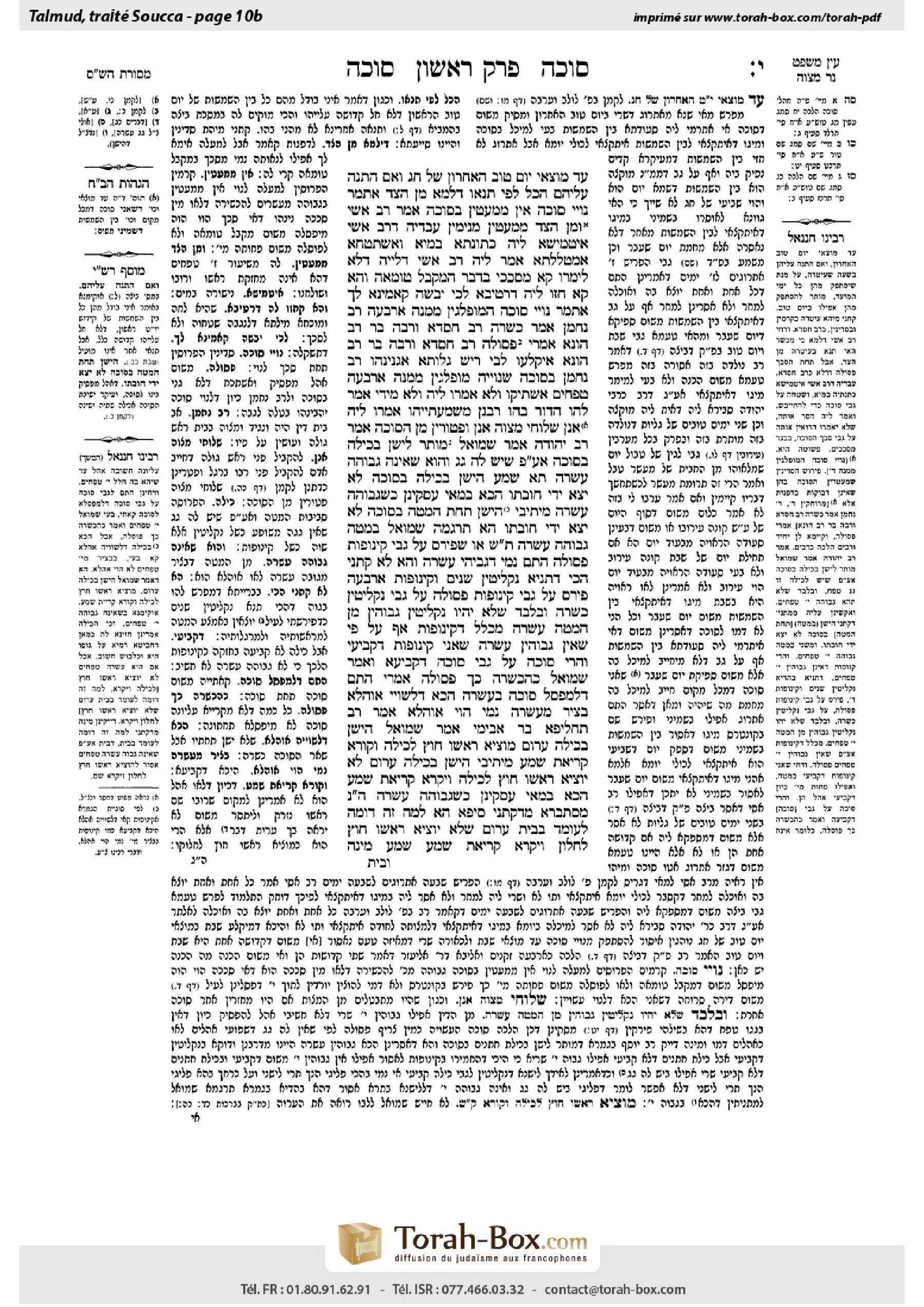
Sukkah 10b: Talmud study for Daf Yomi
Daf Yomi is the daily study of one Talmud folio. Explore 37 tractates with scans, Hebrew text, Sefaria English and AI-generated French translations where annotated.
Passage selection and English or AI-generated French translation are available where the scan has annotations. Daf Study is independent of Torah-Box and Sefaria.
Browse Sukkah · סוכה · All tractatesSukkah 10b text and translations
This page of Sukkah includes the Aramaic text, an English translation and an AI-generated French translation, alongside the scan above.
סוכה י׳ ב · Aramaic and Hebrew text
עַד מוֹצָאֵי יוֹם טוֹב הָאַחֲרוֹן שֶׁל חַג. וְאִם הִתְנָה עֲלֵיהֶם — הַכֹּל לְפִי תְנָאוֹ. דִּלְמָא מִן הַצַּד.
אִתְּמַר: נוֹיֵי סוּכָּה אֵין מְמַעֲטִין בַּסּוּכָּה. אָמַר רַב אָשֵׁי: וּמִן הַצַּד — מְמַעֲטִין.
מִנְיָמִין עַבְדֵּיהּ דְּרַב אָשֵׁי אִיטְּמִישָׁא לֵיהּ כִּתּוּנְתָּא בְּמַיָּא, וְאַשְׁטְחַהּ אַמְּטַלַּלְתָּא. אֲמַר לֵיהּ רַב אָשֵׁי: דַּלְיַיהּ, דְּלָא לֵימְרוּ קָא מְסַכְּכִי בְּדָבָר הַמְקַבֵּל טוּמְאָה. וְהָא קָא חָזוּ לַיהּ דְּרַטִּיבָא! לְכִי יָבְשָׁה קָאָמֵינָא לָךְ.
אִתְּמַר: נוֹיֵי סוּכָּה הַמּוּפְלָגִין מִמֶּנָּה אַרְבָּעָה, רַב נַחְמָן אָמַר: כְּשֵׁרָה, רַב חִסְדָּא וְרַבָּה בַּר רַב הוּנָא אָמְרִי: פְּסוּלָה.
רַב חִסְדָּא וְרַבָּה בַּר רַב הוּנָא אִיקְּלַעוּ לְבֵי רֵישׁ גָּלוּתָא. אַגְנִינְהוּ רַב נַחְמָן בְּסוּכָּה שֶׁנּוֹיֶיהָ מוּפְלָגִין מִמֶּנָּה אַרְבָּעָה טְפָחִים, אִשְׁתִּיקוּ וְלָא אֲמַרוּ לֵיהּ וְלָא מִידֵּי. אֲמַר לְהוּ: הֲדוּר בְּהוּ רַבָּנַן מִשְּׁמַעְתַּיְיהוּ? אֲמַרוּ לֵיהּ: אֲנַן שְׁלוּחֵי מִצְוָה אֲנַן, וּפְטוּרִין מִן הַסּוּכָּה.
אָמַר רַב יְהוּדָה אָמַר שְׁמוּאֵל: מוּתָּר לִישַׁן בְּכִילָּה בַּסּוּכָּה, אַף עַל פִּי שֶׁיֵּשׁ לָהּ גַּג, וְהוּא שֶׁאֵינָהּ גְּבוֹהָה עֲשָׂרָה.
תָּא שְׁמַע: הַיָּשֵׁן בְּכִילָּה בַּסּוּכָּה — לֹא יָצָא יְדֵי חוֹבָתוֹ! הָכָא בְּמַאי עָסְקִינַן, כְּשֶׁגְּבוֹהָה עֲשָׂרָה.
מֵיתִיבִי: הַיָּשֵׁן תַּחַת הַמִּטָּה בַּסּוּכָּה — לֹא יָצָא יְדֵי חוֹבָתוֹ! הָא תַּרְגְּמַהּ שְׁמוּאֵל בְּמִטָּה גְּבוֹהָה עֲשָׂרָה.
תָּא שְׁמַע: אוֹ שֶׁפֵּירַס עַל גַּבֵּי קִינוֹפוֹת — פְּסוּלָה! הָתָם נָמֵי דִּגְבִיהִי עֲשָׂרָה.
וְהָא לָא קָתָנֵי הָכִי. דְּתַנְיָא: נַקְלִיטִין שְׁנַיִם, וְקִינוֹפוֹת אַרְבָּעָה. פֵּירַס עַל גַּבֵּי קִינוֹפוֹת — פְּסוּלָה, עַל גַּבֵּי נַקְלִיטִין — כְּשֵׁרָה, וּבִלְבַד שֶׁלֹּא יִהְיוּ נַקְלִיטִין גְּבוֹהִין מִן הַמִּטָּה עֲשָׂרָה. מִכְּלָל דְּקִינוֹפוֹת — אַף עַל פִּי שֶׁאֵין גְּבוֹהִין עֲשָׂרָה!
שָׁאנֵי קִינוֹפוֹת, דִּקְבִיעִי. וַהֲרֵי סוּכָּה עַל גַּבֵּי סוּכָּה דִּקְבִיעָא, וְאָמַר שְׁמוּאֵל: כְּהֶכְשֵׁרָהּ כָּךְ פְּסוּלָהּ! אָמְרִי: הָתָם, דִּלְמִפְסַל סוּכָּה — בַּעֲשָׂרָה. הָכָא, דִּלְשַׁוּוֹיֵי אוּהְלָא — בְּצִיר מֵעֲשָׂרָה נָמֵי הָוֵי אוּהְלָא.
אָמַר רַב תַּחְלִיפָא בַּר אֲבִימִי אָמַר שְׁמוּאֵל: הַיָּשֵׁן בְּכִילָּה עָרוֹם — מוֹצִיא רֹאשׁוֹ חוּץ לַכִּילָה וְקוֹרֵא קְרִיאַת שְׁמַע.
מֵיתִיבִי: הַיָּשֵׁן בְּכִילָּה עָרוֹם — לֹא יוֹצִיא רֹאשׁוֹ חוּץ לַכִּילָה וְיִקְרָא קְרִיאַת שְׁמַע! הָכָא בְּמַאי עָסְקִינַן — כְּשֶׁגְּבוֹהָה עֲשָׂרָה.
הָכִי נָמֵי מִסְתַּבְּרָא, מִדְּקָתָנֵי סֵיפָא: הָא לְמָה זֶה דּוֹמֶה? לְעוֹמֵד בְּבַיִת עָרוֹם, שֶׁלֹּא יוֹצִיא רֹאשׁוֹ חוּץ לַחַלּוֹן וְיִקְרָא קְרִיאַת שְׁמַע. שְׁמַע מִינַּהּ.
Sukkah 10b · English translation
until the conclusion of the last day of the Festival. And if before he hung the decorations he stipulated with regard to them that he will be permitted to use them even during the Festival, everything is according to his stipulation, and he is permitted to use them. Apparently, sheets may indeed be spread in the sukka for decorative purposes. The Gemara rejects this: There is no proof from the Tosefta, as perhaps the reference is to sheets spread on the side of the sukka. However, if they are spread beneath the roofing, it renders the sukka unfit.
§ Apropos decorations, it was stated: Sukka decorations do not diminish the height of the sukka. Decorations hanging from the roofing are not considered part of the structure and therefore do not diminish the height of the sukka. If the roofing is more than twenty cubits above the ground, the decorations hanging within twenty cubits of the ground do not render the sukka fit. Rav Ashi said: However, if the decorations are spread on the side of the roof, they are considered part of the structure and diminish the area. If the decorations render the interior of the sukka less than seven by seven handbreadths, the sukka is unfit.
The Gemara relates with regard to Minyamin, the servant of Rav Ashi, that his shirt became wet [itamisha], and he spread it over the sukka to dry it. Rav Ashi said to him: Take it down so that people will not say that they are roofing the sukka with an item susceptible to ritual impurity. The servant said to him: But don’t they see that it is wet and understand that I placed it there to dry? Rav Ashi replied: Take it down once it is dry is what I am saying to you, as then people are apt to think that it is part of the roofing.
It was stated with regard to sukka decorations, e.g., sheets spread beneath the roofing to decorate the sukka, that are removed from the roofing four handbreadths, the amora’im disagreed whether they interpose between the roofing and the sukka. Rav Naḥman said: The sukka remains fit. Rav Ḥisda and Rabba bar Rav Huna said: It is unfit.
The Gemara relates that Rav Ḥisda and Rabba bar Rav Huna happened to come to the house of the Exilarch. Rav Naḥman, who was the official in charge of the Exilarch’s household, lodged them in a sukka whose decorations were removed from the roofing four handbreadths. They were silent and did not say anything to him, even though in their opinion the sukka was unfit. Rav Naḥman said to them: Did the Sages retract their halakhic ruling? Does your silence indicate that you concede to my ruling? They said to him: We are on the path to perform a mitzva and, therefore, we are exempt from the mitzva of sukka. Therefore, it is permitted for us to sleep in this sukka. In terms of the halakha, our ruling is unchanged.
Rav Yehuda said that Shmuel said: It is permitted to sleep in a bed with netting inside the sukka, even though the bed has a roof, provided that the netting is not more than ten handbreadths higher than the bed. In that case, the netting is not considered a tent in and of itself.
Come and hear: One who sleeps in a bed with netting inside the sukka did not fulfill his obligation, contrary to the statement that Rav Yehuda cited in the name of Shmuel. The Gemara answers: With what are we dealing here? It is a case where the netting is more than ten handbreadths higher than the bed and is considered a tent in and of itself.
The Gemara raises an objection from a mishna: One who sleeps beneath the bed in the sukka did not fulfill his obligation. As the height of a typical bed is less than ten handbreadths, apparently, even if the covering beneath which one is sleeping in less than ten handbreadths high, it is a tent in and of itself and he does not fulfill his obligation. The Gemara answers: Didn’t Shmuel interpret the mishna as referring to the case of a bed ten handbreadths high? Therefore, one who sleeps beneath the bed did not fulfill his obligation.
Come and hear that which is taught in the mishna: Or if one spread a sheet as a canopy over the frame of a four-post bed, the area in the sukka beneath the sheet is unfit. Apparently, a bed with certain types of netting is unfit. The Gemara answers: There, too, it is a case where the posts are ten handbreadths high.
The Gemara asks: But that is not the way it is taught, as it is taught in the baraita: Naklitin are two posts and kinofot are four posts. If one spread a sheet over four posts, the area in the sukka beneath the sheet is unfit; if one did so over two posts the entire sukka is fit, provided the two posts are not ten handbreadths higher than the bed. This proves by inference that a sheet spread over four posts renders the area in the sukka beneath the sheet unfit even if it is not ten handbreadths high.
The Gemara answers: Four posts are different because they are fixed in the bed and constitute a significant space even without the requisite height. The Gemara asks: But a sukka atop another sukka is fixed, and yet Shmuel said: As the criterion for its fitness, so too is the criterion for its unfitness. The upper sukka renders the lower sukka unfit only if it is ten handbreadths high. The Sages say in distinguishing between the cases: There, in the case of a sukka atop another sukka, where the measurement is in order to disqualify the lower sukka, ten handbreadths are required to render the upper sukka a separate entity. However, here, in the case of the four-post bed, in order to consider the covering a tent, less than ten handbreadths is also considered to be a tent, as it is fixed.
§ Rav Taḥalifa bar Avimi said that Shmuel said: One who sleeps naked in a bed with netting and is required to recite Shema moves his head out from beneath the netting and recites Shema. Although he is naked, the netting is considered like a garment; therefore, it is permitted to recite Shema.
The Gemara raises an objection from a baraita: One who sleeps naked in a bed with netting may not move his head out from beneath the netting and recite Shema. The Gemara answers: With what are we dealing here? It is a case where the netting is ten handbreadths high. In that case, it is considered a tent and not a garment.
The Gemara notes: So too, it is reasonable to understand the baraita in that manner from the fact that it is taught in the latter clause of that baraita: To what is this comparable? It is comparable to one standing naked in his house, that he may not move his head out the window and recite Shema. That is certainly ineffective. The fact that the baraita likens the bed with netting to a house indicates that it is netting at least ten handbreadths high. The Gemara concludes: Indeed, learn from it that this is the correct understanding.
Sukkah 10b · Traduction française (IA)
jusqu’à la fin du dernier jour de la fête. Et si, avant d’y suspendre les ornements, il avait stipulé qu’il pourrait les utiliser même pendant la fête, tout dépend de sa stipulation et il lui est permis de les utiliser. Apparemment, on peut effectivement étendre des draps dans la soukka à des fins décoratives. La Guemara rejette cette conclusion : on ne peut rien déduire de la Tosefta, car il se peut que les draps dont il est question soient étendus sur le côté de la soukka. En revanche, s’ils sont étendus sous le sakhakh, la soukka est impropre.
§ À propos des ornements, il a été enseigné : les ornements de la soukka n’en réduisent pas la hauteur. Les ornements suspendus au sakhakh ne sont pas considérés comme faisant partie de la structure et n’en réduisent donc pas la hauteur. Si le sakhakh se trouve à plus de vingt coudées du sol, les ornements suspendus à moins de vingt coudées du sol ne rendent pas la soukka apte. Rav Ashi a dit : toutefois, si les ornements sont étendus sur le côté du toit, ils sont considérés comme faisant partie de la structure et en réduisent la superficie. Si les ornements réduisent l’espace intérieur de la soukka à moins de sept palmes sur sept, la soukka est impropre.
La Guemara rapporte que la chemise de Minyamin, le serviteur de Rav Ashi, fut mouillée [itamisha], et qu’il l’étendit sur la soukka pour la faire sécher. Rav Ashi lui dit : « Enlève-la, afin que les gens ne disent pas qu’on couvre la soukka avec un objet susceptible de contracter l’impureté rituelle. » Le serviteur lui dit : « Mais ne voient-ils pas qu’elle est mouillée et ne comprennent-ils pas que je l’ai mise là pour la faire sécher ? » Rav Ashi lui répondit : « Ce que je te dis, c’est de l’enlever une fois qu’elle sera sèche, car alors les gens risqueraient de penser qu’elle fait partie du sakhakh. »
À propos des ornements de la soukka, par exemple des draps étendus sous le sakhakh pour décorer la soukka et placés à quatre palmes de celui-ci, les amoraïm sont en désaccord sur la question de savoir s’ils font écran entre le sakhakh et la soukka. Rav Naḥman a dit : la soukka reste apte. Rav Ḥisda et Rabba bar Rav Huna ont dit : elle est impropre.
La Guemara rapporte que Rav Ḥisda et Rabba bar Rav Huna se rendirent par hasard chez l’Exilarque. Rav Naḥman, qui était l’intendant de la maison de l’Exilarque, les logea dans une soukka dont les ornements étaient placés à quatre palmes du sakhakh. Ils gardèrent le silence et ne lui dirent rien, bien qu’à leur avis la soukka fût impropre. Rav Naḥman leur dit : « Les Sages ont-ils rétracté leur décision halakhique ? Votre silence signifie-t-il que vous reconnaissez que ma décision est juste ? » Ils lui répondirent : « Nous sommes en chemin pour accomplir une mitsva et, par conséquent, nous sommes dispensés de la mitsva de soukka. Nous sommes donc autorisés à dormir dans cette soukka. Quant à la halakha, notre décision reste inchangée. »
Rav Yehouda a dit au nom de Chmouel : il est permis de dormir sur un lit muni d’un baldaquin en filet à l’intérieur de la soukka, même si le lit a un toit, à condition que le filet ne dépasse pas le lit de plus de dix palmes. Dans ce cas, le filet n’est pas considéré comme une tente à part entière.
Viens et entends : celui qui dort sur un lit muni d’un baldaquin en filet à l’intérieur de la soukka ne s’est pas acquitté de son obligation, contrairement à ce que Rav Yehouda a rapporté au nom de Chmouel. La Guemara répond : de quoi s’agit-il ici ? D’un cas où le filet dépasse le lit de plus de dix palmes et est considéré comme une tente à part entière.
La Guemara soulève une objection à partir d’une Michna : celui qui dort sous le lit dans la soukka ne s’est pas acquitté de son obligation. Comme la hauteur d’un lit ordinaire est inférieure à dix palmes, il semble donc que même si la couverture sous laquelle on dort mesure moins de dix palmes de haut, elle constitue une tente à part entière et l’on ne s’acquitte pas de son obligation. La Guemara répond : Chmouel n’a-t-il pas interprété la Michna comme se rapportant au cas d’un lit haut de dix palmes ? Par conséquent, celui qui dort sous le lit ne s’est pas acquitté de son obligation.
Viens et entends ce qui est enseigné dans la Michna : ou si quelqu’un étend un drap en guise de dais au-dessus de la structure d’un lit à quatre montants, la zone de la soukka située sous le drap est impropre. Il semble donc qu’un lit muni de certains types de filet rende la soukka impropre. La Guemara répond : là aussi, il s’agit d’un cas où les montants font dix palmes de haut.
La Guemara demande : mais ce n’est pas ainsi que l’enseignement est formulé, car la baraïta enseigne : les naklitin sont deux montants et les kinofot sont quatre montants. Si l’on étend un drap sur quatre montants, la zone de la soukka située sous le drap est impropre ; si on le fait sur deux montants, toute la soukka est apte, à condition que les deux montants ne dépassent pas le lit de dix palmes. On en déduit qu’un drap étendu sur quatre montants rend impropre la zone de la soukka située dessous, même s’il n’est pas à dix palmes de hauteur.
La Guemara répond : les quatre montants sont différents, car ils sont fixés au lit et constituent un espace important même sans atteindre la hauteur requise. La Guemara demande : mais une soukka au-dessus d’une autre soukka est fixe, et pourtant Chmouel a dit : le critère qui la rend apte est également celui qui la rend impropre. La soukka supérieure ne rend la soukka inférieure impropre que si elle mesure dix palmes de haut. Les Sages distinguent les cas ainsi : là, dans le cas d’une soukka au-dessus d’une autre soukka, lorsqu’il s’agit de disqualifier la soukka inférieure, dix palmes sont nécessaires pour que la soukka supérieure constitue une entité distincte. Mais ici, dans le cas du lit à quatre montants, une couverture de moins de dix palmes de haut est également considérée comme une tente, puisqu’elle est fixe.
§ Rav Taḥalifa bar Avimi a dit au nom de Chmouel : celui qui dort nu sur un lit muni d’un baldaquin en filet et doit réciter le Chéma sort sa tête de sous le filet et récite le Chéma. Bien qu’il soit nu, le filet est considéré comme un vêtement ; il lui est donc permis de réciter le Chéma.
La Guemara soulève une objection à partir d’une baraïta : celui qui dort nu sur un lit muni d’un baldaquin en filet ne peut pas sortir sa tête de sous le filet et réciter le Chéma. La Guemara répond : de quoi s’agit-il ici ? D’un cas où le filet mesure dix palmes de haut. Dans ce cas, il est considéré comme une tente et non comme un vêtement.
La Guemara remarque qu’il est également raisonnable de comprendre la baraïta de cette manière, puisque sa dernière clause enseigne : à quoi cela est-il comparable ? À quelqu’un qui se tient nu dans sa maison et ne peut pas sortir la tête par la fenêtre pour réciter le Chéma. Cela ne lui serait certainement d’aucune utilité. Le fait que la baraïta compare le lit muni d’un filet à une maison indique que le filet mesure au moins dix palmes de haut. La Guemara conclut : en effet, déduis-en que telle est la bonne interprétation.
Traduction française générée par IA à partir de l’édition anglaise de Sefaria. Vérifie toujours un passage avec le texte source.
Text from Sefaria: William Davidson Edition - Vocalized Aramaic (CC BY NC); William Davidson Edition - English (CC BY NC).