Sukkah 11a: Talmud study for Daf Yomi
Daf Yomi is the daily study of one Talmud folio. Explore 37 tractates with scans, Hebrew text, Sefaria English and AI-generated French translations where annotated.
Passage selection and English or AI-generated French translation are available where the scan has annotations. Daf Study is independent of Torah-Box and Sefaria.
Browse Sukkah · סוכה · All tractatesSukkah 11a text and translations
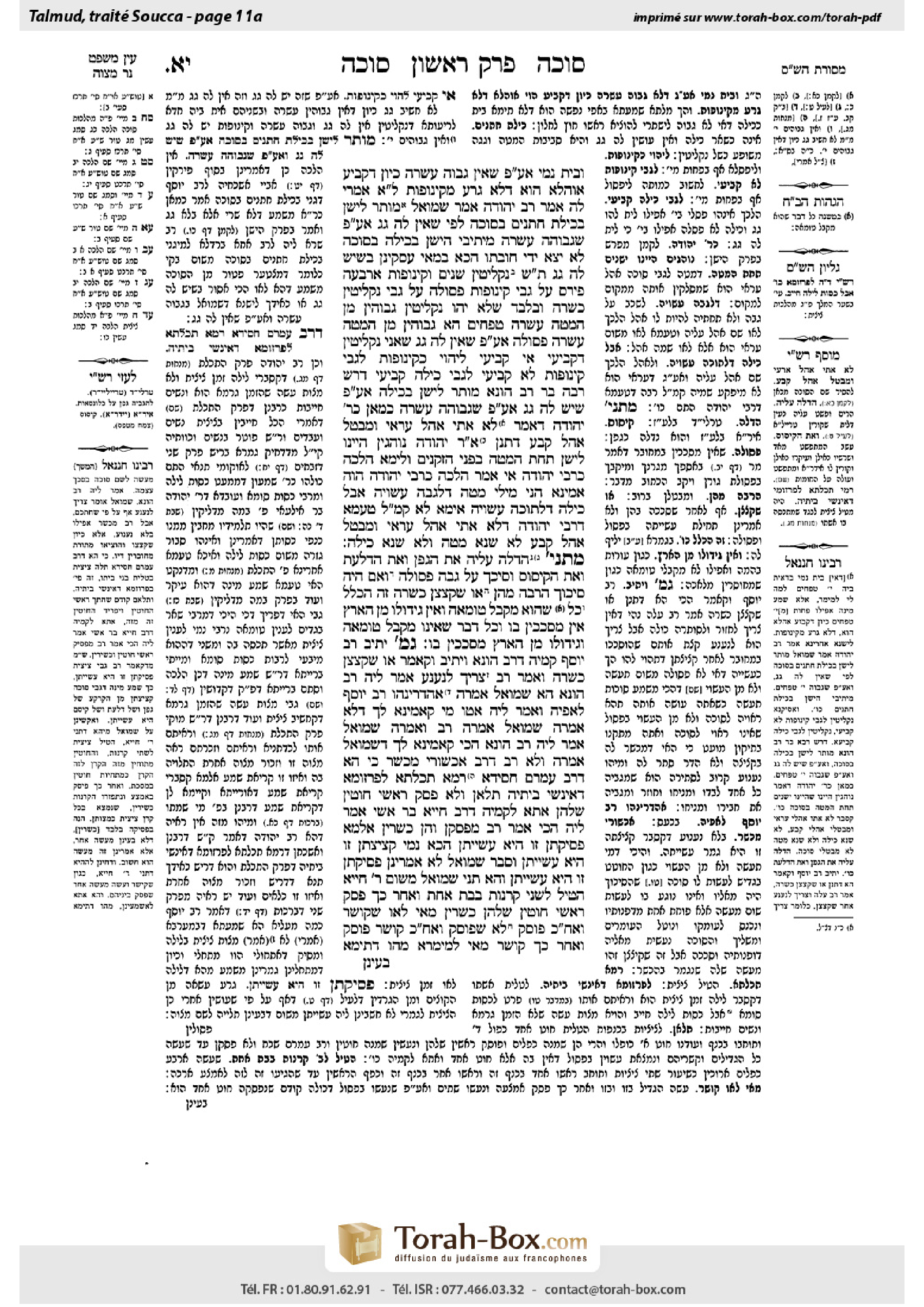
This page of Sukkah includes the Aramaic text, an English translation and an AI-generated French translation, alongside the scan above.
סוכה י״א א · Aramaic and Hebrew text
וּבַיִת נָמֵי, אַף עַל פִּי שֶׁאֵין גָּבוֹהַּ עֲשָׂרָה, כֵּיוָן דִּקְבִיעַ — אוּהְלָא הוּא, דְּלָא גָּרַע מִקִּינוֹפוֹת.
לִישָּׁנָא אַחֲרִינָא אָמְרִי לַהּ, אָמַר רַב יְהוּדָה אָמַר שְׁמוּאֵל: מוּתָּר לִישַׁן בְּכִילַּת חֲתָנִים בַּסּוּכָּה לְפִי שֶׁאֵין לָהּ גַּג, אַף עַל פִּי שֶׁגְּבוֹהָה עֲשָׂרָה.
מֵיתִיבִי: הַיָּשֵׁן בְּכִילָּה בַּסּוּכָּה — לֹא יָצָא יְדֵי חוֹבָתוֹ! הָכָא בְּמַאי עָסְקִינַן — בְּשֶׁיֵּשׁ לָהּ גַּג.
תָּא שְׁמַע: נַקְלִיטִין שְׁנַיִם, וְקִינוֹפוֹת אַרְבָּעָה, פֵּירַס עַל גַּבֵּי קִינוֹפוֹת — פְּסוּלָה, עַל גַּבֵּי נַקְלִיטִין — כְּשֵׁרָה, וּבִלְבַד שֶׁלֹּא יְהוּ נַקְלִיטִין גְּבוֹהִין מִן הַמִּטָּה עֲשָׂרָה טְפָחִים. הָא גְּבוֹהִין מִן הַמִּטָּה עֲשָׂרָה — פְּסוּלָה, אַף עַל פִּי שֶׁאֵין לָהּ גַּג!
שָׁאנֵי נַקְלִיטִין, דִּקְבִיעִי. אִי קְבִיעִי, לֶיהֱוֵי כְּקִינוֹפוֹת! לְגַבַּי קִינוֹפוֹת — לָא קְבִיעִי, לְגַבֵּי כִילָּה — קְבִיעִי.
דָּרֵשׁ רַבָּה בַּר רַב הוּנָא: מוּתָּר לִישַׁן בְּכִילָּה, אַף עַל פִּי שֶׁיֵּשׁ לָהּ גַּג, אַף עַל פִּי שֶׁגְּבוֹהָה עֲשָׂרָה. כְּמַאן — כְּרַבִּי יְהוּדָה, דְּאָמַר: לָא אָתֵי אֹהֶל עֲרַאי וּמְבַטֵּל אֹהֶל קֶבַע. דִּתְנַן, אָמַר רַבִּי יְהוּדָה: נוֹהֲגִין הָיִינוּ לִישַׁן תַּחַת הַמִּטָּה בִּפְנֵי הַזְּקֵנִים.
וְלֵימָא הֲלָכָה כְּרַבִּי יְהוּדָה!
אִי אָמַר הֲלָכָה כְּרַבִּי יְהוּדָה, הֲוָה אָמֵינָא: הָנֵי מִילֵּי מִטָּה, דִּלְגַבָּהּ עֲשׂוּיָה, אֲבָל כִּילָּה, דִּלְתוֹכָהּ עֲשׂוּיָה — אֵימָא לָא, קָא מַשְׁמַע לַן טַעְמָא דְּרַבִּי יְהוּדָה דְּלָא אָתֵי אֹהֶל עֲרַאי וּמְבַטֵּל אֹהֶל קָבַע, לָא שְׁנָא מִטָּה וְלָא שְׁנָא כִּילָּה.
מַתְנִי׳ הִדְלָה עָלֶיהָ אֶת הַגֶּפֶן וְאֶת הַדַּלַּעַת וְאֶת הַקִּיסוֹס וְסִיכֵּךְ עַל גַּבָּהּ — פְּסוּלָה. וְאִם הָיָה סִיכּוּךְ הַרְבֵּה מֵהֶן, אוֹ שֶׁקְּצָצָן — כְּשֵׁרָה.
זֶה הַכְּלָל: כֹּל שֶׁהוּא מְקַבֵּל טוּמְאָה וְאֵין גִּידּוּלוֹ מִן הָאָרֶץ — אֵין מְסַכְּכִין בּוֹ. וְכׇל דָּבָר שֶׁאֵינוֹ מְקַבֵּל טוּמְאָה וְגִידּוּלוֹ מִן הָאָרֶץ — מְסַכְּכִין בּוֹ.
גְּמָ׳ יָתֵיב רַב יוֹסֵף קַמֵּיהּ דְּרַב הוּנָא, וְיָתֵיב וְקָאָמַר: אוֹ שֶׁקְּצָצָן כְּשֵׁרָה, וְאָמַר רַב: צָרִיךְ לְנַעְנֵעַ.
אֲמַר לֵיהּ רַב הוּנָא: הָא שְׁמוּאֵל אַמְרַהּ. אַהְדְּרִינְהוּ רַב יוֹסֵף לְאַפֵּיהּ וַאֲמַר לֵיהּ: אַטּוּ מִי קָאָמֵינָא לָךְ דְּלָא אַמְרַהּ שְׁמוּאֵל? אַמְרַהּ רַב, וְאַמְרַהּ שְׁמוּאֵל! אֲמַר לֵיהּ רַב הוּנָא: הָכִי קָאָמֵינָא לָךְ דִּשְׁמוּאֵל אַמְרַהּ וְלָא רַב, דְּרַב אַכְשׁוֹרֵי מַכְשַׁר. כִּי הָא דְּרַב עַמְרָם חֲסִידָא רְמָא תְּכֵלְתָּא לְפַרְזוּמָא דְּאִינָשֵׁי בֵּיתֵיהּ. תְּלָאָן, וְלֹא פָּסַק רָאשֵׁי חוּטִין שֶׁלָּהֶן.
אֲתָא לְקַמֵּיהּ דְּרַב חִיָּיא בַּר אָשֵׁי, אֲמַר לֵיהּ: הָכִי אָמַר רַב: מְפַסְּקָן וְהֵן כְּשֵׁרִין. אַלְמָא: פְּסִיקָתָן זוֹ הִיא עֲשִׂיָּיתָן. הָכָא נָמֵי: קְצִיצָתָן זוֹ הִיא עֲשִׂיָּיתָן.
וְסָבַר שְׁמוּאֵל לָא אָמְרִינַן פְּסִיקָתָן זוֹ הִיא עֲשִׂיָּיתָן? וְהָא תָּנֵי שְׁמוּאֵל מִשּׁוּם רַבִּי חִיָּיא: הֵטִיל לִשְׁנֵי קְרָנוֹת בְּבַת אַחַת, וְאַחַר כָּךְ פָּסַק רָאשֵׁי חוּטִין שֶׁלָּהֶן — כְּשֵׁרִין. מַאי לָאו — שֶׁקּוֹשֵׁר וְאַחַר כָּךְ פּוֹסֵק! לֹא, שֶׁפּוֹסֵק וְאַחַר כָּךְ קוֹשֵׁר.
פּוֹסֵק וְאַחַר כָּךְ קוֹשֵׁר מַאי לְמֵימְרָא! מַהוּ דְּתֵימָא:
Sukkah 11a · English translation
And this halakha that it is not sufficient to place his head out the window applies also to a house even if it is not ten handbreadths high. Since it is a fixed structure it is considered a tent in and of itself, as it is no less permanent than a bed with four posts, which is considered a tent even though the netting is less than ten handbreadths higher than the bed.
Some say another version of the previous discussion: Rav Yehuda said that Shmuel said: It is permitted to sleep inside a netted bridal canopy in the sukka since it is inclined and does not have a roof, even though it is ten handbreadths high.
The Gemara raises an objection from a baraita: One who sleeps in a bed with netting inside the sukka did not fulfill his obligation. The Gemara answers: With what are we dealing here in the baraita? It is with a bed with netting in a case where, unlike a bridal canopy, it has a roof.
Come and hear another question from what we learned: Naklitin are two posts and kinofot are four posts. If one spread a sheet over four posts, the sukka is unfit; if he spread a sheet over two posts the sukka is fit, provided the two posts are not ten handbreadths higher than the bed. It can be inferred from here: But if they are higher than ten handbreadths the sukka is unfit even though it has no roof, contrary to the opinion of Shmuel.
The Gemara answers: Two posts are different from the bridal canopy because they are fixed in the bed, and therefore the sheet over them is considered a tent even with an inclined roof. The Gemara asks: If they are fixed then let them be considered like four posts and let them render the sukka unfit even when they are less than ten handbreadths high. The Gemara answers: Vis-à-vis four posts, two posts are not considered fixed and therefore, they render the sukka unfit only when they are ten handbreadths higher than the bed. However, vis-à-vis a bed with netting, two posts are considered fixed and consequently, they render the sukka unfit even though they lack a roof.
Rabba bar Rav Huna taught: It is permitted to sleep in a bed with netting even though it has a roof and even though it is higher than ten handbreadths. In accordance with whose opinion did Rabba bar Rav Huna teach this halakha? It is in accordance with the opinion of Rabbi Yehuda who said that in principle, a temporary tent does not come and negate a permanent tent, as we learned in a mishna that Rabbi Yehuda said: We were accustomed to sleep beneath the bed before the Elders. Since a bed is a temporary tent relative to the more permanent sukka, even one sleeping beneath a bed is considered to be sleeping in the sukka and he fulfills his obligation in that manner.
The Gemara asks: And if the statement of Rabba bar Rav Huna is in accordance with the opinion of Rabbi Yehuda, let him say simply that the halakha is in accordance with the opinion of Rabbi Yehuda.
The Gemara answers: If he said the halakha is in accordance with the opinion of Rabbi Yehuda, I would have said that this applies only to a bed, which is made for use atop it and not beneath it. Perhaps the reason a bed is not considered a tent in and of itself is that its primary purpose is to lie on top of it, not in the space beneath it. However, with regard to a bed with netting, which is made for use of the space within it, say that no, it is indeed considered a tent in and of itself and one who sleeps in it does not fulfill his obligation. Therefore, Rabba bar Rav Huna teaches us that the rationale for the opinion of Rabbi Yehuda is that a temporary tent does not come and negate a permanent tent, and there is no difference whether the temporary tent is a bed or whether it is the netting over a bed.
MISHNA: If one trellised climbing plants such as a grapevine, or gourd plant, or ivy [kissos], over a sukka while they were still attached to the ground, and then added roofing atop them, the sukka is unfit. If the amount of fit roofing was greater than the plants attached to the ground, or if he cut the climbing plants so that they were no longer attached to the ground, it is fit.
This is the principle with regard to the roofing of a sukka: Anything that is susceptible to ritual impurity, e.g., vessels, or its growth is not from the ground, e.g., animal hides, one may not roof his sukka with it. And anything that is not susceptible to ritual impurity and its growth is from the ground, one may roof his sukka with it.
GEMARA: Rav Yosef sat before Rav Huna, and he sat and said, citing the mishna: Or if he cut them, it is fit. He added: And Rav said that it is not enough merely to cut the climbing plants; one is obligated to move the branches, thereby performing an action with the branches in order to render the roofing fit. When he placed the climbing plants atop the sukka, they were attached and therefore unfit roofing. When he ultimately cut them, it was as if the sukka were roofed by itself. In that case, the sukka is unfit due to the principle: Prepare it, and not from that which has already been prepared, derived from the verse: “You shall prepare for you the festival of Sukkot” (Deuteronomy 16:13).
Rav Huna said to Rav Yosef: Shmuel stated this halakha. Rav Yosef turned his face away in anger and said to him: Did I say to you that Shmuel did not say it? Rav said it, and Shmuel said it as well. What is your point? Rav Huna said to him: This is what I am saying to you, that Shmuel said it and not Rav, as Rav deems the roofing fit merely by cutting them, without moving them, as in that incident where Rav Amram the Pious cast the sky-blue dye, i.e., ritual fringes, upon the garment [pirzuma] of the people of his household. However, he attached them, but did not cut the ends of their strands prior to tying them, i.e., he took a single string, folded it a number of times, and inserted it into the hole in the garment. Since the fringes were uncut when he tied them, he was uncertain whether they were fit for use in fulfilling the mitzva, due to the principle: Prepare it, and not from that which has already been prepared.
Rav Amram came before Rav Ḥiyya bar Ashi and asked him about the halakhic status of the ritual fringes. He said to him that this is what Rav said: One cuts them into separate strands and they are fit. There is no need to remove them, cut them, and reattach them to the garment as separate strands. Apparently, according to Rav, their cutting is their preparation. Cutting them qualifies as active preparation of the fringes. Here too, in the case of the roofing of a sukka, Rav holds: Their cutting is their preparation, and no further action is required.
The Gemara asks: And does Shmuel hold that we do not say: Their cutting is their preparation? But didn’t Shmuel teach in the name of Rabbi Ḥiyya: If one cast fringes upon two corners of a garment simultaneously by repeatedly inserting one strand into holes in both corners and afterward cut the ends of their strands resulting in two full-fledged fringes, the fringes are fit. What, is it not referring to a case where one ties the fringes as required and afterward cuts them? The Gemara answers: No, it is referring to a case where he cuts the strands and afterward ties them.
The Gemara asks: If the reference is to a case where he cuts the strands and afterward ties them, what need was there to state that the ritual fringes are fit? That is the prescribed manner of preparing ritual fringes. The Gemara answers: Lest you say that in addition to tying the fringes separately
Sukkah 11a · Traduction française (IA)
Cette halakha, selon laquelle il ne suffit pas de faire dépasser sa tête par la fenêtre, s’applique également à une maison, même si elle n’atteint pas dix palmes de hauteur. Comme il s’agit d’une construction fixe, elle est considérée comme une tente à part entière, car elle n’est pas moins permanente qu’un lit à quatre montants, qui est considéré comme une tente même si le baldaquin se trouve à moins de dix palmes au-dessus du lit.
Certains transmettent une autre version de la discussion précédente : Rav Yehouda a dit au nom de Shmuel qu’il est permis de dormir sous un baldaquin de mariée dans la soukka, puisqu’il est incliné et dépourvu de toit, même s’il atteint dix palmes de hauteur.
La Guemara soulève une objection à partir d’une baraïta : Celui qui dort dans un lit à baldaquin à l’intérieur de la soukka ne s’est pas acquitté de son obligation. La Guemara répond : De quoi s’agit-il dans cette baraïta ? D’un lit à baldaquin qui, contrairement à un baldaquin de mariée, a un toit.
Viens et entends une autre question, tirée de ce que nous avons appris : Les naklitin sont deux montants et les kinofot sont quatre montants. Si quelqu’un étend une toile sur quatre montants, la soukka est invalide ; s’il l’étend sur deux montants, la soukka est valide, à condition que ces deux montants ne dépassent pas le lit de dix palmes. On peut en déduire que si les montants dépassent le lit de dix palmes, la soukka est invalide, même si elle n’a pas de toit, contrairement à l’avis de Shmuel.
La Guemara répond : Deux montants diffèrent du baldaquin de mariée, car ils sont fixés au lit ; la toile étendue sur eux est donc considérée comme une tente, même si son toit est incliné. La Guemara demande : S’ils sont fixés, qu’ils soient donc considérés comme quatre montants et rendent la soukka invalide même s’ils ne dépassent pas le lit de dix palmes. La Guemara répond : Par rapport à quatre montants, deux montants ne sont pas considérés comme fixes ; ils ne rendent donc la soukka invalide que lorsqu’ils dépassent le lit de dix palmes. En revanche, par rapport à un lit à baldaquin, deux montants sont considérés comme fixes et rendent par conséquent la soukka invalide, même s’ils n’ont pas de toit.
Rabba bar Rav Houna enseignait qu’il est permis de dormir dans un lit à baldaquin, même s’il a un toit et même s’il dépasse dix palmes de hauteur. Selon l’avis de qui Rabba bar Rav Houna a-t-il enseigné cette halakha ? Selon l’avis de Rabbi Yehouda, qui a dit qu’en principe, une tente temporaire ne vient pas annuler une tente permanente, comme nous l’avons appris dans une Michna où Rabbi Yehouda a dit : « Nous avions l’habitude de dormir sous le lit devant les Anciens. » Puisque le lit est une tente temporaire par rapport à la soukka, qui est plus permanente, même celui qui dort sous un lit est considéré comme dormant dans la soukka et s’acquitte ainsi de son obligation.
La Guemara demande : Et si la déclaration de Rabba bar Rav Houna suit l’avis de Rabbi Yehouda, qu’il dise simplement que la halakha suit l’avis de Rabbi Yehouda.
La Guemara répond : S’il avait dit que la halakha suit l’avis de Rabbi Yehouda, j’aurais dit que cela ne s’applique qu’à un lit, qui est fait pour être utilisé par-dessus et non en dessous. Peut-être un lit n’est-il pas considéré comme une tente à part entière parce que sa fonction principale est de s’y étendre, et non d’occuper l’espace situé dessous. En revanche, à propos d’un lit à baldaquin, qui est fait pour que l’on utilise l’espace intérieur, on pourrait dire que celui-ci est bel et bien considéré comme une tente à part entière et que celui qui y dort ne s’acquitte pas de son obligation. Rabba bar Rav Houna nous enseigne donc que le motif de l’avis de Rabbi Yehouda est qu’une tente temporaire ne vient pas annuler une tente permanente, et qu’il n’y a pas de différence entre une tente temporaire constituée par un lit et une tente constituée par le baldaquin au-dessus d’un lit.
MICHNA : Si quelqu’un fait courir sur une soukka des plantes grimpantes, comme une vigne, une courge ou du lierre [kissos], alors qu’elles sont encore attachées au sol, puis ajoute une couverture par-dessus, la soukka est invalide. Si la quantité de matériau de couverture valide est supérieure à celle des plantes attachées au sol, ou s’il coupe les plantes grimpantes de sorte qu’elles ne soient plus attachées au sol, la soukka est valide.
Voici le principe concernant la couverture d’une soukka : tout ce qui est susceptible de contracter l’impureté rituelle, par exemple les ustensiles, ou tout ce qui ne pousse pas à partir du sol, par exemple les peaux d’animaux, ne peut pas servir à couvrir sa soukka. Tout ce qui n’est pas susceptible de contracter l’impureté rituelle et pousse à partir du sol peut servir à couvrir sa soukka.
Rav Yossef était assis devant Rav Houna, qui s’assit et cita la Michna : « Ou s’il les a coupées, la soukka est valide. » Il ajouta : Rav a dit qu’il ne suffit pas de couper les plantes grimpantes ; il faut déplacer les branches, accomplissant ainsi un acte sur celles-ci afin de rendre la couverture valide. Lorsqu’il a posé les plantes grimpantes sur la soukka, elles étaient attachées et constituaient donc un matériau de couverture invalide. Lorsqu’il les a finalement coupées, c’était comme si la soukka s’était couverte d’elle-même. Dans ce cas, la soukka est invalide en vertu du principe : « Prépare-la », et non à partir de ce qui est déjà préparé, principe déduit du verset : « Tu célébreras pour toi la fête de Soukkot » (Deutéronome 16, 13).
Rav Houna dit à Rav Yossef : Shmuel a énoncé cette halakha. Rav Yossef détourna le visage avec colère et lui dit : « T’ai-je dit que Shmuel ne l’avait pas énoncée ? Rav l’a dit, et Shmuel l’a dit également. Que veux-tu donc dire ? » Rav Houna lui dit : « Voici ce que je veux te dire : c’est Shmuel qui l’a dit, et non Rav, car Rav juge la couverture valide par le simple fait de couper les plantes, sans les déplacer, comme dans l’épisode où Rav Amram le Pieux jeta les fils bleu azur, c’est-à-dire les franges rituelles, sur le vêtement [pirzuma] des gens de sa maison. Il les attacha, mais ne coupa pas les extrémités de leurs fils avant de les nouer ; autrement dit, il prit un seul fil, le plia plusieurs fois et le fit passer dans le trou du vêtement. Comme les franges n’étaient pas coupées au moment où il les noua, il doutait qu’elles puissent servir à accomplir la mitsva, en vertu du principe : “Prépare-la”, et non à partir de ce qui est déjà préparé. »
Rav Amram se présenta devant Rav Ḥiyya bar Ashi et l’interrogea sur le statut halakhique des franges rituelles. Celui-ci lui répondit que Rav avait dit ceci : On les coupe en fils séparés, et elles sont valides. Il n’est pas nécessaire de les retirer, de les couper, puis de les rattacher au vêtement en fils séparés. Il apparaît donc que, selon Rav, les couper constitue leur préparation. Les couper équivaut à une préparation active des franges. Ici aussi, dans le cas de la couverture d’une soukka, Rav estime que les couper constitue leur préparation et qu’aucune autre action n’est nécessaire.
La Guemara demande : Shmuel soutient-il vraiment que l’on ne dit pas : « Les couper constitue leur préparation » ? Pourtant, Shmuel a enseigné au nom de Rabbi Ḥiyya : Si quelqu’un passe des franges dans les deux coins d’un vêtement simultanément, en faisant passer à plusieurs reprises un même fil dans les trous des deux coins, puis coupe les extrémités des fils, obtenant ainsi deux franges complètes, celles-ci sont valides. N’est-il pas question d’un cas où il noue les franges comme il se doit, puis les coupe ? La Guemara répond : Non, il s’agit d’un cas où il coupe les fils, puis les noue.
La Guemara demande : S’il s’agit d’un cas où il coupe les fils, puis les noue, pourquoi était-il nécessaire de préciser que les franges rituelles sont valides ? C’est la manière prescrite de préparer les franges rituelles. La Guemara répond : De peur que tu ne dises qu’en plus de nouer séparément les franges
Traduction française générée par IA à partir de l’édition anglaise de Sefaria. Vérifie toujours un passage avec le texte source.
Text from Sefaria: William Davidson Edition - Vocalized Aramaic (CC BY NC); William Davidson Edition - English (CC BY NC).