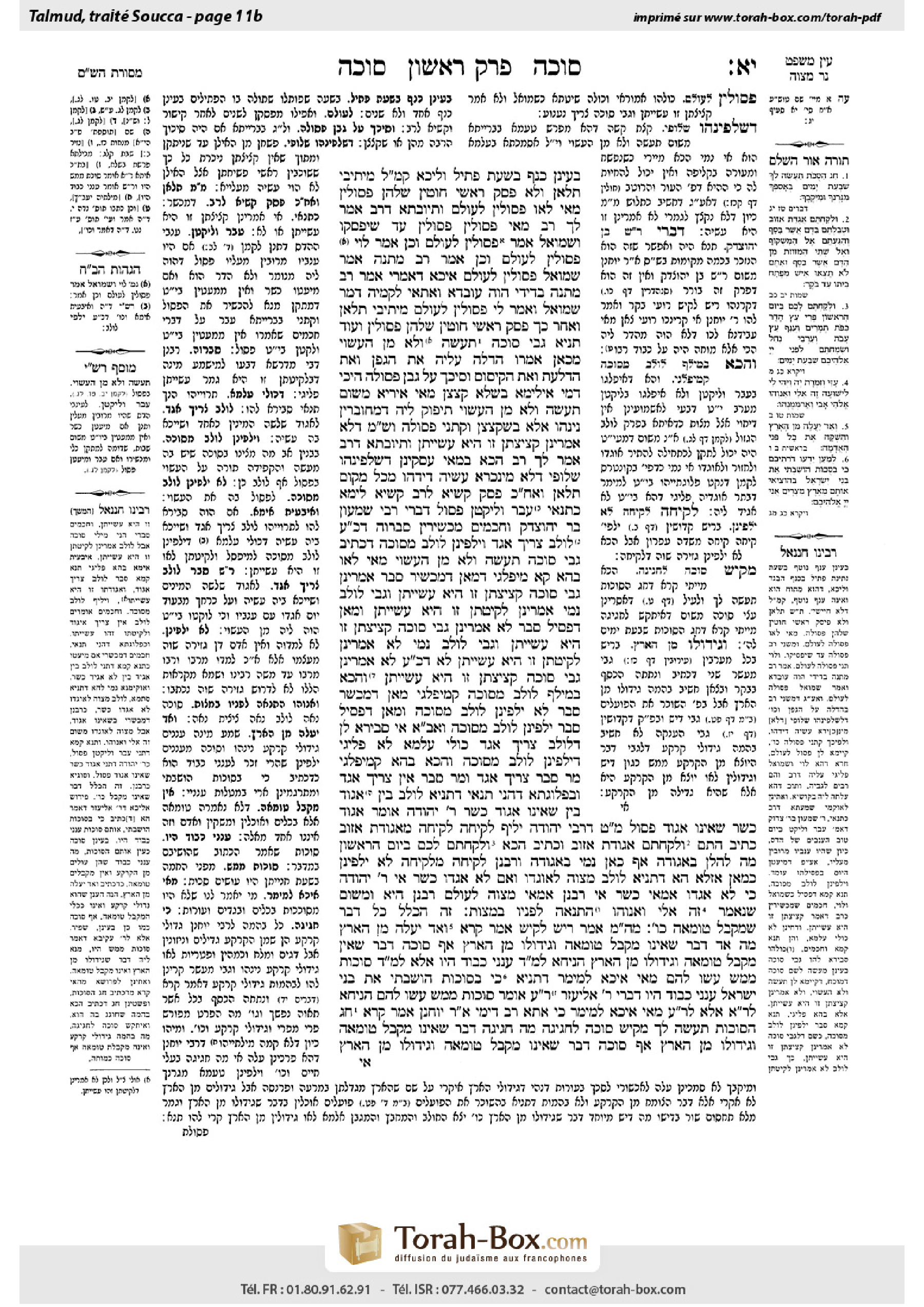
Sukkah 11b: Talmud study for Daf Yomi
Daf Yomi is the daily study of one Talmud folio. Explore 37 tractates with scans, Hebrew text, Sefaria English and AI-generated French translations where annotated.
Passage selection and English or AI-generated French translation are available where the scan has annotations. Daf Study is independent of Torah-Box and Sefaria.
Browse Sukkah · סוכה · All tractatesSukkah 11b text and translations
This page of Sukkah includes the Aramaic text, an English translation and an AI-generated French translation, alongside the scan above.
סוכה י״א ב · Aramaic and Hebrew text
בָּעֵינַן כָּנָף בִּשְׁעַת פְּתִיל — וְלֵיכָּא, קָא מַשְׁמַע לַן.
מֵיתִיבִי: תְּלָאָן וְלֹא פָּסַק רָאשֵׁי חוּטִין שֶׁלָּהֶן — פְּסוּלִין. מַאי לָאו: פְּסוּלִין לְעוֹלָם, וּתְיוּבְתָּא דְּרַב? אָמַר לְךָ רַב: מַאי פְּסוּלִין — פְּסוּלִין עַד שֶׁיִּפָּסְקוּ. וּשְׁמוּאֵל אָמַר: פְּסוּלִין לְעוֹלָם. וְכֵן אָמַר לֵוִי: פְּסוּלִין לְעוֹלָם. וְכֵן אָמַר רַב מַתְנָה אָמַר שְׁמוּאֵל: פְּסוּלִין לְעוֹלָם.
אִיכָּא דְּאָמְרִי, אָמַר רַב מַתְנָה: בְּדִידִי הֲוָה עוֹבָדָא, וַאֲתַאי לְקַמֵּיהּ דְּמָר שְׁמוּאֵל, וַאֲמַר לִי: פְּסוּלִין לְעוֹלָם.
מֵיתִיבִי: תְּלָאָן, וְאַחַר כָּךְ פָּסַק רָאשֵׁי חוּטִין שֶׁלָּהֶן פְּסוּלִין. וְעוֹד תַּנְיָא גַּבֵּי סוּכָּה: ״תַּעֲשֶׂה״ — וְלֹא מִן הֶעָשׂוּי. מִכָּאן אָמְרוּ: הִדְלָה עָלֶיהָ אֶת הַגֶּפֶן וְאֶת הַדַּלַּעַת וְאֶת הַקִּיסוֹס וְסִיכֵּךְ עַל גַּבָּן — פְּסוּלָה.
הֵיכִי דָמֵי? אִילֵּימָא בְּשֶׁלֹּא קְצָצָן, מַאי אִירְיָא מִשּׁוּם ״תַּעֲשֶׂה״ — וְלֹא מִן הֶעָשׂוּי? תִּיפּוֹק לֵיהּ דִּמְחוּבָּרִין נִינְהוּ! אֶלָּא בְּשֶׁקְּצָצָן, וְקָתָנֵי פְּסוּלָה, וּשְׁמַע מִינַּהּ דְּלָא אָמְרִינַן קְצִיצָתָן זוֹ הִיא עֲשִׂיָּיתָן, וּתְיוּבְתָּא דְּרַב!
אָמַר לְךָ רַב: הָכָא בְּמַאי עָסְקִינַן — דְּשַׁלְפִינְהוּ שַׁלּוֹפֵי, דְּלָא מִינַּכְרָא עֲשִׂיָּה דִּידְהוּ. מִכׇּל מָקוֹם, תְּלָאָן וְאַחַר כָּךְ פָּסַק, קַשְׁיָא לְרַב! קַשְׁיָא.
לֵימָא כְּתַנָּאֵי. עָבַר וְלִיקְּטָן — פָּסוּל, דִּבְרֵי רַבִּי שִׁמְעוֹן בַּר יְהוֹצָדָק. וַחֲכָמִים מַכְשִׁירִין.
סַבְרוּהָ דְּכוּלֵּי עָלְמָא לוּלָב צָרִיךְ אֶגֶד, וְיָלְפִינַן לוּלָב מִסּוּכָּה. דִּכְתִיב גַּבֵּי סוּכָּה: ״תַּעֲשֶׂה״ — וְלֹא מִן הֶעָשׂוּי.
מַאי לָאו, בְּהָא קָא מִיפַּלְגִי: דְּמַאן דְּמַכְשַׁיר סָבַר: אָמְרִינַן גַּבֵּי סוּכָּה קְצִיצָתָן זוֹ הִיא עֲשִׂיָּיתָן, וְגַבֵּי לוּלָב נָמֵי אָמְרִינַן לְקִיטָתָן זוֹ הִיא עֲשִׂיָּיתָן. וּמַאן דְּפָסֵיל סָבַר: לָא אָמְרִינַן גַּבֵּי סוּכָּה קְצִיצָתָן זוֹ הִיא עֲשִׂיָּיתָן, וְגַבֵּי לוּלָב נָמֵי לָא אָמְרִינַן לְקִיטָתָן זוֹ הִיא עֲשִׂיָּיתָן!
לָא, דְּכוּלֵּי עָלְמָא לָא אָמְרִינַן גַּבֵּי סוּכָּה קְצִיצָתָן זוֹ הִיא עֲשִׂיָּיתָן, וְהָכָא בְּמֵילַף לוּלָב מִסּוּכָּה קָמִיפַּלְגִי. מַאן דְּמַכְשַׁר סָבַר: לָא יָלְפִינַן לוּלָב מִסּוּכָּה, וּמַאן דְּפָסֵיל סָבַר: יָלְפִינַן לוּלָב מִסּוּכָּה.
וְאִי בָּעֵית אֵימָא: אִי סְבִירָא לַן דְּלוּלָב צָרִיךְ אֶגֶד, כּוּלֵּי עָלְמָא לָא פְּלִיגִי דְּיָלְפִינַן לוּלָב מִסּוּכָּה. וְהָכָא בְּהָא קָמִיפַּלְגִי, מָר סָבַר: צָרִיךְ אֶגֶד, וּמַר סָבַר: אֵין צָרִיךְ אֶגֶד. וּבִפְלוּגְתָּא דְהָנֵי תַּנָּאֵי, דְּתַנְיָא: לוּלָב, בֵּין אָגוּד בֵּין שֶׁאֵינוֹ אָגוּד — כָּשֵׁר, רַבִּי יְהוּדָה אוֹמֵר: אָגוּד — כָּשֵׁר, שֶׁאֵינוֹ אָגוּד — פָּסוּל.
מַאי טַעְמֵיהּ דְּרַבִּי יְהוּדָה? יָלֵיף ״לְקִיחָה״ ״לְקִיחָה״ מֵאֲגוּדַּת אֵזוֹב. כְּתִיב הָתָם: ״וּלְקַחְתֶּם אֲגוּדַּת אֵזוֹב״, וּכְתִיב הָכָא: ״וּלְקַחְתֶּם לָכֶם בַּיּוֹם הָרִאשׁוֹן״. מָה לְהַלָּן בַּאֲגוּדָּה, אַף כָּאן נָמֵי בַּאֲגוּדָּה. וְרַבָּנַן: ״לְקִיחָה״ מִ״לְּקִיחָה״ לָא יָלְפִינַן.
כְּמַאן אָזְלָא הָא דְּתַנְיָא: לוּלָב מִצְוָה לְאוֹגְדוֹ, וְאִם לֹא אֲגָדוֹ — כָּשֵׁר. אִי רַבִּי יְהוּדָה, כִּי לֹא אֲגָדוֹ אַמַּאי כָּשֵׁר? אִי רַבָּנַן, אַמַּאי מִצְוָה? לְעוֹלָם רַבָּנַן הִיא, וּמִשּׁוּם שֶׁנֶּאֱמַר: ״זֶה אֵלִי וְאַנְוֵהוּ״ — הִתְנָאֶה לְפָנָיו בְּמִצְוֹת.
זֶה הַכְּלָל: כׇּל דָּבָר שֶׁמְּקַבֵּל טוּמְאָה כּוּ׳. מְנָא הָנֵי מִילֵּי? אָמַר רֵישׁ לָקִישׁ, אָמַר קְרָא: ״וְאֵד יַעֲלֶה מִן הָאָרֶץ״. מָה אֵד — דָּבָר שֶׁאֵינוֹ מְקַבֵּל טוּמְאָה וְגִידּוּלוֹ מִן הָאָרֶץ, אַף סוּכָּה — דָּבָר שֶׁאֵין מְקַבֵּל טוּמְאָה וְגִידּוּלוֹ מִן הָאָרֶץ.
הָנִיחָא לְמַאן דְּאָמַר עַנְנֵי כָבוֹד הָיוּ. אֶלָּא לְמַאן דְּאָמַר סוּכּוֹת מַמָּשׁ עָשׂוּ לָהֶם, מַאי אִיכָּא לְמֵימַר? דְּתַנְיָא: ״כִּי בַסּוּכּוֹת הוֹשַׁבְתִּי אֶת בְּנֵי יִשְׂרָאֵל״, עַנְנֵי כָבוֹד הָיוּ, דִּבְרֵי רַבִּי אֱלִיעֶזֶר. רַבִּי עֲקִיבָא אוֹמֵר: סוּכּוֹת מַמָּשׁ עָשׂוּ לָהֶם. הָנִיחָא לְרַבִּי אֱלִיעֶזֶר, אֶלָּא לְרַבִּי עֲקִיבָא מַאי אִיכָּא לְמֵימַר?
כִּי אֲתָא רַב דִּימִי אָמַר רַבִּי יוֹחָנָן, אָמַר קְרָא: ״חַג הַסּוּכּוֹת תַּעֲשֶׂה לְךָ״, מַקִּישׁ סוּכָּה לַחֲגִיגָה. מָה חֲגִיגָה — דָּבָר שֶׁאֵינוֹ מְקַבֵּל טוּמְאָה וְגִידּוּלוֹ מִן הָאָרֶץ, אַף סוּכָּה — דָּבָר שֶׁאֵינוֹ מְקַבֵּל טוּמְאָה וְגִידּוּלוֹ מִן הָאָרֶץ.
Sukkah 11b · English translation
we require that it must be a single corner at the time of threading the strand through the hole. And there is not a single corner in this case, as although he ties the fringes separately, he threads the two corners simultaneously. Therefore, Shmuel teaches us that with regard to threading it is not a concern.
The Gemara raises an objection from a baraita: If one attached the ritual fringes and did not first cut the ends of their strands, they are unfit. What, is it not saying that the ritual fringes are unfit forever with no way to remedy the situation, and this is a conclusive refutation of the opinion of Rav? The Gemara answers that Rav could have said to you: What is the meaning of unfit? It means they are unfit until they will be cut; not that they are unfit forever. And Shmuel said that it means they are unfit forever. And Levi also said: They are unfit forever. And likewise, Rav Mattana said that Shmuel said: They are unfit forever.
Some say that Rav Mattana said: There was an incident that happened to me involving this uncertainty with regard to ritual fringes, and I came before Master Shmuel and he said to me: They are unfit forever.
The Gemara raises an objection to Rav’s opinion from a different baraita: If one attached the ritual fringes and only afterward cut the ends of their strands, they are unfit. And furthermore, it is taught in another baraita with regard to a sukka: The verse states: “Prepare for you the festival of Sukkot” (Deuteronomy 16:13), and from the language of this verse the Sages derived the principle: Prepare it, and not from that which has already been prepared. From here the Sages said: If one trellised a grapevine, a gourd plant, or ivy over a sukka while still attached to the ground, and then he added roofing atop the vines, the sukka is unfit.
What are the circumstances? If we say that the baraita is referring to a case where he did not subsequently cut the vines, why does the tanna particularly teach that it is unfit due to the principle: Prepare it, and not from that which has already been prepared? Let him derive that the climbing plants are unfit for roofing due to the fact that they are attached to the ground, unrelated to the manner in which they were placed. Rather, it must be referring to a case where he cut them and nevertheless, the baraita is teaching that the vines are unfit, and learn from it that we do not say: Their cutting is their preparation; and this is a conclusive refutation of the opinion of Rav.
Rav could have said to you: With what are we dealing here? It is a case where he pulled the branches until they broke off the tree. Since, in that case, their active preparation is not conspicuous, it does not render the climbing plants fit roofing. The Gemara asks: In any case, does that which was taught with regard to ritual fringes: If one attached the ritual fringes and only afterward cut their strands, etc., pose a difficulty to the opinion of Rav? The Gemara concludes: Indeed, it remains difficult according to Rav.
The Gemara suggests: Let us say that this dispute is parallel to a dispute between tanna’im. If black berries grew on a myrtle branch, one of the four species taken on Sukkot, and its berries were more numerous than its leaves, the myrtle branch is unfit for use in fulfilling the mitzva of taking the four species on Sukkot. However, if one picked enough berries so that the leaves were more numerous, it is fit, although one may not pick the berries on the Festival itself. If he transgressed and picked them on the Festival, it is unfit; this is the statement of Rabbi Shimon bar Yehotzadak. And the Rabbis deem it fit in that case.
The Gemara proceeds to explain the basis for the comparison between the dispute with regard to the roofing of the sukka and the dispute with regard to the myrtle branch. The Sages initially thought that everyone, Rabbi Shimon bar Yehotzadak and the Rabbis, agrees that in fulfilling the mitzva of the four species, the three species, i.e., the lulav, the myrtle branch, and the willow branch, require a binding by Torah law. Therefore, it is relevant to discuss preparation with regard to this binding. And the Sages also initially thought that everyone agrees that we derive the halakhot of lulav from the halakhot of sukka, as it is written with regard to sukka: Prepare, from which is derived the principle: Prepare it, and not from that which has already been prepared, and the same applies to the halakhot of lulav as well.
What, is it not that the tanna’im disagree with regard to the following? That the one who deems the myrtle branch whose berries were picked on the Festival fit, holds that with regard to the branches on a sukka we say: Their cutting is their preparation, and therefore, with regard to berries on the myrtle branch as one of the species bound with the lulav as well, we say: Their picking is their preparation, and no further action is required. And the one who deems it unfit holds that with regard to the branches on a sukka we do not say: Their cutting is their preparation, and therefore, with regard to lulav as well, we do not say: Their picking is their preparation. Therefore, since the myrtle branch was not prepared for use prior to the Festival, and it was bound together with the other species, it is considered already prepared and picking the fruit off the branch is not active preparation sufficient to render it fit.
The Gemara rejects that explanation of the dispute. No, the fact is that everyone agrees that we do not say with regard to sukka: Their cutting is their preparation, and here in the case of the myrtle branch, it is with regard to deriving the halakhot of lulav from the halakhot of sukka that they disagree. The one who deems the myrtle branch fit holds that we do not derive the halakhot of lulav from the halakhot of sukka, and therefore the principle: Prepare it, and not from that which has already been prepared, does not apply to lulav. And the one who deems the myrtle branch unfit holds that we derive the halakhot of lulav from the halakhot of sukka.
And if you wish, say instead: If we hold that lulav requires a binding, everyone agrees that we derive the halakhot of lulav from the halakhot of sukka and the principle: Prepare it, and not from that which has already been prepared, applies to the halakhot of the four species as well. And here it is with regard to the following that they disagree: One Sage, Rabbi Shimon bar Yehotzadak, holds that the lulav requires a binding, and therefore the myrtle branch is unfit; and the other Sage, i.e., the Rabbis, holds that the lulav does not require a binding, and therefore, preparation is not relevant with regard to lulav and it makes no difference whether the berries were picked before or after the myrtle branch was bound together with the lulav and the willow branch. And they disagree with regard to the same topic as in the dispute between these tanna’im, as it is taught in a baraita: A lulav, whether it is bound with the myrtle and willow and whether it is not bound, is fit. Rabbi Yehuda says: If it is bound it is fit; if it is not bound it is unfit.
The Gemara asks: What is the rationale for the opinion of Rabbi Yehuda? From where does he derive this requirement by Torah law? The Gemara answers: By means of a verbal analogy, he derives the term taking, written with regard to the four species, from the term taking written with regard to the bundle of hyssop. It is written there, in the context of the sacrifice of the Paschal lamb in Egypt: “Take a bundle of hyssop” (Exodus 12:22), and it is written here, in the context of the four species: “And you shall take for yourselves on the first day the fruit of a beautiful tree, branches of a date palm, and boughs of a dense-leaved tree, and willows of the brook, and you shall rejoice before the Lord your God seven days” (Leviticus 23:40). Just as there, with regard to the Paschal lamb, the mitzva to take the hyssop is specifically in a bundle, so too here, the mitzva to take the four species is specifically in a bundle. And the Rabbis hold: We do not derive the term taking from the term taking by means of the verbal analogy.
The Gemara asks: In accordance with whose opinion is that which is taught in this baraita: There is a mitzva to bind the myrtle and the willow with the lulav. And if he did not bind it, it is fit. If the baraita is in accordance with the opinion of Rabbi Yehuda, when one did not bind it, why is it fit? If it is in accordance with the opinion of the Rabbis, why is there a mitzva to bind it at all? The Gemara answers: Actually, it is in accordance with the opinion of the Rabbis. And the reason that there is a mitzva to bind it is due to the fact that it is stated: “This is my God and I will glorify Him [ve’anvehu]” (Exodus 15:2), which they interpreted to mean: Beautify yourself [hitna’e] before Him in the performance of the mitzvot. The Rabbis agree that although failure to bind the three species does not render them unfit for the mitzva, the performance of the mitzva is more beautiful when the lulav is bound.
§ We learned in the mishna: This is the principle with regard to the roofing of a sukka: One may not roof the sukka with anything that is susceptible to ritual impurity or whose growth is not from the ground. The Gemara asks: From where are these matters with regard to the roofing of a sukka derived? Reish Lakish said that the verse states: “And there went up a mist from the earth, and watered the entire face of the ground” (Genesis 2:6); just as mist, i.e., a cloud, is a substance not capable of contracting ritual impurity, and its growth is from the ground, i.e., arises from the ground, so too, the roofing of the sukka must consist of a substance that is not susceptible to ritual impurity and its growth is from the ground. Since the mitzva of sukka evokes the clouds of glory with which God enveloped the Israelites in the desert, the legal status of roofing should be like that of a cloud.
The Gemara asks: This works out well according to the one who said that the sukkot mentioned in the verse: “I made the children of Israel to reside in sukkot” (Leviticus 23:43), were clouds of glory, as it is reasonable that the roofing of the sukka is modeled after clouds. However, according to the one who said that the children of Israel established for themselves actual sukkot in the desert, and the sukkot of today commemorate those, what can be said? According to that opinion, there is no connection between a sukka and a cloud. As it is taught in a baraita that the verse states: “I made the children of Israel to reside in sukkot”; these booths were clouds of glory, this is the statement of Rabbi Eliezer. Rabbi Akiva says: They established for themselves actual sukkot. This works out well according to Rabbi Eliezer; however, according to Rabbi Akiva what can be said?
When Rav Dimi came from Eretz Yisrael to Babylonia, he said that Rabbi Yoḥanan said that the verse states: “You shall prepare for you the festival of Sukkot” (Deuteronomy 16:13). The expression “festival of Sukkot” likens sukka to the Festival peace-offering [ḥagiga]. Just as the Festival peace-offering is an item not susceptible to ritual impurity, and its growth is from the ground, as animals draw nourishment from vegetation, so too, the roofing of the sukka must be a substance that is not susceptible to ritual impurity and its growth is from the ground.
Sukkah 11b · Traduction française (IA)
Nous exigeons qu’il n’y ait qu’un seul angle au moment où l’on fait passer le fil dans le trou. Or, dans ce cas, il n’y a pas un seul angle, car, bien qu’il noue séparément les franges, il fait passer le fil simultanément dans les deux angles. Chmouel nous enseigne donc que, pour ce qui est de faire passer le fil, cela ne pose pas de problème.
La Guemara soulève une objection à partir d’une baraïta : si quelqu’un a attaché les franges rituelles sans avoir d’abord coupé l’extrémité de leurs fils, elles sont impropres. Ne faut-il pas comprendre qu’elles sont impropres à jamais, sans possibilité de remédier à la situation, ce qui réfuterait de manière décisive l’opinion de Rav ? La Guemara répond que Rav aurait pu te dire : que signifie « impropres » ? Elles sont impropres jusqu’à ce que l’on coupe les fils, et non à jamais. Quant à Chmouel, il dit qu’elles sont impropres à jamais. Levi a également dit : elles sont impropres à jamais. De même, Rav Mattana a dit au nom de Chmouel : elles sont impropres à jamais.
Certains disent que Rav Mattana a dit : « Un cas d’incertitude de ce genre concernant des franges rituelles m’est arrivé, et je suis allé trouver notre maître Chmouel, qui m’a dit : “Elles sont impropres à jamais.” »
La Guemara soulève une objection à l’opinion de Rav à partir d’une autre baraïta : si quelqu’un a attaché les franges rituelles et n’en a coupé les fils qu’ensuite, elles sont impropres. En outre, il est enseigné dans une autre baraïta au sujet d’une soukka : le verset dit : « Prépare pour toi la fête de Soukkot » (Deutéronome 16,13). Les Sages déduisent de la formulation de ce verset le principe suivant : prépare-la, et non à partir de ce qui a déjà été préparé. De là, les Sages ont dit : si quelqu’un fait courir une vigne, un plant de courge ou du lierre au-dessus d’une soukka alors que ces plantes sont encore attachées au sol, puis ajoute une couverture au-dessus des plantes, la soukka est impropre.
Dans quelles circonstances ? Si nous disons que la baraïta parle d’un cas où il n’a pas coupé les plantes par la suite, pourquoi le tanna enseigne-t-il précisément que la soukka est impropre en vertu du principe : « Prépare-la, et non à partir de ce qui a déjà été préparé » ? Il aurait pu déduire que les plantes grimpantes ne conviennent pas comme couverture parce qu’elles sont attachées au sol, indépendamment de la manière dont elles ont été disposées. Il faut donc plutôt dire qu’il les a coupées et que, malgré cela, la baraïta enseigne que les plantes rendent la soukka impropre. On en déduit qu’on ne dit pas : « Leur coupe constitue leur préparation » ; cela réfute de manière décisive l’opinion de Rav.
Rav aurait pu te dire : de quoi s’agit-il ici ? D’un cas où il a tiré sur les branches jusqu’à ce qu’elles se détachent de l’arbre. Puisque, dans ce cas, leur préparation par une action n’est pas manifeste, cela ne rend pas les plantes grimpantes aptes à servir de couverture. La Guemara demande : quoi qu’il en soit, l’enseignement concernant les franges rituelles — « si quelqu’un a attaché les franges rituelles et n’en a coupé les fils qu’ensuite », etc. — pose-t-il une difficulté à l’opinion de Rav ? La Guemara conclut : en effet, cet enseignement reste difficile pour Rav.
La Guemara propose : disons que cette controverse correspond à une controverse entre des tannaïm. Si des baies noires poussent sur une branche de myrte, l’une des quatre espèces prises à Soukkot, et que les baies sont plus nombreuses que les feuilles, la branche de myrte est impropre à l’accomplissement de la mitsva de prendre les quatre espèces à Soukkot. Toutefois, si l’on cueille suffisamment de baies pour que les feuilles soient plus nombreuses, elle est apte, bien qu’il soit interdit de cueillir les baies pendant la fête. Si quelqu’un transgresse cette interdiction et les cueille pendant la fête, la branche est impropre. Telle est l’opinion de Rabbi Chimon bar Yehotsadak. Les Rabbins la déclarent apte dans ce cas.
La Guemara explique le fondement de la comparaison entre la controverse sur la couverture de la soukka et celle sur la branche de myrte. Les Sages pensaient initialement que tous — Rabbi Chimon bar Yehotsadak comme les Rabbins — convenaient que, pour accomplir la mitsva des quatre espèces, les trois espèces, c’est-à-dire le loulav, la branche de myrte et la branche de saule, doivent être liées en vertu de la Torah. Il est donc pertinent de parler de préparation à propos de ce lien. Les Sages pensaient aussi initialement que tous convenaient que les halakhot du loulav se déduisent de celles de la soukka, comme il est écrit au sujet de la soukka : « Prépare », d’où l’on déduit le principe : « Prépare-la, et non à partir de ce qui a déjà été préparé » ; la même règle s’applique également aux halakhot du loulav.
N’est-ce pas sur le point suivant que les tannaïm sont en désaccord ? Celui qui déclare apte la branche de myrte dont les baies ont été cueillies pendant la fête estime que, pour les branches utilisées comme couverture de la soukka, on dit : « Leur coupe constitue leur préparation. » Par conséquent, pour les baies du myrte, l’une des espèces liées au loulav, on dit également : « Leur cueillette constitue leur préparation », et aucune autre action n’est nécessaire. Celui qui la déclare impropre estime que, pour les branches utilisées comme couverture de la soukka, on ne dit pas : « Leur coupe constitue leur préparation. » Par conséquent, pour le loulav également, on ne dit pas : « Leur cueillette constitue leur préparation. » Ainsi, puisque la branche de myrte n’avait pas été préparée pour être utilisée avant la fête et qu’elle avait été liée aux autres espèces, elle est considérée comme déjà préparée ; cueillir les baies de la branche n’est pas une action de préparation suffisante pour la rendre apte.
La Guemara rejette cette explication de la controverse. Non, en réalité, tous conviennent que, pour la soukka, on ne dit pas : « Leur coupe constitue leur préparation. » Dans le cas de la branche de myrte, leur désaccord porte sur la question de savoir si les halakhot du loulav se déduisent de celles de la soukka. Celui qui déclare la branche de myrte apte estime que les halakhot du loulav ne se déduisent pas de celles de la soukka ; le principe « Prépare-la, et non à partir de ce qui a déjà été préparé » ne s’applique donc pas au loulav. Celui qui déclare la branche de myrte impropre estime que les halakhot du loulav se déduisent de celles de la soukka.
Et si tu le souhaites, dis plutôt ceci : si nous estimons que le loulav doit être lié, tous conviennent que les halakhot du loulav se déduisent de celles de la soukka et que le principe « Prépare-la, et non à partir de ce qui a déjà été préparé » s’applique également aux halakhot des quatre espèces. Leur désaccord porte alors sur le point suivant : un Sage, Rabbi Chimon bar Yehotsadak, estime que le loulav doit être lié, et la branche de myrte est donc impropre ; l’autre Sage, c’est-à-dire les Rabbins, estime que le loulav n’a pas besoin d’être lié, et la préparation n’est donc pas pertinente pour le loulav. Peu importe alors que les baies aient été cueillies avant ou après que la branche de myrte ait été liée au loulav et à la branche de saule. Leur désaccord porte sur le même sujet que celui de ces tannaïm, comme il est enseigné dans une baraïta : un loulav, qu’il soit lié ou non au myrte et au saule, est apte. Rabbi Yehouda dit : s’il est lié, il est apte ; s’il n’est pas lié, il est impropre.
La Guemara demande : quel est le raisonnement de Rabbi Yehouda ? D’où tire-t-il cette obligation en vertu de la Torah ? La Guemara répond : au moyen d’une analogie verbale, il déduit le terme « prendre », écrit à propos des quatre espèces, du terme « prendre », écrit à propos du bouquet d’hysope. Il est écrit là, dans le contexte du sacrifice de l’agneau pascal en Égypte : « Prenez un bouquet d’hysope » (Exode 12,22), et il est écrit ici, dans le contexte des quatre espèces : « Vous prendrez le premier jour le fruit d’un bel arbre, des branches de palmier, des rameaux d’un arbre touffu et des saules de rivière, et vous vous réjouirez devant l’Éternel, votre Dieu, pendant sept jours » (Lévitique 23,40). De même que là, pour l’agneau pascal, la mitsva de prendre l’hysope exige précisément qu’il soit en bouquet, de même ici, la mitsva de prendre les quatre espèces exige précisément qu’elles soient en bouquet. Les Rabbins, eux, estiment que nous ne déduisons pas le terme « prendre » du terme « prendre » au moyen de l’analogie verbale.
La Guemara demande : selon l’opinion de qui est l’enseignement de cette baraïta : il y a une mitsva de lier le myrte et le saule au loulav. S’il ne les a pas liés, celui-ci est apte. Si la baraïta suit l’opinion de Rabbi Yehouda, pourquoi est-il apte lorsqu’il ne les a pas liés ? Si elle suit l’opinion des Rabbins, pourquoi y a-t-il une mitsva de les lier ? La Guemara répond : en réalité, elle suit l’opinion des Rabbins. La mitsva de les lier tient au fait qu’il est dit : « C’est mon Dieu et je le glorifierai [ve’anvehu] » (Exode 15,2), qu’ils interprètent ainsi : « Embellis-toi [hitna’e] devant Lui » dans l’accomplissement des mitsvot. Les Rabbins conviennent que, bien que l’absence de lien entre les trois espèces ne les rende pas impropres à la mitsva, celle-ci est accomplie de manière plus belle lorsque le loulav est lié.
§ Nous avons appris dans la Michna : voici le principe concernant la couverture d’une soukka : on ne peut la couvrir avec quoi que ce soit qui soit susceptible de contracter l’impureté rituelle ou qui ne pousse pas à partir du sol. La Guemara demande : d’où tire-t-on ces règles relatives à la couverture d’une soukka ? Rech Lakich dit que le verset affirme : « Une vapeur s’élevait de la terre et arrosait toute la surface du sol » (Genèse 2,6). De même que la vapeur, c’est-à-dire un nuage, est une substance qui ne peut contracter l’impureté rituelle et qui provient du sol, c’est-à-dire s’élève du sol, de même la couverture de la soukka doit être faite d’une substance qui n’est pas susceptible de contracter l’impureté rituelle et qui pousse à partir du sol. Puisque la mitsva de la soukka évoque les nuées de gloire dont Dieu enveloppa les Israélites dans le désert, le statut juridique de la couverture doit être semblable à celui d’un nuage.
La Guemara demande : cela convient selon celui qui estime que les soukkot mentionnées dans le verset « J’ai fait résider les enfants d’Israël dans des soukkot » (Lévitique 23,43) étaient les nuées de gloire, car il est raisonnable que la couverture de la soukka soit conçue à l’image des nuages. Mais que peut-on répondre selon celui qui estime que les enfants d’Israël se sont construit de véritables soukkot dans le désert et que les soukkot d’aujourd’hui les commémorent ? Selon cette opinion, il n’y a pas de lien entre une soukka et un nuage. En effet, il est enseigné dans une baraïta au sujet du verset « J’ai fait résider les enfants d’Israël dans des soukkot » : ces abris étaient les nuées de gloire. Telle est l’opinion de Rabbi Eliezer. Rabbi Akiva dit : ils se sont construit de véritables soukkot. Cela convient selon Rabbi Eliezer ; mais que peut-on répondre selon Rabbi Akiva ?
Lorsque Rav Dimi vint d’Eretz Israël en Babylonie, il rapporta que Rabbi Yoḥanan avait dit que le verset affirme : « Tu prépareras pour toi la fête de Soukkot » (Deutéronome 16,13). L’expression « fête de Soukkot » assimile la soukka au sacrifice de paix de la fête [ḥagiga]. De même que le sacrifice de paix de la fête n’est pas susceptible de contracter l’impureté rituelle et provient du sol, puisque les animaux tirent leur nourriture des végétaux, de même la couverture de la soukka doit être faite d’une substance qui n’est pas susceptible de contracter l’impureté rituelle et qui pousse à partir du sol.
Traduction française générée par IA à partir de l’édition anglaise de Sefaria. Vérifie toujours un passage avec le texte source.
Text from Sefaria: William Davidson Edition - Vocalized Aramaic (CC BY NC); William Davidson Edition - English (CC BY NC).