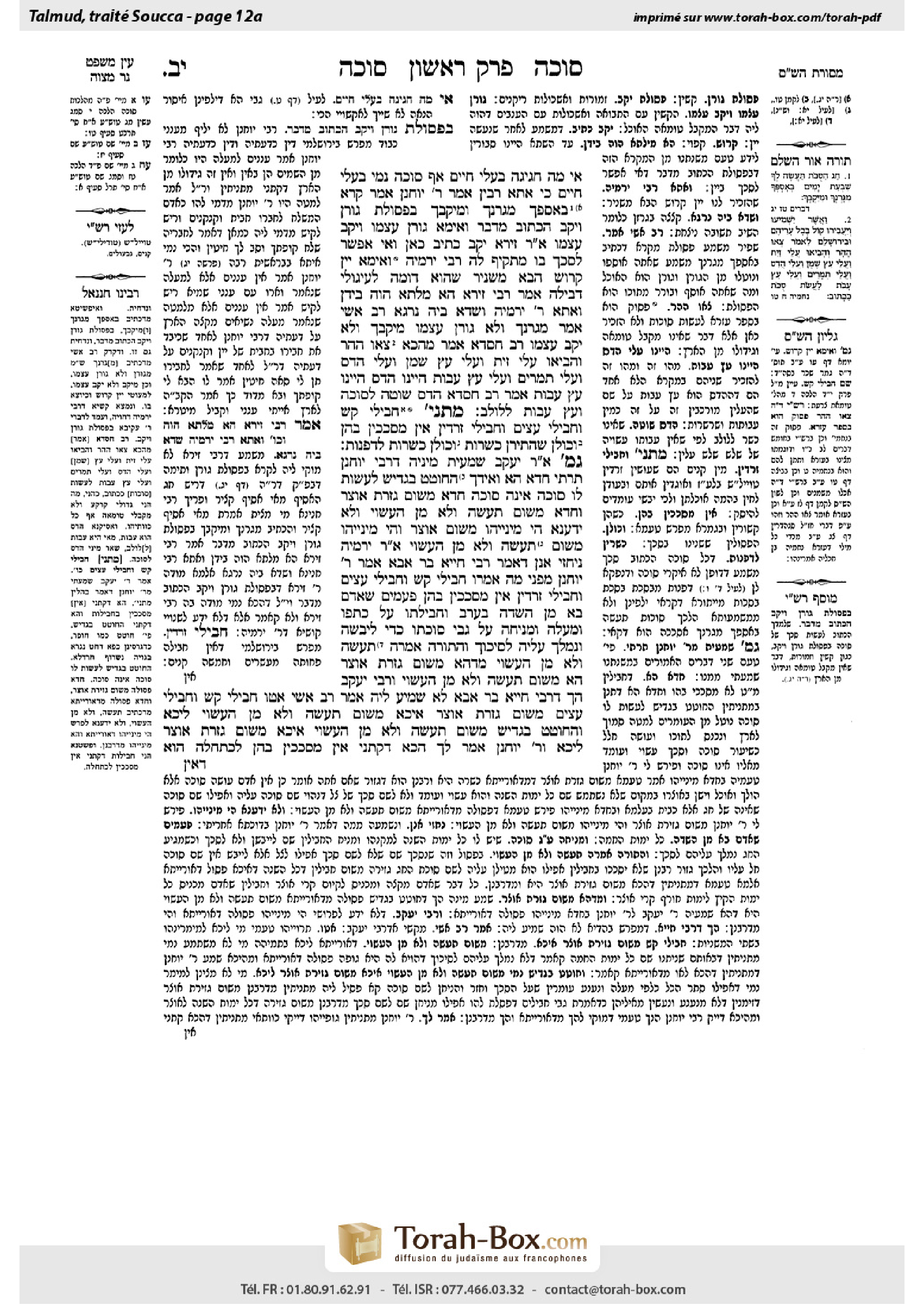
Sukkah 12a: Talmud study for Daf Yomi
Daf Yomi is the daily study of one Talmud folio. Explore 37 tractates with scans, Hebrew text, Sefaria English and AI-generated French translations where annotated.
Passage selection and English or AI-generated French translation are available where the scan has annotations. Daf Study is independent of Torah-Box and Sefaria.
Browse Sukkah · סוכה · All tractatesSukkah 12a text and translations
This page of Sukkah includes the Aramaic text, an English translation and an AI-generated French translation, alongside the scan above.
סוכה י״ב א · Aramaic and Hebrew text
אִי: מָה חֲגִיגָה בַּעֲלֵי חַיִּים, אַף סוּכָּה נָמֵי בַּעֲלֵי חַיִּים!
כִּי אֲתָא רָבִין אָמַר רַבִּי יוֹחָנָן, אָמַר קְרָא: ״בְּאׇסְפְּךָ מִגׇּרְנְךָ וּמִיִּקְבֶךָ״, בִּפְסוֹלֶת גּוֹרֶן וָיֶקֶב הַכָּתוּב מְדַבֵּר.
וְאֵימָא גּוֹרֶן עַצְמוֹ וָיֶקֶב עַצְמוֹ! אָמַר רַבִּי זֵירָא: ״יֶקֶב״ כְּתִיב כָּאן, וְאִי אֶפְשָׁר לְסַכֵּךְ בּוֹ.
מַתְקֵיף לַהּ רַבִּי יִרְמְיָה: וְאֵימָא יַיִן קָרוּשׁ הַבָּא מִשְּׂנִיר שֶׁהוּא דּוֹמֶה לְעִיגּוּלֵי דְּבֵילָה! אָמַר רַבִּי זֵירָא: הָא מִלְּתָא הֲוָה בִּידַן, וַאֲתָא רַבִּי יִרְמְיָה וּשְׁדָא בַּיהּ נַרְגָּא.
רַב אָשֵׁי אָמַר: ״מִגׇּרְנְךָ״ וְלֹא גּוֹרֶן עַצְמוֹ, ״מִיִּקְבֶךָ״ וְלֹא יֶקֶב עַצְמוֹ.
רַב חִסְדָּא אָמַר מֵהָכָא: ״צְאוּ הָהָר וְהָבִיאוּ עֲלֵי זַיִת וַעֲלֵי עֵץ שֶׁמֶן וַעֲלֵי הֲדַס וַעֲלֵי תְמָרִים וַעֲלֵי עֵץ עָבוֹת״.
הַיְינוּ ״הֲדַס״, הַיְינוּ ״עֵץ עָבוֹת״! אָמַר רַב חִסְדָּא: הֲדַס שׁוֹטֶה — לְסוּכָּה, וְעֵץ עָבוֹת — לְלוּלָב.
מַתְנִי׳ חֲבִילֵי קַשׁ וַחֲבִילֵי עֵצִים וַחֲבִילֵי זְרָדִין — אֵין מְסַכְּכִין בָּהֶן. וְכוּלָּן שֶׁהִתִּירָן — כְּשֵׁרוֹת. וְכוּלָּן כְּשֵׁרוֹת לִדְפָנוֹת.
גְּמָ׳ אָמַר רַבִּי יַעֲקֹב: שְׁמַעִית מִינֵּיהּ דְּרַבִּי יוֹחָנָן תַּרְתֵּי: חֲדָא — הָא, וְאִידַּךְ — הַחוֹטֵט בַּגָּדִישׁ לַעֲשׂוֹת לוֹ סוּכָּה — אֵינָהּ סוּכָּה.
חֲדָא: מִשּׁוּם גְּזֵרַת אוֹצָר. וַחֲדָא מִשּׁוּם: ״תַּעֲשֶׂה״, וְלֹא מִן הֶעָשׂוּי. וְלָא יָדַעְנָא הֵי מִינַּיְיהוּ מִשּׁוּם אוֹצָר וְהֵי מִינַּיְיהוּ מִשּׁוּם תַּעֲשֶׂה וְלֹא מִן הֶעָשׂוּי.
אָמַר רַבִּי יִרְמְיָה: נִיחְזֵי אֲנַן, דְּאָמַר רַבִּי חִיָּיא בַּר אַבָּא אָמַר רַבִּי יוֹחָנָן: מִפְּנֵי מָה אָמְרוּ חֲבִילֵי קַשׁ וַחֲבִילֵי עֵצִים וַחֲבִילֵי זְרָדִין אֵין מְסַכְּכִין בָּהֶן? פְּעָמִים שֶׁאָדָם בָּא מִן הַשָּׂדֶה בָּעֶרֶב וַחֲבִילָתוֹ עַל כְּתֵפוֹ, וּמַעֲלָהּ וּמַנִּיחָהּ עַל גַּבֵּי סוּכָּתוֹ כְּדֵי לְיַבְּשָׁהּ, וְנִמְלַךְ עָלֶיהָ לְסִיכּוּךְ, וְהַתּוֹרָה אָמְרָה: ״תַּעֲשֶׂה״, וְלֹא מִן הֶעָשׂוּי. מִדְּהָא מִשּׁוּם גְּזֵרַת אוֹצָר, הָא מִשּׁוּם ״תַּעֲשֶׂה״ וְלֹא מִן הֶעָשׂוּי.
וְרַבִּי יַעֲקֹב? הָךְ דְּרַבִּי חִיָּיא בַּר אַבָּא לָא שְׁמִיעַ לֵיהּ.
אָמַר רַב אָשֵׁי: אַטּוּ חֲבִילֵי קַשׁ וַחֲבִילֵי עֵצִים מִשּׁוּם גְּזֵרַת אוֹצָר אִיכָּא, מִשּׁוּם ״תַּעֲשֶׂה״ וְלֹא מִן הֶעָשׂוּי לֵיכָּא? וְהַחוֹטֵט בְּגָדִישׁ, מִשּׁוּם ״תַּעֲשֶׂה״ וְלֹא מִן הֶעָשׂוּי אִיכָּא, מִשּׁוּם גְּזֵרַת אוֹצָר לֵיכָּא?
וְרַבִּי יוֹחָנָן אָמַר לָךְ, הָכָא דְּקָתָנֵי: ״אֵין מְסַכְּכִין בָּהֶן״, לְכַתְּחִלָּה הוּא
Sukkah 12a · English translation
The Gemara asks: If that juxtaposition is the source of the halakha, say: Just as the Festival peace-offering is brought from animals, so too the sukka roofing should consist of animals. As that is clearly not the case, that verse cannot be the source for the roofing of the sukka.
The Gemara cites a different source: When Ravin came from Eretz Yisrael to Babylonia he said that Rabbi Yoḥanan said that the verse states: “You shall prepare for you the festival of Sukkot for seven days as you gather from your threshing floor and from your winepress” (Deuteronomy 16:13), and the Sages interpreted that it is with regard to the waste of the threshing floor and of the winepress that the verse is speaking. One uses grain stalks and vines for roofing the sukka, materials that are not susceptible to ritual impurity and grow from the ground.
The Gemara asks: And say that the verse teaches that one uses the items placed on the threshing floor itself, i.e., stalks with the grain still attached to them, and the items placed in the winepress itself, i.e., vines with the grapes still attached, as roofing. Grain and grapes, like all foods, are susceptible to ritual impurity. If the verse is interpreted in this manner, the mishna’s criteria for roofing fit for a sukka could not be derived from it. Rabbi Zeira said: “Winepress” is written in the verse here, referring to the wine, and it is impossible to roof with wine. Apparently, the verse is referring to stalks and sheaves but not to produce.
Rabbi Yirmeya strongly objects to this: Why can’t a sukka be roofed with wine? Say that it is referring to congealed wine that comes from Senir, from Mount Hermon, which is similar to a cake of figs. Since it is possible to interpret the verse as referring to the use of food for roofing, the mishna’s criteria for roofing fit for a sukka could not be derived from it. Rabbi Zeira said: This matter was in our hands, as we assumed that we found the source in the Torah for the materials fit for roofing, and Rabbi Yirmeya came and took an axe to it. He destroyed the proof by raising the matter of congealed wine.
Rav Ashi said: One may nevertheless derive the ruling of the mishna from this verse: “From your threshing floor,” indicating an item that comes from the threshing floor, but not the items placed on the threshing floor, i.e., grain, itself; “from your winepress,” but not the items placed in the winepress, i.e., grapes, itself. The verse is referring to the waste products of the produce placed on the threshing floor and in the winepress.
Rav Ḥisda said that proof can be cited from here: “Go forth to the mount and fetch olive branches, and branches of wild olive, and myrtle branches, and palm branches, and the boughs of a dense-leaved tree in order to make sukkot as written” (Nehemiah 8:15). From this verse, the materials for sukka roofing can be derived.
Apropos this verse, the Gemara asks: These myrtle branches are the same as those boughs of a dense-leaved tree; why does the verse mention both? Rav Ḥisda said that this is how it is to be understood. The term “myrtle branches” is referring to a wild myrtle, unfit for use as one of the four species, to be used for the roofing of the sukka. And the term “boughs of a dense-leaved tree” is referring to the myrtle, whose leaves overlie each other, to be used for the lulav, the mitzva of the four species.
MISHNA: One may not roof a sukka with bundles of straw tied with rope, or bundles of wood, or bundles of twigs. And with regard to all of the bundles, if one untied them, they are fit for use in roofing the sukka, as their lack of fitness is due to the fact that the bundles are tied. And even when tied, all of the bundles are fit for use in constructing the walls of the sukka.
GEMARA: Rabbi Ya’akov said: I heard explanations from Rabbi Yoḥanan for two similar halakhot of sukka: One with regard to the halakha in this mishna that bundles may not be used in roofing the sukka, and the other with regard to the mishna below, pertaining to one who hollows out space in a stack of grain by removing sheaves from the bottom of the stack to establish a sukka for him. In that case, the space is surrounded by grain on the sides and above, and therefore it is not a sukka.
The rationale for one of the halakhot is due to the decree of the storehouse. Although, fundamentally, the sukka is fit, the Sages issued a decree prohibiting its use, lest one come to use his storehouse as a sukka and fail to establish it properly. And the rationale for one of the halakhot is due to the principle: Prepare it, and not from that which has already been prepared, as no active preparation was performed. And I do not know at present which of the halakhot is due to the decree of the storehouse and which of them is due to the principle: Prepare it, and not from that which has already been prepared.
Rabbi Yirmeya said: Let us see and determine which rationale Rabbi Yoḥanan applied to each halakha; as Rabbi Ḥiyya bar Abba said that Rabbi Yoḥanan said: For what reason did they say that one may not roof a sukka with bundles of straw, and bundles of wood, and bundles of twigs? It is because sometimes a person comes from the field in the evening, and he has his bundle of wood or straw on his shoulder, and he lifts it and places it atop his storage shed to dry it. And, when the festival of Sukkot arrives, he reconsiders and decides to use the shed as a sukka and the bundle on top of it for roofing. And in that case the roofing would be unfit, as the Torah said: Prepare it, and not from that which has already been prepared. From Rabbi Yoḥanan’s formulation, apparently it is unfit due to the decree lest one come to use his storehouse as a sukka and fail to establish it properly, not due to some fundamental prohibition. From the fact that this case of the bundles is prohibited due to the decree of the storehouse, that case of the stack of grain must be prohibited due to the principle: Prepare it, and not from that which has already been prepared.
The Gemara asks: And why was Rabbi Ya’akov unable to arrive at Rabbi Yoḥanan’s opinion based on the halakha cited in his name? The Gemara explains: It is because he did not hear this statement of Rabbi Ḥiyya bar Abba, and there was no other proof.
Rav Ashi said: The distinction of Rabbi Yoḥanan between these two cases is difficult. Is that to say that bundles of straw and bundles of wood are unfit roofing due to the decree of the storehouse and not due to the principle: Prepare it, and not from that which has already been prepared? Is that ultimately the principle underlying the decree of the storehouse? And on the other hand, in the case of one who hollows a stack of grain, is the sukka unfit due only to the principle: Prepare it, and not from that which has already been prepared, but not due to the decree of the storehouse? Rather, there is no distinction between the halakhot and both reasons apply to both.
The Gemara notes: And Rabbi Yoḥanan could have said to you, in response to Rav Ashi, that it is not so because the halakhot are formulated differently in the respective mishnayot. Here, in the mishna pertaining to bundles, where it teaches: One may not roof with them, it is ab initio
Sukkah 12a · Traduction française (IA)
La Guemara demande : Si cette juxtaposition est la source de la halakha, disons que, de même que le sacrifice de paix de la fête est offert avec des animaux, de même le revêtement de la soukka devrait être constitué d’animaux. Puisque ce n’est manifestement pas le cas, ce verset ne peut pas être la source des matériaux servant au revêtement de la soukka.
La Guemara cite une autre source : lorsque Ravin vint d’Eretz Israël en Babylonie, il rapporta que Rabbi Yoḥanan avait dit que le verset déclare : « Tu célébreras pendant sept jours la fête de Soukkot, lorsque tu auras récolté les produits de ton aire et de ton pressoir » (Deutéronome 16,13). Les Sages ont interprété que le verset parle des déchets de l’aire et du pressoir. On utilise des tiges de céréales et des sarments pour le revêtement de la soukka, des matériaux qui ne sont pas susceptibles d’impureté rituelle et qui poussent du sol.
La Guemara demande : Et disons que le verset enseigne qu’on utilise comme revêtement les éléments qui se trouvent sur l’aire elle-même, c’est-à-dire les tiges auxquelles les grains sont encore attachés, et ceux qui se trouvent dans le pressoir lui-même, c’est-à-dire les sarments auxquels les raisins sont encore attachés. Les grains et les raisins, comme tous les aliments, sont susceptibles d’impureté rituelle. Si l’on interprète le verset de cette manière, on ne pourrait pas en déduire les critères de la Michna concernant les matériaux adaptés au revêtement d’une soukka. Rabbi Zeira dit : « Pressoir » est écrit ici dans le verset, en référence au vin, et il est impossible de couvrir avec du vin. Il apparaît donc que le verset parle des tiges et des gerbes, mais pas des produits eux-mêmes.
Rabbi Yirmeya objecte vivement : Pourquoi ne pourrait-on pas couvrir une soukka avec du vin ? Disons que le verset parle de vin solidifié, qui vient de Senir, du mont Hermon, et ressemble à un gâteau de figues. Puisqu’il est possible d’interpréter le verset comme faisant référence à l’utilisation d’aliments pour le revêtement, on ne pourrait pas en déduire les critères de la Michna concernant les matériaux adaptés au revêtement d’une soukka. Rabbi Zeira dit : Cette question était entre nos mains, car nous pensions avoir trouvé dans la Torah la source des matériaux adaptés au revêtement, puis Rabbi Yirmeya est venu et y a porté la hache. Il a détruit la preuve en soulevant la possibilité du vin solidifié.
Rav Ashi dit : On peut néanmoins déduire la règle de la Michna de ce verset : « De ton aire » indique un élément qui provient de l’aire, mais non les éléments placés sur l’aire, c’est-à-dire les grains eux-mêmes ; « de ton pressoir », mais non les éléments placés dans le pressoir, c’est-à-dire les raisins eux-mêmes. Le verset fait référence aux déchets des produits placés sur l’aire et dans le pressoir.
Rav Ḥisda dit qu’on peut apporter une preuve de ce passage : « Allez à la montagne et rapportez des branches d’olivier, des branches d’olivier sauvage, des branches de myrte, des branches de palmier et des branches d’un arbre touffu, afin de faire des soukkot, comme il est écrit » (Néhémie 8,15). On peut déduire de ce verset les matériaux servant au revêtement de la soukka.
À propos de ce verset, la Guemara demande : Les branches de myrte sont identiques à ces branches d’arbre touffu ; pourquoi le verset mentionne-t-il les deux ? Rav Ḥisda dit qu’il faut comprendre ainsi : l’expression « branches de myrte » désigne un myrte sauvage, impropre à servir parmi les quatre espèces, que l’on utilisera pour le revêtement de la soukka. L’expression « branches d’un arbre touffu » désigne le myrte dont les feuilles se chevauchent, qui servira au loulav, pour la mitsva des quatre espèces.
MICHNA : On ne peut pas couvrir une soukka avec des bottes de paille liées par une corde, ni avec des bottes de bois, ni avec des bottes de brindilles. En revanche, pour toutes ces bottes, si on les a déliées, elles conviennent pour couvrir la soukka, car leur inadéquation tient au fait qu’elles sont liées en bottes. Même liées, toutes ces bottes conviennent pour construire les parois de la soukka.
GUEMARA : Rabbi Ya’akov dit : J’ai entendu Rabbi Yoḥanan donner des explications concernant deux halakhot similaires relatives à la soukka : l’une porte sur la halakha de cette Michna, selon laquelle on ne peut pas utiliser des bottes pour couvrir la soukka ; l’autre porte sur la Michna plus loin, à propos de celui qui creuse un espace dans une meule de céréales en retirant des gerbes du bas de la meule afin de s’y aménager une soukka. Dans ce cas, l’espace est entouré de céréales sur les côtés et au-dessus ; ce n’est donc pas une soukka.
La raison de l’une de ces halakhot tient au décret du grenier. Bien que, fondamentalement, la soukka convienne, les Sages ont décrété qu’il est interdit de l’utiliser, de peur qu’on en vienne à utiliser son grenier comme soukka sans l’aménager correctement. La raison de l’autre halakha tient au principe suivant : « Prépare-la », et non à partir de ce qui a déjà été préparé, puisqu’aucun acte de préparation n’a été effectué. Et je ne sais pas à présent laquelle des halakhot relève du décret du grenier et laquelle relève du principe : « Prépare-la », et non à partir de ce qui a déjà été préparé.
Rabbi Yirmeya dit : Examinons la question afin de déterminer quelle raison Rabbi Yoḥanan a appliquée à chaque halakha. En effet, Rabbi Ḥiyya bar Abba a dit que Rabbi Yoḥanan a dit : Pour quelle raison a-t-on dit qu’on ne peut pas couvrir une soukka avec des bottes de paille, des bottes de bois ou des bottes de brindilles ? C’est parce qu’il arrive qu’un homme revienne des champs le soir avec une botte de bois ou de paille sur l’épaule, la soulève et la pose sur le toit de son entrepôt pour la faire sécher. Puis, lorsque la fête de Soukkot arrive, il change d’avis et décide d’utiliser l’entrepôt comme soukka et la botte posée dessus comme revêtement. Dans ce cas, le revêtement serait impropre, car la Torah a dit : « Prépare-la », et non à partir de ce qui a déjà été préparé. D’après la formulation de Rabbi Yoḥanan, il semble que cette botte soit impropre en raison du décret visant à éviter qu’on utilise son grenier comme soukka sans l’aménager correctement, et non en raison d’une interdiction fondamentale. Puisque, dans le cas des bottes, l’interdiction découle du décret du grenier, l’autre cas, celui de la meule de céréales, doit être interdit en vertu du principe : « Prépare-la », et non à partir de ce qui a déjà été préparé.
La Guemara demande : Et pourquoi Rabbi Ya’akov n’a-t-il pas pu parvenir à l’opinion de Rabbi Yoḥanan à partir de la halakha rapportée en son nom ? La Guemara explique : C’est parce qu’il n’avait pas entendu cette déclaration de Rabbi Ḥiyya bar Abba ; il n’y avait pas d’autre preuve.
Rav Ashi dit : La distinction établie par Rabbi Yoḥanan entre ces deux cas est difficile. Cela signifie-t-il que les bottes de paille et les bottes de bois ne conviennent pas comme revêtement en raison du décret du grenier, et non en vertu du principe : « Prépare-la », et non à partir de ce qui a déjà été préparé ? Est-ce là, en définitive, le principe qui sous-tend le décret du grenier ? Et, à l’inverse, dans le cas de celui qui creuse dans une meule de céréales, la soukka est-elle impropre uniquement en vertu du principe : « Prépare-la », et non à partir de ce qui a déjà été préparé, mais pas en raison du décret du grenier ? Au contraire, il n’y a pas de distinction entre les halakhot, et les deux raisons s’appliquent aux deux.
La Guemara note : Rabbi Yoḥanan aurait pu te répondre, face à Rav Ashi, qu’il n’en est pas ainsi, car les halakhot sont formulées différemment dans les Michnayot respectives. Ici, dans la Michna concernant les bottes, où il est enseigné : « On ne peut pas les utiliser pour couvrir », il s’agit a priori
Traduction française générée par IA à partir de l’édition anglaise de Sefaria. Vérifie toujours un passage avec le texte source.
Text from Sefaria: William Davidson Edition - Vocalized Aramaic (CC BY NC); William Davidson Edition - English (CC BY NC).