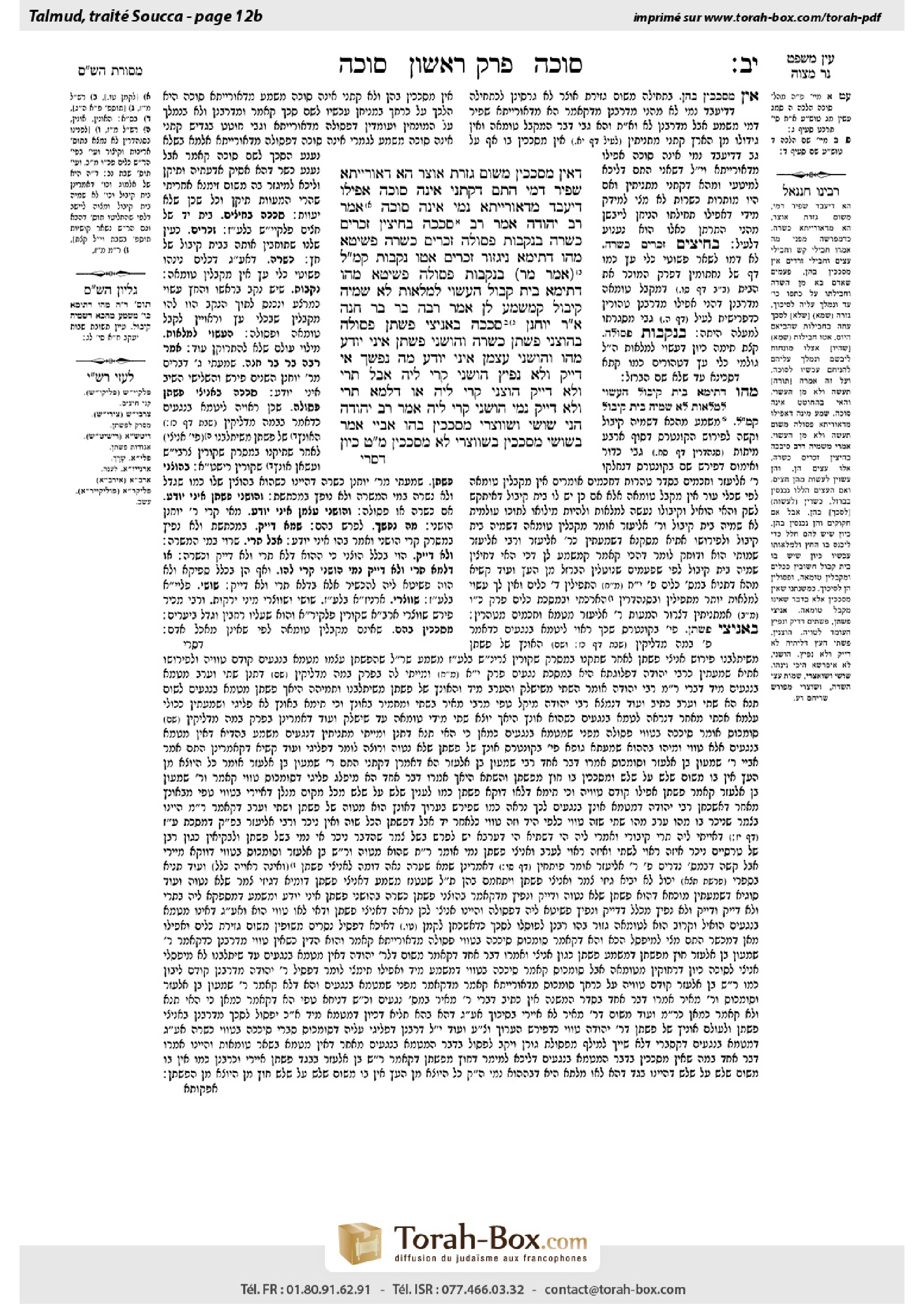
Sukkah 12b: Talmud study for Daf Yomi
Daf Yomi is the daily study of one Talmud folio. Explore 37 tractates with scans, Hebrew text, Sefaria English and AI-generated French translations where annotated.
Passage selection and English or AI-generated French translation are available where the scan has annotations. Daf Study is independent of Torah-Box and Sefaria.
Browse Sukkah · סוכה · All tractatesSukkah 12b text and translations
This page of Sukkah includes the Aramaic text, an English translation and an AI-generated French translation, alongside the scan above.
סוכה י״ב ב · Aramaic and Hebrew text
דְּאֵין מְסַכְּכִין מִשּׁוּם גְּזֵרַת אוֹצָר, הָא דְּאוֹרָיְיתָא שַׁפִּיר דָּמֵי. הָתָם דְּקָתָנֵי ״אֵינָהּ סוּכָּה״ אֲפִילּוּ דִּיעֲבַד — מִדְּאוֹרָיְיתָא נָמֵי אֵינָהּ סוּכָּה.
אָמַר רַב יְהוּדָה אָמַר רַב: סִכְּכָהּ בְּחִיצִּין זְכָרִים — כְּשֵׁרָה. בִּנְקֵבוֹת — פְּסוּלָה.
זְכָרִים כְּשֵׁרָה, פְּשִׁיטָא! מַהוּ דְּתֵימָא: נִיגְזוֹר זְכָרִים אַטּוּ נְקֵבוֹת, קָא מַשְׁמַע לַן.
(אָמַר מָר:) בִּנְקֵבוֹת פְּסוּלָה, פְּשִׁיטָא! מַהוּ דְּתֵימָא: בֵּית קִבּוּל הֶעָשׂוּי לְמַלּאוֹת לָא שְׁמֵיהּ קִיבּוּל, קָמַשְׁמַע לַן.
אָמַר רַבָּה בַּר בַּר חָנָה אָמַר רַבִּי יוֹחָנָן: סִכְּכָהּ בַּאֲנִיצֵי פִשְׁתָּן — פְּסוּלָה. בְּהוּצְנֵי פִשְׁתָּן — כְּשֵׁרָה. וְהוּשְׁנֵי פִשְׁתָּן, אֵינִי יוֹדֵעַ מַהוּ.
וְהוּשְׁנֵי עַצְמָן אֵינִי יוֹדֵעַ. מָה נַפְשָׁךְ: אִי דְּיִיק וְלָא נְפִיץ — הוּשְׁנֵי קָרֵי לֵיהּ, אֲבָל תְּרֵי וְלָא דְּיִיק — הוּצְנֵי קָרֵי לֵיהּ, אוֹ דִלְמָא: תְּרֵי וְלָא דְּיִיק נָמֵי הוּשְׁנֵי קָרֵי לֵיהּ.
אָמַר רַב יְהוּדָה: הָנֵי שׁוּשֵׁי וּשְׁווֹצְרֵי — מְסַכְּכִין בְּהוּ. אַבָּיֵי אָמַר: בְּשׁוּשֵׁי מְסַכְּכִין, בִּשְׁווֹצְרֵי לָא מְסַכְּכִין. מַאי טַעְמָא, כֵּיוָן
Sukkah 12b · English translation
that one may not roof, due to the decree of the storehouse issued by the Sages; but by Torah law, it seems well to do so. There, in the mishna pertaining to the stack of grain, where it teaches: It is not a sukka, it means that not only by rabbinic decree, but even after the fact, by Torah law as well, it is not a sukka.
§ Rav Yehuda said that Rav said: If one roofed a sukka with convex arrow shafts, which are made of wood with a protrusion on the end that is fitted into the socket of the metal arrowhead, the sukka is fit. These shafts are flat wooden utensils, which are not susceptible to ritual impurity. Therefore, they are fit roofing for a sukka. If, however, one roofed his sukka with concave arrow shafts, which have a socket into which a protrusion from the metal arrowhead is inserted, the sukka is unfit. Since these shafts are wooden utensils with a receptacle, they are susceptible to ritual impurity. Therefore, they are unfit roofing for a sukka.
The Gemara asks: The fact that if one roofed a sukka with convex arrow shafts, the sukka is fit is obvious. It is no different from roofing with straight, smooth reeds. The Gemara answers: Stating this halakha is necessary. Lest you say: Let us issue a decree and prohibit roofing with convex shafts due to the prohibition against roofing with concave shafts, therefore Rav teaches us that no decree is issued, and convex shafts are fit roofing.
The Master said: If one roofed a sukka with concave arrows, the sukka is unfit. The Gemara asks: This is obvious. All wooden receptacles are susceptible to ritual impurity. The Gemara answers: Stating this halakha is necessary. Lest you say: A receptacle that is designated to be permanently filled, its status is not that of a receptacle, as a receptacle is typically filled and emptied; in this case, once the arrowhead fills the receptacle, it remains there, therefore Rav teaches us that it is deemed a receptacle and is not fit roofing.
§ Rabba bar bar Ḥana said that Rabbi Yoḥanan said: If one roofed a sukka with bundles of combed flax, the sukka is unfit, as flax at that stage of processing is the raw material from which threads are spun, and it is susceptible to ritual impurity. If one roofed a sukka with stalks of flax, the sukka is fit. Since they remain in their natural state and have not been processed in any way, their legal status is that of any tree, and they are not susceptible to ritual impurity. And if one roofed with the hoshen of flax, stalks at an intermediate stage of processing, I do not know what their status is, i.e., whether or not they are fit for roofing.
Rabba bar bar Ḥana added: And when Rabbi Yoḥanan used the term hoshen of flax itself, I do not know to what stage of processing the flax he was referring. Which way do you look at it? Is it that if one crushed the flax and did not comb it, Rabbi Yoḥanan calls it hoshen, but if he soaked it and did not crush it, Rabbi Yoḥanan calls it hotzen, because he has not actually begun processing the flax itself? Or, perhaps if he soaked it and did not crush it, Rabbi Yoḥanan calls it hoshen, while hotzen is reserved for flax that was not processed at all.
§ Rav Yehuda said: With regard to these wide licorice and wormwood leaves, one may roof his sukka with them, since these are not consumed by people. Their legal status is that of any other plant; they are not susceptible to ritual impurity. Abaye said: With licorice leaves, one may roof his sukka; with wormwood leaves, one may not roof his sukka. What is the reason for this distinction? Since
Sukkah 12b · Traduction française (IA)
on ne peut pas couvrir la soukka, en raison du décret des Sages concernant le grenier ; mais, selon la Torah, cela semble convenir. Là, dans la Michna concernant le tas de céréales, lorsqu’elle enseigne : « Ce n’est pas une soukka », cela signifie que celle-ci n’est pas une soukka non seulement en vertu d’un décret rabbinique, mais aussi, même après coup, selon la Torah.
§ Rav Yehouda a dit au nom de Rav : si quelqu’un a couvert une soukka avec des hampes de flèches à extrémité convexe, en bois et munies d’une saillie à l’extrémité qui s’emboîte dans la douille de la pointe métallique, la soukka est valide. Ces hampes sont des ustensiles plats en bois, qui ne sont pas susceptibles de contracter l’impureté rituelle. Elles conviennent donc comme couverture de soukka. En revanche, si quelqu’un a couvert sa soukka avec des hampes de flèches à extrémité concave, munies d’une douille dans laquelle s’insère une saillie de la pointe métallique, la soukka est invalide. Ces hampes étant des ustensiles en bois dotés d’un réceptacle, elles sont susceptibles de contracter l’impureté rituelle. Elles ne conviennent donc pas comme couverture de soukka.
La Guemara demande : il est évident que si quelqu’un a couvert une soukka avec des hampes de flèches à extrémité convexe, la soukka est valide. Cela ne diffère en rien d’une couverture faite de roseaux droits et lisses. La Guemara répond : il était nécessaire d’énoncer cette halakha. De crainte que tu ne dises : « Émettons un décret interdisant de couvrir avec des hampes convexes, par crainte que l’on ne couvre avec des hampes concaves », Rav nous enseigne qu’on n’émet pas un tel décret et que les hampes convexes conviennent comme couverture.
Le Maître a dit : si quelqu’un a couvert une soukka avec des flèches concaves, la soukka est invalide. La Guemara demande : cela est évident. Tous les réceptacles en bois sont susceptibles de contracter l’impureté rituelle. La Guemara répond : il était nécessaire d’énoncer cette halakha. De crainte que tu ne dises : « Un réceptacle destiné à être rempli en permanence n’a pas le statut de réceptacle, car un réceptacle est généralement rempli puis vidé ; dans ce cas, une fois que la pointe de la flèche remplit le réceptacle, elle y reste », Rav nous enseigne qu’il est considéré comme un réceptacle et ne convient donc pas comme couverture.
§ Rabba bar bar Ḥana a dit au nom de Rabbi Yoḥanan : si quelqu’un a couvert une soukka avec des bottes de lin peigné, la soukka est invalide, car, à ce stade de traitement, le lin constitue la matière première à partir de laquelle on file les fils et il est susceptible de contracter l’impureté rituelle. Si quelqu’un a couvert une soukka avec des tiges de lin, la soukka est valide. Puisqu’elles sont restées à l’état naturel et n’ont subi aucun traitement, elles ont le statut de n’importe quel arbre et ne sont pas susceptibles de contracter l’impureté rituelle. Et si quelqu’un a couvert sa soukka avec du hoshen de lin, c’est-à-dire des tiges à un stade intermédiaire de traitement, je ne sais pas quel est leur statut, autrement dit si elles conviennent ou non comme couverture.
Rabba bar bar Ḥana ajouta : lorsque Rabbi Yoḥanan employait lui-même l’expression « hoshen de lin », je ne sais pas à quel stade du traitement du lin il faisait référence. Comment faut-il comprendre cela ? Si l’on a broyé le lin sans le peigner, Rabbi Yoḥanan appelle-t-il cela hoshen, tandis que, si on l’a trempé sans le broyer, il appelle cela hotzen, puisqu’on n’a pas encore commencé à traiter le lin lui-même ? Ou bien, si on l’a trempé sans le broyer, Rabbi Yoḥanan appelle-t-il cela hoshen, tandis que hotzen désigne le lin qui n’a subi aucun traitement ?
§ Rav Yehouda a dit : on peut couvrir sa soukka avec ces larges feuilles de réglisse et d’absinthe, car les gens ne les consomment pas. Elles ont le statut de n’importe quelle autre plante et ne sont pas susceptibles de contracter l’impureté rituelle. Abayé a dit : on peut couvrir sa soukka avec des feuilles de réglisse, mais pas avec des feuilles d’absinthe. Quelle est la raison de cette distinction ? Puisque
Traduction française générée par IA à partir de l’édition anglaise de Sefaria. Vérifie toujours un passage avec le texte source.
Text from Sefaria: William Davidson Edition - Vocalized Aramaic (CC BY NC); William Davidson Edition - English (CC BY NC).