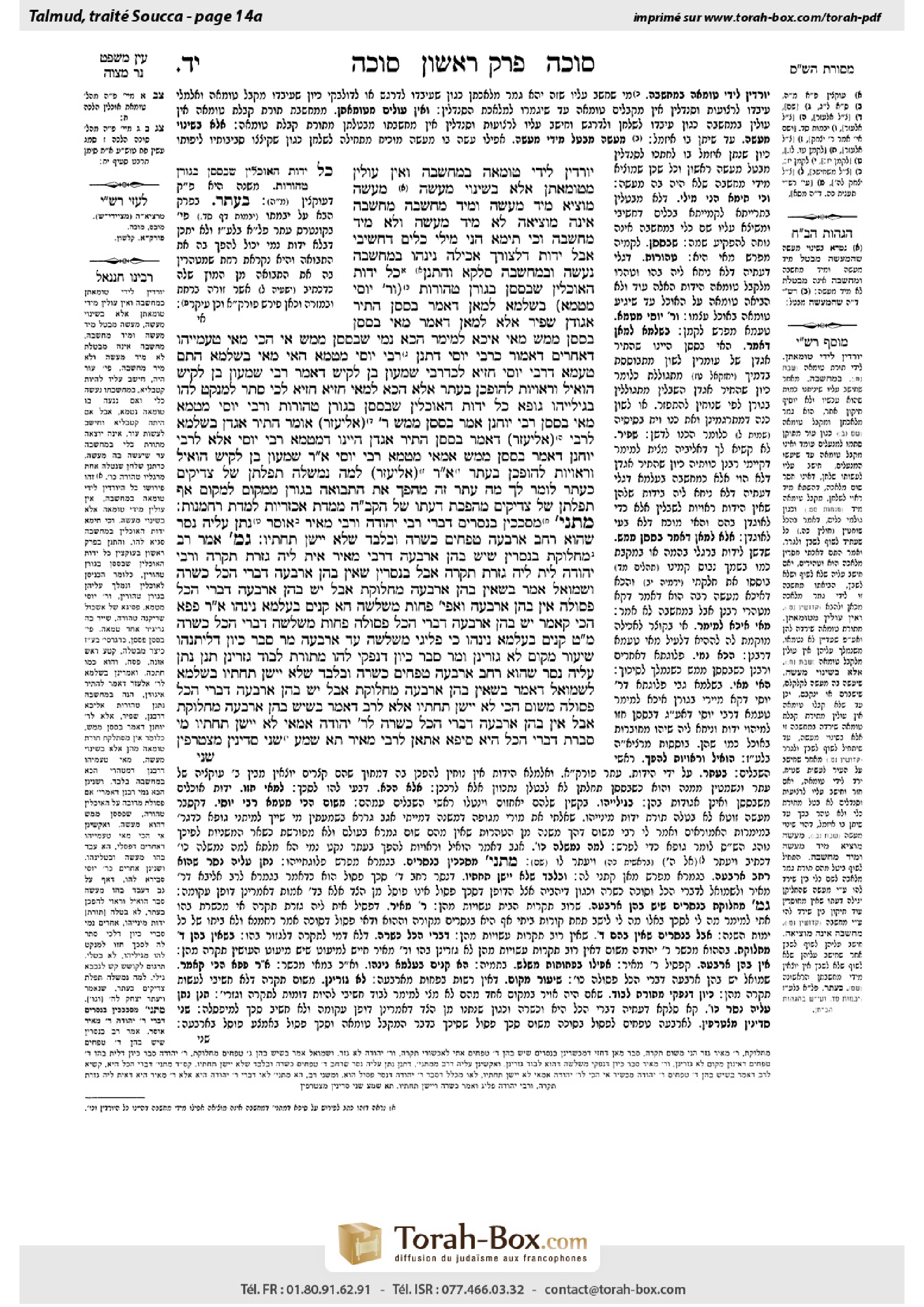
Sukkah 14a: Talmud study for Daf Yomi
Daf Yomi is the daily study of one Talmud folio. Explore 37 tractates with scans, Hebrew text, Sefaria English and AI-generated French translations where annotated.
Passage selection and English or AI-generated French translation are available where the scan has annotations. Daf Study is independent of Torah-Box and Sefaria.
Browse Sukkah · סוכה · All tractatesSukkah 14a text and translations
This page of Sukkah includes the Aramaic text, an English translation and an AI-generated French translation, alongside the scan above.
סוכה י״ד א · Aramaic and Hebrew text
יוֹרְדִין לִידֵי טוּמְאָה בְּמַחְשָׁבָה, וְאֵין עוֹלִין מִטּוּמְאָתָן אֶלָּא בְּשִׁינּוּי מַעֲשֶׂה. מַעֲשֶׂה מוֹצִיא מִיַּד מַעֲשֶׂה וּמִיַּד מַחְשָׁבָה. מַחְשָׁבָה אֵינָהּ מוֹצִיאָה לֹא מִיַּד מַעֲשֶׂה וְלֹא מִיַּד מַחְשָׁבָה.
וְכִי תֵּימָא הָנֵי מִילֵּי כֵּלִים דַּחֲשִׁיבִי, אֲבָל יָדוֹת, דִּלְצוֹרֶךְ אֲכִילָה נִינְהוּ — בְּמַחְשָׁבָה נַעֲשֶׂה וּבְמַחְשָׁבָה סָלְקָא. וְהָתְנַן: כָּל יְדוֹת הָאוֹכָלִין שֶׁבְּסָסָן בַּגּוֹרֶן — טְהוֹרוֹת (וְרַבִּי יוֹסֵי מְטַמֵּא).
בִּשְׁלָמָא לְמַאן דְּאָמַר ״בְּסָסָן״ — הִתִּיר אִגּוּדָן, שַׁפִּיר. אֶלָּא לְמַאן דְּאָמַר מַאי ״בְּסָסָן״ — בְּסָסָן מַמָּשׁ, מַאי אִיכָּא לְמֵימַר?
הָכָא נָמֵי, שֶׁבְּסָסָן מַמָּשׁ. אִי הָכִי, מַאי טַעְמַיְיהוּ דַּאֲחֵרִים? דַּאֲמוּר כְּרַבִּי יוֹסֵי. דִּתְנַן: רַבִּי יוֹסֵי מְטַמֵּא.
הַאי מַאי?! בִּשְׁלָמָא הָתָם — טַעְמָא דְּרַבִּי יוֹסֵי חַזְיָא לְכִדְרַבִּי שִׁמְעוֹן בֶּן לָקִישׁ. דְּאָמַר רַבִּי שִׁמְעוֹן בֶּן לָקִישׁ: הוֹאִיל וּרְאוּיוֹת לְהוֹפְכָן בְּעֶתֶר.
אֶלָּא הָכָא לְמַאי חַזְיָא? חַזְיָא לְכִי סָתַר לְמִנְקַט לְהוּ בְּגִילַיְיהוּ.
גּוּפָא, כָּל יְדוֹת הָאוֹכָלִין שֶׁבְּסָסָן בַּגּוֹרֶן — טְהוֹרוֹת, וְרַבִּי יוֹסֵי מְטַמֵּא. מַאי ״בְּסָסָן״? רַבִּי יוֹחָנָן אָמַר: בְּסָסָן מַמָּשׁ. רַבִּי (אֱלִיעֶזֶר) אוֹמֵר: הִתִּיר אַגְדָּן.
בִּשְׁלָמָא לְרַבִּי (אֱלִיעֶזֶר), דְּאָמַר ״בְּסָסָן״ — הִתִּיר אַגְדָּן, הַיְינוּ דִּמְטַמֵּא רַבִּי יוֹסֵי. אֶלָּא לְרַבִּי יוֹחָנָן דְּאָמַר בְּסָסָן מַמָּשׁ, אַמַּאי מְטַמֵּא רַבִּי יוֹסֵי? אָמַר רַבִּי שִׁמְעוֹן בֶּן לָקִישׁ: הוֹאִיל וּרְאוּיוֹת לְהוֹפְכָן בְּעֶתֶר.
אָמַר רַבִּי (אֱלִיעֶזֶר): לָמָּה נִמְשְׁלָה תְּפִלָּתָן שֶׁל צַדִּיקִים כְּעֶתֶר — לוֹמַר לָךְ: מָה עֶתֶר זֶה מְהַפֵּךְ אֶת הַתְּבוּאָה בַּגּוֹרֶן מִמָּקוֹם לְמָקוֹם, אַף תְּפִלָּתָן שֶׁל צַדִּיקִים מְהַפֶּכֶת דַּעְתּוֹ שֶׁל הַקָּדוֹשׁ בָּרוּךְ הוּא מִמִּדַּת אַכְזָרִיּוּת לְמִדַּת רַחֲמָנוּת.
מַתְנִי׳ מְסַכְּכִין בִּנְסָרִים, דִּבְרֵי רַבִּי יְהוּדָה, וְרַבִּי מֵאִיר אוֹסֵר. נָתַן עָלֶיהָ נֶסֶר שֶׁהוּא רָחָב אַרְבָּעָה טְפָחִים — כְּשֵׁרָה, וּבִלְבַד שֶׁלֹּא יִישַׁן תַּחְתָּיו.
גְּמָ׳ אָמַר רַב: מַחְלוֹקֶת בִּנְסָרִין שֶׁיֵּשׁ בָּהֶן אַרְבָּעָה, דְּרַבִּי מֵאִיר אִית לֵיהּ גְּזֵרַת תִּקְרָה, וְרַבִּי יְהוּדָה לֵית לֵיהּ גְּזֵרַת תִּקְרָה. אֲבָל בִּנְסָרִין שֶׁאֵין בָּהֶן אַרְבָּעָה — דִּבְרֵי הַכֹּל כְּשֵׁרָה. וּשְׁמוּאֵל אָמַר: בְּשֶׁאֵין בָּהֶן אַרְבָּעָה מַחֲלוֹקֶת, אֲבָל יֵשׁ בָּהֶן אַרְבָּעָה — דִּבְרֵי הַכֹּל פְּסוּלָה.
אֵין בָּהֶן אַרְבָּעָה, וַאֲפִילּוּ פָּחוֹת מִשְּׁלֹשָׁה, הָא קָנִים בְּעָלְמָא נִינְהוּ?
אָמַר רַב פָּפָּא, הָכִי קָאָמַר: יֵשׁ בָּהֶן אַרְבָּעָה — דִּבְרֵי הַכֹּל פְּסוּלָה, פָּחוֹת מִשְּׁלֹשָׁה — דִּבְרֵי הַכֹּל כְּשֵׁרָה, מַאי טַעְמָא — קָנִים בְּעָלְמָא נִינְהוּ. כִּי פְּלִיגִי, מִשְּׁלֹשָׁה עַד אַרְבָּעָה. מָר סָבַר: כֵּיוָן דְּלֵיתַנְהוּ שִׁיעוּר מָקוֹם, לָא גָּזְרִינַן. וּמָר סָבַר: כֵּיוָן דְּנָפְקִי לְהוּ מִתּוֹרַת לָבוּד, גָּזְרִינַן.
תְּנַן: נָתַן עָלֶיהָ נֶסֶר שֶׁהוּא רָחָב אַרְבָּעָה טְפָחִים — כְּשֵׁרָה, וּבִלְבַד שֶׁלֹּא יִישַׁן תַּחְתָּיו. בִּשְׁלָמָא לִשְׁמוּאֵל דְּאָמַר בְּשֶׁאֵין בָּהֶן אַרְבָּעָה מַחְלוֹקֶת, אֲבָל יֵשׁ בָּהֶן אַרְבָּעָה דִּבְרֵי הַכֹּל פְּסוּלָה, מִשּׁוּם הָכִי לָא יִישַׁן תַּחְתָּיו. אֶלָּא לְרַב דְּאָמַר בְּשֶׁיֵּשׁ בָּהֶן אַרְבָּעָה מַחְלוֹקֶת, אֲבָל אֵין בָּהֶן אַרְבָּעָה דִּבְרֵי הַכֹּל כְּשֵׁרָה, לְרַבִּי יְהוּדָה אַמַּאי לֹא יִישַׁן תַּחְתָּיו?
מִי סָבְרַתְּ דִּבְרֵי הַכֹּל הִיא? סֵיפָא אֲתָאן לְרַבִּי מֵאִיר.
תָּא שְׁמַע: שְׁנֵי סְדִינִין מִצְטָרְפִין.
Sukkah 14a · English translation
descend into their state of ritual impurity by means of thought? Although an unfinished vessel ordinarily cannot become ritually impure, if the craftsman decided to leave it in its unfinished state, it immediately assumes the legal status of a completed vessel and can become ritually impure. However, they ascend from their state of ritual impurity only by means of a change resulting from an action. Merely deciding to complete the unfinished vessel does not alter its status. It loses its status as a vessel only when he takes action to complete it. Action negates status created by action and status created by thought; however, thought negates neither status created by action nor status created by thought. Therefore, once the straw of the grain harvested for food is considered a handle and is susceptible to ritual impurity, its status cannot be negated by thought alone.
And if you say: There is a distinction between the cases, as this principle applies only to vessels, which are significant, but with regard to handles that are not independently significant but are merely for the purpose of handling food, perhaps by means of thought they become handles and by means of thought they emerge from that status; but didn’t we learn in the mishna to the contrary? All handles of food that one besasan on the threshing floor are ritually pure, as through one’s actions he indicated that has no use for them and does not consider them significant. And Rabbi Yosei deems them capable of becoming ritually impure.
The Gemara elaborates: Granted, according to the one who said that besasan means that one untied their binding, it works out well. Although no action was performed on the sheaves, nevertheless, since their only purpose is to facilitate binding the sheaves, he indicated by unbinding them that the handles no longer suit his needs. However, according to the one who said: What is the meaning of besasan? It means he actually trampled them, what can be said? According to that opinion, only an action can negate the status of the handles. What, then, is the rationale for the opinion of the Rabbis, who hold that thought alone can negate their status?
The Gemara answers: Here too, the dispute between the Rabbis and Aḥerim with regard to using grain for roofing the sukka is in a case where one actually trampled them, and that is the reason that they are no longer susceptible to ritual impurity. The Gemara asks: If so, and a change was made to the grain itself, what is the rationale for the opinion of Aḥerim, who nevertheless prohibit their use as roofing? The Gemara answers: It is because Aḥerim state their opinion in accordance with the opinion of Rabbi Yosei, as we learned in the previously cited mishna: Rabbi Yosei deems them capable of becoming ritually impure even after trampling.
The Gemara asks: What is the basis of this comparison between the cases? Granted, there, in the dispute concerning the ritual impurity of the grain on the threshing floor, the rationale for the opinion of Rabbi Yosei, i.e., that the handles remain susceptible to ritual impurity, is that they are suitable for use. This is in accordance with the statement of Rabbi Shimon ben Lakish, as Rabbi Shimon ben Lakish said: Even after the grain is trampled the straw suits his needs, since the straw is suited to facilitate turning over the grain with a pitchfork, as the straw prevents the grain from falling between the prongs of the pitchfork.
However, here, where one needs the straw only for roofing the sukka, for what are the handles suited after they have been trampled? They serve no purpose in terms of handling the grain. The Gemara answers: They are suited when one dismantles the roofing, in order to hold the grain by the straw, so that it will scatter. Therefore, Aḥerim hold that the straw remains capable of contracting ritual impurity.
Apropos the dispute between the Rabbis and Rabbi Yosei, the Gemara discusses the matter itself: All handles of food that one besasan on the threshing floor are ritually pure, and Rabbi Yosei deems them capable of becoming ritually impure. The Gemara asks: What is the meaning of besasan? Rabbi Yoḥanan said: It means that one actually trampled them under foot. Rabbi Elazar says: It means he untied their binding.
The Gemara notes: Granted, according to Rabbi Elazar, who said that besasan means that he untied their binding, this is the reason that Rabbi Yosei deems the handles capable of contracting ritual impurity. However, according to Rabbi Yoḥanan, who said that besasan means that one actually trampled them, why does Rabbi Yosei deem the handles capable of contracting ritual impurity? Didn’t one thereby render them insignificant? Rabbi Shimon ben Lakish said: Even after the grain is trampled, the straw suits his needs, since the straw is suited to facilitate turning over the grain with a pitchfork.
Apropos a pitchfork, the Gemara cites a related aggadic teaching: Rabbi Elazar said: Why are the prayers of the righteous likened to a pitchfork [eter]? It is written: “And Isaac entreated [vayetar] the Lord for his wife, because she was barren” (Genesis 25:21), to say to you: Just as this pitchfork overturns the grain on the threshing floor from place to place, so too, the prayers of the righteous overturn the mind of the Holy One, Blessed be He, from the attribute of cruelty to the attribute of mercy, and He accepts their prayers.
MISHNA: One may roof the sukka with boards like those used in the ceiling of a house; this is the statement of Rabbi Yehuda. Rabbi Meir prohibits their use. If one placed a board that is four handbreadths wide atop the sukka, the sukka is fit. He fulfills his obligation, provided he does not sleep beneath the board.
GEMARA: Rav said: The dispute is with regard to boards that have four handbreadths in their width, the standard size for boards used in house ceilings, as Rabbi Meir is of the opinion that the Sages issued the decree of the roof. In that case, the roofing of the sukka with boards that wide could be confused with a ceiling. If it were permitted to roof the sukka with a board that size, one might come to sleep beneath the ceiling of his own home during the Festival. And Rabbi Yehuda is not of the opinion that the Sages issued the decree of the roof. However, with regard to boards that do not have four handbreadths in their width, everyone agrees that the sukka is fit. And Shmuel said: The dispute is with regard to boards that do not have four handbreadths in their width; however, if they have four handbreadths in their width, everyone agrees that it is unfit.
The Gemara asks: According to Shmuel, the dispute is with regard to boards that do not have four handbreadths in their width, and apparently the same would hold true even if their width were less than three handbreadths. In that case, aren’t they merely reeds; why would Rabbi Meir prohibit their use?
Rav Pappa said that this is what Shmuel is saying: If they have four handbreadths in their width, everyone agrees that the sukka is unfit. If their width is less than three handbreadths, everyone agrees that the sukka is fit. What is the reason? It is because they are merely reeds. When they disagree in the mishna, their disagreement pertains to a case where the boards are from three to four handbreadths wide. In that case, one Sage, Rabbi Yehuda, holds that since they are not the measure of a significant place, we do not issue a decree prohibiting their use. And one Sage, Rabbi Meir, holds that since they have departed from the halakhic status of being joined [lavud], which applies only to gaps of less than three handbreadths, we issue a decree prohibiting their use as roofing.
The Gemara cites proof with regard to the dispute between Rav and Shmuel. We learned in the mishna: If one placed a board that is four handbreadths wide atop the sukka, the sukka is fit. He fulfills his obligation, provided he does not sleep beneath the board. Granted, according to Shmuel, who said that the dispute is with regard to boards that do not have four handbreadths in their width, however, if they have four handbreadths in their width, everyone agrees that it is unfit roofing, it is due to that reason that one should not sleep beneath the board. However, according to Rav, who said that the dispute is with regard to boards that have four handbreadths in their width, however, if they do not have four handbreadths in their width, everyone agrees that it is fit, according to Rabbi Yehuda, why may one not sleep beneath it?
The Gemara answers: Do you hold that this last halakha in the mishna, about not sleeping beneath the board, is a ruling with which everyone, including Rabbi Yehuda agrees? Rather, in the latter clause of the mishna we have come to the opinion of Rabbi Meir. He alone, not Rabbi Yehuda, holds that one may not sleep beneath the board. Therefore, no proof can be cited from the mishna.
The Gemara cites an additional proof. Come and hear: Two sheets placed over the roofing of the sukka join together to constitute four handbreadths, the measure of unfit roofing that renders a sukka unfit.
Sukkah 14a · Traduction française (IA)
accéder à leur statut d’impureté rituelle par la pensée ? Bien qu’un ustensile inachevé ne puisse généralement pas devenir rituellement impur, si l’artisan décide de le laisser inachevé, il acquiert immédiatement le statut juridique d’un ustensile achevé et peut devenir rituellement impur. Cependant, il ne sort de son statut d’impureté rituelle que par un changement résultant d’une action. Décider simplement d’achever l’ustensile inachevé ne modifie pas son statut. Il ne perd son statut d’ustensile que lorsque l’artisan agit pour l’achever. Une action annule un statut créé par une action, ainsi qu’un statut créé par la pensée ; en revanche, la pensée n’annule ni un statut créé par une action ni un statut créé par la pensée. Par conséquent, dès lors que la paille du grain récolté pour l’alimentation est considérée comme une poignée et peut être atteinte par l’impureté rituelle, son statut ne peut être annulé par la seule pensée.
Et si tu dis qu’il existe une distinction entre les cas, car ce principe ne s’applique qu’aux ustensiles, qui ont de l’importance, tandis que les poignées n’ont pas d’importance en elles-mêmes et ne servent qu’à manipuler les aliments : peut-être deviennent-elles des poignées par la pensée et cessent-elles de l’être par la pensée. Mais n’avons-nous pas appris le contraire dans la Michna ? Toutes les poignées d’aliments que l’on a piétinées sur l’aire de battage sont rituellement pures, car, par ses actes, on a indiqué qu’on n’en avait plus l’usage et qu’on ne leur accordait pas d’importance. Rabbi Yosei, lui, les considère comme susceptibles de devenir rituellement impures.
La Guemara développe : il est vrai que, selon celui qui dit que besasan signifie qu’on a défait leur lien, cela s’explique bien. Bien qu’aucune action n’ait été effectuée sur les gerbes, puisqu’elles ne servent qu’à faciliter leur liaison, le fait de les délier montre qu’elles ne répondent plus à ses besoins. Cependant, selon celui qui dit : « Que signifie besasan ? » Cela signifie qu’on les a effectivement piétinées. Que peut-on dire ? Selon cette opinion, seule une action peut annuler le statut des poignées. Quel est donc le fondement de l’opinion des Rabbins, qui soutiennent que la pensée seule peut annuler leur statut ?
La Guemara répond : ici aussi, le désaccord entre les Rabbins et les Aḥerim au sujet de l’utilisation du grain pour couvrir la soukka concerne un cas où on l’a effectivement piétiné ; c’est pourquoi il n’est plus susceptible de devenir rituellement impur. La Guemara demande : si tel est le cas et qu’un changement a été apporté au grain lui-même, quel est le fondement de l’opinion des Aḥerim, qui interdisent malgré tout de l’utiliser comme couverture ? La Guemara répond : c’est parce que les Aḥerim expriment leur opinion conformément à celle de Rabbi Yosei, comme nous l’avons appris dans la Michna citée précédemment : Rabbi Yosei le considère comme susceptible de devenir rituellement impur même après qu’il a été piétiné.
La Guemara demande : sur quoi repose cette comparaison entre les cas ? Il est vrai que là-bas, dans le désaccord portant sur l’impureté rituelle du grain sur l’aire de battage, le fondement de l’opinion de Rabbi Yosei — à savoir que les poignées restent susceptibles de devenir rituellement impures — est qu’elles conviennent à un usage. Cela concorde avec l’enseignement de Rabbi Shimon ben Lakish, car Rabbi Shimon ben Lakish a dit : même après que le grain a été piétiné, la paille répond encore à ses besoins, puisqu’elle permet de retourner le grain à la fourche ; en effet, elle l’empêche de tomber entre les dents de la fourche.
Mais ici, où l’on n’a besoin de la paille que pour couvrir la soukka, à quoi les poignées servent-elles après qu’elles ont été piétinées ? Elles ne servent à rien pour manipuler le grain. La Guemara répond : elles sont utiles lorsqu’on démonte la couverture, pour saisir le grain par la paille afin qu’il se disperse. Les Aḥerim soutiennent donc que la paille reste susceptible de contracter l’impureté rituelle.
À propos du désaccord entre les Rabbins et Rabbi Yosei, la Guemara examine le sujet lui-même : toutes les poignées d’aliments que l’on a piétinées sur l’aire de battage sont rituellement pures, et Rabbi Yosei les considère comme susceptibles de devenir rituellement impures. La Guemara demande : que signifie besasan ? Rabbi Yoḥanan dit : cela signifie qu’on les a effectivement piétinées. Rabbi Elazar dit : cela signifie qu’on a défait leur lien.
La Guemara relève : il est vrai que, selon Rabbi Elazar, qui dit que besasan signifie qu’on a défait leur lien, c’est pour cette raison que Rabbi Yosei considère les poignées comme susceptibles de contracter l’impureté rituelle. Mais selon Rabbi Yoḥanan, qui dit que besasan signifie qu’on les a effectivement piétinées, pourquoi Rabbi Yosei considère-t-il les poignées comme susceptibles de contracter l’impureté rituelle ? N’a-t-on pas ainsi montré qu’elles n’avaient aucune importance ? Rabbi Shimon ben Lakish a dit : même après que le grain a été piétiné, la paille répond encore à ses besoins, puisqu’elle permet de retourner le grain à la fourche.
À propos de la fourche, la Guemara cite un enseignement aggadique lié au sujet : Rabbi Elazar a dit : pourquoi les prières des justes sont-elles comparées à une fourche [eter] ? Il est écrit : « Isaac implora [vayetar] le Seigneur pour sa femme, car elle était stérile » (Genèse 25,21), pour t’enseigner que, de même que cette fourche retourne le grain d’un endroit à l’autre sur l’aire de battage, de même les prières des justes font passer l’esprit du Saint, béni soit-Il, de l’attribut de cruauté à l’attribut de miséricorde, et Il accueille leurs prières.
MICHNA : On peut couvrir la soukka avec des planches semblables à celles qui servent au plafond d’une maison ; telle est l’opinion de Rabbi Yehuda. Rabbi Meir en interdit l’usage. Si l’on a posé sur la soukka une planche large de quatre palmes, la soukka est apte. On s’acquitte de son obligation, à condition de ne pas dormir sous la planche.
GUEMARA : Rav a dit : le désaccord porte sur des planches larges de quatre palmes, la largeur habituelle des planches utilisées pour les plafonds des maisons, car Rabbi Meir estime que les Sages ont décrété au sujet du toit. Dans ce cas, couvrir la soukka avec des planches aussi larges pourrait être confondu avec un plafond. Si l’on permettait de couvrir la soukka avec une planche de cette dimension, on pourrait en venir à dormir sous le plafond de sa propre maison pendant la fête. Rabbi Yehuda, lui, estime que les Sages n’ont pas décrété au sujet du toit. Toutefois, pour des planches de moins de quatre palmes de large, tous conviennent que la soukka est apte. Shmuel a dit : le désaccord porte sur des planches de moins de quatre palmes de large ; en revanche, si elles font quatre palmes de large, tous conviennent que la soukka est inapte.
La Guemara demande : selon Shmuel, le désaccord porte sur des planches de moins de quatre palmes de large, et il semble que cela s’applique même si elles font moins de trois palmes de large. Dans ce cas, ne s’agit-il pas simplement de roseaux ? Pourquoi Rabbi Meir en interdirait-il l’usage ?
Rav Pappa a dit que voici ce que veut dire Shmuel : si les planches font quatre palmes de large, tous conviennent que la soukka est inapte. Si elles font moins de trois palmes de large, tous conviennent que la soukka est apte. Pour quelle raison ? Parce qu’il s’agit simplement de roseaux. Le désaccord de la Michna porte sur des planches larges de trois à quatre palmes. Dans ce cas, un Sage, Rabbi Yehuda, estime que, puisqu’elles n’atteignent pas la mesure d’un emplacement significatif, nous ne décrétons pas leur interdiction. L’autre Sage, Rabbi Meir, estime que, puisqu’elles ne relèvent plus du statut halakhique de jonction [lavud], qui ne s’applique qu’aux espaces de moins de trois palmes, nous décrétons leur interdiction comme couverture.
La Guemara cite une preuve concernant le désaccord entre Rav et Shmuel. Nous avons appris dans la Michna : si l’on a posé sur la soukka une planche large de quatre palmes, la soukka est apte. On s’acquitte de son obligation, à condition de ne pas dormir sous la planche. Il est vrai que, selon Shmuel, qui dit que le désaccord porte sur des planches de moins de quatre palmes de large, tandis que si elles font quatre palmes de large tous conviennent qu’elles ne peuvent servir de couverture, c’est pour cette raison qu’on ne doit pas dormir sous la planche. Mais selon Rav, qui dit que le désaccord porte sur des planches larges de quatre palmes, tandis que si elles font moins de quatre palmes tous conviennent qu’elles conviennent, pourquoi, selon Rabbi Yehuda, ne peut-on pas dormir dessous ?
La Guemara répond : crois-tu que cette dernière halakha de la Michna, qui interdit de dormir sous la planche, soit une décision à laquelle tous, y compris Rabbi Yehuda, souscrivent ? En réalité, dans la dernière partie de la Michna, nous sommes parvenus à l’opinion de Rabbi Meir. Lui seul, et non Rabbi Yehuda, soutient qu’on ne peut pas dormir sous la planche. On ne peut donc tirer aucune preuve de la Michna.
La Guemara cite une preuve supplémentaire. Viens et entends : deux nattes posées sur la couverture de la soukka s’additionnent pour atteindre quatre palmes, la mesure d’une couverture impropre qui rend une soukka inapte.
Traduction française générée par IA à partir de l’édition anglaise de Sefaria. Vérifie toujours un passage avec le texte source.
Text from Sefaria: William Davidson Edition - Vocalized Aramaic (CC BY NC); William Davidson Edition - English (CC BY NC).