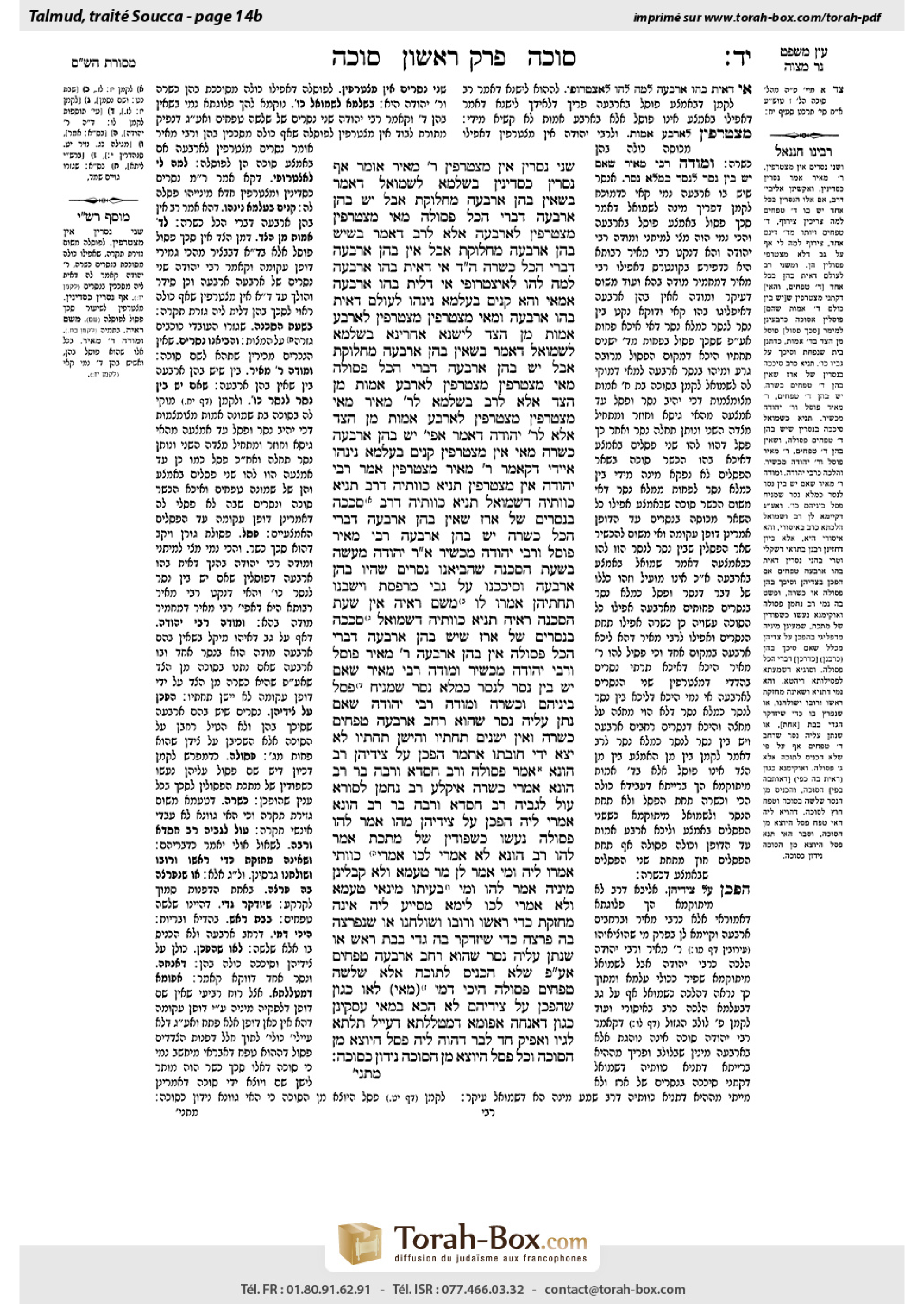
Sukkah 14b: Talmud study for Daf Yomi
Daf Yomi is the daily study of one Talmud folio. Explore 37 tractates with scans, Hebrew text, Sefaria English and AI-generated French translations where annotated.
Passage selection and English or AI-generated French translation are available where the scan has annotations. Daf Study is independent of Torah-Box and Sefaria.
Browse Sukkah · סוכה · All tractatesSukkah 14b text and translations
This page of Sukkah includes the Aramaic text, an English translation and an AI-generated French translation, alongside the scan above.
סוכה י״ד ב · Aramaic and Hebrew text
שְׁנֵי נְסָרִין אֵין מִצְטָרְפִין. רַבִּי מֵאִיר אוֹמֵר: אַף נְסָרִין כִּסְדִינִין.
בִּשְׁלָמָא לִשְׁמוּאֵל דְּאָמַר בְּשֶׁאֵין בָּהֶן אַרְבָּעָה מַחְלוֹקֶת, אֲבָל יֵשׁ בָּהֶן אַרְבָּעָה דִּבְרֵי הַכֹּל פְּסוּלָה, מַאי ״מִצְטָרְפִין״ — מִצְטָרְפִין לְאַרְבָּעָה.
אֶלָּא לְרַב, דְּאָמַר בְּשֶׁיֵּשׁ בָּהֶן אַרְבָּעָה מַחְלוֹקֶת, אֲבָל אֵין בָּהֶן אַרְבָּעָה דִּבְרֵי הַכֹּל כְּשֵׁרָה, הֵיכִי דָמֵי? אִי דְּאִית בְּהוּ אַרְבָּעָה, לְמָה לְהוּ לְאִיצְטְרוֹפֵי? אִי דְּלֵית בְּהוּ אַרְבָּעָה, אַמַּאי? וְהָא קָנִים בְּעָלְמָא נִינְהוּ?
לְעוֹלָם דְּאִית בְּהוּ אַרְבָּעָה, וּמַאי ״מִצְטָרְפִין״ — מִצְטָרְפִין לְאַרְבַּע אַמּוֹת מִן הַצַּד.
לִישָּׁנָא אַחֲרִינָא: בִּשְׁלָמָא לִשְׁמוּאֵל דְּאָמַר בְּשֶׁאֵין בָּהֶן אַרְבָּעָה מַחְלוֹקֶת, אֲבָל יֵשׁ בָּהֶן אַרְבָּעָה דִּבְרֵי הַכֹּל פְּסוּלָה, מַאי ״מִצְטָרְפִין״ — מִצְטָרְפִין לְאַרְבַּע אַמּוֹת מִן הַצַּד.
אֶלָּא לְרַב: בִּשְׁלָמָא לְרַבִּי מֵאִיר, מַאי ״מִצְטָרְפִין״ — מִצְטָרְפִין לְאַרְבַּע אַמּוֹת מִן הַצַּד. אֶלָּא לְרַבִּי יְהוּדָה דְּאָמַר אֲפִילּוּ יֵשׁ בָּהֶן אַרְבָּעָה כְּשֵׁרָה, מַאי ״אֵין מִצְטָרְפִין״? קָנִים בְּעָלְמָא נִינְהוּ! אַיְּידֵי דְּקָאָמַר רַבִּי מֵאִיר ״מִצְטָרְפִין״, אָמַר רַבִּי יְהוּדָה ״אֵין מִצְטָרְפִין״.
תַּנְיָא כְּווֹתֵיהּ דְּרַב, תַּנְיָא כְּווֹתֵיהּ דִּשְׁמוּאֵל.
תַּנְיָא כְּווֹתֵיהּ דְּרַב: סִכְּכָהּ בִּנְסָרִים שֶׁל אֶרֶז שֶׁאֵין בָּהֶן אַרְבָּעָה — דִּבְרֵי הַכֹּל כְּשֵׁרָה. יֵשׁ בָּהֶן אַרְבָּעָה — רַבִּי מֵאִיר פּוֹסֵל וְרַבִּי יְהוּדָה מַכְשִׁיר.
אָמַר רַבִּי יְהוּדָה: מַעֲשֶׂה בִּשְׁעַת הַסַּכָּנָה שֶׁהֵבֵיאנוּ נְסָרִים שֶׁהָיוּ בָּהֶן אַרְבָּעָה וְסִיכַּכְנוּ עַל גַּבֵּי מִרְפֶּסֶת, וְיָשַׁבְנוּ תַּחְתֵּיהֶן! אָמְרוּ לוֹ: מִשָּׁם רְאָיָה?! אֵין שְׁעַת הַסַּכָּנָה רְאָיָה.
תַּנְיָא כְּווֹתֵיהּ דִּשְׁמוּאֵל: סִכְּכָהּ בִּנְסָרִים שֶׁל אֶרֶז שֶׁיֵּשׁ בָּהֶן אַרְבָּעָה — דִּבְרֵי הַכֹּל פְּסוּלָה. אֵין בָּהֶן אַרְבָּעָה — רַבִּי מֵאִיר פּוֹסֵל וְרַבִּי יְהוּדָה מַכְשִׁיר. וּמוֹדֶה רַבִּי מֵאִיר שֶׁאִם יֵשׁ בֵּין נֶסֶר לְנֶסֶר כִּמְלֹא נֶסֶר — שֶׁמַּנִּיחַ פְּסָל בֵּינֵיהֶם, וּכְשֵׁרָה. וּמוֹדֶה רַבִּי יְהוּדָה שֶׁאִם נָתַן עָלֶיהָ נֶסֶר שֶׁהוּא רָחָב אַרְבָּעָה טְפָחִים — כְּשֵׁרָה, וְאֵין יְשֵׁנִים תַּחְתָּיו, וְהַיָּשֵׁן תַּחְתָּיו — לֹא יָצָא יְדֵי חוֹבָתוֹ.
אִתְּמַר: הֲפָכָן עַל צִידֵּיהֶן, רַב הוּנָא אָמַר: פְּסוּלָה, וְרַב חִסְדָּא וְרַבָּה בַּר רַב הוּנָא אָמְרִי: כְּשֵׁרָה.
אִיקְּלַע רַב נַחְמָן לְסוּרָא, עוּל לְגַבֵּיהּ רַב חִסְדָּא וְרַבָּה בַּר רַב הוּנָא. אָמְרִי לֵיהּ: הֲפָכָן עַל צִידֵּיהֶן, מַהוּ? אֲמַר לְהוּ: פְּסוּלָה, נַעֲשׂוּ כְּשַׁפּוּדִין שֶׁל מַתֶּכֶת.
אֲמַר לְהוּ רַב הוּנָא: לָא אֲמַרִי לְכוּ אֱמַרוּ כְּווֹתִי? אֲמַרוּ לֵיהּ: וּמִי אָמַר לַן מָר טַעְמָא וְלָא קַבֵּלְינַן מִינֵּיהּ? אֲמַר לְהוּ: וּמִי בְּעֵיתוּ מִינַּאי טַעְמָא וְלָא אֲמַרִי לְכוּ?
לֵימָא מְסַיַּיע לֵיהּ: אֵינָהּ מַחְזֶקֶת כְּדֵי רֹאשׁוֹ וְרוּבּוֹ וְשׁוּלְחָנוֹ, אוֹ שֶׁנִּפְרְצָה בָּהּ פִּרְצָה כְּדֵי שֶׁיִּזְדַּקֵּר בָּהּ גְּדִי בְּבַת רֹאשׁ, אוֹ שֶׁנָּתַן עָלֶיהָ נֶסֶר שֶׁהוּא רָחָב אַרְבָּעָה טְפָחִים, אַף עַל פִּי שֶׁלֹּא הִכְנִיס לְתוֹכָהּ אֶלָּא שְׁלֹשָׁה טְפָחִים — פְּסוּלָה.
הֵיכִי דָּמֵי, (מַאי) לָאו כְּגוֹן שֶׁהֲפָכָן עַל צִידֵּיהֶם? לָא, הָכָא בְּמַאי עָסְקִינַן — כְּגוֹן דְּאַנְּחַהּ אַפּוּמָּא דִמְטַלַּלְתָּא, דְּעָיֵיל תְּלָתָא לְגָיו וְאַפֵּיק חַד לְבַר, דְּהָוֵה לֵיהּ פְּסָל הַיּוֹצֵא מִן הַסּוּכָּה, וְכׇל פְּסָל הַיּוֹצֵא מִן הַסּוּכָּה — נִידּוֹן כַּסּוּכָּה.
Sukkah 14b · English translation
However, two boards placed on the sukka do not combine. Rabbi Meir says: Even boards are like sheets, in that they join together to constitute the measure of unfitness.
The Gemara elaborates: Granted, according to Shmuel, who said that the dispute between Rabbi Yehuda and Rabbi Meir is with regard to boards that do not have four handbreadths in their width, but if they have four handbreadths in their width everyone agrees that it is unfit; what is the meaning of that which Rabbi Meir said: Boards join together? It means that boards less than four handbreadths wide combine to measure four handbreadths, which renders the sukka unfit.
However, according to Rav, who said that the dispute is with regard to boards that have four handbreadths in their width, but if they do not have four handbreadths in their width everyone agrees that it is fit, what are the circumstances? If each of the boards has four handbreadths in its width, why must they join together to render the sukka unfit? If each board is four handbreadths wide, each is capable of rendering the sukka unfit on its own. And if each of the boards does not have four handbreadths in its width, why would Rabbi Meir prohibit their use? But aren’t they merely reeds according to Rav? Just as one may roof the sukka with reeds, one should be permitted to roof the sukka with these narrow boards.
The Gemara answers: Actually, explain that there are four handbreadths in the width of each board and each renders the sukka unfit on its own. However, what is the meaning of: Boards join together? It is with regard to a completely different matter. They join together to constitute four cubits from the side. If one placed these unfit boards adjacent to one of the walls of the sukka, they do not render the sukka unfit, due to the halakhic principle of curved wall, which views that roofing as an extension of that wall. However, that principle applies only up to four cubits of unfit roofing. If these boards join together to measure four cubits, the sukka is unfit according to Rabbi Meir. According to this explanation, the mishna can be explained in accordance with the opinion of Rav as well.
There is another version of the above exchange. Granted, according to Shmuel, who said that the dispute between Rabbi Yehuda and Rabbi Meir is with regard to boards that do not have four handbreadths in their width, but if they have four handbreadths in their width, everyone agrees that it is unfit, what is the meaning of that which Rabbi Meir said: Boards join together? It means that they join together to constitute four cubits from the side, which renders the sukka unfit.
However, according to Rav, granted, according to Rabbi Meir, what is the meaning of: Boards join together? It means that they join together to constitute four cubits from the side. However, according to the opinion of Rabbi Yehuda, who said that even if they have four handbreadths in their width, the sukka is fit, what is the meaning of: Boards do not join together? They are merely reeds, which is fit roofing and fit roofing that joins together remains fit roofing. The Gemara answers: Since Rabbi Meir used the phrase: Join together, Rabbi Yehuda, although it is irrelevant according to his opinion, also said: Do not join together.
The Gemara notes: It is taught in a baraita in accordance with the opinion of Rav, and it is taught in a baraita in accordance with the opinion of Shmuel.
It is taught in a baraita in accordance with the opinion of Rav: If one roofed the sukka with cedar boards that do not have four handbreadths in their width, everyone agrees that it is fit. If there are four handbreadths in their width, Rabbi Meir deems it unfit and Rabbi Yehuda deems it fit.
Rabbi Yehuda said: There was an incident during a time of danger, when the gentiles decreed that it is prohibited for Jews to construct a sukka, at which point we brought boards that had four handbreadths in their width, and we roofed the porch with them so that it would not appear to be a sukka, and we sat beneath them. Evidently, boards four handbreadths wide are fit roofing for a sukka. They said to him: Is there proof to be cited from there? There is no proof from actions performed during a time of danger. It is possible that the sukka that they built on the porch was unfit, and they built it merely to commemorate the mitzva that they were unable to fulfill. From this baraita, it is apparent that the dispute between Rabbi Meir and Rabbi Yehuda is in a case of boards that are four handbreadths wide, in accordance with the opinion of Rav.
It is taught in a baraita in accordance with the opinion of Shmuel: If one roofed the sukka with cedar boards that have four handbreadths in their width, everyone agrees that the sukka is unfit. If there are not four handbreadths in their width, Rabbi Meir deems it unfit and Rabbi Yehuda deems it fit. And Rabbi Meir concedes that, if there is between one board and another board a gap the complete width of a board, then one places fit roofing from the waste of the threshing floor and the winepress, and the sukka is fit. And Rabbi Yehuda concedes that if one roofed the sukka with a board that is four handbreadths wide adjacent to one of the walls, the sukka is fit based on the principle of curved wall; and, nevertheless, one may not sleep beneath that board, and one who sleeps beneath it does not fulfill his obligation. In any event, there are two baraitot, each in accordance with one of the two views presented.
§ It is stated that there is an amoraic dispute: If one turned the unfit boards on their sides, and the width of the side is less than the measure that renders them unfit, do the boards remain unfit, or are they fit because in their current placement their width is narrower? Rav Huna said: The sukka is unfit, and Rav Ḥisda and Rabba bar Rav Huna said: It is fit.
The Gemara relates: Rav Naḥman happened to come to Sura. Rav Ḥisda and Rabba bar Rav Huna entered before him. They said to him: If one turned these boards on their sides and roofed the sukka, what is the halakha? They sought to ascertain whether his ruling is in accordance with their opinion or in accordance with the opinion of Rav Huna. He said to them: The sukka is unfit; since the boards are unfit roofing when placed flat, their legal status became like that of skewers [shapudin] of metal, which are unfit under all circumstances.
When they related this encounter to Rav Huna, Rav Huna said to them: Didn’t I tell you that you should say the halakha in accordance with my opinion? Even Rav Naḥman agrees with me. They said to him: And did the Master actually say a reason for this ruling to us, and we did not accept it from him? Rav Naḥman not only issued a ruling, he also explained his ruling to us. He said to them: And did you ask me for the reason and I did not say it to you?
The Gemara notes: Let us say that this baraita supports the opinion of Rav Huna: With regard to a sukka that does not hold one’s head, most of his body, and his table; a sukka whose wall was breached with a breach large enough for a goat to jump through headlong, i.e., three handbreadths; a sukka that one placed atop it a board that is four handbreadths wide, even if he only introduced three handbreadths of the board into the sukka, in all these cases, the sukka is unfit.
What are the circumstances of the case where one introduces only three handbreadths of a board that is four handbreadths wide? What, is it not that he turned the board on its side, thereby diminishing its width from four to three handbreadths, in accordance with the opinion of Rav Huna? The Gemara rejects this: No, with what are we dealing here? It is a case where one placed the board over the entrance of the sukka, where there is no wall. He introduced three handbreadths into the sukka and took one handbreadth out of the sukka, so that the legal status of that part of the board would be like that of roofing that protrudes from the sukka, and the halakha is that the legal status of any roofing that protrudes from the sukka is considered like that of the sukka. However, since this board is not adjacent to the wall of a sukka, the principle of curved wall does not apply. Therefore, it is four handbreadths of unfit roofing; it is prohibited to sleep beneath that board, and the entire sukka is rendered unfit. Consequently, there is no support for or against the opinion of Rav Huna from this baraita.
Sukkah 14b · Traduction française (IA)
Cependant, deux planches posées sur la soukka ne se joignent pas. Rabbi Meïr dit : Même les planches sont comme des nattes, en ce qu’elles se joignent pour atteindre la mesure qui rend la soukka invalide.
La Guemara développe : Cela se comprend selon Chmouel, qui dit que le désaccord entre Rabbi Yehouda et Rabbi Meïr porte sur des planches de moins de quatre téfaḥim de largeur, tandis que, si elles mesurent quatre téfaḥim de largeur, tous conviennent que la soukka est invalide. Que signifie alors la déclaration de Rabbi Meïr : « Les planches se joignent » ? Cela signifie que des planches de moins de quatre téfaḥim de largeur se joignent pour atteindre quatre téfaḥim, ce qui rend la soukka invalide.
Cependant, selon Rav, qui dit que le désaccord porte sur des planches de quatre téfaḥim de largeur, tandis que, si elles mesurent moins de quatre téfaḥim de largeur, tous conviennent que la soukka est valide, de quelles circonstances s’agit-il ? Si chacune des planches mesure quatre téfaḥim de largeur, pourquoi doivent-elles se joindre pour rendre la soukka invalide ? Chacune peut à elle seule rendre la soukka invalide. Et si aucune des planches ne mesure quatre téfaḥim de largeur, pourquoi Rabbi Meïr interdirait-il leur utilisation ? Mais, selon Rav, ne sont-elles pas simplement des roseaux ? De même qu’on peut couvrir la soukka avec des roseaux, on devrait pouvoir la couvrir avec ces planches étroites.
La Guemara répond : En réalité, il faut expliquer que chacune des planches mesure quatre téfaḥim de largeur et rend la soukka invalide à elle seule. Mais que signifie : « Les planches se joignent » ? Cela concerne une tout autre question : elles se joignent pour atteindre quatre coudées à partir du côté. Si l’on a placé ces planches invalides contre l’un des murs de la soukka, elles ne rendent pas la soukka invalide, en vertu du principe du mur courbe, selon lequel cette couverture est considérée comme le prolongement de ce mur. Toutefois, ce principe ne s’applique que jusqu’à quatre coudées de couverture invalide. Si ces planches se joignent pour atteindre quatre coudées, la soukka est invalide selon Rabbi Meïr. Selon cette explication, la Michna peut également s’interpréter conformément à l’opinion de Rav.
Il existe une autre version de l’échange précédent. Cela se comprend selon Chmouel, qui dit que le désaccord entre Rabbi Yehouda et Rabbi Meïr porte sur des planches de moins de quatre téfaḥim de largeur, tandis que, si elles mesurent quatre téfaḥim de largeur, tous conviennent que la soukka est invalide. Que signifie alors la déclaration de Rabbi Meïr : « Les planches se joignent » ? Cela signifie qu’elles se joignent pour atteindre quatre coudées à partir du côté, ce qui rend la soukka invalide.
Cependant, selon Rav, la déclaration de Rabbi Meïr, « les planches se joignent », se comprend : elles se joignent pour atteindre quatre coudées à partir du côté. Mais, selon Rabbi Yehouda, qui dit que même si elles mesurent quatre téfaḥim de largeur, la soukka reste valide, que signifie : « Les planches ne se joignent pas » ? Ce ne sont que des roseaux, qui constituent une couverture valide ; or, une couverture valide qui se joint demeure une couverture valide. La Guemara répond : Puisque Rabbi Meïr a employé l’expression « se joignent », Rabbi Yehouda a lui aussi dit : « Ne se joignent pas », bien que cela soit sans pertinence selon son opinion.
La Guemara relève : Une baraïta est enseignée conformément à l’opinion de Rav, et une autre baraïta conformément à celle de Chmouel.
Une baraïta est enseignée conformément à l’opinion de Rav : Si l’on a couvert la soukka avec des planches de cèdre de moins de quatre téfaḥim de largeur, tous conviennent qu’elle est valide. Si elles mesurent quatre téfaḥim de largeur, Rabbi Meïr la déclare invalide et Rabbi Yehouda la déclare valide.
Rabbi Yehouda dit : Il arriva, à une époque de persécution, où les non-Juifs avaient décrété qu’il était interdit aux Juifs de construire une soukka, que nous prîmes des planches de quatre téfaḥim de largeur et en couvrîmes le porche afin qu’il ne ressemble pas à une soukka, puis nous nous assîmes dessous. Cela montre que des planches de quatre téfaḥim de largeur constituent une couverture valide pour une soukka. Ils lui dirent : Peut-on tirer une preuve de là ? Les actes accomplis à une époque de persécution ne constituent pas une preuve. Il se peut que la soukka construite sur le porche ait été invalide et qu’ils l’aient construite uniquement pour commémorer la mitsva qu’ils ne pouvaient pas accomplir. Cette baraïta montre que le désaccord entre Rabbi Meïr et Rabbi Yehouda porte sur des planches de quatre téfaḥim de largeur, conformément à l’opinion de Rav.
Une baraïta est enseignée conformément à l’opinion de Chmouel : Si l’on a couvert la soukka avec des planches de cèdre de quatre téfaḥim de largeur, tous conviennent que la soukka est invalide. Si elles mesurent moins de quatre téfaḥim de largeur, Rabbi Meïr la déclare invalide et Rabbi Yehouda la déclare valide. Rabbi Meïr reconnaît que si, entre deux planches, il y a un espace de la largeur entière d’une planche, et que l’on y place une couverture valide faite des résidus de l’aire de battage et du pressoir, la soukka est valide. Rabbi Yehouda reconnaît que si l’on a couvert la soukka avec une planche de quatre téfaḥim de largeur placée contre l’un des murs, la soukka est valide en vertu du principe du mur courbe ; néanmoins, on ne peut pas dormir sous cette planche, et celui qui y dort ne s’acquitte pas de son obligation. Quoi qu’il en soit, il y a deux baraïtot, chacune conforme à l’une des deux opinions présentées.
§ Il est rapporté qu’il existe un désaccord entre les amoraïm : si l’on a placé les planches invalides sur la tranche et que la largeur de leur tranche est inférieure à la mesure qui les rend invalides, restent-elles invalides, ou sont-elles valides parce que leur largeur est moindre dans cette position ? Rav Houna dit : La soukka est invalide. Rav Ḥisda et Rabba bar Rav Houna disent : Elle est valide.
La Guemara rapporte : Rav Naḥman vint par hasard à Soura. Rav Ḥisda et Rabba bar Rav Houna se présentèrent devant lui. Ils lui dirent : Si l’on plaçait ces planches sur la tranche et que l’on couvrait la soukka avec elles, quelle serait la halakha ? Ils cherchaient à savoir si sa décision serait conforme à leur opinion ou à celle de Rav Houna. Il leur dit : La soukka est invalide ; puisque les planches constituent une couverture invalide lorsqu’elles sont posées à plat, leur statut halakhique est devenu celui de broches en métal [shapudin], qui sont invalides en toutes circonstances.
Lorsqu’ils rapportèrent cette rencontre à Rav Houna, celui-ci leur dit : Ne vous avais-je pas dit de trancher la halakha conformément à mon opinion ? Même Rav Naḥman est d’accord avec moi. Ils lui dirent : Le Maître nous a-t-il réellement donné une raison à cette décision, que nous n’aurions pas entendue de sa bouche ? Rav Naḥman ne s’est pas contenté de rendre une décision ; il nous l’a également expliquée. Il leur dit : M’avez-vous demandé la raison et ne vous l’ai-je pas donnée ?
La Guemara relève : Peut-on dire que cette baraïta soutient l’opinion de Rav Houna ? Dans les cas suivants, la soukka est invalide : une soukka qui ne peut contenir la tête, la majeure partie du corps et la table d’une personne ; une soukka dont le mur a été percé d’une ouverture assez grande pour qu’une chèvre puisse y bondir tête la première, c’est-à-dire de trois téfaḥim ; et une soukka sur laquelle on a placé une planche de quatre téfaḥim de largeur, même si l’on n’en a introduit que trois téfaḥim dans la soukka.
Dans quelles circonstances n’introduit-on que trois téfaḥim d’une planche de quatre téfaḥim de largeur ? N’est-ce pas parce qu’on a placé la planche sur la tranche, réduisant ainsi sa largeur de quatre à trois téfaḥim, conformément à l’opinion de Rav Houna ? La Guemara rejette cette interprétation : Non. De quoi s’agit-il ici ? On a placé la planche au-dessus de l’entrée de la soukka, là où il n’y a pas de mur. On en a introduit trois téfaḥim dans la soukka et on en a fait sortir un téfaḥ, de sorte que cette partie de la planche ait le statut d’une couverture qui dépasse de la soukka ; or, toute couverture qui dépasse de la soukka est considérée comme faisant partie de la soukka. Cependant, puisque cette planche n’est pas adjacente au mur de la soukka, le principe du mur courbe ne s’applique pas. Il y a donc quatre téfaḥim de couverture invalide ; il est interdit de dormir sous cette planche, et toute la soukka est rendue invalide. Par conséquent, cette baraïta ne fournit aucun appui, ni pour ni contre l’opinion de Rav Houna.
Traduction française générée par IA à partir de l’édition anglaise de Sefaria. Vérifie toujours un passage avec le texte source.
Text from Sefaria: William Davidson Edition - Vocalized Aramaic (CC BY NC); William Davidson Edition - English (CC BY NC).