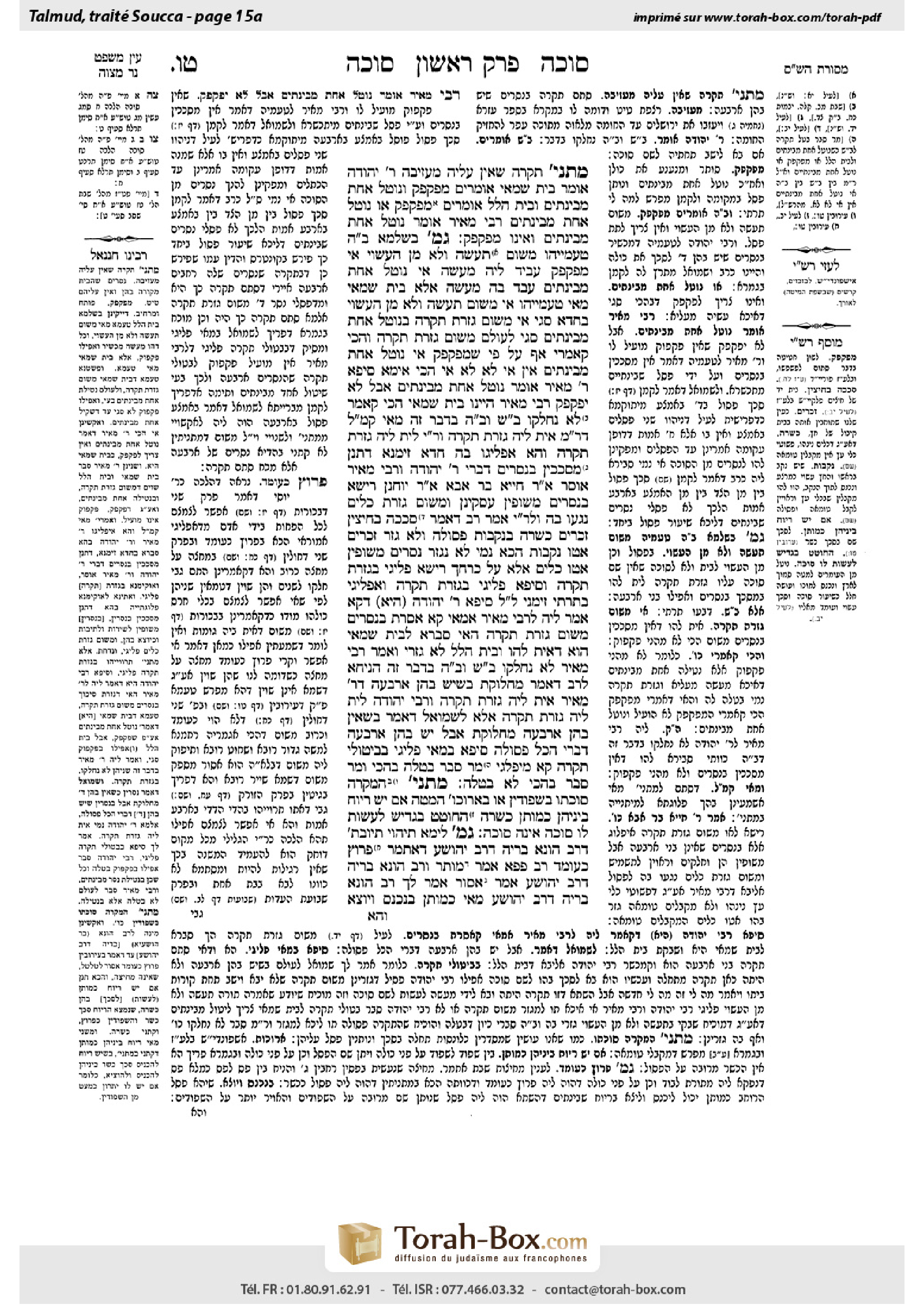
Sukkah 15a: Talmud study for Daf Yomi
Daf Yomi is the daily study of one Talmud folio. Explore 37 tractates with scans, Hebrew text, Sefaria English and AI-generated French translations where annotated.
Passage selection and English or AI-generated French translation are available where the scan has annotations. Daf Study is independent of Torah-Box and Sefaria.
Browse Sukkah · סוכה · All tractatesSukkah 15a text and translations
This page of Sukkah includes the Aramaic text, an English translation and an AI-generated French translation, alongside the scan above.
סוכה י״ה א · Aramaic and Hebrew text
מַתְנִי׳ תִּקְרָה שֶׁאֵין עָלֶיהָ מַעֲזִיבָה, רַבִּי יְהוּדָה אוֹמֵר: בֵּית שַׁמַּאי אוֹמְרִים: מְפַקְפֵּק, וְנוֹטֵל אַחַת מִבֵּינְתַיִם. וּבֵית הִלֵּל אוֹמְרִים: מְפַקְפֵּק, אוֹ נוֹטֵל אַחַת מִבֵּינְתַיִם. רַבִּי מֵאִיר אוֹמֵר: נוֹטֵל אַחַת מִבֵּינְתַיִם, וְאֵינוֹ מְפַקְפֵּק.
גְּמָ׳ בִּשְׁלָמָא בֵּית הִלֵּל, טַעְמַיְיהוּ מִשּׁוּם ״תַּעֲשֶׂה״ וְלֹא מִן הֶעָשׂוּי. אִי מְפַקְפֵּק, עָבֵיד לֵיהּ מַעֲשֶׂה. אִי נוֹטֵל אַחַת מִבֵּינְתַיִם, עָבֵד בַּהּ מַעֲשֶׂה. אֶלָּא בֵּית שַׁמַּאי, מַאי טַעְמַיְיהוּ? אִי מִשּׁוּם ״תַּעֲשֶׂה״ וְלֹא מִן הֶעָשׂוּי — בַּחֲדָא סַגִּי! אִי מִשּׁוּם גְּזֵרַת תִּקְרָה — בְּנוֹטֵל אַחַת מִבֵּינְתַיִם סַגִּי!
לְעוֹלָם מִשּׁוּם גְּזֵרַת תִּקְרָה, וְהָכִי קָאָמְרִי: אַף עַל פִּי שֶׁמְּפַקְפֵּק, אִי נוֹטֵל אַחַת מִבֵּינְתַיִם — אִין, אִי לָא — לָא.
אִי הָכִי, אֵימָא סֵיפָא: רַבִּי מֵאִיר אוֹמֵר: נוֹטֵל אַחַת מִבֵּינְתַיִם, אֲבָל לֹא יְפַקְפֵּק — רַבִּי מֵאִיר הַיְינוּ בֵּית שַׁמַּאי!
הָכִי קָאָמַר: לֹא נֶחְלְקוּ בֵּית שַׁמַּאי וּבֵית הִלֵּל בְּדָבָר זֶה.
מַאי קָא מַשְׁמַע לַן? דְּרַבִּי מֵאִיר אִית לֵיהּ גְּזֵרַת תִּקְרָה, וְרַבִּי יְהוּדָה לֵית לֵיהּ גְּזֵרַת תִּקְרָה — וְהָא אִפְּלִיגוּ בַּהּ חֲדָא זִימְנָא! דִּתְנַן: מְסַכְּכִין בִּנְסָרִים, דִּבְרֵי רַבִּי יְהוּדָה. וְרַבִּי מֵאִיר אוֹסֵר.
אָמַר רַבִּי חִיָּיא בַּר אַבָּא אָמַר רַבִּי יוֹחָנָן: רֵישָׁא — בִּנְסָרִים מְשׁוּפִּין עָסְקִינַן, וּמִשּׁוּם גְּזֵרַת כֵּלִים נָגְעוּ בָּהּ.
וּלְרַב יְהוּדָה אָמַר רַב, דְּאָמַר: סִכְּכָהּ בְּחִיצִּין זְכָרִים — כְּשֵׁרָה. בִּנְקֵבוֹת — פְּסוּלָה, וְלָא גָּזַר זְכָרִים אַטּוּ נְקֵבוֹת. הָכָא נָמֵי לָא נִגְזַר נְסָרִים מְשׁוּפִּין אַטּוּ כֵּלִים!
אֶלָּא עַל כׇּרְחָךְ רֵישָׁא פְּלִיגִי בִּגְזֵרַת תִּקְרָה, וְסֵיפָא פְּלִיגִי בִּגְזֵרַת תִּקְרָה. וְאִפְּלוֹגֵי בְּתַרְתֵּי זִימְנֵי לְמָה לִי?
סֵיפָא רַבִּי יְהוּדָה (הִיא), דְּקָא אֲמַר לֵיהּ לְרַבִּי מֵאִיר: אַמַּאי קָא אָסְרַתְּ בִּנְסָרִים — מִשּׁוּם גְּזֵרַת תִּקְרָה? הַאי סְבָרָא לְבֵית שַׁמַּאי הוּא דְּאִית לְהוּ, וּבֵית הִלֵּל לָא גָּזְרִי! וְאָמַר רַבִּי מֵאִיר: לֹא נֶחְלְקוּ בֵּית שַׁמַּאי וּבֵית הִלֵּל בְּדָבָר זֶה.
הָנִיחָא לְרַב, דְּאָמַר מַחְלוֹקֶת בְּשֶׁיֵּשׁ בָּהֶן אַרְבָּעָה, דְּרַבִּי מֵאִיר אִית לֵיהּ גְּזֵרַת תִּקְרָה וְרַבִּי יְהוּדָה לֵית לֵיהּ גְּזֵרַת תִּקְרָה. אֶלָּא שְׁמוּאֵל, דְּאָמַר בְּשֶׁאֵין בָּהֶן אַרְבָּעָה מַחְלוֹקֶת, אֲבָל יֵשׁ בָּהֶן אַרְבָּעָה — דִּבְרֵי הַכֹּל פְּסוּלָה, סֵיפָא בְּמַאי פְּלִיגִי?
בְּבַיטּוֹלֵי תִּקְרָה קָא מִיפַּלְגִי: מָר סָבַר בָּטְלָה בְּהָכִי, וּמַר סָבַר בְּהָכִי לָא בָּטְלָה.
מַתְנִי׳ הַמְקָרֶה סוּכָּתוֹ בְּשַׁפּוּדִין אוֹ בַּאֲרוּכּוֹת הַמִּטָּה, אִם יֵשׁ רֶיוַח בֵּינֵיהֶן כְּמוֹתָן — כְּשֵׁרָה. הַחוֹטֵט בְּגָדִישׁ לַעֲשׂוֹת לוֹ סוּכָּה — אֵינָהּ סוּכָּה.
גְּמָ׳ לֵימָא תֶּיהְוֵי תְּיוּבְתָּא דְּרַב הוּנָא בְּרֵיהּ דְּרַב יְהוֹשֻׁעַ. דְּאִתְּמַר: פָּרוּץ כְּעוֹמֵד, רַב פָּפָּא אָמַר: מוּתָּר. וְרַב הוּנָא בְּרֵיהּ דְּרַב יְהוֹשֻׁעַ אָמַר: אָסוּר!
אָמַר לְךָ רַב הוּנָא בְּרֵיהּ דְּרַב יְהוֹשֻׁעַ: מַאי כְּמוֹתָן — בְּנִכְנָס וְיוֹצֵא.
Sukkah 15a · English translation
MISHNA: In the case of a roof made of boards that are four handbreadths wide upon which there is no coat of plaster, Rabbi Yehuda says that Beit Shammai and Beit Hillel disagree with regard to the manner in which to render it fit. Beit Shammai say: One moves each board, and then it is considered as though he placed the board there for the sake of the mitzva of sukka, and one then removes one board from among the boards and replaces it with fit roofing. Beit Hillel say: One need not perform both actions; rather, one must either move the boards or remove one from among them. Rabbi Meir says: One only removes one from among them and does not move the others.
GEMARA: The Gemara asks: Granted, according to Beit Hillel, their reason for initially prohibiting this roof is due to the principle: Prepare it, and not from that which has already been prepared. If one moves the boards, he performs an action. Likewise, if he removes one of the boards from among them, he also performs an action. Therefore, in both cases, he prepared the roofing and the sukka is fit. However, with regard to the opinion of Beit Shammai, what is the rationale for their prohibition against using the original ceiling for a sukka? If the rationale is also due to the principle: Prepare it, and not from that which has already been prepared, one action should suffice. Or if the rationale is due to the decree of the roof, lest one come to reside beneath a regular plastered ceiling inside a house, removing one board from among them should suffice.
The Gemara answers: Actually, the rationale is due to the decree of the roof, and this is what they are saying: Although one moves the boards, if he removes one board from among them, yes, it is fit; if not, no, it is unfit. Moving the boards is inconsequential. Removing one board from among them is all that is necessary.
The Gemara asks: If so, say the latter clause of the mishna: Rabbi Meir says: One removes one from among them but does not move the others. This indicates that the opinion of Rabbi Meir is identical to the opinion of Beit Shammai, as according to the above explanation, Beit Shammai also hold that removing one of the boards and replacing it with fit roofing can render the sukka fit. It is unreasonable to say that Rabbi Meir would hold in accordance with the opinion of Beit Shammai, which is rejected.
The Gemara answers: This is what Rabbi Meir is saying: Beit Shammai and Beit Hillel do not disagree on this matter. They agree that the boards are prohibited due to the decree of the roof and that only by removing one of the boards is the sukka rendered fit. Rabbi Meir disagrees with the opinion of Rabbi Yehuda that there is a dispute between Beit Shammai and Beit Hillel.
The Gemara asks: What is the tanna of the mishna teaching us? Is it that Rabbi Meir is of the opinion that the Sages issued the decree of the roof and Rabbi Yehuda is of the opinion that the Sages did not issue the decree of the roof? But didn’t they disagree about this once, as we learned in the mishna above: One may roof the sukka with boards; this is the statement of Rabbi Yehuda. Rabbi Meir prohibits their use. The Gemara explained that the dispute is whether or not the Sages issued the decree of the roof.
Rabbi Ḥiyya bar Abba said that Rabbi Yoḥanan said: That is not the dispute, as in the first clause, i.e., in the earlier mishna, we are dealing with the case of planed boards. The rationale for their disagreement is not due to the decree of the roof; but it is due to the decree of the vessels that they touched upon it. The dispute is whether or not the Sages issued a decree prohibiting the use of planed beams in roofing the sukka, although as flat wooden vessels they are not susceptible to ritual impurity, lest one come to roof the sukka with vessels that are susceptible to ritual impurity.
The Gemara asks: And according to Rav Yehuda, who said that Rav said: If one roofed a sukka with convex arrow shafts, the sukka is fit, but if he roofed his sukka with concave arrow shafts, the sukka is unfit; and he did not issue a decree and prohibit roofing with convex shafts due to the prohibition against roofing with concave shafts, here too, let us not issue a decree and prohibit roofing with planed boards, due to the prohibition against roofing with actual vessels.
Rather, according to Rav, perforce you must say that in the first clause of the mishna they disagree with regard to the decree of the roof, and in the latter clause, i.e., this mishna as well, they disagree with regard to the decree of the roof. Once again, the question arises: Why do I need them to disagree about the same issue twice?
The Gemara answers: Rather, the latter clause is the opinion of Rabbi Yehuda, who is saying to Rabbi Meir: Why do you prohibit roofing with boards? Is it due to the decree of the roof? That is the reason according to Beit Shammai, who are of the opinion that the Sages issued the decree. But, contrary to your opinion, Beit Hillel do not issue the decree. And Rabbi Meir said to Rabbi Yehuda: Beit Shammai and Beit Hillel did not disagree with regard to this matter at all. These are not two separate disputes; rather, it is one extended dispute.
The Gemara continues to ask: This works out well according to Rav, who said that the dispute is specifically in a case where the boards have four handbreadths in their width. He says that Rabbi Meir is of the opinion that the Sages issued the decree of the roof, and Rabbi Yehuda is not of the opinion that the Sages issued the decree of the roof. However, according to Shmuel, who said that the dispute is specifically in a case where the boards do not have four handbreadths in their width, but where they have four handbreadths in their width, everyone agrees that the sukka is unfit, and both Rabbi Meir and Rabbi Yehuda agree that the Sages issued the decree of the roof; if so, in the latter clause of the mishna, with regard to what matter do they disagree?
The Gemara answers: One may not use boards of this sort for roofing his sukka. Even according to Rabbi Yehuda, a sukka roofed in that manner is unfit, due to the decree of the roof. However, here, in the latter clause, it is with regard to negating an existing roof that consists of boards of this sort, in order to render the sukka fit that they disagree. One Sage, Rabbi Yehuda, holds: The ceiling is thereby negated, by moving the boards, and one Sage, Rabbi Meir, holds that the ceiling is not thereby negated unless he also removes one beam from among them.
MISHNA: In the case of one who roofs his sukka with metal skewers or with the long boards of the bed, which compose its frame, if there is space between each one of them equal to the width of the skewers or the boards, and if he places fit roofing in those spaces, the sukka is fit. In the case of one who hollows out and creates a space inside a stack of grain to establish a sukka for him, it is not a sukka.
GEMARA: Let us say, based on the mishna, that this will be a conclusive refutation of the opinion of Rav Huna, son of Rav Yehoshua, as it is stated that the amora’im disagreed concerning the following matter: With regard to the domains of Shabbat, if the breached segment is equal to the standing segment, is it deemed a partition or not? Rav Pappa said: It is permitted to carry within the partition; as long as the breached segment is not greater, it is considered a solid partition. Rav Huna, son of Rav Yehoshua, said: It is prohibited to carry within the partition, unless the standing portion is greater. Apparently, from the mishna, even if the fit roofing is equal to the unfit skewers and boards, the sukka is fit, contrary to the opinion of Rav Huna, son of Rav Yehoshua.
The Gemara answers that Rav Huna, son of Rav Yehoshua, could have said to you: What is the meaning of: Like the skewers and the boards? It does not mean that the space between the skewers and boards equals the width of the skewers and boards themselves. It is referring to a case where the space is large enough so that the fit roofing can enter and emerge easily, i.e., it is wider than the unfit roofing. According to this interpretation, the mishna can be explained according to Rav Huna, son of Rav Yehoshua, as well. The mishna agrees that even if the standing and breached areas are equal, the sukka is unfit.
Sukkah 15a · Traduction française (IA)
MICHNA : Dans le cas d’un toit constitué de planches larges de quatre téfa’him et dépourvues de couche de plâtre, Rabbi Yehouda dit que Beit Shammaï et Beit Hillel sont en désaccord sur la manière de le rendre apte. Beit Shammaï disent : On déplace chaque planche, de sorte qu’elle soit considérée comme si on l’avait placée là pour la mitsva de soukka, puis on retire l’une des planches et on la remplace par un s’khakh apte. Beit Hillel disent : Il n’est pas nécessaire d’accomplir les deux actions ; il suffit soit de déplacer les planches, soit d’en retirer une. Rabbi Meïr dit : On en retire une, sans déplacer les autres.
GUEMARA : La Guemara demande : On comprend que, selon Beit Hillel, la raison pour laquelle ce toit est interdit au départ relève du principe : « Prépare-le, et non à partir de ce qui a déjà été préparé. » Si l’on déplace les planches, on accomplit une action. De même, si l’on en retire une, on accomplit également une action. Dans les deux cas, on a donc préparé le s’khakh et la soukka est apte. Mais, concernant l’opinion de Beit Shammaï, quelle est la raison pour laquelle ils interdisent d’utiliser le plafond d’origine pour une soukka ? Si la raison est également le principe : « Prépare-le, et non à partir de ce qui a déjà été préparé », une seule action devrait suffire. Ou, si la raison est le décret relatif au toit, de peur que l’on en vienne à séjourner sous un plafond ordinaire plâtré, à l’intérieur d’une maison, il devrait suffire d’en retirer une planche.
La Guemara répond : En réalité, c’est le décret relatif au toit qui en est la raison, et voici ce qu’ils disent : Même si l’on déplace les planches, il faut en retirer une pour que la soukka soit apte ; sinon, elle ne l’est pas. Le déplacement des planches ne change rien. Il suffit d’en retirer une.
La Guemara demande : Si tel est le cas, examinons la dernière partie de la Michna : Rabbi Meïr dit : On en retire une, mais on ne déplace pas les autres. Cela indique que l’opinion de Rabbi Meïr est identique à celle de Beit Shammaï, puisque, selon l’explication qui précède, Beit Shammaï aussi considèrent que retirer l’une des planches et la remplacer par un s’khakh apte peut rendre la soukka apte. Il est déraisonnable de dire que Rabbi Meïr serait d’accord avec l’opinion de Beit Shammaï, qui est rejetée.
La Guemara répond : Voici ce que dit Rabbi Meïr : Beit Shammaï et Beit Hillel ne sont pas en désaccord sur ce point. Ils conviennent que les planches sont interdites en raison du décret relatif au toit et que seule l’extraction de l’une d’elles rend la soukka apte. Rabbi Meïr conteste l’opinion de Rabbi Yehouda selon laquelle Beit Shammaï et Beit Hillel sont en désaccord.
La Guemara demande : Que nous enseigne le tanna de la Michna ? Que Rabbi Meïr pense que les Sages ont institué le décret relatif au toit, tandis que Rabbi Yehouda pense qu’ils ne l’ont pas institué ? Mais ils ont déjà été en désaccord à ce sujet, comme nous l’avons appris dans la Michna précédente : « On peut couvrir la soukka avec des planches » ; telle est l’opinion de Rabbi Yehouda. Rabbi Meïr interdit leur utilisation. La Guemara a expliqué que leur désaccord porte sur la question de savoir si les Sages ont institué ou non le décret relatif au toit.
Rabbi Ḥiyya bar Abba a dit au nom de Rabbi Yoḥanan : Tel n’est pas le sujet du désaccord. Dans la première partie, c’est-à-dire dans la Michna précédente, il s’agit de planches rabotées. Leur désaccord ne s’explique pas par le décret relatif au toit, mais par le décret concernant les ustensiles, qu’ils ont évoqué à ce propos. Le désaccord porte sur la question de savoir si les Sages ont institué ou non un décret interdisant d’utiliser des poutres rabotées pour couvrir la soukka, bien que, en tant qu’ustensiles plats en bois, elles ne soient pas susceptibles de contracter l’impureté rituelle, de peur que l’on en vienne à couvrir la soukka avec des ustensiles susceptibles de contracter l’impureté rituelle.
La Guemara demande : Et selon Rav Yehouda, qui a dit au nom de Rav : « Si quelqu’un couvre une soukka avec des hampes de flèches convexes, la soukka est apte, mais s’il la couvre avec des hampes de flèches concaves, elle ne l’est pas », et qui n’a pas institué de décret interdisant de couvrir avec des hampes convexes à cause de l’interdiction de couvrir avec des hampes concaves, pourquoi, ici aussi, ne pas s’abstenir de décréter l’interdiction d’utiliser des planches rabotées à cause de l’interdiction d’utiliser de véritables ustensiles comme couverture ?
Il faut donc dire que, selon Rav, dans la première partie de la Michna, leur désaccord porte sur le décret relatif au toit et que, dans la dernière partie, c’est-à-dire dans cette Michna également, leur désaccord porte sur le décret relatif au toit. La question se pose donc à nouveau : pourquoi leur faire exprimer deux fois leur désaccord sur la même question ?
La Guemara répond : La dernière partie exprime plutôt l’opinion de Rabbi Yehouda, qui dit à Rabbi Meïr : « Pourquoi interdis-tu de couvrir avec des planches ? Est-ce à cause du décret relatif au toit ? C’est la raison selon Beit Shammaï, qui pensent que les Sages ont institué ce décret. Mais, contrairement à ton opinion, Beit Hillel n’instituent pas ce décret. » Et Rabbi Meïr dit à Rabbi Yehouda : « Beit Shammaï et Beit Hillel ne sont pas du tout en désaccord sur cette question. » Il ne s’agit pas de deux désaccords distincts, mais d’un seul désaccord qui se poursuit.
La Guemara poursuit sa question : Cela s’explique bien selon Rav, qui a dit que le désaccord porte précisément sur le cas où les planches ont quatre téfa’him de largeur. Selon lui, Rabbi Meïr pense que les Sages ont institué le décret relatif au toit, tandis que Rabbi Yehouda pense qu’ils ne l’ont pas institué. Mais, selon Shmuel, qui a dit que le désaccord porte précisément sur le cas où les planches ont moins de quatre téfa’him de largeur, tandis que, si elles ont quatre téfa’him de largeur, tous conviennent que la soukka n’est pas apte et que les Sages ont institué le décret relatif au toit, quel est alors l’objet de leur désaccord dans la dernière partie de la Michna ?
La Guemara répond : On ne peut pas utiliser ce type de planches pour couvrir sa soukka. Même selon Rabbi Yehouda, une soukka couverte de cette manière n’est pas apte, en raison du décret relatif au toit. Toutefois, ici, dans la dernière partie, leur désaccord porte sur l’annulation d’un toit existant constitué de planches de ce type, afin de rendre la soukka apte. Un Sage, Rabbi Yehouda, estime que le plafond est ainsi annulé par le déplacement des planches ; un autre Sage, Rabbi Meïr, estime qu’il n’est pas annulé de cette manière, à moins que l’on ne retire également l’une des poutres.
MICHNA : Dans le cas de quelqu’un qui couvre sa soukka avec des broches en métal ou avec les longues planches du lit qui en constituent le cadre, si l’espace entre chacune d’elles est égal à la largeur des broches ou des planches et qu’il place un s’khakh apte dans ces espaces, la soukka est apte. Dans le cas de quelqu’un qui creuse un espace à l’intérieur d’un tas de grain pour s’y aménager une soukka, ce n’est pas une soukka.
GUEMARA : Peut-on dire que la Michna réfute de manière décisive l’opinion de Rav Houna, fils de Rav Yehoshoua ? Les amoraïm sont en désaccord sur la question suivante concernant les domaines du Chabbat : lorsque la partie ouverte est égale à la partie pleine, cette dernière est-elle considérée comme une cloison ou non ? Rav Pappa a dit : Il est permis de transporter des objets à l’intérieur de la cloison ; tant que la partie ouverte n’est pas plus grande, la cloison est considérée comme pleine. Rav Houna, fils de Rav Yehoshoua, a dit : Il est interdit de transporter des objets à l’intérieur de la cloison, à moins que la partie pleine ne soit plus grande. Or, la Michna semble indiquer que, même si le s’khakh apte est égal aux broches et aux planches inaptes, la soukka est apte, contrairement à l’opinion de Rav Houna, fils de Rav Yehoshoua.
La Guemara répond que Rav Houna, fils de Rav Yehoshoua, aurait pu te dire : Que signifie « comme les broches et les planches » ? Cela ne veut pas dire que l’espace entre les broches et les planches est égal à leur propre largeur. Il s’agit d’un cas où l’espace est suffisamment large pour que le s’khakh apte puisse y entrer et en ressortir facilement, c’est-à-dire qu’il est plus large que la couverture inapte. Selon cette interprétation, la Michna peut également s’expliquer conformément à l’opinion de Rav Houna, fils de Rav Yehoshoua. La Michna convient qu’une soukka n’est pas apte même lorsque les parties pleines et ouvertes sont égales.
Traduction française générée par IA à partir de l’édition anglaise de Sefaria. Vérifie toujours un passage avec le texte source.
Text from Sefaria: William Davidson Edition - Vocalized Aramaic (CC BY NC); William Davidson Edition - English (CC BY NC).