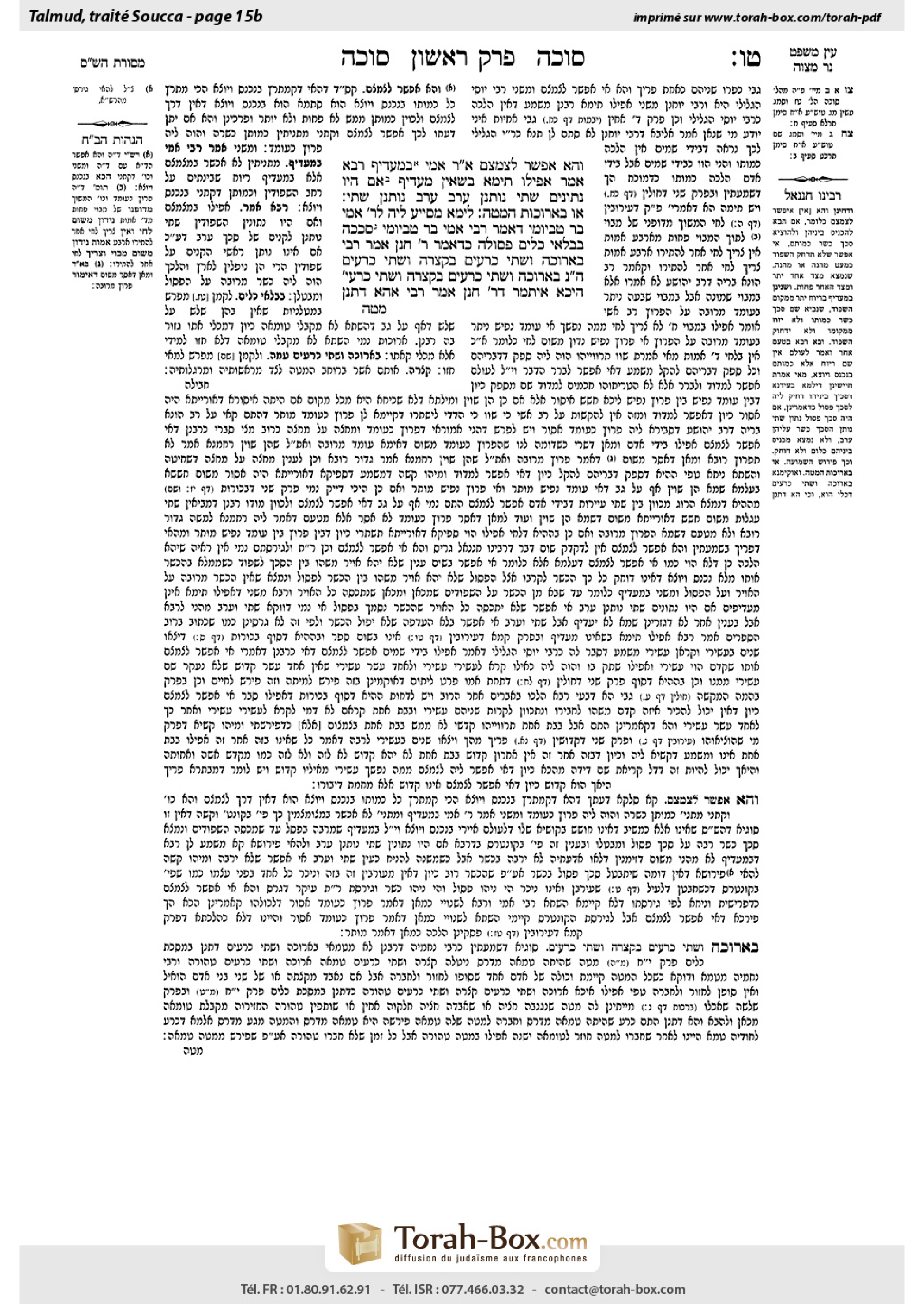
Sukkah 15b: Talmud study for Daf Yomi
Daf Yomi is the daily study of one Talmud folio. Explore 37 tractates with scans, Hebrew text, Sefaria English and AI-generated French translations where annotated.
Passage selection and English or AI-generated French translation are available where the scan has annotations. Daf Study is independent of Torah-Box and Sefaria.
Browse Sukkah · סוכה · All tractatesSukkah 15b text and translations
This page of Sukkah includes the Aramaic text, an English translation and an AI-generated French translation, alongside the scan above.
סוכה י״ה ב · Aramaic and Hebrew text
וְהָא אֶפְשָׁר לְצַמְצֵם! אָמַר רַבִּי אַמֵּי: בְּמַעֲדִיף.
רָבָא אָמַר: אֲפִילּוּ תֵּימָא בְּשֶׁאֵין מַעֲדִיף, אִם הָיוּ נְתוּנִים שְׁתִי — נוֹתְנָן עֵרֶב, עֵרֶב — נוֹתְנָן שְׁתִי.
אוֹ בַּאֲרוּכּוֹת הַמִּטָּה. לֵימָא מְסַיַּיע לֵיהּ לְרַבִּי אַמֵּי בַּר טַבְיוֹמֵי, דְּאָמַר רַבִּי אַמֵּי בַּר טַבְיוֹמֵי: סִכְּכָהּ בִּבְלָאֵי כֵלִים — פְּסוּלָה.
כִּדְאָמַר רַבִּי חָנָן אָמַר רַבִּי: בַּאֲרוּכָּה וּשְׁתֵּי כְרָעַיִם, בִּקְצָרָה וּשְׁתֵּי כְרָעַיִם. הָכָא נָמֵי: בַּאֲרוּכָּה וּשְׁתֵּי כְרָעַיִם, בִּקְצָרָה וּשְׁתֵּי כְרָעַיִם.
הֵיכָא אִיתְּמַר דְּרַבִּי חָנָן אָמַר רַבִּי? אַהָא דִּתְנַן:
Sukkah 15b · English translation
The Gemara asks: But isn’t it possible to be precise? The mishna need not be understood in that manner, since it is possible to calibrate the width of the spaces to equal the width of the unfit roofing, as the mishna required no more than that. Rabbi Ami said: The mishna is referring to a case where one extends the width of the spaces beyond the width of the unfit roofing. The mishna deems the sukka fit only if the width of the spaces is greater than the width of the unfit roofing.
Rava said: Even if you say that the mishna is referring to a case where one does not extend the width of the spaces, and nevertheless, the fit roofing is greater than the unfit roofing, if the skewers were placed lengthwise across the sukka, one places the fit roofing widthwise, and if the skewers were placed widthwise, one places the fit roofing lengthwise. By doing so, the fit roofing overlaps the skewers at least somewhat; otherwise it would fall between the unfit roofing. Consequently, even if the space equals the unfit roofing, the fit roofing is greater than the unfit roofing.
§ The mishna continues: Or with the long boards of the bed, which compose its frame, the sukka is unfit. The Gemara suggests: Let us say that the mishna supports the opinion of Rabbi Ami bar Tavyomei, as Rabbi Ami bar Tavyomei said: If one roofed the sukka with worn, incomplete, vessels, the sukka is unfit. Although these incomplete vessels are no longer susceptible to ritual impurity, they remain unfit because they were initially unfit for roofing. Proof can be adduced from the mishna: The long boards of the bed are no longer vessels but rather pieces from broken vessels; still, they may not be used for roofing the sukka.
The Gemara rejects this: The mishna is referring to a case similar to that which Rabbi Ḥanan said that Rabbi Yehuda HaNasi said in another context: It is not referring to the long boards alone. Rather, it is referring to a case with the long board of the bed and two of the legs attached to it or to a case with the short board of the bed with two legs attached to it. In this case, the structure could be propped up against a wall and used as a bed. Here too, the mishna is referring to roofing with the long board and two legs or with the short board and two legs, which are still considered complete vessels.
The Gemara asks: Where is it stated that which Rabbi Ḥanan said that Rabbi Yehuda HaNasi said? The Gemara answers: As we learned in a mishna:
Sukkah 15b · Traduction française (IA)
La Guemara demande : Mais n’est-il pas possible d’être précis ? La Michna n’a pas besoin d’être comprise ainsi, puisqu’on peut ajuster la largeur des espaces pour qu’elle soit égale à celle de la couverture impropre, et la Michna n’exigeait rien de plus. Rabbi Ami dit : La Michna parle d’un cas où l’on élargit les espaces au-delà de la largeur de la couverture impropre. Selon la Michna, la soukka n’est valide que si la largeur des espaces est supérieure à celle de la couverture impropre.
Rava dit : Même si tu affirmes que la Michna parle d’un cas où l’on n’élargit pas les espaces et que, malgré cela, la couverture valide est plus importante que la couverture impropre, si les liteaux sont disposés dans le sens de la longueur de la soukka, on place la couverture valide dans le sens de la largeur ; et si les liteaux sont disposés dans le sens de la largeur, on place la couverture valide dans le sens de la longueur. Ainsi, la couverture valide chevauche les liteaux au moins en partie ; sinon, elle tomberait entre les éléments de couverture impropre. Par conséquent, même si l’espace est égal à la couverture impropre, la couverture valide est plus importante que la couverture impropre.
§ La Michna poursuit : Ou bien, si l’on utilise les longues planches du lit, qui en constituent le cadre, la soukka est invalide. La Guemara suggère : Disons que la Michna appuie l’opinion de Rabbi Ami bar Tavyomei, car Rabbi Ami bar Tavyomei a dit : Si quelqu’un couvre la soukka avec des ustensiles usés et incomplets, la soukka est invalide. Bien que ces ustensiles incomplets ne soient plus susceptibles de contracter l’impureté rituelle, ils restent impropres, car ils étaient impropres dès le départ à servir de couverture. La Michna en fournit la preuve : les longues planches du lit ne sont plus des ustensiles, mais des morceaux d’ustensiles brisés ; pourtant, elles ne peuvent pas servir à couvrir la soukka.
La Guemara rejette cette explication : La Michna parle d’un cas semblable à celui que Rabbi Ḥanan a rapporté au nom de Rabbi Yehuda HaNasi dans un autre contexte : il ne s’agit pas des longues planches seules. Elle parle plutôt d’un cas où une longue planche du lit est accompagnée de deux pieds, ou d’un cas où une courte planche du lit est accompagnée de deux pieds. Dans ce cas, la structure peut être appuyée contre un mur et servir de lit. Ici aussi, la Michna parle d’une couverture faite avec une longue planche et deux pieds, ou avec une courte planche et deux pieds ; ces éléments sont encore considérés comme des ustensiles complets.
La Guemara demande : Où est-il enseigné que Rabbi Ḥanan a rapporté au nom de Rabbi Yehuda HaNasi ? La Guemara répond : Comme nous l’avons appris dans une Michna :
Traduction française générée par IA à partir de l’édition anglaise de Sefaria. Vérifie toujours un passage avec le texte source.
Text from Sefaria: William Davidson Edition - Vocalized Aramaic (CC BY NC); William Davidson Edition - English (CC BY NC).