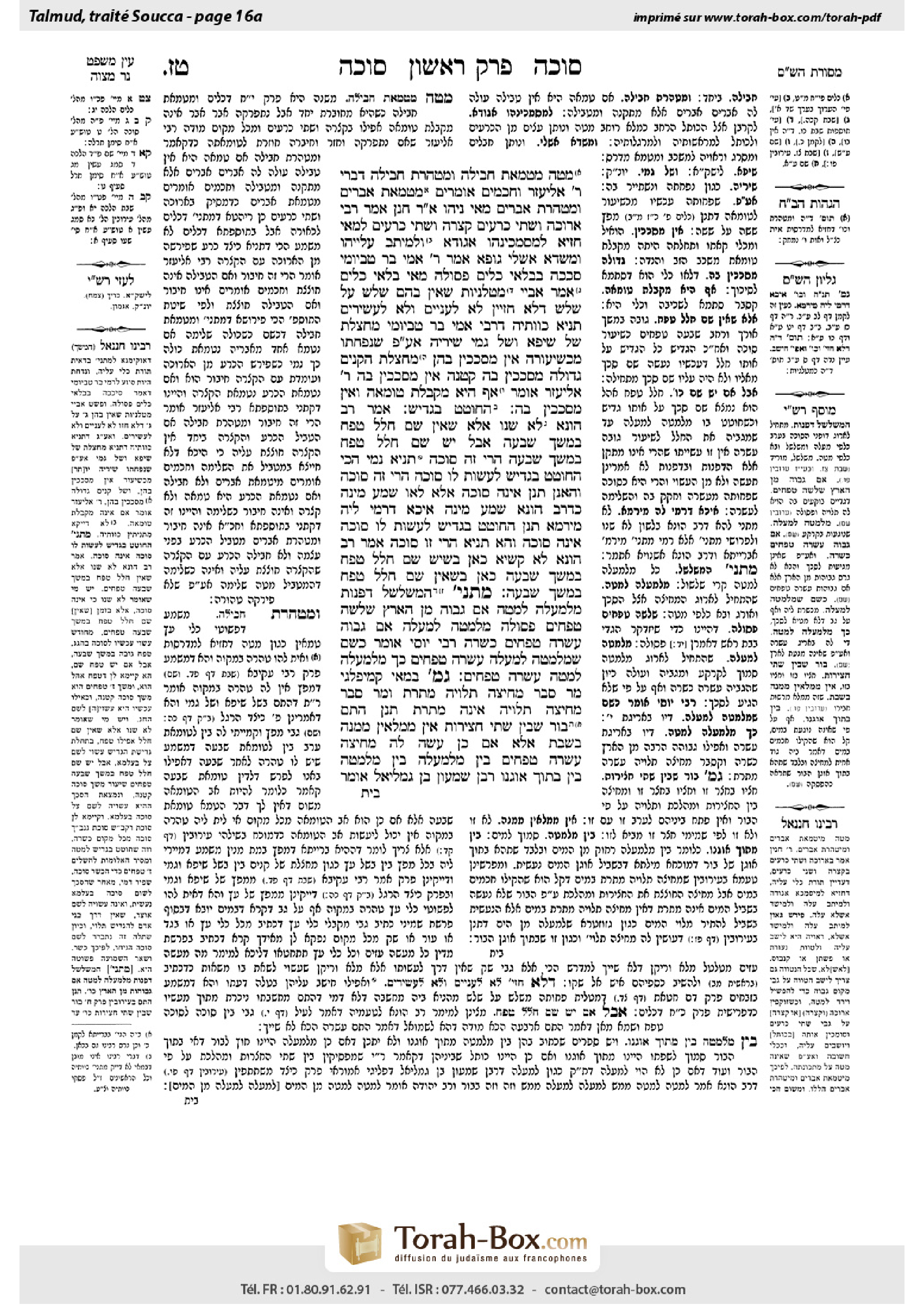
Sukkah 16a: Talmud study for Daf Yomi
Daf Yomi is the daily study of one Talmud folio. Explore 37 tractates with scans, Hebrew text, Sefaria English and AI-generated French translations where annotated.
Passage selection and English or AI-generated French translation are available where the scan has annotations. Daf Study is independent of Torah-Box and Sefaria.
Browse Sukkah · סוכה · All tractatesSukkah 16a text and translations
This page of Sukkah includes the Aramaic text, an English translation and an AI-generated French translation, alongside the scan above.
סוכה י״ו א · Aramaic and Hebrew text
מִטָּה מְטַמֵּאת חֲבִילָה וּמְטַהֶרֶת חֲבִילָה, דִּבְרֵי רַבִּי אֱלִיעֶזֶר. וַחֲכָמִים אוֹמְרִים: מְטַמֵּאת אֵבָרִים וּמְטַהֶרֶת אֵבָרִים. מַאי נִיהוּ? אָמַר רַבִּי חָנָן אָמַר רַבִּי: אֲרוּכָּה וּשְׁתֵּי כְרָעַיִם, קְצָרָה וּשְׁתֵּי כְרָעַיִם.
לְמַאי חַזְיָא? לְמִסְמְכִינְהוּ אַגּוּדָּא וּלְמֵיתַב עֲלַיְיהוּ וּמִשְׁדֵּא אַשְׁלֵי.
גּוּפָא, אָמַר רַבִּי אַמֵּי בַּר טַבְיוֹמֵי: סִכְּכָהּ בִּבְלָאֵי כֵלִים פְּסוּלָה. מַאי בְּלָאֵי כֵלִים? אָמַר אַבָּיֵי: מַטְלָנִיּוֹת שֶׁאֵין בָּהֶם שָׁלֹשׁ עַל שָׁלֹשׁ, דְּלָא חַזְיָין לֹא לַעֲנִיִּים וְלֹא לַעֲשִׁירִים.
תַּנְיָא כְּווֹתֵיהּ דְּרַבִּי אַמֵּי בַּר טַבְיוֹמֵי: מַחְצֶלֶת שֶׁל שִׁיפָא וְשֶׁל גֶּמִי, שְׁיָרֶיהָ, אַף עַל פִּי שֶׁנִּפְחֲתוּ מִכְּשִׁיעוּרָהּ — אֵין מְסַכְּכִין בָּהֶן.
מַחְצֶלֶת הַקָּנִים, גְּדוֹלָה — מְסַכְּכִין בָּהּ, קְטַנָּה, — אֵין מְסַכְּכִין בָּהּ. רַבִּי אֱלִיעֶזֶר אוֹמֵר: אַף הִיא מְקַבֶּלֶת טוּמְאָה, וְאֵין מְסַכְּכִין בָּהּ.
הַחוֹטֵט בְּגָדִישׁ. אָמַר רַב הוּנָא: לֹא שָׁנוּ אֶלָּא שֶׁאֵין שָׁם חָלָל טֶפַח בְּמֶשֶׁךְ שִׁבְעָה, אֲבָל יֵשׁ שָׁם חָלָל טֶפַח בְּמֶשֶׁךְ שִׁבְעָה — הֲרֵי זֹה סוּכָּה.
תַּנְיָא נָמֵי הָכִי: הַחוֹטֵט בְּגָדִישׁ לַעֲשׂוֹת לוֹ סוּכָּה — הֲרֵי זֹה סוּכָּה. וְהָאֲנַן תְּנַן אֵינָהּ סוּכָּה! אֶלָּא לָאו, שְׁמַע מִינַּהּ כִּדְרַב הוּנָא. שְׁמַע מִינַּהּ.
אִיכָּא דְּרָמֵי לַיהּ מִירְמֵא. תְּנַן: הַחוֹטֵט בְּגָדִישׁ לַעֲשׂוֹת לוֹ סוּכָּה — אֵינָהּ סוּכָּה. וְהָא תַּנְיָא: הֲרֵי זוֹ סוּכָּה! אָמַר רַב הוּנָא, לָא קַשְׁיָא: כָּאן בְּשֶׁיֵּשׁ שָׁם חָלָל טֶפַח בְּמֶשֶׁךְ שִׁבְעָה, כָּאן בְּשֶׁאֵין שָׁם חָלָל טֶפַח בְּמֶשֶׁךְ שִׁבְעָה.
מַתְנִי׳ הַמְשַׁלְשֵׁל דְּפָנוֹת מִלְמַעְלָה לְמַטָּה, אִם גָּבוֹהַּ מִן הָאָרֶץ שְׁלֹשָׁה טְפָחִים — פְּסוּלָה. מִלְּמַטָּה לְמַעְלָה, אִם גָּבוֹהַּ עֲשָׂרָה טְפָחִים — כְּשֵׁרָה. רַבִּי יוֹסֵי אוֹמֵר: כְּשֵׁם שֶׁמִּלְּמַטָּה לְמַעְלָה עֲשָׂרָה טְפָחִים, כָּךְ מִלְמַעְלָה לְמַטָּה עֲשָׂרָה טְפָחִים.
גְּמָ׳ בְּמַאי קָמִיפַּלְגִי? מָר סָבַר מְחִיצָה תְּלוּיָה מַתֶּרֶת, וּמַר סָבַר מְחִיצָה תְּלוּיָה אֵינָהּ מַתֶּרֶת.
תְּנַן הָתָם: בּוֹר שֶׁבֵּין שְׁתֵּי חֲצֵירוֹת — אֵין מְמַלְּאִין מִמֶּנָּה בְּשַׁבָּת אֶלָּא אִם כֵּן עָשָׂה לָהּ מְחִיצָה עֲשָׂרָה טְפָחִים, בֵּין מִלְמַעְלָה בֵּין מִלְּמַטָּה, בֵּין בְּתוֹךְ אוֹגְנוֹ. רַבָּן שִׁמְעוֹן בֶּן גַּמְלִיאֵל אוֹמֵר:
Sukkah 16a · English translation
A bed becomes ritually impure as a complete entity if it comes into contact with a source of impurity. And it becomes ritually pure as a single entity through immersion, and in the case of impurity imparted by a corpse, through sprinkling and immersion. However, it may be neither impurified nor purified when dismantled. This is the statement of Rabbi Eliezer. The Rabbis say: It becomes ritually impure even when it is dismantled into its component parts, and, so too, it becomes ritually pure even when it is dismantled into its component parts. The Gemara asks: If the bed breaks into parts that serve no purpose, it is pure; what are these component parts mentioned by the Rabbis? Rabbi Ḥanan said that Rabbi Yehuda HaNasi said: The component parts are a long board and two legs attached to it and a short board and two legs attached to it.
The Gemara asks: And for what purpose are these parts suited; what function qualifies their status as vessels? The Gemara answers: It is possible for one to lean them against the wall and to sit on them, after placing boards across the top and placing ropes across their length and width. The boards of the bed can thereby be used for the purpose of sitting or lying upon them; consequently, they are considered vessels.
§ The Gemara returns to discuss the matter itself cited above. Rabbi Ami bar Tavyomei said: If one roofed the sukka with worn, incomplete, vessels, the sukka is unfit. The Gemara asks: What are these worn vessels? Abaye said: They are small cloths that do not have an area of three by three fingerbreadths, which, due to their size, are not suited for use either by the poor or by the wealthy.
It is taught in a baraita in accordance with the opinion of Rabbi Ami bar Tavyomei: In the case of a mat made of different types of vegetation, e.g., papyrus and reed grass, even though its remnants were reduced from the requisite measure for contracting ritual impurity, one may not roof the sukka with them. This precisely corresponds to the opinion of Rabbi Ami.
The baraita continues: If a mat of reeds is large and not designated for sleeping, but is suited only for roofing, one may roof the sukka with it. However, the status of a small mat, which can be utilized for sleeping, is that of a vessel, and one may not roof the sukka with it. Rabbi Eliezer says: The status of even a large mat is that of a vessel. It is capable of contracting ritual impurity, and therefore one may not roof his sukka with it.
The mishna states: In the case of one who hollows out and creates a space inside a stack of grain, it is not a sukka. Rav Huna said: The Sages taught that it is not a sukka only in a case where there is not a space one handbreadth high along seven handbreadths upon which the grain was piled. However, if there is a space measuring one handbreadth high along seven handbreadths upon which the grain was piled, and now, by hollowing out the stack, one is raising the existing walls and not forming a new space, it is a fit sukka.
That is also taught in a baraita: One who hollows out a stack of grain to make himself a sukka, it is a sukka. The Gemara wonders: But didn’t we learn in the mishna that it is not a sukka? Rather, is it not correct to conclude from it, in accordance with the opinion of Rav Huna, that in certain circumstances it is possible to hollow out a stack of grain and establish a fit sukka? The Gemara concludes: Indeed, learn from it that this is the case.
Some raised this matter as a contradiction between the mishna and the baraita. We learned in the mishna: One who hollows out a stack of grain in order to make himself a sukka, it is not a sukka. But wasn’t it taught in a baraita that this is a sukka? Rav Huna said: This is not difficult. Here, where it is a sukka, it is a case where there is a space measuring one handbreadth high along seven handbreadths, while there, where it is not a sukka, it is a case where there is not a space one handbreadth high along seven handbreadths.
MISHNA: One who lowers the walls of the sukka from up downward, if the lower edge of the wall is three handbreadths above the ground, the sukka is unfit. Since animals can enter through that space, it is not the wall of a fit sukka. However, if one constructs the wall from down upward, if the wall is ten handbreadths high, even if it does not reach the roofing, the sukka is fit. Rabbi Yosei says: Just as a wall built from down upward must be ten handbreadths, so too, in a case where one lowers the wall from up downward, it must be ten handbreadths in length. Regardless of its height off the ground, it is the wall of a fit sukka, as the legal status of a ten-handbreadth partition is that of a full-fledged partition in all areas of halakha.
GEMARA: The Gemara asks: With regard to what principle do Rabbi Yosei and the Rabbis disagree? The Gemara explains: One Sage, Rabbi Yosei, holds that a suspended partition, even if it does not reach all the way down, renders it permitted to carry on Shabbat, like a full-fledged partition. And one Sage, the Rabbis, holds that a suspended partition does not render it permitted to carry on Shabbat.
We learned in a mishna there, in tractate Eiruvin: In the case of a cistern that is located between two courtyards, situated partly in each courtyard, one may draw water from it on Shabbat only if a partition ten handbreadths high was erected specifically for the cistern to separate the water between the domains, lest the residents of one courtyard draw water from the domain of the other courtyard. This partition is effective whether it is above, and lowered toward the water; whether it is below, in the water; or whether it is within the airspace of the cistern below the rim, above the surface of the water. A partition situated in any of these places forms a boundary between the two courtyards, permitting one to draw water from the cistern. Rabban Shimon ben Gamliel says that this is the subject of an early dispute of tanna’im.
Sukkah 16a · Traduction française (IA)
Un lit devient rituellement impur dans son ensemble s’il entre en contact avec une source d’impureté. Il devient rituellement pur dans son ensemble par immersion et, dans le cas d’une impureté due à un cadavre, par aspersion et immersion. Toutefois, il ne peut être ni rendu impur ni purifié lorsqu’il est démonté. Telle est l’opinion de Rabbi Eliezer. Les Sages disent : il devient rituellement impur même lorsqu’il est démonté en ses différentes parties et, de même, il devient rituellement pur même lorsqu’il est démonté en ses différentes parties. La Guemara demande : si le lit se brise en morceaux qui ne servent à rien, il est pur ; quelles sont donc ces différentes parties dont parlent les Sages ? Rabbi Ḥanan a dit au nom de Rabbi Yehuda HaNasi : ces parties sont une longue planche à laquelle sont fixés deux pieds, et une planche courte à laquelle sont fixés deux pieds.
La Guemara demande : à quoi ces parties peuvent-elles servir, et quelle fonction leur confère le statut de récipients ? La Guemara répond : on peut les appuyer contre un mur et s’asseoir dessus, après avoir posé des planches en travers et tendu des cordes dans le sens de la longueur et de la largeur. Les planches du lit peuvent ainsi servir à s’asseoir ou à s’allonger ; elles sont donc considérées comme des récipients.
§ La Guemara revient sur le sujet cité plus haut. Rabbi Ami bar Tavyomei a dit : si quelqu’un couvre la soukka avec des récipients usés et incomplets, la soukka est invalide. La Guemara demande : que sont ces récipients usés ? Abaye a dit : ce sont de petits morceaux d’étoffe dont la superficie est inférieure à trois largeurs de doigt sur trois et qui, en raison de leur taille, ne conviennent ni aux pauvres ni aux riches.
Une baraïta enseigne conformément à l’opinion de Rabbi Ami bar Tavyomei : dans le cas d’une natte faite de différentes sortes de végétaux, par exemple de papyrus et de roseaux, même si ses restes ont été réduits à une mesure insuffisante pour contracter l’impureté rituelle, on ne peut pas les utiliser pour couvrir la soukka. Cela correspond précisément à l’opinion de Rabbi Ami.
La baraïta poursuit : si une natte de roseaux est grande et n’est pas destinée à servir de couche, mais uniquement de couverture, on peut l’utiliser pour couvrir la soukka. En revanche, une petite natte, qui peut servir de couche, a le statut d’un récipient ; on ne peut donc pas l’utiliser pour couvrir la soukka. Rabbi Eliezer dit : même une grande natte a le statut d’un récipient. Elle est susceptible de contracter l’impureté rituelle et l’on ne peut donc pas l’utiliser pour couvrir sa soukka.
La Michna enseigne : celui qui creuse un espace à l’intérieur d’un tas de céréales pour en faire une soukka n’a pas de soukka. Rav Huna a dit : les Sages ont enseigné qu’il ne s’agit pas d’une soukka uniquement lorsqu’il n’existe pas, sous le tas de céréales, un espace d’une hauteur d’une largeur de main et d’une longueur de sept largeurs de main. En revanche, s’il existe sous le tas un espace d’une hauteur d’une largeur de main et d’une longueur de sept largeurs de main, et que, en creusant le tas, on ne fait que rehausser les parois déjà présentes sans créer un nouvel espace, la soukka est valide.
Cela est également enseigné dans une baraïta : celui qui creuse un tas de céréales pour s’en faire une soukka a une soukka. La Guemara s’étonne : mais n’avons-nous pas appris dans la Michna qu’il ne s’agit pas d’une soukka ? Ne faut-il pas plutôt en conclure, conformément à l’opinion de Rav Huna, que, dans certaines circonstances, il est possible de creuser un tas de céréales et d’en faire une soukka valide ? La Guemara conclut : en effet, apprenez-en que c’est le cas.
Certains ont présenté cela comme une contradiction entre la Michna et la baraïta. Nous avons appris dans la Michna : celui qui creuse un tas de céréales pour s’en faire une soukka n’a pas de soukka. Mais n’a-t-il pas été enseigné dans une baraïta qu’il s’agit bien d’une soukka ? Rav Huna a dit : il n’y a pas de difficulté. Ici, là où il s’agit d’une soukka, c’est un cas où il existe un espace d’une hauteur d’une largeur de main et d’une longueur de sept largeurs de main ; là, là où il ne s’agit pas d’une soukka, c’est un cas où un tel espace n’existe pas.
MICHNA : Celui qui abaisse les parois de la soukka du haut vers le bas : si le bord inférieur de la paroi se trouve à trois largeurs de main du sol, la soukka est invalide. Puisque des animaux peuvent passer par cet espace, il ne s’agit pas de la paroi d’une soukka valide. En revanche, si l’on construit la paroi du bas vers le haut, dès lors qu’elle mesure dix largeurs de main, la soukka est valide, même si elle n’atteint pas le toit. Rabbi Yosei dit : de même qu’une paroi construite du bas vers le haut doit mesurer dix largeurs de main, de même, lorsque l’on abaisse la paroi du haut vers le bas, elle doit mesurer dix largeurs de main. Quelle que soit sa distance par rapport au sol, elle constitue la paroi d’une soukka valide, car une séparation de dix largeurs de main a le statut d’une séparation à part entière dans tous les domaines de la halakha.
GUEMARA : La Guemara demande : sur quel principe Rabbi Yosei et les Sages sont-ils en désaccord ? La Guemara explique : l’un des Sages, Rabbi Yosei, considère qu’une séparation suspendue, même si elle ne descend pas jusqu’au sol, permet de transporter des objets pendant Chabbat, comme une séparation à part entière. L’autre avis, celui des Sages, considère qu’une séparation suspendue ne permet pas de transporter des objets pendant Chabbat.
Nous avons appris dans une Michna, là-bas, dans le traité Erouvin : dans le cas d’une citerne située entre deux cours, dont une partie se trouve dans chacune des cours, on ne peut y puiser de l’eau pendant Chabbat que si une séparation de dix largeurs de main a été érigée spécifiquement pour la citerne afin de diviser l’eau entre les deux domaines, de peur que les habitants d’une cour ne puisent de l’eau dans le domaine de l’autre cour. Cette séparation est efficace qu’elle se trouve au-dessus de l’eau et descende vers celle-ci, qu’elle se trouve en dessous, dans l’eau, ou qu’elle soit dans l’espace intérieur de la citerne, sous son rebord et au-dessus de la surface de l’eau. Où qu’elle soit située, elle forme une limite entre les deux cours et permet d’y puiser de l’eau. Rabban Shimon ben Gamliel dit que cette question fait l’objet d’un ancien désaccord entre tannaïm.
Traduction française générée par IA à partir de l’édition anglaise de Sefaria. Vérifie toujours un passage avec le texte source.
Text from Sefaria: William Davidson Edition - Vocalized Aramaic (CC BY NC); William Davidson Edition - English (CC BY NC).